Shohail Choudhury Living in the Environment 14 th  Edition Chapter 3   Science, Systems, Matter and Energy Introduction to   ENVIRONMENTAL SCIENCE 3
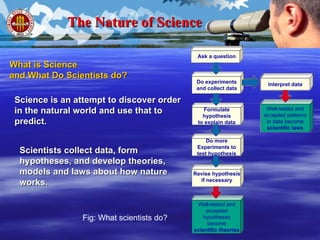
What is Science  and What Do Scientists do? Science is an attempt to discover order in the natural world and use that to predict.   Scientists collect data, form hypotheses, and develop theories, models and laws about how nature works. Fig: What scientists do? The Nature of Science Ask a question Do experiments and collect data Formulate hypothesis to explain data Do more Experiments to test hypothesis Revise hypothesis if necessary Well-tested and accepted hypotheses become scientific theories Interpret data Well-tested and accepted patterns In data become scientific laws Ask a question Do experiments and collect data Formulate hypothesis to explain data Do more Experiments to test hypothesis Revise hypothesis if necessary Well-tested and accepted hypotheses become scientific theories Interpret data Well-tested and accepted patterns In data become scientific laws
Scientists use models or simulations to find out how systems work and to evaluate ideas or hypothesis.  A system is a set of components that function in some regular manner. Most systems have Inputs (from the environment) Flows or throughputs Outputs (to environment)  Models and Behaviour of Systems
What types of matter do we find in nature? Matter is anything that has mass and takes up space.  Matter has two forms: 1. Elements: building blocks of matter. 2. Compounds: 2 or more elements held together by chemical bonds. Chemists use symbols: e.g. Carbon (C), Oxygen (O), Calcium (Ca). Matter
Atom: The smallest unit of matter. Ion: An electrically charged atom/atoms Molecule: A combination of two or more atoms of the same or different elements. In nature we find molecules. For example nitrogen (N 2 ) and oxygen (O 2 ) are found in air.  Here 2 is number of Atoms.  Ex: O 3  is Ozone.  Building Blocks of Matter
1. Protons (positively charged) 2. Neutrons (uncharged) 3. Electron (negatively charged) Centre of the atom is Nucleus. Equal number of protons and electrons. So no net electrical charge. Each element has a specific atomic number.   Atomic number is equal to number of protons in the nucleus. H=1, C=6, U=92 An atom is made up of a cloud of electrons that surrounds a nucleus containing protons and (in most cases) neutrons. Most of the mass of an atom is concentrated in the nucleus. So  Atomic Mass= P+N in its nucleus.  Inside Atom
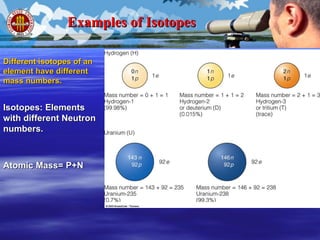
Different isotopes of an element have different mass numbers.   Isotopes: Elements with different Neutron numbers. Atomic Mass= P+N Examples of Isotopes
Atoms of some elements can lose or gain electrons to form ions. (See CD:  Metals: Electron givers Non-metals: Electron receivers H +  ions in a solution are a measure of how acidic or basic it is.  The pH of a solution is a measure of its concentration of hydrogen ions (H + ).  Neutral pH is 7; acid solutions are below 7; and basic solutions are above 7. Ions and  P H
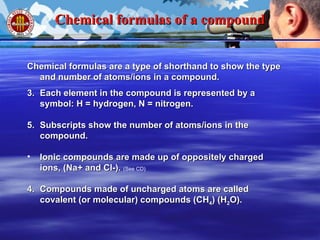
Chemical formulas of a compound Chemical formulas are a type of shorthand to show the type and number of atoms/ions in a compound. Each element in the compound is represented by a symbol: H = hydrogen, N = nitrogen. Subscripts show the number of atoms/ions in the compound. Ionic compounds are made up of oppositely charged ions, (Na+ and Cl-).  (See CD) 4. Compounds made of uncharged atoms are called covalent (or molecular) compounds (CH 4 ) (H 2 O).
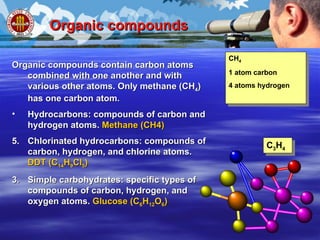
Organic compounds contain carbon atoms combined with one another and with various other atoms. Only methane (CH 4 ) has one carbon atom. Hydrocarbons: compounds of carbon and hydrogen atoms.  Methane (CH4) Chlorinated hydrocarbons: compounds of carbon, hydrogen, and chlorine atoms. DDT (C 14 H 9 Cl 5 ) 3.  Simple carbohydrates: specific types of compounds of carbon, hydrogen, and oxygen atoms.  Glucose (C 6 H 12 O 6 ) CH 4 1 atom carbon 4 atoms hydrogen C 3 H 4 Organic compounds
All compounds without the combination of carbon atoms and other elements’ atoms are  inorganic compounds . Water, Carbon monoxide, Ammonia, Sulfuric Acid.  Inorganic Compounds
Matter exists in four states:  solid, liquid, and gaseous  physical states and a fourth state known as  plasma .  1.Water exists as ice, liquid, or water vapor depending on its temperature.  2.Plasma is a high-energy mixture of positively charged ions and negatively charged electrons. It is the most abundant form of matter in the universe, but very little is found on Earth. 3. Scientists make artificial plasmas in fluorescent light, arc lamps, neon signs, gas discharge lasers, and TV and computer screens. Four States of Matter
Energy is the capacity to do work and transfer heat; it moves matter. Kinetic energy  has mass and speed; wind and electricity are examples. 2. Potential energy  is stored energy, ready to be used: an unlit match, for example. Potential energy can be changed to kinetic energy: drop an object, for example. Energy
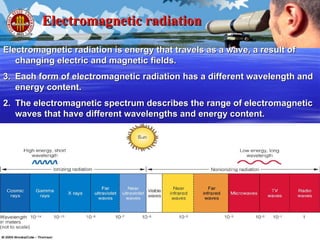
Electromagnetic radiation is energy that travels as a wave, a result of changing electric and magnetic fields.  Each form of electromagnetic radiation has a different wavelength and energy content.  2. The electromagnetic spectrum describes the range of electromagnetic waves that have different wavelengths and energy content. Electromagnetic radiation
Heat is the total kinetic energy of all moving atoms, ions, or molecules in a substance.  It can be transferred from one place to another by convection, conduction, and radiation. 2. Temperature is the average speed of motion of atoms, ions, or molecules in a sample of matter. 3. Energy quality is measured by its usefulness. High energy is concentrated and has high usefulness.  Low energy is dispersed and can do little work. Heat and Temperature
When matter has a physical change, its chemical composition is not changed; the molecules are organized in different patterns. In a chemical change, the chemical composition of the elements/compounds change. Shorthand chemical equations represent what happens in the reaction. The Law of Conservation of Matter states that no atoms are created/destroyed during a physical or chemical change. The same is true for energy. 1. Atoms are rearranged into different patterns/combinations. 2. Atoms can have physical or chemical changes, but they are never created nor destroyed. The Law of Conservation of Matter
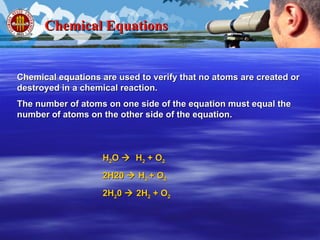
Chemical equations are used to verify that no atoms are created or destroyed in a chemical reaction.  The number of atoms on one side of the equation must equal the number of atoms on the other side of the equation. H 2 O     H 2  + O 2 2H20    H 2  + O 2 2H 2 0    2H 2  + O 2 Chemical Equations
Harmful Pollutants Fig. 3-9 p. 44 We will always have some pollutants, but we can produce less and clean up some that we do produce. Three factors determine the severity of a pollutant’s harmful effects:  chemical nature, concentration, and persistence . Dilution of concentration of a pollutant is only a partial answer. 3. Pollutants are classified into four categories based on persistence:  degradable, biodegradable, slowly degradable, and non-degradable .
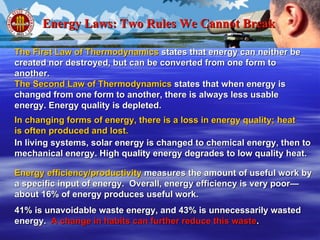
Energy efficiency/productivity  measures the amount of useful work by a specific input of energy.  Overall, energy efficiency is very poor—about 16% of energy produces useful work. 41% is unavoidable waste energy, and 43% is unnecessarily wasted energy.  A change in habits can further reduce this waste . Energy Laws: Two Rules We Cannot Break The First Law of Thermodynamics  states that energy can neither be created nor destroyed, but can be converted from one form to another.  The Second Law of Thermodynamics  states that when energy is changed from one form to another, there is always less usable energy. Energy quality is depleted. In changing forms of energy, there is a loss in energy quality; heat is often produced and lost. In living systems, solar energy is changed to chemical energy, then to mechanical energy. High quality energy degrades to low quality heat.
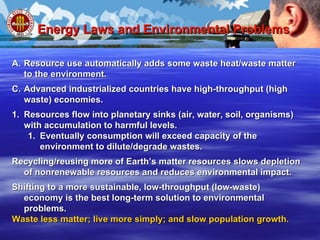
Resource use automatically adds some waste heat/waste matter to the environment. Advanced industrialized countries have high-throughput (high waste) economies. 1. Resources flow into planetary sinks (air, water, soil, organisms) with accumulation to harmful levels. Eventually consumption will exceed capacity of the environment to dilute/degrade wastes. Recycling/reusing more of Earth’s matter resources slows depletion of nonrenewable resources and reduces environmental impact. Shifting to a more sustainable, low-throughput (low-waste) economy is the best long-term solution to environmental problems.  Waste less matter; live more simply; and slow population growth. Energy Laws and Environmental Problems
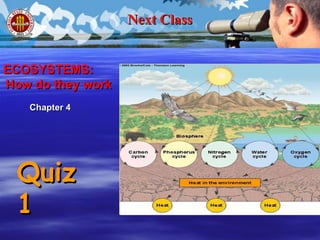
Next Class ECOSYSTEMS:  How do they work   Chapter 4 Quiz 1