Dr.V.Malathi,Associate Professor in Biochem
istry,Ethiraj College for Women,Chennai-8
Gene Interactions - Epistasis
Dr.V.Malathi,Associate Professor in Biochem
istry,Ethiraj College for Women,Chennai-8
• Gene interaction is of two types
Allelic or intragenic interaction
• This kind of interaction occurs between alleles of the same gene pair
• Eg., incomplete dominance, co dominance and multiple allelism.
Non-allelic or intergenic interactions
• These interactions occur between alleles of different genes present
either on the same or different chromosome and alter the normal
phenotype.
• Eg.,Complementary gene interaction, supplementary gene interaction,
duplicate factors and inhibitory factors
Epistasis
• Epistasis is the interaction between different genes.
• If one allele or allelic pair masks the expression of
an allele at the second gene, that allele or allelic pair
is epistatic to the second gene
• Epistasis describes a relationship between genes,
where an allele of one gene hides or masks the
visible output, or phenotype, of another gene
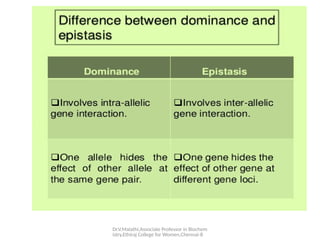
• This is entirely different from dominant and
recessive relationship, which apply to different
alleles of the same gene
Dr.V.Malathi,Associate Professor in
Biochemistry,Ethiraj College for
Women,Chennai-8
Dr.V.Malathi,Associate Professor in Biochem
istry,Ethiraj College for Women,Chennai-8
Dr.V.Malathi,Associate Professor in Biochem
istry,Ethiraj College for Women,Chennai-8
• The gene or locus which suppresses or masks
the action of a gene at another locus is called
epistatic gene.
• The gene or locus whose expression is
suppressed by an epistatic gene is called
hypostatic gene.
• Epistasis is due to interaction of non allelic
genes.
Dr.V.Malathi, Associate Professor in Biochemistry, Ethiraj College for Women,Chennai-8
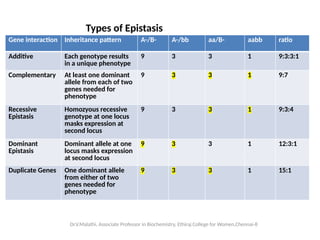
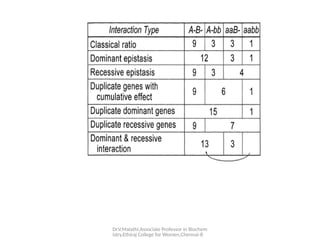
Gene interaction Inheritance pattern A-/B- A-/bb aa/B- aabb ratio
Additive Each genotype results
in a unique phenotype
9 3 3 1 9:3:3:1
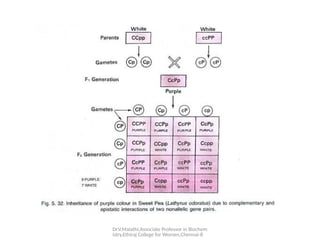
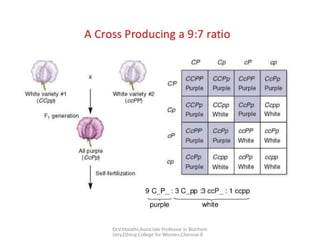
Complementary At least one dominant
allele from each of two
genes needed for
phenotype
9 3 3 1 9:7
Recessive
Epistasis
Homozyous recessive
genotype at one locus
masks expression at
second locus
9 3 3 1 9:3:4
Dominant
Epistasis
Dominant allele at one
locus masks expression
at second locus
9 3 3 1 12:3:1
Duplicate Genes One dominant allele
from either of two
genes needed for
phenotype
9 3 3 1 15:1
Types of Epistasis
Dr.V.Malathi,Associate Professor in Biochem
istry,Ethiraj College for Women,Chennai-8
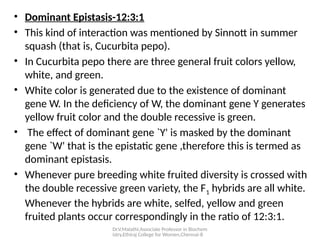
• Dominant Epistasis-12:3:1
• This kind of interaction was mentioned by Sinnott in summer
squash (that is, Cucurbita pepo).
• In Cucurbita pepo there are three general fruit colors yellow,
white, and green.
• White color is generated due to the existence of dominant
gene W. In the deficiency of W, the dominant gene Y generates
yellow fruit color and the double recessive is green.
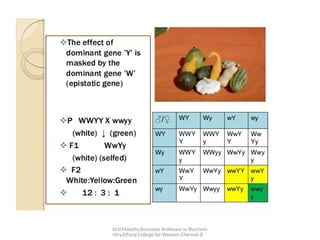
• The effect of dominant gene `Y' is masked by the dominant
gene `W' that is the epistatic gene ,therefore this is termed as
dominant epistasis.
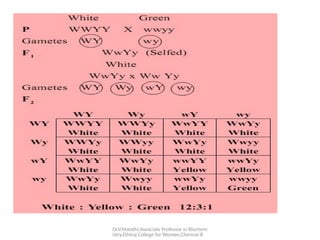
• Whenever pure breeding white fruited diversity is crossed with
the double recessive green variety, the F1 hybrids are all white.
Whenever the hybrids are white, selfed, yellow and green
fruited plants occur correspondingly in the ratio of 12:3:1.
Dr.V.Malathi,Associate Professor in Biochem
istry,Ethiraj College for Women,Chennai-8
Dr.V.Malathi,Associate Professor in Biochem
istry,Ethiraj College for Women,Chennai-8
Dr.V.Malathi,Associate Professor in Biochem
istry,Ethiraj College for Women,Chennai-8
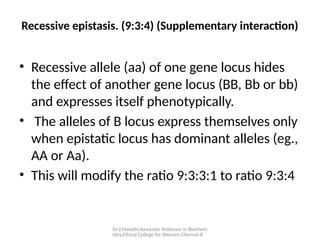
Recessive epistasis. (9:3:4) (Supplementary interaction)
• Recessive allele (aa) of one gene locus hides
the effect of another gene locus (BB, Bb or bb)
and expresses itself phenotypically.
• The alleles of B locus express themselves only
when epistatic locus has dominant alleles (eg.,
AA or Aa).
• This will modify the ratio 9:3:3:1 to ratio 9:3:4
Dr.V.Malathi,Associate Professor in Biochem
istry,Ethiraj College for Women,Chennai-8
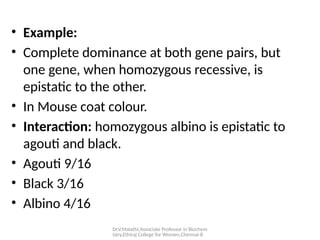
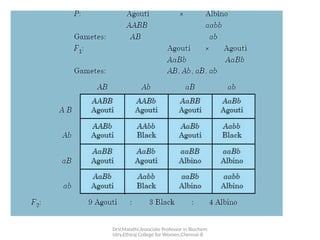
• Example:
• Complete dominance at both gene pairs, but
one gene, when homozygous recessive, is
epistatic to the other.
• In Mouse coat colour.
• Interaction: homozygous albino is epistatic to
agouti and black.
• Agouti 9/16
• Black 3/16
• Albino 4/16
Dr.V.Malathi,Associate Professor in Biochem
istry,Ethiraj College for Women,Chennai-8
Dr.V.Malathi,Associate Professor in Biochem
istry,Ethiraj College for Women,Chennai-8
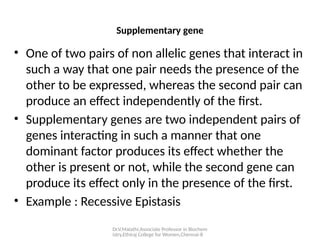
Supplementary gene
• One of two pairs of non allelic genes that interact in
such a way that one pair needs the presence of the
other to be expressed, whereas the second pair can
produce an effect independently of the first.
• Supplementary genes are two independent pairs of
genes interacting in such a manner that one
dominant factor produces its effect whether the
other is present or not, while the second gene can
produce its effect only in the presence of the first.
• Example : Recessive Epistasis
Dr.V.Malathi,Associate Professor in Biochem
istry,Ethiraj College for Women,Chennai-8
Dr.V.Malathi,Associate Professor in Biochem
istry,Ethiraj College for Women,Chennai-8
Dr.V.Malathi,Associate Professor in Biochem
istry,Ethiraj College for Women,Chennai-8
Dr.V.Malathi,Associate Professor in Biochem
istry,Ethiraj College for Women,Chennai-8
Dr.V.Malathi,Associate Professor in Biochem
istry,Ethiraj College for Women,Chennai-8
Dr.V.Malathi,Associate Professor in Biochem
istry,Ethiraj College for Women,Chennai-8
Dr.V.Malathi,Associate Professor in Biochem
istry,Ethiraj College for Women,Chennai-8
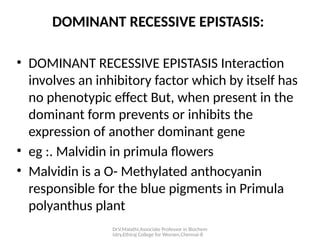
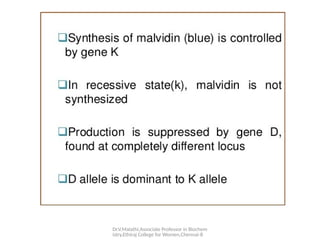
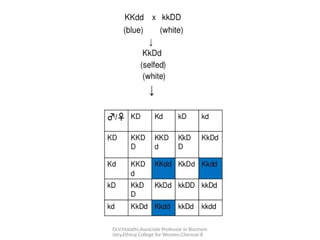
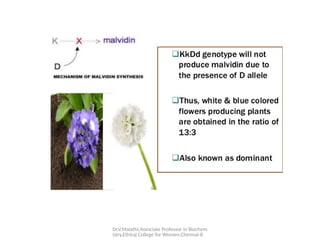
DOMINANT RECESSIVE EPISTASIS:
• DOMINANT RECESSIVE EPISTASIS Interaction
involves an inhibitory factor which by itself has
no phenotypic effect But, when present in the
dominant form prevents or inhibits the
expression of another dominant gene
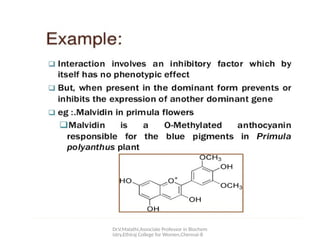
• eg :. Malvidin in primula flowers
• Malvidin is a O- Methylated anthocyanin
responsible for the blue pigments in Primula
polyanthus plant
Dr.V.Malathi,Associate Professor in Biochem
istry,Ethiraj College for Women,Chennai-8
Dr.V.Malathi,Associate Professor in Biochem
istry,Ethiraj College for Women,Chennai-8
Dr.V.Malathi,Associate Professor in Biochem
istry,Ethiraj College for Women,Chennai-8
Dr.V.Malathi,Associate Professor in Biochem
istry,Ethiraj College for Women,Chennai-8
Dr.V.Malathi,Associate Professor in Biochem
istry,Ethiraj College for Women,Chennai-8
Dr.V.Malathi,Associate Professor in Biochem
istry,Ethiraj College for Women,Chennai-8
References
• https://www.genetics.org/content/149/3/116
7
• https://www.wikilectures.eu/w/Interaction_of
_non-allelic_genes
• http://www.csun.edu/~cmalone/pdf360/Ch04
-2extensions.pdf
• http://www.brainkart.com/article/Epistasis---
Gene-Interaction_929/

gene_interaction-epistasis. Dr.V.Malathi.pptx

  • 1.
    Dr.V.Malathi,Associate Professor inBiochem istry,Ethiraj College for Women,Chennai-8 Gene Interactions - Epistasis
  • 2.
    Dr.V.Malathi,Associate Professor inBiochem istry,Ethiraj College for Women,Chennai-8 • Gene interaction is of two types Allelic or intragenic interaction • This kind of interaction occurs between alleles of the same gene pair • Eg., incomplete dominance, co dominance and multiple allelism. Non-allelic or intergenic interactions • These interactions occur between alleles of different genes present either on the same or different chromosome and alter the normal phenotype. • Eg.,Complementary gene interaction, supplementary gene interaction, duplicate factors and inhibitory factors
  • 3.
    Epistasis • Epistasis isthe interaction between different genes. • If one allele or allelic pair masks the expression of an allele at the second gene, that allele or allelic pair is epistatic to the second gene • Epistasis describes a relationship between genes, where an allele of one gene hides or masks the visible output, or phenotype, of another gene • This is entirely different from dominant and recessive relationship, which apply to different alleles of the same gene Dr.V.Malathi,Associate Professor in Biochemistry,Ethiraj College for Women,Chennai-8
  • 4.
    Dr.V.Malathi,Associate Professor inBiochem istry,Ethiraj College for Women,Chennai-8
  • 5.
    Dr.V.Malathi,Associate Professor inBiochem istry,Ethiraj College for Women,Chennai-8 • The gene or locus which suppresses or masks the action of a gene at another locus is called epistatic gene. • The gene or locus whose expression is suppressed by an epistatic gene is called hypostatic gene. • Epistasis is due to interaction of non allelic genes.
  • 6.
    Dr.V.Malathi, Associate Professorin Biochemistry, Ethiraj College for Women,Chennai-8 Gene interaction Inheritance pattern A-/B- A-/bb aa/B- aabb ratio Additive Each genotype results in a unique phenotype 9 3 3 1 9:3:3:1 Complementary At least one dominant allele from each of two genes needed for phenotype 9 3 3 1 9:7 Recessive Epistasis Homozyous recessive genotype at one locus masks expression at second locus 9 3 3 1 9:3:4 Dominant Epistasis Dominant allele at one locus masks expression at second locus 9 3 3 1 12:3:1 Duplicate Genes One dominant allele from either of two genes needed for phenotype 9 3 3 1 15:1 Types of Epistasis
  • 7.
    Dr.V.Malathi,Associate Professor inBiochem istry,Ethiraj College for Women,Chennai-8 • Dominant Epistasis-12:3:1 • This kind of interaction was mentioned by Sinnott in summer squash (that is, Cucurbita pepo). • In Cucurbita pepo there are three general fruit colors yellow, white, and green. • White color is generated due to the existence of dominant gene W. In the deficiency of W, the dominant gene Y generates yellow fruit color and the double recessive is green. • The effect of dominant gene `Y' is masked by the dominant gene `W' that is the epistatic gene ,therefore this is termed as dominant epistasis. • Whenever pure breeding white fruited diversity is crossed with the double recessive green variety, the F1 hybrids are all white. Whenever the hybrids are white, selfed, yellow and green fruited plants occur correspondingly in the ratio of 12:3:1.
  • 8.
    Dr.V.Malathi,Associate Professor inBiochem istry,Ethiraj College for Women,Chennai-8
  • 9.
    Dr.V.Malathi,Associate Professor inBiochem istry,Ethiraj College for Women,Chennai-8
  • 10.
    Dr.V.Malathi,Associate Professor inBiochem istry,Ethiraj College for Women,Chennai-8 Recessive epistasis. (9:3:4) (Supplementary interaction) • Recessive allele (aa) of one gene locus hides the effect of another gene locus (BB, Bb or bb) and expresses itself phenotypically. • The alleles of B locus express themselves only when epistatic locus has dominant alleles (eg., AA or Aa). • This will modify the ratio 9:3:3:1 to ratio 9:3:4
  • 11.
    Dr.V.Malathi,Associate Professor inBiochem istry,Ethiraj College for Women,Chennai-8 • Example: • Complete dominance at both gene pairs, but one gene, when homozygous recessive, is epistatic to the other. • In Mouse coat colour. • Interaction: homozygous albino is epistatic to agouti and black. • Agouti 9/16 • Black 3/16 • Albino 4/16
  • 12.
    Dr.V.Malathi,Associate Professor inBiochem istry,Ethiraj College for Women,Chennai-8
  • 13.
    Dr.V.Malathi,Associate Professor inBiochem istry,Ethiraj College for Women,Chennai-8 Supplementary gene • One of two pairs of non allelic genes that interact in such a way that one pair needs the presence of the other to be expressed, whereas the second pair can produce an effect independently of the first. • Supplementary genes are two independent pairs of genes interacting in such a manner that one dominant factor produces its effect whether the other is present or not, while the second gene can produce its effect only in the presence of the first. • Example : Recessive Epistasis
  • 14.
    Dr.V.Malathi,Associate Professor inBiochem istry,Ethiraj College for Women,Chennai-8
  • 15.
    Dr.V.Malathi,Associate Professor inBiochem istry,Ethiraj College for Women,Chennai-8
  • 16.
    Dr.V.Malathi,Associate Professor inBiochem istry,Ethiraj College for Women,Chennai-8
  • 17.
    Dr.V.Malathi,Associate Professor inBiochem istry,Ethiraj College for Women,Chennai-8
  • 18.
    Dr.V.Malathi,Associate Professor inBiochem istry,Ethiraj College for Women,Chennai-8
  • 19.
    Dr.V.Malathi,Associate Professor inBiochem istry,Ethiraj College for Women,Chennai-8
  • 20.
    Dr.V.Malathi,Associate Professor inBiochem istry,Ethiraj College for Women,Chennai-8 DOMINANT RECESSIVE EPISTASIS: • DOMINANT RECESSIVE EPISTASIS Interaction involves an inhibitory factor which by itself has no phenotypic effect But, when present in the dominant form prevents or inhibits the expression of another dominant gene • eg :. Malvidin in primula flowers • Malvidin is a O- Methylated anthocyanin responsible for the blue pigments in Primula polyanthus plant
  • 21.
    Dr.V.Malathi,Associate Professor inBiochem istry,Ethiraj College for Women,Chennai-8
  • 22.
    Dr.V.Malathi,Associate Professor inBiochem istry,Ethiraj College for Women,Chennai-8
  • 23.
    Dr.V.Malathi,Associate Professor inBiochem istry,Ethiraj College for Women,Chennai-8
  • 24.
    Dr.V.Malathi,Associate Professor inBiochem istry,Ethiraj College for Women,Chennai-8
  • 25.
    Dr.V.Malathi,Associate Professor inBiochem istry,Ethiraj College for Women,Chennai-8
  • 26.
    Dr.V.Malathi,Associate Professor inBiochem istry,Ethiraj College for Women,Chennai-8 References • https://www.genetics.org/content/149/3/116 7 • https://www.wikilectures.eu/w/Interaction_of _non-allelic_genes • http://www.csun.edu/~cmalone/pdf360/Ch04 -2extensions.pdf • http://www.brainkart.com/article/Epistasis--- Gene-Interaction_929/