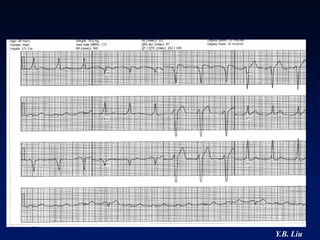
Wolff-Parkinson-White Syndrome

      Yen-Bin Liu, 2013 March


                                 Y.B. Liu
Outline
• General consideration of SVT

• WPW and accessory pathway

• Catheter ablation of accessory pathway

• Multiple accessory pathway

• Special considerations in WPW and AVRT

• Issue not covered in today’s talk


                                           Y.B. Liu
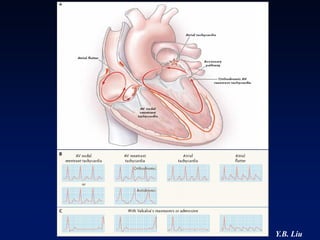
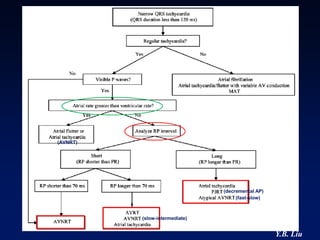
General consideration of SVT


                               Y.B. Liu
Y.B. Liu
(AVNRT)


                                (decremental AP)
                                     (fast-slow)


          (slow-intermediate)


                                                   Y.B. Liu
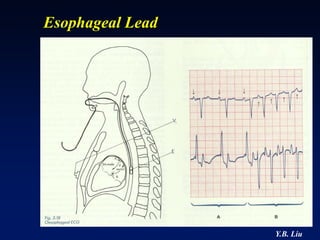
Esophageal Lead


                  Y.B. Liu
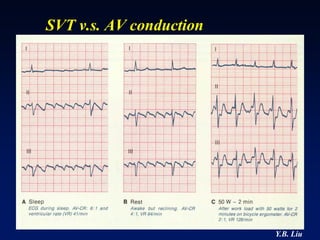
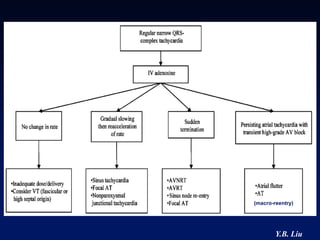
SVT v.s. AV conduction


                         Y.B. Liu
(macro-reentry)


        Y.B. Liu
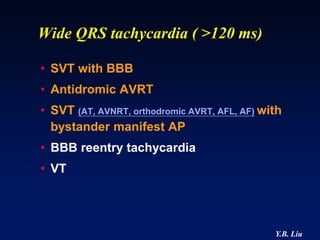
Wide QRS tachycardia ( >120 ms)

• SVT with BBB
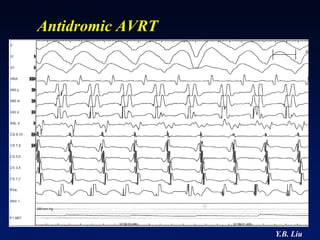
• Antidromic AVRT
• SVT (AT, AVNRT, orthodromic AVRT, AFL, AF) with
  bystander manifest AP
• BBB reentry tachycardia
• VT


                                               Y.B. Liu
WPW and accessory pathway


                            Y.B. Liu
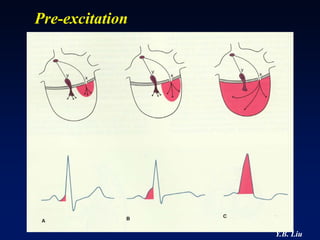
Pre-excitation


                 Y.B. Liu
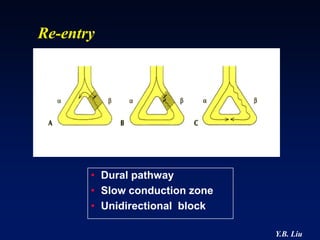
Re-entry


       • Dural pathway
       • Slow conduction zone
       • Unidirectional block

                                Y.B. Liu
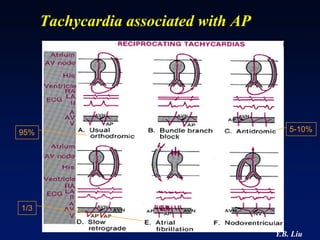
Tachycardia associated with AP


95%                                        5-10%


1/3


                                       Y.B. Liu
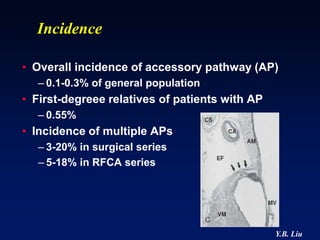
Incidence

• Overall incidence of accessory pathway (AP)
  – 0.1-0.3% of general population
• First-degreee relatives of patients with AP
  – 0.55%
• Incidence of multiple APs
  – 3-20% in surgical series
  – 5-18% in RFCA series


                                                Y.B. Liu
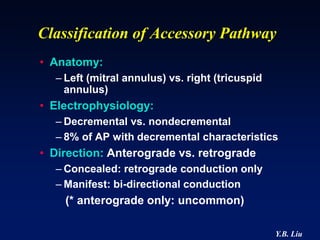
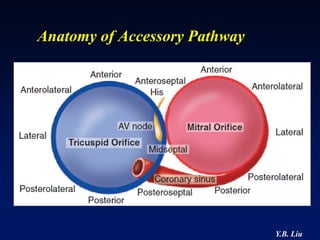
Classification of Accessory Pathway
• Anatomy:
  – Left (mitral annulus) vs. right (tricuspid
    annulus)
• Electrophysiology:
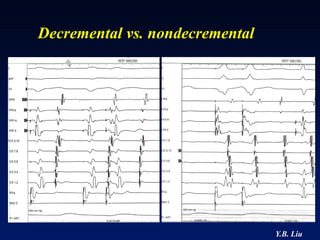
  – Decremental vs. nondecremental
  – 8% of AP with decremental characteristics
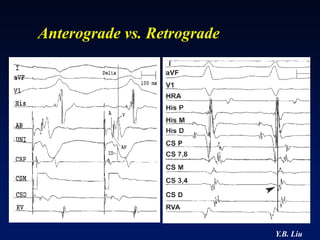
• Direction: Anterograde vs. retrograde
  – Concealed: retrograde conduction only
  – Manifest: bi-directional conduction
    (* anterograde only: uncommon)

                                                 Y.B. Liu
Anatomy of Accessory Pathway


                               Y.B. Liu
Anterograde vs. Retrograde


                             Y.B. Liu
Decremental vs. nondecremental


                                 Y.B. Liu
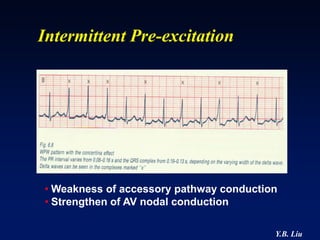
Intermittent Pre-excitation


• Weakness of accessory pathway conduction
• Strengthen of AV nodal conduction

                                         Y.B. Liu
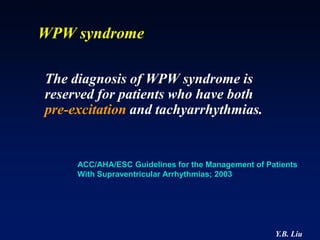
WPW syndrome

The diagnosis of WPW syndrome is
reserved for patients who have both
pre-excitation and tachyarrhythmias.


     ACC/AHA/ESC Guidelines for the Management of Patients
     With Supraventricular Arrhythmias; 2003


                                                    Y.B. Liu
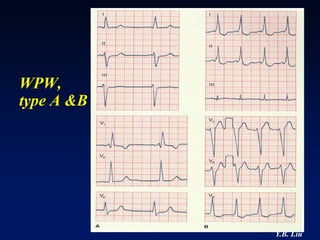
WPW,
type A &B


            Y.B. Liu
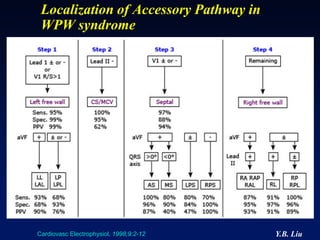
Localization of Accessory
Pathway in WPW syndrome

   • Transition zone
   • R in lead I
   • Positive or
     Negative vector
     of delta wave in
     II, III, aVF

  [PACE 1995; 18: 1469-1473]


                               Y.B. Liu
Localization of Accessory Pathway in
 WPW syndrome


Cardiovasc Electrophysiol. 1998;9:2-12   Y.B. Liu
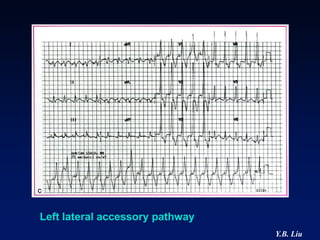
Left lateral accessory pathway
                                 Y.B. Liu
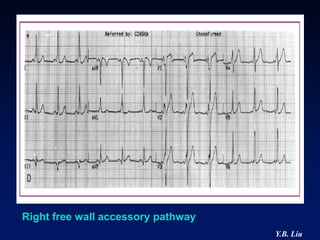
Right free wall accessory pathway
                                    Y.B. Liu
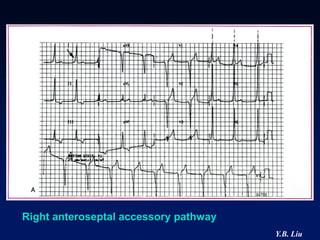
Right anteroseptal accessory pathway
                                       Y.B. Liu
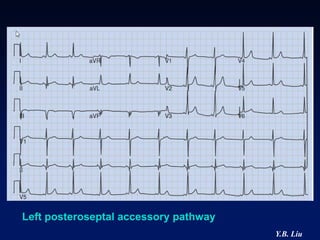
Left posteroseptal accessory pathway
                                       Y.B. Liu
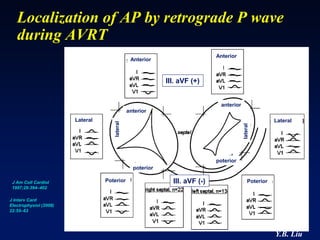
Localization of AP by retrograde P wave
   during AVRT
                                                                             Anterior
                                                Anterior


                                                            III. aVF (+)


                                                                               anterior
                                               anterior
                        Lateral                                                                          Lateral
                                     lateral


                                                                                          lateral
                                                                             poterior
                                                 poterior

 J Am Coll Cardiol                Poterior                    III. aVF (-)                    Poterior
 1997;29:394–402

J Interv Card
Electrophysiol (2008)
22:55–63


                                                                                                         Y.B. Liu
Catheter ablation of accessory pathway


                                   Y.B. Liu
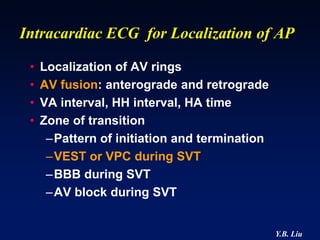
Intracardiac ECG for Localization of AP

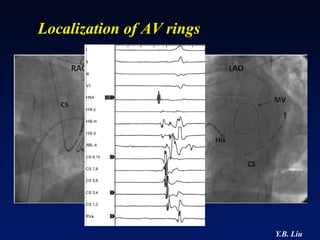
 •   Localization of AV rings
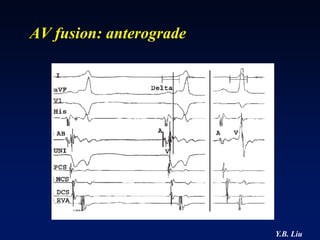
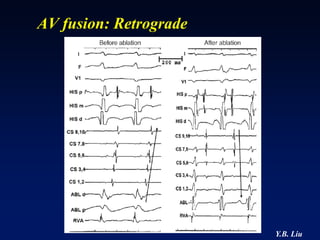
 •   AV fusion: anterograde and retrograde
 •   VA interval, HH interval, HA time
 •   Zone of transition
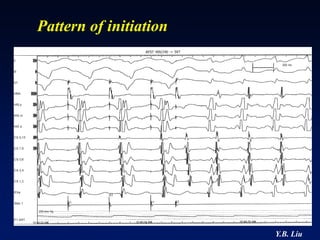
      –Pattern of initiation and termination
      –VEST or VPC during SVT
      –BBB during SVT
      –AV block during SVT


                                               Y.B. Liu
Localization of AV rings


                           Y.B. Liu
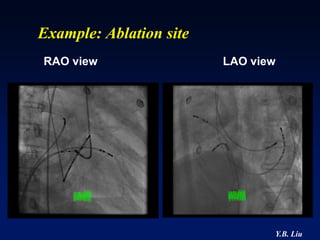
Example: Ablation site
RAO view                 LAO view


                                Y.B. Liu
AV fusion: anterograde


                         Y.B. Liu
AV fusion: Retrograde


                        Y.B. Liu
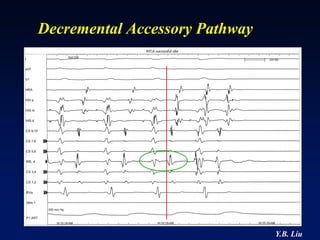
Decremental Accessory Pathway


                                Y.B. Liu
Pattern of initiation


                        Y.B. Liu
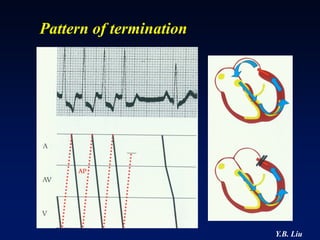
Pattern of termination


                         Y.B. Liu
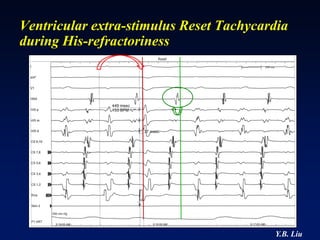
Ventricular extra-stimulus Reset Tachycardia
during His-refractoriness


                                         Y.B. Liu
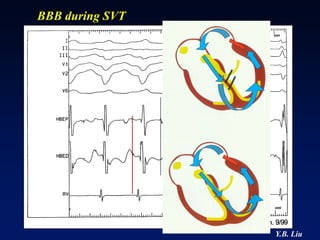
BBB during SVT


                 Y.B. Liu
Y.B. Liu
Y.B. Liu
Antidromic AVRT


                  Y.B. Liu
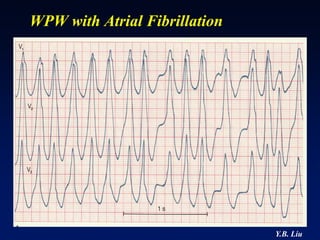
WPW with Atrial Fibrillation


                               Y.B. Liu
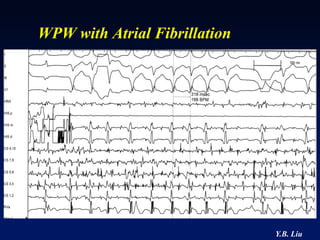
WPW with Atrial Fibrillation


                               Y.B. Liu
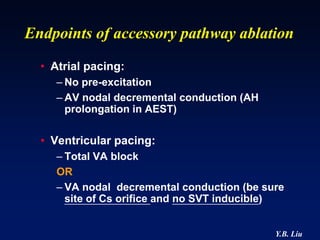
Endpoints of accessory pathway ablation
  • Atrial pacing:
     – No pre-excitation
     – AV nodal decremental conduction (AH
       prolongation in AEST)

  • Ventricular pacing:
     – Total VA block
     OR
     – VA nodal decremental conduction (be sure
       site of Cs orifice and no SVT inducible)


                                             Y.B. Liu
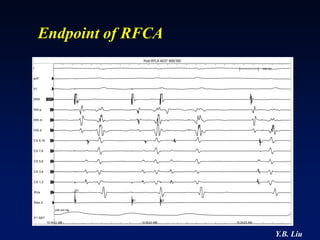
Endpoint of RFCA


                   Y.B. Liu
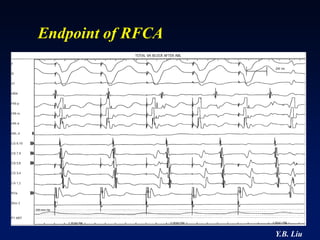
Endpoint of RFCA


                   Y.B. Liu
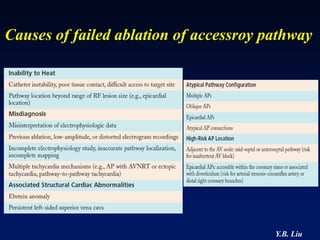
Causes of failed ablation of accessroy pathway


                                        Y.B. Liu
RFCA in WPW
•約有93-95% (87-99%)的成功率,而復發率則
 約為7% (0-11%) 。
•手術的併發症發生率約為1-4%,主要和手術傷
 口、電極導管的操作或高頻波的燒灼有關,約
 有1%的機會發生心房室傳導阻斷,但會因RFCA
 而發生致命性併發症的機率則很低 (<0.2%)。
•對AVRT而言,RFCA的成功率和復發率取決於是
 否能精準的定位accessory pathway並加以燒
 灼移除,因此,手術的結果和手術者的經驗十
 分相關,而和病人的年齡則無明顯的關聯。


                          Y.B. Liu
Multiple accessory pathway


                             Y.B. Liu
Definition of multiple accessory pathway

 • APs separated by 1-3 cm

 • Multistranded or broad-banded bypass
   tracts as wide as 3 cm had been reported


                                              Y.B. Liu
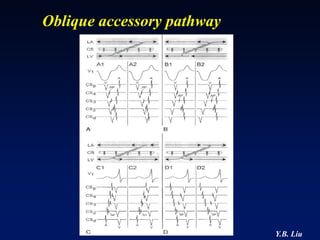
Oblique accessory pathway


                            Y.B. Liu
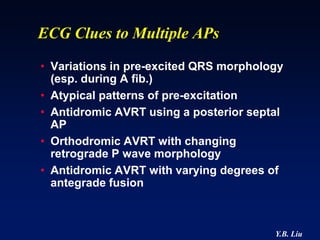
ECG Clues to Multiple APs
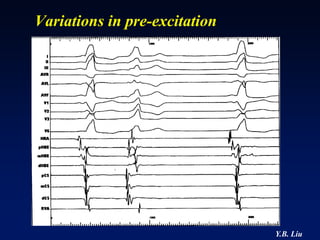
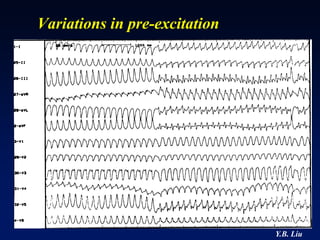
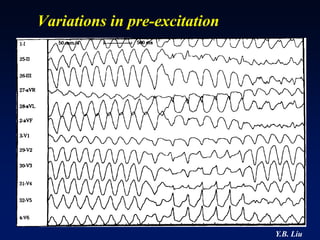
• Variations in pre-excited QRS morphology
  (esp. during A fib.)
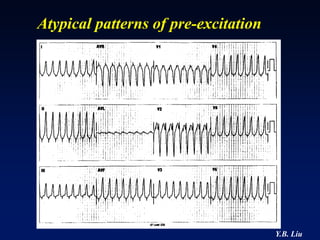
• Atypical patterns of pre-excitation
• Antidromic AVRT using a posterior septal
  AP
• Orthodromic AVRT with changing
  retrograde P wave morphology
• Antidromic AVRT with varying degrees of
  antegrade fusion


                                        Y.B. Liu
Variations in pre-excitation


                               Y.B. Liu
Variations in pre-excitation


                               Y.B. Liu
Variations in pre-excitation


                               Y.B. Liu
Atypical patterns of pre-excitation


                                      Y.B. Liu
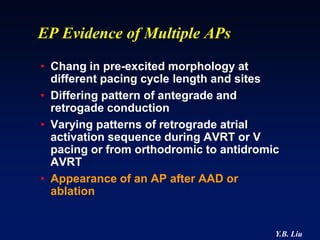
EP Evidence of Multiple APs
• Chang in pre-excited morphology at
  different pacing cycle length and sites
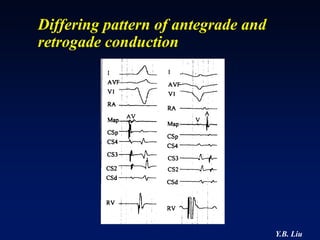
• Differing pattern of antegrade and
  retrogade conduction
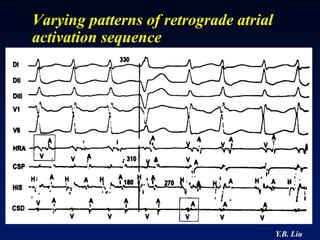
• Varying patterns of retrograde atrial
  activation sequence during AVRT or V
  pacing or from orthodromic to antidromic
  AVRT
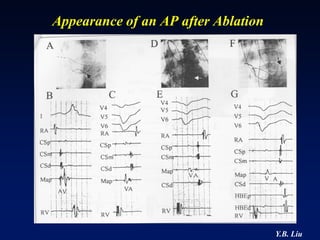
• Appearance of an AP after AAD or
  ablation


                                         Y.B. Liu
Differing pattern of antegrade and
retrogade conduction


                                     Y.B. Liu
Appearance of an AP after Ablation


                                     Y.B. Liu
Varying patterns of retrograde atrial
activation sequence


                                        Y.B. Liu
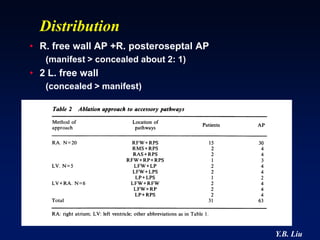
Distribution
• R. free wall AP +R. posteroseptal AP
   (manifest > concealed about 2: 1)
• 2 L. free wall
   (concealed > manifest)


                                         Y.B. Liu
Arrhythmias associated with multiple APs
  • Orthodromic AVRT
  • Antidromic AVRT
     – 33% vs. 6%
  • Atrial fibrillation
     – More clinical AF
     – More induced AF
     – More AF after RV pacing and AVRT
  • AP as a bystander

  Sudden death?

                                           Y.B. Liu
RFCA in multiple APs
• Longer procedure time
• Greater radiation time
• Higher recurrent rate
  – per patient
  – per AP


Dual AV nodal pathway, 10-20%
  – Only 1 patient develop AVNRT


                                   Y.B. Liu
Special considerations in WPW and AVRT


                                  Y.B. Liu
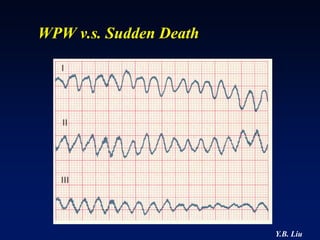
WPW v.s. Sudden Death


                        Y.B. Liu
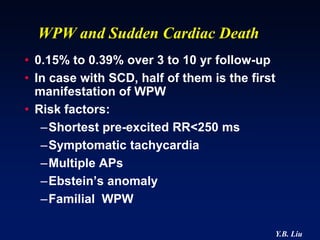
WPW and Sudden Cardiac Death
• 0.15% to 0.39% over 3 to 10 yr follow-up
• In case with SCD, half of them is the first
  manifestation of WPW
• Risk factors:
   –Shortest pre-excited RR<250 ms
   –Symptomatic tachycardia
   –Multiple APs
   –Ebstein’s anomaly
   –Familial WPW

                                            Y.B. Liu
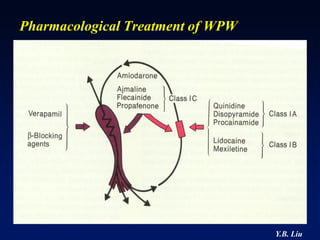
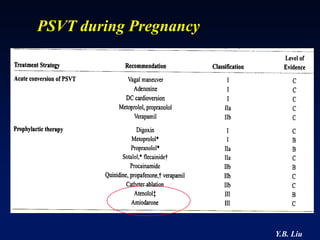
Pharmacological Treatment of WPW


                                   Y.B. Liu
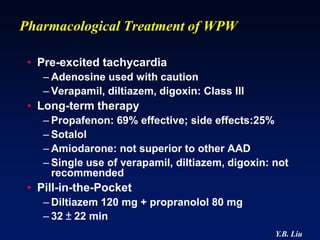
Pharmacological Treatment of WPW

 • Pre-excited tachycardia
    – Adenosine used with caution
    – Verapamil, diltiazem, digoxin: Class III
 • Long-term therapy
    – Propafenon: 69% effective; side effects:25%
    – Sotalol
    – Amiodarone: not superior to other AAD
    – Single use of verapamil, diltiazem, digoxin: not
      recommended
 • Pill-in-the-Pocket
    – Diltiazem 120 mg + propranolol 80 mg
    – 32 ± 22 min
                                                   Y.B. Liu
PSVT during Pregnancy


                        Y.B. Liu
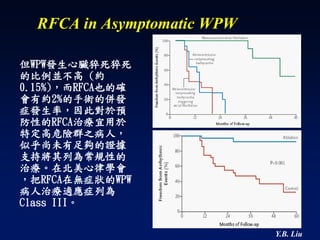
RFCA in Asymptomatic WPW

但WPW發生心臟猝死猝死
的比例並不高 (約
0.15%),而RFCA也的確
會有約2%的手術的併發
症發生率,因此對於預
防性的RFCA治療宜用於
特定高危險群之病人,
似乎尚未有足夠的證據
支持將其列為常規性的
治療。在北美心律學會
,把RFCA在無症狀的WPW
病人治療適應症列為
Class III。

                             Y.B. Liu
Issue NOT covered in today’s talk


                                    Y.B. Liu
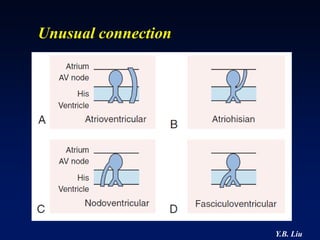
Unusual connection


                     Y.B. Liu
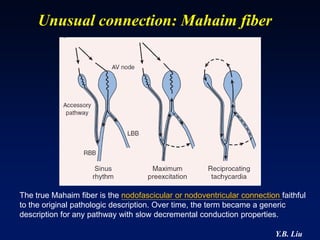
Unusual connection: Mahaim fiber


The true Mahaim fiber is the nodofascicular or nodoventricular connection faithful
to the original pathologic description. Over time, the term became a generic
description for any pathway with slow decremental conduction properties.

                                                                         Y.B. Liu
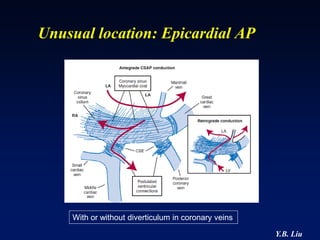
Unusual location: Epicardial AP


    With or without diverticulum in coronary veins

                                                     Y.B. Liu
Thank you for your attention !


                                 Y.B. Liu

Wolff - Parkinson - White Syndrome

  • 1.
    Wolff-Parkinson-White Syndrome Yen-Bin Liu, 2013 March Y.B. Liu
  • 2.
    Outline • General considerationof SVT • WPW and accessory pathway • Catheter ablation of accessory pathway • Multiple accessory pathway • Special considerations in WPW and AVRT • Issue not covered in today’s talk Y.B. Liu
  • 3.
  • 4.
  • 5.
    (AVNRT) (decremental AP) (fast-slow) (slow-intermediate) Y.B. Liu
  • 6.
  • 7.
    SVT v.s. AVconduction Y.B. Liu
  • 8.
  • 9.
    Wide QRS tachycardia( >120 ms) • SVT with BBB • Antidromic AVRT • SVT (AT, AVNRT, orthodromic AVRT, AFL, AF) with bystander manifest AP • BBB reentry tachycardia • VT Y.B. Liu
  • 10.
    WPW and accessorypathway Y.B. Liu
  • 11.
  • 12.
    Re-entry • Dural pathway • Slow conduction zone • Unidirectional block Y.B. Liu
  • 13.
    Tachycardia associated withAP 95% 5-10% 1/3 Y.B. Liu
  • 14.
    Incidence • Overall incidenceof accessory pathway (AP) – 0.1-0.3% of general population • First-degreee relatives of patients with AP – 0.55% • Incidence of multiple APs – 3-20% in surgical series – 5-18% in RFCA series Y.B. Liu
  • 15.
    Classification of AccessoryPathway • Anatomy: – Left (mitral annulus) vs. right (tricuspid annulus) • Electrophysiology: – Decremental vs. nondecremental – 8% of AP with decremental characteristics • Direction: Anterograde vs. retrograde – Concealed: retrograde conduction only – Manifest: bi-directional conduction (* anterograde only: uncommon) Y.B. Liu
  • 16.
    Anatomy of AccessoryPathway Y.B. Liu
  • 17.
  • 18.
  • 19.
    Intermittent Pre-excitation • Weaknessof accessory pathway conduction • Strengthen of AV nodal conduction Y.B. Liu
  • 20.
    WPW syndrome The diagnosisof WPW syndrome is reserved for patients who have both pre-excitation and tachyarrhythmias. ACC/AHA/ESC Guidelines for the Management of Patients With Supraventricular Arrhythmias; 2003 Y.B. Liu
  • 21.
  • 22.
    Localization of Accessory Pathwayin WPW syndrome • Transition zone • R in lead I • Positive or Negative vector of delta wave in II, III, aVF [PACE 1995; 18: 1469-1473] Y.B. Liu
  • 23.
    Localization of AccessoryPathway in WPW syndrome Cardiovasc Electrophysiol. 1998;9:2-12 Y.B. Liu
  • 24.
    Left lateral accessorypathway Y.B. Liu
  • 25.
    Right free wallaccessory pathway Y.B. Liu
  • 26.
  • 27.
  • 28.
    Localization of APby retrograde P wave during AVRT Anterior Anterior III. aVF (+) anterior anterior Lateral Lateral lateral lateral poterior poterior J Am Coll Cardiol Poterior III. aVF (-) Poterior 1997;29:394–402 J Interv Card Electrophysiol (2008) 22:55–63 Y.B. Liu
  • 29.
    Catheter ablation ofaccessory pathway Y.B. Liu
  • 30.
    Intracardiac ECG forLocalization of AP • Localization of AV rings • AV fusion: anterograde and retrograde • VA interval, HH interval, HA time • Zone of transition –Pattern of initiation and termination –VEST or VPC during SVT –BBB during SVT –AV block during SVT Y.B. Liu
  • 31.
    Localization of AVrings Y.B. Liu
  • 32.
    Example: Ablation site RAOview LAO view Y.B. Liu
  • 33.
  • 34.
  • 35.
  • 36.
  • 37.
  • 38.
    Ventricular extra-stimulus ResetTachycardia during His-refractoriness Y.B. Liu
  • 39.
  • 40.
  • 41.
  • 42.
  • 43.
    WPW with AtrialFibrillation Y.B. Liu
  • 44.
    WPW with AtrialFibrillation Y.B. Liu
  • 45.
    Endpoints of accessorypathway ablation • Atrial pacing: – No pre-excitation – AV nodal decremental conduction (AH prolongation in AEST) • Ventricular pacing: – Total VA block OR – VA nodal decremental conduction (be sure site of Cs orifice and no SVT inducible) Y.B. Liu
  • 46.
  • 47.
  • 48.
    Causes of failedablation of accessroy pathway Y.B. Liu
  • 49.
    RFCA in WPW •約有93-95%(87-99%)的成功率,而復發率則 約為7% (0-11%) 。 •手術的併發症發生率約為1-4%,主要和手術傷 口、電極導管的操作或高頻波的燒灼有關,約 有1%的機會發生心房室傳導阻斷,但會因RFCA 而發生致命性併發症的機率則很低 (<0.2%)。 •對AVRT而言,RFCA的成功率和復發率取決於是 否能精準的定位accessory pathway並加以燒 灼移除,因此,手術的結果和手術者的經驗十 分相關,而和病人的年齡則無明顯的關聯。 Y.B. Liu
  • 50.
  • 51.
    Definition of multipleaccessory pathway • APs separated by 1-3 cm • Multistranded or broad-banded bypass tracts as wide as 3 cm had been reported Y.B. Liu
  • 52.
  • 53.
    ECG Clues toMultiple APs • Variations in pre-excited QRS morphology (esp. during A fib.) • Atypical patterns of pre-excitation • Antidromic AVRT using a posterior septal AP • Orthodromic AVRT with changing retrograde P wave morphology • Antidromic AVRT with varying degrees of antegrade fusion Y.B. Liu
  • 54.
  • 55.
  • 56.
  • 57.
    Atypical patterns ofpre-excitation Y.B. Liu
  • 58.
    EP Evidence ofMultiple APs • Chang in pre-excited morphology at different pacing cycle length and sites • Differing pattern of antegrade and retrogade conduction • Varying patterns of retrograde atrial activation sequence during AVRT or V pacing or from orthodromic to antidromic AVRT • Appearance of an AP after AAD or ablation Y.B. Liu
  • 59.
    Differing pattern ofantegrade and retrogade conduction Y.B. Liu
  • 60.
    Appearance of anAP after Ablation Y.B. Liu
  • 61.
    Varying patterns ofretrograde atrial activation sequence Y.B. Liu
  • 62.
    Distribution • R. freewall AP +R. posteroseptal AP (manifest > concealed about 2: 1) • 2 L. free wall (concealed > manifest) Y.B. Liu
  • 63.
    Arrhythmias associated withmultiple APs • Orthodromic AVRT • Antidromic AVRT – 33% vs. 6% • Atrial fibrillation – More clinical AF – More induced AF – More AF after RV pacing and AVRT • AP as a bystander Sudden death? Y.B. Liu
  • 64.
    RFCA in multipleAPs • Longer procedure time • Greater radiation time • Higher recurrent rate – per patient – per AP Dual AV nodal pathway, 10-20% – Only 1 patient develop AVNRT Y.B. Liu
  • 65.
    Special considerations inWPW and AVRT Y.B. Liu
  • 66.
    WPW v.s. SuddenDeath Y.B. Liu
  • 67.
    WPW and SuddenCardiac Death • 0.15% to 0.39% over 3 to 10 yr follow-up • In case with SCD, half of them is the first manifestation of WPW • Risk factors: –Shortest pre-excited RR<250 ms –Symptomatic tachycardia –Multiple APs –Ebstein’s anomaly –Familial WPW Y.B. Liu
  • 68.
  • 69.
    Pharmacological Treatment ofWPW • Pre-excited tachycardia – Adenosine used with caution – Verapamil, diltiazem, digoxin: Class III • Long-term therapy – Propafenon: 69% effective; side effects:25% – Sotalol – Amiodarone: not superior to other AAD – Single use of verapamil, diltiazem, digoxin: not recommended • Pill-in-the-Pocket – Diltiazem 120 mg + propranolol 80 mg – 32 ± 22 min Y.B. Liu
  • 70.
  • 71.
    RFCA in AsymptomaticWPW 但WPW發生心臟猝死猝死 的比例並不高 (約 0.15%),而RFCA也的確 會有約2%的手術的併發 症發生率,因此對於預 防性的RFCA治療宜用於 特定高危險群之病人, 似乎尚未有足夠的證據 支持將其列為常規性的 治療。在北美心律學會 ,把RFCA在無症狀的WPW 病人治療適應症列為 Class III。 Y.B. Liu
  • 72.
    Issue NOT coveredin today’s talk Y.B. Liu
  • 73.
  • 74.
    Unusual connection: Mahaimfiber The true Mahaim fiber is the nodofascicular or nodoventricular connection faithful to the original pathologic description. Over time, the term became a generic description for any pathway with slow decremental conduction properties. Y.B. Liu
  • 75.
    Unusual location: EpicardialAP With or without diverticulum in coronary veins Y.B. Liu
  • 76.
    Thank you foryour attention ! Y.B. Liu