Concepts of Techniques
for differentiating
SVT
SAKHAN SOLIDA, MD
Cardiologist
ESC, EHRA and ACC member
Preah Kossamak Hospital
OUTLINE
Induction of tachycardia
Baseline tachycardia feature
Diagnostic maneuvers during tachycardia
Diagnostic maneuvers during SR after termination of
tachycardia
Induction of tachycardia
• Initiation by AES or Atrial pacing
• Requirement of Av conduction delay
• Warm-up
• VA interval
• Initiation by VES or Ventricular pacing
• HA interval
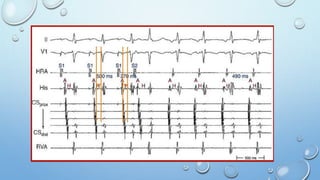
Initiation by AES or Atrial pacing
Requirement of AV conduction delay
SVT initiation is reproducibly dependent on a critical AH interval :
• Classic for typical AVNRT
• Not always obvious with atypical AVNRT
• Maybe present in AT but not a prerequisite
• ORT often associated with AV delay but antegrade block in the AP is the key
• Warm-up
• Characteristic but not exclusive of AT
• VA linking at induction
• Compare VA interval of the first tachycardia beat to the rest the of the SVT
• if reproducibly identical, AT is very unlikely
Initiation by AES or Atrial pacing
• HA interval : compare HA interval during SVT and HA interval
occurring after a VES
• HASVT < HAVES : AVNRT
• HASVT > HAVES : AVRT
Initiation by VES or Ventricular pacing
Baseline Tachycardia Feature
• Atrial activation sequence
• Eccentric vs Concentric
• Is the earliest A near the AV ring ?
• PR/RP relationship
• AT : PR interval usually longer than during SR, the faster the AT, the longer the PR
interval
• Typical AVNRT : VA typically 40-75ms
• Atypical AVNRT : long RP tachycardia, but PR and AH interval often shorter than
during SR
• ORT : usually short RP but VA > 70ms
• VA block
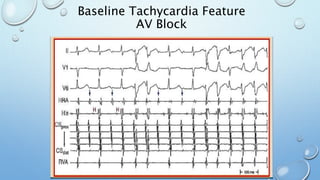
Baseline Tachycardia Feature
AV Block
Baseline Tachycardia Feature
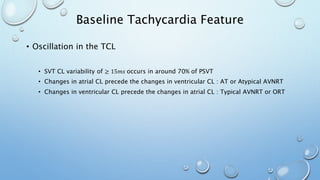
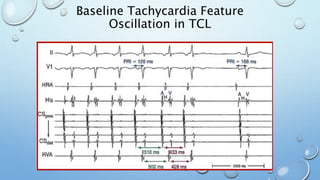
• Oscillation in the TCL
• SVT CL variability of ≥ 15𝑚𝑠 occurs in around 70% of PSVT
• Changes in atrial CL precede the changes in ventricular CL : AT or Atypical AVNRT
• Changes in ventricular CL precede the changes in atrial CL : Typical AVNRT or ORT
Baseline Tachycardia Feature
Oscillation in TCL
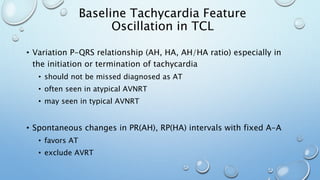
• Variation P-QRS relationship (AH, HA, AH/HA ratio) especially in
the initiation or termination of tachycardia
• should not be missed diagnosed as AT
• often seen in atypical AVNRT
• may seen in typical AVNRT
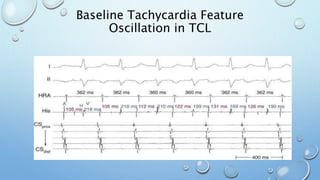
• Spontaneous changes in PR(AH), RP(HA) intervals with fixed A-A
• favors AT
• exclude AVRT
Baseline Tachycardia Feature
Oscillation in TCL
Baseline Tachycardia Feature
Oscillation in TCL
Effects of BBB :
• BBB aberrancy during SVT is often suggestive of ORT
• BBB during SVT that does not prolong the VA (HA) interval excludes ORT using
ipsilateral AP, may still be AVNRT, AT or ORT using contralateral AP
• Prolongation of VA interval with BBB > 35ms indicates ORT with ipsilateral free wall
AP
• Prolongation of VA interval < 25ms suggests ORT utilizing a septal AP
Baseline Tachycardia Feature
Diagnostic Maneuvers during Tachycardia
• AES during tachycardia
• Resetting
• Termination
• Atrial pacing during tachycardia
• Entrainment
• Delta AH
• Acceleration
• Overdrive suppression
• Termination
• Differential site atrial pacing
• VA interval in return cycle following cessation of pacing
AES during SVT
Resetting
• AES can reset AT, AVNRT and ORT
• Resetting with manifest atrial fusion
• maybe seen in ORT and macroreentrant AT
• Not seen in AVNRT or focal AT
• Overdrive atrial pacing can entrain macroreentrant AT, AVNRT and ORT
• Automatic or triggered AT can not be entrained
• Entrainment with manifest fusion in ORT or macroreentrant AT (similar to AES
concept)
• VA linking : compare post pacing VA interval to SVT VA interval
Atrial pacing during SVT
Entrainment
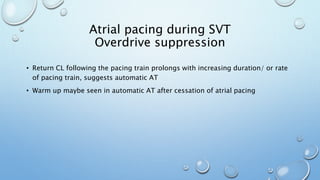
• Return CL following the pacing train prolongs with increasing duration/ or rate
of pacing train, suggests automatic AT
• Warm up maybe seen in automatic AT after cessation of atrial pacing
Atrial pacing during SVT
Overdrive suppression
Atrial pacing during SVT
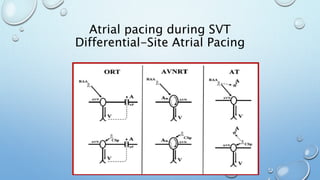
Differential-Site Atrial Pacing
Atrial pacing during SVT
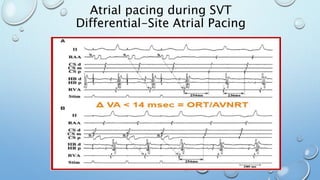
Differential-Site Atrial Pacing
Atrial pacing during SVT
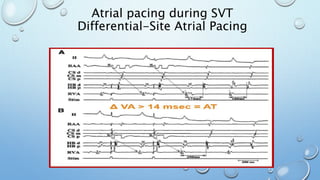
Differential-Site Atrial Pacing
• VES during tachycardia
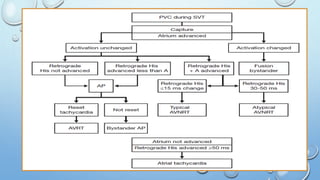
• Resetting (His refractory VES)
• Ventricular pacing during SVT
• Atrial activation
• Entrainment
• AV vs AAV response
• Termination
Diagnostic Maneuvers during Tachycardia
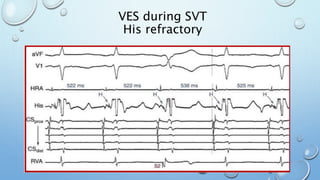
VES during SVT
His refractory
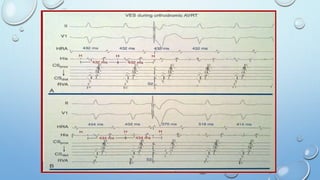
• VES delivered during SVT when the His potential is already manifest or within 35 to
55ms before the time of expected His potential
• Advancing the next A +/- termination of SVT
• confirms presence of retrogradely conducting AP
• excludes AVNRT but not AT with bystander AP
• Advancing the next A with activation sequence identical to SVT favors ORT over AT
with bystander
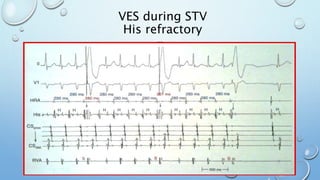
VES during STV
His refractory
• Delay of the next A = ORT
• decremental conduction over AP
• an innocent bystander AP can not delay A during AT
• Termination of SVT without an A = ORT
• VA block in AP
• Note, even a well timed His refractory VES may not affect the atrial activation if the
stim is far from the site of AP
VES during STV
His refractory
VES during SVT
His refractory
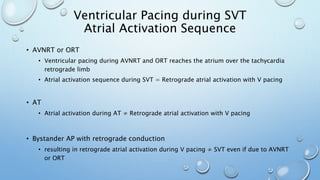
Ventricular Pacing during SVT
Atrial Activation Sequence
• AVNRT or ORT
• Ventricular pacing during AVNRT and ORT reaches the atrium over the tachycardia
retrograde limb
• Atrial activation sequence during SVT = Retrograde atrial activation with V pacing
• AT
• Atrial activation during AT ≠ Retrograde atrial activation with V pacing
• Bystander AP with retrograde conduction
• resulting in retrograde atrial activation during V pacing ≠ SVT even if due to AVNRT
or ORT
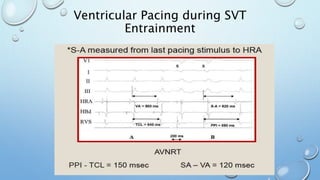
Ventricular Pacing during SVT
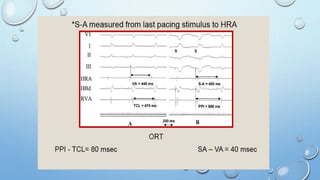
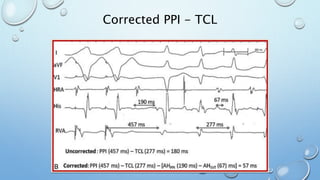
Entrainment
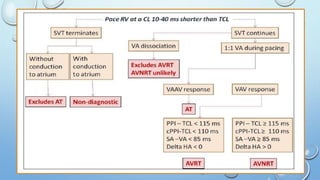
Corrected PPI - TCL
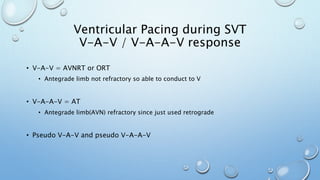
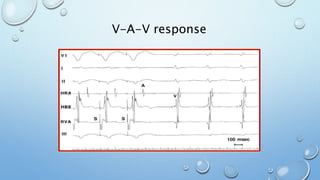
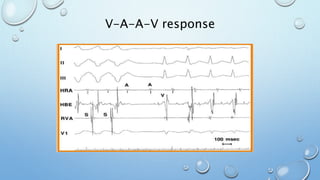
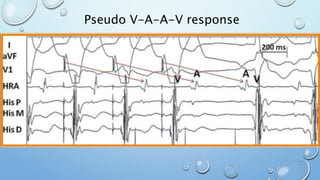
• V-A-V = AVNRT or ORT
• Antegrade limb not refractory so able to conduct to V
• V-A-A-V = AT
• Antegrade limb(AVN) refractory since just used retrograde
• Pseudo V-A-V and pseudo V-A-A-V
Ventricular Pacing during SVT
V-A-V / V-A-A-V response
V-A-V response
V-A-A-V response
Pseudo V-A-A-V response
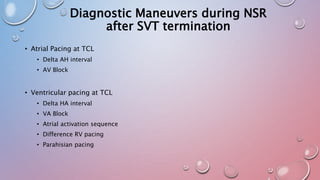
Diagnostic Maneuvers during NSR
after SVT termination
• Atrial Pacing at TCL
• Delta AH interval
• AV Block
• Ventricular pacing at TCL
• Delta HA interval
• VA Block
• Atrial activation sequence
• Difference RV pacing
• Parahisian pacing
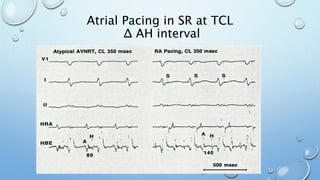
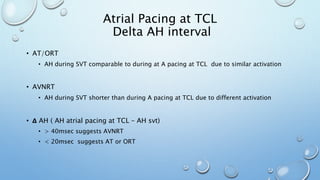
Atrial Pacing at TCL
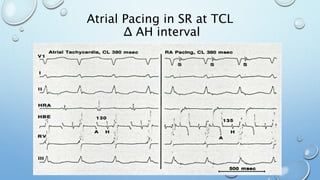
Delta AH interval
• AT/ORT
• AH during SVT comparable to during at A pacing at TCL due to similar activation
• AVNRT
• AH during SVT shorter than during A pacing at TCL due to different activation
• 𝝙 AH ( AH atrial pacing at TCL – AH svt)
• > 40msec suggests AVNRT
• < 20msec suggests AT or ORT
Atrial Pacing in SR at TCL
Δ AH interval
Atrial Pacing in SR at TCL
Δ AH interval
• AT/ORT
• Atrial pacing at the TCL should result in 1:1 AV conduction
• AVNRT
• Development of AV block/ Upper common pathway block
Atrial Pacing in SR at TCL
AV Block
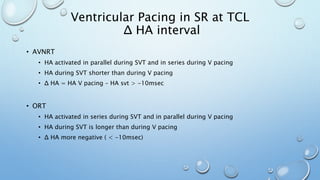
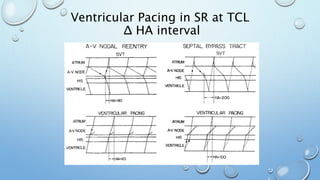
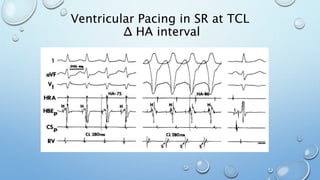
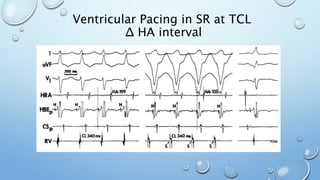
• AVNRT
• HA activated in parallel during SVT and in series during V pacing
• HA during SVT shorter than during V pacing
• Δ HA = HA V pacing – HA svt > -10msec
• ORT
• HA activated in series during SVT and in parallel during V pacing
• HA during SVT is longer than during V pacing
• Δ HA more negative ( < -10msec)
Ventricular Pacing in SR at TCL
Δ HA interval
Ventricular Pacing in SR at TCL
Δ HA interval
Ventricular Pacing in SR at TCL
Δ HA interval
Ventricular Pacing in SR at TCL
Δ HA interval
• VA block during ventricular pacing makers ORT with a fast retrograde AP
unlikely
• In the setting of VA block, it could be :
• AT
• AVNRT with lower common pathway block
• PJRT
Ventricular Pacing in SR at TCL
VA Block
• AVNRT
• Atrial activation sequence usually similar during AVNRT and ventricular pacing in
NSR
• ORT
• Retrograde VA conduction during pacing may procced over the AVN, the AP or both
• AT
• Atrial activation during AT ≄ retrograde atrial activation with V pacing
• Pitfall : AT originating close to AVJ
Ventricular Pacing in SR at TCL
Retrograde atrial activation sequence
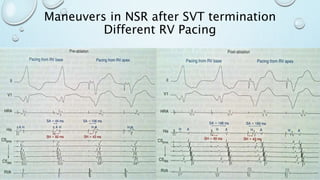
• Compare VA interval and Atrial activation sequence with pacing from RV base vs RV apex
• (-) Retrogradely conducting septal AP
• Shorter VA interval when pacing from the apex
• Same atrial activation sequence
• (+) Retrogradely conducting septal AP
• Shorter VA interval when pacing from the base
• Atrial activation sequence can be the same or different depending on degree of contribution
AVN and AP
• Pitfall
• Doesn’t exclude free wall AP or slowly conducting AP
Maneuvers in NSR after SVT termination
Different RV Pacing
Maneuvers in NSR after SVT termination
Different RV Pacing
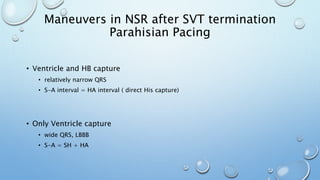
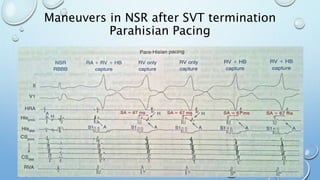
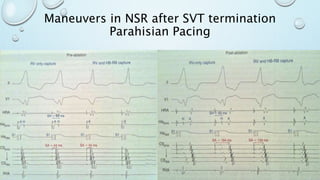
• Ventricle and HB capture
• relatively narrow QRS
• S-A interval = HA interval ( direct His capture)
• Only Ventricle capture
• wide QRS, LBBB
• S-A = SH + HA
Maneuvers in NSR after SVT termination
Parahisian Pacing
Maneuvers in NSR after SVT termination
Parahisian Pacing
Maneuvers in NSR after SVT termination
Parahisian Pacing
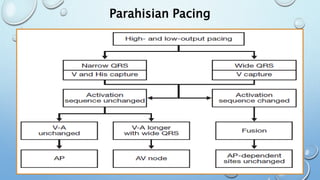
Parahisian Pacing
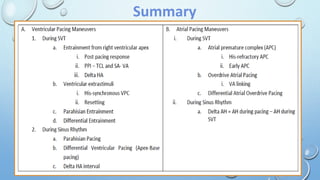
Summary
THANKS

SVT maneuvers

  • 1.
    Concepts of Techniques fordifferentiating SVT SAKHAN SOLIDA, MD Cardiologist ESC, EHRA and ACC member Preah Kossamak Hospital
  • 2.
    OUTLINE Induction of tachycardia Baselinetachycardia feature Diagnostic maneuvers during tachycardia Diagnostic maneuvers during SR after termination of tachycardia
  • 3.
    Induction of tachycardia •Initiation by AES or Atrial pacing • Requirement of Av conduction delay • Warm-up • VA interval • Initiation by VES or Ventricular pacing • HA interval
  • 4.
    Initiation by AESor Atrial pacing Requirement of AV conduction delay SVT initiation is reproducibly dependent on a critical AH interval : • Classic for typical AVNRT • Not always obvious with atypical AVNRT • Maybe present in AT but not a prerequisite • ORT often associated with AV delay but antegrade block in the AP is the key
  • 6.
    • Warm-up • Characteristicbut not exclusive of AT • VA linking at induction • Compare VA interval of the first tachycardia beat to the rest the of the SVT • if reproducibly identical, AT is very unlikely Initiation by AES or Atrial pacing
  • 7.
    • HA interval: compare HA interval during SVT and HA interval occurring after a VES • HASVT < HAVES : AVNRT • HASVT > HAVES : AVRT Initiation by VES or Ventricular pacing
  • 9.
    Baseline Tachycardia Feature •Atrial activation sequence • Eccentric vs Concentric • Is the earliest A near the AV ring ? • PR/RP relationship • AT : PR interval usually longer than during SR, the faster the AT, the longer the PR interval • Typical AVNRT : VA typically 40-75ms • Atypical AVNRT : long RP tachycardia, but PR and AH interval often shorter than during SR • ORT : usually short RP but VA > 70ms • VA block
  • 10.
  • 11.
    Baseline Tachycardia Feature •Oscillation in the TCL • SVT CL variability of ≥ 15𝑚𝑠 occurs in around 70% of PSVT • Changes in atrial CL precede the changes in ventricular CL : AT or Atypical AVNRT • Changes in ventricular CL precede the changes in atrial CL : Typical AVNRT or ORT
  • 12.
  • 13.
    • Variation P-QRSrelationship (AH, HA, AH/HA ratio) especially in the initiation or termination of tachycardia • should not be missed diagnosed as AT • often seen in atypical AVNRT • may seen in typical AVNRT • Spontaneous changes in PR(AH), RP(HA) intervals with fixed A-A • favors AT • exclude AVRT Baseline Tachycardia Feature Oscillation in TCL
  • 14.
  • 15.
    Effects of BBB: • BBB aberrancy during SVT is often suggestive of ORT • BBB during SVT that does not prolong the VA (HA) interval excludes ORT using ipsilateral AP, may still be AVNRT, AT or ORT using contralateral AP • Prolongation of VA interval with BBB > 35ms indicates ORT with ipsilateral free wall AP • Prolongation of VA interval < 25ms suggests ORT utilizing a septal AP Baseline Tachycardia Feature
  • 16.
    Diagnostic Maneuvers duringTachycardia • AES during tachycardia • Resetting • Termination • Atrial pacing during tachycardia • Entrainment • Delta AH • Acceleration • Overdrive suppression • Termination • Differential site atrial pacing • VA interval in return cycle following cessation of pacing
  • 17.
    AES during SVT Resetting •AES can reset AT, AVNRT and ORT • Resetting with manifest atrial fusion • maybe seen in ORT and macroreentrant AT • Not seen in AVNRT or focal AT
  • 18.
    • Overdrive atrialpacing can entrain macroreentrant AT, AVNRT and ORT • Automatic or triggered AT can not be entrained • Entrainment with manifest fusion in ORT or macroreentrant AT (similar to AES concept) • VA linking : compare post pacing VA interval to SVT VA interval Atrial pacing during SVT Entrainment
  • 19.
    • Return CLfollowing the pacing train prolongs with increasing duration/ or rate of pacing train, suggests automatic AT • Warm up maybe seen in automatic AT after cessation of atrial pacing Atrial pacing during SVT Overdrive suppression
  • 20.
    Atrial pacing duringSVT Differential-Site Atrial Pacing
  • 21.
    Atrial pacing duringSVT Differential-Site Atrial Pacing
  • 22.
    Atrial pacing duringSVT Differential-Site Atrial Pacing
  • 23.
    • VES duringtachycardia • Resetting (His refractory VES) • Ventricular pacing during SVT • Atrial activation • Entrainment • AV vs AAV response • Termination Diagnostic Maneuvers during Tachycardia
  • 24.
    VES during SVT Hisrefractory • VES delivered during SVT when the His potential is already manifest or within 35 to 55ms before the time of expected His potential • Advancing the next A +/- termination of SVT • confirms presence of retrogradely conducting AP • excludes AVNRT but not AT with bystander AP • Advancing the next A with activation sequence identical to SVT favors ORT over AT with bystander
  • 26.
    VES during STV Hisrefractory • Delay of the next A = ORT • decremental conduction over AP • an innocent bystander AP can not delay A during AT • Termination of SVT without an A = ORT • VA block in AP • Note, even a well timed His refractory VES may not affect the atrial activation if the stim is far from the site of AP
  • 27.
  • 28.
  • 29.
    Ventricular Pacing duringSVT Atrial Activation Sequence • AVNRT or ORT • Ventricular pacing during AVNRT and ORT reaches the atrium over the tachycardia retrograde limb • Atrial activation sequence during SVT = Retrograde atrial activation with V pacing • AT • Atrial activation during AT ≠ Retrograde atrial activation with V pacing • Bystander AP with retrograde conduction • resulting in retrograde atrial activation during V pacing ≠ SVT even if due to AVNRT or ORT
  • 30.
  • 32.
  • 33.
    • V-A-V =AVNRT or ORT • Antegrade limb not refractory so able to conduct to V • V-A-A-V = AT • Antegrade limb(AVN) refractory since just used retrograde • Pseudo V-A-V and pseudo V-A-A-V Ventricular Pacing during SVT V-A-V / V-A-A-V response
  • 34.
  • 35.
  • 36.
  • 37.
    Diagnostic Maneuvers duringNSR after SVT termination • Atrial Pacing at TCL • Delta AH interval • AV Block • Ventricular pacing at TCL • Delta HA interval • VA Block • Atrial activation sequence • Difference RV pacing • Parahisian pacing
  • 38.
    Atrial Pacing atTCL Delta AH interval • AT/ORT • AH during SVT comparable to during at A pacing at TCL due to similar activation • AVNRT • AH during SVT shorter than during A pacing at TCL due to different activation • 𝝙 AH ( AH atrial pacing at TCL – AH svt) • > 40msec suggests AVNRT • < 20msec suggests AT or ORT
  • 39.
    Atrial Pacing inSR at TCL Δ AH interval
  • 40.
    Atrial Pacing inSR at TCL Δ AH interval
  • 41.
    • AT/ORT • Atrialpacing at the TCL should result in 1:1 AV conduction • AVNRT • Development of AV block/ Upper common pathway block Atrial Pacing in SR at TCL AV Block
  • 42.
    • AVNRT • HAactivated in parallel during SVT and in series during V pacing • HA during SVT shorter than during V pacing • Δ HA = HA V pacing – HA svt > -10msec • ORT • HA activated in series during SVT and in parallel during V pacing • HA during SVT is longer than during V pacing • Δ HA more negative ( < -10msec) Ventricular Pacing in SR at TCL Δ HA interval
  • 43.
    Ventricular Pacing inSR at TCL Δ HA interval
  • 44.
    Ventricular Pacing inSR at TCL Δ HA interval
  • 45.
    Ventricular Pacing inSR at TCL Δ HA interval
  • 46.
    • VA blockduring ventricular pacing makers ORT with a fast retrograde AP unlikely • In the setting of VA block, it could be : • AT • AVNRT with lower common pathway block • PJRT Ventricular Pacing in SR at TCL VA Block
  • 47.
    • AVNRT • Atrialactivation sequence usually similar during AVNRT and ventricular pacing in NSR • ORT • Retrograde VA conduction during pacing may procced over the AVN, the AP or both • AT • Atrial activation during AT ≄ retrograde atrial activation with V pacing • Pitfall : AT originating close to AVJ Ventricular Pacing in SR at TCL Retrograde atrial activation sequence
  • 48.
    • Compare VAinterval and Atrial activation sequence with pacing from RV base vs RV apex • (-) Retrogradely conducting septal AP • Shorter VA interval when pacing from the apex • Same atrial activation sequence • (+) Retrogradely conducting septal AP • Shorter VA interval when pacing from the base • Atrial activation sequence can be the same or different depending on degree of contribution AVN and AP • Pitfall • Doesn’t exclude free wall AP or slowly conducting AP Maneuvers in NSR after SVT termination Different RV Pacing
  • 49.
    Maneuvers in NSRafter SVT termination Different RV Pacing
  • 50.
    • Ventricle andHB capture • relatively narrow QRS • S-A interval = HA interval ( direct His capture) • Only Ventricle capture • wide QRS, LBBB • S-A = SH + HA Maneuvers in NSR after SVT termination Parahisian Pacing
  • 51.
    Maneuvers in NSRafter SVT termination Parahisian Pacing
  • 52.
    Maneuvers in NSRafter SVT termination Parahisian Pacing
  • 53.
  • 54.
  • 57.