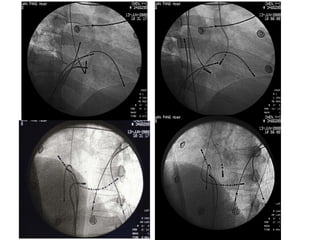
Advanced AVNRT and AVRT
   With differentiation
     Advanced EP Training
      (中華民國心律醫學會)

      謝敏雄 醫師
   台北醫學大學醫學系副教授
    萬芳醫院心臟內科主任
      April 24, 2011 於台北國際飯店
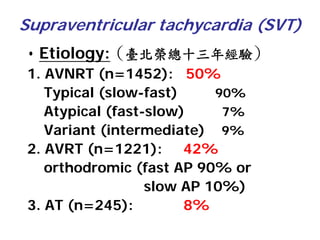
Supraventricular tachycardia (SVT)
 • Etiology: (臺北榮總十三年經驗)
 1. AVNRT (n=1452): 50%
    Typical (slow-fast)     90%
    Atypical (fast-slow)     7%
    Variant (intermediate) 9%
 2. AVRT (n=1221): 42%
    orthodromic (fast AP 90% or
                   slow AP 10%)
 3. AT (n=245):         8%
12-lead ECG for
differential diagnosis
 of SVTs (important!)
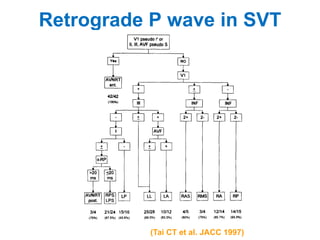
Retrograde P wave in SVT


           (Tai CT et al. JACC 1997)
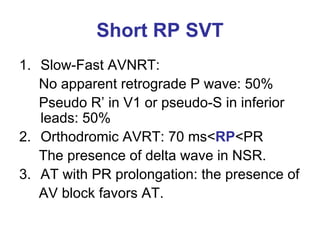
Short RP SVT
1. Slow-Fast AVNRT:
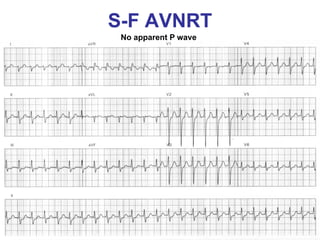
   No apparent retrograde P wave: 50%
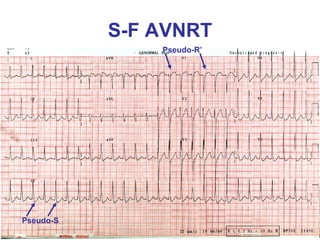
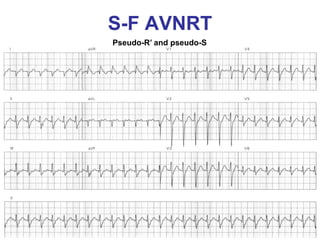
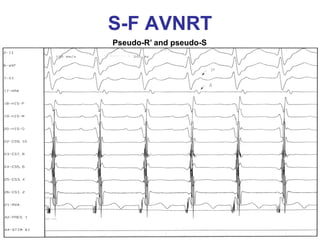
   Pseudo R’ in V1 or pseudo-S in inferior
   leads: 50%
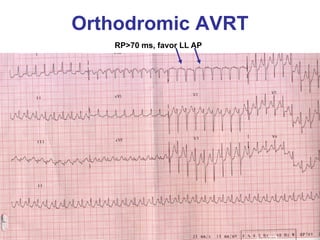
2. Orthodromic AVRT: 70 ms<RP<PR
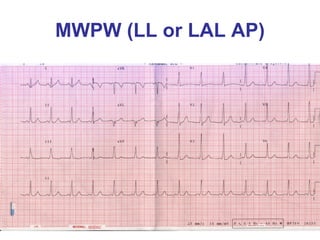
   The presence of delta wave in NSR.
3. AT with PR prolongation: the presence of
   AV block favors AT.
S-F AVNRT
               Pseudo-R’


Pseudo-S
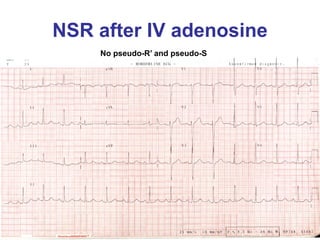
NSR after IV adenosine
    No pseudo-R’ and pseudo-S
S-F AVNRT
 No apparent P wave
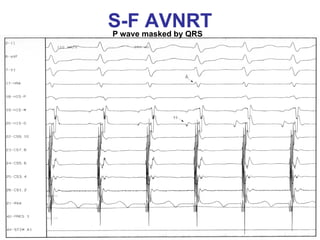
S-F masked by QRS
P wave
       AVNRT
S-F AVNRT
Pseudo-R’ and pseudo-S
S-F AVNRT
Pseudo-R’ and pseudo-S
Orthodromic AVRT
   RP>70 ms, favor LL AP
MWPW (LL or LAL AP)
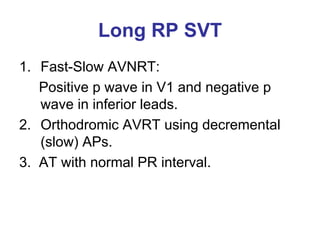
Long RP SVT
1. Fast-Slow AVNRT:
   Positive p wave in V1 and negative p
   wave in inferior leads.
2. Orthodromic AVRT using decremental
   (slow) APs.
3. AT with normal PR interval.
EP study for
differential diagnosis
        of SVTs
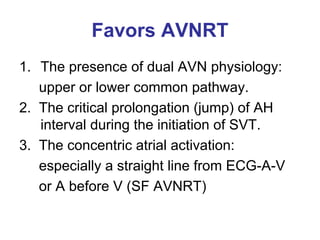
Favors AVNRT
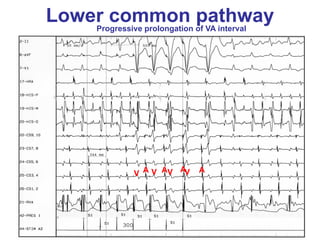
1. The presence of dual AVN physiology:
   upper or lower common pathway.
2. The critical prolongation (jump) of AH
   interval during the initiation of SVT.
3. The concentric atrial activation:
   especially a straight line from ECG-A-V
   or A before V (SF AVNRT)
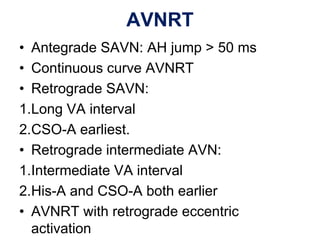
AVNRT
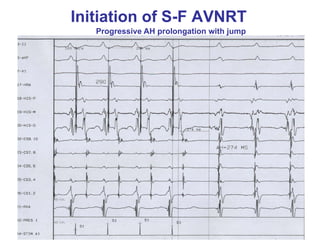
• Antegrade SAVN: AH jump > 50 ms
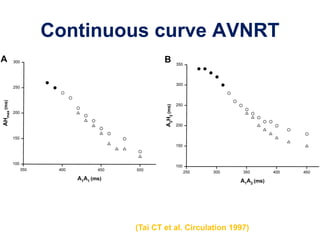
• Continuous curve AVNRT
• Retrograde SAVN:
1.Long VA interval
2.CSO-A earliest.
• Retrograde intermediate AVN:
1.Intermediate VA interval
2.His-A and CSO-A both earlier
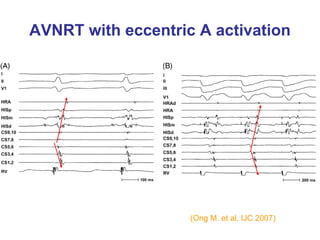
• AVNRT with retrograde eccentric
  activation
Continuous curve AVNRT


        (Tai CT et al. Circulation 1997)
Initiation of S-F AVNRT
   Progressive AH prolongation with jump
Lower common of VA interval
    Progressive prolongation
                             pathway


             V A V AV AV   A
AVNRT with eccentric A activation


                    (Ong M. et al. IJC 2007)
Favors AVRT
1. No decremental conduction during
   pacing (except slow AP).
2. The eccentric atrial activation with short
   VA interval (>70 ms)
3. VA interval increases >30 ms with
   functional BBB.
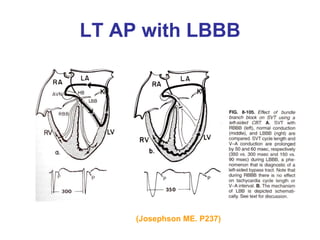
LT AP with LBBB


     (Josephson ME. P237)
Single VPC reset SVT
His refractory VPC
• 35-55 ms before the His deflection.
• Advance the following A: AVRT
• VPC without conducting to atrium but
  terminate the SVT: rule out AT.
• VPC from the sites other than RVA:
  LV: for left side APs
  RVOT: for septal APs
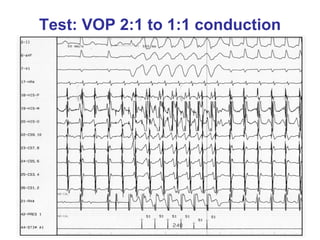
Ventricular Overdrive
 Pacing (VOP) (10-40 ms
shorter than tachycardia)
       during SVT
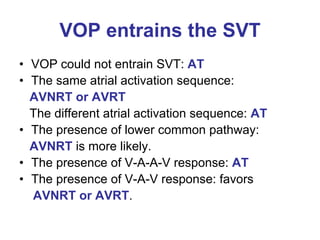
VOP entrains the SVT
• VOP could not entrain SVT: AT
• The same atrial activation sequence:
  AVNRT or AVRT
  The different atrial activation sequence: AT
• The presence of lower common pathway:
  AVNRT is more likely.
• The presence of V-A-A-V response: AT
• The presence of V-A-V response: favors
  AVNRT or AVRT.
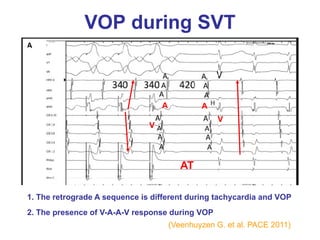
VOP during SVT


                                   A           A
                                                   V
                               V


                                          AT

1. The retrograde A sequence is different during tachycardia and VOP
2. The presence of V-A-A-V response during VOP
                                       (Veenhuyzen G. et al. PACE 2011)
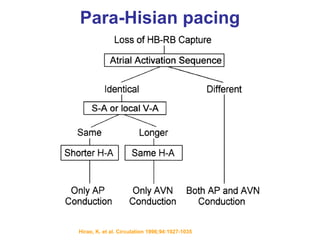
Para-Hisian pacing


Hirao, K. et al. Circulation 1996;94:1027-1035
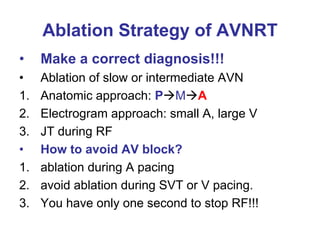
Ablation Strategy of AVNRT
•    Make a correct diagnosis!!!
•    Ablation of slow or intermediate AVN
1.   Anatomic approach: P M A
2.   Electrogram approach: small A, large V
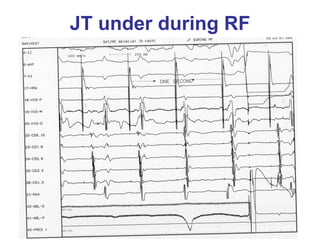
3.   JT during RF
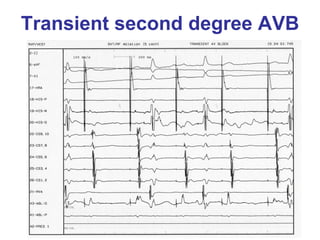
•    How to avoid AV block?
1.   ablation during A pacing
2.   avoid ablation during SVT or V pacing.
3.   You have only one second to stop RF!!!
JT under during RF
Transient second degree AVB
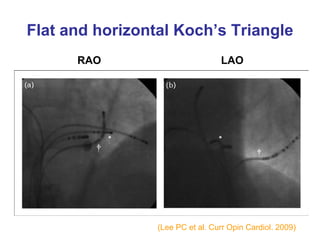
Flat and horizontal Koch’s Triangle
      RAO                         LAO


                 (Lee PC et al. Curr Opin Cardiol. 2009)
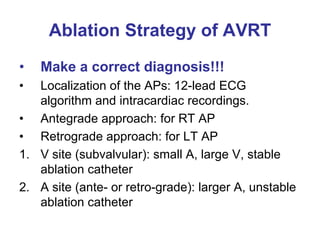
Ablation Strategy of AVRT
•   Make a correct diagnosis!!!
•  Localization of the APs: 12-lead ECG
   algorithm and intracardiac recordings.
• Antegrade approach: for RT AP
• Retrograde approach: for LT AP
1. V site (subvalvular): small A, large V, stable
   ablation catheter
2. A site (ante- or retro-grade): larger A, unstable
   ablation catheter
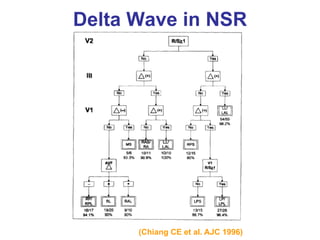
Delta Wave in NSR


      (Chiang CE et al. AJC 1996)
What’s on the other side
   背面是啥米碗糕
這是真的呀
Cases Discussion
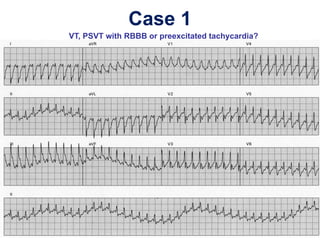
Case 1
VT, PSVT with RBBB or preexcitated tachycardia?
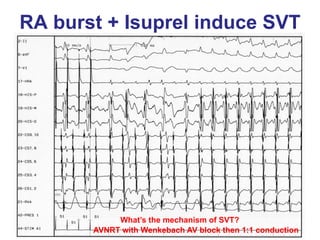
RA burst + Isuprel induce SVT


            What’s the mechanism of SVT?
       AVNRT with Wenkebach AV block then 1:1 conduction
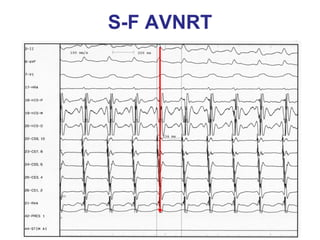
S-F AVNRT
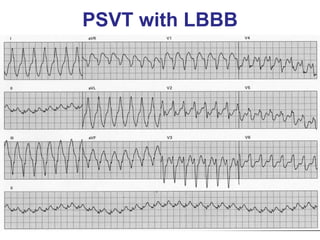
PSVT with LBBB
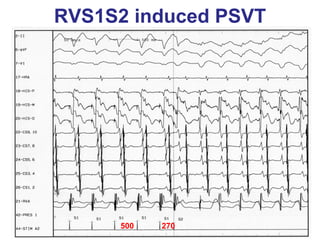
RVS1S2 induced PSVT


     500   270
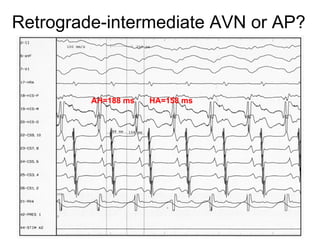
Retrograde-intermediate AVN or AP?


         AH=188 ms   HA=158 ms
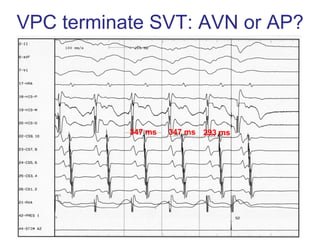
VPC terminate SVT: AVN or AP?


           347 ms   347 ms 293 ms
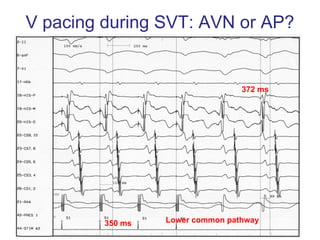
V pacing during SVT: AVN or AP?


                                  372 ms


         350 ms   Lower common pathway
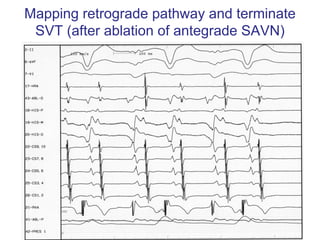
Mapping retrograde pathway and terminate
 SVT (after ablation of antegrade SAVN)
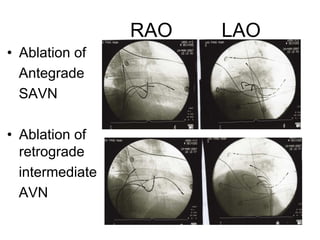
RAO   LAO
• Ablation of
  Antegrade
  SAVN

• Ablation of
  retrograde
  intermediate
  AVN
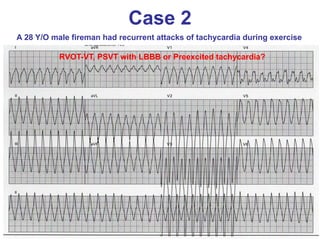
Case 2
A 28 Y/O male fireman had recurrent attacks of tachycardia during exercise

           RVOT-VT, PSVT with LBBB or Preexcited tachycardia?
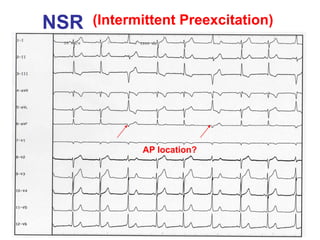
NSR   (Intermittent Preexcitation)


             AP location?
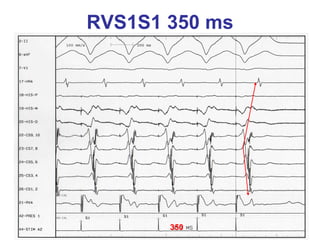
RVS1S1 350 ms


       350
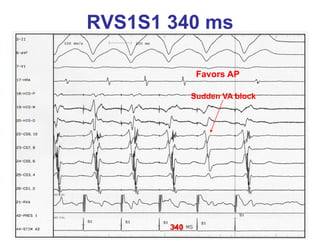
RVS1S1 340 ms

              Favors AP

             Sudden VA block


       340
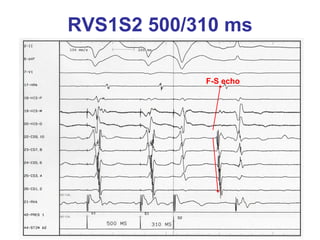
RVS1S2 500/310 ms

            F-S echo
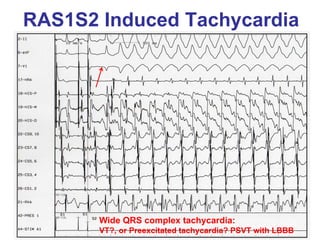
RAS1S2 Induced Tachycardia


       Wide QRS complex tachycardia:
       VT?, or Preexcitated tachycardia? PSVT with LBBB
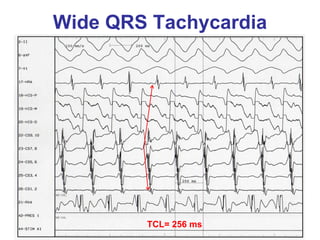
Wide QRS Tachycardia


        TCL= 256 ms
Question?
• What’s the mechanism of Wide QRS
  complex tachycardia?
  VT? Preexcitated tachycardia? PSVT with
  LBBB? PSVT with LBBB
• What’s the next step to D.D?
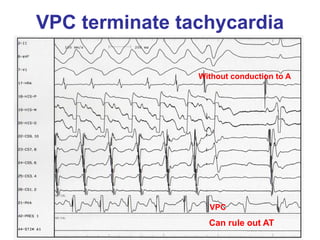
VPC terminate tachycardia

                Without conduction to A


                  VPC
                  Can rule out AT
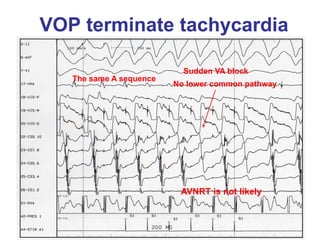
VOP terminate tachycardia

                           Sudden VA block
   The same A sequence
                         No lower common pathway


                          AVNRT is not likely
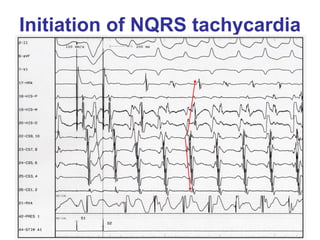
Initiation of NQRS tachycardia
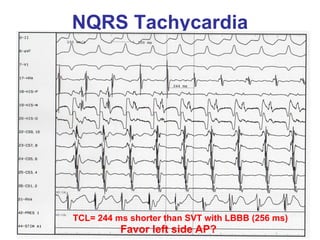
NQRS Tachycardia


TCL= 244 ms shorter than SVT with LBBB (256 ms)
          Favor left side AP?
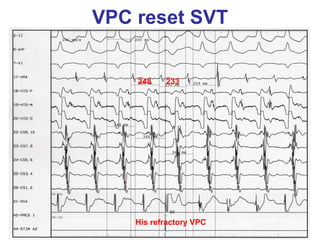
VPC reset SVT


    248    233


    His refractory VPC
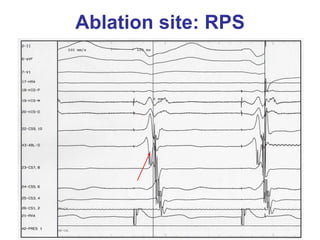
Ablation site: RPS
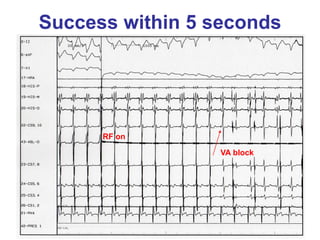
Success within 5 seconds


      RF on

                 VA block
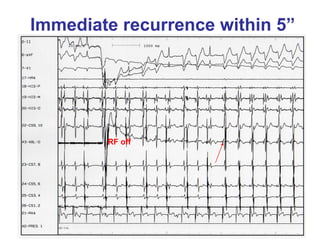
Immediate recurrence within 5”


        RF off
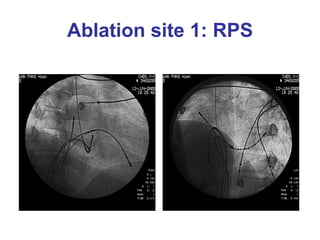
Ablation site 1: RPS
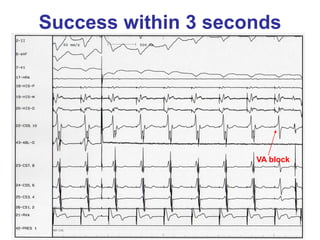
Success within 3 seconds


                     VA block
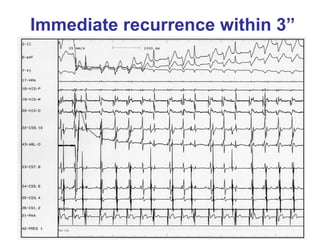
Immediate recurrence within 3”
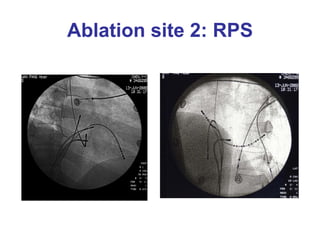
Ablation site 2: RPS
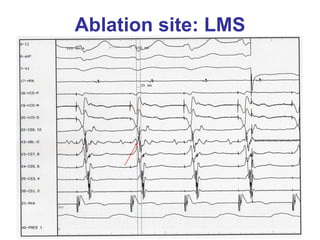
Ablation site: LMS
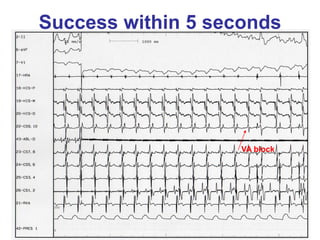
Success within 5 seconds


                    VA block
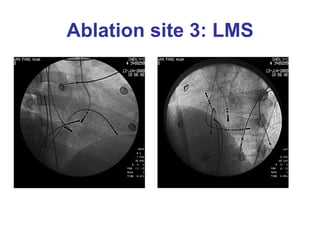
Ablation site 3: LMS
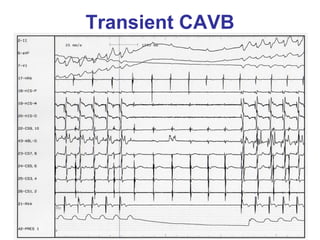
Transient CAVB
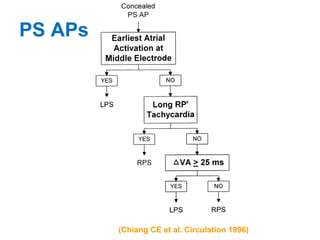
PS APs


         (Chiang CE et al. Circulation 1996)
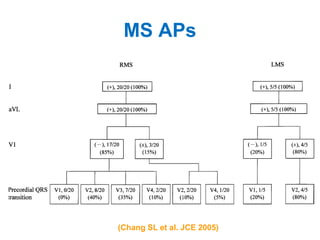
MS APs


(Chang SL et al. JCE 2005)
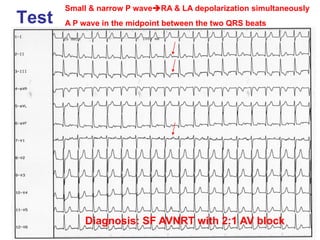
Small & narrow P wave   RA & LA depolarization simultaneously
Test   A P wave in the midpoint between the two QRS beats


            Diagnosis: SF AVNRT with 2:1 AV block
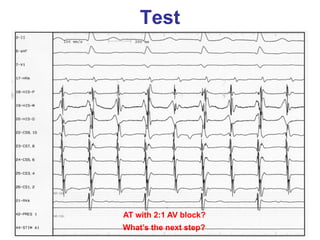
Test


AT with 2:1 AV block?
What’s the next step?
Test: VOP 2:1 to 1:1 conduction
謝謝聆聽
敬請指教

Differentiation between AVNRT and AVRT_advanced lecture