Hany S. Abed
B . P h a r m a c y , M B B S , P h D , I B H R E C e r t i f i e d E P a n d C a r d i a c D e v i c e s S p e c i a l i s t
C l i n i c a l C a r d i a c E l e c t r o p h y s i o l o g y F e l l o w L o y o l a U n i v e r s i t y M e d i c a l C e n t e r
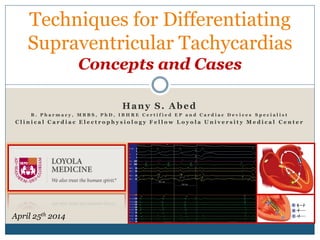
Techniques for Differentiating
Supraventricular Tachycardias
Concepts and Cases
April 25th 2014
Outline
 Induction of tachycardia
 Baseline tachycardia features
 Diagnostic maneuvers during tachycardia
 Diagnostic maneuvers in sinus rhythm after
tachycardia termination
Induction of Tachycardia
 Initiation by AES or atrial pacing
 Requirement of AV conduction delay
 Warm-up
 VA interval
 Initiation by VES or ventricular pacing
 HA interval
Initiation by AES or Atrial Pacing:
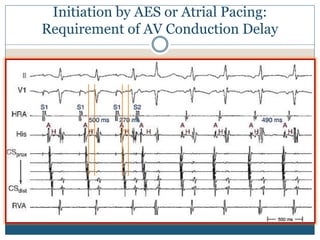
Requirement of AV Conduction Delay
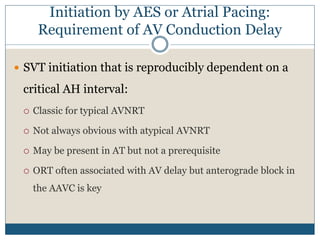
 SVT initiation that is reproducibly dependent on a
critical AH interval:
 Classic for typical AVNRT
 Not always obvious with atypical AVNRT
 May be present in AT but not a prerequisite
 ORT often associated with AV delay but anterograde block in
the AAVC is key
Initiation by AES or Atrial Pacing:
Requirement of AV Conduction Delay
Initiation by AES or Atrial Pacing
 Warm-up
 Characteristic but not exclusive of automatic AT
 VA linking at induction
 Compare VA interval of first tachycardia beat to the rest of SVT
 If reproducibly identical, AT is very unlikely
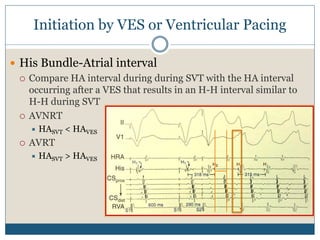
Initiation by VES or Ventricular Pacing
 His Bundle-Atrial interval
 Compare HA interval during during SVT with the HA interval
occurring after a VES that results in an H-H interval similar to
H-H during SVT
 AVNRT
 HASVT < HAVES
 AVRT
 HASVT > HAVES
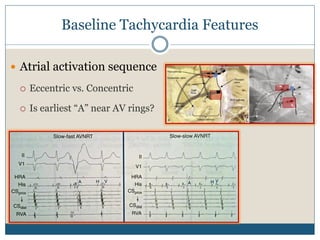
Baseline Tachycardia Features
 Atrial activation sequence
 Eccentric vs. Concentric
 Is earliest “A” near AV rings?
Baseline Tachycardia Features:
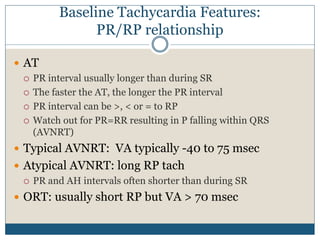
PR/RP relationship
 AT
 PR interval usually longer than during SR
 The faster the AT, the longer the PR interval
 PR interval can be >, < or = to RP
 Watch out for PR=RR resulting in P falling within QRS
(AVNRT)
 Typical AVNRT: VA typically -40 to 75 msec
 Atypical AVNRT: long RP tach
 PR and AH intervals often shorter than during SR
 ORT: usually short RP but VA > 70 msec
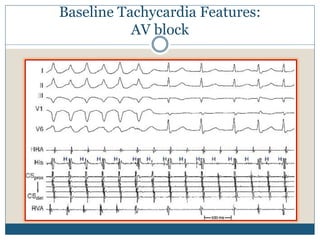
Baseline Tachycardia Features:
AV block
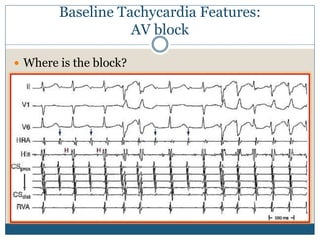
Baseline Tachycardia Features:
AV block
 Where is the block?
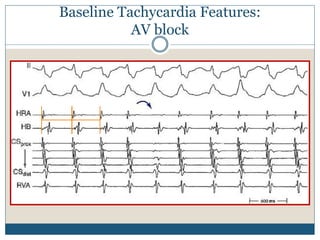
Baseline Tachycardia Features:
AV block
Baseline Tachycardia Features:
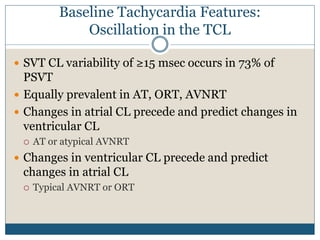
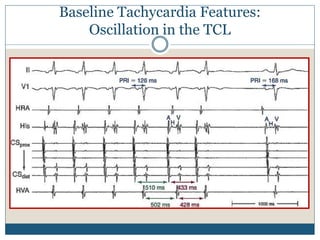
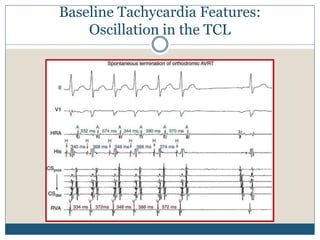
Oscillation in the TCL
 SVT CL variability of ≥15 msec occurs in 73% of
PSVT
 Equally prevalent in AT, ORT, AVNRT
 Changes in atrial CL precede and predict changes in
ventricular CL
 AT or atypical AVNRT
 Changes in ventricular CL precede and predict
changes in atrial CL
 Typical AVNRT or ORT
Baseline Tachycardia Features:
Oscillation in the TCL
Baseline Tachycardia Features:
Oscillation in the TCL
Baseline Tachycardia Features:
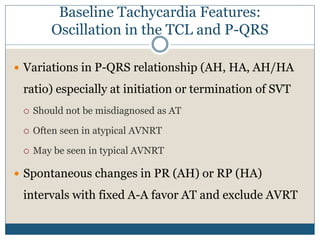
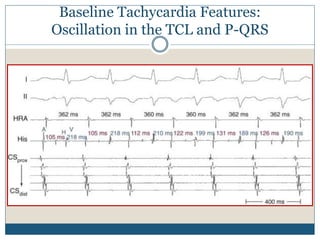
Oscillation in the TCL and P-QRS
 Variations in P-QRS relationship (AH, HA, AH/HA
ratio) especially at initiation or termination of SVT
 Should not be misdiagnosed as AT
 Often seen in atypical AVNRT
 May be seen in typical AVNRT
 Spontaneous changes in PR (AH) or RP (HA)
intervals with fixed A-A favor AT and exclude AVRT
Baseline Tachycardia Features:
Oscillation in the TCL and P-QRS
Baseline Tachycardia Features:
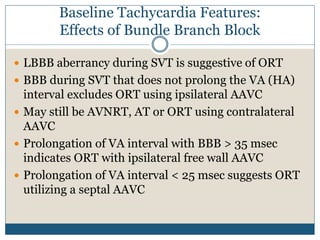
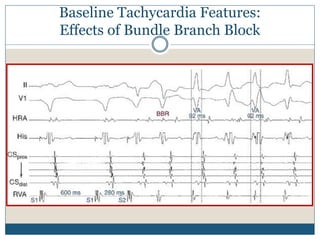
Effects of Bundle Branch Block
 LBBB aberrancy during SVT is suggestive of ORT
 BBB during SVT that does not prolong the VA (HA)
interval excludes ORT using ipsilateral AAVC
 May still be AVNRT, AT or ORT using contralateral
AAVC
 Prolongation of VA interval with BBB > 35 msec
indicates ORT with ipsilateral free wall AAVC
 Prolongation of VA interval < 25 msec suggests ORT
utilizing a septal AAVC
Baseline Tachycardia Features:
Effects of Bundle Branch Block
Outline
 Induction of tachycardia
 Baseline tachycardia features
 Diagnostic maneuvers during tachycardia
 Diagnostic maneuvers in sinus rhythm after
tachycardia termination
Diagnostic Maneuvers During Tachycardia
 AES during tachycardia
 Resetting
 Termination
 Atrial pacing during tachycardia
 Entrainment
 Δ AH
 Acceleration
 Overdrive suppression
 Termination
 Differential site atrial pacing
 VA interval in return cycle following cessation of pacing
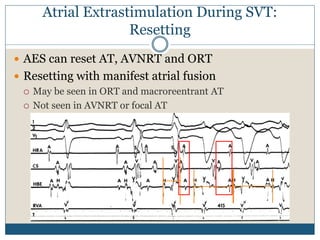
Atrial Extrastimulation During SVT:
Resetting
 AES can reset AT, AVNRT and ORT
 Resetting with manifest atrial fusion
 May be seen in ORT and macroreentrant AT
 Not seen in AVNRT or focal AT
Atrial Pacing During SVT:
Entrainment
 Overdrive atrial pacing can entrain macroreentrant
AT, AVNRT and ORT
 Automatic or triggered AT cannot be entrained
 Entrainment with manifest fusion in ORT or
macroreentrant AT (similar to AES concept)
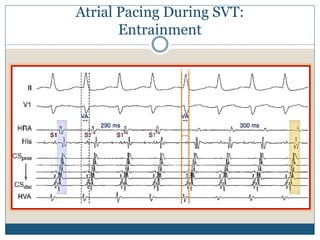
 VA linking
 Compare postpacing VA interval to SVT VA interval
Atrial Pacing During SVT:
Entrainment
Atrial Pacing During SVT:
Overdrive Suppression
 Return CL following the pacing train prolongs with
increasing duration and/or rate of pacing train
 Suggests automatic AT
 Entrained reentrant circuits have constant return
cycles regardless of the length of pacing drive
 Warm up may be seen in automatic AT after
cessation of atrial pacing
Atrial Pacing During SVT:
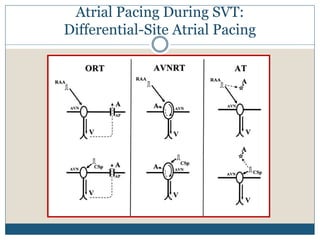
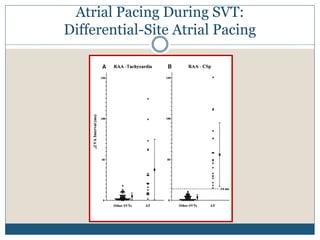
Differential-Site Atrial Pacing
Atrial Pacing During SVT:
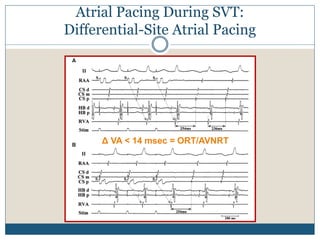
Differential-Site Atrial Pacing
Δ VA < 14 msec = ORT/AVNRT
Atrial Pacing During SVT:
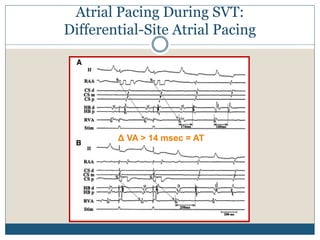
Differential-Site Atrial Pacing
Δ VA > 14 msec = AT
Atrial Pacing During SVT:
Differential-Site Atrial Pacing
Diagnostic Maneuvers During Tachycardia
 VES during tachycardia
 Resetting (His refractory VES, Preexcitation index)
 Termination
 Ventricular pacing during SVT
 Atrial activation sequence
 Entrainment
 AV vs AAV response
 Termination
VES During SVT:
His Refractory VES
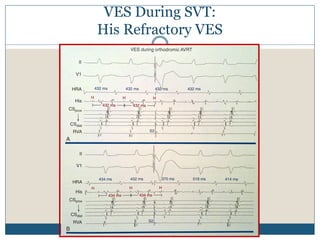
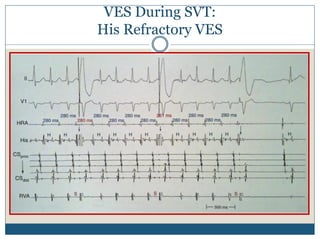
 VES delivered during SVT when the His potential is
already manifest or within 35 to 55 msec before the
time of the expected His potential
 Advancing the next A +/- termination of SVT
 Confirms presence of retrogradely conducting AAVC
 Excludes AVNRT but not AT with bystander AAVC
 Advancing the next A with activation sequence
identical to SVT favors ORT over AT with bystander
VES During SVT:
His Refractory VES
VES During SVT:
His Refractory VES
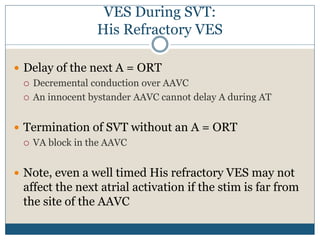
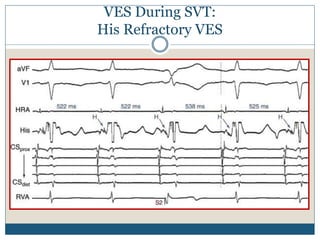
 Delay of the next A = ORT
 Decremental conduction over AAVC
 An innocent bystander AAVC cannot delay A during AT
 Termination of SVT without an A = ORT
 VA block in the AAVC
 Note, even a well timed His refractory VES may not
affect the next atrial activation if the stim is far from
the site of the AAVC
VES During SVT:
His Refractory VES
VES During SVT:
His Refractory VES
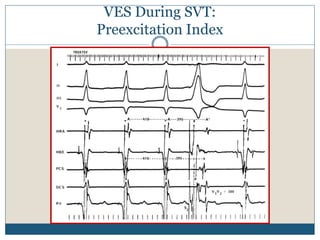
VES During SVT:
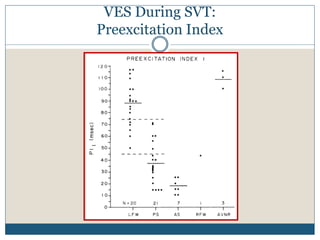
Preexcitation Index
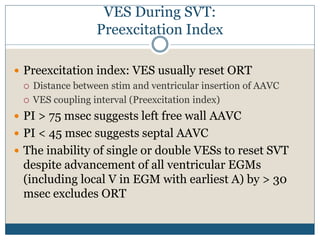
 Preexcitation index: VES usually reset ORT
 Distance between stim and ventricular insertion of AAVC
 VES coupling interval (Preexcitation index)
 PI > 75 msec suggests left free wall AAVC
 PI < 45 msec suggests septal AAVC
 The inability of single or double VESs to reset SVT
despite advancement of all ventricular EGMs
(including local V in EGM with earliest A) by > 30
msec excludes ORT
VES During SVT:
Preexcitation Index
VES During SVT:
Preexcitation Index
 AVNRT or ORT
 Ventricular pacing during AVNRT and ORT reaches the atrium
over the tachycardia retrograde limb
 Atrial activation sequence during SVT = Retrograde atrial
activation with V pacing during SVT
 AT
 Atrial activation during AT ≠ retrograde atrial activation with
V pacing
 Pitfall: AT originating close to AVJ
 Beware bystander AAVC with retrograde conduction
resulting in retrograde atrial activation during
V pacing ≠ SVT even if due to AVNRT or ORT
Ventricular Pacing During SVT:
Atrial Activation Sequence
Ventricular Pacing During SVT:
Entrainment
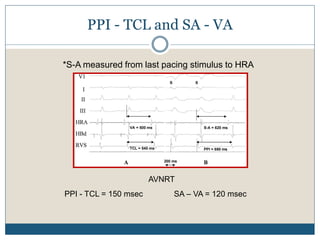
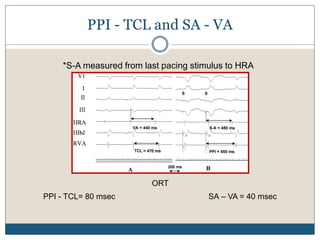
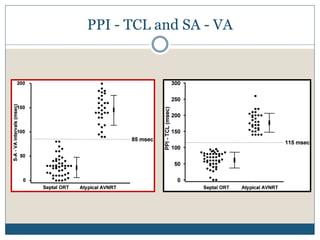
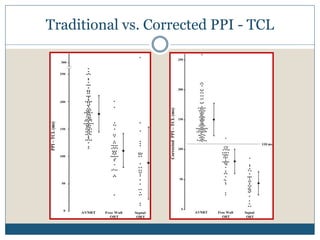
 PPI – TCL and SA – VA
 Original paper evaluated 30 patients with atypical
AVNRT and 44 patients with ORT using a septal
AAVC
 Same criteria apply to typical AVNRT
 For borderline values pace RV base instead of apex
 PPI-TCL will be exaggerated in AVNRT (farther from circuit)
 No significant change in ORT (still in the circuit for septal
AAVCs)
PPI - TCL and SA - VA
AVNRT
PPI - TCL = 150 msec SA – VA = 120 msec
*S-A measured from last pacing stimulus to HRA
PPI - TCL and SA - VA
ORT
PPI - TCL= 80 msec SA – VA = 40 msec
*S-A measured from last pacing stimulus to HRA
PPI - TCL and SA - VA
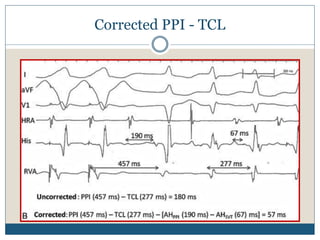
Corrected PPI - TCL
Traditional vs. Corrected PPI - TCL
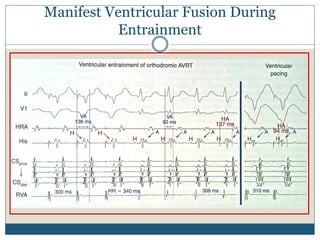
Manifest Ventricular Fusion During
Entrainment
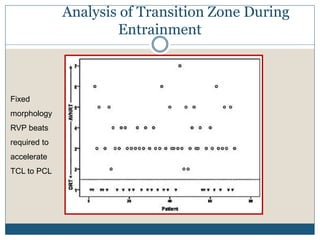
Analysis of Transition Zone During
Entrainment
 Not dependent on tachycardia continuation after
RVP
 His bundle recording is unnecessary
 AVNRT was identified with PPV and NPV of 100%
using criteria of > 1 QRS of fixed morphology to
accelerate TCL to PCL
 A cut-off of ≤ 1 QRS of fixed morphology resulting in
acceleration of TCL to PCL had a PPV and NPV of
100% for identifying ORT
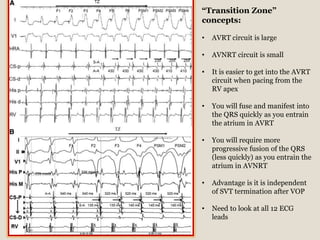
“Transition Zone”
concepts:
• AVRT circuit is large
• AVNRT circuit is small
• It is easier to get into the AVRT
circuit when pacing from the
RV apex
• You will fuse and manifest into
the QRS quickly as you entrain
the atrium in AVRT
• You will require more
progressive fusion of the QRS
(less quickly) as you entrain the
atrium in AVNRT
• Advantage is it is independent
of SVT termination after VOP
• Need to look at all 12 ECG
leads
Fixed
morphology
RVP beats
required to
accelerate
TCL to PCL
Analysis of Transition Zone During
Entrainment
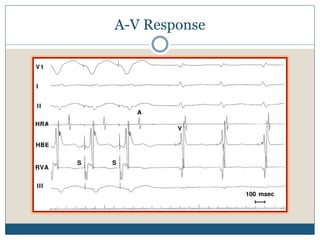
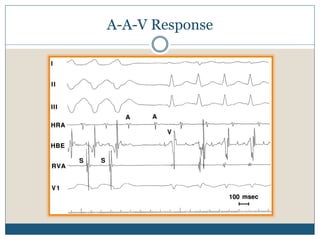
Ventricular Pacing During SVT:
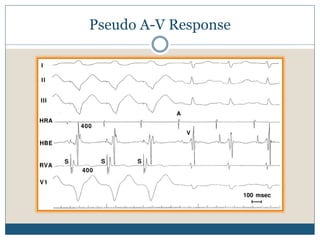
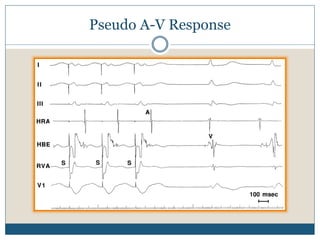
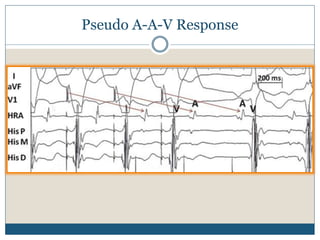
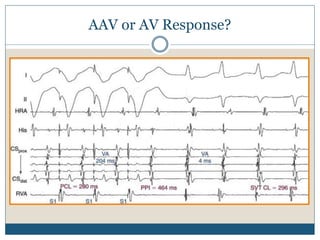
A-V vs. A-A-V Response
 A-V = AVNRT or ORT
 Antegrade limb not refractory so able to conduct to V
 A-A-V = AT
 Antegrade limb (AVN) refractory since just used retrograde
 Must confirm entrrainment before applying
 Pseudo A-V and Pseudo A-A-V
A-V Response
A-A-V Response
Pseudo A-V Response
Pseudo A-V Response
Pseudo A-A-V Response
AAV or AV Response?
Diagnostic Maneuvers in NSR After SVT
Termination
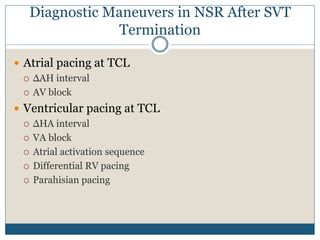
 Atrial pacing at TCL
 ΔAH interval
 AV block
 Ventricular pacing at TCL
 ΔHA interval
 VA block
 Atrial activation sequence
 Differential RV pacing
 Parahisian pacing
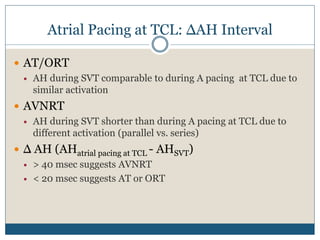
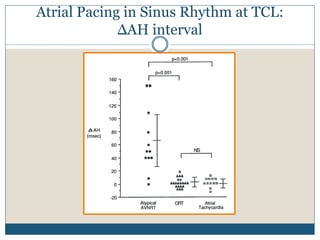
Atrial Pacing at TCL: ΔAH Interval
 AT/ORT
 AH during SVT comparable to during A pacing at TCL due to
similar activation
 AVNRT
 AH during SVT shorter than during A pacing at TCL due to
different activation (parallel vs. series)
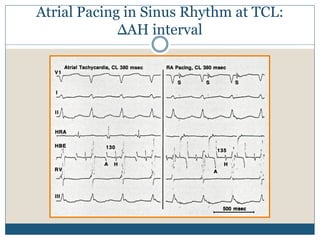
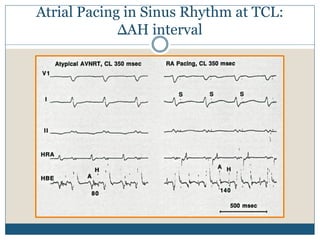
 Δ AH (AHatrial pacing at TCL - AHSVT)
 > 40 msec suggests AVNRT
 < 20 msec suggests AT or ORT
Atrial Pacing in Sinus Rhythm at TCL:
ΔAH interval
Atrial Pacing in Sinus Rhythm at TCL:
ΔAH interval
Atrial Pacing in Sinus Rhythm at TCL:
ΔAH interval
Atrial Pacing in Sinus Rhythm at TCL:
AV block
 AT/ORT
 Atrial pacing at the TCL should result in 1:1 AV conduction
 Should test shortly after SVT termination to maintain similar
autonomic tone
 The development of AV block with atrial pacing at
TCL is consistent with AVNRT
 Upper common pathway block
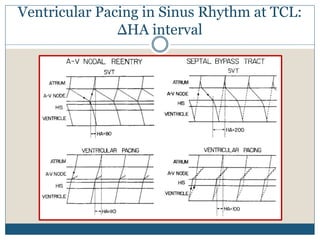
 AVNRT
 HA activated in parallel during SVT and in series during
ventricular pacing
 HA during SVT shorter than during ventricular pacing at TCL
 ORT
 HA activated in series during SVT and in parallel during
ventricular pacing
 HA during SVT is longer than during ventricular pacing at TCL
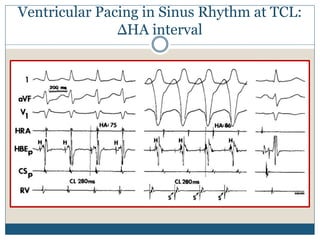
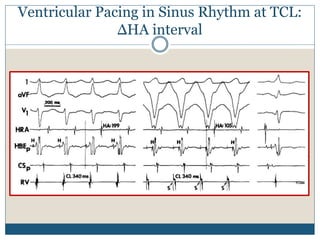
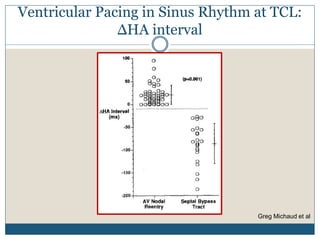
 Δ HA (HAV pacing at TCL – HASVT) more negative (<)
than -10 msec = ORT
 Δ HA > -10 msec = AVNRT
Ventricular Pacing in Sinus Rhythm at TCL:
ΔHA interval
Ventricular Pacing in Sinus Rhythm at TCL:
ΔHA interval
Ventricular Pacing in Sinus Rhythm at TCL:
ΔHA interval
Ventricular Pacing in Sinus Rhythm at TCL:
ΔHA interval
Ventricular Pacing in Sinus Rhythm at TCL:
ΔHA interval
Greg Michaud et al
Ventricular Pacing in Sinus Rhythm at TCL:
VA Block
 VA block during ventricular pacing makes ORT with
a fast retrograde AAVC unlikely
 More likely in setting of VA block
 AT
 AVNRT with lower common pathway block
 PJRT
Ventricular Pacing in Sinus Rhythm at TCL:
Retrograde Atrial Activation Sequence
 AVNRT
 Atrial activation sequence usually similar during AVNRT and
ventricular pacing in NSR
 ORT
 Retrograde VA conduction during ventricular pacing may proceed
over the AVN, the AAVC, or both
 Atrial activation sequence may be similar or different during
ORT and ventricular pacing in NSR
 AT
 Atrial activation during AT ≠ retrograde atrial activation with
V pacing
 Pitfall: AT originating close to AVJ
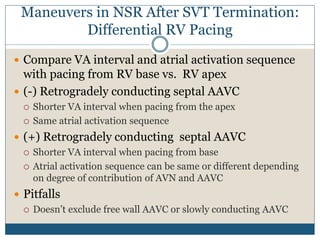
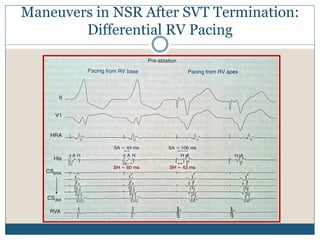
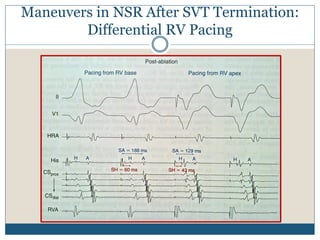
Maneuvers in NSR After SVT Termination:
Differential RV Pacing
 Compare VA interval and atrial activation sequence
with pacing from RV base vs. RV apex
 (-) Retrogradely conducting septal AAVC
 Shorter VA interval when pacing from the apex
 Same atrial activation sequence
 (+) Retrogradely conducting septal AAVC
 Shorter VA interval when pacing from base
 Atrial activation sequence can be same or different depending
on degree of contribution of AVN and AAVC
 Pitfalls
 Doesn’t exclude free wall AAVC or slowly conducting AAVC
Maneuvers in NSR After SVT Termination:
Differential RV Pacing
Maneuvers in NSR After SVT Termination:
Differential RV Pacing
2
Maneuvers in NSR After SVT Termination:
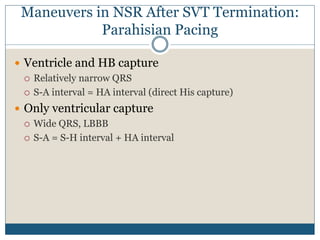
Parahisian Pacing
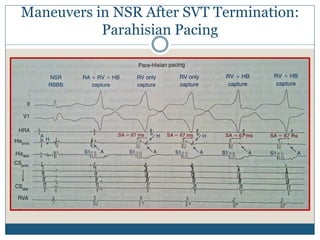
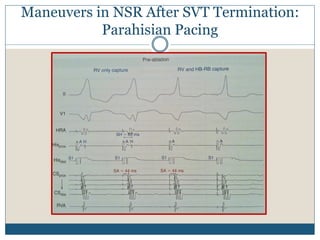
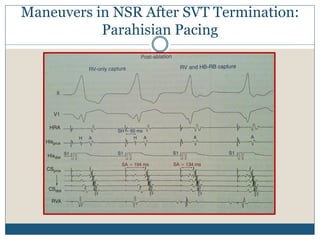
 Ventricle and HB capture
 Relatively narrow QRS
 S-A interval = HA interval (direct His capture)
 Only ventricular capture
 Wide QRS, LBBB
 S-A = S-H interval + HA interval
Maneuvers in NSR After SVT Termination:
Parahisian Pacing
Maneuvers in NSR After SVT Termination:
Parahisian Pacing
Maneuvers in NSR After SVT Termination:
Parahisian Pacing
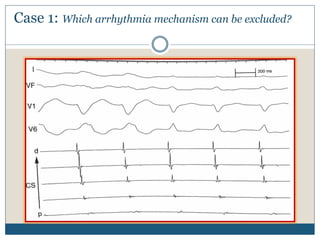
Case 1: Which arrhythmia mechanism can be excluded?
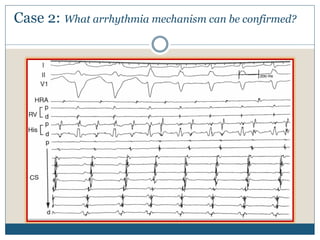
Case 2: What arrhythmia mechanism can be confirmed?
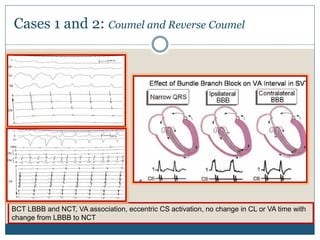
Cases 1 and 2: Coumel and Reverse Coumel
BCT LBBB and NCT, VA association, eccentric CS activation, no change in CL or VA time with
change from LBBB to NCT
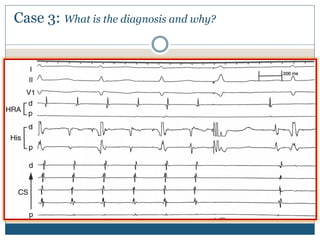
Case 3: What is the diagnosis and why?
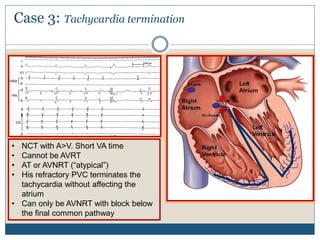
Case 3: Tachycardia termination
• NCT with A>V. Short VA time
• Cannot be AVRT
• AT or AVNRT (“atypical”)
• His refractory PVC terminates the
tachycardia without affecting the
atrium
• Can only be AVNRT with block below
the final common pathway
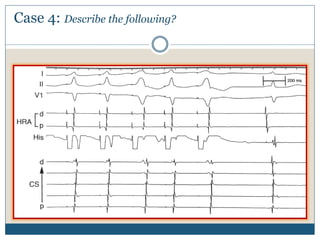
Case 4: Describe the following?
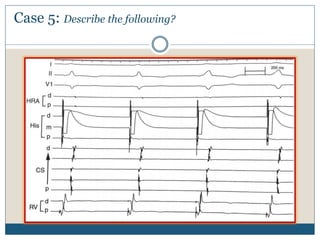
Case 5: Describe the following?
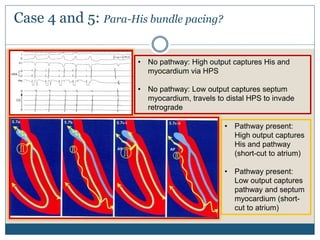
Case 4 and 5: Para-His bundle pacing?
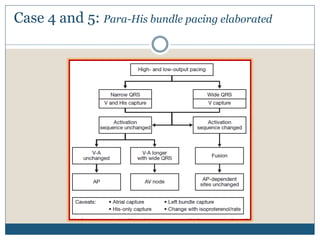
• No pathway: High output captures His and
myocardium via HPS
• No pathway: Low output captures septum
myocardium, travels to distal HPS to invade
retrograde
• Pathway present:
High output captures
His and pathway
(short-cut to atrium)
• Pathway present:
Low output captures
pathway and septum
myocardium (short-
cut to atrium)
Case 4 and 5: Para-His bundle pacing elaborated
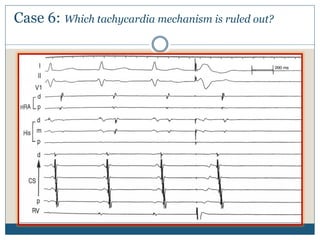
Case 6: Which tachycardia mechanism is ruled out?
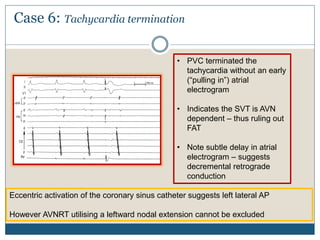
Case 6: Tachycardia termination
Eccentric activation of the coronary sinus catheter suggests left lateral AP
However AVNRT utilising a leftward nodal extension cannot be excluded
• PVC terminated the
tachycardia without an early
(“pulling in”) atrial
electrogram
• Indicates the SVT is AVN
dependent – thus ruling out
FAT
• Note subtle delay in atrial
electrogram – suggests
decremental retrograde
conduction
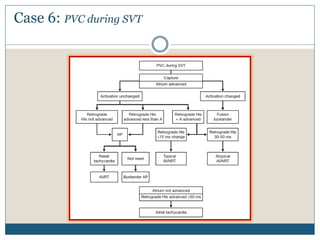
Case 6: PVC during SVT
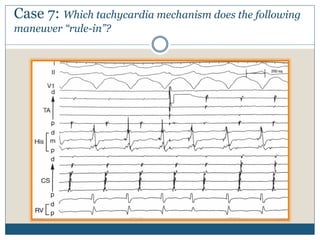
Case 7: Which tachycardia mechanism does the following
maneuver “rule-in”?
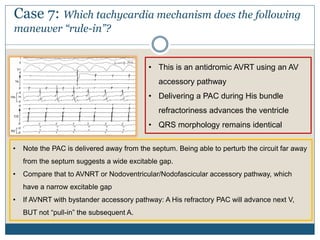
Case 7: Which tachycardia mechanism does the following
maneuver “rule-in”?
• Note the PAC is delivered away from the septum. Being able to perturb the circuit far away
from the septum suggests a wide excitable gap.
• Compare that to AVNRT or Nodoventricular/Nodofascicular accessory pathway, which
have a narrow excitable gap
• If AVNRT with bystander accessory pathway: A His refractory PAC will advance next V,
BUT not “pull-in” the subsequent A.
• This is an antidromic AVRT using an AV
accessory pathway
• Delivering a PAC during His bundle
refractoriness advances the ventricle
• QRS morphology remains identical
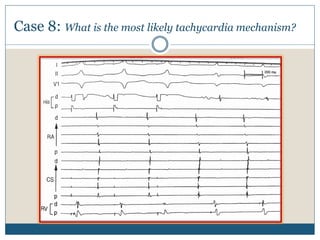
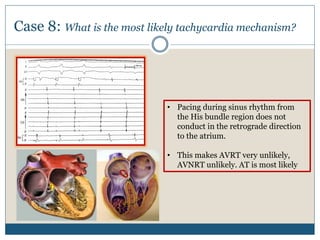
Case 8: What is the most likely tachycardia mechanism?
• Pacing during sinus rhythm from
the His bundle region does not
conduct in the retrograde direction
to the atrium.
• This makes AVRT very unlikely,
AVNRT unlikely. AT is most likely
The End
Hany S. Abed
B . P h a r m a c y , M B B S , P h D , I B H R E C e r t i f i e d E P a n d C a r d i a c D e v i c e s S p e c i a l i s t
C l i n i c a l C a r d i a c E l e c t r o p h y s i o l o g y F e l l o w
L o y o l a U n i v e r s i t y M e d i c a l C e n t e r
A p r i l 2 0 1 4

Svt maneuvers hany abed

  • 1.
    Hany S. Abed B. P h a r m a c y , M B B S , P h D , I B H R E C e r t i f i e d E P a n d C a r d i a c D e v i c e s S p e c i a l i s t C l i n i c a l C a r d i a c E l e c t r o p h y s i o l o g y F e l l o w L o y o l a U n i v e r s i t y M e d i c a l C e n t e r Techniques for Differentiating Supraventricular Tachycardias Concepts and Cases April 25th 2014
  • 2.
    Outline  Induction oftachycardia  Baseline tachycardia features  Diagnostic maneuvers during tachycardia  Diagnostic maneuvers in sinus rhythm after tachycardia termination
  • 3.
    Induction of Tachycardia Initiation by AES or atrial pacing  Requirement of AV conduction delay  Warm-up  VA interval  Initiation by VES or ventricular pacing  HA interval
  • 4.
    Initiation by AESor Atrial Pacing: Requirement of AV Conduction Delay  SVT initiation that is reproducibly dependent on a critical AH interval:  Classic for typical AVNRT  Not always obvious with atypical AVNRT  May be present in AT but not a prerequisite  ORT often associated with AV delay but anterograde block in the AAVC is key
  • 5.
    Initiation by AESor Atrial Pacing: Requirement of AV Conduction Delay
  • 6.
    Initiation by AESor Atrial Pacing  Warm-up  Characteristic but not exclusive of automatic AT  VA linking at induction  Compare VA interval of first tachycardia beat to the rest of SVT  If reproducibly identical, AT is very unlikely
  • 7.
    Initiation by VESor Ventricular Pacing  His Bundle-Atrial interval  Compare HA interval during during SVT with the HA interval occurring after a VES that results in an H-H interval similar to H-H during SVT  AVNRT  HASVT < HAVES  AVRT  HASVT > HAVES
  • 8.
    Baseline Tachycardia Features Atrial activation sequence  Eccentric vs. Concentric  Is earliest “A” near AV rings?
  • 9.
    Baseline Tachycardia Features: PR/RPrelationship  AT  PR interval usually longer than during SR  The faster the AT, the longer the PR interval  PR interval can be >, < or = to RP  Watch out for PR=RR resulting in P falling within QRS (AVNRT)  Typical AVNRT: VA typically -40 to 75 msec  Atypical AVNRT: long RP tach  PR and AH intervals often shorter than during SR  ORT: usually short RP but VA > 70 msec
  • 10.
  • 11.
    Baseline Tachycardia Features: AVblock  Where is the block?
  • 12.
  • 13.
    Baseline Tachycardia Features: Oscillationin the TCL  SVT CL variability of ≥15 msec occurs in 73% of PSVT  Equally prevalent in AT, ORT, AVNRT  Changes in atrial CL precede and predict changes in ventricular CL  AT or atypical AVNRT  Changes in ventricular CL precede and predict changes in atrial CL  Typical AVNRT or ORT
  • 14.
  • 15.
  • 16.
    Baseline Tachycardia Features: Oscillationin the TCL and P-QRS  Variations in P-QRS relationship (AH, HA, AH/HA ratio) especially at initiation or termination of SVT  Should not be misdiagnosed as AT  Often seen in atypical AVNRT  May be seen in typical AVNRT  Spontaneous changes in PR (AH) or RP (HA) intervals with fixed A-A favor AT and exclude AVRT
  • 17.
  • 18.
    Baseline Tachycardia Features: Effectsof Bundle Branch Block  LBBB aberrancy during SVT is suggestive of ORT  BBB during SVT that does not prolong the VA (HA) interval excludes ORT using ipsilateral AAVC  May still be AVNRT, AT or ORT using contralateral AAVC  Prolongation of VA interval with BBB > 35 msec indicates ORT with ipsilateral free wall AAVC  Prolongation of VA interval < 25 msec suggests ORT utilizing a septal AAVC
  • 19.
  • 20.
    Outline  Induction oftachycardia  Baseline tachycardia features  Diagnostic maneuvers during tachycardia  Diagnostic maneuvers in sinus rhythm after tachycardia termination
  • 21.
    Diagnostic Maneuvers DuringTachycardia  AES during tachycardia  Resetting  Termination  Atrial pacing during tachycardia  Entrainment  Δ AH  Acceleration  Overdrive suppression  Termination  Differential site atrial pacing  VA interval in return cycle following cessation of pacing
  • 22.
    Atrial Extrastimulation DuringSVT: Resetting  AES can reset AT, AVNRT and ORT  Resetting with manifest atrial fusion  May be seen in ORT and macroreentrant AT  Not seen in AVNRT or focal AT
  • 23.
    Atrial Pacing DuringSVT: Entrainment  Overdrive atrial pacing can entrain macroreentrant AT, AVNRT and ORT  Automatic or triggered AT cannot be entrained  Entrainment with manifest fusion in ORT or macroreentrant AT (similar to AES concept)  VA linking  Compare postpacing VA interval to SVT VA interval
  • 24.
    Atrial Pacing DuringSVT: Entrainment
  • 25.
    Atrial Pacing DuringSVT: Overdrive Suppression  Return CL following the pacing train prolongs with increasing duration and/or rate of pacing train  Suggests automatic AT  Entrained reentrant circuits have constant return cycles regardless of the length of pacing drive  Warm up may be seen in automatic AT after cessation of atrial pacing
  • 26.
    Atrial Pacing DuringSVT: Differential-Site Atrial Pacing
  • 27.
    Atrial Pacing DuringSVT: Differential-Site Atrial Pacing Δ VA < 14 msec = ORT/AVNRT
  • 28.
    Atrial Pacing DuringSVT: Differential-Site Atrial Pacing Δ VA > 14 msec = AT
  • 29.
    Atrial Pacing DuringSVT: Differential-Site Atrial Pacing
  • 30.
    Diagnostic Maneuvers DuringTachycardia  VES during tachycardia  Resetting (His refractory VES, Preexcitation index)  Termination  Ventricular pacing during SVT  Atrial activation sequence  Entrainment  AV vs AAV response  Termination
  • 31.
    VES During SVT: HisRefractory VES  VES delivered during SVT when the His potential is already manifest or within 35 to 55 msec before the time of the expected His potential  Advancing the next A +/- termination of SVT  Confirms presence of retrogradely conducting AAVC  Excludes AVNRT but not AT with bystander AAVC  Advancing the next A with activation sequence identical to SVT favors ORT over AT with bystander
  • 32.
    VES During SVT: HisRefractory VES
  • 33.
    VES During SVT: HisRefractory VES  Delay of the next A = ORT  Decremental conduction over AAVC  An innocent bystander AAVC cannot delay A during AT  Termination of SVT without an A = ORT  VA block in the AAVC  Note, even a well timed His refractory VES may not affect the next atrial activation if the stim is far from the site of the AAVC
  • 34.
    VES During SVT: HisRefractory VES
  • 35.
    VES During SVT: HisRefractory VES
  • 36.
    VES During SVT: PreexcitationIndex  Preexcitation index: VES usually reset ORT  Distance between stim and ventricular insertion of AAVC  VES coupling interval (Preexcitation index)  PI > 75 msec suggests left free wall AAVC  PI < 45 msec suggests septal AAVC  The inability of single or double VESs to reset SVT despite advancement of all ventricular EGMs (including local V in EGM with earliest A) by > 30 msec excludes ORT
  • 37.
  • 38.
  • 39.
     AVNRT orORT  Ventricular pacing during AVNRT and ORT reaches the atrium over the tachycardia retrograde limb  Atrial activation sequence during SVT = Retrograde atrial activation with V pacing during SVT  AT  Atrial activation during AT ≠ retrograde atrial activation with V pacing  Pitfall: AT originating close to AVJ  Beware bystander AAVC with retrograde conduction resulting in retrograde atrial activation during V pacing ≠ SVT even if due to AVNRT or ORT Ventricular Pacing During SVT: Atrial Activation Sequence
  • 40.
    Ventricular Pacing DuringSVT: Entrainment  PPI – TCL and SA – VA  Original paper evaluated 30 patients with atypical AVNRT and 44 patients with ORT using a septal AAVC  Same criteria apply to typical AVNRT  For borderline values pace RV base instead of apex  PPI-TCL will be exaggerated in AVNRT (farther from circuit)  No significant change in ORT (still in the circuit for septal AAVCs)
  • 41.
    PPI - TCLand SA - VA AVNRT PPI - TCL = 150 msec SA – VA = 120 msec *S-A measured from last pacing stimulus to HRA
  • 42.
    PPI - TCLand SA - VA ORT PPI - TCL= 80 msec SA – VA = 40 msec *S-A measured from last pacing stimulus to HRA
  • 43.
    PPI - TCLand SA - VA
  • 44.
  • 45.
  • 46.
    Manifest Ventricular FusionDuring Entrainment
  • 47.
    Analysis of TransitionZone During Entrainment  Not dependent on tachycardia continuation after RVP  His bundle recording is unnecessary  AVNRT was identified with PPV and NPV of 100% using criteria of > 1 QRS of fixed morphology to accelerate TCL to PCL  A cut-off of ≤ 1 QRS of fixed morphology resulting in acceleration of TCL to PCL had a PPV and NPV of 100% for identifying ORT
  • 48.
    “Transition Zone” concepts: • AVRTcircuit is large • AVNRT circuit is small • It is easier to get into the AVRT circuit when pacing from the RV apex • You will fuse and manifest into the QRS quickly as you entrain the atrium in AVRT • You will require more progressive fusion of the QRS (less quickly) as you entrain the atrium in AVNRT • Advantage is it is independent of SVT termination after VOP • Need to look at all 12 ECG leads
  • 49.
    Fixed morphology RVP beats required to accelerate TCLto PCL Analysis of Transition Zone During Entrainment
  • 50.
    Ventricular Pacing DuringSVT: A-V vs. A-A-V Response  A-V = AVNRT or ORT  Antegrade limb not refractory so able to conduct to V  A-A-V = AT  Antegrade limb (AVN) refractory since just used retrograde  Must confirm entrrainment before applying  Pseudo A-V and Pseudo A-A-V
  • 51.
  • 52.
  • 53.
  • 54.
  • 55.
  • 56.
    AAV or AVResponse?
  • 57.
    Diagnostic Maneuvers inNSR After SVT Termination  Atrial pacing at TCL  ΔAH interval  AV block  Ventricular pacing at TCL  ΔHA interval  VA block  Atrial activation sequence  Differential RV pacing  Parahisian pacing
  • 58.
    Atrial Pacing atTCL: ΔAH Interval  AT/ORT  AH during SVT comparable to during A pacing at TCL due to similar activation  AVNRT  AH during SVT shorter than during A pacing at TCL due to different activation (parallel vs. series)  Δ AH (AHatrial pacing at TCL - AHSVT)  > 40 msec suggests AVNRT  < 20 msec suggests AT or ORT
  • 59.
    Atrial Pacing inSinus Rhythm at TCL: ΔAH interval
  • 60.
    Atrial Pacing inSinus Rhythm at TCL: ΔAH interval
  • 61.
    Atrial Pacing inSinus Rhythm at TCL: ΔAH interval
  • 62.
    Atrial Pacing inSinus Rhythm at TCL: AV block  AT/ORT  Atrial pacing at the TCL should result in 1:1 AV conduction  Should test shortly after SVT termination to maintain similar autonomic tone  The development of AV block with atrial pacing at TCL is consistent with AVNRT  Upper common pathway block
  • 63.
     AVNRT  HAactivated in parallel during SVT and in series during ventricular pacing  HA during SVT shorter than during ventricular pacing at TCL  ORT  HA activated in series during SVT and in parallel during ventricular pacing  HA during SVT is longer than during ventricular pacing at TCL  Δ HA (HAV pacing at TCL – HASVT) more negative (<) than -10 msec = ORT  Δ HA > -10 msec = AVNRT Ventricular Pacing in Sinus Rhythm at TCL: ΔHA interval
  • 64.
    Ventricular Pacing inSinus Rhythm at TCL: ΔHA interval
  • 65.
    Ventricular Pacing inSinus Rhythm at TCL: ΔHA interval
  • 66.
    Ventricular Pacing inSinus Rhythm at TCL: ΔHA interval
  • 67.
    Ventricular Pacing inSinus Rhythm at TCL: ΔHA interval Greg Michaud et al
  • 68.
    Ventricular Pacing inSinus Rhythm at TCL: VA Block  VA block during ventricular pacing makes ORT with a fast retrograde AAVC unlikely  More likely in setting of VA block  AT  AVNRT with lower common pathway block  PJRT
  • 69.
    Ventricular Pacing inSinus Rhythm at TCL: Retrograde Atrial Activation Sequence  AVNRT  Atrial activation sequence usually similar during AVNRT and ventricular pacing in NSR  ORT  Retrograde VA conduction during ventricular pacing may proceed over the AVN, the AAVC, or both  Atrial activation sequence may be similar or different during ORT and ventricular pacing in NSR  AT  Atrial activation during AT ≠ retrograde atrial activation with V pacing  Pitfall: AT originating close to AVJ
  • 70.
    Maneuvers in NSRAfter SVT Termination: Differential RV Pacing  Compare VA interval and atrial activation sequence with pacing from RV base vs. RV apex  (-) Retrogradely conducting septal AAVC  Shorter VA interval when pacing from the apex  Same atrial activation sequence  (+) Retrogradely conducting septal AAVC  Shorter VA interval when pacing from base  Atrial activation sequence can be same or different depending on degree of contribution of AVN and AAVC  Pitfalls  Doesn’t exclude free wall AAVC or slowly conducting AAVC
  • 71.
    Maneuvers in NSRAfter SVT Termination: Differential RV Pacing
  • 72.
    Maneuvers in NSRAfter SVT Termination: Differential RV Pacing 2
  • 73.
    Maneuvers in NSRAfter SVT Termination: Parahisian Pacing  Ventricle and HB capture  Relatively narrow QRS  S-A interval = HA interval (direct His capture)  Only ventricular capture  Wide QRS, LBBB  S-A = S-H interval + HA interval
  • 74.
    Maneuvers in NSRAfter SVT Termination: Parahisian Pacing
  • 75.
    Maneuvers in NSRAfter SVT Termination: Parahisian Pacing
  • 76.
    Maneuvers in NSRAfter SVT Termination: Parahisian Pacing
  • 77.
    Case 1: Whicharrhythmia mechanism can be excluded?
  • 78.
    Case 2: Whatarrhythmia mechanism can be confirmed?
  • 79.
    Cases 1 and2: Coumel and Reverse Coumel BCT LBBB and NCT, VA association, eccentric CS activation, no change in CL or VA time with change from LBBB to NCT
  • 80.
    Case 3: Whatis the diagnosis and why?
  • 81.
    Case 3: Tachycardiatermination • NCT with A>V. Short VA time • Cannot be AVRT • AT or AVNRT (“atypical”) • His refractory PVC terminates the tachycardia without affecting the atrium • Can only be AVNRT with block below the final common pathway
  • 82.
    Case 4: Describethe following?
  • 83.
    Case 5: Describethe following?
  • 84.
    Case 4 and5: Para-His bundle pacing? • No pathway: High output captures His and myocardium via HPS • No pathway: Low output captures septum myocardium, travels to distal HPS to invade retrograde • Pathway present: High output captures His and pathway (short-cut to atrium) • Pathway present: Low output captures pathway and septum myocardium (short- cut to atrium)
  • 85.
    Case 4 and5: Para-His bundle pacing elaborated
  • 86.
    Case 6: Whichtachycardia mechanism is ruled out?
  • 87.
    Case 6: Tachycardiatermination Eccentric activation of the coronary sinus catheter suggests left lateral AP However AVNRT utilising a leftward nodal extension cannot be excluded • PVC terminated the tachycardia without an early (“pulling in”) atrial electrogram • Indicates the SVT is AVN dependent – thus ruling out FAT • Note subtle delay in atrial electrogram – suggests decremental retrograde conduction
  • 88.
    Case 6: PVCduring SVT
  • 89.
    Case 7: Whichtachycardia mechanism does the following maneuver “rule-in”?
  • 90.
    Case 7: Whichtachycardia mechanism does the following maneuver “rule-in”? • Note the PAC is delivered away from the septum. Being able to perturb the circuit far away from the septum suggests a wide excitable gap. • Compare that to AVNRT or Nodoventricular/Nodofascicular accessory pathway, which have a narrow excitable gap • If AVNRT with bystander accessory pathway: A His refractory PAC will advance next V, BUT not “pull-in” the subsequent A. • This is an antidromic AVRT using an AV accessory pathway • Delivering a PAC during His bundle refractoriness advances the ventricle • QRS morphology remains identical
  • 91.
    Case 8: Whatis the most likely tachycardia mechanism?
  • 92.
    Case 8: Whatis the most likely tachycardia mechanism? • Pacing during sinus rhythm from the His bundle region does not conduct in the retrograde direction to the atrium. • This makes AVRT very unlikely, AVNRT unlikely. AT is most likely
  • 93.
    The End Hany S.Abed B . P h a r m a c y , M B B S , P h D , I B H R E C e r t i f i e d E P a n d C a r d i a c D e v i c e s S p e c i a l i s t C l i n i c a l C a r d i a c E l e c t r o p h y s i o l o g y F e l l o w L o y o l a U n i v e r s i t y M e d i c a l C e n t e r A p r i l 2 0 1 4