Chapter 2Chapter 2
Experimental
Design
By Kathy Fritz
Plano West High School
Definitions:
1) Observational study -
observe outcomes without
imposing any treatment
2) Experiment - actively impose
some treatment in order to
observe the response
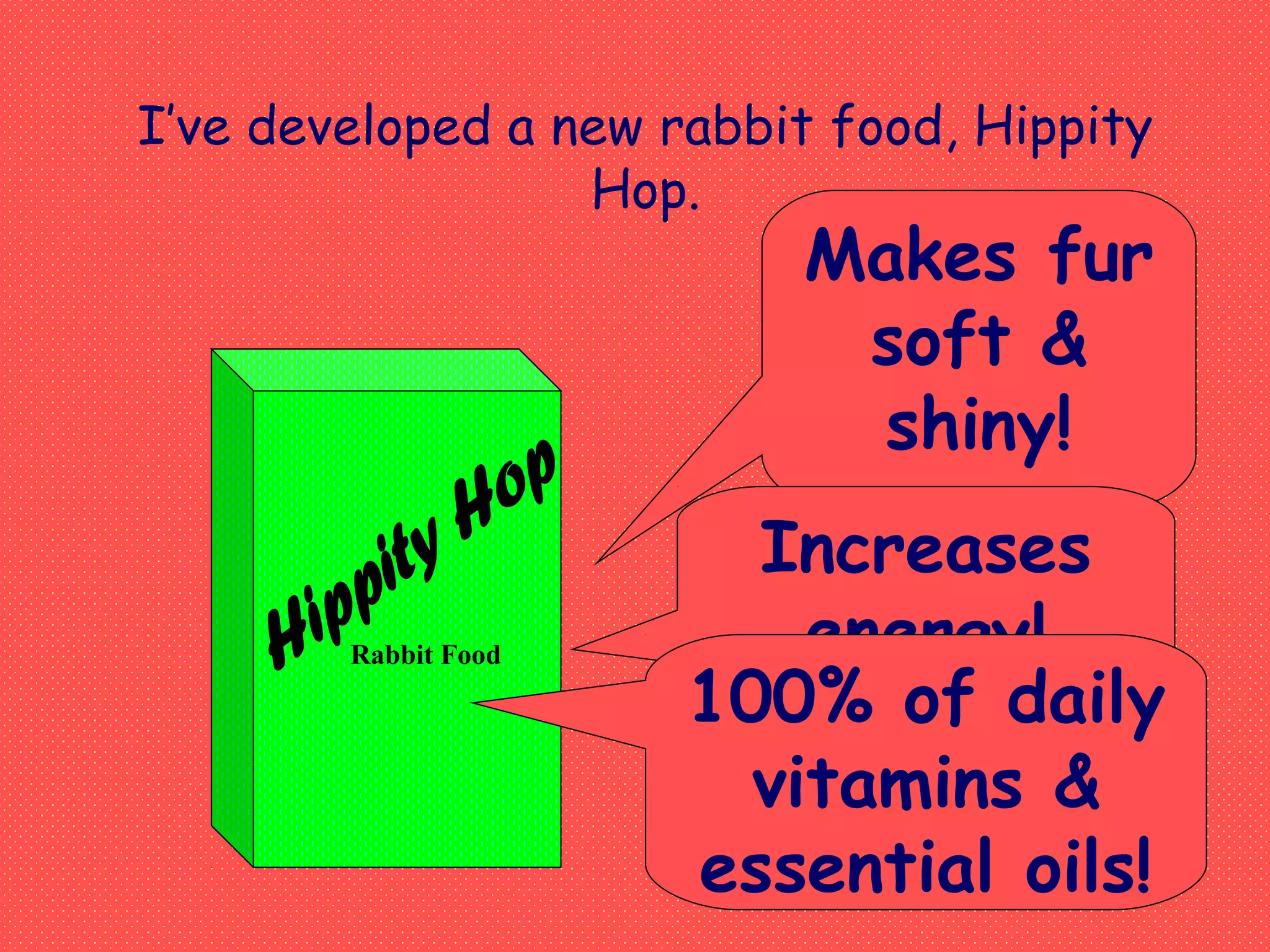
I’ve developed a new rabbit food, Hippity
Hop.
Rabbit Food
Makes fur
soft &
shiny!
Increases
energy!
100% of daily
vitamins &
essential oils!
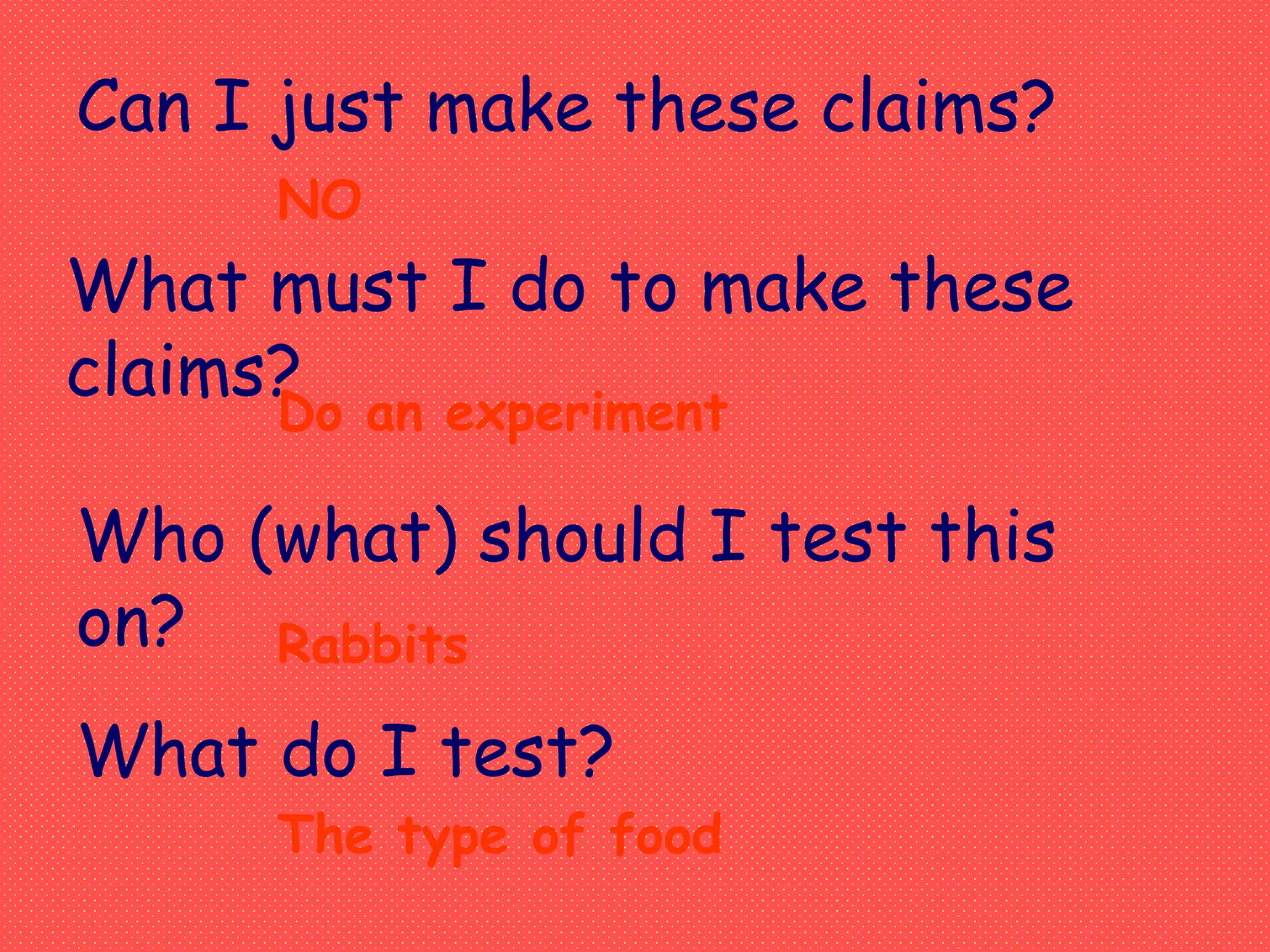
Can I just make these claims?
What must I do to make these
claims?
Who (what) should I test this
on?
What do I test?
NO
Do an experiment
Rabbits
The type of food
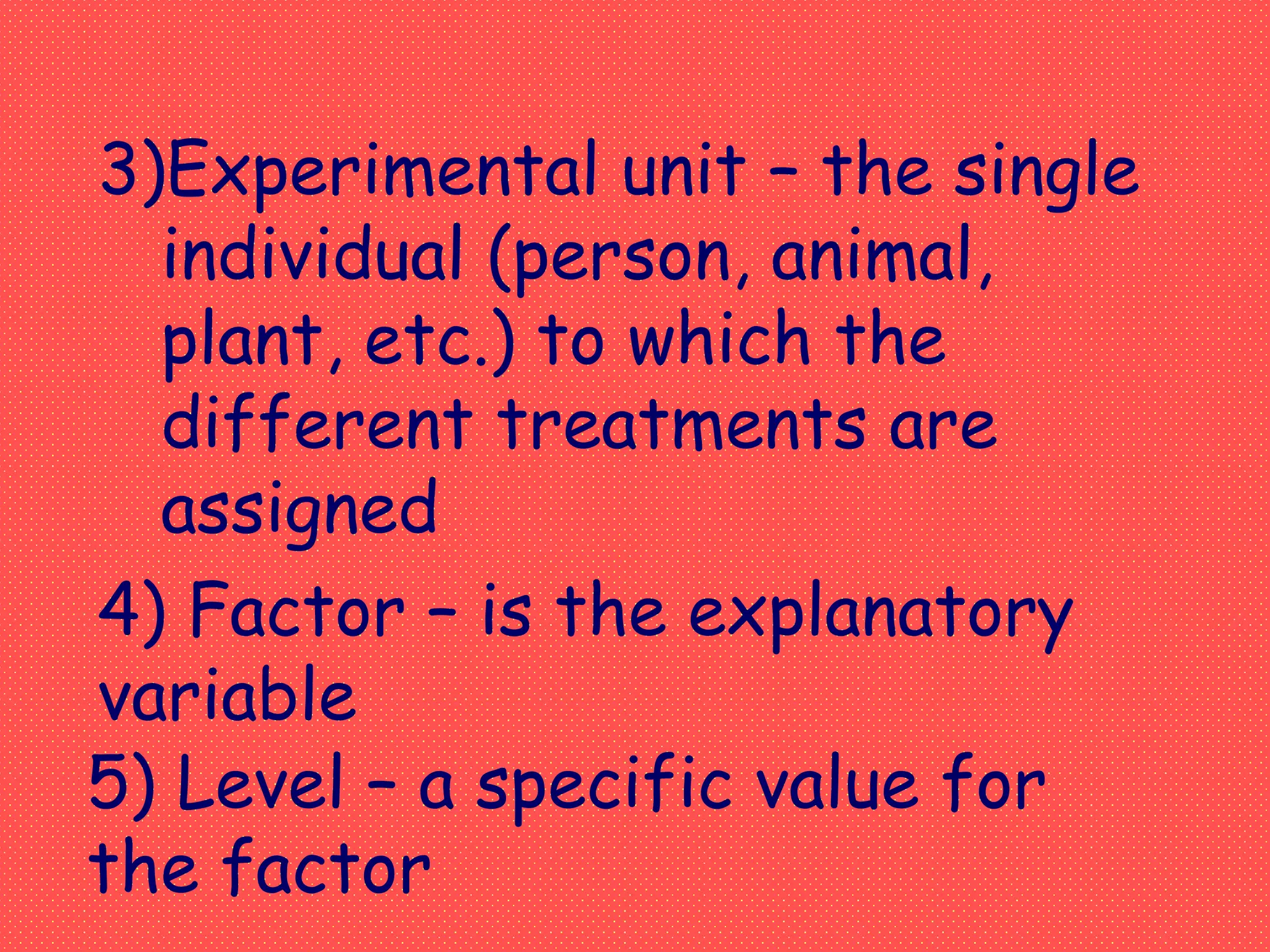
3)Experimental unit – the single
individual (person, animal,
plant, etc.) to which the
different treatments are
assigned
4) Factor – is the explanatory
variable
5) Level – a specific value for
the factor
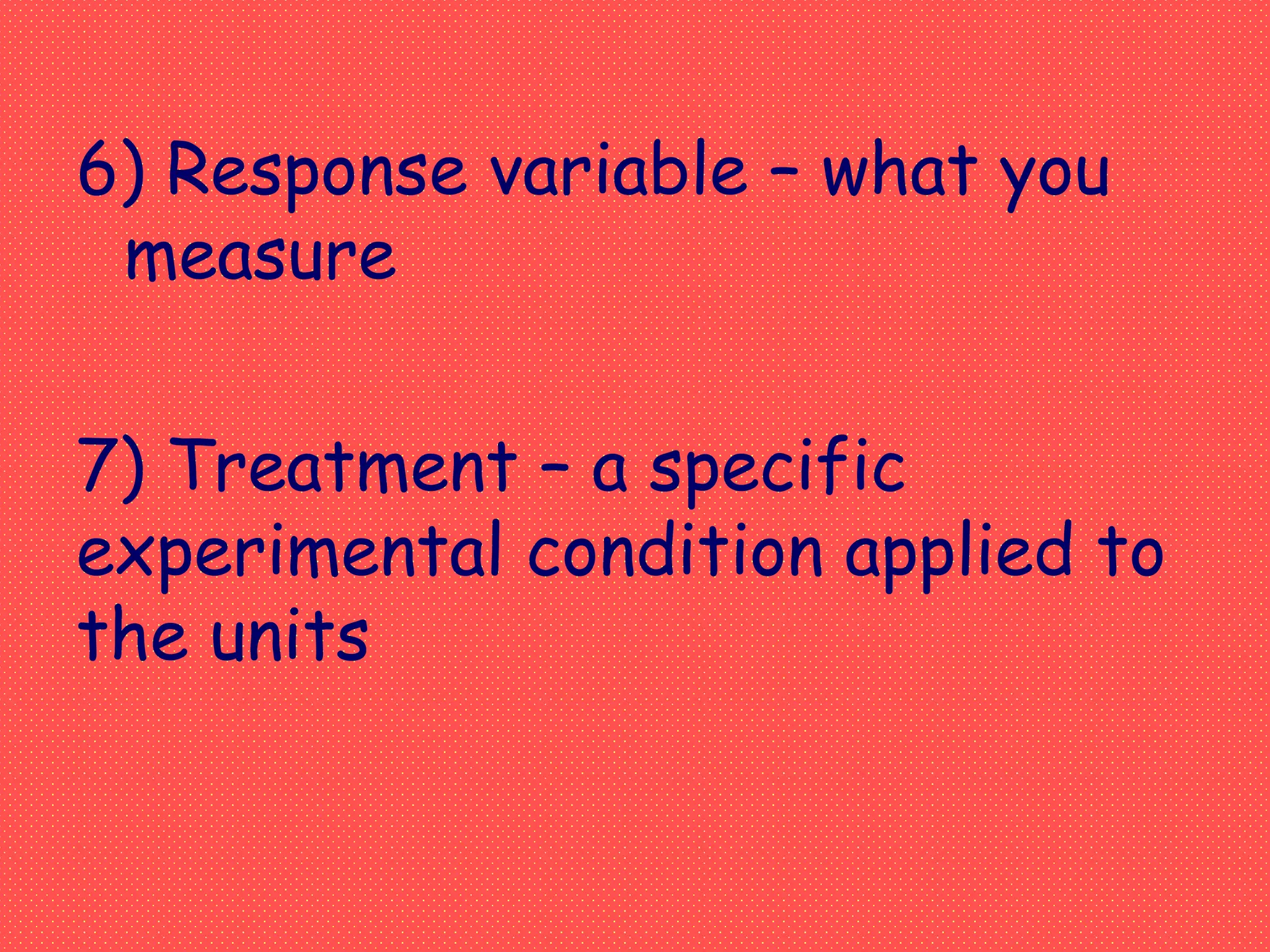
6) Response variable – what you
measure
7) Treatment – a specific
experimental condition applied to
the units
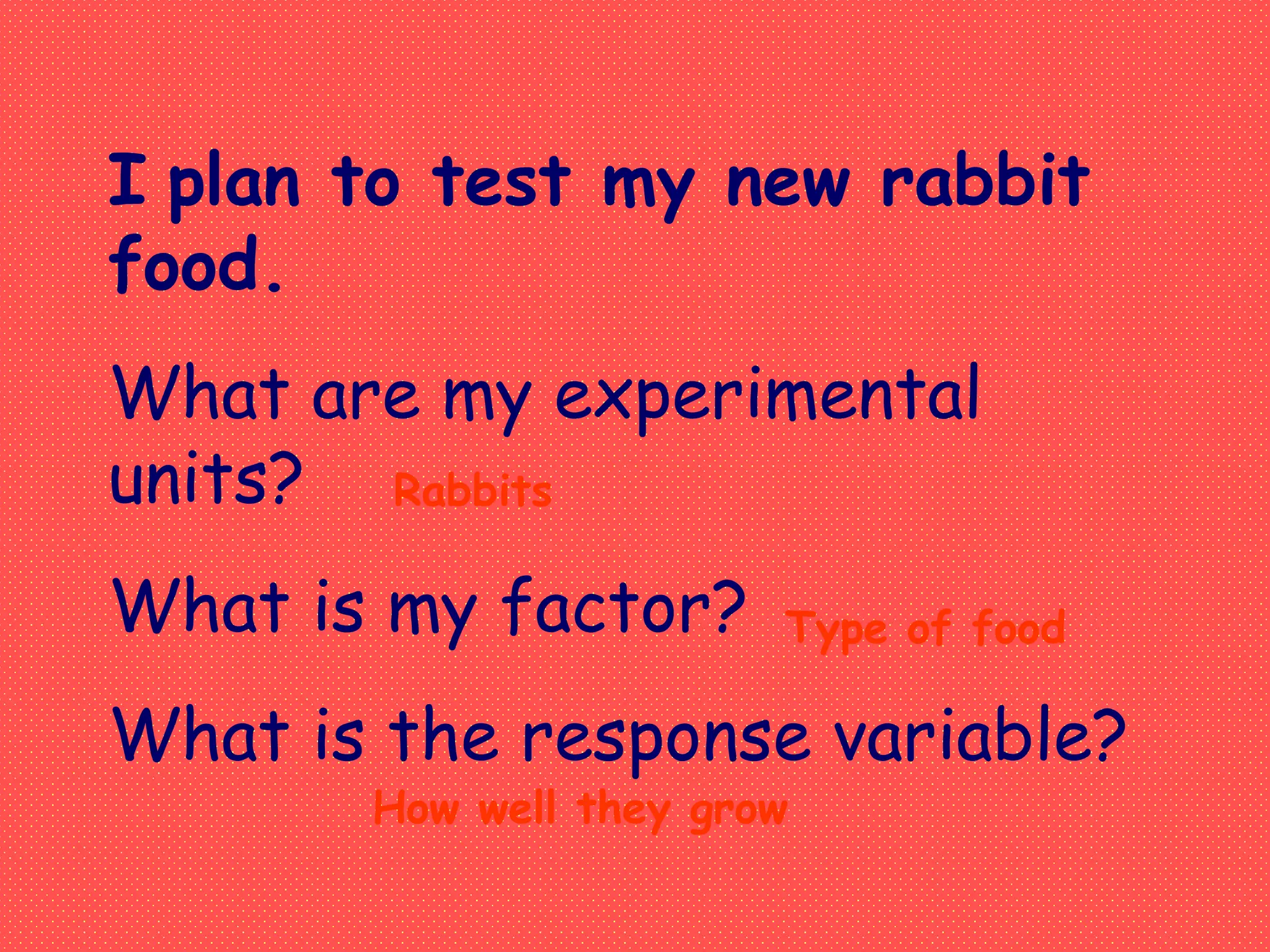
I plan to test my new rabbit
food.
What are my experimental
units?
What is my factor?
What is the response variable?
Rabbits
Type of food
How well they grow
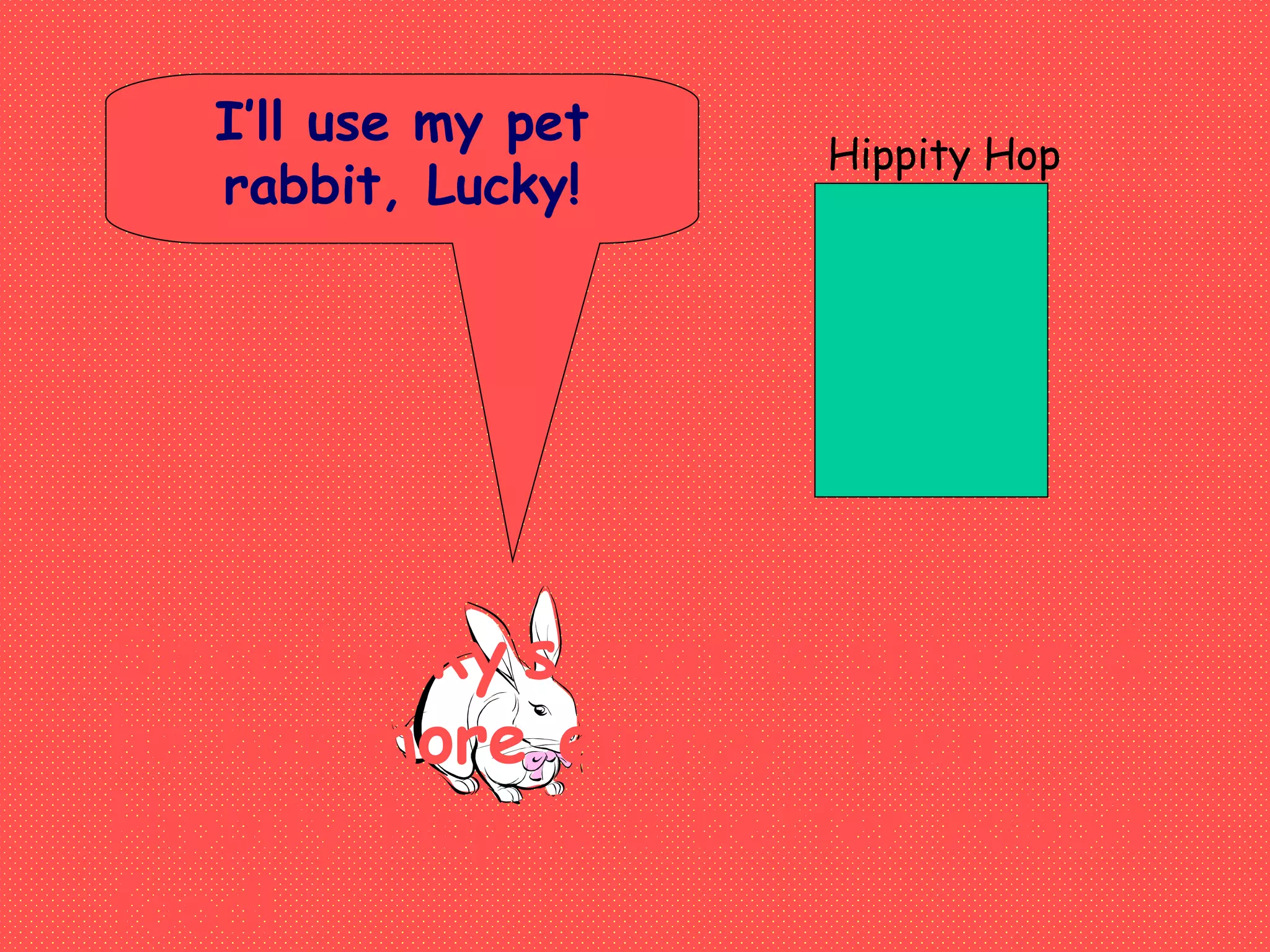
Hippity Hop
I’ll use my pet
rabbit, Lucky!
Since Lucky’s coat is shinier &
he has more energy, then
Hippity Hop is a better rabbit
food!
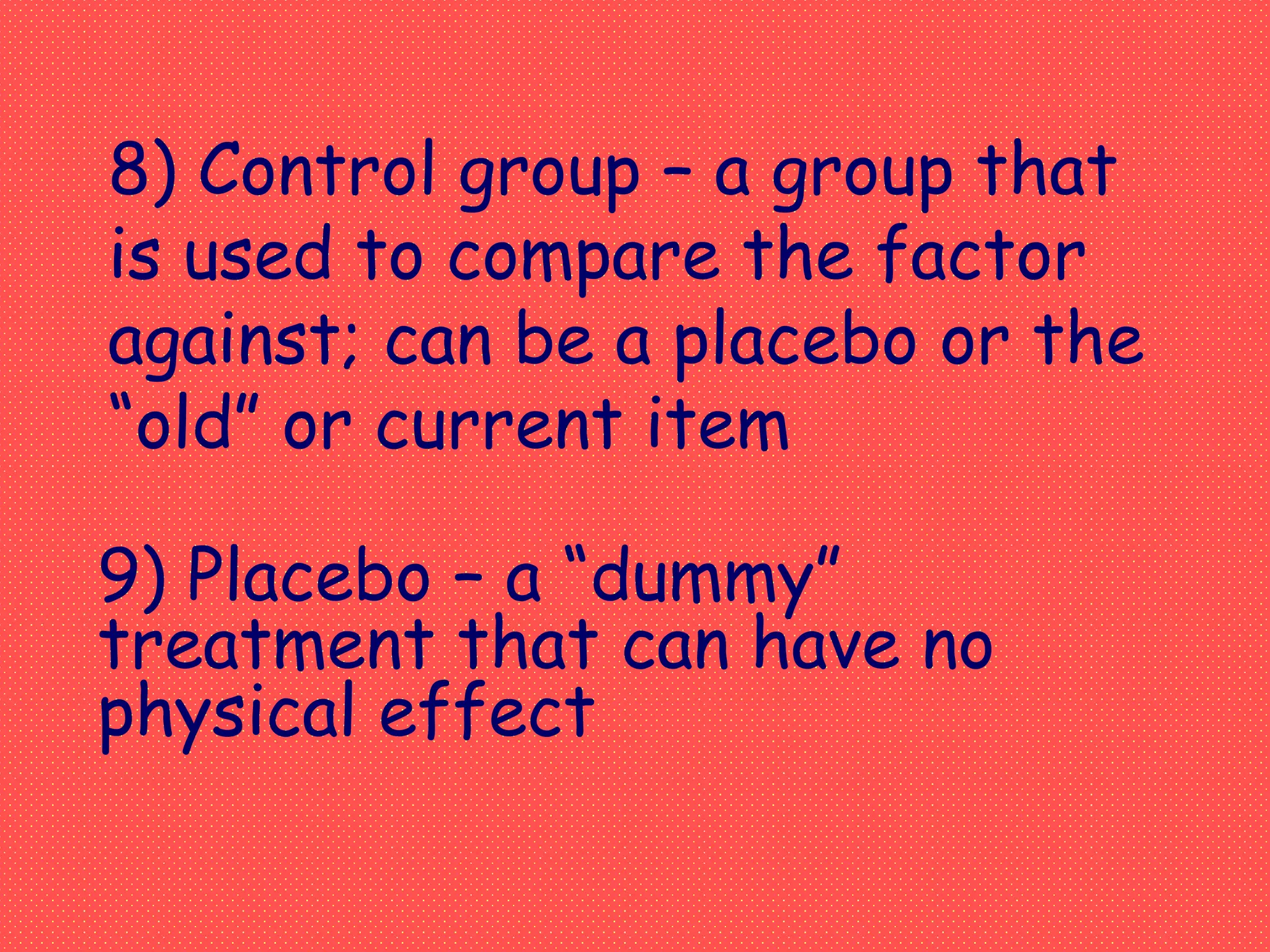
8) Control group – a group that
is used to compare the factor
against; can be a placebo or the
“old” or current item
9) Placebo – a “dummy”
treatment that can have no
physical effect
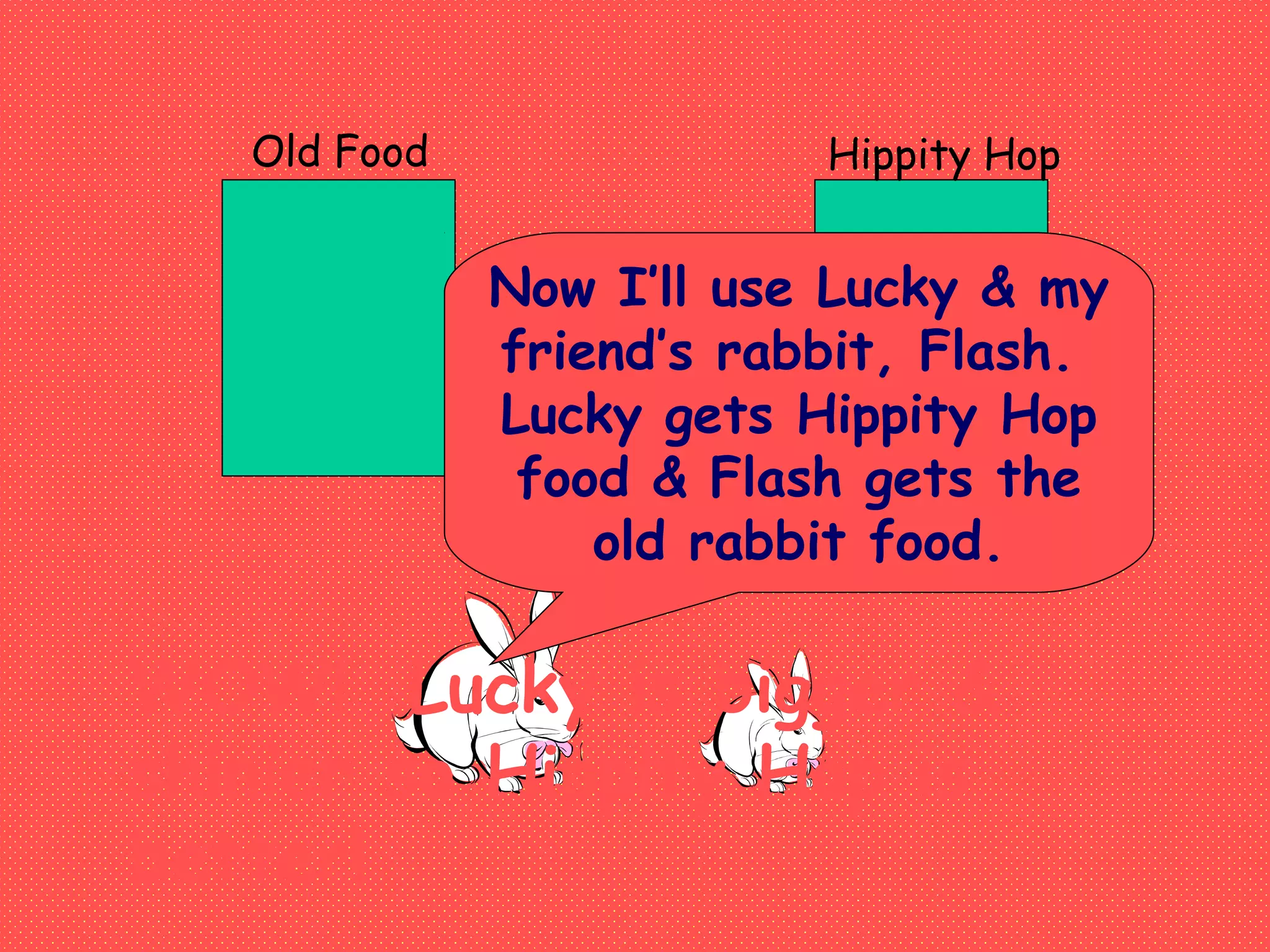
Old Food Hippity Hop
Now I’ll use Lucky & my
friend’s rabbit, Flash.
Lucky gets Hippity Hop
food & Flash gets the
old rabbit food.
WOW! Lucky is bigger &
shinier so Hippity Hop is
better!
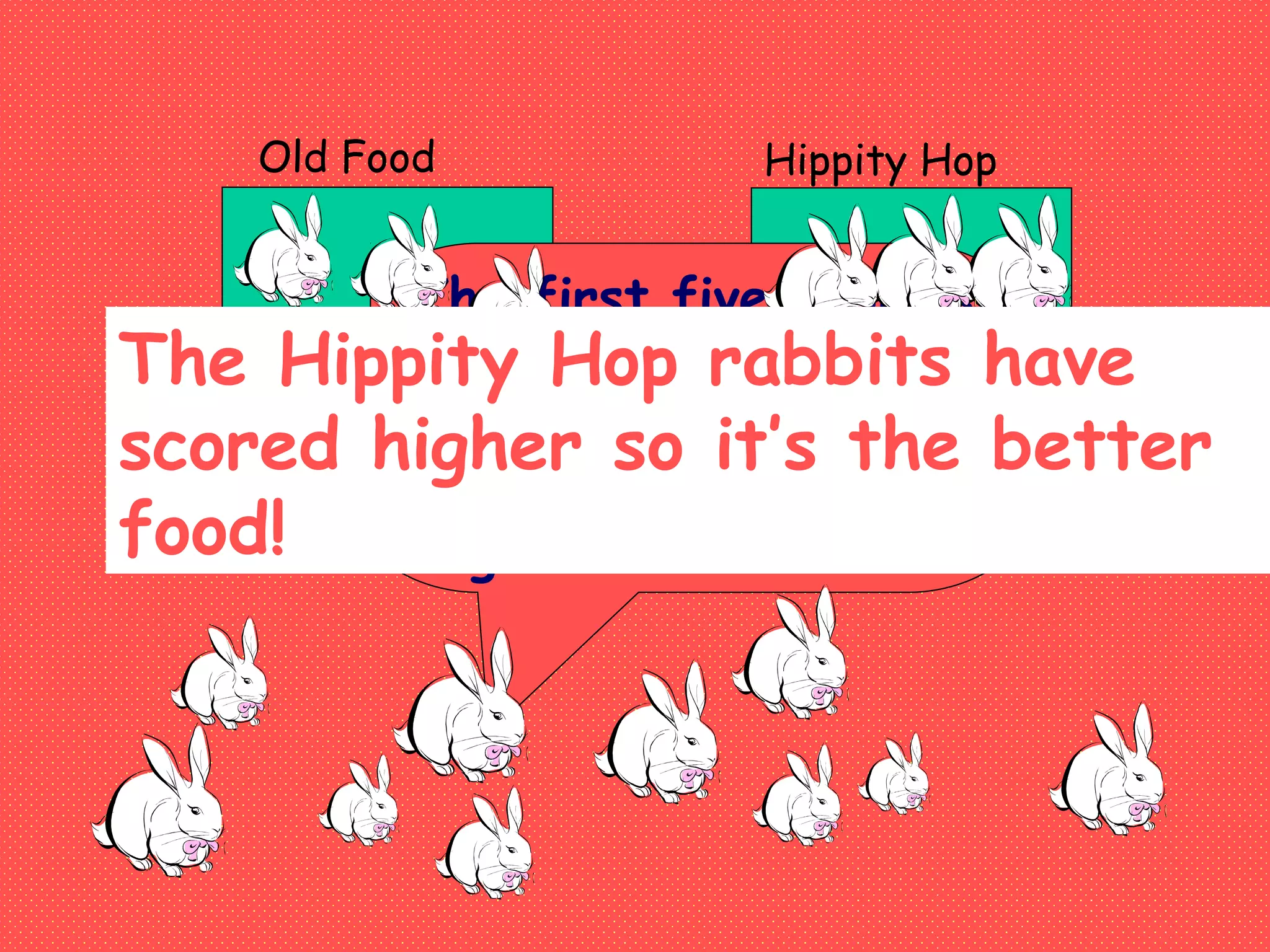
Old Food Hippity Hop
The first five rabbits
that I catch will get
Hippity Hop food and
the remaining five will
get the old food.
The Hippity Hop rabbits have
scored higher so it’s the better
food!
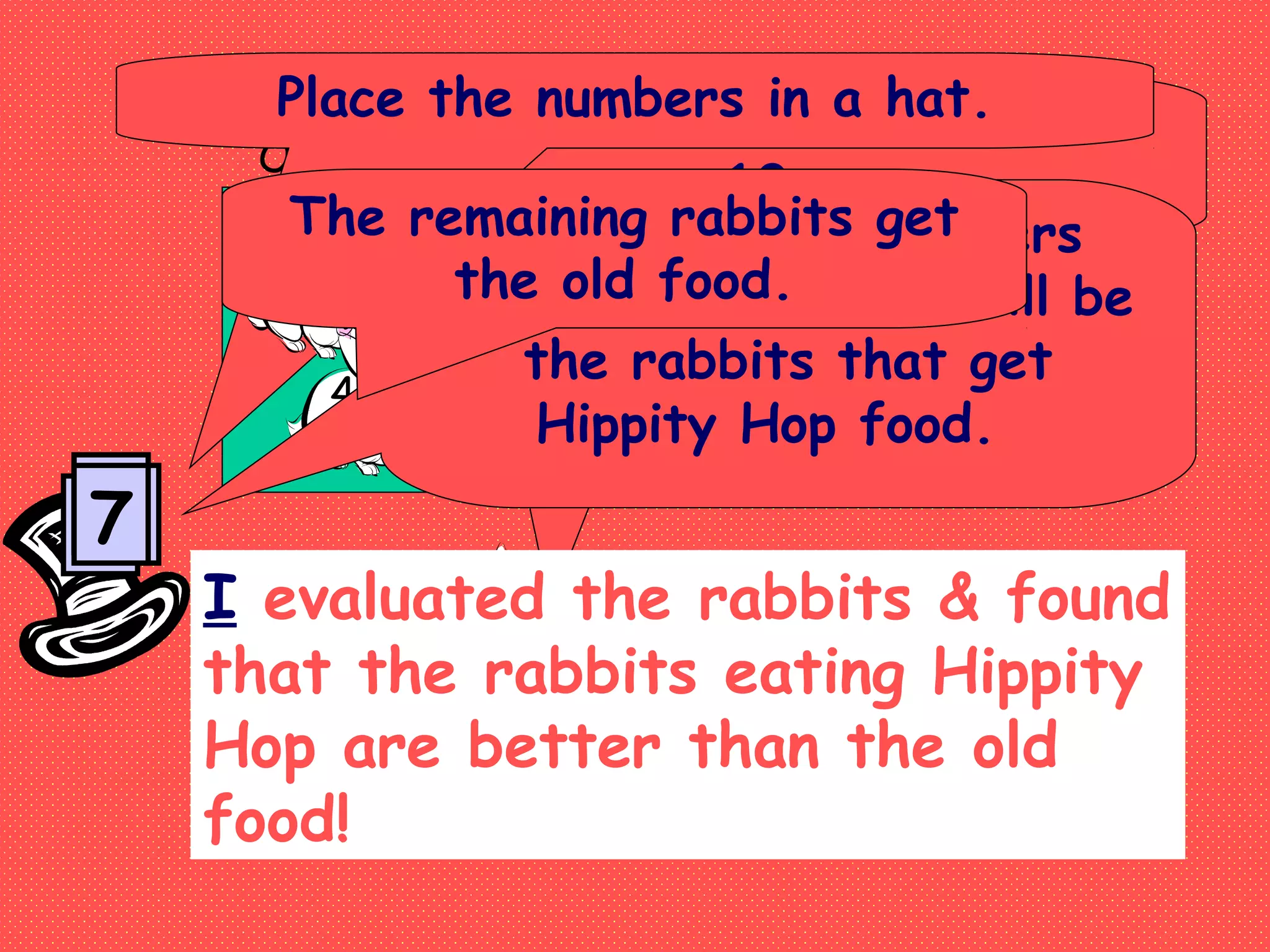
Old Food Hippity Hop
Number the rabbits from 1 –
10.
Place the numbers in a hat.
3
5 7
8
9
41
2 6
10
I evaluated the rabbits & found
that the rabbits eating Hippity
Hop are better than the old
food!
39857
9
7
5
8
3
6
1 2 10
4
The first five numbers
pulled from the hat will be
the rabbits that get
Hippity Hop food.
The remaining rabbits get
the old food.
10) blinding - method used so
that units do not know which
treatment they are getting
11) double blind - neither the
units nor the evaluator know
which treatment a subject
received
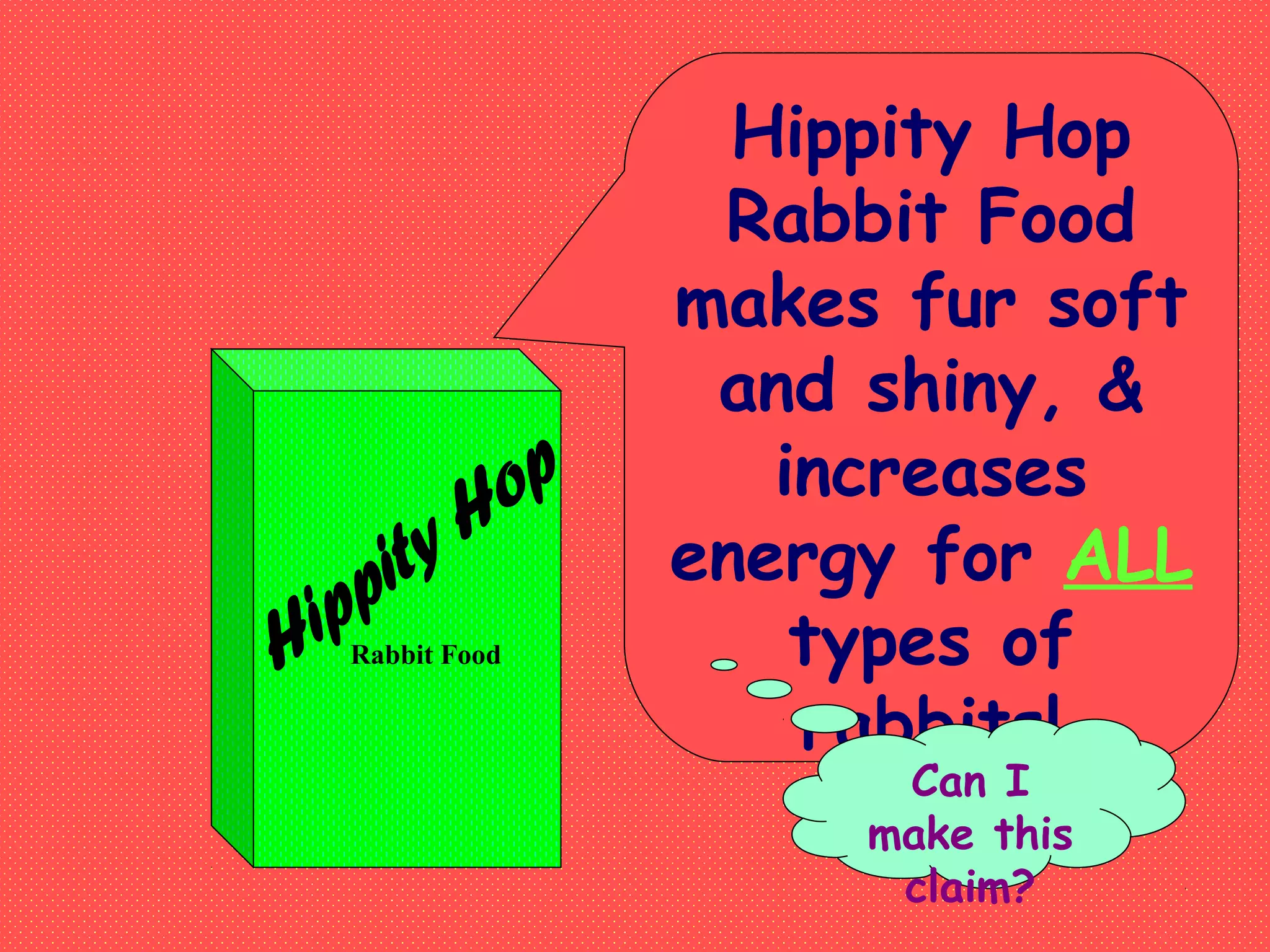
Rabbit Food
Hippity Hop
Rabbit Food
makes fur soft
and shiny, &
increases
energy for ALL
types of
rabbits!
Can I
make this
claim?
Principles of ExperimentalPrinciples of Experimental
DesignDesign
• Control of effects of extraneous
variables on the response – by
comparing treatment groups to a
control group (placebo or “old”)
• Replication of the experiment on
many subjects to quantify the
natural variation in the experiment
• Randomization – the use of chance
to assign subjects to treatments
The ONLY way to show cause &
effect is with a well-designed,
well-controlled experiment!
The ONLY way to show cause &
effect is with a well-designed,
well-controlled experiment!!
The ONLY way to show cause
& effect is with a well-
designed, well-controlled
experiment!!!
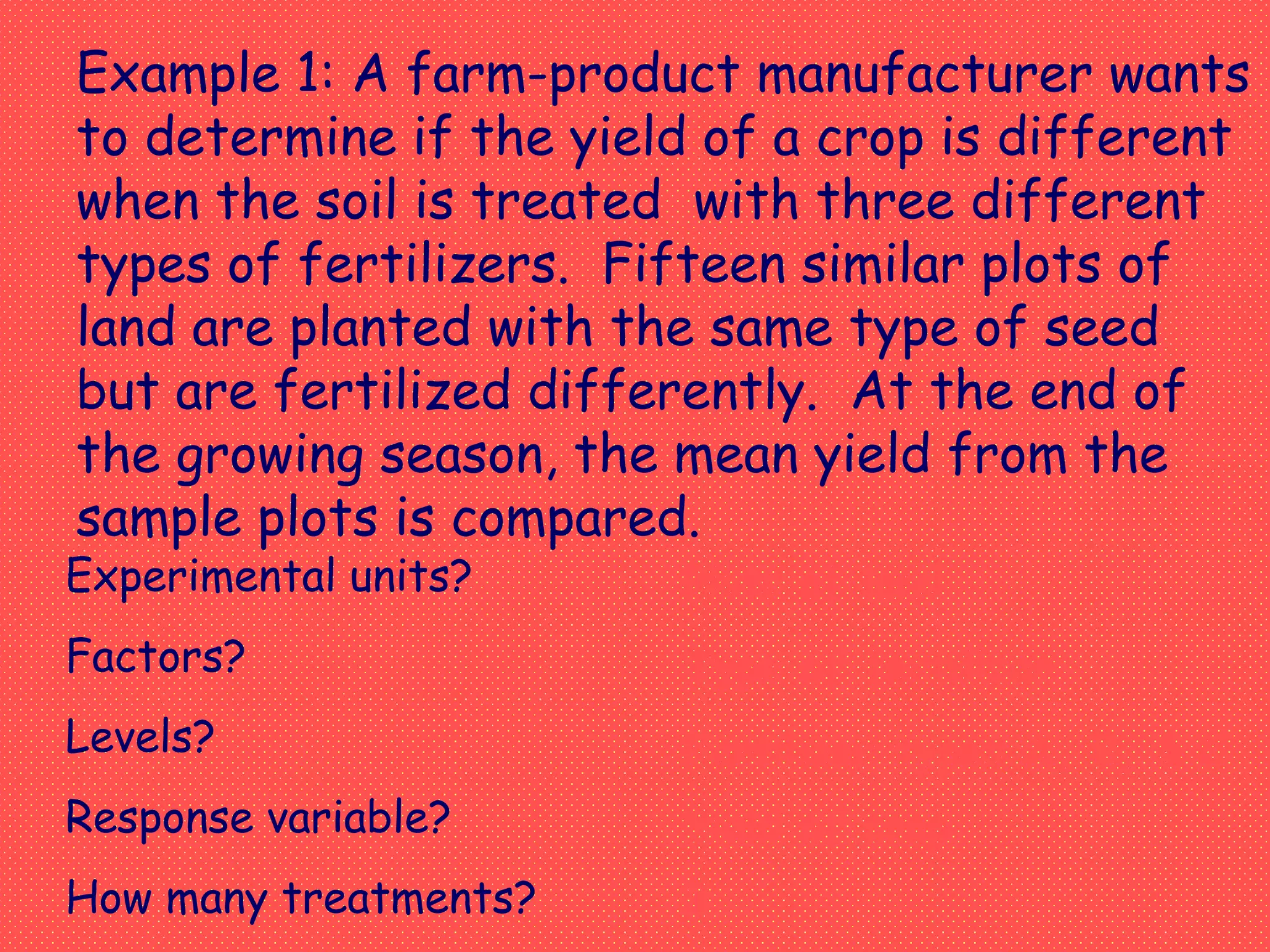
Example 1: A farm-product manufacturer wants
to determine if the yield of a crop is different
when the soil is treated with three different
types of fertilizers. Fifteen similar plots of
land are planted with the same type of seed
but are fertilized differently. At the end of
the growing season, the mean yield from the
sample plots is compared.
Experimental units?
Factors?
Levels?
Response variable?
How many treatments?
Plots of land
Type of fertilizer
Fertilizer types A, B, & C
Yield of crop
3
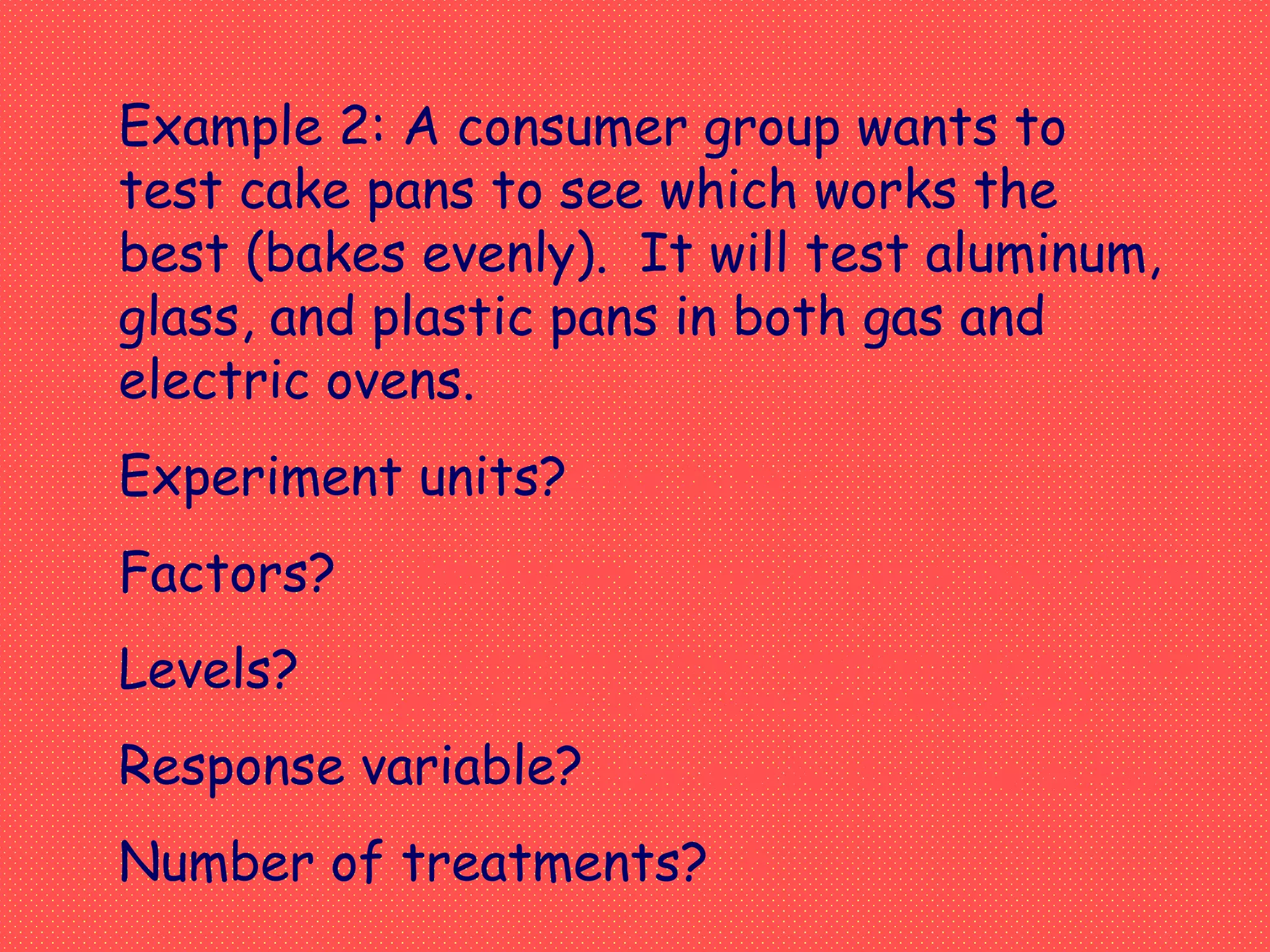
Example 2: A consumer group wants to
test cake pans to see which works the
best (bakes evenly). It will test aluminum,
glass, and plastic pans in both gas and
electric ovens.
Experiment units?
Factors?
Levels?
Response variable?
Number of treatments?
Two factors - type of pan & type of oven
Type of pan has 3 levels (aluminum, glass, & plastic
& type of oven has 2 levels (electric & gas)
How evenly the cake bakes
6
Cake batter
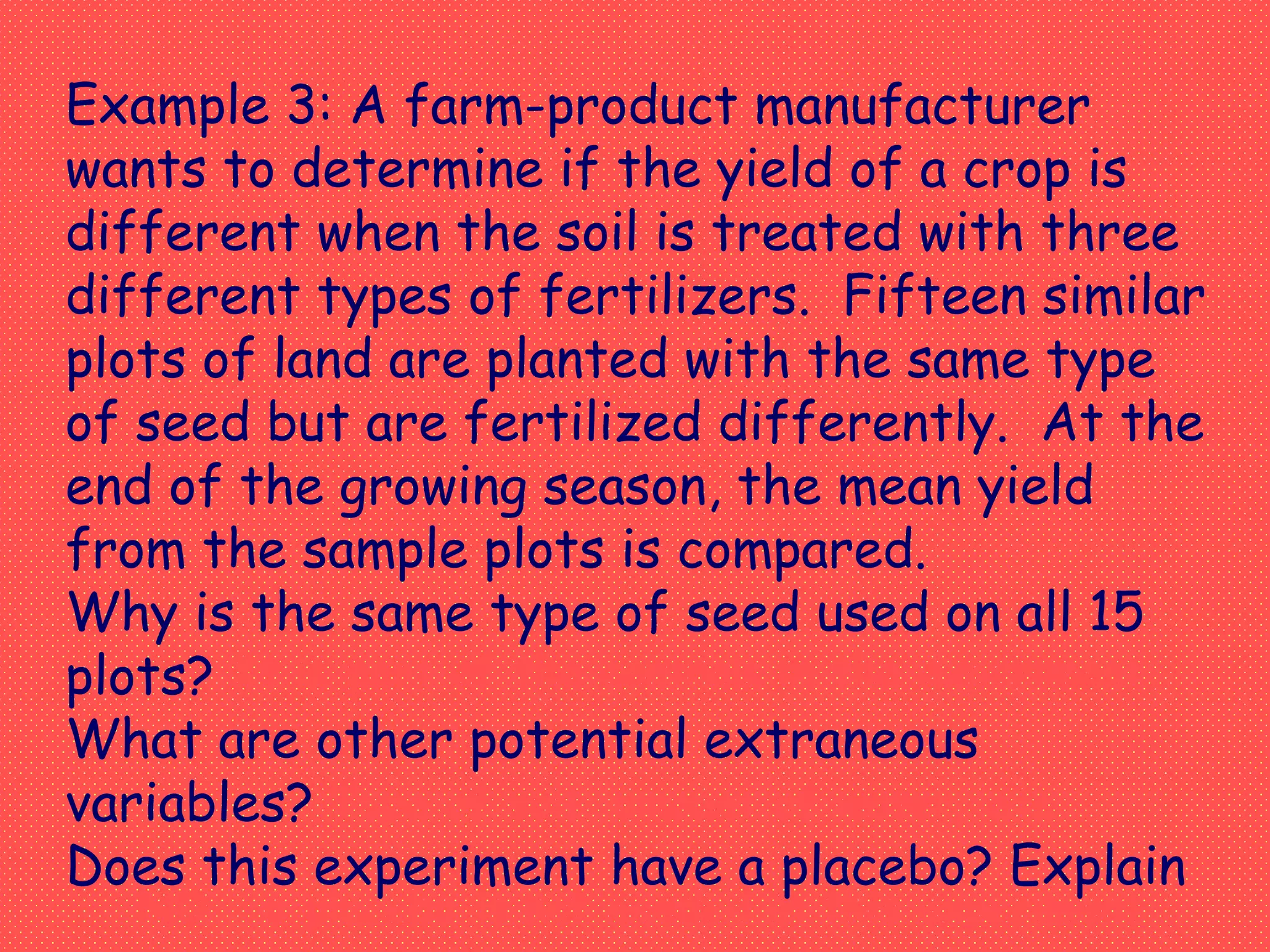
Example 3: A farm-product manufacturer
wants to determine if the yield of a crop is
different when the soil is treated with three
different types of fertilizers. Fifteen similar
plots of land are planted with the same type
of seed but are fertilized differently. At the
end of the growing season, the mean yield
from the sample plots is compared.
Why is the same type of seed used on all 15
plots?
What are other potential extraneous
variables?
Does this experiment have a placebo? Explain
It is part of the controls in the experiment.
Type of soil, amount of water, etc.
NO – a placebo is not needed in this experiment
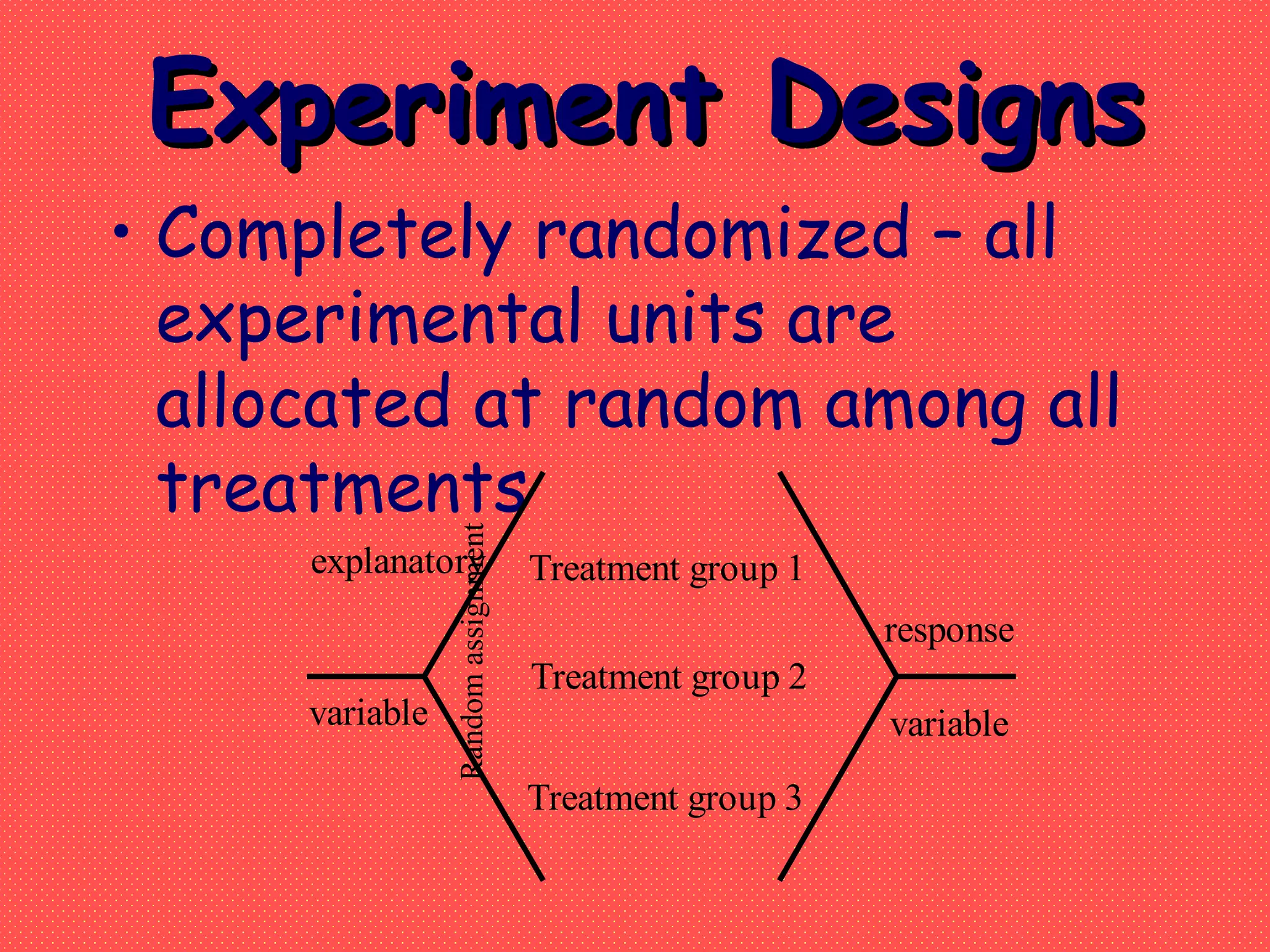
Experiment DesignsExperiment Designs
• Completely randomized – all
experimental units are
allocated at random among all
treatments
Treatment group 1
Treatment group 2
Treatment group 3
explanatory
variable
response
variable
Randomassignment
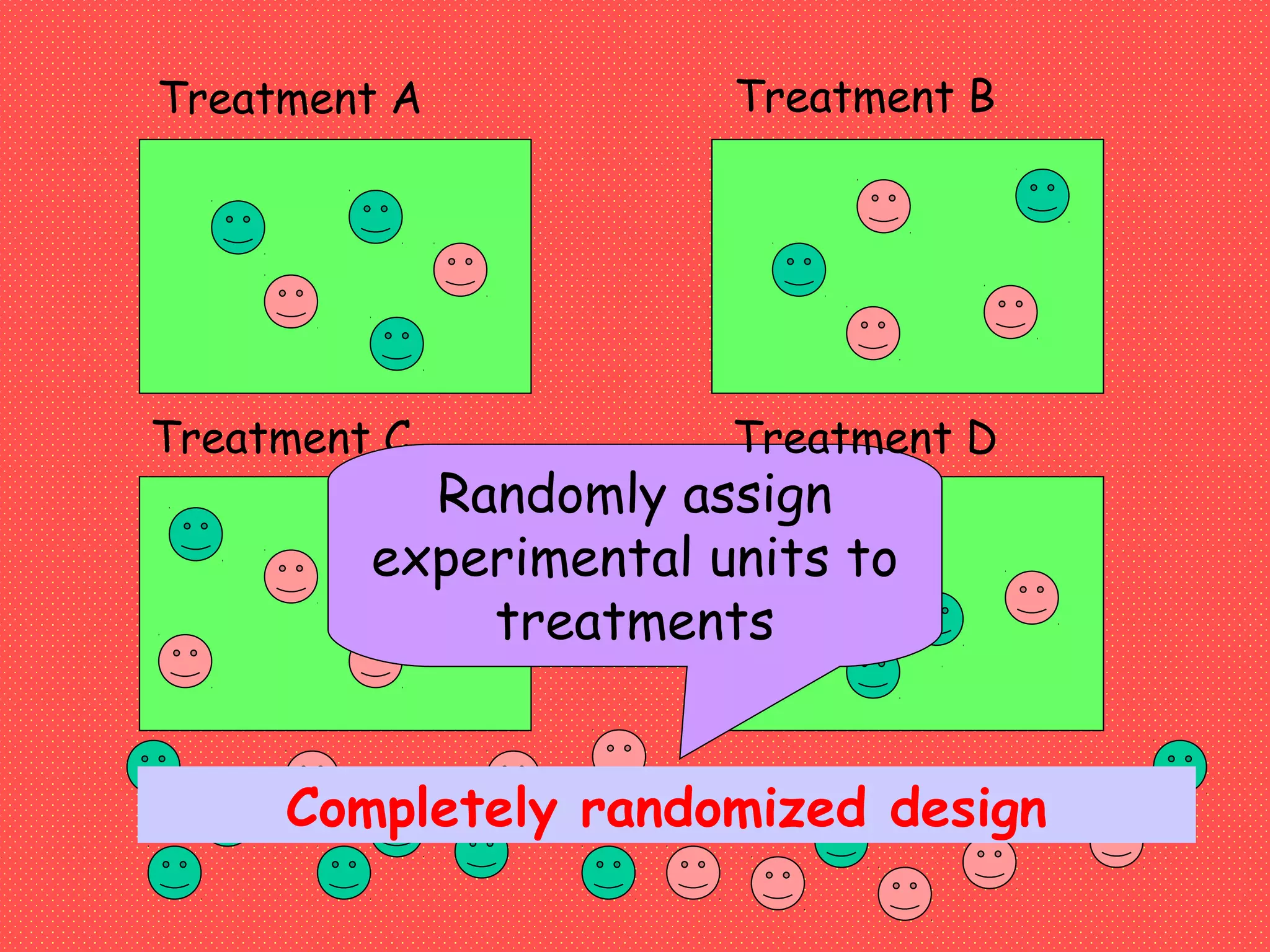
Treatment C
Treatment B
Randomly assign
experimental units to
treatments
Treatment A
Treatment D
Completely randomized design
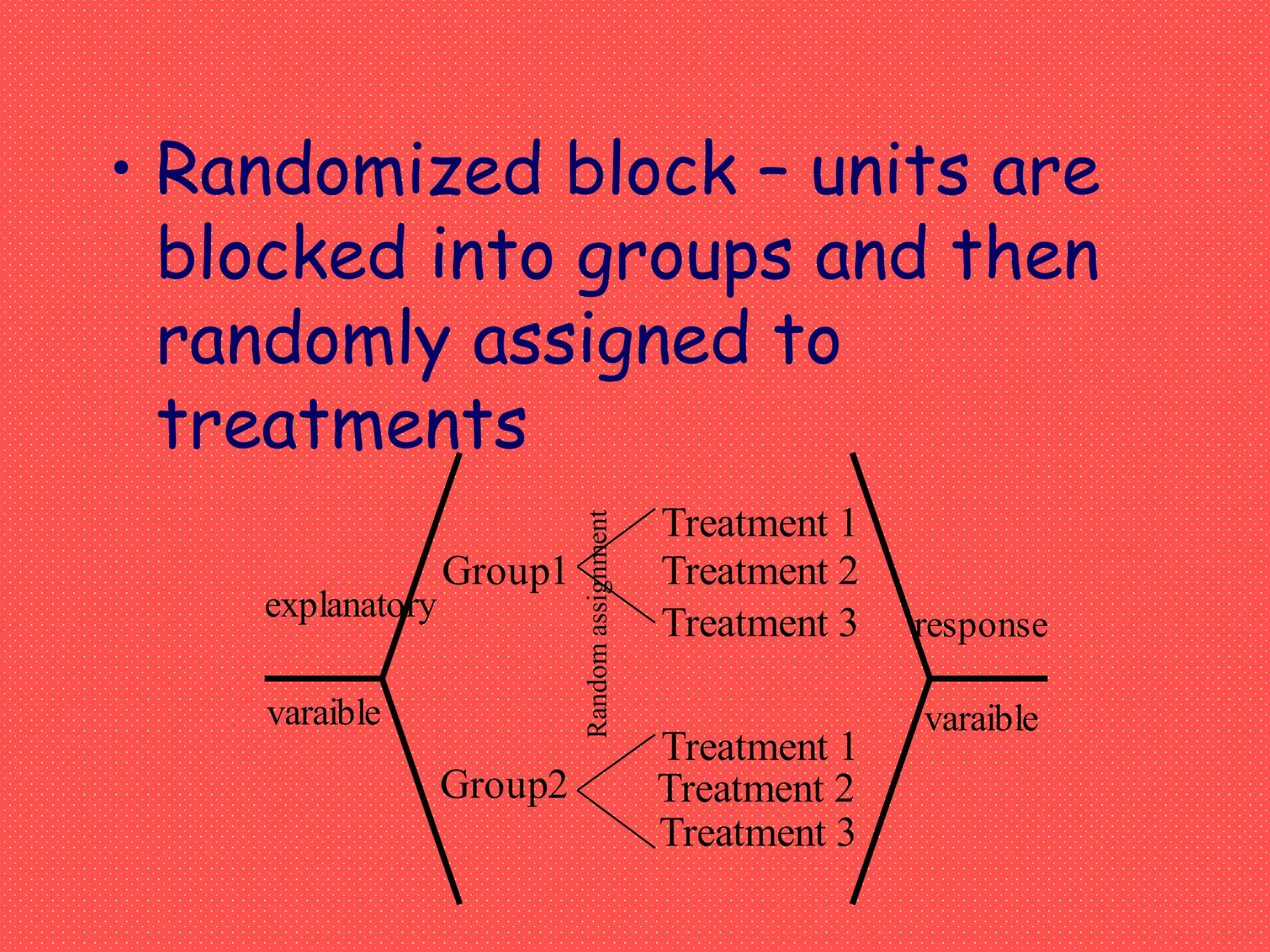
• Randomized block – units are
blocked into groups and then
randomly assigned to
treatments
Randomassignment
Group1
Group2
Treatment 1
Treatment 2
Treatment 3
Treatment 3
Treatment 2
Treatment 1
explanatory
response
varaible varaible
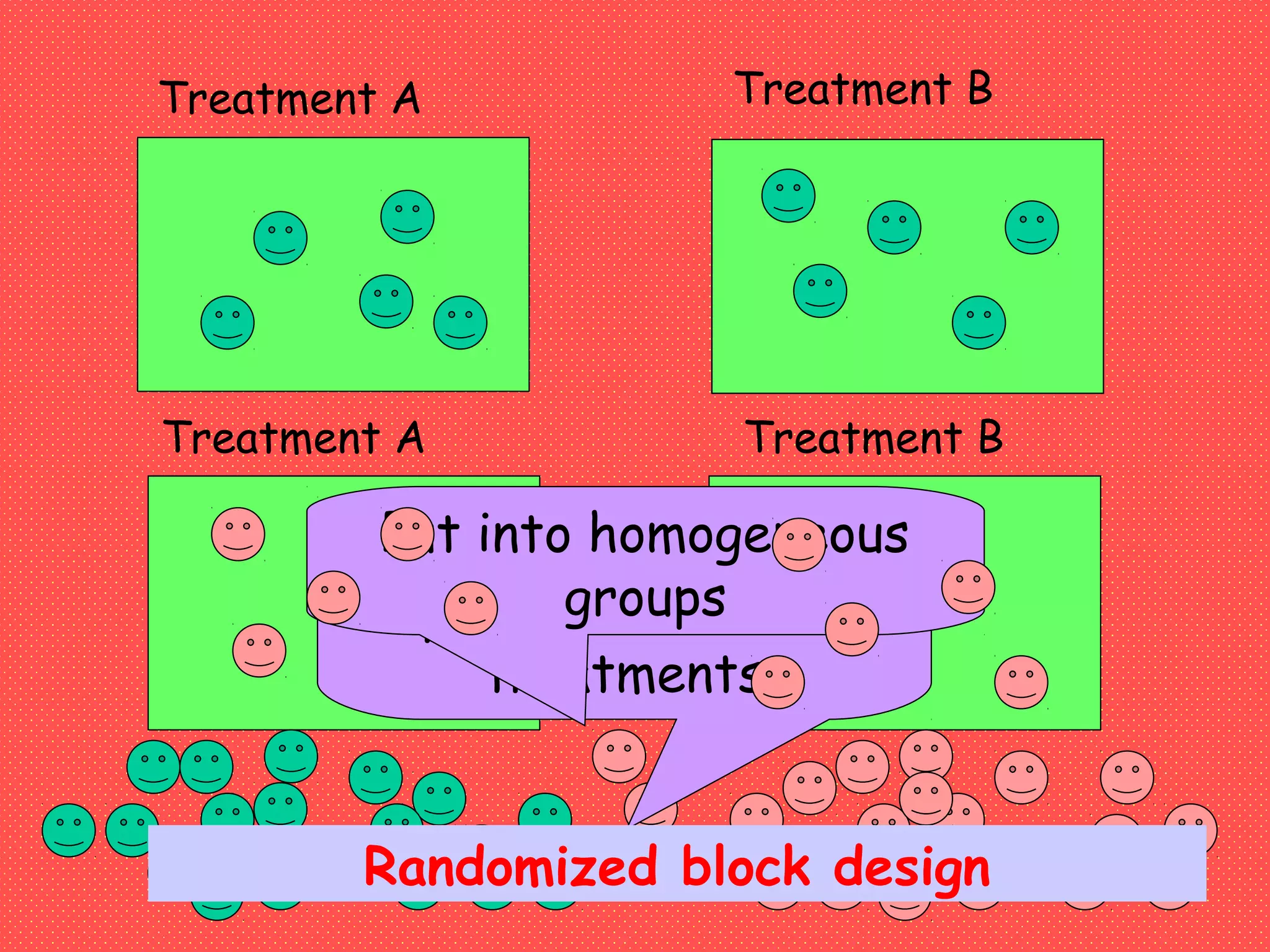
Treatment B
Randomly assign
experimental units to
treatments
Treatment A
Put into homogeneous
groups
Treatment A Treatment B
Randomized block design
– match up experimental units
according to similar
characteristics & randomly assign
one to one treatment & the other
automatically gets the 2nd
treatment
– have each unit do both
treatments in random order
– the assignment of treatments is
dependent
•Matched pairs - a specialMatched pairs - a special
type of block designtype of block design
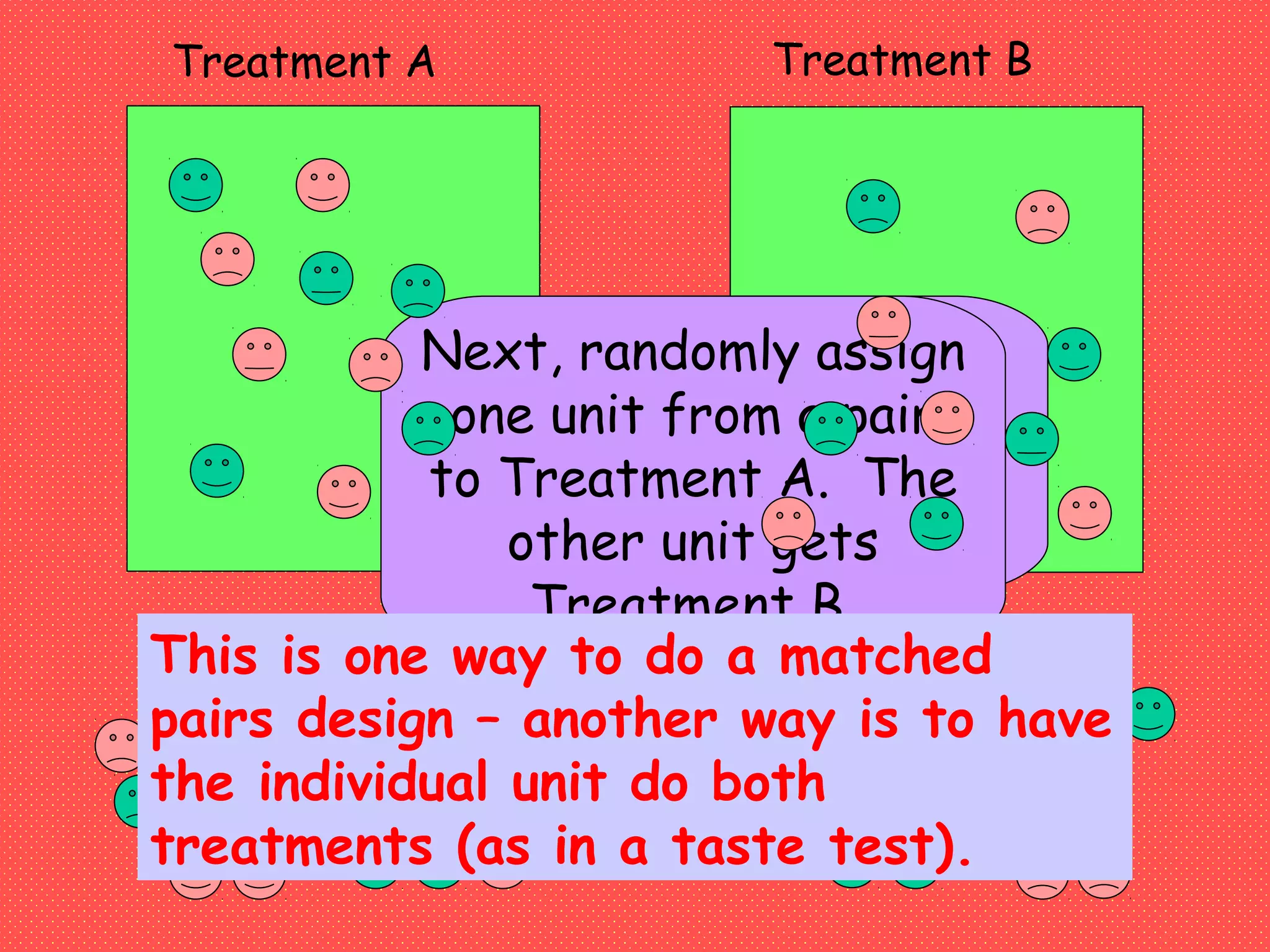
Pair experimental
units according to
specific
characteristics.
Next, randomly assign
one unit from a pair
to Treatment A. The
other unit gets
Treatment B.
Treatment A Treatment B
This is one way to do a matched
pairs design – another way is to have
the individual unit do both
treatments (as in a taste test).
12) Confounding variable – the
effect of the confounding
variable on the response cannot
be separated from the effects of
the explanatory variable (factor)
Suppose we wish to test a new
deodorant against one currently on
the market.
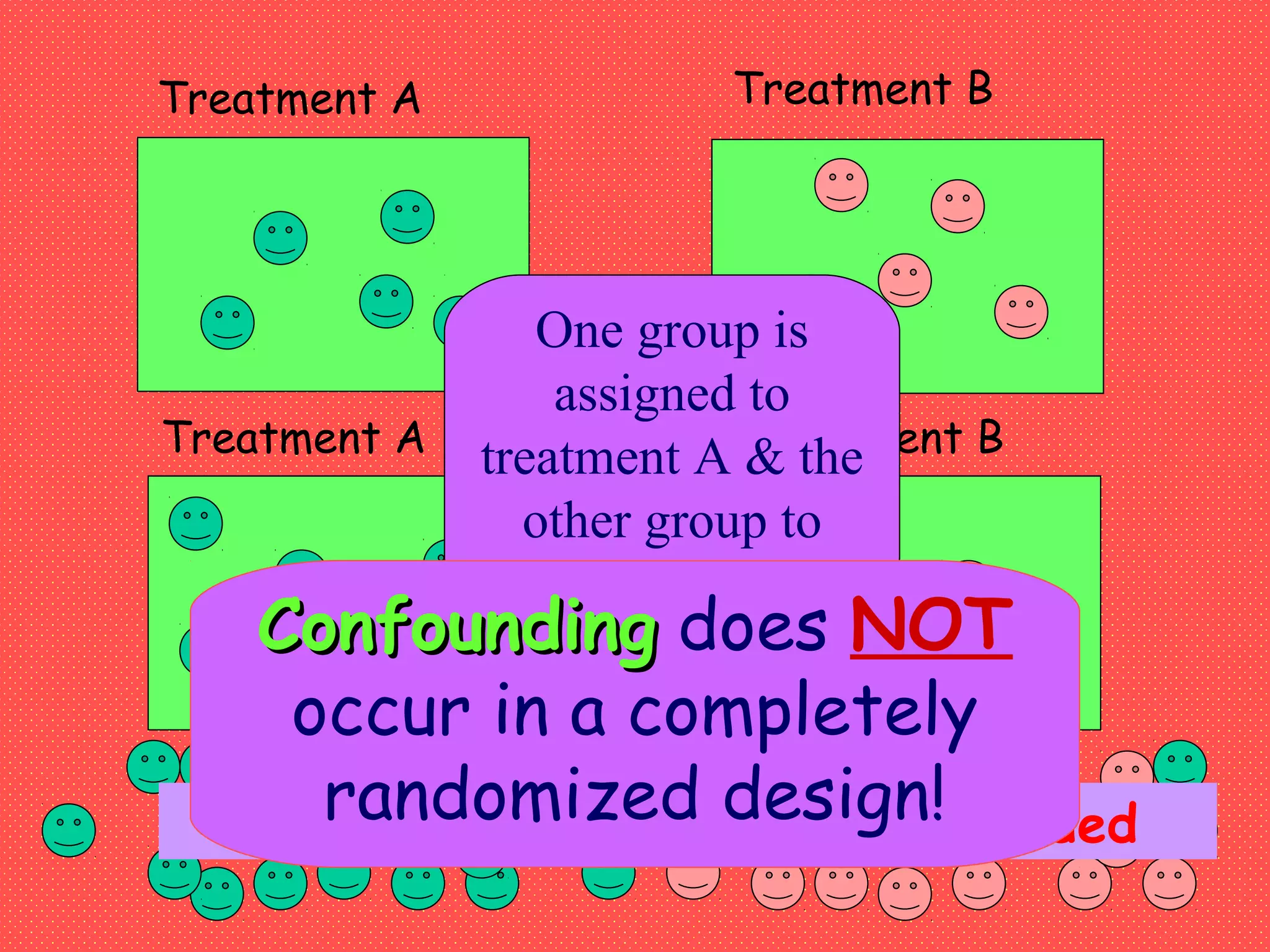
Treatment BTreatment A
Treatment A Treatment B
One group is
assigned to
treatment A & the
other group to
treatment B.
Treatment & group are confounded
ConfoundingConfounding does NOT
occur in a completely
randomized design!
Example 4: An article from USA
Today reports the number of victims
of violent crimes per 1000 people. 51
victims have never been married, 42
are divorced or separated, 13 are
married, and 8 are widowed.
Is this an experiment? Why or why
not?
What is a potential confounding
variable? Age – younger people are more at risk
to be victims of violent crimes
No, no treatment was imposed on people.
Example 5: Four new word-processing
programs are to be compared by measuring
the speed with which standard tasks can
be completed. One hundred volunteers are
randomly assigned to one of the four
programs and their speeds are measured.
Is this an experiment? Why or why not?
What type of design is this?
Factors? Levels?
Response variable?
Yes, a treatment is imposed.
Completely randomized
one factor: word-processing
program with 4 levels
speed
Example 5: Four new word-processing
programs are to be compared by
measuring the speed with which
standard tasks can be completed.
One hundred volunteers are randomly
assigned to one of the four programs
and their speeds are measured.
Is there a potential confounding
variable? Can this design
be improved?
Explain.
NO, completely randomized
designs have no confounding
You could do a block
design where each person
uses each program in
random order.
Example 6: Suppose that the manufacturer
wants to test a new fertilizer against the
current one on the market. Ten 2-acre plots of
land scattered throughout the county are used.
Each plot is subdivided into two subplots, one
of which is treated with the current fertilizer,
and the other with the new fertilizer. Wheat
is planted and the crop yields are measured.
What type of design is
this? Why use this
method?
When does
randomization occur?
Matched - pairs
design
Randomly assigned
treatment to first acre
of each two-acre plot
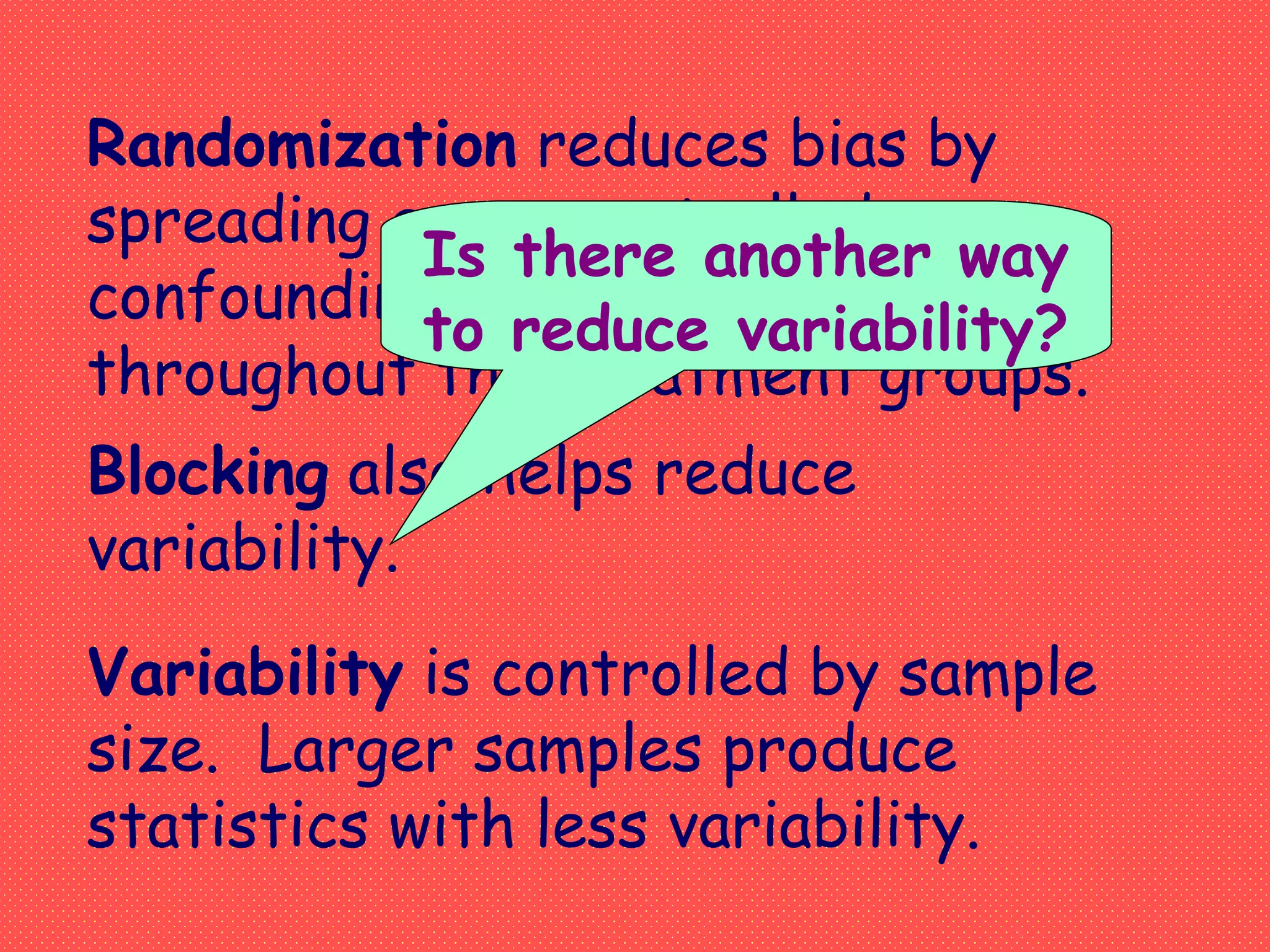
Randomization reduces bias by
spreading any uncontrolled
confounding variables evenly
throughout the treatment groups.
Variability is controlled by sample
size. Larger samples produce
statistics with less variability.
Blocking also helps reduce
variability.
Is there another way
to reduce variability?
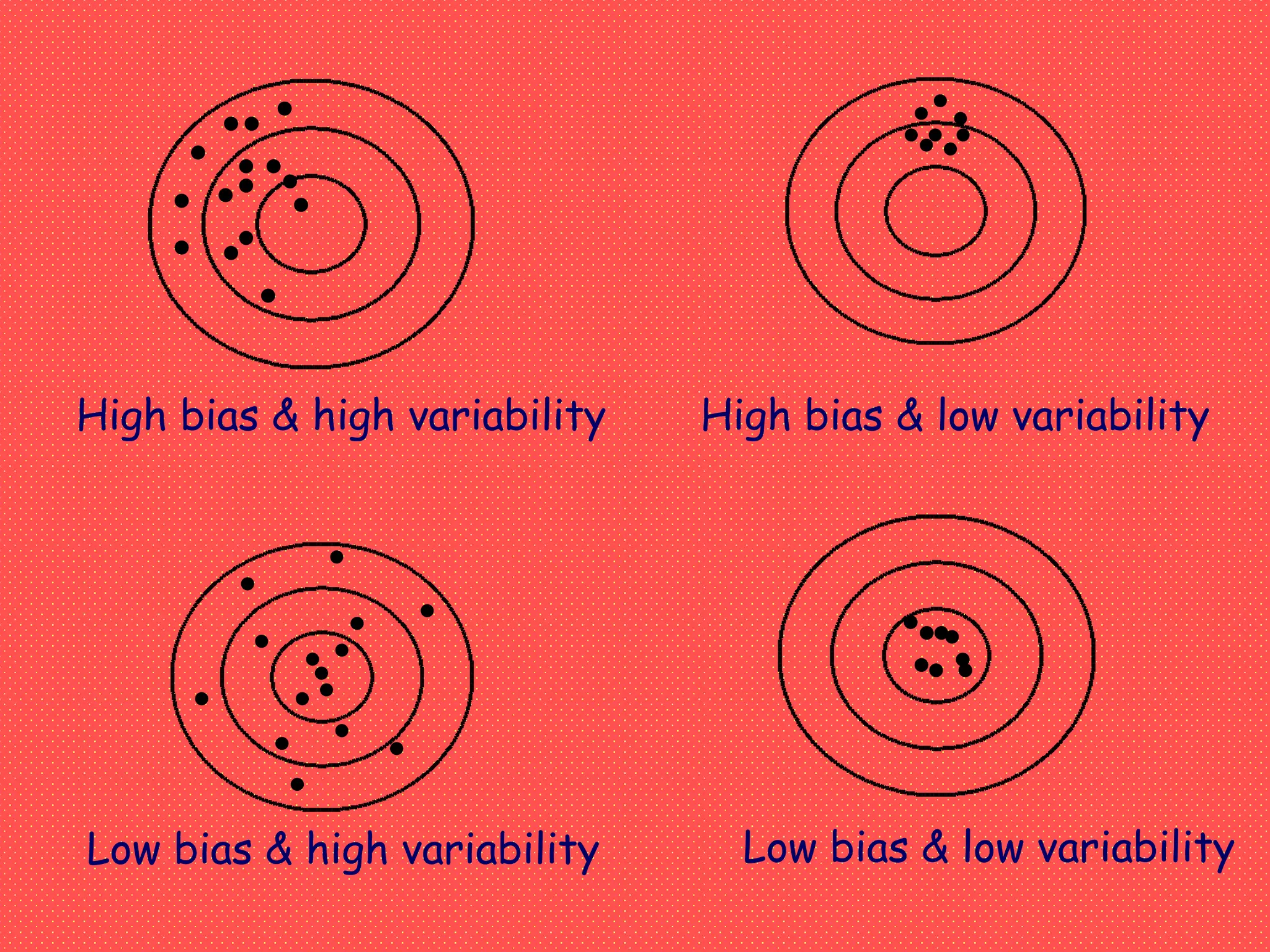
High bias & low variability
Low bias & low variabilityLow bias & high variability
High bias & high variability

Experimental design powerpoint2

  • 1.
    Chapter 2Chapter 2 Experimental Design ByKathy Fritz Plano West High School
  • 2.
    Definitions: 1) Observational study- observe outcomes without imposing any treatment 2) Experiment - actively impose some treatment in order to observe the response
  • 3.
    I’ve developed anew rabbit food, Hippity Hop. Rabbit Food Makes fur soft & shiny! Increases energy! 100% of daily vitamins & essential oils!
  • 4.
    Can I justmake these claims? What must I do to make these claims? Who (what) should I test this on? What do I test? NO Do an experiment Rabbits The type of food
  • 5.
    3)Experimental unit –the single individual (person, animal, plant, etc.) to which the different treatments are assigned 4) Factor – is the explanatory variable 5) Level – a specific value for the factor
  • 6.
    6) Response variable– what you measure 7) Treatment – a specific experimental condition applied to the units
  • 7.
    I plan totest my new rabbit food. What are my experimental units? What is my factor? What is the response variable? Rabbits Type of food How well they grow
  • 8.
    Hippity Hop I’ll usemy pet rabbit, Lucky! Since Lucky’s coat is shinier & he has more energy, then Hippity Hop is a better rabbit food!
  • 9.
    8) Control group– a group that is used to compare the factor against; can be a placebo or the “old” or current item 9) Placebo – a “dummy” treatment that can have no physical effect
  • 10.
    Old Food HippityHop Now I’ll use Lucky & my friend’s rabbit, Flash. Lucky gets Hippity Hop food & Flash gets the old rabbit food. WOW! Lucky is bigger & shinier so Hippity Hop is better!
  • 11.
    Old Food HippityHop The first five rabbits that I catch will get Hippity Hop food and the remaining five will get the old food. The Hippity Hop rabbits have scored higher so it’s the better food!
  • 12.
    Old Food HippityHop Number the rabbits from 1 – 10. Place the numbers in a hat. 3 5 7 8 9 41 2 6 10 I evaluated the rabbits & found that the rabbits eating Hippity Hop are better than the old food! 39857 9 7 5 8 3 6 1 2 10 4 The first five numbers pulled from the hat will be the rabbits that get Hippity Hop food. The remaining rabbits get the old food.
  • 13.
    10) blinding -method used so that units do not know which treatment they are getting 11) double blind - neither the units nor the evaluator know which treatment a subject received
  • 14.
    Rabbit Food Hippity Hop RabbitFood makes fur soft and shiny, & increases energy for ALL types of rabbits! Can I make this claim?
  • 15.
    Principles of ExperimentalPrinciplesof Experimental DesignDesign • Control of effects of extraneous variables on the response – by comparing treatment groups to a control group (placebo or “old”) • Replication of the experiment on many subjects to quantify the natural variation in the experiment • Randomization – the use of chance to assign subjects to treatments
  • 16.
    The ONLY wayto show cause & effect is with a well-designed, well-controlled experiment! The ONLY way to show cause & effect is with a well-designed, well-controlled experiment!! The ONLY way to show cause & effect is with a well- designed, well-controlled experiment!!!
  • 17.
    Example 1: Afarm-product manufacturer wants to determine if the yield of a crop is different when the soil is treated with three different types of fertilizers. Fifteen similar plots of land are planted with the same type of seed but are fertilized differently. At the end of the growing season, the mean yield from the sample plots is compared. Experimental units? Factors? Levels? Response variable? How many treatments? Plots of land Type of fertilizer Fertilizer types A, B, & C Yield of crop 3
  • 18.
    Example 2: Aconsumer group wants to test cake pans to see which works the best (bakes evenly). It will test aluminum, glass, and plastic pans in both gas and electric ovens. Experiment units? Factors? Levels? Response variable? Number of treatments? Two factors - type of pan & type of oven Type of pan has 3 levels (aluminum, glass, & plastic & type of oven has 2 levels (electric & gas) How evenly the cake bakes 6 Cake batter
  • 19.
    Example 3: Afarm-product manufacturer wants to determine if the yield of a crop is different when the soil is treated with three different types of fertilizers. Fifteen similar plots of land are planted with the same type of seed but are fertilized differently. At the end of the growing season, the mean yield from the sample plots is compared. Why is the same type of seed used on all 15 plots? What are other potential extraneous variables? Does this experiment have a placebo? Explain It is part of the controls in the experiment. Type of soil, amount of water, etc. NO – a placebo is not needed in this experiment
  • 20.
    Experiment DesignsExperiment Designs •Completely randomized – all experimental units are allocated at random among all treatments Treatment group 1 Treatment group 2 Treatment group 3 explanatory variable response variable Randomassignment
  • 21.
    Treatment C Treatment B Randomlyassign experimental units to treatments Treatment A Treatment D Completely randomized design
  • 22.
    • Randomized block– units are blocked into groups and then randomly assigned to treatments Randomassignment Group1 Group2 Treatment 1 Treatment 2 Treatment 3 Treatment 3 Treatment 2 Treatment 1 explanatory response varaible varaible
  • 23.
    Treatment B Randomly assign experimentalunits to treatments Treatment A Put into homogeneous groups Treatment A Treatment B Randomized block design
  • 24.
    – match upexperimental units according to similar characteristics & randomly assign one to one treatment & the other automatically gets the 2nd treatment – have each unit do both treatments in random order – the assignment of treatments is dependent •Matched pairs - a specialMatched pairs - a special type of block designtype of block design
  • 25.
    Pair experimental units accordingto specific characteristics. Next, randomly assign one unit from a pair to Treatment A. The other unit gets Treatment B. Treatment A Treatment B This is one way to do a matched pairs design – another way is to have the individual unit do both treatments (as in a taste test).
  • 26.
    12) Confounding variable– the effect of the confounding variable on the response cannot be separated from the effects of the explanatory variable (factor)
  • 27.
    Suppose we wishto test a new deodorant against one currently on the market.
  • 28.
    Treatment BTreatment A TreatmentA Treatment B One group is assigned to treatment A & the other group to treatment B. Treatment & group are confounded ConfoundingConfounding does NOT occur in a completely randomized design!
  • 29.
    Example 4: Anarticle from USA Today reports the number of victims of violent crimes per 1000 people. 51 victims have never been married, 42 are divorced or separated, 13 are married, and 8 are widowed. Is this an experiment? Why or why not? What is a potential confounding variable? Age – younger people are more at risk to be victims of violent crimes No, no treatment was imposed on people.
  • 30.
    Example 5: Fournew word-processing programs are to be compared by measuring the speed with which standard tasks can be completed. One hundred volunteers are randomly assigned to one of the four programs and their speeds are measured. Is this an experiment? Why or why not? What type of design is this? Factors? Levels? Response variable? Yes, a treatment is imposed. Completely randomized one factor: word-processing program with 4 levels speed
  • 31.
    Example 5: Fournew word-processing programs are to be compared by measuring the speed with which standard tasks can be completed. One hundred volunteers are randomly assigned to one of the four programs and their speeds are measured. Is there a potential confounding variable? Can this design be improved? Explain. NO, completely randomized designs have no confounding You could do a block design where each person uses each program in random order.
  • 32.
    Example 6: Supposethat the manufacturer wants to test a new fertilizer against the current one on the market. Ten 2-acre plots of land scattered throughout the county are used. Each plot is subdivided into two subplots, one of which is treated with the current fertilizer, and the other with the new fertilizer. Wheat is planted and the crop yields are measured. What type of design is this? Why use this method? When does randomization occur? Matched - pairs design Randomly assigned treatment to first acre of each two-acre plot
  • 33.
    Randomization reduces biasby spreading any uncontrolled confounding variables evenly throughout the treatment groups. Variability is controlled by sample size. Larger samples produce statistics with less variability. Blocking also helps reduce variability. Is there another way to reduce variability?
  • 34.
    High bias &low variability Low bias & low variabilityLow bias & high variability High bias & high variability

Editor's Notes

  • #9 Discuss the need for a comparison group.
  • #11 Discuss the need for replication.
  • #12 Discuss the need for random assignment to treatment groups.
  • #13 Discuss the need for the evaluator to be blinded
  • #15 Discuss scope of inference.
  • #20 To control the factor of type of seed. Type of soil; amount of water, sunlight, etc. No, one would compare the three types of fertilizers
  • #28 Ask for 4 male & 4 female volunteers Randomly assign to treatments – no confounding between gender & deodorant Block by gender & randomly assign – no confounding Block by gender – give females new deodorant & males get current – NOW have confounding!
  • #31 Yes, a treatment was imposed Completely randomized one factor, word processing program & 4 levels, the four new programs Speed at which standard tasks can be done
  • #32 a) Speed/expertise of each individual b) Use a matched pairs design where each volunteer uses all four programs in random order