Clinical Trials Design
Dr Ritu Budania
MBBS , MD
Overview
•Introduction
• Clinical Trial Designs
•Challenges
•Application in different phases of trial
•Summary
Clinical Research
All scientific approaches to evaluate medical
disease in terms
Prevention
Diagnosis
Treatment
Humans
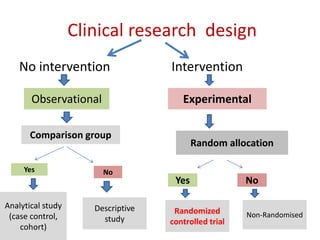
Clinical research design
No intervention Intervention
Observational Experimental
Comparison group
NoYes
Analytical study
(case control,
cohort)
Descriptive
study
Random allocation
Yes No
Randomized
controlled trial
Non-Randomised
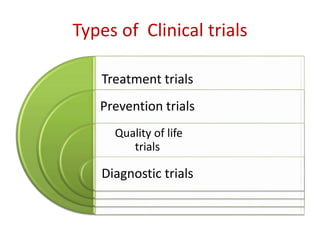
Types of Clinical trials
Treatment trials
Prevention trials
Quality of life
trials
Diagnostic trials
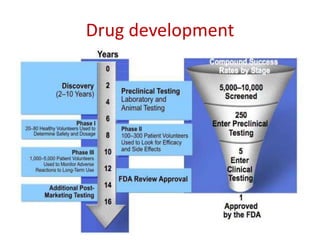
Drug development
Clinical Trial Designs
Designs
 Parallel
 Cross over
 Factorial
 Randomized withdrawal approach
 Adaptive
 Superiority
 Non-inferiority
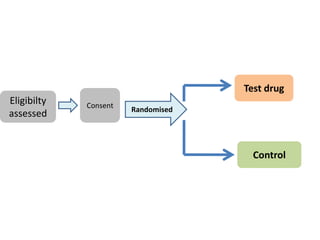
Parallel
• Subjects are randomised to one of two or
more arms
• Each arm being allocated a different
treatment
• Most commonly used design
Eligibilty
assessed
Consent
Control
Test drug
Randomised
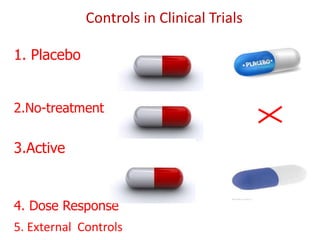
Controls in Clinical Trials
1. Placebo
2.No-treatment
3.Active
4. Dose Response
5. External Controls
5 mg
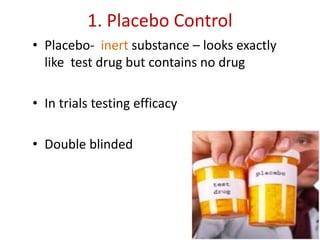
1. Placebo Control
• Placebo- inert substance – looks exactly
like test drug but contains no drug
• In trials testing efficacy
• Double blinded
Advantages of Placebo control
• Minimizes bias
• Ability to demonstrate efficacy
When to use placebo?
1.In disease in which no prior drug has been
established as - standard therapy
2. Minimal risk, short term study
3.Add-on design
Disadvantages of Placebo Control:
1.Ethical Issues
- Lack of treatment -Serious harm( such as
death or irreversible morbidity)
-Declaration of Helsinki – use of standard
treatment as control
-Used where minimal risk
2.Patient and physician concerns:
-Patients may not enroll
-Withdraw
2. No treatment control
• Subjects are randomly assigned to test
treatment or to no treatment
• Subjects, investigators are not blind to
treatment
• Bias
3.Active control
Standard treatment exists
phase III study designs
compare “new drug” to standard or
compare standard to combination therapy that
involves the standard + “new drug”
• 4.Dose response control
• 5.External control
Comparability ?
Baseline characteristics?
No randomization, blinding
Bias
Uncontrolled trials
• No controls
• When-
- Determine pharmacokinetic properties of a
new drug (phase 1 trial)
• Limitation- Bias , as no randomization, less
validity than RCT
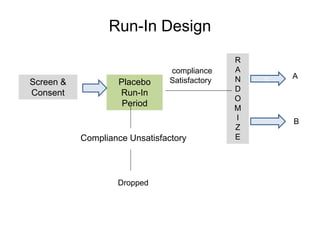
Run-In Design
• Non-compliance
Run-In Design
Screen &
Consent
Placebo
Run-In
Period
R
A
N
D
O
M
I
Z
ECompliance Unsatisfactory
Dropped
B
A
compliance
Satisfactory c
2.Cross over
• Each patient gets both drugs
• the order in which the patient gets each drug is
randomized
• Each patient serves as his own control
• Avoids between participant variation in estimating
intervention effect
• Requires a small sample size
• Assumptions:
–The effects of intervention during first period does not
carry over into second period.
–Internal and external factors are constant over time
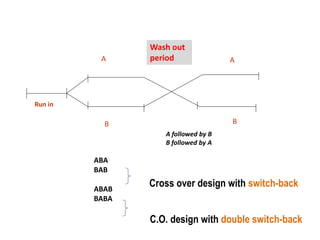
A A
B B
A followed by B
B followed by A
ABA
BAB
ABAB
BABA
Cross over design with switch-back
C.O. design with double switch-back
Run in
Wash out
period
Prerequisites for crossover design
• Disease – chronic (asthma, osteoarthritis)
stable
• Effects of drug should develop fully within
treatment period (not for Hit and run type
drugs)
• Washout periods -sufficiently long for
complete reversibility of drug effect
• Wash out period- five half lives of drug
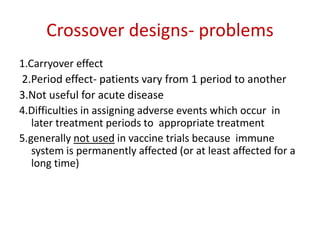
Crossover designs- problems
1.Carryover effect
2.Period effect- patients vary from 1 period to another
3.Not useful for acute disease
4.Difficulties in assigning adverse events which occur in
later treatment periods to appropriate treatment
5.generally not used in vaccine trials because immune
system is permanently affected (or at least affected for a
long time)
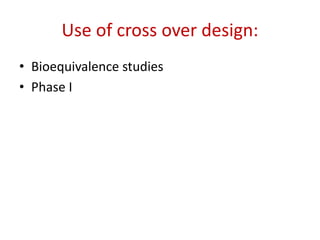
Use of cross over design:
• Bioequivalence studies
• Phase I
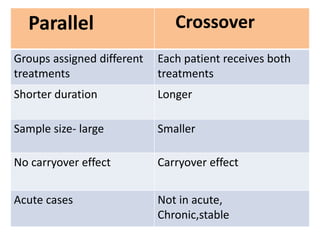
Parallel Crossover
Groups assigned different
treatments
Each patient receives both
treatments
Shorter duration Longer
Sample size- large Smaller
No carryover effect Carryover effect
Acute cases Not in acute,
Chronic,stable
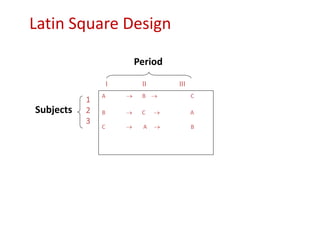
Latin Square Design
A  B  C
B  C  A
C  A  B
I II III
1
2
3
Subjects
Period
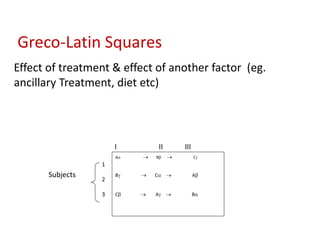
Greco-Latin Squares
Effect of treatment & effect of another factor (eg.
ancillary Treatment, diet etc)
A  B  C
B  C  A
C  A  B
I II III
1
2
3
Subjects
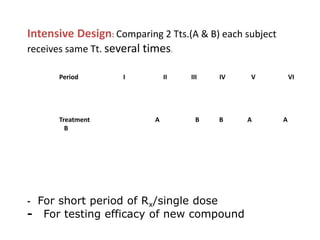
Intensive Design: Comparing 2 Tts.(A & B) each subject
receives same Tt. several times.
Period I II III IV V VI
Treatment A B B A A
B
- For short period of Rx/single dose
- For testing efficacy of new compound
3.Factorial design
- two or more interventions
- Allows study of interactive effects
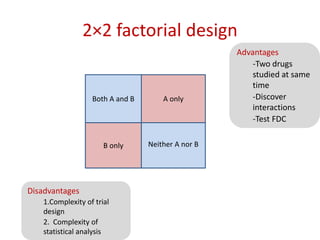
2×2 factorial design
B only Neither A nor B
A onlyBoth A and B
Advantages
-Two drugs
studied at same
time
-Discover
interactions
-Test FDC
Disadvantages
1.Complexity of trial
design
2. Complexity of
statistical analysis
33
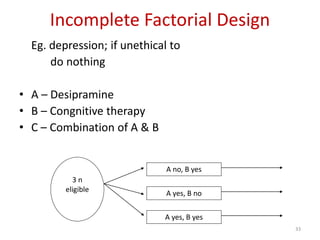
Incomplete Factorial Design
Eg. depression; if unethical to
do nothing
• A – Desipramine
• B – Congnitive therapy
• C – Combination of A & B
3 n
eligible
A no, B yes
A yes, B no
A yes, B yes
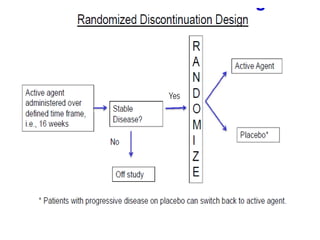
4.Randomized withdrawal approach
Third, the design is particularly useful in
determining how long a therapy should be
continued (e.g., post-infarction treatments
with a beta-blocker
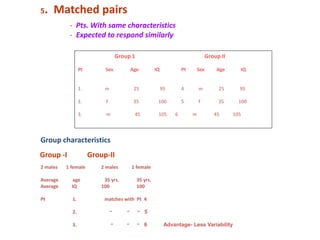
Group 1 Group II
Pt Sex Age IQ Pt Sex Age IQ
1. m 25 95 4 m 25 95
2. f 35 100 5 f 35 100
3. m 45 105 6 m 45 105
5. Matched pairs
- Pts. With same characteristics
- Expected to respond similarly
Group characteristics
2 males 1 female 2 males 1 female
Average age 35 yrs. 35 yrs.
Average IQ 100 100
Pt 1. matches with Pt 4
2. ‫״‬ ‫״‬ ‫״‬ 5
3. ‫״‬ ‫״‬ ‫״‬ 6 Advantage- Less Variability
Group -I Group-II
Clinical trial design innovations
• Adaptive Design
- allows adaptations or modifications to trial
design after its initiation without undermining
validity and integrity of trial
1.Maximum Information Design
• interim analyses until the target or maximum
information level reached.
• Whenever the pre-specified target
information level is reached, the patient
recruitment is stopped.
2.N-Adjustable Design
3. Group sequential design
prematurely terminating trial based on the
results of interim analyses
• Early-efficacy stopping
• Early futility stopping
(4) Drop-Losers Design
- allows dropping of treatment arm(s) during
study based on interim analysis results
-trial starts with several treatment groups; at
each stage, interim analyses are performed
- losers (inferior groups) are dropped based on
prespecified criteria.
-best arm(s) will be retained.
-used in a phase-II/III combined trial
5.Adaptive Randomization Design
• Response-adaptive randomization (RAR) -
allocation probability is based on response of
previous patients.
• The purpose is to provide the patients with a
better chance of being assigned to the
better/best treatment
42
Superiority Trials
Show that new treatment is better than control or standard
(maybe a placebo)
• Examples:
Placebo-controlled efficacy trials
Active controlled
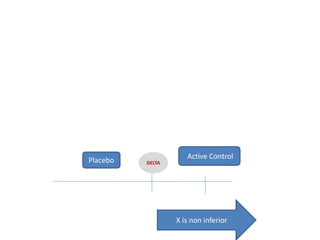
Non-Inferiority Trials
-Show that new treatment
Is not worse that the standard by more than
some margin
-Active control equivalence trial
-Placebo not used
-Better tolerated,
less dosing
X is non inferior
Placebo
Active Control
DELTA
Multicentric trials
1. Large sample size needed- in less time
2. Availability of eligible patients is a constraint
3. Role of Racial/ Ethnic factors to be studied
• Strict protocol compliance by Investigators at
all centres
• Central monitoring committee
• Phase III trials
Challenges in Design:
Control of bias (Randomization, Blinding )
Bias
 Prejudice
 Deviation from truth
 Selection/Allocation bias
 Observer bias
Good study design - minimizing all possible
sources of bias
Randomization
-Assigns patients to treatment arms by chance
-Eliminates selection bias
Pseudo randomization
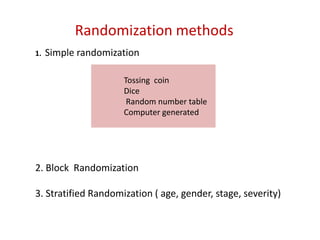
Randomization methods
1. Simple randomization
2. Block Randomization
3. Stratified Randomization ( age, gender, stage, severity)
Tossing coin
Dice
Random number table
Computer generated
Randomized controlled trials
• Gold standard
• Minimize bias
• Costly, time consuming
Allocation Concealment
• Preventing next assignment in clinical trial
from being known
• procedure for protecting randomization
process so that treatment to be allocated is
not known before the patient is entered into
the study
Methods of Allocation concealement
• Sequentially numbered, opaque, sealed
envelopes,
• Pharmacy-controlled allocations
• Coded identical containers or kits
• Central randomisation systems
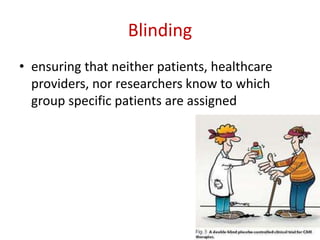
Blinding
• ensuring that neither patients, healthcare
providers, nor researchers know to which
group specific patients are assigned
Reasons for blinding
-Patients on active treatment - adhere
Placebo- do not adhere
- Observer’s bias- Principal investigator-more
vigorously examine active group
Blinding types
• Open label
• Single blind
• Double blind
• Triple blind
• PROBE (Prospective Randomized Open with
Blinded End point Assessment)
No standard definition
Should be specified who is blinded and
how
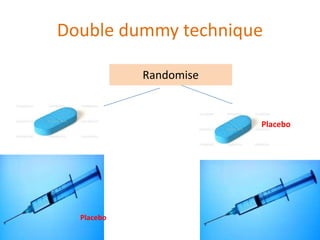
Double dummy technique
Randomise
Placebo
Placebo
Blinding not possible when
• Surgery with non–surgical treatment
• Types of dialysis [hemodialysis versus
peritoneal dialysis]
Application of various designs
in phases of clinical trial
Phase I (Human Pharmacology)
Aims:
– To find safe dose range
– Pharmacokinetics of drug
– Drug food interaction
– First in man study
Sample:
• Healthy volunteers
• Drug -too toxic (cancer, HIV): patients
Sample size- 20-50
Phase I contd
Design
Open label
Non-randomized
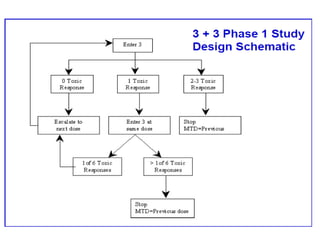
Dose escalation
Uncontrolled
Randomized 2 way crossover study of one dose level of
drug under fasting and fed conditions
6010/21/2016
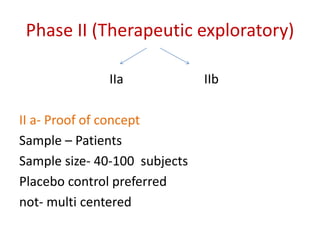
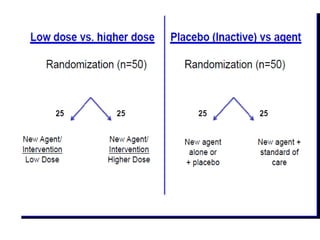
Phase II (Therapeutic exploratory)
IIa IIb
II a- Proof of concept
Sample – Patients
Sample size- 40-100 subjects
Placebo control preferred
not- multi centered
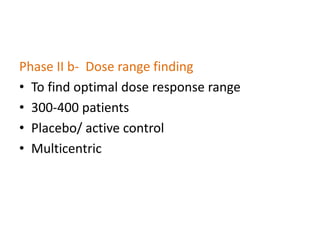
Phase II b- Dose range finding
• To find optimal dose response range
• 300-400 patients
• Placebo/ active control
• Multicentric
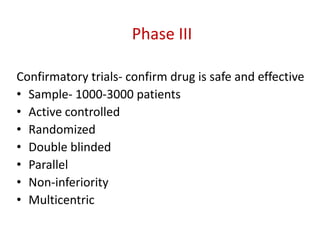
Phase III
Confirmatory trials- confirm drug is safe and effective
• Sample- 1000-3000 patients
• Active controlled
• Randomized
• Double blinded
• Parallel
• Non-inferiority
• Multicentric
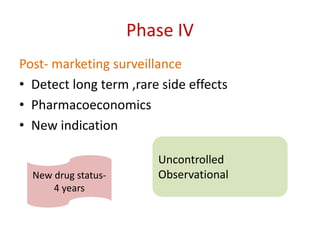
Phase IV
Post- marketing surveillance
• Detect long term ,rare side effects
• Pharmacoeconomics
• New indication
Uncontrolled
ObservationalNew drug status-
4 years
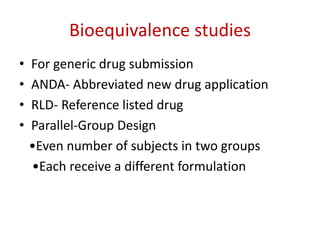
Bioequivalence studies
• For generic drug submission
• ANDA- Abbreviated new drug application
• RLD- Reference listed drug
• Parallel-Group Design
•Even number of subjects in two groups
•Each receive a different formulation
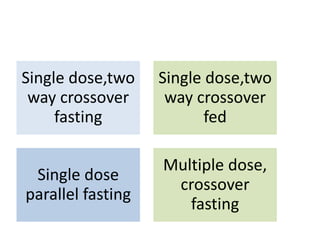
Single dose,two
way crossover
fasting
Single dose,two
way crossover
fed
Single dose
parallel fasting
Multiple dose,
crossover
fasting
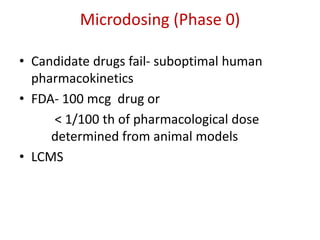
Microdosing (Phase 0)
• Candidate drugs fail- suboptimal human
pharmacokinetics
• FDA- 100 mcg drug or
< 1/100 th of pharmacological dose
determined from animal models
• LCMS
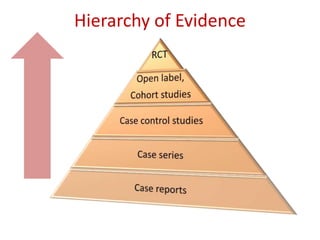
Hierarchy of Evidence
Summary
Success of clinical trial- appropriate clinical
design, control group
RCT – gold standard
Blinding, randomization- minimize bias
References
1.ICH E8 ,9,10 Guidelines : General consideration for clinical
trials, Current Step 4 version, 1997
2. Lawrence J. Appel. Primer on the Design, Conduct, and
Interpretation of Clinical Trials. Clin J Am Soc Nephrol 1:
1360–1367, 2006
3.Shein-Chung Chow and Mark Chang. Adaptive design
methods in clinical trials – a review .Orphanet Journal of
Rare Diseases 2008, 3:11
4.Kenneth F Schulz, David A Grimes. Blinding in randomised
trials: hiding who got what. THE LANCET 2002 ,359:2
5.New Movement in Drug Development Technology –
Micro-dosing and its challenges, QUARTERL REVIEW
No.40 / July 2011
6.Thereasa A , Clinical pharmacology ; Goodman and
Gilmans, Pharmacological basis of therapeutics; 12;1731-50;
2010.
7.HL Sharma and KK Sharma, Clinical pharmacology ,
Principles of Pharmacology;2;871-91;2010
Clinical trial design

Clinical trial design

  • 1.
    Clinical Trials Design DrRitu Budania MBBS , MD
  • 2.
    Overview •Introduction • Clinical TrialDesigns •Challenges •Application in different phases of trial •Summary
  • 3.
    Clinical Research All scientificapproaches to evaluate medical disease in terms Prevention Diagnosis Treatment Humans
  • 4.
    Clinical research design Nointervention Intervention Observational Experimental Comparison group NoYes Analytical study (case control, cohort) Descriptive study Random allocation Yes No Randomized controlled trial Non-Randomised
  • 5.
    Types of Clinicaltrials Treatment trials Prevention trials Quality of life trials Diagnostic trials
  • 6.
  • 7.
  • 8.
    Designs  Parallel  Crossover  Factorial  Randomized withdrawal approach  Adaptive  Superiority  Non-inferiority
  • 9.
    Parallel • Subjects arerandomised to one of two or more arms • Each arm being allocated a different treatment • Most commonly used design
  • 10.
  • 11.
    Controls in ClinicalTrials 1. Placebo 2.No-treatment 3.Active 4. Dose Response 5. External Controls 5 mg
  • 12.
    1. Placebo Control •Placebo- inert substance – looks exactly like test drug but contains no drug • In trials testing efficacy • Double blinded
  • 13.
    Advantages of Placebocontrol • Minimizes bias • Ability to demonstrate efficacy
  • 14.
    When to useplacebo? 1.In disease in which no prior drug has been established as - standard therapy 2. Minimal risk, short term study 3.Add-on design
  • 15.
    Disadvantages of PlaceboControl: 1.Ethical Issues - Lack of treatment -Serious harm( such as death or irreversible morbidity) -Declaration of Helsinki – use of standard treatment as control -Used where minimal risk 2.Patient and physician concerns: -Patients may not enroll -Withdraw
  • 16.
    2. No treatmentcontrol • Subjects are randomly assigned to test treatment or to no treatment • Subjects, investigators are not blind to treatment • Bias
  • 17.
    3.Active control Standard treatmentexists phase III study designs compare “new drug” to standard or compare standard to combination therapy that involves the standard + “new drug”
  • 18.
    • 4.Dose responsecontrol • 5.External control Comparability ? Baseline characteristics? No randomization, blinding Bias
  • 19.
    Uncontrolled trials • Nocontrols • When- - Determine pharmacokinetic properties of a new drug (phase 1 trial) • Limitation- Bias , as no randomization, less validity than RCT
  • 20.
  • 21.
  • 22.
    2.Cross over • Eachpatient gets both drugs • the order in which the patient gets each drug is randomized • Each patient serves as his own control • Avoids between participant variation in estimating intervention effect • Requires a small sample size • Assumptions: –The effects of intervention during first period does not carry over into second period. –Internal and external factors are constant over time
  • 23.
    A A B B Afollowed by B B followed by A ABA BAB ABAB BABA Cross over design with switch-back C.O. design with double switch-back Run in Wash out period
  • 24.
    Prerequisites for crossoverdesign • Disease – chronic (asthma, osteoarthritis) stable • Effects of drug should develop fully within treatment period (not for Hit and run type drugs) • Washout periods -sufficiently long for complete reversibility of drug effect • Wash out period- five half lives of drug
  • 25.
    Crossover designs- problems 1.Carryovereffect 2.Period effect- patients vary from 1 period to another 3.Not useful for acute disease 4.Difficulties in assigning adverse events which occur in later treatment periods to appropriate treatment 5.generally not used in vaccine trials because immune system is permanently affected (or at least affected for a long time)
  • 26.
    Use of crossover design: • Bioequivalence studies • Phase I
  • 27.
    Parallel Crossover Groups assigneddifferent treatments Each patient receives both treatments Shorter duration Longer Sample size- large Smaller No carryover effect Carryover effect Acute cases Not in acute, Chronic,stable
  • 28.
    Latin Square Design A B  C B  C  A C  A  B I II III 1 2 3 Subjects Period
  • 29.
    Greco-Latin Squares Effect oftreatment & effect of another factor (eg. ancillary Treatment, diet etc) A  B  C B  C  A C  A  B I II III 1 2 3 Subjects
  • 30.
    Intensive Design: Comparing2 Tts.(A & B) each subject receives same Tt. several times. Period I II III IV V VI Treatment A B B A A B - For short period of Rx/single dose - For testing efficacy of new compound
  • 31.
    3.Factorial design - twoor more interventions - Allows study of interactive effects
  • 32.
    2×2 factorial design Bonly Neither A nor B A onlyBoth A and B Advantages -Two drugs studied at same time -Discover interactions -Test FDC Disadvantages 1.Complexity of trial design 2. Complexity of statistical analysis
  • 33.
    33 Incomplete Factorial Design Eg.depression; if unethical to do nothing • A – Desipramine • B – Congnitive therapy • C – Combination of A & B 3 n eligible A no, B yes A yes, B no A yes, B yes
  • 34.
    4.Randomized withdrawal approach Third,the design is particularly useful in determining how long a therapy should be continued (e.g., post-infarction treatments with a beta-blocker
  • 36.
    Group 1 GroupII Pt Sex Age IQ Pt Sex Age IQ 1. m 25 95 4 m 25 95 2. f 35 100 5 f 35 100 3. m 45 105 6 m 45 105 5. Matched pairs - Pts. With same characteristics - Expected to respond similarly Group characteristics 2 males 1 female 2 males 1 female Average age 35 yrs. 35 yrs. Average IQ 100 100 Pt 1. matches with Pt 4 2. ‫״‬ ‫״‬ ‫״‬ 5 3. ‫״‬ ‫״‬ ‫״‬ 6 Advantage- Less Variability Group -I Group-II
  • 37.
    Clinical trial designinnovations • Adaptive Design - allows adaptations or modifications to trial design after its initiation without undermining validity and integrity of trial
  • 38.
    1.Maximum Information Design •interim analyses until the target or maximum information level reached. • Whenever the pre-specified target information level is reached, the patient recruitment is stopped. 2.N-Adjustable Design
  • 39.
    3. Group sequentialdesign prematurely terminating trial based on the results of interim analyses • Early-efficacy stopping • Early futility stopping
  • 40.
    (4) Drop-Losers Design -allows dropping of treatment arm(s) during study based on interim analysis results -trial starts with several treatment groups; at each stage, interim analyses are performed - losers (inferior groups) are dropped based on prespecified criteria. -best arm(s) will be retained. -used in a phase-II/III combined trial
  • 41.
    5.Adaptive Randomization Design •Response-adaptive randomization (RAR) - allocation probability is based on response of previous patients. • The purpose is to provide the patients with a better chance of being assigned to the better/best treatment
  • 42.
    42 Superiority Trials Show thatnew treatment is better than control or standard (maybe a placebo) • Examples: Placebo-controlled efficacy trials Active controlled
  • 43.
    Non-Inferiority Trials -Show thatnew treatment Is not worse that the standard by more than some margin -Active control equivalence trial -Placebo not used -Better tolerated, less dosing
  • 44.
    X is noninferior Placebo Active Control DELTA
  • 45.
    Multicentric trials 1. Largesample size needed- in less time 2. Availability of eligible patients is a constraint 3. Role of Racial/ Ethnic factors to be studied • Strict protocol compliance by Investigators at all centres • Central monitoring committee • Phase III trials
  • 46.
    Challenges in Design: Controlof bias (Randomization, Blinding )
  • 47.
    Bias  Prejudice  Deviationfrom truth  Selection/Allocation bias  Observer bias Good study design - minimizing all possible sources of bias
  • 48.
    Randomization -Assigns patients totreatment arms by chance -Eliminates selection bias Pseudo randomization
  • 49.
    Randomization methods 1. Simplerandomization 2. Block Randomization 3. Stratified Randomization ( age, gender, stage, severity) Tossing coin Dice Random number table Computer generated
  • 50.
    Randomized controlled trials •Gold standard • Minimize bias • Costly, time consuming
  • 51.
    Allocation Concealment • Preventingnext assignment in clinical trial from being known • procedure for protecting randomization process so that treatment to be allocated is not known before the patient is entered into the study
  • 52.
    Methods of Allocationconcealement • Sequentially numbered, opaque, sealed envelopes, • Pharmacy-controlled allocations • Coded identical containers or kits • Central randomisation systems
  • 53.
    Blinding • ensuring thatneither patients, healthcare providers, nor researchers know to which group specific patients are assigned
  • 54.
    Reasons for blinding -Patientson active treatment - adhere Placebo- do not adhere - Observer’s bias- Principal investigator-more vigorously examine active group
  • 55.
    Blinding types • Openlabel • Single blind • Double blind • Triple blind • PROBE (Prospective Randomized Open with Blinded End point Assessment) No standard definition Should be specified who is blinded and how
  • 56.
  • 57.
    Blinding not possiblewhen • Surgery with non–surgical treatment • Types of dialysis [hemodialysis versus peritoneal dialysis]
  • 58.
    Application of variousdesigns in phases of clinical trial
  • 59.
    Phase I (HumanPharmacology) Aims: – To find safe dose range – Pharmacokinetics of drug – Drug food interaction – First in man study Sample: • Healthy volunteers • Drug -too toxic (cancer, HIV): patients Sample size- 20-50
  • 60.
    Phase I contd Design Openlabel Non-randomized Dose escalation Uncontrolled Randomized 2 way crossover study of one dose level of drug under fasting and fed conditions 6010/21/2016
  • 62.
    Phase II (Therapeuticexploratory) IIa IIb II a- Proof of concept Sample – Patients Sample size- 40-100 subjects Placebo control preferred not- multi centered
  • 64.
    Phase II b-Dose range finding • To find optimal dose response range • 300-400 patients • Placebo/ active control • Multicentric
  • 65.
    Phase III Confirmatory trials-confirm drug is safe and effective • Sample- 1000-3000 patients • Active controlled • Randomized • Double blinded • Parallel • Non-inferiority • Multicentric
  • 66.
    Phase IV Post- marketingsurveillance • Detect long term ,rare side effects • Pharmacoeconomics • New indication Uncontrolled ObservationalNew drug status- 4 years
  • 67.
    Bioequivalence studies • Forgeneric drug submission • ANDA- Abbreviated new drug application • RLD- Reference listed drug • Parallel-Group Design •Even number of subjects in two groups •Each receive a different formulation
  • 68.
    Single dose,two way crossover fasting Singledose,two way crossover fed Single dose parallel fasting Multiple dose, crossover fasting
  • 69.
    Microdosing (Phase 0) •Candidate drugs fail- suboptimal human pharmacokinetics • FDA- 100 mcg drug or < 1/100 th of pharmacological dose determined from animal models • LCMS
  • 70.
  • 71.
    Summary Success of clinicaltrial- appropriate clinical design, control group RCT – gold standard Blinding, randomization- minimize bias
  • 72.
    References 1.ICH E8 ,9,10Guidelines : General consideration for clinical trials, Current Step 4 version, 1997 2. Lawrence J. Appel. Primer on the Design, Conduct, and Interpretation of Clinical Trials. Clin J Am Soc Nephrol 1: 1360–1367, 2006 3.Shein-Chung Chow and Mark Chang. Adaptive design methods in clinical trials – a review .Orphanet Journal of Rare Diseases 2008, 3:11 4.Kenneth F Schulz, David A Grimes. Blinding in randomised trials: hiding who got what. THE LANCET 2002 ,359:2 5.New Movement in Drug Development Technology – Micro-dosing and its challenges, QUARTERL REVIEW No.40 / July 2011
  • 73.
    6.Thereasa A ,Clinical pharmacology ; Goodman and Gilmans, Pharmacological basis of therapeutics; 12;1731-50; 2010. 7.HL Sharma and KK Sharma, Clinical pharmacology , Principles of Pharmacology;2;871-91;2010

Editor's Notes

  • #12 Placebo : test treatment or an identical-appearing treatment that does not contain the test drug No treatment : subjects are assigned to the test treatment or to no study treatment Dose-response: subjects are randomized to one of several fixed dose groups Active: subjects are assigned to the test treatment or to an active control treatment External(including historical): compares a group of subjects receiving the test treatment with a group of patients external to the study. Can be historical, i.e, group of patients treated at an earlier time