Ch1 Larson/Farber
1.1 An Overview of
Statistics
1
Ch1 Larson/Farber
Objective
The Executives will Learn and Understand
The Definition of Statistics.
2
Ch1 Larson/Farber
Consider the following

“The number of Americans with diabetes
will nearly double in the next 25 years.”
n “The NRF expects holiday sales to decline
1% versus a 3.4% drop in holiday sales
the previous year.”
n EIA projects total U.S. natural gas
consumption will decline by 2.6 percent in
2009 and increases by 0.5 percent in
2010”
3
Ch1 Larson/Farber
What is Data

Data consists of information coming from
observations, counts, measurements or
responses.

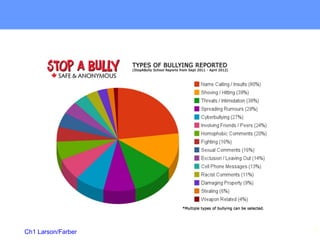
Sometimes data is represented
graphically.
4
Ch1 Larson/Farber 5
Ch1 Larson/Farber
Where does Statistics come
from

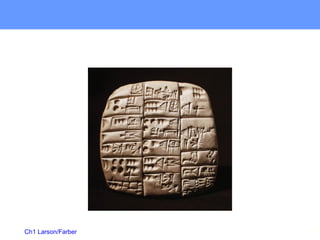
The use of Statistics dates back to census
taking to ancient Babylonia, Egypt, and
later the Roman Empire, when data were
collected about matters concerning the
state, such as births and deaths. In fact,
the word statistics is derived from the Latin
word status, meaning “state”.
6
Ch1 Larson/Farber 7
Ch1 Larson/Farber 8
Statistics is the science of
collecting, organizing,
analyzing, and interpreting
data in order to make
decisions.
What Is Statistics?
Ch1 Larson/Farber
Objective

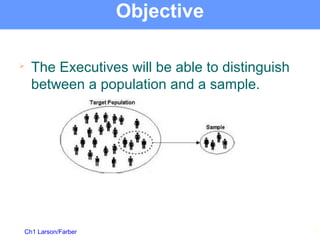
The Executives will be able to distinguish
between a population and a sample.
9
Ch1 Larson/Farber
DATA SETS

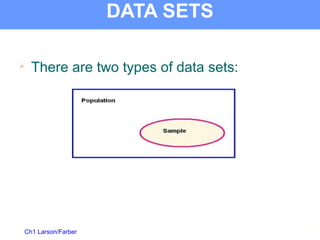
There are two types of data sets:
10
Ch1 Larson/Farber 11
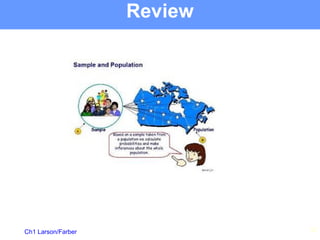
Important Terms
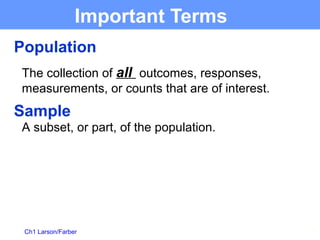
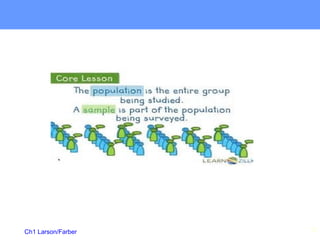
Population
The collection of all outcomes, responses,
measurements, or counts that are of interest.
Sample
A subset, or part, of the population.
Ch1 Larson/Farber 12
Ch1 Larson/Farber
Example 1 (page 3)

Identifying Data Sets:

In a recent survey, 1500 adults in the
United States were asked if they thught
there was solid evidence of global
warming. Eight hundred fifty-five of the
adults said yes. Identify the population
and the sample. Describe the sample data
set.
13
Ch1 Larson/Farber
Independent Work

Try it yourself 1 for 7 min.

Partner work for 5 min.

Class discussion.
14
Ch1 Larson/Farber
Class Discussion

Classifying a Data Set. Page 6

Exit Ticket

Independent work page 7, questions 26-
34 even.
15
Ch1 Larson/Farber
Objective

The Executives will be able to distinguish
between a parameter and a statistic.
16
Ch1 Larson/Farber 17
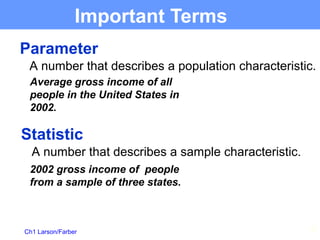
Important Terms
Parameter
A number that describes a population characteristic.
Statistic
A number that describes a sample characteristic.
Average gross income of all
people in the United States in
2002.
2002 gross income of people
from a sample of three states.
Ch1 Larson/Farber
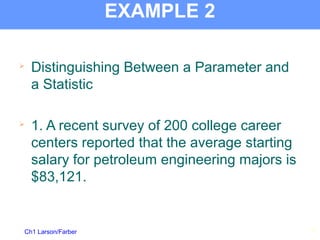
EXAMPLE 2

Distinguishing Between a Parameter and
a Statistic

1. A recent survey of 200 college career
centers reported that the average starting
salary for petroleum engineering majors is
$83,121.
18
Ch1 Larson/Farber
Things to Ponder

Why can a sample statistic differ from
sample to sample, and a population
parameter is constant for a population?
19
Ch1 Larson/Farber
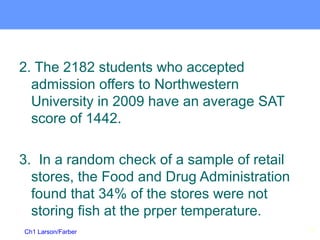
2. The 2182 students who accepted
admission offers to Northwestern
University in 2009 have an average SAT
score of 1442.
3. In a random check of a sample of retail
stores, the Food and Drug Administration
found that 34% of the stores were not
storing fish at the prper temperature.
20
Ch1 Larson/Farber

Try it yourself 2 (pg 4) for 7 min.

Partner work for 5 min.

Class discussion.
21
Ch1 Larson/Farber

Class review

Page 8

35-39

Exit Ticket

Page 8

40-42
22
Ch1 Larson/Farber
Objective

The Executives will learn how to
distinguish between descriptive statistics
and inferential statistics.
23
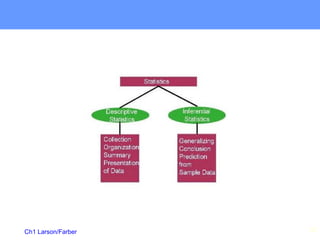
Ch1 Larson/Farber 24
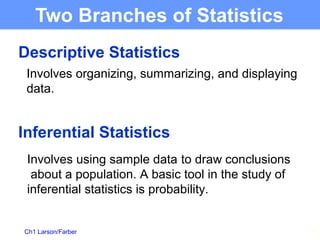
Inferential Statistics
Two Branches of Statistics
Descriptive Statistics
Involves organizing, summarizing, and displaying
data.
Involves using sample data to draw conclusions
about a population. A basic tool in the study of
inferential statistics is probability.
Ch1 Larson/Farber 25
Ch1 Larson/Farber
Example 3 (page 5)
1. A large sample of men, aged 48, was
studied for 18 years. For unmarried men
approximately 70% were alive at age 65.
For married men 90% were alive at age
65.
2. In a sample of Wall Street analysts, the
percentage who incorrectly forecasted
high-tech earnings in a recent year wass
44%.
26
Ch1 Larson/Farber

Try it yourself 3 (pg 5) for 7 min.

Partner work for 5 min.

Class discussion.
27
Ch1 Larson/Farber
Review
28
Ch1 Larson/Farber
Class practice
Page 8 43-44
Page 29
Exercise 3/9, 4/10
Exit Ticket
Page 8
Question 46 29

Statistics ch01.1

Editor's Notes

  • #9 Most students have enrolled in statistics because it is required. Most have no idea of what statistics is about. In Chapter 1 you’ll learn about different types of data (pieces of information) and methods of collecting data.
  • #12 To learn about any subject, it is important that you know the language of that subject. Here are some commonly used terms. Although a group of people working for a specific computer software company is shown, the population actually consists of the data set. Each piece of data is represented by an x. The population could be the type of car they each drive, their seniority rank, the year they were born or their gross income in 2002. How do you know if a data set is a population or a sample? This depends on the context of the problem. If you are doing a study that only concerns workers of this company then use the people in the company to produce the population of values. On the other hand, if your study involves all workers in computer software companies in California, then you would use all the people at the top as a sample (called a cluster sample) of the population. Each population has many many possible samples. Population of values may not come from people at all. If you are interested in the miles per gallon of all Honda Civics then the population would be measured from the cars.
  • #18 These terms are used throughout the course. The arrows at the end, emphasize the connection between population parameter and sample statistic. You will also later learn that this type of sample is called a cluster sample because it comes from intact units in the population.
  • #25 Descriptive statistics involve graphs creating numerical summaries. Techniques of descriptive statistics will be covered in the next chapter. Inferential statistics will be introduced in later chapters.