

LATIN SQUARE
DESIGN
PRESENTED BY: MANISHA THAKUR
DEFINITION
A Latin square is a square array of objects (letters A, B, C, …) such that each
object appears once and only once in each row and each column. Example -
4 x 4 Latin Square.
A B C D
B C D A
C D A B
D A B C
LATIN SQUARE DESIGN
Latin Square Designs
Selected Latin Squares can be in these forms:
3 x 3 4 x 4
A B C A B C D A B C D A B C D A B C D
B C A B A D C B C D A B D A C B A D C
C A B C D B A C D A B C A D B C D A B
D C A B D A B C D C B A D C B A
In a Latin square we have three factors:
• Treatments (t)(letters A, B, C, …)
• Rows (t)
• Columns (t)
The number of treatments = the number of rows = the number of columns = t.
The row-column treatments are represented by cells in a t x t array.
The treatments are assigned to row-column combinations using a Latin-square
arrangement.
Procedure for a Latin Experiment
An appropriate randomization strategy is as follows:
1. Write down any Latin square of the required size (it could be a standard
Latin square)
2. Randomize the order of the rows.
3. Randomize the order of the columns.
4. Randomize the allocation of treatments to the letters of the square.
EXAMPLE In this Experiment the we are interested in how weight gain
(Y) in rats is affected by Source of protein (Beef, Cereal, and Pork) and
by Level of Protein (High or Low). There are a total of t = 3 X 2 = 6 treat
ment combinations of the two factors.
1. Beef -High Protein
2. Cereal-High Protein
3. Pork-High Protein
4. Beef -Low Protein
5. Cereal-Low Protein
6. Pork-Low Protein
IN THIS EXAMPLE WE WILL CONSIDER USING A LATIN SQUARE
DESIGN
• Six Initial Weight categories are identified for the test animals in addition to Six
Appetite categories.
• A test animal is then selected from each of the 6 X 6 = 36 combinations of Initial
Weight and Appetite categories.
• A Latin square is then used to assign the 6 diets to the 36 test animals in the study.
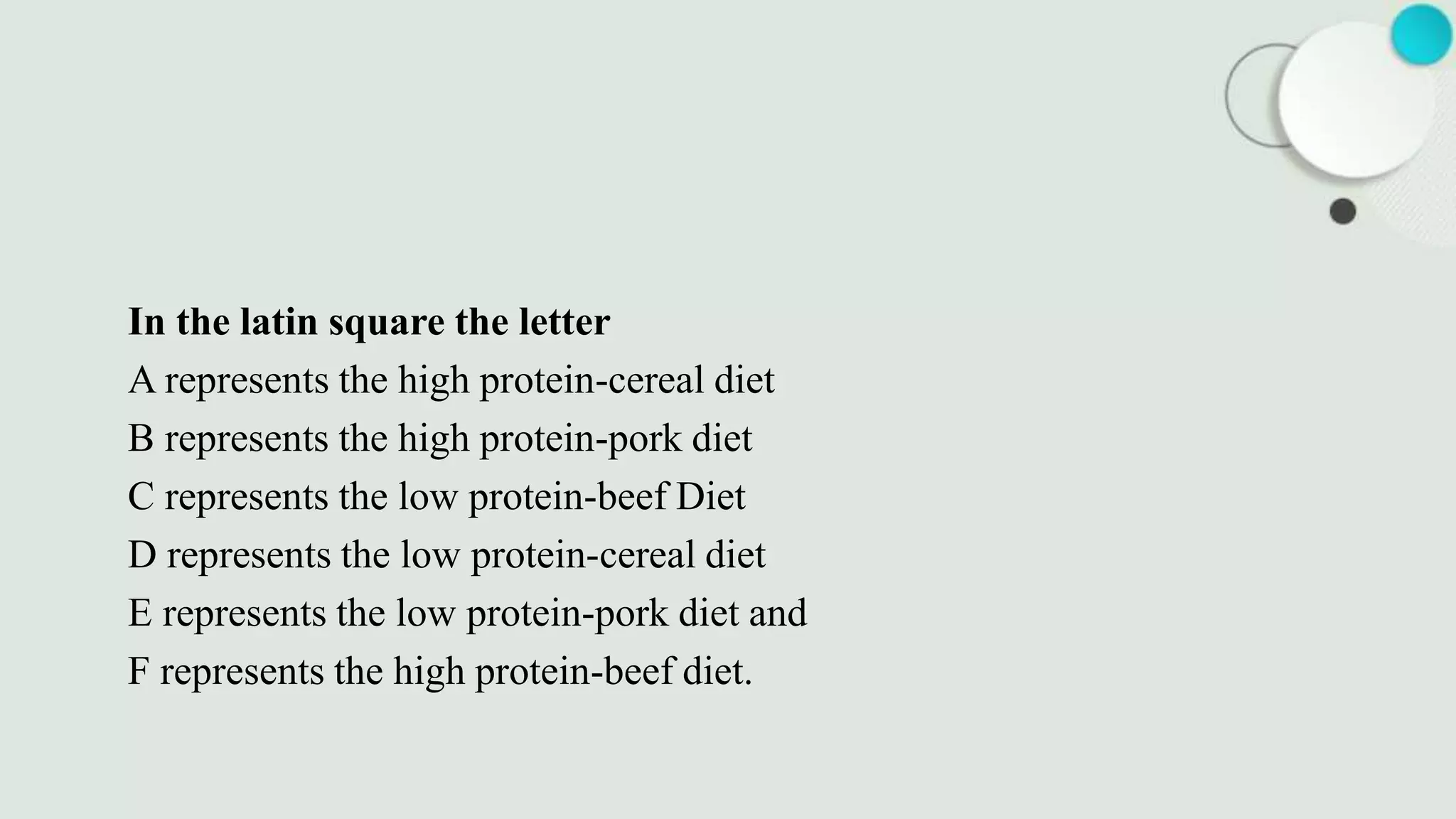
In the latin square the letter
A represents the high protein-cereal diet
B represents the high protein-pork diet
C represents the low protein-beef Diet
D represents the low protein-cereal diet
E represents the low protein-pork diet and
F represents the high protein-beef diet.
ADVANTAGES
1. Allows the experimenter to control two sources of variation
DISADVANTAGES
1. The experiment becomes very large if the number of treatments is
large.
2. The statistical analysis is complicated by missing plots and
misassigned treatments.
3. Error df is small if there are only a few treatments • This limitation
can be overcome by repeating a small Latin Square and then
combining the experiments - 3x3 Latin Square repeated 4 times, a
4x4 Latin Square repeated 2 times
LATIN SQUARE DESIGN - RESEARCH DESIGN

LATIN SQUARE DESIGN - RESEARCH DESIGN

  • 1.
  • 2.
    DEFINITION A Latin squareis a square array of objects (letters A, B, C, …) such that each object appears once and only once in each row and each column. Example - 4 x 4 Latin Square. A B C D B C D A C D A B D A B C LATIN SQUARE DESIGN
  • 3.
    Latin Square Designs SelectedLatin Squares can be in these forms: 3 x 3 4 x 4 A B C A B C D A B C D A B C D A B C D B C A B A D C B C D A B D A C B A D C C A B C D B A C D A B C A D B C D A B D C A B D A B C D C B A D C B A
  • 4.
    In a Latinsquare we have three factors: • Treatments (t)(letters A, B, C, …) • Rows (t) • Columns (t) The number of treatments = the number of rows = the number of columns = t. The row-column treatments are represented by cells in a t x t array. The treatments are assigned to row-column combinations using a Latin-square arrangement.
  • 5.
    Procedure for aLatin Experiment An appropriate randomization strategy is as follows: 1. Write down any Latin square of the required size (it could be a standard Latin square) 2. Randomize the order of the rows. 3. Randomize the order of the columns. 4. Randomize the allocation of treatments to the letters of the square.
  • 6.
    EXAMPLE In thisExperiment the we are interested in how weight gain (Y) in rats is affected by Source of protein (Beef, Cereal, and Pork) and by Level of Protein (High or Low). There are a total of t = 3 X 2 = 6 treat ment combinations of the two factors. 1. Beef -High Protein 2. Cereal-High Protein 3. Pork-High Protein 4. Beef -Low Protein 5. Cereal-Low Protein 6. Pork-Low Protein
  • 7.
    IN THIS EXAMPLEWE WILL CONSIDER USING A LATIN SQUARE DESIGN • Six Initial Weight categories are identified for the test animals in addition to Six Appetite categories. • A test animal is then selected from each of the 6 X 6 = 36 combinations of Initial Weight and Appetite categories. • A Latin square is then used to assign the 6 diets to the 36 test animals in the study.
  • 8.
    In the latinsquare the letter A represents the high protein-cereal diet B represents the high protein-pork diet C represents the low protein-beef Diet D represents the low protein-cereal diet E represents the low protein-pork diet and F represents the high protein-beef diet.
  • 13.
    ADVANTAGES 1. Allows theexperimenter to control two sources of variation
  • 14.
    DISADVANTAGES 1. The experimentbecomes very large if the number of treatments is large. 2. The statistical analysis is complicated by missing plots and misassigned treatments. 3. Error df is small if there are only a few treatments • This limitation can be overcome by repeating a small Latin Square and then combining the experiments - 3x3 Latin Square repeated 4 times, a 4x4 Latin Square repeated 2 times