Survival analysis
Dr HAR ASHISH JINDAL
JR
Contents
•
•
•
•
•
•
•
•
•

Survival
Need for survival analysis
Survival analysis
Life table/ Actuarial
Kaplan Meier product limit method
Log rank test
Mantel Hanzel method
Cox proportional hazard model
Take home message
Survival
• It is the probability of remaining alive for a
specific length of time.
• point of interest : prognosis of disease e.g.
– 5 year survival
e.g. 5 year survival for AML is 0.19, indicate 19% of
patients with AML will survive for 5 years after
diagnosis
Survival
• In simple terms survival (S) is mathematically
given by the formula;
S = A-D/A
A = number of newly diagnosed patients under
observation
D= number of deaths observed in a specified period
e.g For 2 year survival:
S= A-D/A= 6-1/6 =5/6 = .83=83%
e.g For 5 year survival:
S= A-D/A
Censoring
• Subjects are said to be censored
– if they are lost to follow up
– drop out of the study,
– if the study ends before they die or have an outcome of
interest.

• They are counted as alive or disease-free for the
time they were enrolled in the study.
• In simple words, some important information
required to make a calculation is not available to
us. i.e. censored.
Types of censoring

Three Types of
Censoring

Right censoring

Left censoring

Interval censoring
Right Censoring
• Right censoring is the most common of concern.
• It means that we are not certain what happened to
people after some point in time.
• This happens when some people cannot be
followed the entire time because they died or were
lost to follow-up or withdrew from the study.
Left Censoring
• Left censoring is when we are not certain what
happened to people before some point in time.
• Commonest example is when people already have
the disease of interest when the study starts.
Interval Censoring
• Interval censoring is when we know that
something happened in an interval (i.e. not before
starting time and not after ending time of the study
), but do not know exactly when in the interval it
happened.
• For example, we know that the patient was well at
time of start of the study and was diagnosed with
disease at time of end of the study, so when did the
disease actually begin?
• All we know is the interval.
2 possibilities

B AND E Survived
5 years

S=6- 2/6=4/6=0.67=67%

FOR 5 YEAR
SURVIVAL
B and E did not
survive for full 5
years .

S=6-4/6= 2/6= 0.33=33%

Conclusion: since the observations are censored , it is not possible to know
how long will subject survive . Hence the need for Special techniques to
account such censored observations
Need for survival analysis
• Investigators frequently must analyze data before all
patients have died; otherwise, it may be many years
before they know which treatment is better.
• Survival analysis gives patients credit for how long they
have been in the study, even if the outcome has not yet
occurred.
• The Kaplan–Meier procedure is the most commonly used
method to illustrate survival curves.
• Life table or actuarial methods were developed to show
survival curves; although surpassed by Kaplan–Meier
curves.
What is survival analysis?
• Statistical methods for analyzing longitudinal data on
the occurrence of events.
• Events may include death, injury, onset of
illness, recovery from illness (binary variables) or
transition above or below the clinical threshold of a
meaningful continuous variable (e.g. CD4 counts).
• Accommodates data from randomized clinical trial or
cohort study design.

15
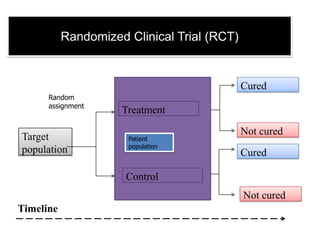
Randomized Clinical Trial (RCT)

Disease
Random
assignment

Target
population

Intervention
Diseasefree, at-risk
cohort

Disease-free
Disease

Control

Disease-free
Timeline
Randomized Clinical Trial (RCT)

Cured
Random
assignment

Target
population

Treatment
Patient
population

Not cured
Cured

Control

Not cured
Timeline

TIME
Randomized Clinical Trial (RCT)
Dead
Random
assignment

Target
population

Treatment
Patient
population

Alive
Dead

Control

Alive
Timeline

TIME
Cohort study (prospective/retrospective)
Disease
Exposed

Target
population

Disease-free
cohort

Disease-free
Disease

Unexposed

Disease-free
Timeline

TIME
Objectives of survival analysis
 Estimate time-to-event for a group of
individuals, such as time until second heart-attack for a
group of MI patients.
 To compare time-to-event between two or more
groups, such as treated vs. placebo MI patients in a
randomized controlled trial.
 To assess the relationship of co-variables to time-toevent, such as: does weight, insulin resistance, or
cholesterol influence survival time of MI patients?

20
nominal

Censored
observations

Kaplan- meier
or
Actuarial

Scale of
measurement of
dependent variable
numerical

Censored
observations
Cox Proportional
Hazard Model
Life table
History of life table

• John Graunt developed a life table in 1662 based on
London‟s bills of mortality, but he engaged in a great deal
of guess work because age at death was unrecorded and
because London‟s population was growing in an unquantified manner due to migration.
HISTORY OF THE LIFE TABLE

Edmund Halley (1656 – 1742) - ‘An estimate of
the Degree of the Mortality of Mankind drawn
from the curious Table of the Births and
Funerals at the city of Breslau’.
Life table/ Actuarial methods
Actuary means “someone collection and interpretation of
numerical data (especially someone who uses statistics to
calculate insurance premiums)”
Known as the Cutler–Ederer method (1958) in the
medical literature
Widely used for descriptive and analytical purposes in
demography, public health, epidemiology, population
geography, biology and many other branches of sci ence.
Describe the extent to which a generation of people dies
off with age.
Life table
A special type of analysis which takes into account the
life history of a hypothetical group or cohort of people
that decreases gradually by death till all members of the
group died.
A special measure not only for mortality but also for
other vital events like reproduction, chances of survival
etc.
Uses & Applications
The probability of surviving any particular year of age

Remaining life expectancy for people at different ages
Moreover, can be used to assess:
At the age of 5, to find number of children likely to
enter primary school.
At the age of 15, to find number of women entering
fertile period.
At age of 18, to find number of persons become
eligible for voting.
Uses & Applications
Computation of net reproduction rates.

Helps to project population estimates by age & sex.
To estimate the number likely to die after joining service
till retirement, helping in budgeting for payment towards
risk or pension.
If
we want to construct a life table
showing survival & death
in a cohort of 150000 babies

STEPS
Steps
1. These 1,50,000 babies born at same time were subjected to those
mortality influences at various ages that influence population at
certain period of time.
2. On the basis of mortality rates operating, we can estimate what
number would be alive at first birthday by applying mortality rates
during first year on them.
3. By applying mortality rates of second year on numbers of babies
surviving at the end of the first year, we estimate number who
would survive at the end of second year.
4. Similarly for other ages by applying mortality rates of selected year
follow them till all members of cohort die.
5. These number of survivors at various ages form the basic data set
out in a life table.
6. From these numbers we can calculate the average life time a person
can expect to live after any age.
SECOND COLUMN (lx)
SIXTH COLUMN (Px)
(Lx)
THIRD COLUMN )
FIFTH COLUMN(ex0(dx) age ‘x’ out of
EIGHT aggregate
• lx is thenumber of years are expected to attain exact of lx persons
It is of persons who lived in COLUMN by cohort
COLUMN person survive till his x
(qx)
• ItItmeasures number FOURTH of precise‘lx’ x willof given reaching
•• number of births. thatof person ofamong aagewho dieabefore agenext
the probability
a persons
Itisgives the average numbers years (Tx)
between ages x & rate to which population
x+1
•‘x+1’ the mortality SEVENTH COLUMN groups would be exposed, but it
It is
b’daybenumber 1,42,759 in lx COLUMN (x) ‘0’ year indicates the
cannumber same
• • Thus isLx=lx-1/2dx astolived by group fromrates obtained fromthem die.
It is the expected theFIRST column against x until all of death
age
not the of years live under the prevailing mortality conditions.
• number that begin their life together and a particular year year ofso
Since a dx=lx-(lx+1) either live or die in are running first of life their
person must age specific death
The age exact years of age starting
••••It gives Tx=(Lx)+(Lx+1)+(Lx+2)+……………Ln. fromby
Thus the 2, Lx=108163-1/2×3144=106591
For expectation of life at age x is obtained age
OR
registration records.
qx+px=1 life0table corresponding to ‘x = 0’
• Thusis based =Tx/lx
In for qx= on assumption that deaths are evenly distributed
life. this the above table
•••0,1,2,3…………………99. T0=129197+111899+106591+……..+9+5+2=
Lx
ex dx/lx.
So px=1-qx
• throughout the year. against q0=27124/142759=.19000
If x=2,
in above 1,15,635
4638611z e20 life table, x=0/ 108163 40.66
•• Similarly dx=142759-115635=27124= indicates the number who have
Forx=0,figure = 4397525 then 1 year
• completed first year q1=7472/115635=.06462 second & so on.
For Similarly for x=1, of life and running the
p0=1-0.19000=0.81000
= also 0 dx=115635-108163=7472
• • •If ‘xx=95,then calculated = 1.5 = lx+(lx+1)
Lx can 1’ e be = 32 / 21 as: Lx
For
95
••
Similarly x=1, p1=1-0.06462=0.93538

2

Table 1. Life table of a birth cohort
1

2

3

4

5

6

7

8

Age
X

Living
at age x
(lx)

Dying
b/w x &
x+1 (dx)

Mortality
rate (qx)

Survival
rate (px)

Living
b/w x &
x+1 (Lx)

Living
above
age x (Tx)

Life
expectancy
at x (ex0)

0

142759

27124

.19000

.81000

129197

4638611

32.49

1

115635

7472

.06462

.93538

111899

4509414

39.00

2

108163

3144

.02907

.97093

106591

4397525

40.66

3

.

.

.

.

.

.

.
Age
x

Living
Dying Mortality
at age x b/w x & rate (qx)
x+1 (dx)
(lx)

1

2

3

Survival
rate (px)

4

Living
b/w x &
x+1 (Lx)

5

Living
> age x
(Tx)

6

Life
expectancy
at x (ex0)

7

8

0

142759

27124

.19000

.81000

129197

4638611

32.49

1

115635

7472

.06462

.93538

111899

4509414

39.00

2

108163

3144

.02907

.97093

106591

4397525

40.66

3

105019

3254

.03098

.96902

103392

4290934

40.86

4

102006

2006

.01967

.98033

101121

4187542

41.05

5

100000

.01710

.98290

99145

4086420

40.86

.

.

.

.

.

.

.

.

.

.

.

.

.

.

.

.

.

.

.

.

.

.

.

.

95

21

9

.40957

.59043

16

32

1.52

96

12

6

.42932

.57068

9

16

1.34

97

6

3

.44964

.55036

5

7

1.17

98

3

1

.47046

.52954

2

2

0.64

99

1

1

.49176

.50823

…

…

…

1710
Modified life table
1. For survival in different treatment regimens
2. Arrange the the 13 patients on etoposide plus
cisplatin(treatment arm =1) according to
length of time they had no progression of
their disease.
3. Features of the intervals:
1. arbitrary
2. should be selected with minimum censored
observations
Life table for sample of 13 patient treated with etoposide with cisplatin
Life Table Survival Variable: Progression-Free Survival

ni

wi

di

No. of pts (13) began the
study, so n1 is 13
Interval
No.
No.
No.
No. of
Start entering withdrawn exposed terminal
2 patients are
Time
Interval
du.referredto risk
events
to as
Interval
withdrawals (w1).

qi = di/[ni- pi = 1–qi si = pipi–1pi(wi/2)]
2…p1
Propn
Propn
terminating surviving

Cumul Propn
Surv at End

0.0

13.0

2.0

12.0

1.0

1 patient's disease
0.0833 progressed, referred
0.9167
0.9167
to as a terminal
event (d1)

3.0

10.0

4.0

8.0

1.0

0.1250

0.8750

0.8021

6.0

5.0

4.0

3.0

0.0

0.0000

1.0000

0.8021

9.0

1.0

1.0

0.5

0.0

0.0000

1.0000

0.8021

Source: Noda K, Nishiwaki Y, Kawahara M, Negoro S, Sugiura T, Yokoyama A, et al: Irinotecan plus cisplatin
compared with etoposide plus cisplatin for extensive small-cell lung cancer. N Engl J Med 2002; 346: 85–
Assumption:
• The actuarial method assumes that patients withdraw
randomly throughout the interval; therefore, on the
average, they withdraw halfway through the time
represented by the interval.
• In a sense, this method gives patients who withdraw credit
for being in the study for half of the period.
Life table for sample of 13 patient treated with etoposide with cisplatin
Life Table Survival Variable: Progression-Free Survival

ni

wi

Interval
No.
No.
Start entering withdrawn
Time
Interval
du.
Interval

One-half of the number of patients
di
qi = di/[niwithdrawing is subtracted from the pi = 1–qi
(wi/2)]
number beginning the interval, so the
EXPOSED TO RISK during the
period, 13 – No. of2), or 12 in first
(½
No.
Propn
Propn
interval. terminal terminating surviving
exposed

to risk

si = pipi–1pi2…p1
Cumul Propn
Surv at End

events

0.0

13.0

2.0

12.0

1.0

0.0833

0.9167

0.9167

3.0

10.0

4.0

8.0

1.0

0.1250

0.8750

0.8021

6.0

5.0

4.0

3.0

0.0

0.0000

1.0000

0.8021

9.0

1.0

1.0

0.5

0.0

0.0000

1.0000

0.8021

Source: Noda K, Nishiwaki Y, Kawahara M, Negoro S, Sugiura T, Yokoyama A, et al: Irinotecan plus cisplatin
compared with etoposide plus cisplatin for extensive small-cell lung cancer. N Engl J Med 2002; 346: 85–
Life table for sample of 13 patient treated with etoposide with cisplatin
Life Table Survival Variable: Progression-Free Survival

ni

wi

Interval
No.
No.
Start entering withdrawn
Time
Interval
du.
Interval

di
No.
exposed
to risk

qi = di/[ni- pi = 1–qi si = pipi–1pi(wi/2)]
2…p1

The of
No. proportion terminating (q1
Propn
Propn
= d1/[n1-(w1/2]) is 1/12 =
terminal terminating surviving
0.0833.
events

Cumul Propn
Surv at End

0.0

13.0

2.0

12.0

1.0

0.0833

0.9167

0.9167

3.0

10.0

4.0

8.0

1.0

0.1250

0.8750

0.8021

6.0

5.0

4.0

3.0

0.0

0.0000

1.0000

0.8021

9.0

1.0

1.0

0.5

0.0

0.0000

1.0000

0.8021

Source: Noda K, Nishiwaki Y, Kawahara M, Negoro S, Sugiura T, Yokoyama A, et al: Irinotecan plus cisplatin
compared with etoposide plus cisplatin for extensive small-cell lung cancer. N Engl J Med 2002; 346: 85–
Life table for sample of 13 patient treated with etoposide with cisplatin
Life Table Survival Variable: Progression-Free Survival

ni

wi

Interval
No.
No.
Start entering withdrawn
Time
Interval
du.
Interval

di
No.
exposed
to risk

qi = di/[ni- pi = 1–qi si = pipi–1pi(wi/2)]
2…p1

No. of
Propn
Propn
Cumul Propn
terminal proportion surviving (p1 = 1-q1) is 1End
Surv at –
The terminating surviving
events
0.0833 = 0.9167

0.0

13.0

2.0

12.0

1.0

0.0833

0.9167

3.0

10.0

4.0

8.0

1.0

0.1250

0.8750 we are still in
0.8021
because

6.0

5.0

4.0

3.0

0.0

0.0000

9.0

1.0

1.0

0.5

0.0

0.0000

0.9167

the first period, the
cumulative survival is
1.0000
0.8021
0.9167

1.0000

0.8021

Source: Noda K, Nishiwaki Y, Kawahara M, Negoro S, Sugiura T, Yokoyama A, et al: Irinotecan plus cisplatin
compared with etoposide plus cisplatin for extensive small-cell lung cancer. N Engl J Med 2002; 346: 85–
Life table for sample of 13 patient treated with etoposide with cisplatin
Life Table Survival Variable: Progression-Free Survival

ni

wi

di

Interval
No.
No.
No.
No. of
the
Start At entering withdrawn exposed terminal
Time beginning of
Interval
du.
to risk
events
the second
four
Interval patients
withdraw w2 = 4
interval, only
0.0 10 patients
13.0
2.0
12.0
1.0
remain.n2=10

3.0

10.0

4.0

8.0

1.0

6.0

5.0

4.0

3.0

0.0

9.0

1.0

1.0

0.5

0.0

qi = di/[ni- pi = 1–qi si = pipi–1pi(wi/2)]
2…p1
Propn
Propn
terminating surviving

0.0833

0.9167

one's
0.1250
0.8750
disease
progressed,
so d2 = 1

Cumul Propn
Surv at End

0.9167
0.8021

0.0000

1.0000

0.8021

0.0000

1.0000

0.8021

Source: Noda K, Nishiwaki Y, Kawahara M, Negoro S, Sugiura T, Yokoyama A, et al: Irinotecan plus cisplatin
compared with etoposide plus cisplatin for extensive small-cell lung cancer. N Engl J Med 2002; 346: 85–
Life table for sample of 13 patient treated with etoposide with cisplatin
Life Table Survival Variable: Progression-Free Survival

ni

wi

di

Interval
No.
No.
No.
No. of
Start entering withdrawn exposed terminal
Time
Interval
du.
to risk
events
Interval
the proportion terminating (q2
nd
0.0
13.0 = d2/[n2-(w2/2]) during 2
2.0
12.0
1.0
interval is 1/[10 – (4/2)] =
1/8, or 0.1250.

qi = di/[ni- pi = 1–qi si = pipi–1pi(wi/2)]
2…p1
Propn
Propn proportion
the Cumul Propn
terminating surviving no
with Surv at End
progression is
1 – 0.1250, or
0.8750 0.9167
0.0833
0.9167

3.0

10.0

4.0

8.0

1.0

0.1250

0.8750

0.8021

6.0

5.0

4.0

3.0

0.0

0.0000

1.0000

0.8021

9.0

1.0

1.0

0.5

0.0

0.0000

1.0000

0.8021

Source: Noda K, Nishiwaki Y, Kawahara M, Negoro S, Sugiura T, Yokoyama A, et al: Irinotecan plus cisplatin
compared with etoposide plus cisplatin for extensive small-cell lung cancer. N Engl J Med 2002; 346: 85–
Life table for sample of 13 patient treated with etoposide with cisplatin
Life Table Survival Variable: Progression-Free Survival

ni

wi

Interval
No.
No.
Start entering withdrawn
Time
Interval
du.
Interval

0.0
3.0

13.0
10.0

2.0

di
No.
exposed
to risk

No. of
terminal
events

qi = di/[ni- pi = 1–qi si = pipi–1pi(wi/2)]
2…p1
Propn
Propn
terminating surviving

the
12.0 cumulative proportion of surv
1.0
0.0833
0.9167

4.0

8.0

6.0 from probability theory:
5.0
4.0
Rule

3.0

=p1*p2= 0.0.9167 × 0.8750=
0.8021

Cumul Propn
Surv at End

0.9167

1.0

0.1250

0.8750

0.8021

0.0

0.0000

1.0000

0.8021

0.0

0.0000

1.0000

0.8021

P(A&B)=P(A)*P(B) if A and B independent

9.0

1.0

1.0

0.5

Source: Noda K, Nishiwaki Y, Kawahara M, Negoro S, Sugiura T, Yokoyama A, et al: Irinotecan plus cisplatin
compared with etoposide plus cisplatin for extensive small-cell lung cancer. N Engl J Med 2002; 346: 85–9
Life table
• Like Cancer treatment, life table of survivorship after any
treatment as treatment of cancer by irradiation or drugs or
after operation, such as of cancer cervix or breast can be
prepared & made use in probabilities of survival at
beginning or at any point of time.
• More recently, survival can be enquired after– Heart operation like bypass, angioplasty, ballooning,
stenting, heart transplantation.
– Kidney, lung, liver & other organ transplantation.
Life Table
• This computation procedure continues until the table is
completed.
• pi = the probability of surviving interval i only; to
survive interval i, a patient must have survived all
previous intervals as well.
• The probability of survival at one period is treated as
though it is independent of the probability of survival at
others
• Thus, pi is an example of a conditional probability
because the probability of surviving interval i is
dependent, or conditional, on surviving until that point.
• This is called survival function.
Limitation
• The assumption that all withdrawals during a given
interval occur, on average, at the midpoint of the
interval.
• This assumption is of less consequence when short
time intervals are analyzed; however, considerable
bias can occur :
• if the intervals are large,
• if many withdrawals occur, &
• if withdrawals do not occur midway in the
interval.
• The Kaplan–Meier method overcomes this problem.
Kaplan Meier product limit method
Kaplan-Meier Product limit method
• Similar to actuarial analysis except time since entry in
the study is not divided into intervals for analysis.
• Survival is estimated each time a patient has an event.
• Withdrawals are ignored
• It gives exact survival times in comparison to
actuarial because it does not group survival time into
intervals

46
Introduction to Kaplan-Meier
• Non-parametric estimate of the survival function.
• Commonly used to describe survivorship of study
population/s.
• Commonly used to compare two study populations.
• Intuitive graphical presentation.

47
Survival Data (right-censored)
Subject A
Subject B
Subject C
Subject D
Subject E
X 1. subject E dies at 4
months

0

Beginning of study

12

 Time in months 

End of study
Corresponding Kaplan-Meier Curve

100%
Probability of
surviving to 4
months is 100% =
5/5
Fraction
surviving this
death = 4/5
Subject E dies at 4
months

4

 Time in months 
Survival Data
Subject A
Subject B

2. subject A
drops out after
6 months

Subject C

3. subject C dies
X at 7 months

Subject D
Subject E
X 1. subject E dies at 4
months

Beginning of study

 Time in months 

End of study
Corresponding Kaplan-Meier Curve

100%

Fraction
surviving this
death = 2/3

subject C dies at
7 months

4

7

 Time in months 
Survival Data
Subject A

2. subject A
drops out after
6 months

Subject B
3. subject C dies
X at 7 months

Subject C

Subject D
Subject E

4. Subjects B
and D survive
for the whole
year-long
study period

X 1. subject E dies at 4
months

Beginning of study

 Time in months 

End of study
Corresponding Kaplan-Meier Curve

Rule from probability theory:

100%

P(A&B)=P(A)*P(B) if A and B independent
In kaplan meier : intervals are defined by failures(2 intervals leading to failures here).

P(surviving intervals 1 and 2)=P(surviving interval 1)*P(surviving interval 2)

Product limit estimate of survival =
P(surviving interval 1/at-risk up to failure 1) *
P(surviving interval 2/at-risk up to failure 2)
= 4/5 * 2/3= .5333
The probability of surviving in the entire year, taking into account
censoring
= (4/5) (2/3) = 53%

0

 Time in months 

12
Example :kaplan–Meier survival curve in detail for
patients on etoposide plus cisplatin
Event
Time
(T)

Number at
Risk
ni

Number of
Events
di

Mortality
qi = di/ni

Survival
pi = 1 - qi

Cumulative Survival
S = pip(i-1)…p2p1

1.0

13

1

0.076

0.9231

0.9231

2.4

12

2.8

11

3.1

10

3.7

9

4.4

8

4.6

7

4.7

6

6.5

5

7.1

4

8.0

3

8.1

2

12.0

1

• In this method first step is to list the times when a death or drop
out occurs, as in the column “Event Time”.
1

0.1250

0.8750

0.8077

• One patient's disease progressed at 1 month and another at 4.4
months, and they are listed under the column “Number of Events.”
• Then, each time an event or outcome occurs, the mortality,
survival, and cumulative survival are calculated in the same
manner as with the life table method.
Contd…
• If the table is published in an article, it is often
formatted in an abbreviated form, such as in Table 5.
Kaplan–Meier survival curve in abbreviated form for patients on etoposide plus
cisplatin
Event Time
(T)

Number at
Risk
ni

Number of
Events
di

Mortality
qi = di/ni

Survival
pi = 1 - qi

Cumulative Survival
S = pip(i-1)…p2p1

1.0

13

1

0.076

0.9231

0.9231

4.4

8

1

0.1250

0.8750

0.8077

..
..
..
12.0
2.0

4.0

6.0

8.0

10.0

12.0

Kaplan meir survival curve for patients on etoposide & cisplatin
(Source: Source: Noda K, Nishiwaki Y, Kawahara M, Negoro S, Sugiura T, Yokoyama A, et al: Irinotecan
plus cisplatin compared with etoposide plus cisplatin for extensive small-cell lung cancer. N Engl J Med
2002; 346: 85–91.)
Limitations of Kaplan-Meier
• Requires nominal predictors only
• Doesn‟t control for covariates

Cox progressive hazard model solves these problems

57
Kaplan meir survival curve with 95 % confidence limits for
patients on irinotecan & cisplatin
(Source: Source: Noda K, Nishiwaki Y, Kawahara M, Negoro S, Sugiura T, Yokoyama A, et al:
Irinotecan plus cisplatin compared with etoposide plus cisplatin for extensive small-cell lung
cancer. N Engl J Med 2002; 346: 85–91.)
Comparison between 2 survival
curve
• Don’t make judgments simply on
the basis of the amount of
separation between two lines
Comparison between 2 survival
curve
• For comparison if no censored observations
occur, the Wilcoxon rank sum test introduced,
is appropriate for comparing the ranks of
survival time.
• If some observations are censored, methods
may be used to compare survival curves.
– the Logrank statistic
– the Mantel–Haenszel chi-square statistic.
Logrank test
• The log rank statistic is one of the most
commonly used methods to learn if two curves
are significantly different.
• This method also known as Mantel-logrank
statistics or Cox-Mantel-logrank statistics
• The logrank test compares the number of
observed deaths in each group with the number of
deaths that would be expected based on the
number of deaths in the combined groups that is,
if group membership did not matter.
Hazard ratio
• The logrank statistic calculates the hazard ratio
• It is estimated by O1st group/E1st group
divided by O2nd group/E2group
• The hazard ratio is interpreted in a similar
manner as the odds ratio
• Using the hazard ratio assumes that the hazard
or risk of death is the same throughout the time
of the study.
Mantel– Haenszel chi test
• Another method for comparing survival distributions is
an estimate of the odds ratio developed by Mantel and
Haenszel that follows (approximately) a chi-square
distribution with 1 degree of freedom.
• The Mantel– Haenszel test combines a series of 2 2
tables formed at different survival times into an overall
test of significance of the survival curves.
• The Mantel–Haenszel statistic is very useful because it
can be used to compare any distributions, not simply
survival curves
Cox progressive hazard model
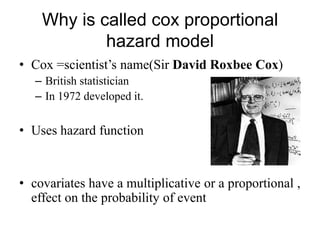
Why is called cox proportional
hazard model
• Cox =scientist‟s name(Sir David Roxbee Cox)
– British statistician
– In 1972 developed it.

• Uses hazard function

• covariates have a multiplicative or a proportional ,
effect on the probability of event
What does cox model do>
• It examines two pieces of information:
– The amount of time since the event first happened
to a person
– The person‟s observations on the independent
variables.
Cox progressive hazard model
• Used to assess the simultaneous effect of
several variables on length of survival.
• It allows the covariates(independent variables)
in the regression equation to vary with time.
• Both numerical and nominal independent
variables may be used in this model.
COX regression coefficient
• Determines relative risk or odd‟s ratio
associated with each independent variable and
outcome variable, adjusted for the effect of all
other variables .
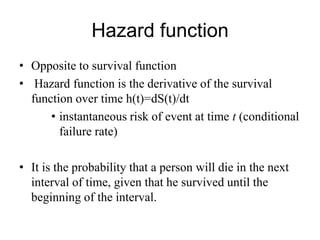
Hazard function
• Opposite to survival function
• Hazard function is the derivative of the survival
function over time h(t)=dS(t)/dt
• instantaneous risk of event at time t (conditional
failure rate)
• It is the probability that a person will die in the next
interval of time, given that he survived until the
beginning of the interval.
Hazard function
• Hazard function given by
h(t,x1,x2…x5)=ƛ0 (t)eb1x1+b2x2+….b5x5
• ƛ0 is the baseline hazard at time t i.e. ƛ0(t)
• For any individual subject the hazard at time t is hi(t).
• hi(t) is linked to the baseline hazard h0(t) by
loge {hi(t)} = loge{ƛ0(t)} + β1X1 + β2X2 +……..+ βpXp

• where X1, X2 and Xp are variables associated with the
subject
Proportional hazards:

Hazard ratio
Hazard for person i (eg a smoker)

hi (t ) 0 (t )e 1xi1 ...  k xik
 ( x  x ) ... 1 ( xik  x jk )
HRi , j 

 e 1 i1 j 1
h j (t ) 0 (t )e 1x j1 ...  k x jk
Hazard for person j (eg
a non-smoker)

Hazard functions should be strictly parallel!
Produces covariate-adjusted hazard ratios!

71
The model: binary predictor



HRlung cancer/ smoking

(1)  

hi (t ) 0 (t )e smoking age

(10 )


 e smoking
h j (t ) 0 (t )e  smoking ( 0)  age ( 60)

HRlung cancer/ smoking  e

( 60 )

 smoking

This is the hazard ratio for smoking adjusted for age.
72
Table 2. Death rates for screenwriters who have won an
academy award.* Values are percentages (95% confidence
intervals) and are adjusted for the factor indicated

Basic analysis
Adjusted analysis
Demographic:
Year of birth

Relative increase
in death rate for
winners
37 (10 to 70)

HR=1.37; interpretation:
37% higher incidence of
death for winners compared
with nominees

32 (6 to 64)

Sex

36 (10 to 69)

Documented education

39 (12 to 73)

All three factors

33 (7 to 65)

Professional:
Film genre
Total films
Total four star films
Total nominations
Age at first film

HR=1.35; interpretation:
35% higher incidence of
death for winners compared
with nominees even after
adjusting for potential
confounders

37 (10 to 70)
39 (12 to 73)
40 (13 to 75)
43 (14 to 79)
36 (9 to 68)

Age at first nomination

32 (6 to 64)

All six factors

40 (11 to 76)

All nine factors

35 (7 to 70)
Importance
• Provides the only valid method of predicting a
time dependent outcome , and many health
related outcomes related to time.
• Can be interpreted in relative risk or odds ratio
• Gives survival curves with control of
confounding variables.
• Can be used with multiple events for a subject.
Take Home Message
• survival analysis deals with situations where
the outcome is dichotomous and is a function
of time
• In survival data is transformed into censored
and uncensored data
• all those who achieve the outcome of interest
are uncensored” data
• those who do not achieve the outcome are
“censored” data
Take Home Message
• The actuarial method adopts fixed class intervals
which are most often year following the end of
treatment given.
• The Kaplan-Meier method uses the next
death, whenever it occurs, to define the end of the last
class interval and the start of the new class interval.
• Log-Rank test used to compare 2 survival curves but
does not control for confounding.
• Mantel henzel test can compare any curve not only
survial curves
• For control for confounding use another test called as
„Cox Proportional Hazards Regression.’
Thank you

Survival analysis

  • 1.
    Survival analysis Dr HARASHISH JINDAL JR
  • 2.
    Contents • • • • • • • • • Survival Need for survivalanalysis Survival analysis Life table/ Actuarial Kaplan Meier product limit method Log rank test Mantel Hanzel method Cox proportional hazard model Take home message
  • 3.
    Survival • It isthe probability of remaining alive for a specific length of time. • point of interest : prognosis of disease e.g. – 5 year survival e.g. 5 year survival for AML is 0.19, indicate 19% of patients with AML will survive for 5 years after diagnosis
  • 4.
    Survival • In simpleterms survival (S) is mathematically given by the formula; S = A-D/A A = number of newly diagnosed patients under observation D= number of deaths observed in a specified period
  • 5.
    e.g For 2year survival: S= A-D/A= 6-1/6 =5/6 = .83=83%
  • 6.
    e.g For 5year survival: S= A-D/A
  • 7.
    Censoring • Subjects aresaid to be censored – if they are lost to follow up – drop out of the study, – if the study ends before they die or have an outcome of interest. • They are counted as alive or disease-free for the time they were enrolled in the study. • In simple words, some important information required to make a calculation is not available to us. i.e. censored.
  • 8.
    Types of censoring ThreeTypes of Censoring Right censoring Left censoring Interval censoring
  • 9.
    Right Censoring • Rightcensoring is the most common of concern. • It means that we are not certain what happened to people after some point in time. • This happens when some people cannot be followed the entire time because they died or were lost to follow-up or withdrew from the study.
  • 10.
    Left Censoring • Leftcensoring is when we are not certain what happened to people before some point in time. • Commonest example is when people already have the disease of interest when the study starts.
  • 11.
    Interval Censoring • Intervalcensoring is when we know that something happened in an interval (i.e. not before starting time and not after ending time of the study ), but do not know exactly when in the interval it happened. • For example, we know that the patient was well at time of start of the study and was diagnosed with disease at time of end of the study, so when did the disease actually begin? • All we know is the interval.
  • 13.
    2 possibilities B ANDE Survived 5 years S=6- 2/6=4/6=0.67=67% FOR 5 YEAR SURVIVAL B and E did not survive for full 5 years . S=6-4/6= 2/6= 0.33=33% Conclusion: since the observations are censored , it is not possible to know how long will subject survive . Hence the need for Special techniques to account such censored observations
  • 14.
    Need for survivalanalysis • Investigators frequently must analyze data before all patients have died; otherwise, it may be many years before they know which treatment is better. • Survival analysis gives patients credit for how long they have been in the study, even if the outcome has not yet occurred. • The Kaplan–Meier procedure is the most commonly used method to illustrate survival curves. • Life table or actuarial methods were developed to show survival curves; although surpassed by Kaplan–Meier curves.
  • 15.
    What is survivalanalysis? • Statistical methods for analyzing longitudinal data on the occurrence of events. • Events may include death, injury, onset of illness, recovery from illness (binary variables) or transition above or below the clinical threshold of a meaningful continuous variable (e.g. CD4 counts). • Accommodates data from randomized clinical trial or cohort study design. 15
  • 16.
    Randomized Clinical Trial(RCT) Disease Random assignment Target population Intervention Diseasefree, at-risk cohort Disease-free Disease Control Disease-free Timeline
  • 17.
    Randomized Clinical Trial(RCT) Cured Random assignment Target population Treatment Patient population Not cured Cured Control Not cured Timeline TIME
  • 18.
    Randomized Clinical Trial(RCT) Dead Random assignment Target population Treatment Patient population Alive Dead Control Alive Timeline TIME
  • 19.
  • 20.
    Objectives of survivalanalysis  Estimate time-to-event for a group of individuals, such as time until second heart-attack for a group of MI patients.  To compare time-to-event between two or more groups, such as treated vs. placebo MI patients in a randomized controlled trial.  To assess the relationship of co-variables to time-toevent, such as: does weight, insulin resistance, or cholesterol influence survival time of MI patients? 20
  • 21.
    nominal Censored observations Kaplan- meier or Actuarial Scale of measurementof dependent variable numerical Censored observations Cox Proportional Hazard Model
  • 22.
  • 23.
    History of lifetable • John Graunt developed a life table in 1662 based on London‟s bills of mortality, but he engaged in a great deal of guess work because age at death was unrecorded and because London‟s population was growing in an unquantified manner due to migration.
  • 24.
    HISTORY OF THELIFE TABLE Edmund Halley (1656 – 1742) - ‘An estimate of the Degree of the Mortality of Mankind drawn from the curious Table of the Births and Funerals at the city of Breslau’.
  • 25.
    Life table/ Actuarialmethods Actuary means “someone collection and interpretation of numerical data (especially someone who uses statistics to calculate insurance premiums)” Known as the Cutler–Ederer method (1958) in the medical literature Widely used for descriptive and analytical purposes in demography, public health, epidemiology, population geography, biology and many other branches of sci ence. Describe the extent to which a generation of people dies off with age.
  • 26.
    Life table A specialtype of analysis which takes into account the life history of a hypothetical group or cohort of people that decreases gradually by death till all members of the group died. A special measure not only for mortality but also for other vital events like reproduction, chances of survival etc.
  • 27.
    Uses & Applications Theprobability of surviving any particular year of age Remaining life expectancy for people at different ages Moreover, can be used to assess: At the age of 5, to find number of children likely to enter primary school. At the age of 15, to find number of women entering fertile period. At age of 18, to find number of persons become eligible for voting.
  • 28.
    Uses & Applications Computationof net reproduction rates. Helps to project population estimates by age & sex. To estimate the number likely to die after joining service till retirement, helping in budgeting for payment towards risk or pension.
  • 29.
    If we want toconstruct a life table showing survival & death in a cohort of 150000 babies STEPS
  • 30.
    Steps 1. These 1,50,000babies born at same time were subjected to those mortality influences at various ages that influence population at certain period of time. 2. On the basis of mortality rates operating, we can estimate what number would be alive at first birthday by applying mortality rates during first year on them. 3. By applying mortality rates of second year on numbers of babies surviving at the end of the first year, we estimate number who would survive at the end of second year. 4. Similarly for other ages by applying mortality rates of selected year follow them till all members of cohort die. 5. These number of survivors at various ages form the basic data set out in a life table. 6. From these numbers we can calculate the average life time a person can expect to live after any age.
  • 31.
    SECOND COLUMN (lx) SIXTHCOLUMN (Px) (Lx) THIRD COLUMN ) FIFTH COLUMN(ex0(dx) age ‘x’ out of EIGHT aggregate • lx is thenumber of years are expected to attain exact of lx persons It is of persons who lived in COLUMN by cohort COLUMN person survive till his x (qx) • ItItmeasures number FOURTH of precise‘lx’ x willof given reaching •• number of births. thatof person ofamong aagewho dieabefore agenext the probability a persons Itisgives the average numbers years (Tx) between ages x & rate to which population x+1 •‘x+1’ the mortality SEVENTH COLUMN groups would be exposed, but it It is b’daybenumber 1,42,759 in lx COLUMN (x) ‘0’ year indicates the cannumber same • • Thus isLx=lx-1/2dx astolived by group fromrates obtained fromthem die. It is the expected theFIRST column against x until all of death age not the of years live under the prevailing mortality conditions. • number that begin their life together and a particular year year ofso Since a dx=lx-(lx+1) either live or die in are running first of life their person must age specific death The age exact years of age starting ••••It gives Tx=(Lx)+(Lx+1)+(Lx+2)+……………Ln. fromby Thus the 2, Lx=108163-1/2×3144=106591 For expectation of life at age x is obtained age OR registration records. qx+px=1 life0table corresponding to ‘x = 0’ • Thusis based =Tx/lx In for qx= on assumption that deaths are evenly distributed life. this the above table •••0,1,2,3…………………99. T0=129197+111899+106591+……..+9+5+2= Lx ex dx/lx. So px=1-qx • throughout the year. against q0=27124/142759=.19000 If x=2, in above 1,15,635 4638611z e20 life table, x=0/ 108163 40.66 •• Similarly dx=142759-115635=27124= indicates the number who have Forx=0,figure = 4397525 then 1 year • completed first year q1=7472/115635=.06462 second & so on. For Similarly for x=1, of life and running the p0=1-0.19000=0.81000 = also 0 dx=115635-108163=7472 • • •If ‘xx=95,then calculated = 1.5 = lx+(lx+1) Lx can 1’ e be = 32 / 21 as: Lx For 95 •• Similarly x=1, p1=1-0.06462=0.93538 2 Table 1. Life table of a birth cohort 1 2 3 4 5 6 7 8 Age X Living at age x (lx) Dying b/w x & x+1 (dx) Mortality rate (qx) Survival rate (px) Living b/w x & x+1 (Lx) Living above age x (Tx) Life expectancy at x (ex0) 0 142759 27124 .19000 .81000 129197 4638611 32.49 1 115635 7472 .06462 .93538 111899 4509414 39.00 2 108163 3144 .02907 .97093 106591 4397525 40.66 3 . . . . . . .
  • 32.
    Age x Living Dying Mortality at agex b/w x & rate (qx) x+1 (dx) (lx) 1 2 3 Survival rate (px) 4 Living b/w x & x+1 (Lx) 5 Living > age x (Tx) 6 Life expectancy at x (ex0) 7 8 0 142759 27124 .19000 .81000 129197 4638611 32.49 1 115635 7472 .06462 .93538 111899 4509414 39.00 2 108163 3144 .02907 .97093 106591 4397525 40.66 3 105019 3254 .03098 .96902 103392 4290934 40.86 4 102006 2006 .01967 .98033 101121 4187542 41.05 5 100000 .01710 .98290 99145 4086420 40.86 . . . . . . . . . . . . . . . . . . . . . . . . 95 21 9 .40957 .59043 16 32 1.52 96 12 6 .42932 .57068 9 16 1.34 97 6 3 .44964 .55036 5 7 1.17 98 3 1 .47046 .52954 2 2 0.64 99 1 1 .49176 .50823 … … … 1710
  • 33.
    Modified life table 1.For survival in different treatment regimens 2. Arrange the the 13 patients on etoposide plus cisplatin(treatment arm =1) according to length of time they had no progression of their disease. 3. Features of the intervals: 1. arbitrary 2. should be selected with minimum censored observations
  • 34.
    Life table forsample of 13 patient treated with etoposide with cisplatin Life Table Survival Variable: Progression-Free Survival ni wi di No. of pts (13) began the study, so n1 is 13 Interval No. No. No. No. of Start entering withdrawn exposed terminal 2 patients are Time Interval du.referredto risk events to as Interval withdrawals (w1). qi = di/[ni- pi = 1–qi si = pipi–1pi(wi/2)] 2…p1 Propn Propn terminating surviving Cumul Propn Surv at End 0.0 13.0 2.0 12.0 1.0 1 patient's disease 0.0833 progressed, referred 0.9167 0.9167 to as a terminal event (d1) 3.0 10.0 4.0 8.0 1.0 0.1250 0.8750 0.8021 6.0 5.0 4.0 3.0 0.0 0.0000 1.0000 0.8021 9.0 1.0 1.0 0.5 0.0 0.0000 1.0000 0.8021 Source: Noda K, Nishiwaki Y, Kawahara M, Negoro S, Sugiura T, Yokoyama A, et al: Irinotecan plus cisplatin compared with etoposide plus cisplatin for extensive small-cell lung cancer. N Engl J Med 2002; 346: 85–
  • 35.
    Assumption: • The actuarialmethod assumes that patients withdraw randomly throughout the interval; therefore, on the average, they withdraw halfway through the time represented by the interval. • In a sense, this method gives patients who withdraw credit for being in the study for half of the period.
  • 36.
    Life table forsample of 13 patient treated with etoposide with cisplatin Life Table Survival Variable: Progression-Free Survival ni wi Interval No. No. Start entering withdrawn Time Interval du. Interval One-half of the number of patients di qi = di/[niwithdrawing is subtracted from the pi = 1–qi (wi/2)] number beginning the interval, so the EXPOSED TO RISK during the period, 13 – No. of2), or 12 in first (½ No. Propn Propn interval. terminal terminating surviving exposed to risk si = pipi–1pi2…p1 Cumul Propn Surv at End events 0.0 13.0 2.0 12.0 1.0 0.0833 0.9167 0.9167 3.0 10.0 4.0 8.0 1.0 0.1250 0.8750 0.8021 6.0 5.0 4.0 3.0 0.0 0.0000 1.0000 0.8021 9.0 1.0 1.0 0.5 0.0 0.0000 1.0000 0.8021 Source: Noda K, Nishiwaki Y, Kawahara M, Negoro S, Sugiura T, Yokoyama A, et al: Irinotecan plus cisplatin compared with etoposide plus cisplatin for extensive small-cell lung cancer. N Engl J Med 2002; 346: 85–
  • 37.
    Life table forsample of 13 patient treated with etoposide with cisplatin Life Table Survival Variable: Progression-Free Survival ni wi Interval No. No. Start entering withdrawn Time Interval du. Interval di No. exposed to risk qi = di/[ni- pi = 1–qi si = pipi–1pi(wi/2)] 2…p1 The of No. proportion terminating (q1 Propn Propn = d1/[n1-(w1/2]) is 1/12 = terminal terminating surviving 0.0833. events Cumul Propn Surv at End 0.0 13.0 2.0 12.0 1.0 0.0833 0.9167 0.9167 3.0 10.0 4.0 8.0 1.0 0.1250 0.8750 0.8021 6.0 5.0 4.0 3.0 0.0 0.0000 1.0000 0.8021 9.0 1.0 1.0 0.5 0.0 0.0000 1.0000 0.8021 Source: Noda K, Nishiwaki Y, Kawahara M, Negoro S, Sugiura T, Yokoyama A, et al: Irinotecan plus cisplatin compared with etoposide plus cisplatin for extensive small-cell lung cancer. N Engl J Med 2002; 346: 85–
  • 38.
    Life table forsample of 13 patient treated with etoposide with cisplatin Life Table Survival Variable: Progression-Free Survival ni wi Interval No. No. Start entering withdrawn Time Interval du. Interval di No. exposed to risk qi = di/[ni- pi = 1–qi si = pipi–1pi(wi/2)] 2…p1 No. of Propn Propn Cumul Propn terminal proportion surviving (p1 = 1-q1) is 1End Surv at – The terminating surviving events 0.0833 = 0.9167 0.0 13.0 2.0 12.0 1.0 0.0833 0.9167 3.0 10.0 4.0 8.0 1.0 0.1250 0.8750 we are still in 0.8021 because 6.0 5.0 4.0 3.0 0.0 0.0000 9.0 1.0 1.0 0.5 0.0 0.0000 0.9167 the first period, the cumulative survival is 1.0000 0.8021 0.9167 1.0000 0.8021 Source: Noda K, Nishiwaki Y, Kawahara M, Negoro S, Sugiura T, Yokoyama A, et al: Irinotecan plus cisplatin compared with etoposide plus cisplatin for extensive small-cell lung cancer. N Engl J Med 2002; 346: 85–
  • 39.
    Life table forsample of 13 patient treated with etoposide with cisplatin Life Table Survival Variable: Progression-Free Survival ni wi di Interval No. No. No. No. of the Start At entering withdrawn exposed terminal Time beginning of Interval du. to risk events the second four Interval patients withdraw w2 = 4 interval, only 0.0 10 patients 13.0 2.0 12.0 1.0 remain.n2=10 3.0 10.0 4.0 8.0 1.0 6.0 5.0 4.0 3.0 0.0 9.0 1.0 1.0 0.5 0.0 qi = di/[ni- pi = 1–qi si = pipi–1pi(wi/2)] 2…p1 Propn Propn terminating surviving 0.0833 0.9167 one's 0.1250 0.8750 disease progressed, so d2 = 1 Cumul Propn Surv at End 0.9167 0.8021 0.0000 1.0000 0.8021 0.0000 1.0000 0.8021 Source: Noda K, Nishiwaki Y, Kawahara M, Negoro S, Sugiura T, Yokoyama A, et al: Irinotecan plus cisplatin compared with etoposide plus cisplatin for extensive small-cell lung cancer. N Engl J Med 2002; 346: 85–
  • 40.
    Life table forsample of 13 patient treated with etoposide with cisplatin Life Table Survival Variable: Progression-Free Survival ni wi di Interval No. No. No. No. of Start entering withdrawn exposed terminal Time Interval du. to risk events Interval the proportion terminating (q2 nd 0.0 13.0 = d2/[n2-(w2/2]) during 2 2.0 12.0 1.0 interval is 1/[10 – (4/2)] = 1/8, or 0.1250. qi = di/[ni- pi = 1–qi si = pipi–1pi(wi/2)] 2…p1 Propn Propn proportion the Cumul Propn terminating surviving no with Surv at End progression is 1 – 0.1250, or 0.8750 0.9167 0.0833 0.9167 3.0 10.0 4.0 8.0 1.0 0.1250 0.8750 0.8021 6.0 5.0 4.0 3.0 0.0 0.0000 1.0000 0.8021 9.0 1.0 1.0 0.5 0.0 0.0000 1.0000 0.8021 Source: Noda K, Nishiwaki Y, Kawahara M, Negoro S, Sugiura T, Yokoyama A, et al: Irinotecan plus cisplatin compared with etoposide plus cisplatin for extensive small-cell lung cancer. N Engl J Med 2002; 346: 85–
  • 41.
    Life table forsample of 13 patient treated with etoposide with cisplatin Life Table Survival Variable: Progression-Free Survival ni wi Interval No. No. Start entering withdrawn Time Interval du. Interval 0.0 3.0 13.0 10.0 2.0 di No. exposed to risk No. of terminal events qi = di/[ni- pi = 1–qi si = pipi–1pi(wi/2)] 2…p1 Propn Propn terminating surviving the 12.0 cumulative proportion of surv 1.0 0.0833 0.9167 4.0 8.0 6.0 from probability theory: 5.0 4.0 Rule 3.0 =p1*p2= 0.0.9167 × 0.8750= 0.8021 Cumul Propn Surv at End 0.9167 1.0 0.1250 0.8750 0.8021 0.0 0.0000 1.0000 0.8021 0.0 0.0000 1.0000 0.8021 P(A&B)=P(A)*P(B) if A and B independent 9.0 1.0 1.0 0.5 Source: Noda K, Nishiwaki Y, Kawahara M, Negoro S, Sugiura T, Yokoyama A, et al: Irinotecan plus cisplatin compared with etoposide plus cisplatin for extensive small-cell lung cancer. N Engl J Med 2002; 346: 85–9
  • 42.
    Life table • LikeCancer treatment, life table of survivorship after any treatment as treatment of cancer by irradiation or drugs or after operation, such as of cancer cervix or breast can be prepared & made use in probabilities of survival at beginning or at any point of time. • More recently, survival can be enquired after– Heart operation like bypass, angioplasty, ballooning, stenting, heart transplantation. – Kidney, lung, liver & other organ transplantation.
  • 43.
    Life Table • Thiscomputation procedure continues until the table is completed. • pi = the probability of surviving interval i only; to survive interval i, a patient must have survived all previous intervals as well. • The probability of survival at one period is treated as though it is independent of the probability of survival at others • Thus, pi is an example of a conditional probability because the probability of surviving interval i is dependent, or conditional, on surviving until that point. • This is called survival function.
  • 44.
    Limitation • The assumptionthat all withdrawals during a given interval occur, on average, at the midpoint of the interval. • This assumption is of less consequence when short time intervals are analyzed; however, considerable bias can occur : • if the intervals are large, • if many withdrawals occur, & • if withdrawals do not occur midway in the interval. • The Kaplan–Meier method overcomes this problem.
  • 45.
  • 46.
    Kaplan-Meier Product limitmethod • Similar to actuarial analysis except time since entry in the study is not divided into intervals for analysis. • Survival is estimated each time a patient has an event. • Withdrawals are ignored • It gives exact survival times in comparison to actuarial because it does not group survival time into intervals 46
  • 47.
    Introduction to Kaplan-Meier •Non-parametric estimate of the survival function. • Commonly used to describe survivorship of study population/s. • Commonly used to compare two study populations. • Intuitive graphical presentation. 47
  • 48.
    Survival Data (right-censored) SubjectA Subject B Subject C Subject D Subject E X 1. subject E dies at 4 months 0 Beginning of study 12  Time in months  End of study
  • 49.
    Corresponding Kaplan-Meier Curve 100% Probabilityof surviving to 4 months is 100% = 5/5 Fraction surviving this death = 4/5 Subject E dies at 4 months 4  Time in months 
  • 50.
    Survival Data Subject A SubjectB 2. subject A drops out after 6 months Subject C 3. subject C dies X at 7 months Subject D Subject E X 1. subject E dies at 4 months Beginning of study  Time in months  End of study
  • 51.
    Corresponding Kaplan-Meier Curve 100% Fraction survivingthis death = 2/3 subject C dies at 7 months 4 7  Time in months 
  • 52.
    Survival Data Subject A 2.subject A drops out after 6 months Subject B 3. subject C dies X at 7 months Subject C Subject D Subject E 4. Subjects B and D survive for the whole year-long study period X 1. subject E dies at 4 months Beginning of study  Time in months  End of study
  • 53.
    Corresponding Kaplan-Meier Curve Rulefrom probability theory: 100% P(A&B)=P(A)*P(B) if A and B independent In kaplan meier : intervals are defined by failures(2 intervals leading to failures here). P(surviving intervals 1 and 2)=P(surviving interval 1)*P(surviving interval 2) Product limit estimate of survival = P(surviving interval 1/at-risk up to failure 1) * P(surviving interval 2/at-risk up to failure 2) = 4/5 * 2/3= .5333 The probability of surviving in the entire year, taking into account censoring = (4/5) (2/3) = 53% 0  Time in months  12
  • 54.
    Example :kaplan–Meier survivalcurve in detail for patients on etoposide plus cisplatin Event Time (T) Number at Risk ni Number of Events di Mortality qi = di/ni Survival pi = 1 - qi Cumulative Survival S = pip(i-1)…p2p1 1.0 13 1 0.076 0.9231 0.9231 2.4 12 2.8 11 3.1 10 3.7 9 4.4 8 4.6 7 4.7 6 6.5 5 7.1 4 8.0 3 8.1 2 12.0 1 • In this method first step is to list the times when a death or drop out occurs, as in the column “Event Time”. 1 0.1250 0.8750 0.8077 • One patient's disease progressed at 1 month and another at 4.4 months, and they are listed under the column “Number of Events.” • Then, each time an event or outcome occurs, the mortality, survival, and cumulative survival are calculated in the same manner as with the life table method.
  • 55.
    Contd… • If thetable is published in an article, it is often formatted in an abbreviated form, such as in Table 5. Kaplan–Meier survival curve in abbreviated form for patients on etoposide plus cisplatin Event Time (T) Number at Risk ni Number of Events di Mortality qi = di/ni Survival pi = 1 - qi Cumulative Survival S = pip(i-1)…p2p1 1.0 13 1 0.076 0.9231 0.9231 4.4 8 1 0.1250 0.8750 0.8077 .. .. .. 12.0
  • 56.
    2.0 4.0 6.0 8.0 10.0 12.0 Kaplan meir survivalcurve for patients on etoposide & cisplatin (Source: Source: Noda K, Nishiwaki Y, Kawahara M, Negoro S, Sugiura T, Yokoyama A, et al: Irinotecan plus cisplatin compared with etoposide plus cisplatin for extensive small-cell lung cancer. N Engl J Med 2002; 346: 85–91.)
  • 57.
    Limitations of Kaplan-Meier •Requires nominal predictors only • Doesn‟t control for covariates Cox progressive hazard model solves these problems 57
  • 58.
    Kaplan meir survivalcurve with 95 % confidence limits for patients on irinotecan & cisplatin (Source: Source: Noda K, Nishiwaki Y, Kawahara M, Negoro S, Sugiura T, Yokoyama A, et al: Irinotecan plus cisplatin compared with etoposide plus cisplatin for extensive small-cell lung cancer. N Engl J Med 2002; 346: 85–91.)
  • 59.
    Comparison between 2survival curve • Don’t make judgments simply on the basis of the amount of separation between two lines
  • 60.
    Comparison between 2survival curve • For comparison if no censored observations occur, the Wilcoxon rank sum test introduced, is appropriate for comparing the ranks of survival time. • If some observations are censored, methods may be used to compare survival curves. – the Logrank statistic – the Mantel–Haenszel chi-square statistic.
  • 61.
    Logrank test • Thelog rank statistic is one of the most commonly used methods to learn if two curves are significantly different. • This method also known as Mantel-logrank statistics or Cox-Mantel-logrank statistics • The logrank test compares the number of observed deaths in each group with the number of deaths that would be expected based on the number of deaths in the combined groups that is, if group membership did not matter.
  • 62.
    Hazard ratio • Thelogrank statistic calculates the hazard ratio • It is estimated by O1st group/E1st group divided by O2nd group/E2group • The hazard ratio is interpreted in a similar manner as the odds ratio • Using the hazard ratio assumes that the hazard or risk of death is the same throughout the time of the study.
  • 63.
    Mantel– Haenszel chitest • Another method for comparing survival distributions is an estimate of the odds ratio developed by Mantel and Haenszel that follows (approximately) a chi-square distribution with 1 degree of freedom. • The Mantel– Haenszel test combines a series of 2 2 tables formed at different survival times into an overall test of significance of the survival curves. • The Mantel–Haenszel statistic is very useful because it can be used to compare any distributions, not simply survival curves
  • 64.
  • 65.
    Why is calledcox proportional hazard model • Cox =scientist‟s name(Sir David Roxbee Cox) – British statistician – In 1972 developed it. • Uses hazard function • covariates have a multiplicative or a proportional , effect on the probability of event
  • 66.
    What does coxmodel do> • It examines two pieces of information: – The amount of time since the event first happened to a person – The person‟s observations on the independent variables.
  • 67.
    Cox progressive hazardmodel • Used to assess the simultaneous effect of several variables on length of survival. • It allows the covariates(independent variables) in the regression equation to vary with time. • Both numerical and nominal independent variables may be used in this model.
  • 68.
    COX regression coefficient •Determines relative risk or odd‟s ratio associated with each independent variable and outcome variable, adjusted for the effect of all other variables .
  • 69.
    Hazard function • Oppositeto survival function • Hazard function is the derivative of the survival function over time h(t)=dS(t)/dt • instantaneous risk of event at time t (conditional failure rate) • It is the probability that a person will die in the next interval of time, given that he survived until the beginning of the interval.
  • 70.
    Hazard function • Hazardfunction given by h(t,x1,x2…x5)=ƛ0 (t)eb1x1+b2x2+….b5x5 • ƛ0 is the baseline hazard at time t i.e. ƛ0(t) • For any individual subject the hazard at time t is hi(t). • hi(t) is linked to the baseline hazard h0(t) by loge {hi(t)} = loge{ƛ0(t)} + β1X1 + β2X2 +……..+ βpXp • where X1, X2 and Xp are variables associated with the subject
  • 71.
    Proportional hazards: Hazard ratio Hazardfor person i (eg a smoker) hi (t ) 0 (t )e 1xi1 ...  k xik  ( x  x ) ... 1 ( xik  x jk ) HRi , j    e 1 i1 j 1 h j (t ) 0 (t )e 1x j1 ...  k x jk Hazard for person j (eg a non-smoker) Hazard functions should be strictly parallel! Produces covariate-adjusted hazard ratios! 71
  • 72.
    The model: binarypredictor  HRlung cancer/ smoking (1)   hi (t ) 0 (t )e smoking age  (10 )    e smoking h j (t ) 0 (t )e  smoking ( 0)  age ( 60) HRlung cancer/ smoking  e ( 60 )  smoking This is the hazard ratio for smoking adjusted for age. 72
  • 73.
    Table 2. Deathrates for screenwriters who have won an academy award.* Values are percentages (95% confidence intervals) and are adjusted for the factor indicated Basic analysis Adjusted analysis Demographic: Year of birth Relative increase in death rate for winners 37 (10 to 70) HR=1.37; interpretation: 37% higher incidence of death for winners compared with nominees 32 (6 to 64) Sex 36 (10 to 69) Documented education 39 (12 to 73) All three factors 33 (7 to 65) Professional: Film genre Total films Total four star films Total nominations Age at first film HR=1.35; interpretation: 35% higher incidence of death for winners compared with nominees even after adjusting for potential confounders 37 (10 to 70) 39 (12 to 73) 40 (13 to 75) 43 (14 to 79) 36 (9 to 68) Age at first nomination 32 (6 to 64) All six factors 40 (11 to 76) All nine factors 35 (7 to 70)
  • 74.
    Importance • Provides theonly valid method of predicting a time dependent outcome , and many health related outcomes related to time. • Can be interpreted in relative risk or odds ratio • Gives survival curves with control of confounding variables. • Can be used with multiple events for a subject.
  • 75.
    Take Home Message •survival analysis deals with situations where the outcome is dichotomous and is a function of time • In survival data is transformed into censored and uncensored data • all those who achieve the outcome of interest are uncensored” data • those who do not achieve the outcome are “censored” data
  • 76.
    Take Home Message •The actuarial method adopts fixed class intervals which are most often year following the end of treatment given. • The Kaplan-Meier method uses the next death, whenever it occurs, to define the end of the last class interval and the start of the new class interval. • Log-Rank test used to compare 2 survival curves but does not control for confounding. • Mantel henzel test can compare any curve not only survial curves • For control for confounding use another test called as „Cox Proportional Hazards Regression.’
  • 77.

Editor's Notes

  • #12 Example of right left interval
  • #21 Journal articles exampleexpected time-to-event = 1/incidence rate
  • #22 numerical
  • #25 Breslau, a city in Silesia which is now the Polish city Wroclaw.)
  • #26 The actuarial method is not computationally overwhelming and, at one time, was the predominant method used in medicine.
  • #30 Steps
  • #36 The actuarial method assumes that patients withdraw randomly throughout the interval; therefore, on the average, they withdraw halfway through the time represented by the interval. In a sense, this method gives patients who withdraw credit for being in the study for half of the period.
  • #44 The results from an actuarial analysis can help answer questions that may help clinicians counsel patients or their families. For example, we might ask, If X is the length of time survived by a patient selected at random from the population represented by these patients, what is the probability that X is 6 months or greater? From Table 5, the probability is 0.80, or 4 out of 5, that a patient will live for at least 6 months.
  • #45 In actuarial science, a life table (also called a mortality table or actuarial table) is a table which shows, for a person at each age, what the probability is that they die before their next birthday.
  • #57 2.0
  • #60 Wilcoxon rank sum test ????
  • #71 In words: the probability that if you survive to t, you will succumb to the event in the next instant.