PRESENTED BY 
Sneh Priya 
Roll no-080603011 
M Pharm part-1 
Dept of Pharmaceutics 
1
Contents: 
1.New Drug Application 
a) Introduction. 
b) Goal of NDA 
c) Classification of NDA 
d) New drug development review 
e) NDA content 
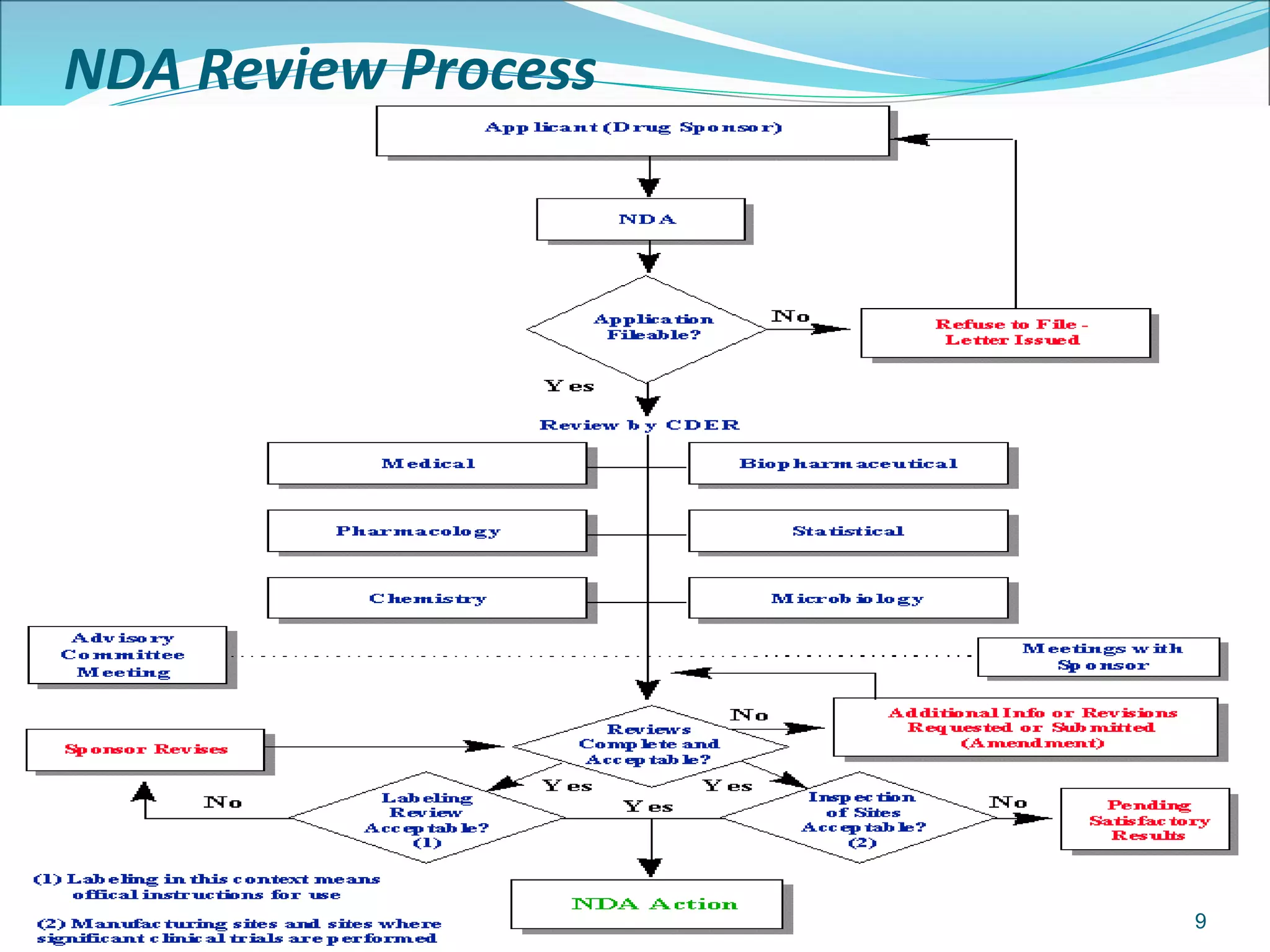
f ) NDA review process flow chart 
g) The NDA in CTD Format 
2. Abbreviated new drug application 
a) Introduction 
b) Goal of ANDA 
c) ANDA contents 
d) ANDA review process flow chart 
e)Patent certification condition 
3. Conclusion. 
4. References. 2
New Drug Application 
 Introduction 
Critical component for drug approval process 
which required to submit to USFDA before drug 
commercialization. 
The data gathered during the animal studies and 
human clinical trials of an Investigational New Drug 
(IND) become part of the NDA. 
 Goal 
The NDA provide enough information to permit 
FDA reviewer to reach safety, efficacy and quality for 
pharmaceutical production 
3
NDA Classifications 
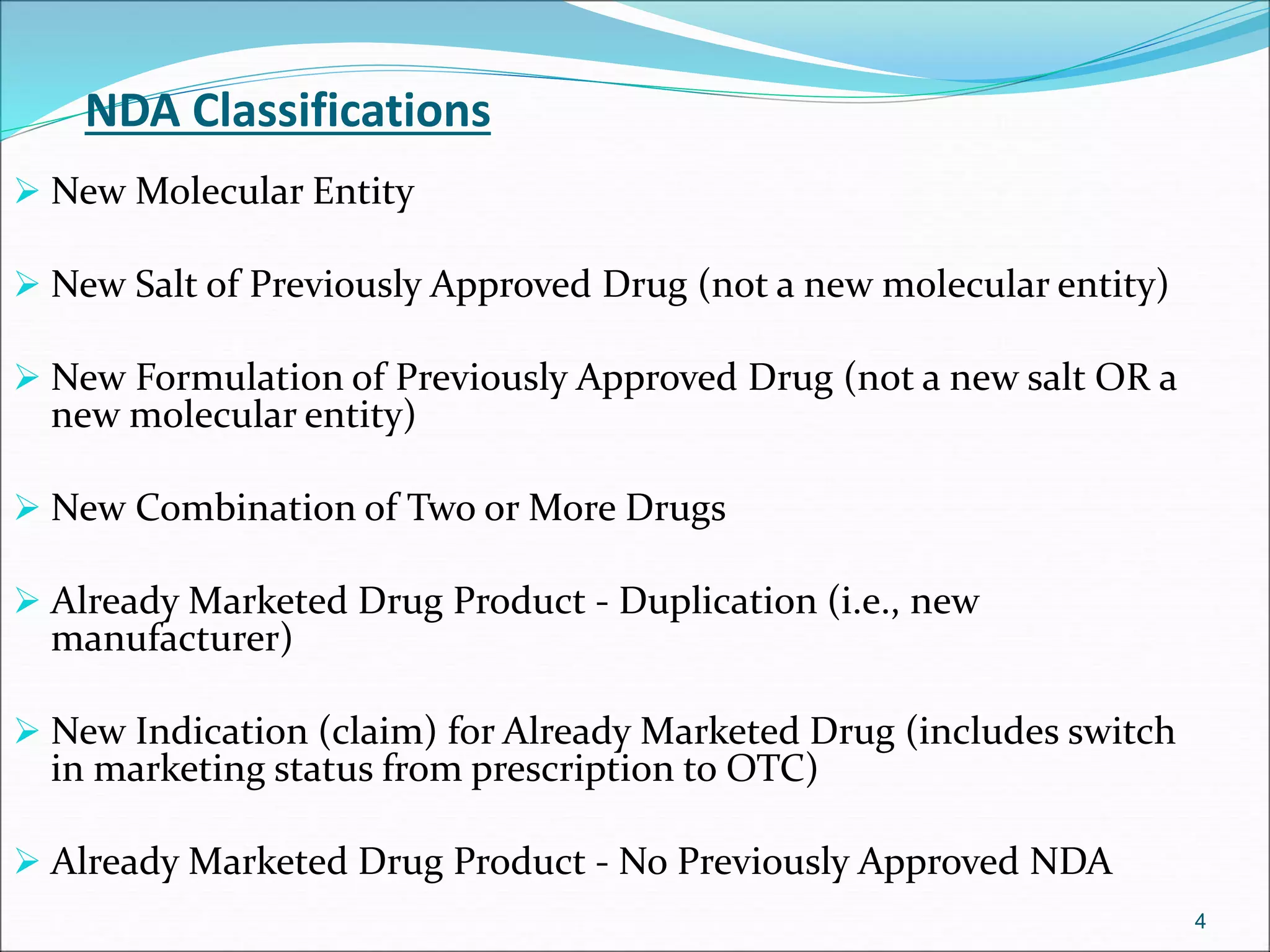
 New Molecular Entity 
 New Salt of Previously Approved Drug (not a new molecular entity) 
 New Formulation of Previously Approved Drug (not a new salt OR a 
new molecular entity) 
 New Combination of Two or More Drugs 
 Already Marketed Drug Product - Duplication (i.e., new 
manufacturer) 
 New Indication (claim) for Already Marketed Drug (includes switch 
in marketing status from prescription to OTC) 
 Already Marketed Drug Product - No Previously Approved NDA 
4
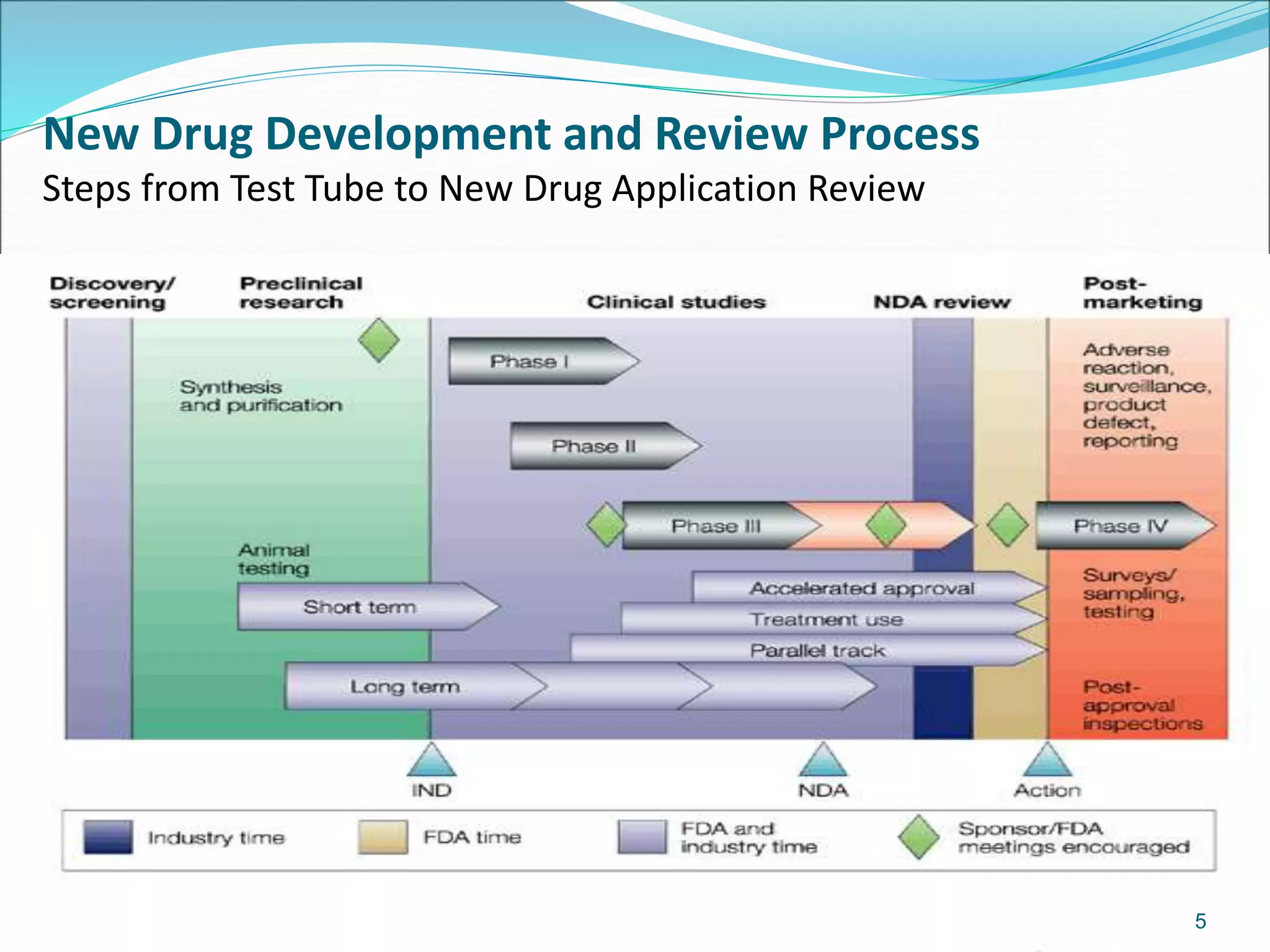
New Drug Development and Review Process 
Steps from Test Tube to New Drug Application Review 
5
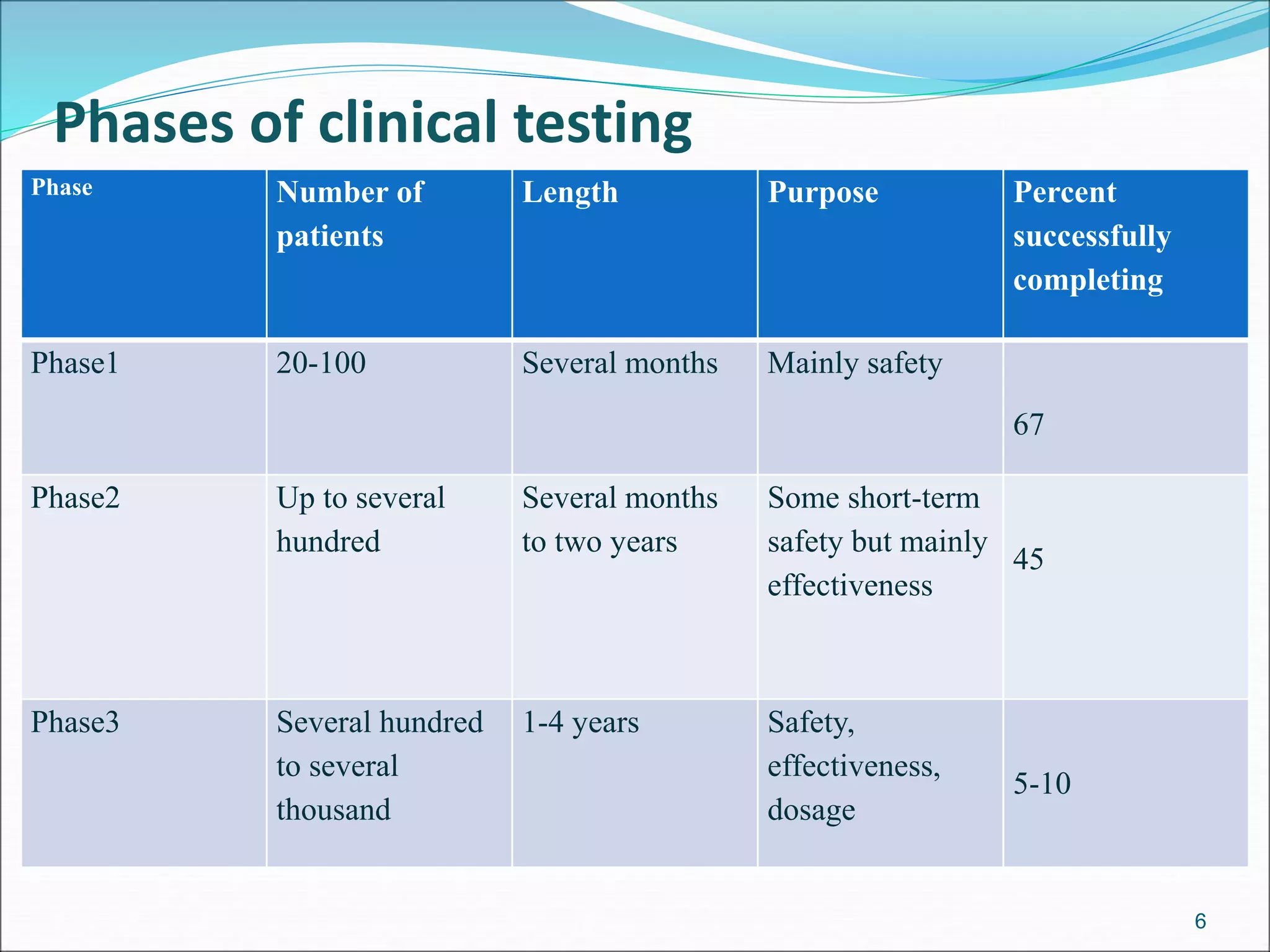
Phases of clinical testing 
Phase Number of 
patients 
Length Purpose Percent 
successfully 
completing 
Phase1 20-100 Several months Mainly safety 
67 
Phase2 Up to several 
hundred 
Several months 
to two years 
Some short-term 
safety but mainly 
effectiveness 
45 
Phase3 Several hundred 
to several 
thousand 
1-4 years Safety, 
effectiveness, 
dosage 
5-10 
6
7
8
NDA Review Process 
9
NDA CONTENTS 
 Section 1: Overall NDA index:- 
The NDA index is a comprehensive table of contents that 
enables the reviewers to find specific information in this 
massive document quickly. 
 Section 2: Labeling 
It must include all draft labeling that is intended for use on 
the product container, cartons or packages, including the 
proposed package insert. 
10
CONTD.... 
Section 3: Application summary 
 Proposed annotated package insert 
 Pharmacology class, scientific rational, intended use, and 
potential clinical benefits 
 Foreign marketing history 
 Chemistry, Manufacturing and control summary 
 Nonclinical pharmacology and toxicology summary 
 Human pharmacokinetics and bioavailability summary 
 Microbiology summary 
 Clinical data summary and results of statistical analysis 
 Discussion of benefit/risk relationship 
11
CONTD....
 
Section 4: Chemistry, manufacturing and controls 
 Chemistry, manufacturing and control information 
 Samples 
 Methods validation package 
 
Section 5: Nonclinical pharmacology and toxicology 
 Provide individual study reports, including pharmacology, 
toxicology, ADME studies. 
 Effects related to the therapeutic indication, such as the 
pharmacodynamic ED50 in dose- ranging studies and the 
mechanism of act ion (if know n) 
 Interactions with other drugs (or cross-reference the location 
of the information in any of the above subsection 12
CONTD.... 
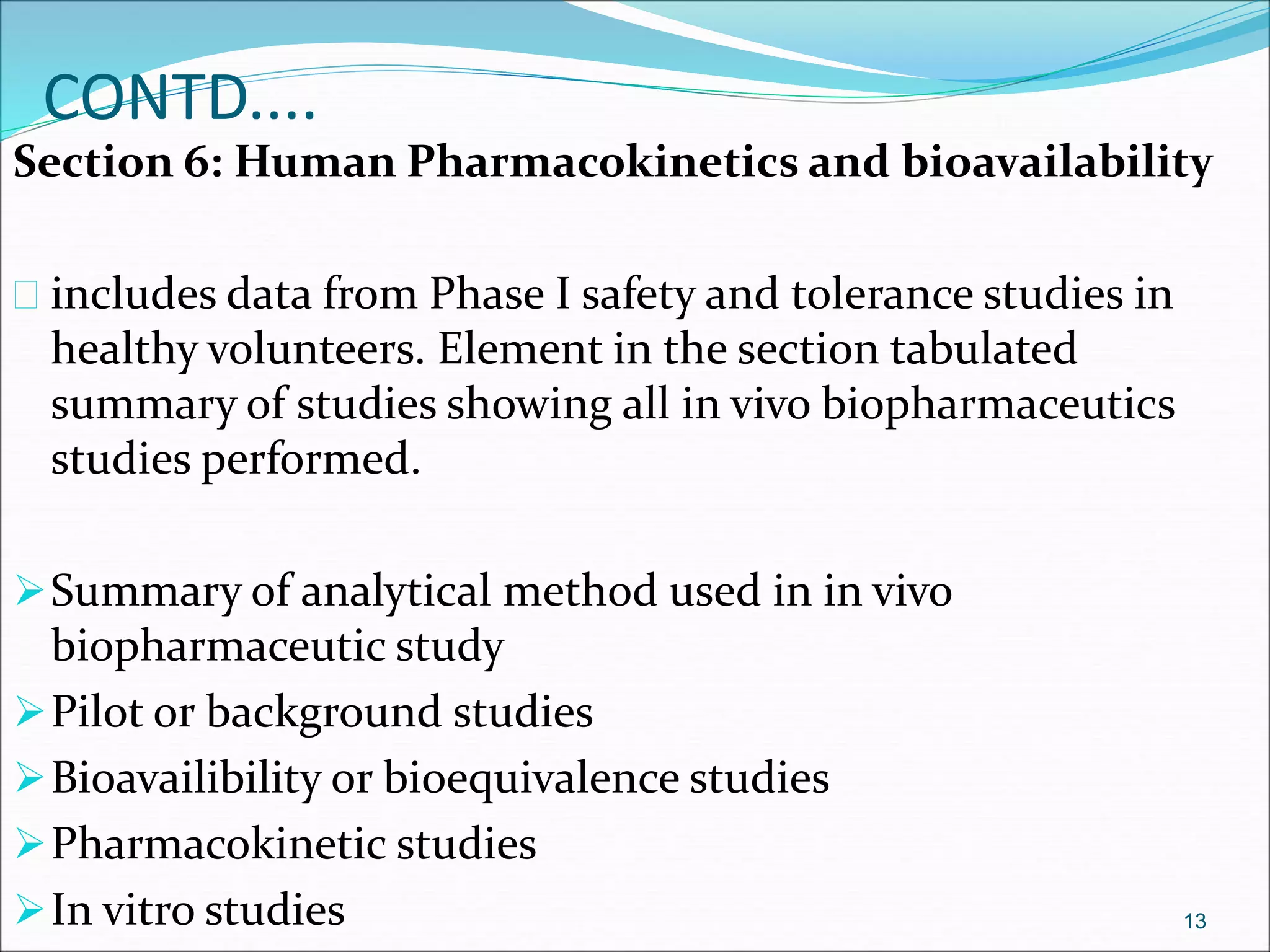
Section 6: Human Pharmacokinetics and bioavailability 
 includes data from Phase I safety and tolerance studies in 
healthy volunteers. Element in the section tabulated 
summary of studies showing all in vivo biopharmaceutics 
studies performed. 
Summary of analytical method used in in vivo 
biopharmaceutic study 
Pilot or background studies 
Bioavailibility or bioequivalence studies 
Pharmacokinetic studies 
In vitro studies 13
CONTD.... 
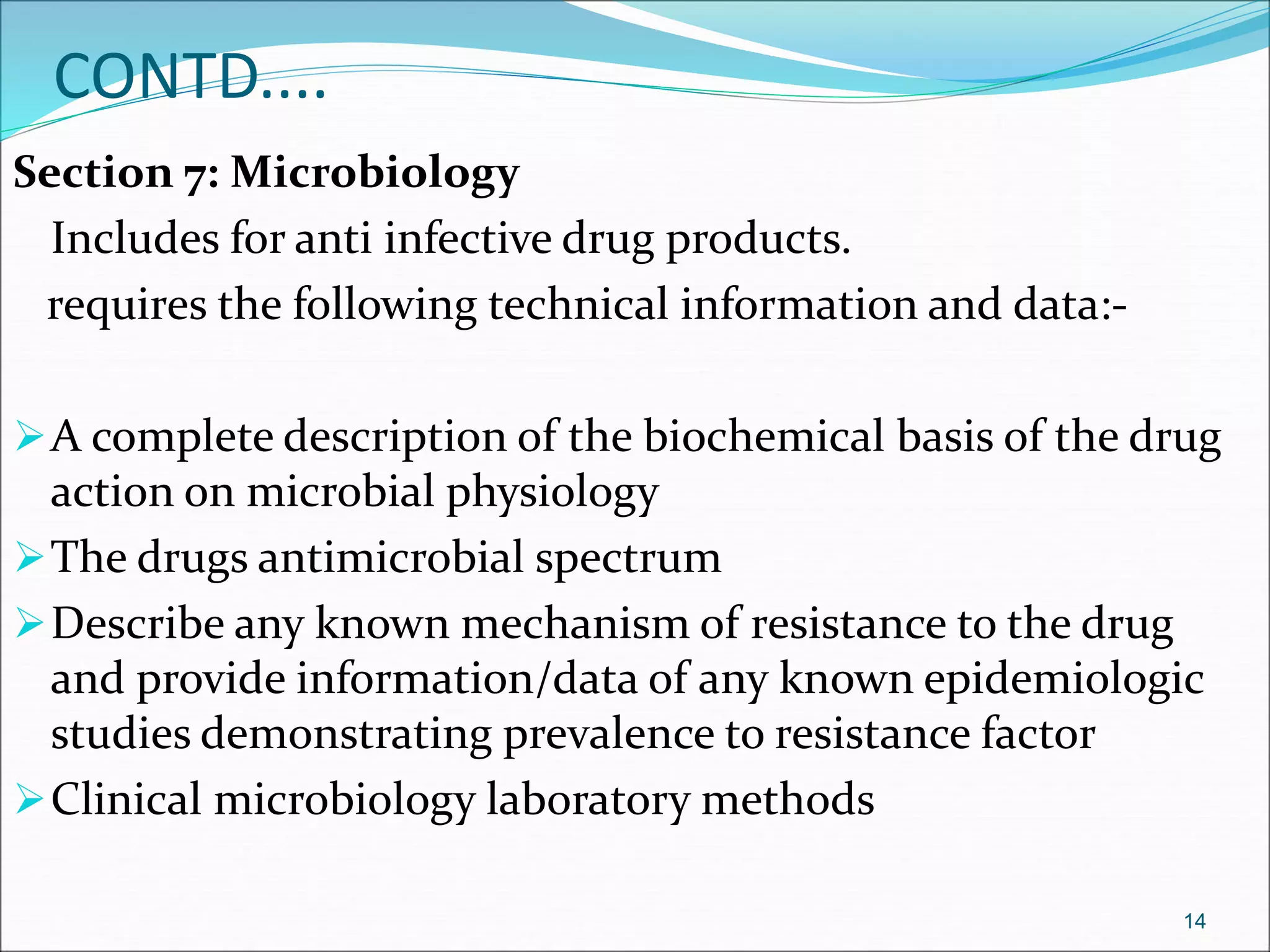
Section 7: Microbiology 
Includes for anti infective drug products. 
requires the following technical information and data:- 
A complete description of the biochemical basis of the drug 
action on microbial physiology 
The drugs antimicrobial spectrum 
Describe any known mechanism of resistance to the drug 
and provide information/data of any known epidemiologic 
studies demonstrating prevalence to resistance factor 
Clinical microbiology laboratory methods 
14
CONTD.... 
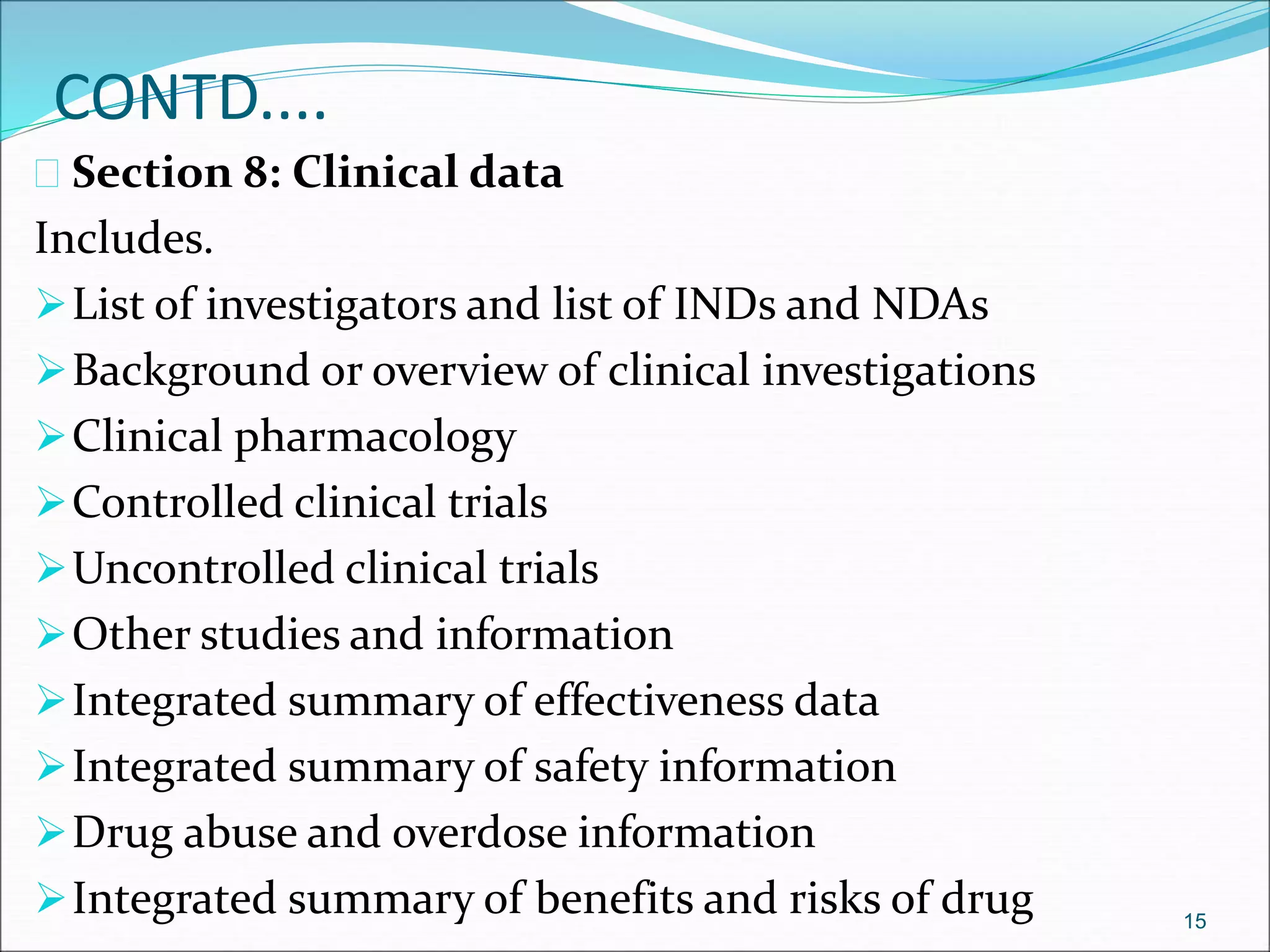
 Section 8: Clinical data 
Includes. 
List of investigators and list of INDs and NDAs 
Background or overview of clinical investigations 
Clinical pharmacology 
Controlled clinical trials 
Uncontrolled clinical trials 
Other studies and information 
Integrated summary of effectiveness data 
Integrated summary of safety information 
Drug abuse and overdose information 
Integrated summary of benefits and risks of drug 15
CONTD.... 
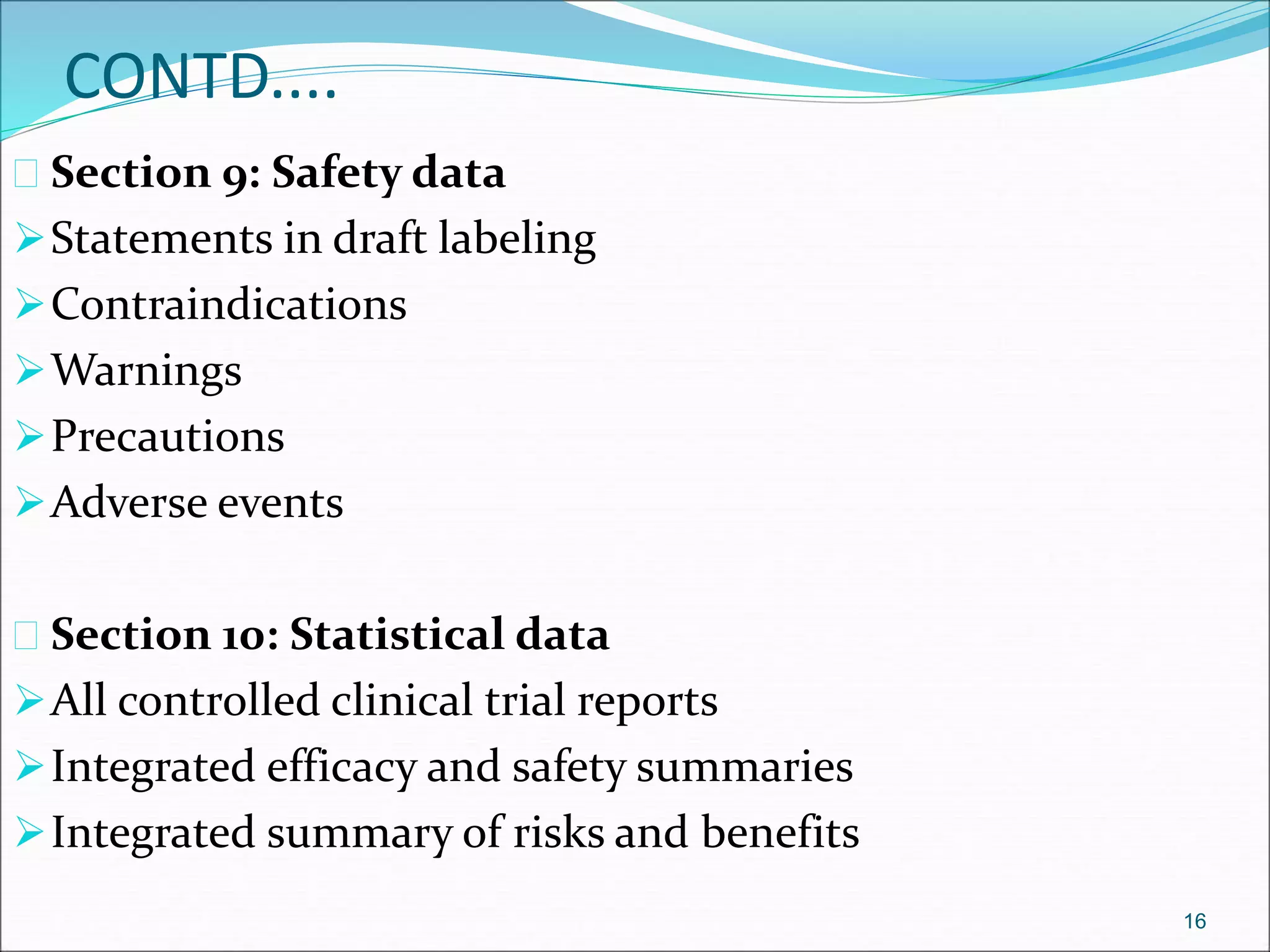
 Section 9: Safety data 
Statements in draft labeling 
Contraindications 
Warnings 
Precautions 
Adverse events 
 Section 10: Statistical data 
All controlled clinical trial reports 
Integrated efficacy and safety summaries 
Integrated summary of risks and benefits 
16
CONTD.... 
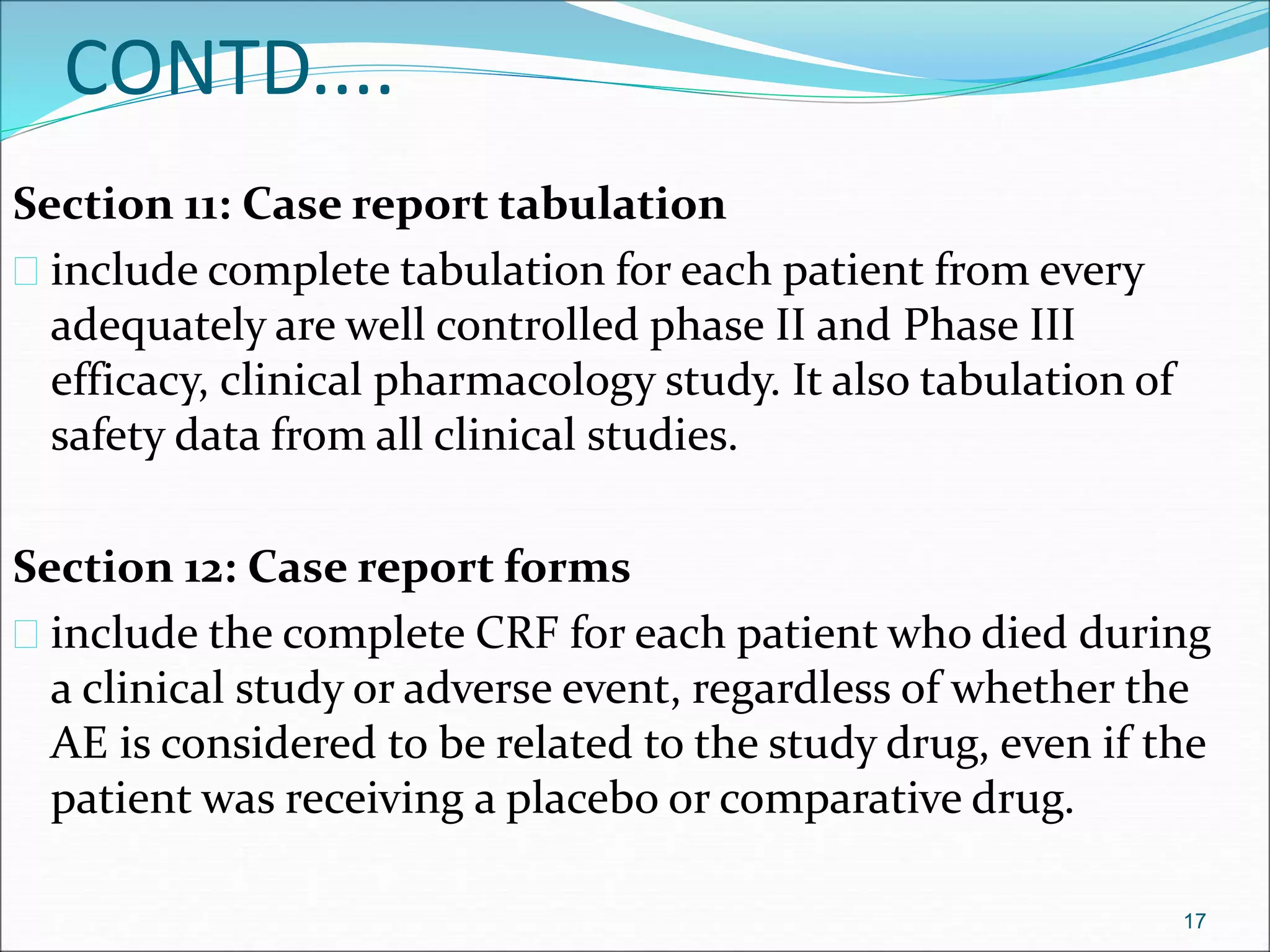
Section 11: Case report tabulation 
 include complete tabulation for each patient from every 
adequately are well controlled phase II and Phase III 
efficacy, clinical pharmacology study. It also tabulation of 
safety data from all clinical studies. 
Section 12: Case report forms 
 include the complete CRF for each patient who died during 
a clinical study or adverse event, regardless of whether the 
AE is considered to be related to the study drug, even if the 
patient was receiving a placebo or comparative drug. 
17
Contd
.. 
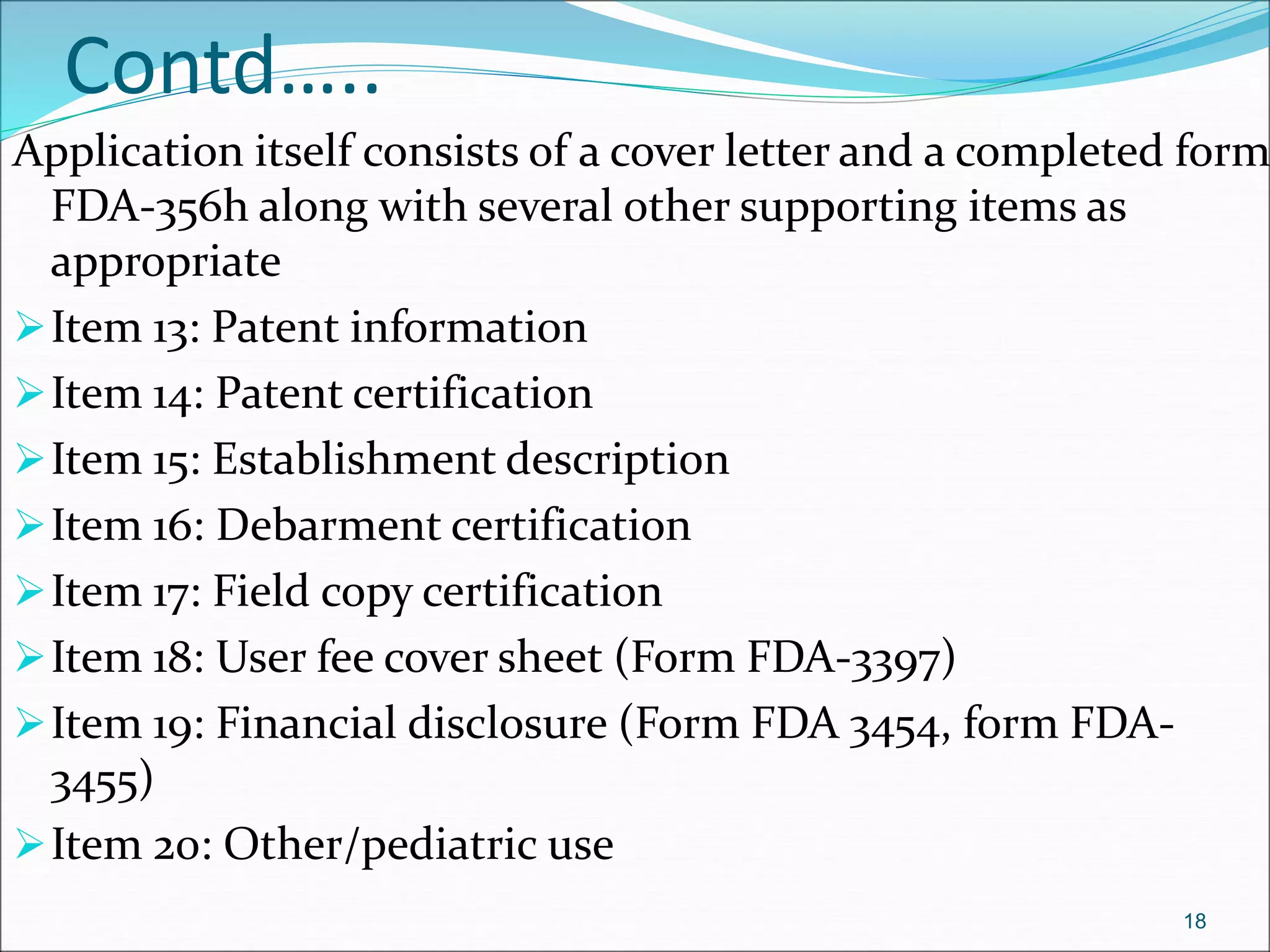
Application itself consists of a cover letter and a completed form 
FDA-356h along with several other supporting items as 
appropriate 
Item 13: Patent information 
Item 14: Patent certification 
Item 15: Establishment description 
Item 16: Debarment certification 
Item 17: Field copy certification 
Item 18: User fee cover sheet (Form FDA-3397) 
Item 19: Financial disclosure (Form FDA 3454, form FDA- 
3455) 
Item 20: Other/pediatric use 
18
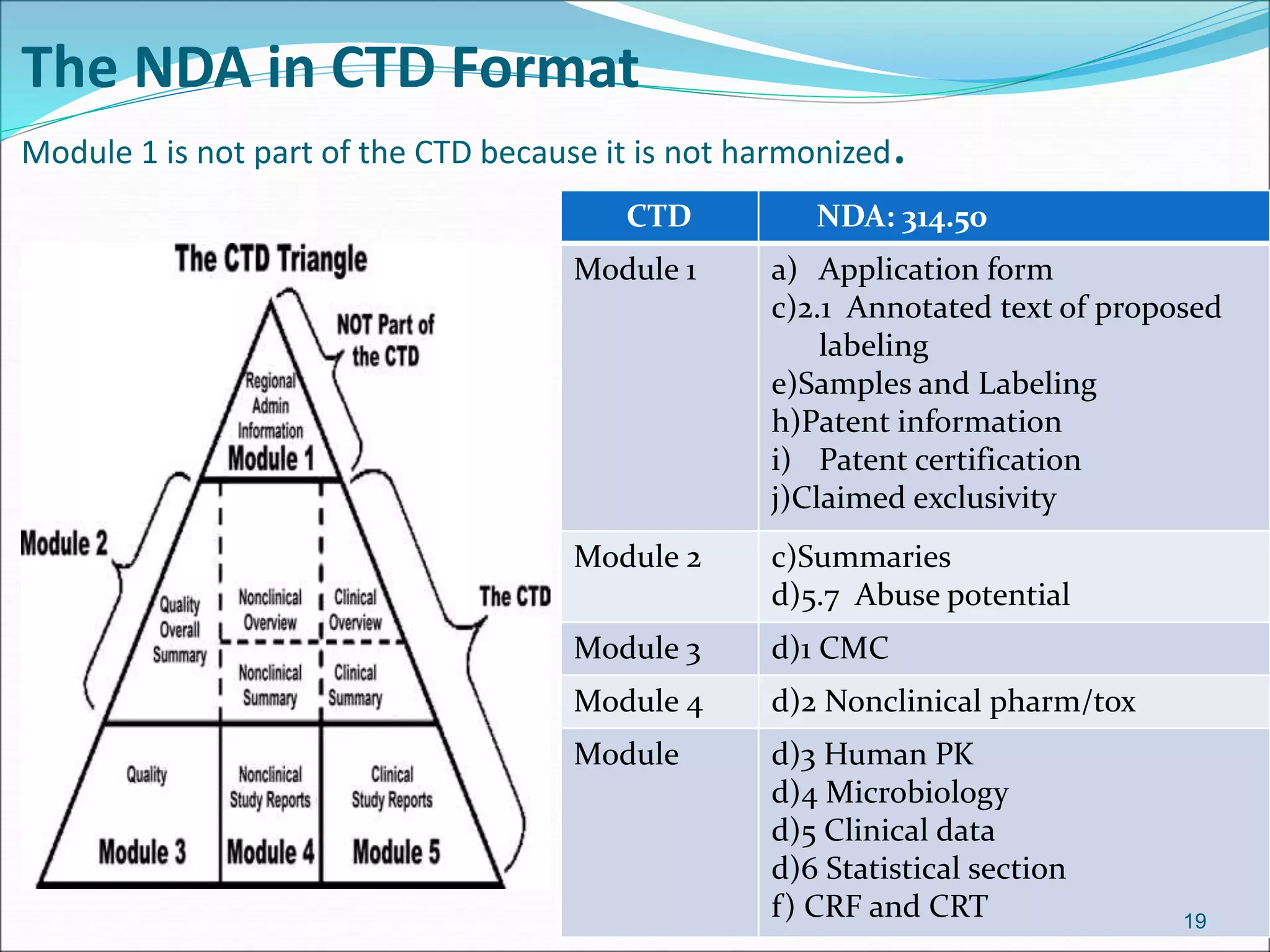
The NDA in CTD Format 
Module 1 is not part of the CTD because it is not harmonized. 
CTD NDA: 314.50 
Module 1 a) Application form 
c)2.1 Annotated text of proposed 
labeling 
e)Samples and Labeling 
h)Patent information 
i) Patent certification 
j)Claimed exclusivity 
Module 2 c)Summaries 
d)5.7 Abuse potential 
Module 3 d)1 CMC 
Module 4 d)2 Nonclinical pharm/tox 
Module d)3 Human PK 
d)4 Microbiology 
d)5 Clinical data 
d)6 Statistical section 
f) CRF and CRT 19
Abbreviated New Drug Application 
(ANDA) 
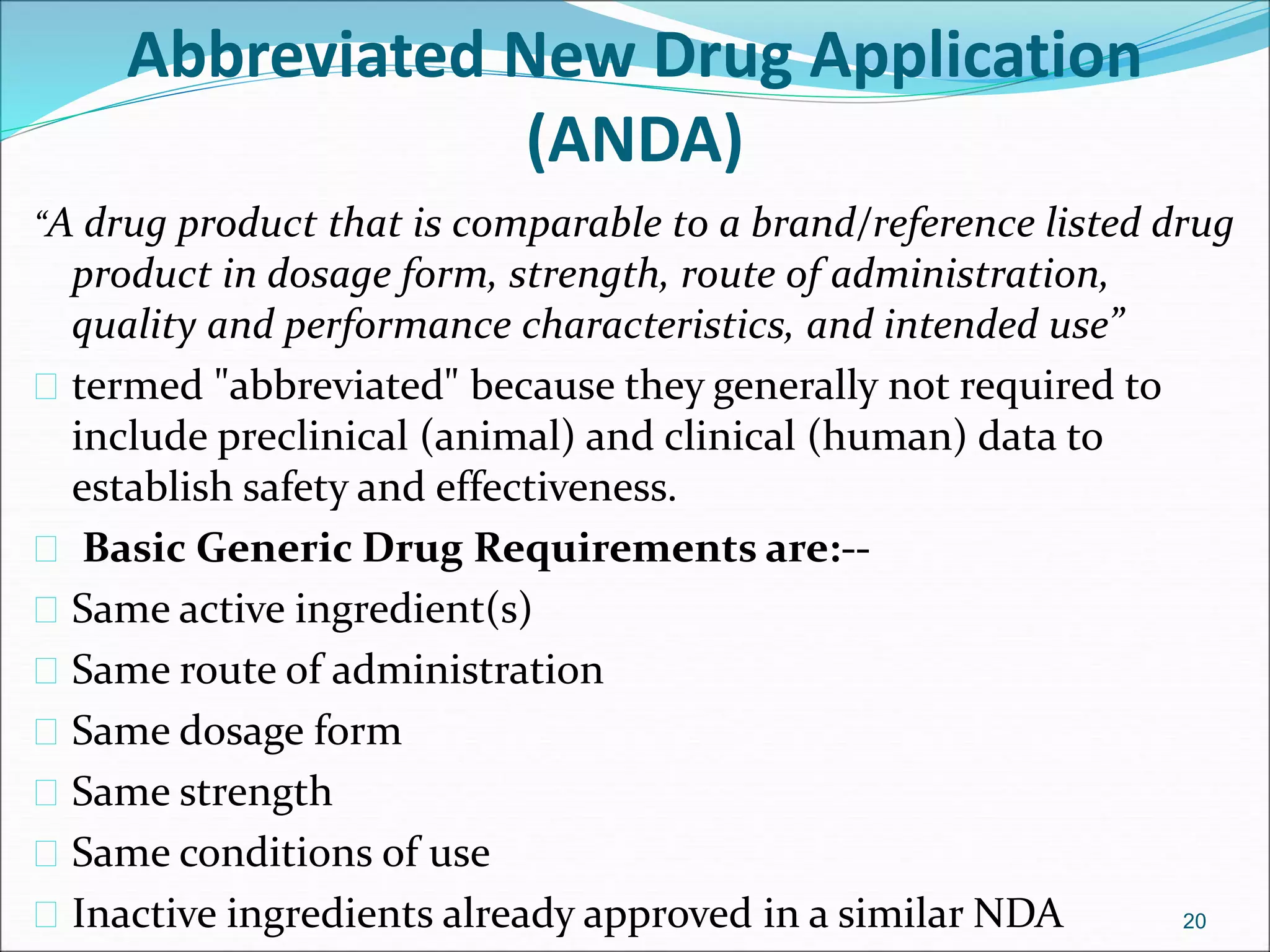
“A drug product that is comparable to a brand/reference listed drug 
product in dosage form, strength, route of administration, 
quality and performance characteristics, and intended use” 
 termed "abbreviated" because they generally not required to 
include preclinical (animal) and clinical (human) data to 
establish safety and effectiveness. 
 Basic Generic Drug Requirements are:-- 
 Same active ingredient(s) 
 Same route of administration 
 Same dosage form 
 Same strength 
 Same conditions of use 
 Inactive ingredients already approved in a similar NDA 20
Goal of ANDA 
 To reduce the price of the drug. 
 To reduce the time development. 
 Increase the bioavailability of the drug in comparison 
to references list drug. 
21
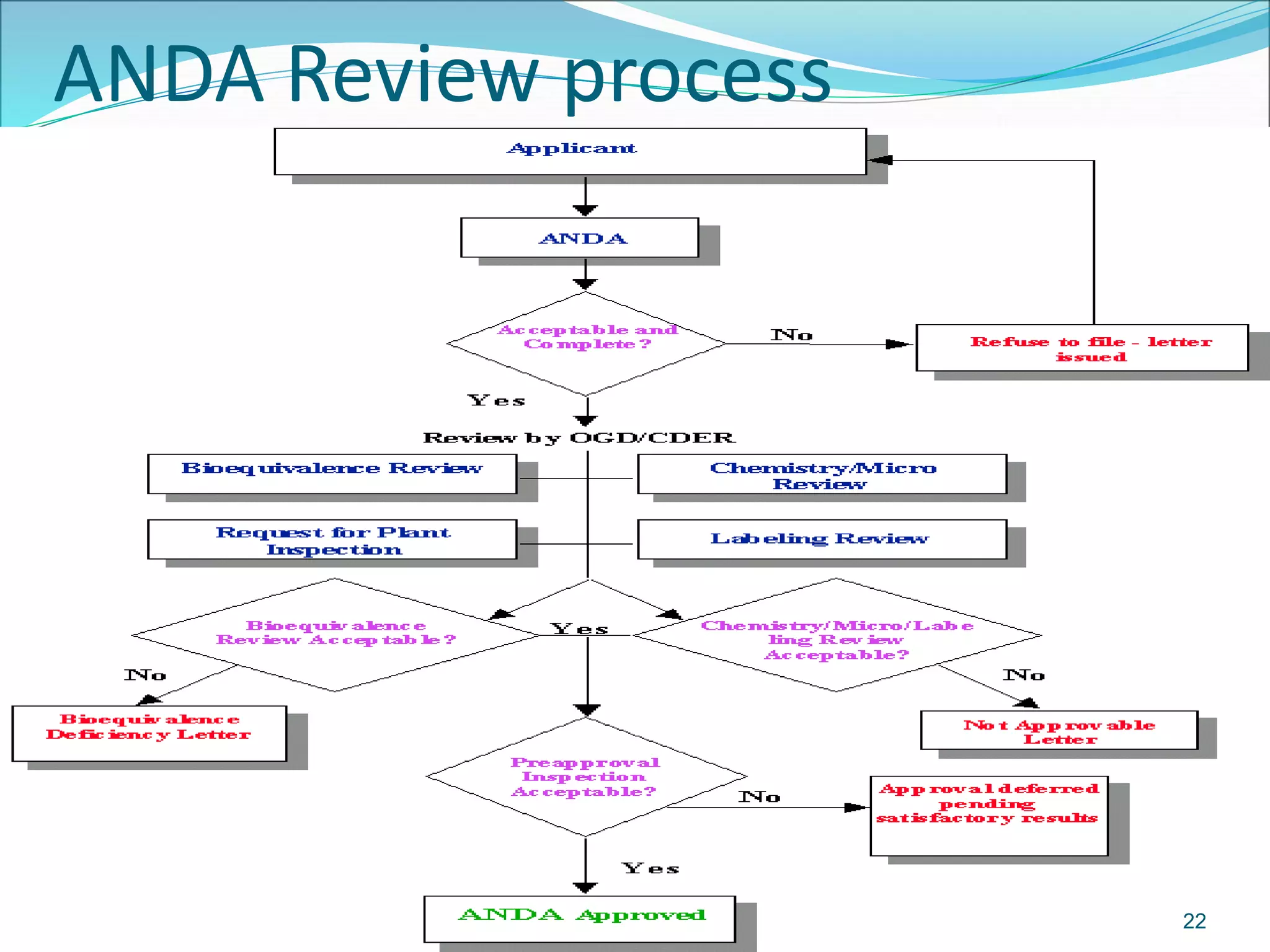
ANDA Review process 
22
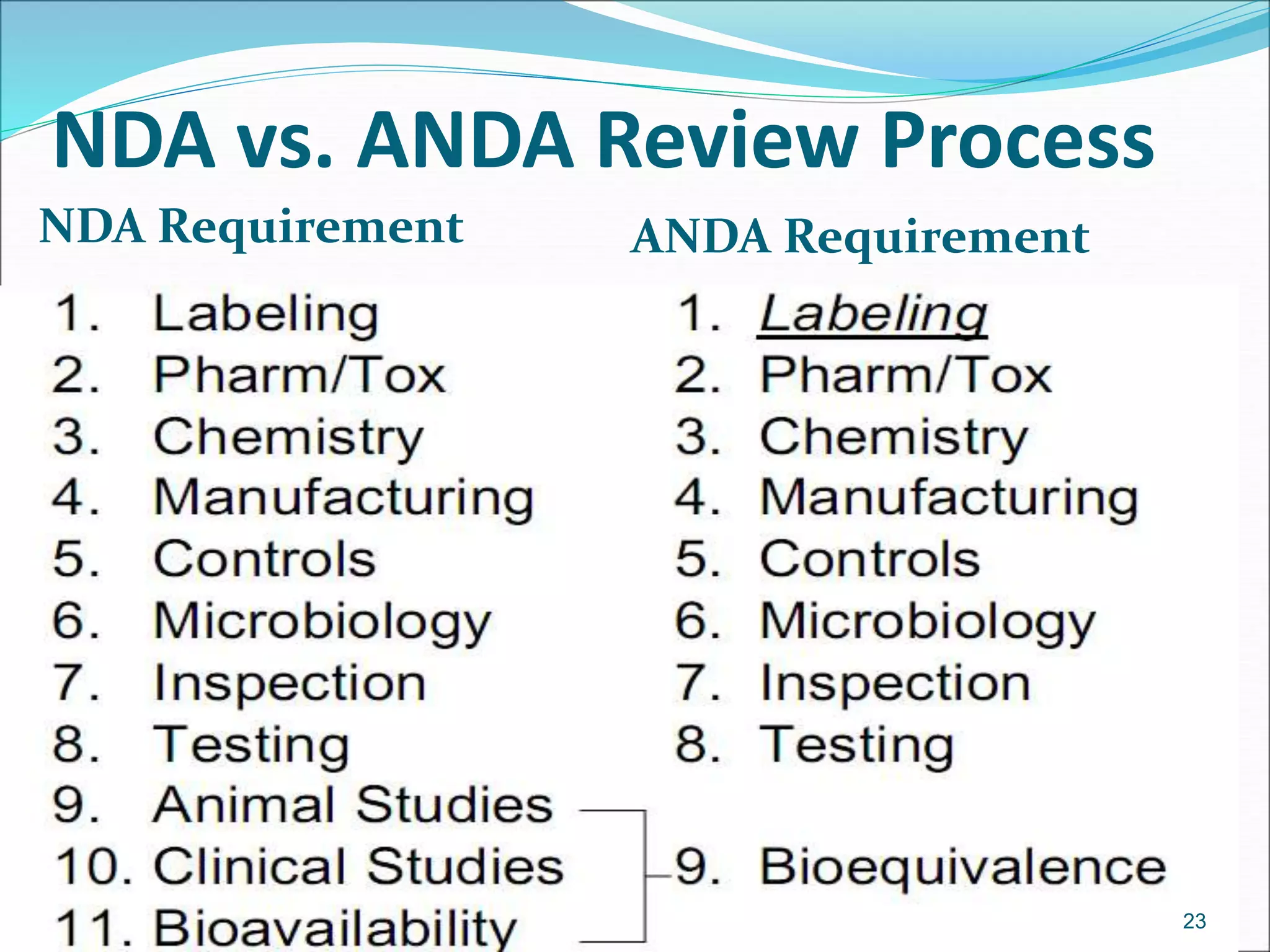
NDA vs. ANDA Review Process 
NDA Requirement ANDA Requirement 
23
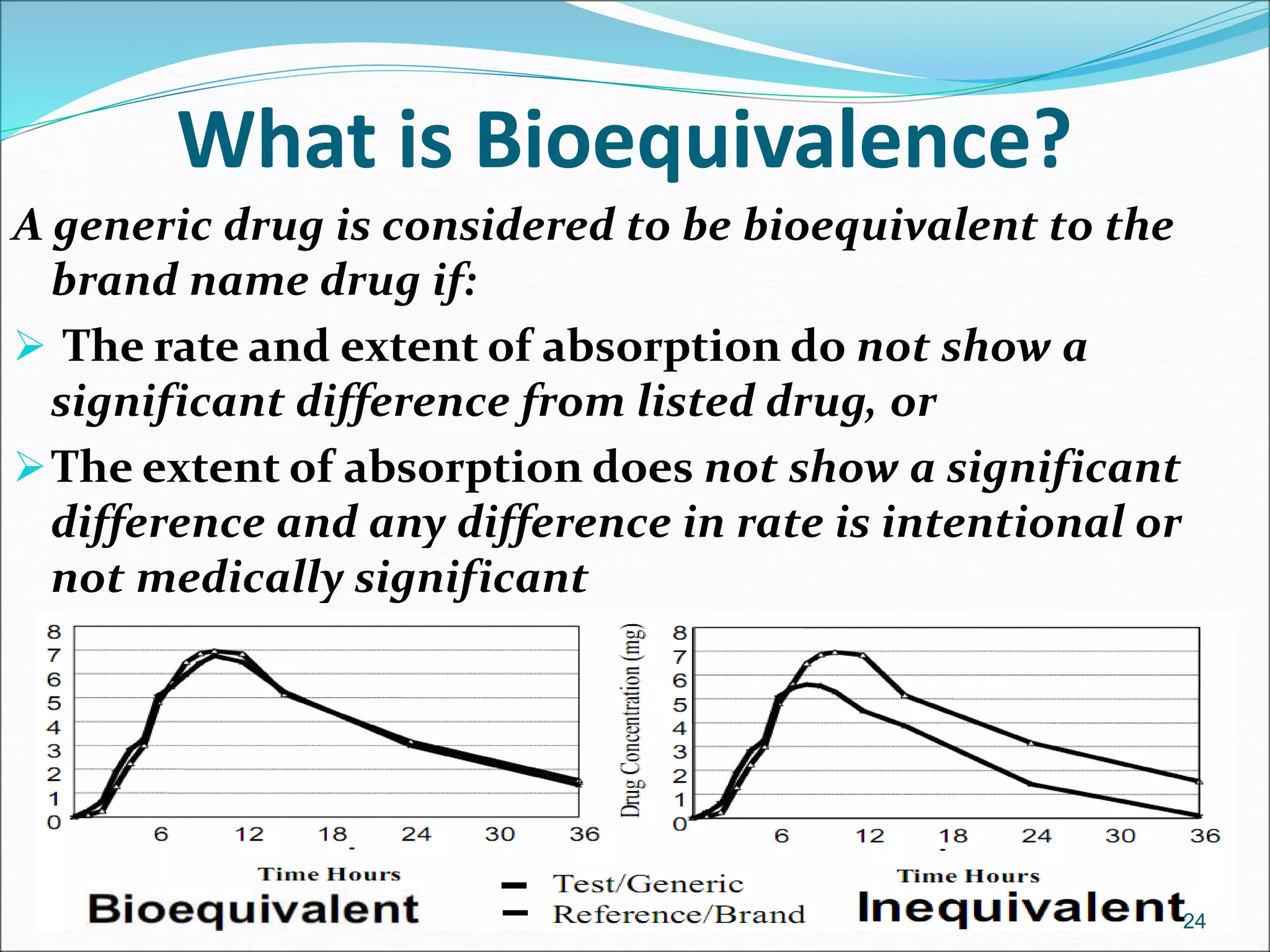
What is Bioequivalence? 
A generic drug is considered to be bioequivalent to the 
brand name drug if: 
 The rate and extent of absorption do not show a 
significant difference from listed drug, or 
The extent of absorption does not show a significant 
difference and any difference in rate is intentional or 
not medically significant 
24
Patent Certification condition for 
ANDA 
Described in section 505(j)(2)(A)(vii) of the Act. 
I Patent Not Submitted to FDA – 
approval effective after OGD scientific determination 
II Patent Expired – 
approval effective after OGD scientific determination 
III Patent Expiration Date (honored) – 
tentative approval after OGD scientific determination, 
final approval when patent expires 
IV Patent Challenge – 
tentative approval after OGD science determination, final 
approval when challenge won 
25
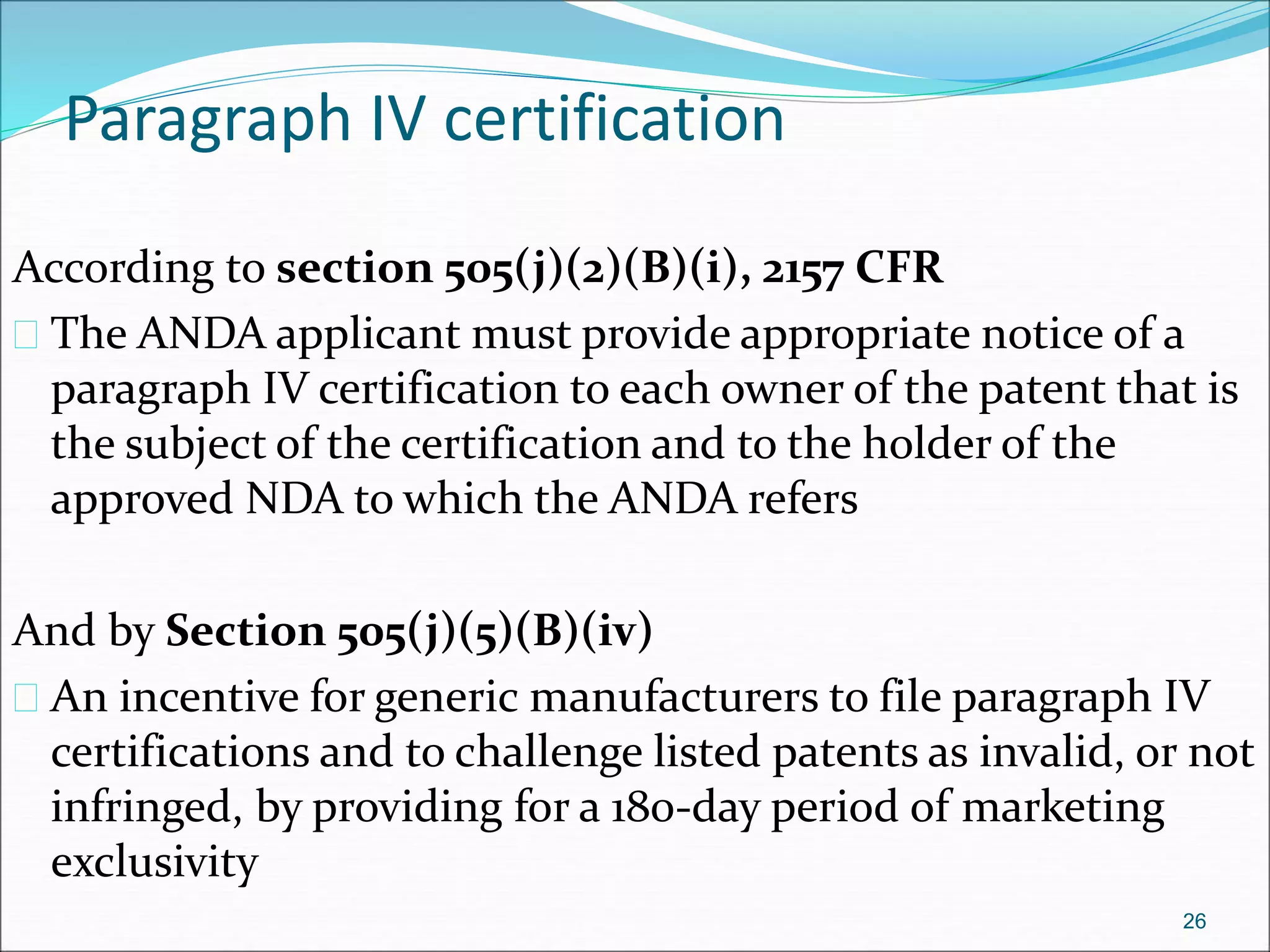
Paragraph IV certification 
According to section 505(j)(2)(B)(i), 2157 CFR 
 The ANDA applicant must provide appropriate notice of a 
paragraph IV certification to each owner of the patent that is 
the subject of the certification and to the holder of the 
approved NDA to which the ANDA refers 
And by Section 505(j)(5)(B)(iv) 
 An incentive for generic manufacturers to file paragraph IV 
certifications and to challenge listed patents as invalid, or not 
infringed, by providing for a 180-day period of marketing 
exclusivity 
26
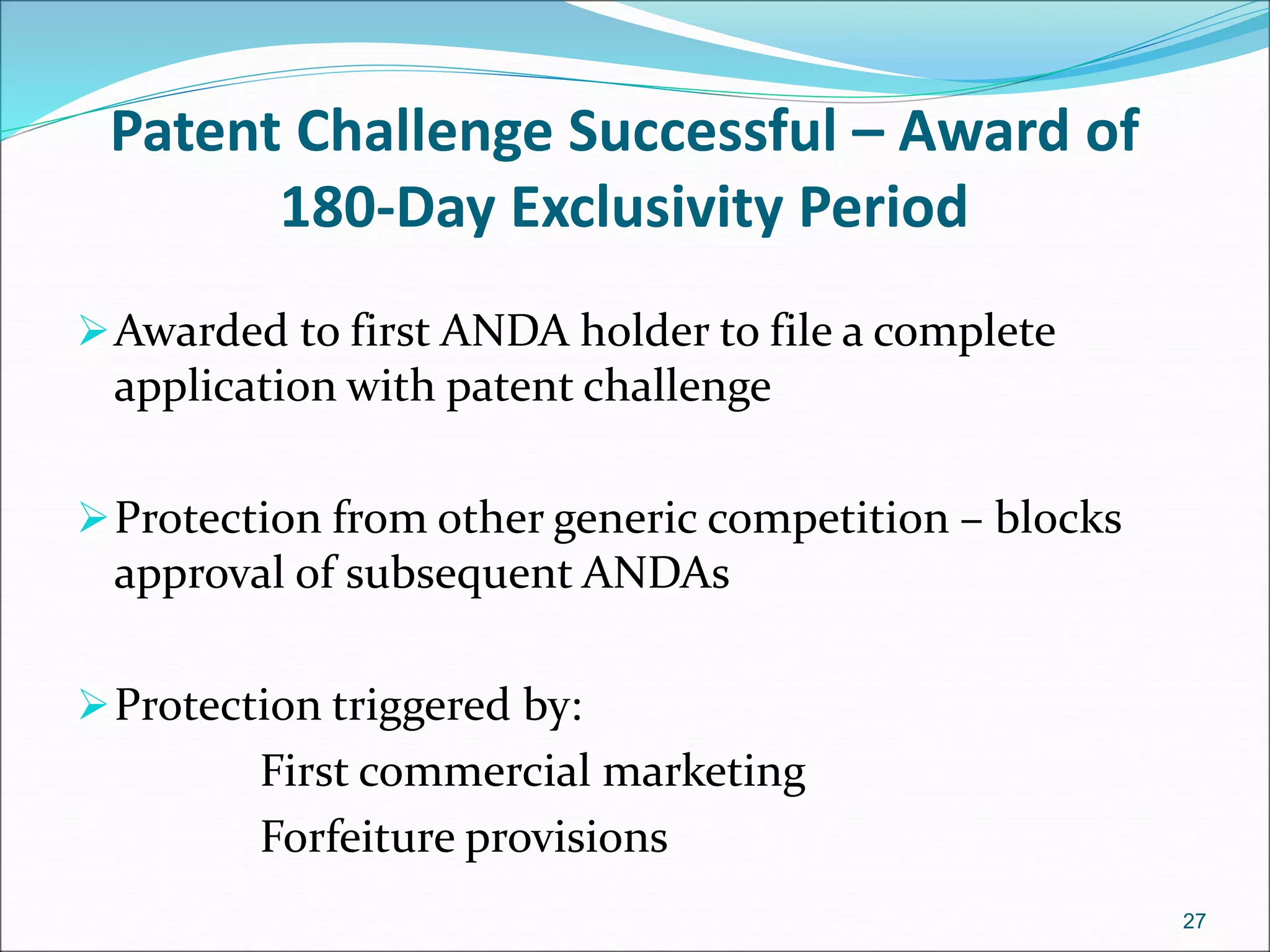
Patent Challenge Successful – Award of 
180-Day Exclusivity Period 
Awarded to first ANDA holder to file a complete 
application with patent challenge 
Protection from other generic competition – blocks 
approval of subsequent ANDAs 
Protection triggered by: 
First commercial marketing 
Forfeiture provisions 
27
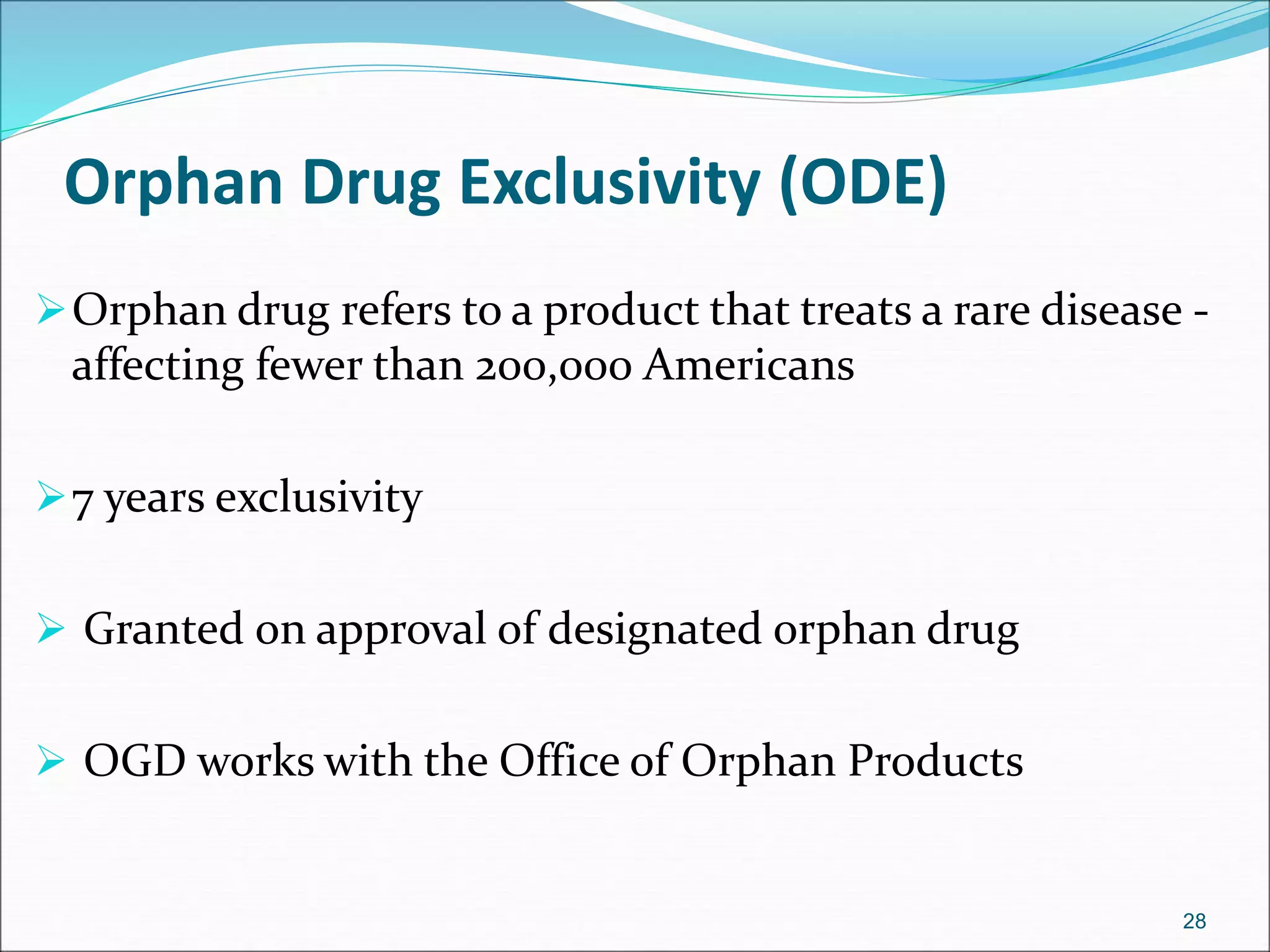
Orphan Drug Exclusivity (ODE) 
Orphan drug refers to a product that treats a rare disease - 
affecting fewer than 200,000 Americans 
7 years exclusivity 
 Granted on approval of designated orphan drug 
 OGD works with the Office of Orphan Products 
28
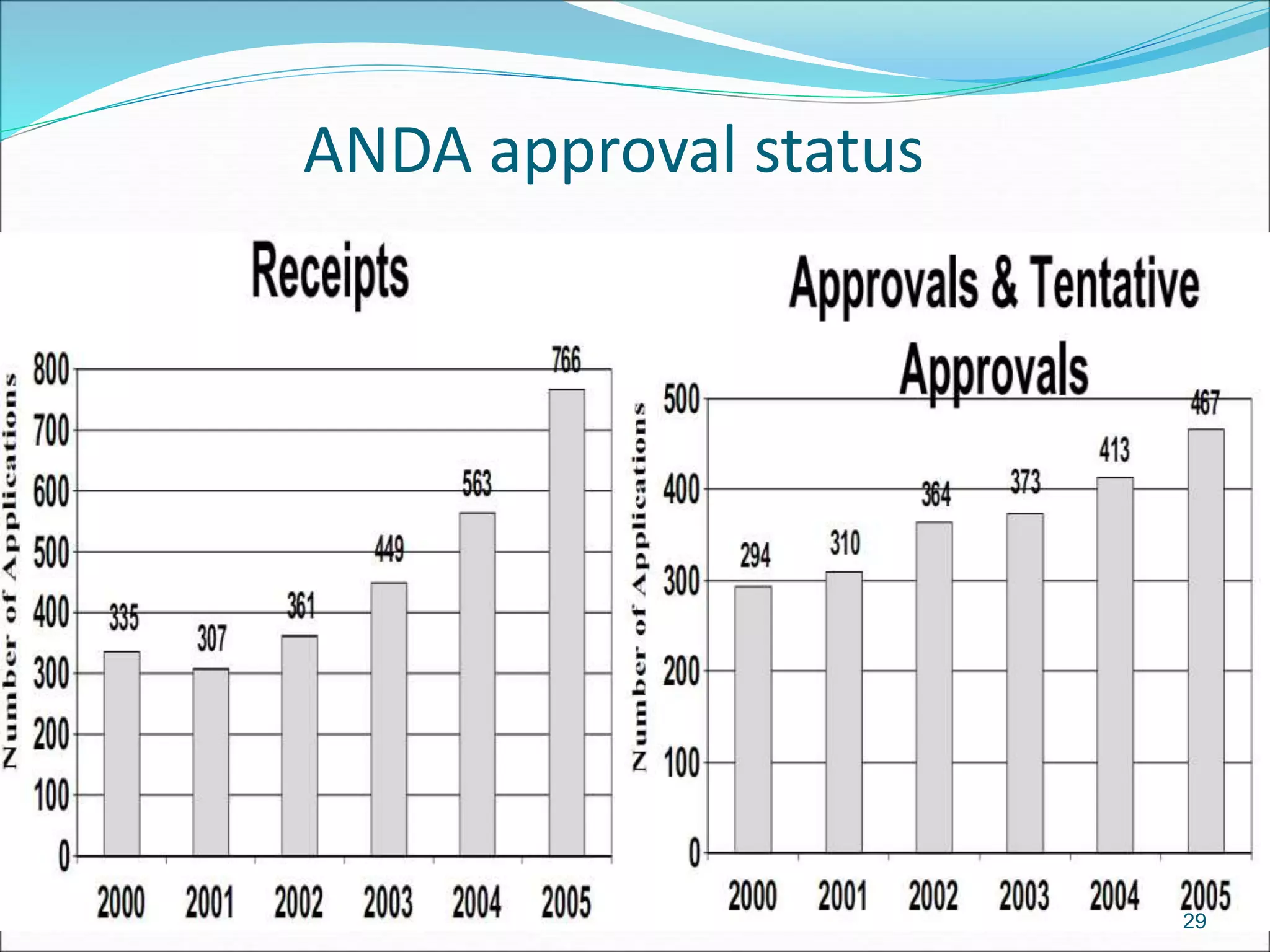
ANDA approval status 
29
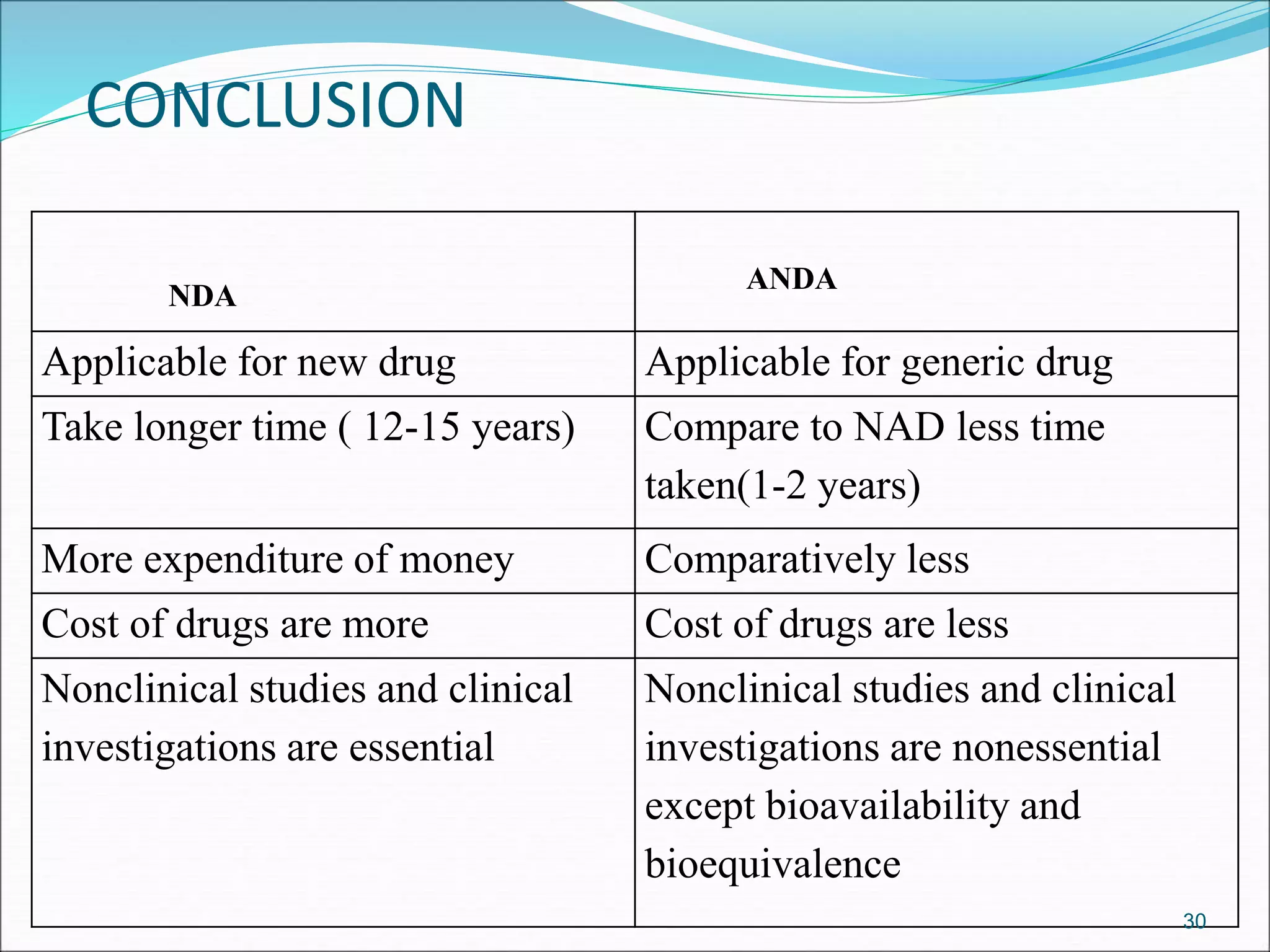
CONCLUSION 
NDA 
ANDA 
Applicable for new drug Applicable for generic drug 
Take longer time ( 12-15 years) Compare to NAD less time 
taken(1-2 years) 
More expenditure of money Comparatively less 
Cost of drugs are more Cost of drugs are less 
Nonclinical studies and clinical 
investigations are essential 
Nonclinical studies and clinical 
investigations are nonessential 
except bioavailability and 
bioequivalence 
30
REFERENCES 
 Douglas J. Pisano $ David S. Manlus –FDA Regulatory Affairs, A 
guide for Prescription Drugs, Medical Devices and Biologics- 
New drug Application –Second edition-Marcel Dekker,inc- page 
no 69-108. 
 Richard A. Guarino- New Drug Approval process-1)The New 
Drug Application, Content, Format 2) Abbreviated $ 
Supplementary New Drug Application- Fourth edition-Marcel 
Dekker,inc- page no 113-183. 
 Loyd V. Allen Jr, Nicholas G. Popovich, Howard C. ansel-Ansel’s 
Pharmaceutical Dosage Forms and delivers systems- New Drug 
Development and Approval Process-8th edition- B.I. publication- 
Page no 25-65. 
 http://www.fda.gov/cder/guidance/index.htm. 
31
THANK YOU 
32

NDS V'S ANDA

  • 1.
    PRESENTED BY SnehPriya Roll no-080603011 M Pharm part-1 Dept of Pharmaceutics 1
  • 2.
    Contents: 1.New DrugApplication a) Introduction. b) Goal of NDA c) Classification of NDA d) New drug development review e) NDA content f ) NDA review process flow chart g) The NDA in CTD Format 2. Abbreviated new drug application a) Introduction b) Goal of ANDA c) ANDA contents d) ANDA review process flow chart e)Patent certification condition 3. Conclusion. 4. References. 2
  • 3.
    New Drug Application  Introduction Critical component for drug approval process which required to submit to USFDA before drug commercialization. The data gathered during the animal studies and human clinical trials of an Investigational New Drug (IND) become part of the NDA.  Goal The NDA provide enough information to permit FDA reviewer to reach safety, efficacy and quality for pharmaceutical production 3
  • 4.
    NDA Classifications New Molecular Entity  New Salt of Previously Approved Drug (not a new molecular entity)  New Formulation of Previously Approved Drug (not a new salt OR a new molecular entity)  New Combination of Two or More Drugs  Already Marketed Drug Product - Duplication (i.e., new manufacturer)  New Indication (claim) for Already Marketed Drug (includes switch in marketing status from prescription to OTC)  Already Marketed Drug Product - No Previously Approved NDA 4
  • 5.
    New Drug Developmentand Review Process Steps from Test Tube to New Drug Application Review 5
  • 6.
    Phases of clinicaltesting Phase Number of patients Length Purpose Percent successfully completing Phase1 20-100 Several months Mainly safety 67 Phase2 Up to several hundred Several months to two years Some short-term safety but mainly effectiveness 45 Phase3 Several hundred to several thousand 1-4 years Safety, effectiveness, dosage 5-10 6
  • 7.
  • 8.
  • 9.
  • 10.
    NDA CONTENTS Section 1: Overall NDA index:- The NDA index is a comprehensive table of contents that enables the reviewers to find specific information in this massive document quickly.  Section 2: Labeling It must include all draft labeling that is intended for use on the product container, cartons or packages, including the proposed package insert. 10
  • 11.
    CONTD.... Section 3:Application summary  Proposed annotated package insert  Pharmacology class, scientific rational, intended use, and potential clinical benefits  Foreign marketing history  Chemistry, Manufacturing and control summary  Nonclinical pharmacology and toxicology summary  Human pharmacokinetics and bioavailability summary  Microbiology summary  Clinical data summary and results of statistical analysis  Discussion of benefit/risk relationship 11
  • 12.
    CONTD....
 Section 4:Chemistry, manufacturing and controls  Chemistry, manufacturing and control information  Samples  Methods validation package  Section 5: Nonclinical pharmacology and toxicology  Provide individual study reports, including pharmacology, toxicology, ADME studies.  Effects related to the therapeutic indication, such as the pharmacodynamic ED50 in dose- ranging studies and the mechanism of act ion (if know n)  Interactions with other drugs (or cross-reference the location of the information in any of the above subsection 12
  • 13.
    CONTD.... Section 6:Human Pharmacokinetics and bioavailability  includes data from Phase I safety and tolerance studies in healthy volunteers. Element in the section tabulated summary of studies showing all in vivo biopharmaceutics studies performed. Summary of analytical method used in in vivo biopharmaceutic study Pilot or background studies Bioavailibility or bioequivalence studies Pharmacokinetic studies In vitro studies 13
  • 14.
    CONTD.... Section 7:Microbiology Includes for anti infective drug products. requires the following technical information and data:- A complete description of the biochemical basis of the drug action on microbial physiology The drugs antimicrobial spectrum Describe any known mechanism of resistance to the drug and provide information/data of any known epidemiologic studies demonstrating prevalence to resistance factor Clinical microbiology laboratory methods 14
  • 15.
    CONTD....  Section8: Clinical data Includes. List of investigators and list of INDs and NDAs Background or overview of clinical investigations Clinical pharmacology Controlled clinical trials Uncontrolled clinical trials Other studies and information Integrated summary of effectiveness data Integrated summary of safety information Drug abuse and overdose information Integrated summary of benefits and risks of drug 15
  • 16.
    CONTD....  Section9: Safety data Statements in draft labeling Contraindications Warnings Precautions Adverse events  Section 10: Statistical data All controlled clinical trial reports Integrated efficacy and safety summaries Integrated summary of risks and benefits 16
  • 17.
    CONTD.... Section 11:Case report tabulation  include complete tabulation for each patient from every adequately are well controlled phase II and Phase III efficacy, clinical pharmacology study. It also tabulation of safety data from all clinical studies. Section 12: Case report forms  include the complete CRF for each patient who died during a clinical study or adverse event, regardless of whether the AE is considered to be related to the study drug, even if the patient was receiving a placebo or comparative drug. 17
  • 18.
    Contd
.. Application itselfconsists of a cover letter and a completed form FDA-356h along with several other supporting items as appropriate Item 13: Patent information Item 14: Patent certification Item 15: Establishment description Item 16: Debarment certification Item 17: Field copy certification Item 18: User fee cover sheet (Form FDA-3397) Item 19: Financial disclosure (Form FDA 3454, form FDA- 3455) Item 20: Other/pediatric use 18
  • 19.
    The NDA inCTD Format Module 1 is not part of the CTD because it is not harmonized. CTD NDA: 314.50 Module 1 a) Application form c)2.1 Annotated text of proposed labeling e)Samples and Labeling h)Patent information i) Patent certification j)Claimed exclusivity Module 2 c)Summaries d)5.7 Abuse potential Module 3 d)1 CMC Module 4 d)2 Nonclinical pharm/tox Module d)3 Human PK d)4 Microbiology d)5 Clinical data d)6 Statistical section f) CRF and CRT 19
  • 20.
    Abbreviated New DrugApplication (ANDA) “A drug product that is comparable to a brand/reference listed drug product in dosage form, strength, route of administration, quality and performance characteristics, and intended use”  termed "abbreviated" because they generally not required to include preclinical (animal) and clinical (human) data to establish safety and effectiveness.  Basic Generic Drug Requirements are:--  Same active ingredient(s)  Same route of administration  Same dosage form  Same strength  Same conditions of use  Inactive ingredients already approved in a similar NDA 20
  • 21.
    Goal of ANDA  To reduce the price of the drug.  To reduce the time development.  Increase the bioavailability of the drug in comparison to references list drug. 21
  • 22.
  • 23.
    NDA vs. ANDAReview Process NDA Requirement ANDA Requirement 23
  • 24.
    What is Bioequivalence? A generic drug is considered to be bioequivalent to the brand name drug if:  The rate and extent of absorption do not show a significant difference from listed drug, or The extent of absorption does not show a significant difference and any difference in rate is intentional or not medically significant 24
  • 25.
    Patent Certification conditionfor ANDA Described in section 505(j)(2)(A)(vii) of the Act. I Patent Not Submitted to FDA – approval effective after OGD scientific determination II Patent Expired – approval effective after OGD scientific determination III Patent Expiration Date (honored) – tentative approval after OGD scientific determination, final approval when patent expires IV Patent Challenge – tentative approval after OGD science determination, final approval when challenge won 25
  • 26.
    Paragraph IV certification According to section 505(j)(2)(B)(i), 2157 CFR  The ANDA applicant must provide appropriate notice of a paragraph IV certification to each owner of the patent that is the subject of the certification and to the holder of the approved NDA to which the ANDA refers And by Section 505(j)(5)(B)(iv)  An incentive for generic manufacturers to file paragraph IV certifications and to challenge listed patents as invalid, or not infringed, by providing for a 180-day period of marketing exclusivity 26
  • 27.
    Patent Challenge Successful– Award of 180-Day Exclusivity Period Awarded to first ANDA holder to file a complete application with patent challenge Protection from other generic competition – blocks approval of subsequent ANDAs Protection triggered by: First commercial marketing Forfeiture provisions 27
  • 28.
    Orphan Drug Exclusivity(ODE) Orphan drug refers to a product that treats a rare disease - affecting fewer than 200,000 Americans 7 years exclusivity  Granted on approval of designated orphan drug  OGD works with the Office of Orphan Products 28
  • 29.
  • 30.
    CONCLUSION NDA ANDA Applicable for new drug Applicable for generic drug Take longer time ( 12-15 years) Compare to NAD less time taken(1-2 years) More expenditure of money Comparatively less Cost of drugs are more Cost of drugs are less Nonclinical studies and clinical investigations are essential Nonclinical studies and clinical investigations are nonessential except bioavailability and bioequivalence 30
  • 31.
    REFERENCES  DouglasJ. Pisano $ David S. Manlus –FDA Regulatory Affairs, A guide for Prescription Drugs, Medical Devices and Biologics- New drug Application –Second edition-Marcel Dekker,inc- page no 69-108.  Richard A. Guarino- New Drug Approval process-1)The New Drug Application, Content, Format 2) Abbreviated $ Supplementary New Drug Application- Fourth edition-Marcel Dekker,inc- page no 113-183.  Loyd V. Allen Jr, Nicholas G. Popovich, Howard C. ansel-Ansel’s Pharmaceutical Dosage Forms and delivers systems- New Drug Development and Approval Process-8th edition- B.I. publication- Page no 25-65.  http://www.fda.gov/cder/guidance/index.htm. 31
  • 32.