2
TOPICS COVERED:
Ø Definition
Ø Regulatory requirement
Ø Type of DMFs
Ø Content of DMF
Ø Submission(s)
Ø DMF Review
Ø Approval
6/5/2018Gautam G. Halder– Regulatory Affairs
5
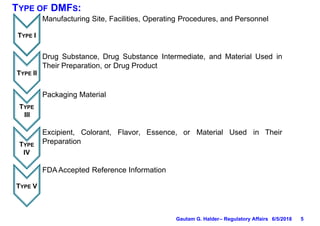
TYPE OF DMFS:
Manufacturing Site, Facilities, Operating Procedures, and Personnel
TYPE I
Drug Substance, Drug Substance Intermediate, and Material Used in
Their Preparation, or Drug Product
TYPE II
Packaging Material
TYPE
III
Excipient, Colorant, Flavor, Essence, or Material Used in Their
PreparationTYPE
IV
FDAAccepted Reference Information
TYPE V
6/5/2018Gautam G. Halder– Regulatory Affairs
6
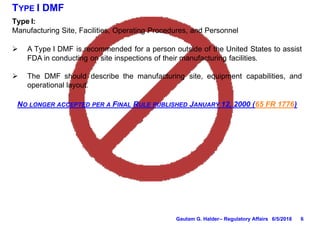
TYPE I DMF
Type I:
Manufacturing Site, Facilities, Operating Procedures, and Personnel
Ø A Type I DMF is recommended for a person outside of the United States to assist
FDA in conducting on site inspections of their manufacturing facilities.
Ø The DMF should describe the manufacturing site, equipment capabilities, and
operational layout.
NO LONGER ACCEPTED PER A FINAL RULE PUBLISHED JANUARY 12, 2000 (65 FR 1776)
6/5/2018Gautam G. Halder– Regulatory Affairs
7
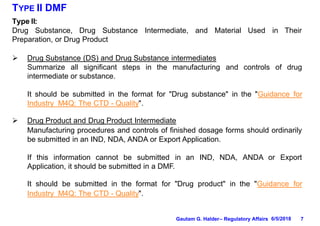
TYPE II DMF
Type II:
Drug Substance, Drug Substance Intermediate, and Material Used in Their
Preparation, or Drug Product
Ø Drug Substance (DS) and Drug Substance intermediates
Summarize all significant steps in the manufacturing and controls of drug
intermediate or substance.
It should be submitted in the format for "Drug substance" in the "Guidance for
Industry M4Q: The CTD - Quality".
Ø Drug Product and Drug Product Intermediate
Manufacturing procedures and controls of finished dosage forms should ordinarily
be submitted in an IND, NDA, ANDA or Export Application.
If this information cannot be submitted in an IND, NDA, ANDA or Export
Application, it should be submitted in a DMF.
It should be submitted in the format for "Drug product" in the "Guidance for
Industry M4Q: The CTD - Quality".
6/5/2018Gautam G. Halder– Regulatory Affairs
8
TYPE III DMF
Type III:
Packaging Material
Ø Each packaging material should be identified by the intended use, components,
composition, and controls for its release.
Ø Toxicological data on these materials would be included under this type of DMF, if
not otherwise available by cross reference to another document.
Ø CTD format: Single components and materials of construction may be submitted
as if they were drug substances i.e., the preparation of the item should be in
S.2. An assembled container closure systems may be treated as if it were a drug
product e.g. the Materials of construction would be in P.1, the finished packaging
material release specification would be in P.5.
Ø Much of the information needed for review can be provided directly to the
applicant for inclusion in the application, thereby avoiding the need to review the
DMF.
6/5/2018Gautam G. Halder– Regulatory Affairs
9
TYPE IV DMF
Type IV:
Excipient, Colorant, Flavor, Essence, or Material Used in Their Preparation
Ø Each additive should be identified and characterized by its method of
manufacture, release specifications, and testing methods.
Ø Toxicological data on these materials would be included under this type of DMF, if
not otherwise available by cross reference to another document.
Ø If toxicology studies are submitted in the same DMF (in paper) as the CMC
information, they should be in a separate volume or volumes, although it is
preferable for holders to submit such information as a separate Type V
DMF . Toxicology studies in an electronic DMF for an excipient should be
submitted in the appropriate module. See also the “Guidance for Industry:
Nonclinical Studies for the Safety Evaluation of Pharmaceutical Excipients”
Ø CTD format: Single entities may be submitted as if they were drug substances
e.g., the preparation of the item should be in S.2. Mixtures e.g., as flavor
mixtures, may be treated as if it were a drug product, i.e.. the Components and
Composition would be in P.1, the finished material release specification would be
in P.5.
6/5/2018Gautam G. Halder– Regulatory Affairs
10
TYPE V DMF
Type V:
FDAAccepted Reference Information
Ø If any holder wishes to submit information and supporting data in a DMF that is not
covered by Types I through IV
Ø As specified in 21 CFR 314.420(a)(5), DMF holders wishing to submit a Type V
DMF must obtain clearance from the FDA (See below for an exception to this
requirement for sterile processing facilities). Prospective Type V DMF holders
should send their request to dmfquestion@cder.fda.gov, including the following:
1. An explanation of the necessity for filing the information in a Type V DMF
2. The proposed Subject (Title) of the DMF
3. The rationale for not submitting the information in an IND, NDA, or ANDA.
4. The clinical division that will be reviewing the information, if applicable.
6/5/2018Gautam G. Halder– Regulatory Affairs
11
TYPE V DMF
Type V:
FDAAccepted Reference Information
Ø Information regarding manufacturing site, facilities, operating procedures, and
personnel for sterile manufacturing plants can be filed as a Type V DMF without
clearance. The Subject field should specify what the DMF covers e.g., “Sterile
Processing Facility.”
See Guidance for Industry for the Submission Documentation for Sterilization
Process Validation in Applications for Human and Veterinary Drug Products
Ø FDA discourages the use of Type V DMF's for miscellaneous information,
duplicate information, or information that should be included in one of the other
types of DMF's.
6/5/2018Gautam G. Halder– Regulatory Affairs
13
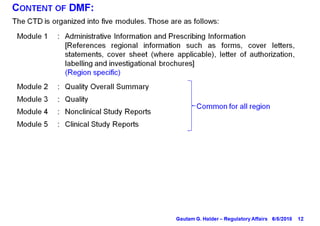
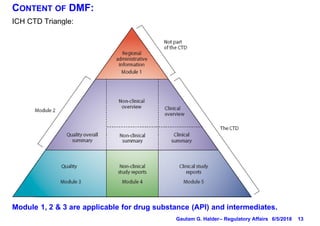
CONTENT OF DMF:
ICH CTD Triangle:
Module 1, 2 & 3 are applicable for drug substance (API) and intermediates.
6/5/2018Gautam G. Halder– Regulatory Affairs
14
MODULE 1 CONTENTS
Module 1. Administrative Information and Prescribing Information
Module 1 should contain the following information
ü Cover Letter
ü Administrative Information
§ Addresses of DMF Holder and Manufacturing & Testing facilities
§ Responsible and Contact persons
ü Statement of Commitment
ü Generic Drug User Fee Cover Sheet (3794), where applicable
ü Letter of Authorization, where applicable
ü US Agent Appointment Letter
ü Debarment Certification [Section 306(k)(1)]
ü Environmental Statement
ü Specimen Product Label
6/5/2018Gautam G. Halder– Regulatory Affairs
15
MODULE 2 CONTENTS
Module 2. Quality Overall Summary (QOS)
Ø The Quality Overall Summary (QOS) is a summary that follows the scope and the
outline of the Body of Data in Module 3.
Ø The QOS should include sufficient information from each section to provide the
Quality reviewer with an overview of Module 3.
Ø The QOS should not include information, data or justification that was not already
included in Module 3 or in other parts of the CTD.
Ø The QOS should also emphasise critical key parameters of the product and
provide, for instance, justification in cases where guidelines were not followed.
Ø This QOS normally should not exceed 40 pages of text, excluding tables and
figures.
Ø QOS should be submitted using the Question-based Review (QbR) format,
although this is not required.
Ø A Manual of Policies and Procedures (MAPP 5015.10) covering reviewer
responsibilities for review of applications submitted using the Question-based
Review (QbR) format has been issued.
6/5/2018Gautam G. Halder– Regulatory Affairs
16
MODULE 3 CONTENTS
Module 3. Quality
Module 3 mainly comprises of 7 sections as follows:
3.2.S.1 General Information
3.2.S.1.1 Nomenclature
3.2.S.1.2 Structure
3.2.S.1.3 General Properties
3.2.S.2 Manufacture
3.2.S.2.1 Manufacturer(s)
3.2.S.2.2 Description of Manufacturing Process and Process Controls
3.2.S.2.3 Control of Materials
3.2.S.2.4 Controls of Critical Steps and Intermediates
3.2.S.2.5 Process Validation and/or Evaluation
3.2.S.2.6 Manufacturing Process Development
3.2.S.3 Characterisation
3.2.S.3.1 Elucidation of Structure and other Characteristics
3.2.S.3.2 Impurities
Continued in next slide
6/5/2018Gautam G. Halder– Regulatory Affairs
17
MODULE 3 CONTENTS
3.2.S.4 Control of Drug Substance
3.2.S.4.1 Specification
3.2.S.4.2 Analytical Procedures
3.2.S.4.3 Validation of Analytical Procedures
3.2.S.4.4 Batch Analyses
3.2.S.4.5 Justification of Specification
3.2.S.5 Reference Standards or Materials
3.2.S.6 Container Closure System
3.2.S.7 Stability
3.2.S.7.1 Stability Summary and Conclusions
3.2.S.7.2 Post-approval Stability Protocol and Stability Commitment
3.2.S.7.3 Stability Data
3.2.R REGIONAL INFORMATION
Any additional drug substance and/or drug product information specific to each region
should be provided in section R of the application (Example: Executed Batch Records).
6/5/2018Gautam G. Halder– Regulatory Affairs
18
MODULE 3 CONTENTS
Relevant information shall be presented in respective sections as prescribed in ICH
M4Q CTD guideline and should comply with "Completeness Assessment" under the
conditions specified in the Final Guidance “Completeness Assessments for Type II API
DMFs Under GDUFA." (CA Guidance).
http://www.ich.org/fileadmin/Public_Web_Site/ICH_Products/CTD/M4_R1_Quality/M4Q
__R1_.pdf
6/5/2018Gautam G. Halder– Regulatory Affairs
20
SUBMISSION(S):
Ø Amendment(s)
§ The DMF holder should notify each authorized party of the nature of the
changes, providing as much detail as is consistent with the confidentiality
agreement between the DMF holder and the authorized party, so that the
authorized party can determine how to report the changes in their approved
NDA or ANDA. See 21 CFR 314.70 and related Guidances.
Guidance for Industry: Changes to an Approved NDA or ANDA and the Q&A
CMC Postapproval Manufacturing Changes Reportable in Annual
Reports (Draft Guidance)
§ For each submission covering letter should be prepared to facilitate
processing of documents, list the submission type and the category/
subcategory of the Amendment (supporting document) in bold type in the
header on the cover letter (transmittal letter)
6/5/2018Gautam G. Halder– Regulatory Affairs
21
SUBMISSION(S):
Ø Annual Report(s)
§ The holder should provide an annual report on the anniversary date of the
original submission.
§ Annual Reports are NOT to be used to report changes in the DMF.
§ The Annual Report should contain
ü An administrative page containing the Administrative Information
ü Date(s) of the amendment(s) reporting changes since the last Annual
Report or the original DMF filing date, whichever is most recent.
ü A statement that no amendments have been submitted since the last
Annual Report or the original DMF filing date, whichever is most recent.
(Only if no amendments have been submitted since last annual report)
ü A complete list of all parties authorized to make reference to the DMF
ü A statement that there are no Authorized Parties (Only if Letter of
Authorization (LOA) has been not issued to any party)
ü List of all parties whose authorization has been withdrawn.
Important New Information:
Annual Reports for DMFs in eCTD can be submitted on the same date as any other
submission but they must have a different Sequence Number.
6/5/2018Gautam G. Halder– Regulatory Affairs
22
SUBMISSION(S):
Ø Annual Report(s)
Failure to submit an Annual Report to the
DMF in the past thirty-six (36) months, FDA
will sends “Overdue Notification Letters”
(ONLs) to DMF holders.
If a DMF holder does not respond with the
submission of an Annual report to this letter
within 90 days, the DMF may be CLOSED by the
FDA.
6/5/2018Gautam G. Halder– Regulatory Affairs
24
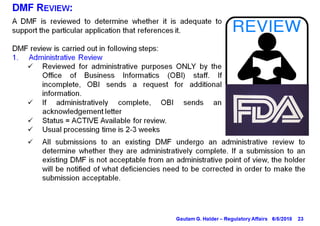
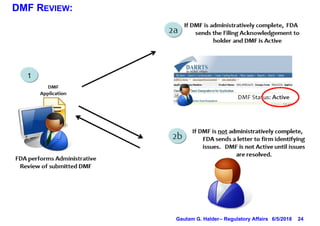
DMF REVIEW:
6/5/2018Gautam G. Halder– Regulatory Affairs
25
DMF REVIEW:
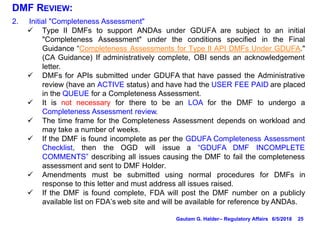
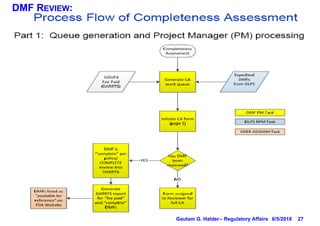
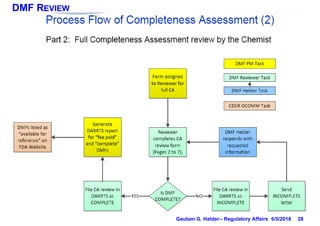
2. Initial "Completeness Assessment"
ü Type II DMFs to support ANDAs under GDUFA are subject to an initial
"Completeness Assessment" under the conditions specified in the Final
Guidance “Completeness Assessments for Type II API DMFs Under GDUFA."
(CA Guidance) If administratively complete, OBI sends an acknowledgement
letter.
ü DMFs for APIs submitted under GDUFA that have passed the Administrative
review (have an ACTIVE status) and have had the USER FEE PAID are placed
in the QUEUE for a Completeness Assessment.
ü It is not necessary for there to be an LOA for the DMF to undergo a
Completeness Assessment review.
ü The time frame for the Completeness Assessment depends on workload and
may take a number of weeks.
ü If the DMF is found incomplete as per the GDUFA Completeness Assessment
Checklist, then the OGD will issue a “GDUFA DMF INCOMPLETE
COMMENTS” describing all issues causing the DMF to fail the completeness
assessment and sent to DMF Holder.
ü Amendments must be submitted using normal procedures for DMFs in
response to this letter and must address all issues raised.
ü If the DMF is found complete, FDA will post the DMF number on a publicly
available list on FDA’s web site and will be available for reference by ANDAs.
6/5/2018Gautam G. Halder– Regulatory Affairs
26
DMF REVIEW:
ü The list of DMFs that have passed the Completeness Assessment and are
available for reference by ANDAs under GDUFA is available
at http://www.fda.gov/downloads/ForIndustry/UserFees/GenericDrugUserFees/
UCM332875.xls.
ü This is the only notification that the DMF has passed the Completeness
Assessment.
ü ANDAs can only be filed by OGD if all DMFs for the drug substance(s) are
“available for reference”
6/5/2018Gautam G. Halder– Regulatory Affairs
27
DMF REVIEW:
6/5/2018Gautam G. Halder– Regulatory Affairs
28
DMF REVIEW
6/5/2018Gautam G. Halder– Regulatory Affairs
29
DMF REVIEW
3. Technical Review
ü DMFs are subjected to a complete review for technical information ONLY when
it is referenced in an Application or another DMF.
ü The DMF is reviewed using same regulatory and scientific criteria as review of
application.
ü Reference must be accompanied by a copy of the DMF holder’s Letter of
Authorization (LOA)
ü LOAs should specify the DMF number, name of the specific item being
referenced, and the date of submission of information about that item..
ü The DMF holder should submit LOA to the FDA and one copy to the authorized
party (company or individual authorized to incorporate the DMF by reference).
ü The authorized party submits an application to the FDA that contains a copy of
the LOA.
ü Failure to submit the original LOA to the DMF may result in a delay in review of
the DMF.
ü The LOA should not be called a “Letter of Access.”
ü An LOA should be submitted even if the DMF holder is the same company as
the authorized party.
ü During review, If more information is needed to complete the review, a list of
the information needed is communicated to the holder in an Information
Request (IR) Letter
6/5/2018Gautam G. Halder– Regulatory Affairs
30
DMF REVIEW
3. Technical Review
ü If the information in the DMF cannot support approval of the application that
references it, FDA sends a Deficiency Letter (DEF) or Complete Response
(CR) Letter (specific for Type II DMFs under GDUFA)
ü Holder should submit amendment to DMF in response to IR, DEF or CR
ü Holder should notify applicant that the DMF has been amended.
ü If the Applicant was sent an IR Letter.
§ Applicant should submit an amendment to APPLICATION notifying FDA
that DMF was amended. Reviewer receives assignment to review
APPLICATION AMENDMENT. DMF amendment may be reviewed
depending on timing relative to due date of A/NDA
ü If the Applicant was sent a CR Letter.
§ The DMF amendment will be reviewed ONLY when the APPLICANT
submits a Resubmission (Complete Response) to their CR letter.
Rationale: CR letter may contain other deficiencies e.g.. Clinical issues. If
these are not addressed then the DMF amendment does not need to be
reviewed
§ The amendment to the DMF must be a Complete Response to DMF letter
from FDA. Cannot be a notification that the DMF or sections thereof WILL
be amended.
§ If amendment to DMF is not complete, then the Resubmission to the
A/NDA is not a Complete Response.
6/5/2018Gautam G. Halder– Regulatory Affairs
31
APPROVAL:
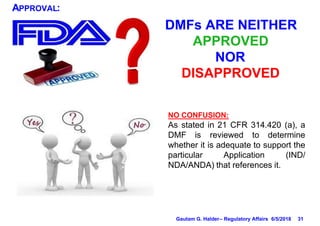
DMFs ARE NEITHER
APPROVED
NOR
DISAPPROVED
NO CONFUSION:
As stated in 21 CFR 314.420 (a), a
DMF is reviewed to determine
whether it is adequate to support the
particular Application (IND/
NDA/ANDA) that references it.
6/5/2018Gautam G. Halder– Regulatory Affairs
326/5/2018Gautam G. Halder– Regulatory Affairs
QUOTE OF THE DAY:
336/5/2018Gautam G. Halder– Regulatory Affairs

USDMF Preparation and Submissions

  • 2.
    2 TOPICS COVERED: Ø Definition ØRegulatory requirement Ø Type of DMFs Ø Content of DMF Ø Submission(s) Ø DMF Review Ø Approval 6/5/2018Gautam G. Halder– Regulatory Affairs
  • 5.
    5 TYPE OF DMFS: ManufacturingSite, Facilities, Operating Procedures, and Personnel TYPE I Drug Substance, Drug Substance Intermediate, and Material Used in Their Preparation, or Drug Product TYPE II Packaging Material TYPE III Excipient, Colorant, Flavor, Essence, or Material Used in Their PreparationTYPE IV FDAAccepted Reference Information TYPE V 6/5/2018Gautam G. Halder– Regulatory Affairs
  • 6.
    6 TYPE I DMF TypeI: Manufacturing Site, Facilities, Operating Procedures, and Personnel Ø A Type I DMF is recommended for a person outside of the United States to assist FDA in conducting on site inspections of their manufacturing facilities. Ø The DMF should describe the manufacturing site, equipment capabilities, and operational layout. NO LONGER ACCEPTED PER A FINAL RULE PUBLISHED JANUARY 12, 2000 (65 FR 1776) 6/5/2018Gautam G. Halder– Regulatory Affairs
  • 7.
    7 TYPE II DMF TypeII: Drug Substance, Drug Substance Intermediate, and Material Used in Their Preparation, or Drug Product Ø Drug Substance (DS) and Drug Substance intermediates Summarize all significant steps in the manufacturing and controls of drug intermediate or substance. It should be submitted in the format for "Drug substance" in the "Guidance for Industry M4Q: The CTD - Quality". Ø Drug Product and Drug Product Intermediate Manufacturing procedures and controls of finished dosage forms should ordinarily be submitted in an IND, NDA, ANDA or Export Application. If this information cannot be submitted in an IND, NDA, ANDA or Export Application, it should be submitted in a DMF. It should be submitted in the format for "Drug product" in the "Guidance for Industry M4Q: The CTD - Quality". 6/5/2018Gautam G. Halder– Regulatory Affairs
  • 8.
    8 TYPE III DMF TypeIII: Packaging Material Ø Each packaging material should be identified by the intended use, components, composition, and controls for its release. Ø Toxicological data on these materials would be included under this type of DMF, if not otherwise available by cross reference to another document. Ø CTD format: Single components and materials of construction may be submitted as if they were drug substances i.e., the preparation of the item should be in S.2. An assembled container closure systems may be treated as if it were a drug product e.g. the Materials of construction would be in P.1, the finished packaging material release specification would be in P.5. Ø Much of the information needed for review can be provided directly to the applicant for inclusion in the application, thereby avoiding the need to review the DMF. 6/5/2018Gautam G. Halder– Regulatory Affairs
  • 9.
    9 TYPE IV DMF TypeIV: Excipient, Colorant, Flavor, Essence, or Material Used in Their Preparation Ø Each additive should be identified and characterized by its method of manufacture, release specifications, and testing methods. Ø Toxicological data on these materials would be included under this type of DMF, if not otherwise available by cross reference to another document. Ø If toxicology studies are submitted in the same DMF (in paper) as the CMC information, they should be in a separate volume or volumes, although it is preferable for holders to submit such information as a separate Type V DMF . Toxicology studies in an electronic DMF for an excipient should be submitted in the appropriate module. See also the “Guidance for Industry: Nonclinical Studies for the Safety Evaluation of Pharmaceutical Excipients” Ø CTD format: Single entities may be submitted as if they were drug substances e.g., the preparation of the item should be in S.2. Mixtures e.g., as flavor mixtures, may be treated as if it were a drug product, i.e.. the Components and Composition would be in P.1, the finished material release specification would be in P.5. 6/5/2018Gautam G. Halder– Regulatory Affairs
  • 10.
    10 TYPE V DMF TypeV: FDAAccepted Reference Information Ø If any holder wishes to submit information and supporting data in a DMF that is not covered by Types I through IV Ø As specified in 21 CFR 314.420(a)(5), DMF holders wishing to submit a Type V DMF must obtain clearance from the FDA (See below for an exception to this requirement for sterile processing facilities). Prospective Type V DMF holders should send their request to dmfquestion@cder.fda.gov, including the following: 1. An explanation of the necessity for filing the information in a Type V DMF 2. The proposed Subject (Title) of the DMF 3. The rationale for not submitting the information in an IND, NDA, or ANDA. 4. The clinical division that will be reviewing the information, if applicable. 6/5/2018Gautam G. Halder– Regulatory Affairs
  • 11.
    11 TYPE V DMF TypeV: FDAAccepted Reference Information Ø Information regarding manufacturing site, facilities, operating procedures, and personnel for sterile manufacturing plants can be filed as a Type V DMF without clearance. The Subject field should specify what the DMF covers e.g., “Sterile Processing Facility.” See Guidance for Industry for the Submission Documentation for Sterilization Process Validation in Applications for Human and Veterinary Drug Products Ø FDA discourages the use of Type V DMF's for miscellaneous information, duplicate information, or information that should be included in one of the other types of DMF's. 6/5/2018Gautam G. Halder– Regulatory Affairs
  • 13.
    13 CONTENT OF DMF: ICHCTD Triangle: Module 1, 2 & 3 are applicable for drug substance (API) and intermediates. 6/5/2018Gautam G. Halder– Regulatory Affairs
  • 14.
    14 MODULE 1 CONTENTS Module1. Administrative Information and Prescribing Information Module 1 should contain the following information ü Cover Letter ü Administrative Information § Addresses of DMF Holder and Manufacturing & Testing facilities § Responsible and Contact persons ü Statement of Commitment ü Generic Drug User Fee Cover Sheet (3794), where applicable ü Letter of Authorization, where applicable ü US Agent Appointment Letter ü Debarment Certification [Section 306(k)(1)] ü Environmental Statement ü Specimen Product Label 6/5/2018Gautam G. Halder– Regulatory Affairs
  • 15.
    15 MODULE 2 CONTENTS Module2. Quality Overall Summary (QOS) Ø The Quality Overall Summary (QOS) is a summary that follows the scope and the outline of the Body of Data in Module 3. Ø The QOS should include sufficient information from each section to provide the Quality reviewer with an overview of Module 3. Ø The QOS should not include information, data or justification that was not already included in Module 3 or in other parts of the CTD. Ø The QOS should also emphasise critical key parameters of the product and provide, for instance, justification in cases where guidelines were not followed. Ø This QOS normally should not exceed 40 pages of text, excluding tables and figures. Ø QOS should be submitted using the Question-based Review (QbR) format, although this is not required. Ø A Manual of Policies and Procedures (MAPP 5015.10) covering reviewer responsibilities for review of applications submitted using the Question-based Review (QbR) format has been issued. 6/5/2018Gautam G. Halder– Regulatory Affairs
  • 16.
    16 MODULE 3 CONTENTS Module3. Quality Module 3 mainly comprises of 7 sections as follows: 3.2.S.1 General Information 3.2.S.1.1 Nomenclature 3.2.S.1.2 Structure 3.2.S.1.3 General Properties 3.2.S.2 Manufacture 3.2.S.2.1 Manufacturer(s) 3.2.S.2.2 Description of Manufacturing Process and Process Controls 3.2.S.2.3 Control of Materials 3.2.S.2.4 Controls of Critical Steps and Intermediates 3.2.S.2.5 Process Validation and/or Evaluation 3.2.S.2.6 Manufacturing Process Development 3.2.S.3 Characterisation 3.2.S.3.1 Elucidation of Structure and other Characteristics 3.2.S.3.2 Impurities Continued in next slide 6/5/2018Gautam G. Halder– Regulatory Affairs
  • 17.
    17 MODULE 3 CONTENTS 3.2.S.4Control of Drug Substance 3.2.S.4.1 Specification 3.2.S.4.2 Analytical Procedures 3.2.S.4.3 Validation of Analytical Procedures 3.2.S.4.4 Batch Analyses 3.2.S.4.5 Justification of Specification 3.2.S.5 Reference Standards or Materials 3.2.S.6 Container Closure System 3.2.S.7 Stability 3.2.S.7.1 Stability Summary and Conclusions 3.2.S.7.2 Post-approval Stability Protocol and Stability Commitment 3.2.S.7.3 Stability Data 3.2.R REGIONAL INFORMATION Any additional drug substance and/or drug product information specific to each region should be provided in section R of the application (Example: Executed Batch Records). 6/5/2018Gautam G. Halder– Regulatory Affairs
  • 18.
    18 MODULE 3 CONTENTS Relevantinformation shall be presented in respective sections as prescribed in ICH M4Q CTD guideline and should comply with "Completeness Assessment" under the conditions specified in the Final Guidance “Completeness Assessments for Type II API DMFs Under GDUFA." (CA Guidance). http://www.ich.org/fileadmin/Public_Web_Site/ICH_Products/CTD/M4_R1_Quality/M4Q __R1_.pdf 6/5/2018Gautam G. Halder– Regulatory Affairs
  • 20.
    20 SUBMISSION(S): Ø Amendment(s) § TheDMF holder should notify each authorized party of the nature of the changes, providing as much detail as is consistent with the confidentiality agreement between the DMF holder and the authorized party, so that the authorized party can determine how to report the changes in their approved NDA or ANDA. See 21 CFR 314.70 and related Guidances. Guidance for Industry: Changes to an Approved NDA or ANDA and the Q&A CMC Postapproval Manufacturing Changes Reportable in Annual Reports (Draft Guidance) § For each submission covering letter should be prepared to facilitate processing of documents, list the submission type and the category/ subcategory of the Amendment (supporting document) in bold type in the header on the cover letter (transmittal letter) 6/5/2018Gautam G. Halder– Regulatory Affairs
  • 21.
    21 SUBMISSION(S): Ø Annual Report(s) §The holder should provide an annual report on the anniversary date of the original submission. § Annual Reports are NOT to be used to report changes in the DMF. § The Annual Report should contain ü An administrative page containing the Administrative Information ü Date(s) of the amendment(s) reporting changes since the last Annual Report or the original DMF filing date, whichever is most recent. ü A statement that no amendments have been submitted since the last Annual Report or the original DMF filing date, whichever is most recent. (Only if no amendments have been submitted since last annual report) ü A complete list of all parties authorized to make reference to the DMF ü A statement that there are no Authorized Parties (Only if Letter of Authorization (LOA) has been not issued to any party) ü List of all parties whose authorization has been withdrawn. Important New Information: Annual Reports for DMFs in eCTD can be submitted on the same date as any other submission but they must have a different Sequence Number. 6/5/2018Gautam G. Halder– Regulatory Affairs
  • 22.
    22 SUBMISSION(S): Ø Annual Report(s) Failureto submit an Annual Report to the DMF in the past thirty-six (36) months, FDA will sends “Overdue Notification Letters” (ONLs) to DMF holders. If a DMF holder does not respond with the submission of an Annual report to this letter within 90 days, the DMF may be CLOSED by the FDA. 6/5/2018Gautam G. Halder– Regulatory Affairs
  • 24.
    24 DMF REVIEW: 6/5/2018Gautam G.Halder– Regulatory Affairs
  • 25.
    25 DMF REVIEW: 2. Initial"Completeness Assessment" ü Type II DMFs to support ANDAs under GDUFA are subject to an initial "Completeness Assessment" under the conditions specified in the Final Guidance “Completeness Assessments for Type II API DMFs Under GDUFA." (CA Guidance) If administratively complete, OBI sends an acknowledgement letter. ü DMFs for APIs submitted under GDUFA that have passed the Administrative review (have an ACTIVE status) and have had the USER FEE PAID are placed in the QUEUE for a Completeness Assessment. ü It is not necessary for there to be an LOA for the DMF to undergo a Completeness Assessment review. ü The time frame for the Completeness Assessment depends on workload and may take a number of weeks. ü If the DMF is found incomplete as per the GDUFA Completeness Assessment Checklist, then the OGD will issue a “GDUFA DMF INCOMPLETE COMMENTS” describing all issues causing the DMF to fail the completeness assessment and sent to DMF Holder. ü Amendments must be submitted using normal procedures for DMFs in response to this letter and must address all issues raised. ü If the DMF is found complete, FDA will post the DMF number on a publicly available list on FDA’s web site and will be available for reference by ANDAs. 6/5/2018Gautam G. Halder– Regulatory Affairs
  • 26.
    26 DMF REVIEW: ü Thelist of DMFs that have passed the Completeness Assessment and are available for reference by ANDAs under GDUFA is available at http://www.fda.gov/downloads/ForIndustry/UserFees/GenericDrugUserFees/ UCM332875.xls. ü This is the only notification that the DMF has passed the Completeness Assessment. ü ANDAs can only be filed by OGD if all DMFs for the drug substance(s) are “available for reference” 6/5/2018Gautam G. Halder– Regulatory Affairs
  • 27.
    27 DMF REVIEW: 6/5/2018Gautam G.Halder– Regulatory Affairs
  • 28.
    28 DMF REVIEW 6/5/2018Gautam G.Halder– Regulatory Affairs
  • 29.
    29 DMF REVIEW 3. TechnicalReview ü DMFs are subjected to a complete review for technical information ONLY when it is referenced in an Application or another DMF. ü The DMF is reviewed using same regulatory and scientific criteria as review of application. ü Reference must be accompanied by a copy of the DMF holder’s Letter of Authorization (LOA) ü LOAs should specify the DMF number, name of the specific item being referenced, and the date of submission of information about that item.. ü The DMF holder should submit LOA to the FDA and one copy to the authorized party (company or individual authorized to incorporate the DMF by reference). ü The authorized party submits an application to the FDA that contains a copy of the LOA. ü Failure to submit the original LOA to the DMF may result in a delay in review of the DMF. ü The LOA should not be called a “Letter of Access.” ü An LOA should be submitted even if the DMF holder is the same company as the authorized party. ü During review, If more information is needed to complete the review, a list of the information needed is communicated to the holder in an Information Request (IR) Letter 6/5/2018Gautam G. Halder– Regulatory Affairs
  • 30.
    30 DMF REVIEW 3. TechnicalReview ü If the information in the DMF cannot support approval of the application that references it, FDA sends a Deficiency Letter (DEF) or Complete Response (CR) Letter (specific for Type II DMFs under GDUFA) ü Holder should submit amendment to DMF in response to IR, DEF or CR ü Holder should notify applicant that the DMF has been amended. ü If the Applicant was sent an IR Letter. § Applicant should submit an amendment to APPLICATION notifying FDA that DMF was amended. Reviewer receives assignment to review APPLICATION AMENDMENT. DMF amendment may be reviewed depending on timing relative to due date of A/NDA ü If the Applicant was sent a CR Letter. § The DMF amendment will be reviewed ONLY when the APPLICANT submits a Resubmission (Complete Response) to their CR letter. Rationale: CR letter may contain other deficiencies e.g.. Clinical issues. If these are not addressed then the DMF amendment does not need to be reviewed § The amendment to the DMF must be a Complete Response to DMF letter from FDA. Cannot be a notification that the DMF or sections thereof WILL be amended. § If amendment to DMF is not complete, then the Resubmission to the A/NDA is not a Complete Response. 6/5/2018Gautam G. Halder– Regulatory Affairs
  • 31.
    31 APPROVAL: DMFs ARE NEITHER APPROVED NOR DISAPPROVED NOCONFUSION: As stated in 21 CFR 314.420 (a), a DMF is reviewed to determine whether it is adequate to support the particular Application (IND/ NDA/ANDA) that references it. 6/5/2018Gautam G. Halder– Regulatory Affairs
  • 32.
    326/5/2018Gautam G. Halder–Regulatory Affairs QUOTE OF THE DAY:
  • 33.