
CONCEPT OF INDA, NDA &
ANDA
 PREPARED BY:
KISHAN RAM
M.PHARM
QUALITY ASSURANCE
 GUIDED BY:
Dr. AJAY I. PATEL
ASSISTANT- PROFESSOR
BKMGPC RAJKOT
M.PHARM, SEM 1
1
Content :
Investigational new drug application ( INDA)
New drug application ( NDA )
Abbreviated new drug application (ANDA)
M.PHARM, SEM 1
2
M.PHARM, SEM 1
3
M.PHARM, SEM 1
4
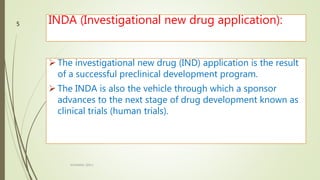
INDA (Investigational new drug application):
 The investigational new drug (IND) application is the result
of a successful preclinical development program.
 The INDA is also the vehicle through which a sponsor
advances to the next stage of drug development known as
clinical trials (human trials).
M.PHARM, SEM 1
5
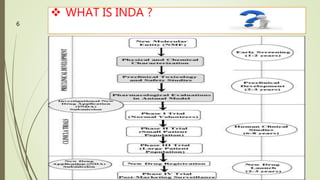
 WHAT IS INDA ?
M.PHARM, SEM 1
6
M.PHARM, SEM 1
7
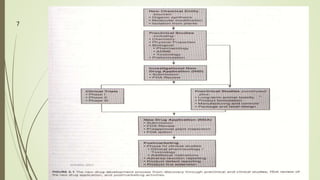
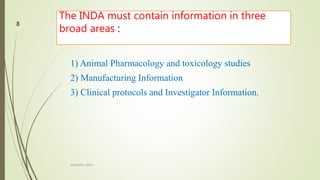
The INDA must contain information in three
broad areas :
1) Animal Pharmacology and toxicology studies
2) Manufacturing Information
3) Clinical protocols and Investigator Information.
M.PHARM, SEM 1
8
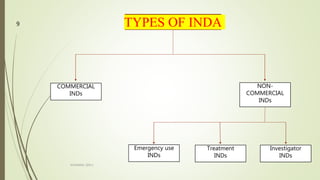
TYPES OF INDA
COMMERCIAL
INDs
NON-
COMMERCIAL
INDs
Emergency use
INDs
Treatment
INDs
Investigator
INDs
M.PHARM, SEM 1
9
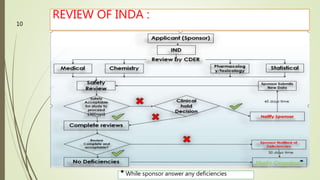
REVIEW OF INDA :
* While sponsor answer any deficiencies
M.PHARM, SEM 1
10
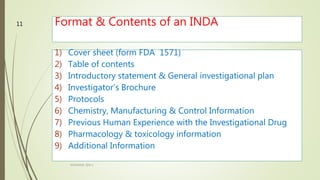
Format & Contents of an INDA
1) Cover sheet (form FDA 1571)
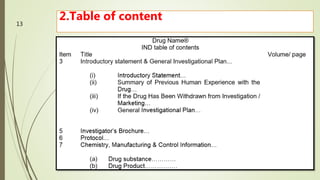
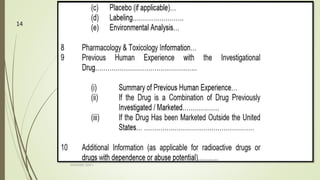
2) Table of contents
3) Introductory statement & General investigational plan
4) Investigator’s Brochure
5) Protocols
6) Chemistry, Manufacturing & Control Information
7) Previous Human Experience with the Investigational Drug
8) Pharmacology & toxicology information
9) Additional Information
M.PHARM, SEM 1
11
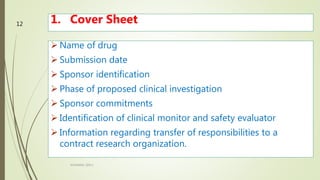
1. Cover Sheet
 Name of drug
 Submission date
 Sponsor identification
 Phase of proposed clinical investigation
 Sponsor commitments
 Identification of clinical monitor and safety evaluator
 Information regarding transfer of responsibilities to a
contract research organization.
M.PHARM, SEM 1
12
2.Table of content
M.PHARM, SEM 1
13
M.PHARM, SEM 1
14
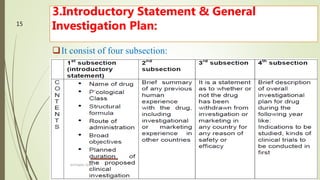
3.Introductory Statement & General
Investigation Plan:
It consist of four subsection:
M.PHARM, SEM 1
15
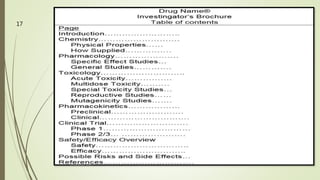
4. Investigator’s Brochure
Definition:
o It is a body of information characterizing the drug
product that is given by a sponsor to each participating
clinical investigation.
o The Investigator’s Brochure is a constantly evolving document that
grows as the knowledge gained form research with the
investigational drug grows. While a drug is under an accepted IND
application, the Brochure serves as the approved labeling for the
substance.
M.PHARM, SEM 1
16
M.PHARM, SEM 1
17
5. Protocols :
 Phase 1 protocols may be less detailed and more flexible than
those for Phase 2 or Phase 3.
 Phase 1 protocol provides an outline of investigation by
specifying information as estimated number of test subjects,
inclusion/exclusion criteria and dosing plan
 It is specific in safety and monitoring of vital sign and clinical
laboratory evaluations.
 Phase 2 and Phase 3 protocols are detailed, describing all
aspects of the studies, such that any deviation in a design if
required, it can be established in the protocol from the
beginning.M.PHARM, SEM 1
18
6. Chemistry, Manufacturing & Control
information:
 Drug Substance:
 Description of the Information regarding the :
 Physical
 chemical or
 biological characteristics of the drug substance, along with the name and address of the
manufacturer.
 general method of preparation
 identification of the analytical methods and
 acceptable limits used to assure the identity, purity and strength of the drug substance.
 Drug Product:
 Information regarding the manufacturing facility,
 manufacturing and packaging procedure description,
 Identification of analytical methods,
 acceptable limits used to assure identity, purity, and strength of components and finished
products.
M.PHARM, SEM 1
19
7.Previous Human Experiences with the
Investigational Drug:
M.PHARM, SEM 1
20
 Such findings if available must be submitted whether drug is marketed in U.S. or other
foreign country.
8.Pharmacology and toxicology information:
M.PHARM, SEM 1
21
8.Pharmacology and toxicology information:
 (i) Pharmacology and drug disposition:
 A section describing the
 pharmacological effects
 mechanism of action of the drug in animals
 information on the ADME of the drug, if known.
 (ii)Toxicology:
 An integrated summary of the toxicological effects of the drug in animals and in vitro.
 Depending on the nature of the drug and the phase of the investigation, the description is
to include the:
 results of acute, subacute, and chronic toxicity tests;
 tests of the drug's effects on reproduction and the developing fetus;
 any special toxicity test related to the drug's particular mode of administration or conditions of
use.
o (e.g., inhalation, dermal, or ocular toxicology)
9.Additional Information:
o (i)Drug dependence and abuse potential:
o If the drug is a psychotropic substance or otherwise has abuse potential, a
section describing relevant clinical studies and experience and studies in
test animals.
o (ii)Radioactive drugs:
o Phase 1 studies of radioactive drugs must include studies which will obtain
sufficient data for dosimetry calculations.
o (iii)Pediatric studies:
o Plans for assessing pediatric safety and effectiveness.
M.PHARM, SEM 1
22
NDA (NEW DRUG APPLICATION:
 Critical component for drug approval process which required to
submit to USFDA before drug commercialization.
 The data gathered during the animal studies and human clinical
trials of an Investigational New Drug (IND) become part of the NDA.
 The goals of the NDA are to provide enough information to permit
FDA reviewer to reach the following key decisions:
 Safety and Effectiveness of a new drug in its proposed use(s)
 Whether the drug's proposed labelling (package insert) is appropriate
 Methods used in manufacturing the drug and the controls used to maintain the
drug's quality are adequate to preserve the drug's identity, strength, quality,
and purity
 The benefits of the drug outweigh the risks.M.PHARM, SEM 1
23
M.PHARM, SEM 1
24
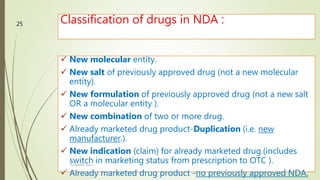
Classification of drugs in NDA :
 New molecular entity.
 New salt of previously approved drug (not a new molecular
entity).
 New formulation of previously approved drug (not a new salt
OR a molecular entity ).
 New combination of two or more drug.
 Already marketed drug product-Duplication (i.e. new
manufacturer.).
 New indication (claim) for already marketed drug.(includes
switch in marketing status from prescription to OTC ).
 Already marketed drug product -no previously approved NDA.
M.PHARM, SEM 1
25
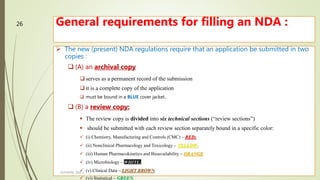
General requirements for filling an NDA :
 The new (present) NDA regulations require that an application be submitted in two
copies :
 (A) an archival copy
 serves as a permanent record of the submission
 it is a complete copy of the application
 must be bound in a BLUE cover jacket.
 (B) a review copy:
 The review copy is divided into six technical sections (“review sections”)
 should be submitted with each review section separately bound in a specific color:
 (i) Chemistry, Manufacturing and Controls (CMC) – RED;
 (ii) Nonclinical Pharmacology and Toxicology – YELLOW;
 (iii) Human Pharmacokinetics and Bioavailability – ORANGE;
 (iv) Microbiology – WHITE;
 (v) Clinical Data – LIGHT BROWN;
 (vi) Statistical – GREEN.
M.PHARM, SEM 1
26
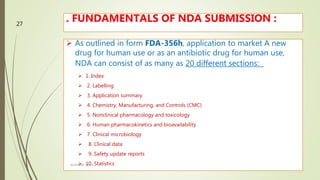
. FUNDAMENTALS OF NDA SUBMISSION :
 As outlined in form FDA-356h, application to market A new
drug for human use or as an antibiotic drug for human use,
NDA can consist of as many as 20 different sections:
 1. Index
 2. Labelling
 3. Application summary
 4. Chemistry, Manufacturing, and Controls (CMC)
 5. Nonclinical pharmacology and toxicology
 6. Human pharmacokinetics and bioavailability
 7. Clinical microbiology
 8. Clinical data
 9. Safety update reports
 10. StatisticsM.PHARM, SEM 1
27
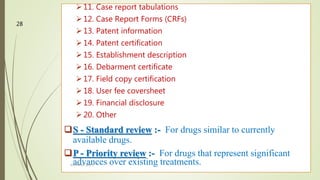
11. Case report tabulations
12. Case Report Forms (CRFs)
13. Patent information
14. Patent certification
15. Establishment description
16. Debarment certificate
17. Field copy certification
18. User fee coversheet
19. Financial disclosure
20. Other
S - Standard review :- For drugs similar to currently
available drugs.
P - Priority review :- For drugs that represent significant
advances over existing treatments.M.PHARM, SEM 1
28
Application form :-
 The applicant shall submit a completed & signed application form
that contains :-
 The name & address of the applicants
 The date of the application
 The application number if previously issued
 The name of the product, including its established ,proprietary code and
chemical names,
 The dosage form and strength, the route of administration.
 The identification number of all IND application.
 The drug products proposed indications for use.
 Whether the submission is in original submission or resubmission to an
application
 Whether the applicant proposes to market the drug product as a prescription
or an OTC product.
 The applicant or the applicants attorney , agent or other authorized official shall
sign the application.
M.PHARM, SEM 1
29
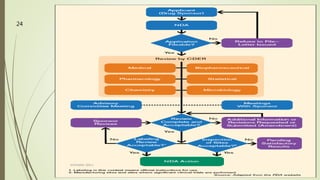
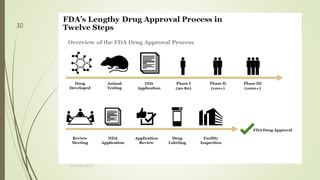
 Review process:
M.PHARM, SEM 1
30
 ANDA (Abbreviated New Drug
Application):
Introduction:
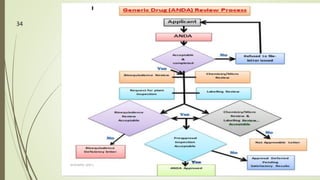
 An “Abbreviated new application” (ANDA) is an application for a U.S.
generic drug approval for an existing licensed medication or approved
drug.
 Once approved, Applicant may manufacture and market the generic drug
product to provide a safe, effective, low cost alternative to brand drug.
 It termed “abbreviated” because they generally not required to include
preclinical (animal) and clinical (human) data to establish safety and
effectiveness.
M.PHARM, SEM 1
31
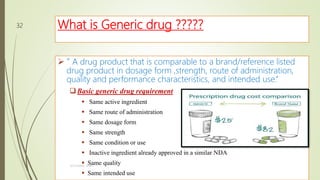
What is Generic drug ?????
 “ A drug product that is comparable to a brand/reference listed
drug product in dosage form ,strength, route of administration,
quality and performance characteristics, and intended use.”
Basic generic drug requirement
 Same active ingredient
 Same route of administration
 Same dosage form
 Same strength
 Same condition or use
 Inactive ingredient already approved in a similar NDA
 Same quality
 Same intended use
M.PHARM, SEM 1
32
Goal of ANDA:
To reduce the price of drug
To reduce the time development
Increase the bioavailability of the drug
in comparison to references to list drug
M.PHARM, SEM 1
33
M.PHARM, SEM 1
34
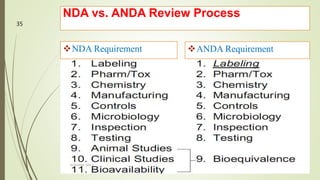
NDA vs. ANDA Review Process
NDA Requirement ANDA Requirement
M.PHARM, SEM 1
35
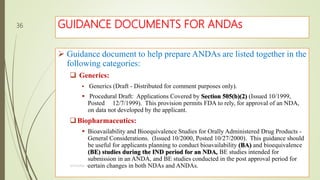
GUIDANCE DOCUMENTS FOR ANDAs
 Guidance document to help prepare ANDAs are listed together in the
following categories:
 Generics:
 Generics (Draft - Distributed for comment purposes only).
 Procedural Draft: Applications Covered by Section 505(b)(2) (Issued 10/1999,
Posted 12/7/1999). This provision permits FDA to rely, for approval of an NDA,
on data not developed by the applicant.
Biopharmaceutics:
 Bioavailability and Bioequivalence Studies for Orally Administered Drug Products -
General Considerations. (Issued 10/2000, Posted 10/27/2000). This guidance should
be useful for applicants planning to conduct bioavailability (BA) and bioequivalence
(BE) studies during the IND period for an NDA, BE studies intended for
submission in an ANDA, and BE studies conducted in the post approval period for
certain changes in both NDAs and ANDAs.M.PHARM, SEM 1
36
Drug Master Files:
 A Drug Master File (DMF) is a submission to the FDA that may be used to
provide confidential detailed information about facilities, processes, or
articles used in the manufacturing, processing, packaging, and storing
one or more human drugs.
Guidance for Industry:
 Changes to an Approved NDA or ANDA
Inactive Ingredient Database:
 This database contains all inactive ingredients present in approved drug
products or conditionally approved drug products currently marketed for
human use.
M.PHARM, SEM 1
37
Guidelines available for ANDA:
 Various guidelines have been developed to assist applicants in
preparing and filing ANDAs. These guidelines describe:
 Format & content for the following sections:
 Application summary
 Chemistry, Manufacturing and controls section
 Non clinical pharmacology and toxicology section
 Human pharmacokinetics & bioavailability section
 Clinical and statically section
 Microbiology sectionM.PHARM, SEM 1
38
Various guidelines available for ANDA
includes:
 1. Organization of ANDA
 2. Electronic submission of data for ANDA
 3. Submission of archival copy of application in Microfiche
 4. Guideline for impurities in drug substances
 5. Guideline for submitting supporting documentation for the Manufacture of Drug substance.
 6. Guideline for submitting supporting documentation for the Manufacture of finished dosage forms.
 7. Guideline for submitting supporting documentation for stability studies of Human drugs and
Biologics.
 8. Guideline for packaging
 9. Guidelines for changes in approved ANDA and NDA
 10. 180 days exclusivity under Hatch Waxman amendment
 11. Guidelines for alternate source of API in pending ANDAs
 12. Post marketing reporting of Adverse Drug reactions
M.PHARM, SEM 1
39
180 DAY GENERIC DRUG UNDER THE HATCH-
WAXMAN AMENDSMENTS TO THE FEDERAL FOOD
,DRUG AND COSMETIC ACT 1984
 Before Hatch Waxman amendment generic manufacturers can
file ANDA only after innovators patent expiration or after
cancellation of such patent.
 But under the section 505(j)(5)(B)(iv)2 of Hatch Waxman
amendment, Congress rewarded the first generic company to
challenge the innovator company’s patent for a given drug with
a 180 day exclusivity period in which no subsequent abbreviated
new drug application (ANDA) could be approved for that drug.
M.PHARM, SEM 1
40
 Commonly known as “Drug Price Competition & Patent Term
Restoration” of 1984
 It permit the preparation and the filling of the ANDA before patent
expiration, it generally contemplated that the effective approval date
of the generic would be on the expiration date of the patent covering
the innovator original drug .
 The act however also establish another procedure as a generic
company could challenge a patent and try to enter the market before
patent expiration.
 This amendment added a patent notification system to U.S. law. As a
result, generic companies can readily find and file the patent(s) that
cover the innovator’s drug.
HATCH WAXMAN AMENDMENTS:-
M.PHARM, SEM 1
41
 This Amendment tells that the innovator should be notified of the
generics intent to challenge the patent. Thus it helps innovator to take
timely legal action.
 Both the generic companies and the innovator companies are provided
with certain benefits by virtue of the ANDA notification system. For the
generic companies, the Hatch-Waxman amendments provide an inventive
a 180- day exclusivity period in which no other ANDA for that drug can be
approved.
 This 180-Day period is to encourage generic companies to challenge the
validity of orange book listed patents or to design around these patents
to bring more quickly a generic drug to market and also to recoup the
possible costs.
 Whereas for the innovator company filing of an ANDA for a product that
is intended to be marketed before expiration of the orange book patent is
an act of patent infringement.
 So if the innovator drug company brings suit within 45 days, the approval
M.PHARM, SEM 1
42
 https://www.fda.gov
 www.drugs.com/new-drug-applications.html
 www.news-medical.net
 pharmtech.findpharma.com
Reference:
M.PHARM, SEM 1
43
THANK YOU
M.PHARM, SEM 1
44

Inda, nda & anda concept

  • 1.
    CONCEPT OF INDA,NDA & ANDA  PREPARED BY: KISHAN RAM M.PHARM QUALITY ASSURANCE  GUIDED BY: Dr. AJAY I. PATEL ASSISTANT- PROFESSOR BKMGPC RAJKOT M.PHARM, SEM 1 1
  • 2.
    Content : Investigational newdrug application ( INDA) New drug application ( NDA ) Abbreviated new drug application (ANDA) M.PHARM, SEM 1 2
  • 3.
  • 4.
  • 5.
    INDA (Investigational newdrug application):  The investigational new drug (IND) application is the result of a successful preclinical development program.  The INDA is also the vehicle through which a sponsor advances to the next stage of drug development known as clinical trials (human trials). M.PHARM, SEM 1 5
  • 6.
     WHAT ISINDA ? M.PHARM, SEM 1 6
  • 7.
  • 8.
    The INDA mustcontain information in three broad areas : 1) Animal Pharmacology and toxicology studies 2) Manufacturing Information 3) Clinical protocols and Investigator Information. M.PHARM, SEM 1 8
  • 9.
    TYPES OF INDA COMMERCIAL INDs NON- COMMERCIAL INDs Emergencyuse INDs Treatment INDs Investigator INDs M.PHARM, SEM 1 9
  • 10.
    REVIEW OF INDA: * While sponsor answer any deficiencies M.PHARM, SEM 1 10
  • 11.
    Format & Contentsof an INDA 1) Cover sheet (form FDA 1571) 2) Table of contents 3) Introductory statement & General investigational plan 4) Investigator’s Brochure 5) Protocols 6) Chemistry, Manufacturing & Control Information 7) Previous Human Experience with the Investigational Drug 8) Pharmacology & toxicology information 9) Additional Information M.PHARM, SEM 1 11
  • 12.
    1. Cover Sheet Name of drug  Submission date  Sponsor identification  Phase of proposed clinical investigation  Sponsor commitments  Identification of clinical monitor and safety evaluator  Information regarding transfer of responsibilities to a contract research organization. M.PHARM, SEM 1 12
  • 13.
  • 14.
  • 15.
    3.Introductory Statement &General Investigation Plan: It consist of four subsection: M.PHARM, SEM 1 15
  • 16.
    4. Investigator’s Brochure Definition: oIt is a body of information characterizing the drug product that is given by a sponsor to each participating clinical investigation. o The Investigator’s Brochure is a constantly evolving document that grows as the knowledge gained form research with the investigational drug grows. While a drug is under an accepted IND application, the Brochure serves as the approved labeling for the substance. M.PHARM, SEM 1 16
  • 17.
  • 18.
    5. Protocols : Phase 1 protocols may be less detailed and more flexible than those for Phase 2 or Phase 3.  Phase 1 protocol provides an outline of investigation by specifying information as estimated number of test subjects, inclusion/exclusion criteria and dosing plan  It is specific in safety and monitoring of vital sign and clinical laboratory evaluations.  Phase 2 and Phase 3 protocols are detailed, describing all aspects of the studies, such that any deviation in a design if required, it can be established in the protocol from the beginning.M.PHARM, SEM 1 18
  • 19.
    6. Chemistry, Manufacturing& Control information:  Drug Substance:  Description of the Information regarding the :  Physical  chemical or  biological characteristics of the drug substance, along with the name and address of the manufacturer.  general method of preparation  identification of the analytical methods and  acceptable limits used to assure the identity, purity and strength of the drug substance.  Drug Product:  Information regarding the manufacturing facility,  manufacturing and packaging procedure description,  Identification of analytical methods,  acceptable limits used to assure identity, purity, and strength of components and finished products. M.PHARM, SEM 1 19
  • 20.
    7.Previous Human Experienceswith the Investigational Drug: M.PHARM, SEM 1 20  Such findings if available must be submitted whether drug is marketed in U.S. or other foreign country.
  • 21.
    8.Pharmacology and toxicologyinformation: M.PHARM, SEM 1 21 8.Pharmacology and toxicology information:  (i) Pharmacology and drug disposition:  A section describing the  pharmacological effects  mechanism of action of the drug in animals  information on the ADME of the drug, if known.  (ii)Toxicology:  An integrated summary of the toxicological effects of the drug in animals and in vitro.  Depending on the nature of the drug and the phase of the investigation, the description is to include the:  results of acute, subacute, and chronic toxicity tests;  tests of the drug's effects on reproduction and the developing fetus;  any special toxicity test related to the drug's particular mode of administration or conditions of use. o (e.g., inhalation, dermal, or ocular toxicology)
  • 22.
    9.Additional Information: o (i)Drugdependence and abuse potential: o If the drug is a psychotropic substance or otherwise has abuse potential, a section describing relevant clinical studies and experience and studies in test animals. o (ii)Radioactive drugs: o Phase 1 studies of radioactive drugs must include studies which will obtain sufficient data for dosimetry calculations. o (iii)Pediatric studies: o Plans for assessing pediatric safety and effectiveness. M.PHARM, SEM 1 22
  • 23.
    NDA (NEW DRUGAPPLICATION:  Critical component for drug approval process which required to submit to USFDA before drug commercialization.  The data gathered during the animal studies and human clinical trials of an Investigational New Drug (IND) become part of the NDA.  The goals of the NDA are to provide enough information to permit FDA reviewer to reach the following key decisions:  Safety and Effectiveness of a new drug in its proposed use(s)  Whether the drug's proposed labelling (package insert) is appropriate  Methods used in manufacturing the drug and the controls used to maintain the drug's quality are adequate to preserve the drug's identity, strength, quality, and purity  The benefits of the drug outweigh the risks.M.PHARM, SEM 1 23
  • 24.
  • 25.
    Classification of drugsin NDA :  New molecular entity.  New salt of previously approved drug (not a new molecular entity).  New formulation of previously approved drug (not a new salt OR a molecular entity ).  New combination of two or more drug.  Already marketed drug product-Duplication (i.e. new manufacturer.).  New indication (claim) for already marketed drug.(includes switch in marketing status from prescription to OTC ).  Already marketed drug product -no previously approved NDA. M.PHARM, SEM 1 25
  • 26.
    General requirements forfilling an NDA :  The new (present) NDA regulations require that an application be submitted in two copies :  (A) an archival copy  serves as a permanent record of the submission  it is a complete copy of the application  must be bound in a BLUE cover jacket.  (B) a review copy:  The review copy is divided into six technical sections (“review sections”)  should be submitted with each review section separately bound in a specific color:  (i) Chemistry, Manufacturing and Controls (CMC) – RED;  (ii) Nonclinical Pharmacology and Toxicology – YELLOW;  (iii) Human Pharmacokinetics and Bioavailability – ORANGE;  (iv) Microbiology – WHITE;  (v) Clinical Data – LIGHT BROWN;  (vi) Statistical – GREEN. M.PHARM, SEM 1 26
  • 27.
    . FUNDAMENTALS OFNDA SUBMISSION :  As outlined in form FDA-356h, application to market A new drug for human use or as an antibiotic drug for human use, NDA can consist of as many as 20 different sections:  1. Index  2. Labelling  3. Application summary  4. Chemistry, Manufacturing, and Controls (CMC)  5. Nonclinical pharmacology and toxicology  6. Human pharmacokinetics and bioavailability  7. Clinical microbiology  8. Clinical data  9. Safety update reports  10. StatisticsM.PHARM, SEM 1 27
  • 28.
    11. Case reporttabulations 12. Case Report Forms (CRFs) 13. Patent information 14. Patent certification 15. Establishment description 16. Debarment certificate 17. Field copy certification 18. User fee coversheet 19. Financial disclosure 20. Other S - Standard review :- For drugs similar to currently available drugs. P - Priority review :- For drugs that represent significant advances over existing treatments.M.PHARM, SEM 1 28
  • 29.
    Application form :- The applicant shall submit a completed & signed application form that contains :-  The name & address of the applicants  The date of the application  The application number if previously issued  The name of the product, including its established ,proprietary code and chemical names,  The dosage form and strength, the route of administration.  The identification number of all IND application.  The drug products proposed indications for use.  Whether the submission is in original submission or resubmission to an application  Whether the applicant proposes to market the drug product as a prescription or an OTC product.  The applicant or the applicants attorney , agent or other authorized official shall sign the application. M.PHARM, SEM 1 29
  • 30.
  • 31.
     ANDA (AbbreviatedNew Drug Application): Introduction:  An “Abbreviated new application” (ANDA) is an application for a U.S. generic drug approval for an existing licensed medication or approved drug.  Once approved, Applicant may manufacture and market the generic drug product to provide a safe, effective, low cost alternative to brand drug.  It termed “abbreviated” because they generally not required to include preclinical (animal) and clinical (human) data to establish safety and effectiveness. M.PHARM, SEM 1 31
  • 32.
    What is Genericdrug ?????  “ A drug product that is comparable to a brand/reference listed drug product in dosage form ,strength, route of administration, quality and performance characteristics, and intended use.” Basic generic drug requirement  Same active ingredient  Same route of administration  Same dosage form  Same strength  Same condition or use  Inactive ingredient already approved in a similar NDA  Same quality  Same intended use M.PHARM, SEM 1 32
  • 33.
    Goal of ANDA: Toreduce the price of drug To reduce the time development Increase the bioavailability of the drug in comparison to references to list drug M.PHARM, SEM 1 33
  • 34.
  • 35.
    NDA vs. ANDAReview Process NDA Requirement ANDA Requirement M.PHARM, SEM 1 35
  • 36.
    GUIDANCE DOCUMENTS FORANDAs  Guidance document to help prepare ANDAs are listed together in the following categories:  Generics:  Generics (Draft - Distributed for comment purposes only).  Procedural Draft: Applications Covered by Section 505(b)(2) (Issued 10/1999, Posted 12/7/1999). This provision permits FDA to rely, for approval of an NDA, on data not developed by the applicant. Biopharmaceutics:  Bioavailability and Bioequivalence Studies for Orally Administered Drug Products - General Considerations. (Issued 10/2000, Posted 10/27/2000). This guidance should be useful for applicants planning to conduct bioavailability (BA) and bioequivalence (BE) studies during the IND period for an NDA, BE studies intended for submission in an ANDA, and BE studies conducted in the post approval period for certain changes in both NDAs and ANDAs.M.PHARM, SEM 1 36
  • 37.
    Drug Master Files: A Drug Master File (DMF) is a submission to the FDA that may be used to provide confidential detailed information about facilities, processes, or articles used in the manufacturing, processing, packaging, and storing one or more human drugs. Guidance for Industry:  Changes to an Approved NDA or ANDA Inactive Ingredient Database:  This database contains all inactive ingredients present in approved drug products or conditionally approved drug products currently marketed for human use. M.PHARM, SEM 1 37
  • 38.
    Guidelines available forANDA:  Various guidelines have been developed to assist applicants in preparing and filing ANDAs. These guidelines describe:  Format & content for the following sections:  Application summary  Chemistry, Manufacturing and controls section  Non clinical pharmacology and toxicology section  Human pharmacokinetics & bioavailability section  Clinical and statically section  Microbiology sectionM.PHARM, SEM 1 38
  • 39.
    Various guidelines availablefor ANDA includes:  1. Organization of ANDA  2. Electronic submission of data for ANDA  3. Submission of archival copy of application in Microfiche  4. Guideline for impurities in drug substances  5. Guideline for submitting supporting documentation for the Manufacture of Drug substance.  6. Guideline for submitting supporting documentation for the Manufacture of finished dosage forms.  7. Guideline for submitting supporting documentation for stability studies of Human drugs and Biologics.  8. Guideline for packaging  9. Guidelines for changes in approved ANDA and NDA  10. 180 days exclusivity under Hatch Waxman amendment  11. Guidelines for alternate source of API in pending ANDAs  12. Post marketing reporting of Adverse Drug reactions M.PHARM, SEM 1 39
  • 40.
    180 DAY GENERICDRUG UNDER THE HATCH- WAXMAN AMENDSMENTS TO THE FEDERAL FOOD ,DRUG AND COSMETIC ACT 1984  Before Hatch Waxman amendment generic manufacturers can file ANDA only after innovators patent expiration or after cancellation of such patent.  But under the section 505(j)(5)(B)(iv)2 of Hatch Waxman amendment, Congress rewarded the first generic company to challenge the innovator company’s patent for a given drug with a 180 day exclusivity period in which no subsequent abbreviated new drug application (ANDA) could be approved for that drug. M.PHARM, SEM 1 40
  • 41.
     Commonly knownas “Drug Price Competition & Patent Term Restoration” of 1984  It permit the preparation and the filling of the ANDA before patent expiration, it generally contemplated that the effective approval date of the generic would be on the expiration date of the patent covering the innovator original drug .  The act however also establish another procedure as a generic company could challenge a patent and try to enter the market before patent expiration.  This amendment added a patent notification system to U.S. law. As a result, generic companies can readily find and file the patent(s) that cover the innovator’s drug. HATCH WAXMAN AMENDMENTS:- M.PHARM, SEM 1 41
  • 42.
     This Amendmenttells that the innovator should be notified of the generics intent to challenge the patent. Thus it helps innovator to take timely legal action.  Both the generic companies and the innovator companies are provided with certain benefits by virtue of the ANDA notification system. For the generic companies, the Hatch-Waxman amendments provide an inventive a 180- day exclusivity period in which no other ANDA for that drug can be approved.  This 180-Day period is to encourage generic companies to challenge the validity of orange book listed patents or to design around these patents to bring more quickly a generic drug to market and also to recoup the possible costs.  Whereas for the innovator company filing of an ANDA for a product that is intended to be marketed before expiration of the orange book patent is an act of patent infringement.  So if the innovator drug company brings suit within 45 days, the approval M.PHARM, SEM 1 42
  • 43.
     https://www.fda.gov  www.drugs.com/new-drug-applications.html www.news-medical.net  pharmtech.findpharma.com Reference: M.PHARM, SEM 1 43
  • 44.