DRUG MASTER FILE
DMF
Introduction:
 A Drug Master File (DMF) is a submission to the
Food and Drug Administration (FDA) that may be
used to provide confidential detailed information
about facilities, processes, or articles used in the
manufacturing, processing, packaging, and
storing of one or more human drugs.
 The submission of a DMF is not required by law or
FDA regulation.
 A DMF is submitted solely at the discretion of the
holder.
 The information contained in the DMF may be
used to support an Investigational New Drug
Application (INDA), a New Drug Application
(NDA), an Abbreviated New Drug Application
(ANDA), another DMF, an Export Application, or
amendments and supplements to any of these.
Introduction:
 A DMF is NOT a substitute for an INDA, NDA,
ANDA, or Export Application.
 It is not approved or disapproved.
 Technical contents of a DMF are reviewed only in
connection with the review of an INDA, NDA,
ANDA, or an Export Application.
 This guideline offer guidance on acceptable
approaches to meeting regulatory requirements.
 Different approaches may be followed, but the
applicant is encouraged to discuss significant
variations in advance with FDA reviewers to
preclude spending time and effort in preparing a
submission that FDA may later determine to be
unacceptable.
Types of Drug Master
Files:
 There are five types of DMF’s.
 Type I: Manufacturing site, Facilities, Operating
Procedures and Personnel.
 Type II: Drug substance, Drug substance
Intermediate and material used in their
preparation, or Drug product.
 Type III: Packaging Material.
 Type IV: Excipient, colorant, flavour, essence or
material used in their preparation.
 Type V: FDA Accepted Reference Information.
 Each DMF should contain only one type of
information and all supporting data.
 Supporting information and data in a DMF can be
cross referenced to any other DMF.
Submission of Drug
Master Files:
 Each DMF submission should contain a
transmittal letter, administrative information
about the submission, and the specific
information to be included in the DMF.
 The DMF must be in the English language.
Whenever a submission contains information in
another language, an accurate certified English
translation must also be included.
 Each page of each copy of the DMF should be
dated and consecutively numbered. An
updated table of contents should be included with
each submission.
Transmittal Letters:
 The following should be included:
 Original Submissions
 a. Identification of submission: Original, the type of
DMF as classified in Section III, and its subject.
 b. Identification of the applications, if known, that the
DMF is intended to support, including the name and
address of each sponsor, applicant, or holder, and all
relevant document numbers.
 c. Signature of the holder or the authorized
representative.
 d. Typewritten name and title of the signer.
 Amendments
 a. Identification of submission: Amendment, the DMF
number, type of DMF, and the subject of the
amendment.
 b. A description of the purpose of submission, e.g.,
update, revised formula, or revised process.
 c. Signature of the holder or the authorized
representative.
 d. Typewritten name and title of the signer..
Administrative
Information:
 IV. B.1. Original Submissions
 a. Names and addresses of the following:
 (1) DMF holder. (2) Corporate headquarters.
 (3) Manufacturing/processing facility. (4) Contact for FDA
correspondence.
 (5) Agent(s), if any.
 b. The specific responsibilities of each person listed in
any of the categories in Section a.
 c. Statement of commitment.
 A signed statement by the holder certifying that the DMF
is current and that the DMF holder will comply with the
statements made in it.
 IV. B2. Amendments
 a. Name of DMF holder.
 b. DMF number.
 c. Name and address for correspondence.
 d. Affected section and/or page numbers of the DMF.
 e. The name and address of each person whose IND,
NDA, ANDA, DMF, or Export Application relies on the
subject of the amendment for support.
 f. The number of each IND, NDA, ANDA, DMF, and
Export Application that relies on the subject of the
amendment for support, if known.
 g. Particular items within the IND, NDA, ANDA, DMF,
and Export Application that are affected, if known.
Drug Master file contents:
 Type I Manufacturing Site, Facilities, Operating
Procedures, and Personnel
 A Type I DMF is recommended for a person outside
of the United States to assist FDA in conducting on
site inspections of their manufacturing facilities. The
DMF should describe the manufacturing site,
equipment capabilities, and operational layout.
 A Type I DMF is normally not needed to describe
domestic facilities, except in special cases, such as
when a person is not registered and not routinely
inspected.
 The description of the site should include Land,
actual site address, & a map showing its location
with respect to the nearest city. An aerial photograph
and a diagram of the site may be helpful.
 A diagram of major production & processing areas is
helpful for understanding the operational layout.
Major equipment should be described in terms of
capabilities, application, & location. Make & model
would not normally be needed unless the equipment
is new or unique.
 A diagram of major corporate organizational
elements, with key manufacturing, quality control,
and quality assurance positions highlighted, at both
the manufacturing site and corporate headquarters,
is also helpful.
Drug Master file
contents:
 Type II Drug Substance, Drug Substance Intermediate,
and Material Used in Their Preparation, or Drug
Product
 A Type II DMF should, in general, be limited to a single
drug intermediate, drug substance, drug product, or type of
material used in their preparation.
 Drug Substance, Drug Substance Intermediates, and
Material Used in Their Preparation
 Summarize all significant steps in the manufacturing and
controls of the drug intermediate or substance.
 Drug Product
 Manufacturing procedures and controls for finished dosage
forms should ordinarily be submitted in an IND, NDA,
ANDA, or Export Application. If this information cannot be
submitted in an IND, NDA, ANDA, or Export Application, it
should be submitted in a DMF.
Drug Master file
contents:
 Type III Packaging Material
 Each packaging material should be identified by the
intended use, components, composition, and controls
for its release.
 The names of the suppliers or fabricators of the
components used in preparing the packaging material
and the acceptance specifications should also be given.
 Data supporting the acceptability of the packaging
material for its intended use should also be submitted
as outlined in the "Guideline for Submitting
Documentation for Packaging for Human Drugs and
Biologics”.
 Toxicological data on these materials would be included
under this type of DMF, if not otherwise available by
cross reference to another document.
Drug Master file
contents:
 Type IV Excipient, Colorant, Flavor, Essence, or
Material Used in Their Preparation
 Each additive should be identified and characterized by
its method of manufacture, release specifications, and
testing methods.
 Toxicological data on these materials would be included
under this type of DMF, if not otherwise available by
cross reference to another document.
 Usually, the official compendia and FDA regulations for
color additives (21 CFR Parts 70 through 82), direct
food additives (21 CFR Parts 170 through 173), indirect
food additives (21 CFR Parts 174 through 178), and
food substances (21 CFR Parts 181 through 186) may
be used as sources for release tests, specifications,
and safety. Guidelines suggested for a Type II DMF
may be helpful for preparing a Type IV DMF.
 The DMF should include any other supporting
information & data that are not available by cross
reference to another document.
Drug Master file
contents:
 Type V: FDA Accepted Reference Information
 FDA discourages the use of Type V DMF's for
miscellaneous information, duplicate information, or
information that should be included in one of the other
types of DMF's.
 If any holder wishes to submit information and
supporting data in a DMF that is not covered by Types I
through IV, a holder must first submit a letter of intent to
the Drug Master File Staff.
 FDA will then contact the holder to discuss the
proposed submission.
General Information and suggestions:
 Environmental Assessment
 Type II, Type III, and Type IV DMF's should
contain a commitment by the firm that its facilities
will be operated in compliance with applicable
environmental laws.
 Stability
 Stability study design, data, interpretation, and
other information should be submitted, when
applicable, as outlined in the "Guideline for
Submitting Documentation for the Stability of
Human Drugs and Biologics."
Format, Assembly and Delivery:
 An original and duplicate are to be submitted for
all DMF submissions.
 Drug Master File holders and their
agents/representatives should retain a complete
reference copy that is identical to, and maintained in
the same chronological order as, their submissions
to FDA.
 The original and duplicate copies must be
collated, fully assembled, and individually
jacketed.
 Each volume of a DMF should, in general, be no
more than 2 inches thick. For multivolume
submissions, number each volume. For example, for
a 3 volume submission, the volumes would be
numbered 1 of 3, 2 of 3, and 3 of 3.
 U.S. standard paper size (8-1/2 by 11 inches) is
preferred. Paper length should not be less than 10
inches nor more than 12 inches. However, it may
occasionally be necessary to use individual pages
larger than standard paper size to present a floor
plan, synthesis diagram, batch formula, or
manufacturing instructions. Those pages should be
folded and mounted to allow the page to be opened
for review without disassembling the jacket and
refolded without damage when the volume is
shelved.
Format, Assembly and Delivery:
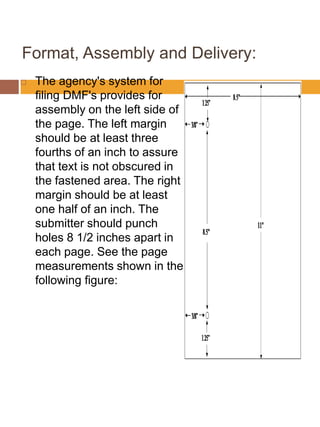
 The agency's system for
filing DMF's provides for
assembly on the left side of
the page. The left margin
should be at least three
fourths of an inch to assure
that text is not obscured in
the fastened area. The right
margin should be at least
one half of an inch. The
submitter should punch
holes 8 1/2 inches apart in
each page. See the page
measurements shown in the
following figure:
Authorization to Refer to a Drug Master
File:
 Letter of Authorization to FDA
 Before FDA can review DMF information in support of
an application, the DMF holder must submit in duplicate
to the DMF a letter of authorization permitting FDA to
reference the DMF. If the holder cross references its
own DMF, the holder should supply in a letter of
authorization the information designated by items 3, 5,
6, 7, and 8 of this section. The holder does not need to
send a transmittal letter with its letter of authorization.
 The letter of authorization should include the
following:
1. The date.
2. Name of DMF holder.
3. DMF number.
4. Name of person(s) authorized to incorporate information in the
DMF by reference.
5. Specific product(s) covered by the DMF.
6. Submission date(s) of 5, above.
7. Section numbers and/or page numbers to be referenced.
8. Statement of commitment that the DMF is current and that the
DMF holder will comply with the statements made in it.
9. Signature of authorizing official.
10. Typed name and title of official authorizing reference to the
DMF.
General Information and suggestions:
 Environmental Assessment
 Type II, Type III, and Type IV DMF's should
contain a commitment by the firm that its facilities
will be operated in compliance with applicable
environmental laws. If a completed environmental
assessment is needed, see 21 CFR Part 25.
 Stability
 Stability study design, data, interpretation, and
other information should be submitted, when
applicable, as outlined in the "Guideline for
Submitting Documentation for the Stability of
Human Drugs and Biologics."
Drug Master File Review:
 A DMF IS NEVER APPROVED OR DISAPPROVED.
 The agency will review information in a DMF only when an
IND sponsor, an applicant for an NDA, ANDA, or Export
Application, or another DMF holder incorporates material in
the DMF by reference. As noted, the incorporation by
reference must be accompanied by a copy of the DMF
holder's letter of authorization.
 If FDA reviewers find deficiencies in the information
provided in a DMF, a letter describing the deficiencies is
sent to the DMF holder.
 At the same time, FDA will notify the person who relies
on the information in the deficient DMF that additional
information is needed in the supporting DMF.
 The general subject of the deficiency is identified, but
details of the deficiency are disclosed only to the DMF
holder.
 When the holder submits the requested information to the
DMF in response to the agency's deficiency letter, the
holder should also send a copy of the accompanying
transmittal letter to the affected persons relying on the
DMF and to the FDA reviewing division that identified the
deficiencies.
 The transmittal letter will provide notice that the
deficiencies have been addressed.
Drug Master File:
 Changes in DMF: May properly notified well in
advance.
 Annual Updates in DMF:
 Appointment of an Agent:
 Transfer of Ownership of a DMF to other party:
 Closure of a DMF:
 Retiring DMF: No activity in 3 years.
 Electronic Filing of DMFs:
THANK
YOU…

Drug master file

  • 1.
  • 2.
    Introduction:  A DrugMaster File (DMF) is a submission to the Food and Drug Administration (FDA) that may be used to provide confidential detailed information about facilities, processes, or articles used in the manufacturing, processing, packaging, and storing of one or more human drugs.  The submission of a DMF is not required by law or FDA regulation.  A DMF is submitted solely at the discretion of the holder.  The information contained in the DMF may be used to support an Investigational New Drug Application (INDA), a New Drug Application (NDA), an Abbreviated New Drug Application (ANDA), another DMF, an Export Application, or amendments and supplements to any of these.
  • 3.
    Introduction:  A DMFis NOT a substitute for an INDA, NDA, ANDA, or Export Application.  It is not approved or disapproved.  Technical contents of a DMF are reviewed only in connection with the review of an INDA, NDA, ANDA, or an Export Application.  This guideline offer guidance on acceptable approaches to meeting regulatory requirements.  Different approaches may be followed, but the applicant is encouraged to discuss significant variations in advance with FDA reviewers to preclude spending time and effort in preparing a submission that FDA may later determine to be unacceptable.
  • 4.
    Types of DrugMaster Files:  There are five types of DMF’s.  Type I: Manufacturing site, Facilities, Operating Procedures and Personnel.  Type II: Drug substance, Drug substance Intermediate and material used in their preparation, or Drug product.  Type III: Packaging Material.  Type IV: Excipient, colorant, flavour, essence or material used in their preparation.  Type V: FDA Accepted Reference Information.  Each DMF should contain only one type of information and all supporting data.  Supporting information and data in a DMF can be cross referenced to any other DMF.
  • 5.
    Submission of Drug MasterFiles:  Each DMF submission should contain a transmittal letter, administrative information about the submission, and the specific information to be included in the DMF.  The DMF must be in the English language. Whenever a submission contains information in another language, an accurate certified English translation must also be included.  Each page of each copy of the DMF should be dated and consecutively numbered. An updated table of contents should be included with each submission.
  • 6.
    Transmittal Letters:  Thefollowing should be included:  Original Submissions  a. Identification of submission: Original, the type of DMF as classified in Section III, and its subject.  b. Identification of the applications, if known, that the DMF is intended to support, including the name and address of each sponsor, applicant, or holder, and all relevant document numbers.  c. Signature of the holder or the authorized representative.  d. Typewritten name and title of the signer.  Amendments  a. Identification of submission: Amendment, the DMF number, type of DMF, and the subject of the amendment.  b. A description of the purpose of submission, e.g., update, revised formula, or revised process.  c. Signature of the holder or the authorized representative.  d. Typewritten name and title of the signer..
  • 7.
    Administrative Information:  IV. B.1.Original Submissions  a. Names and addresses of the following:  (1) DMF holder. (2) Corporate headquarters.  (3) Manufacturing/processing facility. (4) Contact for FDA correspondence.  (5) Agent(s), if any.  b. The specific responsibilities of each person listed in any of the categories in Section a.  c. Statement of commitment.  A signed statement by the holder certifying that the DMF is current and that the DMF holder will comply with the statements made in it.  IV. B2. Amendments  a. Name of DMF holder.  b. DMF number.  c. Name and address for correspondence.  d. Affected section and/or page numbers of the DMF.  e. The name and address of each person whose IND, NDA, ANDA, DMF, or Export Application relies on the subject of the amendment for support.  f. The number of each IND, NDA, ANDA, DMF, and Export Application that relies on the subject of the amendment for support, if known.  g. Particular items within the IND, NDA, ANDA, DMF, and Export Application that are affected, if known.
  • 8.
    Drug Master filecontents:  Type I Manufacturing Site, Facilities, Operating Procedures, and Personnel  A Type I DMF is recommended for a person outside of the United States to assist FDA in conducting on site inspections of their manufacturing facilities. The DMF should describe the manufacturing site, equipment capabilities, and operational layout.  A Type I DMF is normally not needed to describe domestic facilities, except in special cases, such as when a person is not registered and not routinely inspected.  The description of the site should include Land, actual site address, & a map showing its location with respect to the nearest city. An aerial photograph and a diagram of the site may be helpful.  A diagram of major production & processing areas is helpful for understanding the operational layout. Major equipment should be described in terms of capabilities, application, & location. Make & model would not normally be needed unless the equipment is new or unique.  A diagram of major corporate organizational elements, with key manufacturing, quality control, and quality assurance positions highlighted, at both the manufacturing site and corporate headquarters, is also helpful.
  • 9.
    Drug Master file contents: Type II Drug Substance, Drug Substance Intermediate, and Material Used in Their Preparation, or Drug Product  A Type II DMF should, in general, be limited to a single drug intermediate, drug substance, drug product, or type of material used in their preparation.  Drug Substance, Drug Substance Intermediates, and Material Used in Their Preparation  Summarize all significant steps in the manufacturing and controls of the drug intermediate or substance.  Drug Product  Manufacturing procedures and controls for finished dosage forms should ordinarily be submitted in an IND, NDA, ANDA, or Export Application. If this information cannot be submitted in an IND, NDA, ANDA, or Export Application, it should be submitted in a DMF.
  • 10.
    Drug Master file contents: Type III Packaging Material  Each packaging material should be identified by the intended use, components, composition, and controls for its release.  The names of the suppliers or fabricators of the components used in preparing the packaging material and the acceptance specifications should also be given.  Data supporting the acceptability of the packaging material for its intended use should also be submitted as outlined in the "Guideline for Submitting Documentation for Packaging for Human Drugs and Biologics”.  Toxicological data on these materials would be included under this type of DMF, if not otherwise available by cross reference to another document.
  • 11.
    Drug Master file contents: Type IV Excipient, Colorant, Flavor, Essence, or Material Used in Their Preparation  Each additive should be identified and characterized by its method of manufacture, release specifications, and testing methods.  Toxicological data on these materials would be included under this type of DMF, if not otherwise available by cross reference to another document.  Usually, the official compendia and FDA regulations for color additives (21 CFR Parts 70 through 82), direct food additives (21 CFR Parts 170 through 173), indirect food additives (21 CFR Parts 174 through 178), and food substances (21 CFR Parts 181 through 186) may be used as sources for release tests, specifications, and safety. Guidelines suggested for a Type II DMF may be helpful for preparing a Type IV DMF.  The DMF should include any other supporting information & data that are not available by cross reference to another document.
  • 12.
    Drug Master file contents: Type V: FDA Accepted Reference Information  FDA discourages the use of Type V DMF's for miscellaneous information, duplicate information, or information that should be included in one of the other types of DMF's.  If any holder wishes to submit information and supporting data in a DMF that is not covered by Types I through IV, a holder must first submit a letter of intent to the Drug Master File Staff.  FDA will then contact the holder to discuss the proposed submission.
  • 13.
    General Information andsuggestions:  Environmental Assessment  Type II, Type III, and Type IV DMF's should contain a commitment by the firm that its facilities will be operated in compliance with applicable environmental laws.  Stability  Stability study design, data, interpretation, and other information should be submitted, when applicable, as outlined in the "Guideline for Submitting Documentation for the Stability of Human Drugs and Biologics."
  • 14.
    Format, Assembly andDelivery:  An original and duplicate are to be submitted for all DMF submissions.  Drug Master File holders and their agents/representatives should retain a complete reference copy that is identical to, and maintained in the same chronological order as, their submissions to FDA.  The original and duplicate copies must be collated, fully assembled, and individually jacketed.  Each volume of a DMF should, in general, be no more than 2 inches thick. For multivolume submissions, number each volume. For example, for a 3 volume submission, the volumes would be numbered 1 of 3, 2 of 3, and 3 of 3.  U.S. standard paper size (8-1/2 by 11 inches) is preferred. Paper length should not be less than 10 inches nor more than 12 inches. However, it may occasionally be necessary to use individual pages larger than standard paper size to present a floor plan, synthesis diagram, batch formula, or manufacturing instructions. Those pages should be folded and mounted to allow the page to be opened for review without disassembling the jacket and refolded without damage when the volume is shelved.
  • 15.
    Format, Assembly andDelivery:  The agency's system for filing DMF's provides for assembly on the left side of the page. The left margin should be at least three fourths of an inch to assure that text is not obscured in the fastened area. The right margin should be at least one half of an inch. The submitter should punch holes 8 1/2 inches apart in each page. See the page measurements shown in the following figure:
  • 16.
    Authorization to Referto a Drug Master File:  Letter of Authorization to FDA  Before FDA can review DMF information in support of an application, the DMF holder must submit in duplicate to the DMF a letter of authorization permitting FDA to reference the DMF. If the holder cross references its own DMF, the holder should supply in a letter of authorization the information designated by items 3, 5, 6, 7, and 8 of this section. The holder does not need to send a transmittal letter with its letter of authorization.  The letter of authorization should include the following: 1. The date. 2. Name of DMF holder. 3. DMF number. 4. Name of person(s) authorized to incorporate information in the DMF by reference. 5. Specific product(s) covered by the DMF. 6. Submission date(s) of 5, above. 7. Section numbers and/or page numbers to be referenced. 8. Statement of commitment that the DMF is current and that the DMF holder will comply with the statements made in it. 9. Signature of authorizing official. 10. Typed name and title of official authorizing reference to the DMF.
  • 17.
    General Information andsuggestions:  Environmental Assessment  Type II, Type III, and Type IV DMF's should contain a commitment by the firm that its facilities will be operated in compliance with applicable environmental laws. If a completed environmental assessment is needed, see 21 CFR Part 25.  Stability  Stability study design, data, interpretation, and other information should be submitted, when applicable, as outlined in the "Guideline for Submitting Documentation for the Stability of Human Drugs and Biologics."
  • 18.
    Drug Master FileReview:  A DMF IS NEVER APPROVED OR DISAPPROVED.  The agency will review information in a DMF only when an IND sponsor, an applicant for an NDA, ANDA, or Export Application, or another DMF holder incorporates material in the DMF by reference. As noted, the incorporation by reference must be accompanied by a copy of the DMF holder's letter of authorization.  If FDA reviewers find deficiencies in the information provided in a DMF, a letter describing the deficiencies is sent to the DMF holder.  At the same time, FDA will notify the person who relies on the information in the deficient DMF that additional information is needed in the supporting DMF.  The general subject of the deficiency is identified, but details of the deficiency are disclosed only to the DMF holder.  When the holder submits the requested information to the DMF in response to the agency's deficiency letter, the holder should also send a copy of the accompanying transmittal letter to the affected persons relying on the DMF and to the FDA reviewing division that identified the deficiencies.  The transmittal letter will provide notice that the deficiencies have been addressed.
  • 19.
    Drug Master File: Changes in DMF: May properly notified well in advance.  Annual Updates in DMF:  Appointment of an Agent:  Transfer of Ownership of a DMF to other party:  Closure of a DMF:  Retiring DMF: No activity in 3 years.  Electronic Filing of DMFs:
  • 20.