505 (b) (2)
By
Dr. Ajinkya Sarkate
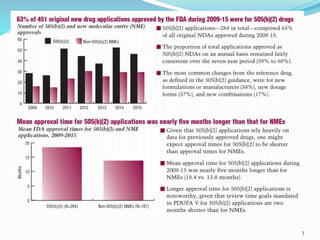
WHAT IS 505(b)(2)
 The 505(b)(2) new drug application (NDA) is one of three U.S. Food and Drug Administration
(FDA) drug approval pathways and represents an appealing regulatory strategy for many
clients.
 The pathway was created by the Hatch-Waxman Amendments of 1984, with 505(b)(2) referring
to a section of the Federal Food, Drug, and Cosmetic Act.
 The provisions of 505(b)(2) were created, in part, to help avoid unnecessary duplication of
studies already performed on a previously approved (“reference” or “listed”) drug; the section
gives the FDA express permission to rely on data not developed by the NDA applicant.
 A 505(b)(2) NDA contains full safety and effectiveness reports but allows at least some of the
information required for NDA approval, such as safety and efficacy information on the active
ingredient, to come from studies not conducted by or for the applicant.
 This can result in a much less expensive and much faster route to approval, compared with a
traditional development path [such as 505(b)(1)], while creating new, differentiated products
with tremendous commercial value.
2
3
4
5
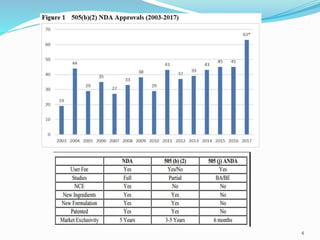
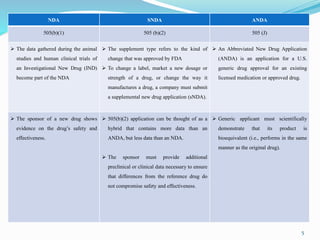
NDA SNDA ANDA
505(b)(1) 505 (b)(2) 505 (J)
 The data gathered during the animal
studies and human clinical trials of
an Investigational New Drug (IND)
become part of the NDA
 The supplement type refers to the kind of
change that was approved by FDA
 To change a label, market a new dosage or
strength of a drug, or change the way it
manufactures a drug, a company must submit
a supplemental new drug application (sNDA).
 An Abbreviated New Drug Application
(ANDA) is an application for a U.S.
generic drug approval for an existing
licensed medication or approved drug.
 The sponsor of a new drug shows
evidence on the drug’s safety and
effectiveness.
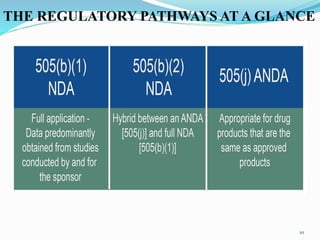
 505(b)(2) application can be thought of as a
hybrid that contains more data than an
ANDA, but less data than an NDA.
 The sponsor must provide additional
preclinical or clinical data necessary to ensure
that differences from the reference drug do
not compromise safety and effectiveness.
 Generic applicant must scientifically
demonstrate that its product is
bioequivalent (i.e., performs in the same
manner as the original drug).
6
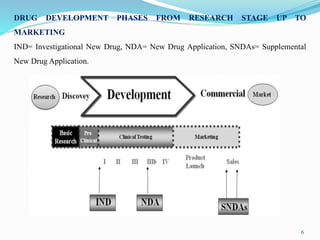
DRUG DEVELOPMENT PHASES FROM RESEARCH STAGE UP TO
MARKETING
IND= Investigational New Drug, NDA= New Drug Application, SNDAs= Supplemental
New Drug Application.
7
8
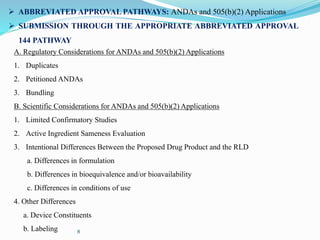
 ABBREVIATED APPROVAL PATHWAYS: ANDAs and 505(b)(2) Applications
 SUBMISSION THROUGH THE APPROPRIATE ABBREVIATED APPROVAL
144 PATHWAY
A. Regulatory Considerations for ANDAs and 505(b)(2) Applications
1. Duplicates
2. Petitioned ANDAs
3. Bundling
B. Scientific Considerations for ANDAs and 505(b)(2) Applications
1. Limited Confirmatory Studies
2. Active Ingredient Sameness Evaluation
3. Intentional Differences Between the Proposed Drug Product and the RLD
a. Differences in formulation
b. Differences in bioequivalence and/or bioavailability
c. Differences in conditions of use
4. Other Differences
a. Device Constituents
b. Labeling
9
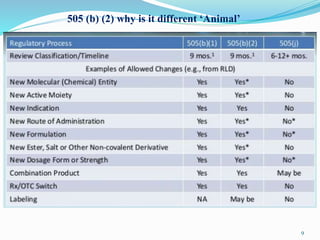
505 (b) (2) why is it different ‘Animal’
THE REGULATORY PATHWAYS AT A GLANCE
10
Drug Candidates with 505(b)(2) Potential
 A company may wish to create a new dosage form that is faster acting, combines two
active ingredients in a novel way, or provides a route of administration or mechanism of
drug delivery that patients or doctors prefer over previous versions.
 Also, a company may wish to seek approval for a new indication for an already-
approved drug or carry out an Rx-to-OTC switch.
 Such new products often contain well-understood active ingredients that are present in
existing, approved drug products (reference drugs); so, companies must only create a
bridge between what is already known about the previously approved reference drug
and the novel drug product or indication.
 The 505(b)(2) NDA pathway makes this possible. In Europe, a regulatory approval
route similar to the 505(b)(2) pathway is the hybrid procedure based on Article 10 of
Directive 2001/83/EC.
11
12
Benefits of 505(b)(2)
 505(b)(2) is particularly valuable for pharmaceutical and generics companies looking to
alleviate competitive forces in their environments while still wanting to benefit from a
development process that eliminates most nonclinical studies as well as extensive safety
and efficacy tests.
 Relatively low risk because of previous drug approval
 Lower cost, accelerated development due to fewer studies
 May qualify for three, five or seven years of market exclusivity
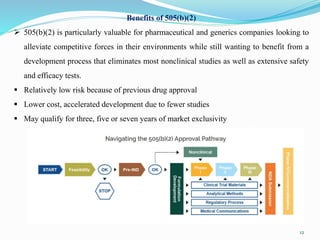
START
Candidate Identification
 While the 505(b)(2) pathway offers a unique opportunity for rapid approval, success
hinges on identifying products that have documented market differentiation, low
development risk and high-profit potential.
Ideal 505(b)(2) candidates include:
 Drugs with new indications
 Drugs with changes in dosage form, strength, formulation, dosing regimen or route of
administration
 New combination products
 Prodrugs of an existing drug
 In some cases, drugs with new active ingredients
Potential types of 505(b)(2)s include:
 Branded generics
 DESI drugs
 Prodrugs
 Orphan drugs
 Drug-device combinations
 Biological therapeutics, so-called biosimilars, are not suitable for approval under the
505(b)(2) pathway.
13
FEASIBILITY
Candidate Assessment
 Predevelopment assessment of candidates is essential to establish the value proposition of
a product concept for investors and to reduce the risk of costly errors. To build evidence
that will substantiate a product’s potential value, the following questions must be
considered:
Scientific Viability
 Does the science make sense? For instance, is the formulation stable and readily
prepared? Is manufacturing scalable? Are active and inactive ingredients available and
affordable?
Medical Viability
 Does the product have a clear niche in the medical specialty? Is it effective for solving a
unique problem or solving a problem in a unique way? Does it present an acceptable
risk/benefit? Is there evidence the product would be appealing to the proposed patient
population?
Regulatory Viability
 What clinical trials or other data will be required to gain approval? Can development be
expedited? Would exclusive marketing rights (“exclusivity”) be available? What
distinguishing information can be presented on the labeling for eventual promotional
activity?
Commercial Viability
 Is there a viable market for the product? What is the potential for future competition or
substitution? What is needed to ensure reimbursement? What is the optimal pricing?
14
Pre-IND
 The 505(b)(1) pre-IND development process is fairly straightforward:
1) conduct required nonclinical (animal) pharmacology, pharmacokinetics and toxicology
studies; carry out early preformulation studies and select a lead formulation to advance;
develop appropriate analytical methods; gather stability data on the active ingredient
and the dosage form; and develop a proposed clinical protocol;
2) complete a pre-IND consultation with the FDA in which the sponsor presents findings
from its nonclinical studies and manufacturing and analytical data, as well as a
proposed clinical trial, in order to gain FDA agreement to move to human testing; and
3) file the investigational new drug (IND) application.
15
Compared to 505(b)(1), the 505(b)(2) process differs greatly. Here’s how:
 First, the order of the steps above is different: The 505(b)(2) process begins with the pre-
IND meeting with the FDA, then moves to formulation development (and nonclinical
studies, if necessary) and then to the IND filing.
 Second, the goals of the pre-IND meeting for a 505(b)(2) product are also different than
for a 505(b)(1). In proposing a 505(b)(2) development strategy in a pre-IND meeting, the
objective is to gain FDA input and concurrence with the nonclinical studies, with the
chemistry, manufacturing, and controls (CMC) strategy and with clinical research plans
in a way that minimizes the number of new studies required. For many companies,
obtaining FDA buy-in and successfully activating an IND are critical steps for securing
investments.
16
17
 Third, the number and type of studies required are different. Since the 505(b)(2)
pathway allows the use of public data or the FDA’s previous findings in lieu of novel trial
data, some development programs may conduct bridging studies that preclude the need
for nonclinical or clinical studies, or both.
 Finally, the timing of studies is different. Because 505(b)(2) development plans rely
largely on pre-existing data, nonclinical and clinical studies can often be started
simultaneously and developed in parallel, significantly shortening the overall time to
market.
Together, these differences represent a formidable multifaceted challenge. When
mishandled, the early steps of 505(b)(2) development can end in product-development
failure. On the other hand, when managed skillfully, these first steps can result in important
victories for the sponsor, including reduced costs, a clear path to approval and immediate
interest from investors — early expert guidance is vital.
FORMULATION DEVELOPMENT
 The chemistry, manufacturing and controls (CMC) strategy is paramount in a 505(b)(2)
submission because frequently the formulation, components and/or the active
pharmaceutical ingredient (API) has been altered compared with the reference product,
and the effect of each of these changes must be evaluated to assess any effects on safety
and efficacy.
 However, comparing the new, proposed formulation with that of the reference drug (via
bridging studies), explaining the rationale for the changes, and establishing that the new
drug product is safe, pure and potent can usually form the basis for the pharmaceutical
development section of a 505(b)(2) NDA.
18
19
TIMING OF CMC WORK DIFFERS
 For a 505(b)(2) product, the clinical trial materials for Phase I studies (often
demonstrations of clinical bioequivalence) must be representative of the commercial
manufacturing process, including packaging.
 In general, the three stability batches that will be used for shelf-life determinations are
also prepared at this time.
 As a consequence, a good deal of CMC work must be invested prior to initiating even
Phase I studies.
NONCLINICAL
 Since public data may be used in lieu of novel trial data, numerous nonclinical studies and
safety and efficacy tests may not be necessary to achieve 505(b)(2) approval.
 Because 505(b)(2) candidates often have known safety profiles and previous
demonstrations of efficacy, risk is diminished, which fosters investment appeal.
 505(b)(2) often allows nonclinical and clinical studies to be completed in parallel,
abridging the process even further.
Phase I
 In certain instances, the 505(b)(2) pathway enables the Phase I process to be reduced to a
single study.
 This study, known as a Phase I bridging study, is used to compare the human
pharmacokinetic profile of the proposed drug product with that of the reference product (a
clinical bioequivalence study).
 Done properly, a bridging study allows a company to reference the established safety
information for the original drug.
20
21
 The specific type of Phase I bridging study for a 505(b)(2) product depends on the nature
of the dose form and the reference product. For an immediate-release oral dosage form,
for example, the Phase I study is often a fasting, single-dose, crossover
bioavailability/bioequivalence (BA/BE) study in healthy human volunteers in which the
new drug product is compared with the reference product using pharmacokinetic
assessments.
 Repeat-dose studies as well as those conducted in the fed state are sometimes required as
well.
 In some cases, the requirement for an in vivo bioequivalence study can be waived via a
formal request called a biowaiver.
PHASE II
 Phase II studies, which are required in 505(b)(1) NDAs, are designed to confirm the
pharmacokinetic profile of the product, ensure safety in patients and determine the
minimum effective dose and the maximum effective/tolerated dose.
 In contrast, certain 505(b)(2) development programs require no Phase II or Phase III
studies (e.g., dosage form changes may rely on Phase I pharmacokinetic studies alone).
 In some 505(b)(2) NDAs, Phase II and Phase III studies can be combined.
PHASE III
 For a standard 505(b)(1) NDA, Phase III generally consists of two large, well-controlled
studies (often referred to as pivotal studies) that include hundreds or even thousands of
patients and are designed to produce statistically and clinically meaningful evidence of the
product’s safety and efficacy.
 Once again, because a 505(b)(2) submission can rely in part on existing data, Phase III
studies are often not necessary.
22
23
 If a Phase III study is required for a 505(b)(2), such as when approval is sought for a
prodrug of a previously approved active ingredient, only one study is often necessary
versus the two generally required for 505(b)(1).
 Fewer patients may be needed for 505(b)(2) product clinical trials due to the existing
large exposure information available in the public literature or in the FDA’s databases.
Sources of existing data to support 505(b)(2) submission:
 Data previously accepted by the FDA as part of a marketing application
 Data available in the public domain (including data for indications not previously
approved by the FDA)
 Foreign clinical trial data
NDA SUBMISSION
 The success of NDA preparation and submission depends heavily on up-front planning and
awareness of FDA expectations throughout the entire development process. To enhance the
quality, organization and completeness of an NDA submission, it’s vital that the application
derives from detailed knowledge of FDA filing requirements, the use of established and well-
accepted methodologies and the design of accurately focused clinical studies.
 Before submission, audits of bioequivalence studies and bioanalytical analyses can reinforce
the accuracy of data submissions to the FDA and help further expedite drug approval and
market launch.
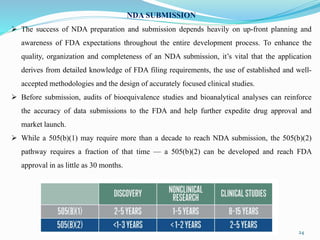
 While a 505(b)(1) may require more than a decade to reach NDA submission, the 505(b)(2)
pathway requires a fraction of that time — a 505(b)(2) can be developed and reach FDA
approval in as little as 30 months.
24
PHASE IV/COMMERCIALIZATION
 To maximize the return on a 505(b)(2) investment, having a plan in place to increase new
drug marketability is key. The basis of this plan should have already been set when the
feasibility of the product was assessed, and questions such as What is needed to ensure
reimbursement? and What is the optimal pricing? should be investigated and answered in
this phase to determine how to best drive physician preference, consumer requests and
sales.
 Unlike drugs approved under the 505(j) approval route for generics, where exclusivity can
only be obtained for 180 days, a 505(b)(2) may qualify for three, five or seven years of
market exclusivity.
25
26
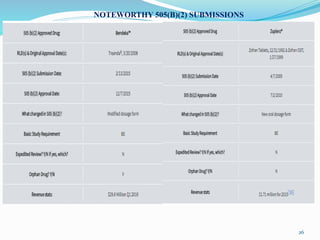
NOTEWORTHY 505(B)(2) SUBMISSIONS
27
WHAT IS A 505(B)(2) APPLICATION
 A 505(b)(2) application is one for which one or more of the investigations relied upon by
the applicant for approval "were not conducted by or for the applicant and for which the
applicant has not obtained a right of reference or use from the person by or for whom the
investigations were conducted" (21 U.S.C. 355(b)(2)).
A. What type of information can an applicant rely on?
1. Published literature
2. The Agency’s finding of safety and effectiveness for an approved drug
B. What kind of application can be submitted as a 505(b)(2) application?
1. New chemical entity (NCE)/new molecular entity (NME)
2. Changes to previously approved drugs
28
SOME EXAMPLES OF 505(B)(2) APPLICATIONS
 Dosage form: An application for a change of dosage form, such as a change from a solid
oral dosage form to a transdermal patch, that relies to some extent upon the Agency's
finding of safety and/or effectiveness for an approved drug.
 Strength: An application for a change to a lower or higher strength.
 Route of administration: An application for a change in the route of administration,
such as a change from an intravenous to intrathecal route.
 Substitution of an active ingredient in a combination product: An application for a
change in one of the active ingredients of an approved combination product for another
active ingredient that has or has not been previously approved.
 Formulation: An application for a proposed drug product that contains a different
quality or quantity of an excipient(s) than the listed drug where the studies required for
approval are beyond those considered limited confirmatory studies appropriate to a
505(j) application.
29
 Dosing regimen: An application for a new dosing regimen, such as a change from twice
daily to once daily.
 Active ingredient: An application for a change in an active ingredient such as a different
salt, ester, complex, chelate, clathrate, racemate, or enantiomer of an active ingredient in
a listed drug containing the same active moiety.
 New molecular entity: In some cases a new molecular entity may have been studied by
parties other than the applicant and published information may be pertinent to the new
application. This is particularly likely if the NME is the prodrug of an approved drug or
the active metabolite of an approved drug. In some cases, data on a drug with similar
pharmacologic effects could be considered critical to approval.
 Combination product: An application for a new combination product in which the
active ingredients have been previously approved individually.
 Indication: An application for a not previously approved indication for a listed drug.
30
 Rx/OTC switch: An application to change a prescription (Rx) indication to an over-the-
counter (OTC) indication.
 OTC monograph: An application for a drug product that differs from a product described
in an OTC monograph (21 CFR 330.11), such as a nonmonograph indication or a new
dosage form.
 Naturally derived or recombinant active ingredient: An application for a drug product
containing an active ingredient(s) derived from animal or botanical sources or recombinant
technology where clinical investigations are necessary to show that the active ingredient is
the same as an active ingredient in a listed drug.
 Bioinequivalence: Generally, an application for a pharmaceutically equivalent drug
product must be submitted under section 505(j) of the Act and the proposed product must
be shown to be bioequivalent to the reference listed drug (21 CFR 314.101(d)(9)).
31
WHAT CAN'T BE SUBMITTED AS 505(B)(2) APPLICATIONS
 An application that is a duplicate of a listed drug and eligible for approval under section
505(j) (see 21 CFR 314.101(d)(9)); or,
 An application in which the only difference from the reference listed drug is that the
extent to which the active ingredient(s) is absorbed or otherwise made available to the
site of action is less than the listed drug (21 CFR 314.54(b)(1)); or,
 An application in which the only difference from the reference listed drug is that the
rate at which its active ingredient(s) is absorbed or otherwise made available to the site
of action is unintentionally less than that of the listed drug (21 CFR 314.54(b)(2)).
32
PATENT AND EXCLUSIVITY PROTECTIONS THAT COULD AFFECT
A 505(B)(2) APPLICATION
A. What type of patent and/or exclusivity protection is a 505(b)(2) application eligible
for?
 A 505(b)(2) application may itself be granted 3 years of Waxman-Hatch exclusivity if
one or more of the clinical investigations, other than BA/BE studies, was essential to
approval of the application and was conducted or sponsored by the applicant (21 CFR
314.50(j); 314.108(b)(4) and (5)).
 A 505(b)(2) application may also be granted 5 years of exclusivity if it is for a new
chemical entity (21 CFR 314.50(j); 314.108(b)(2)). A 505(b)(2) application may also be
eligible for orphan drug exclusivity (21 CFR 314.20-316.36) or pediatric exclusivity
(section 505A of the Act). A 505(b)(2) application must contain information on patents
claiming the drug or its method of use (21 CFR 314.54(a)(1)(v)).
33
B. What could delay the approval or filing of a 505(b)(2) application
 Approval or filing of a 505(b)(2) application, like a 505(j) application, may be delayed
because of patent and exclusivity rights that apply to the listed drug (21 CFR 314.50(i),
314.107, and 314.108 and section 505A of the Act).
 This is the case even if the application also includes clinical investigations supporting
approval of the application.
34
WHAT SHOULD BE INCLUDED IN 505(B)(2) APPLICATIONS
 Identification of those portions of the application that rely on information the applicant
does not own or to which the applicant does not have a right of reference (for example,
for reproductive toxicity studies).
 If the 505(b)(2) seeks to rely on the Agency's previous finding of safety or efficacy for a
listed drug or drugs, identification of any and all listed drugs by established name,
proprietary name (if any), dosage form, strength, route of administration, name of the
listed drug's sponsor, and the application number (21 CFR 314.54(a)(1)(iii)). Even if the
505(b)(2) application is based solely upon literature and does not rely expressly on an
Agency finding of safety and effectiveness for a listed drug, the applicant must identify
the listed drug(s) on which the studies were conducted, if there are any. If the 505(b)(2)
application is for an NCE and the 505(b)(2) applicant is not relying on literature derived
from studies of an approved drug, there may not be a listed drug. If there is a listed drug
that is the pharmaceutical equivalent to the drug proposed in the 505(b)(2) application,
that drug should be identified as the listed drug.
35
 Information with respect to any patents that claim the drug or the use of the drug for
which approval is sought (21 CFR 314.50(h)). This patent information will be published
in the Orange Book when the application is approved.
 Information required under 314.50(j) if the applicant believes it is entitled to marketing
exclusivity (21 CFR 314.54(a)(1)(vii)).
 A patent certification or statement as required under section 505(b)(2) of the Act with
respect to any relevant patents that claim the listed drug and that claim any other drugs
on which the investigations relied on by the applicant for approval of the application
were conducted, or that claim a use for the listed or other drug (21 CFR
314.54(a)(1)(vi)).
 If there is a listed drug that is the pharmaceutical equivalent of the drug proposed in the
505(b)(2) application, the 505(b)(2) applicant should provide patent certifications for the
patents listed for the pharmaceutically equivalent drug. Patent certifications should
specify the exact patent number(s), and the exact name of the listed drug or other drug
even if all relevant patents have expired.
36
 If an application is for approval of a new indication, and not for the indications approved
for the listed drug, a certification so stating (21 CFR 314.54(a)(1)(iv).
 A statement as to whether the listed drug(s) identified above have received a period of
marketing exclusivity (21 CFR 314.108(b)). If a listed drug is protected by exclusivity,
filing or approval of the 505(b)(2) application may be delayed.
 A Bioavailability/Bioequivalence (BA/BE) study comparing the proposed product to the
listed drug (if any).
 Studies necessary to support the change or modification from the listed drug or drugs (if
any). Complete studies of safety and effectiveness may not be necessary if appropriate
bridging studies are found to provide an adequate basis for reliance upon FDA’s finding
of safety and effectiveness of the listed drug(s).
37
EXCLUSIVITY
FIVE YEAR PERIOD OF EXCLUSIVITY
 For NDA’s for products containing chemical entities never previously approved by FDA
alone or in combination.
 No. 505 (b) (2) applications may be submitted during the five-year exclusivity period
except that such applications may be submitted after four years if they contain a
certification of patent invalidity or non-infringement.
THREE YEAR PERIOD OF EXCLUSIVITY
 For NDA’s for products that contain an active moiety that has been previously approved
by FDA but the NDA contains results from new clinical investigations other than
bioavailability studies that are conducted by the applicant.
 For example changes in the approved drug product that affect its active ingredient,
strength, dosage form, route of administration.
38
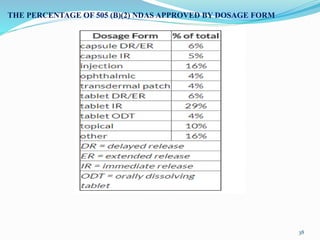
THE PERCENTAGE OF 505 (B)(2) NDAS APPROVED BY DOSAGE FORM
THANK YOU
39

505 (b) (2)

  • 1.
    505 (b) (2) By Dr.Ajinkya Sarkate
  • 2.
    WHAT IS 505(b)(2) The 505(b)(2) new drug application (NDA) is one of three U.S. Food and Drug Administration (FDA) drug approval pathways and represents an appealing regulatory strategy for many clients.  The pathway was created by the Hatch-Waxman Amendments of 1984, with 505(b)(2) referring to a section of the Federal Food, Drug, and Cosmetic Act.  The provisions of 505(b)(2) were created, in part, to help avoid unnecessary duplication of studies already performed on a previously approved (“reference” or “listed”) drug; the section gives the FDA express permission to rely on data not developed by the NDA applicant.  A 505(b)(2) NDA contains full safety and effectiveness reports but allows at least some of the information required for NDA approval, such as safety and efficacy information on the active ingredient, to come from studies not conducted by or for the applicant.  This can result in a much less expensive and much faster route to approval, compared with a traditional development path [such as 505(b)(1)], while creating new, differentiated products with tremendous commercial value. 2
  • 3.
  • 4.
  • 5.
    5 NDA SNDA ANDA 505(b)(1)505 (b)(2) 505 (J)  The data gathered during the animal studies and human clinical trials of an Investigational New Drug (IND) become part of the NDA  The supplement type refers to the kind of change that was approved by FDA  To change a label, market a new dosage or strength of a drug, or change the way it manufactures a drug, a company must submit a supplemental new drug application (sNDA).  An Abbreviated New Drug Application (ANDA) is an application for a U.S. generic drug approval for an existing licensed medication or approved drug.  The sponsor of a new drug shows evidence on the drug’s safety and effectiveness.  505(b)(2) application can be thought of as a hybrid that contains more data than an ANDA, but less data than an NDA.  The sponsor must provide additional preclinical or clinical data necessary to ensure that differences from the reference drug do not compromise safety and effectiveness.  Generic applicant must scientifically demonstrate that its product is bioequivalent (i.e., performs in the same manner as the original drug).
  • 6.
    6 DRUG DEVELOPMENT PHASESFROM RESEARCH STAGE UP TO MARKETING IND= Investigational New Drug, NDA= New Drug Application, SNDAs= Supplemental New Drug Application.
  • 7.
  • 8.
    8  ABBREVIATED APPROVALPATHWAYS: ANDAs and 505(b)(2) Applications  SUBMISSION THROUGH THE APPROPRIATE ABBREVIATED APPROVAL 144 PATHWAY A. Regulatory Considerations for ANDAs and 505(b)(2) Applications 1. Duplicates 2. Petitioned ANDAs 3. Bundling B. Scientific Considerations for ANDAs and 505(b)(2) Applications 1. Limited Confirmatory Studies 2. Active Ingredient Sameness Evaluation 3. Intentional Differences Between the Proposed Drug Product and the RLD a. Differences in formulation b. Differences in bioequivalence and/or bioavailability c. Differences in conditions of use 4. Other Differences a. Device Constituents b. Labeling
  • 9.
    9 505 (b) (2)why is it different ‘Animal’
  • 10.
  • 11.
    Drug Candidates with505(b)(2) Potential  A company may wish to create a new dosage form that is faster acting, combines two active ingredients in a novel way, or provides a route of administration or mechanism of drug delivery that patients or doctors prefer over previous versions.  Also, a company may wish to seek approval for a new indication for an already- approved drug or carry out an Rx-to-OTC switch.  Such new products often contain well-understood active ingredients that are present in existing, approved drug products (reference drugs); so, companies must only create a bridge between what is already known about the previously approved reference drug and the novel drug product or indication.  The 505(b)(2) NDA pathway makes this possible. In Europe, a regulatory approval route similar to the 505(b)(2) pathway is the hybrid procedure based on Article 10 of Directive 2001/83/EC. 11
  • 12.
    12 Benefits of 505(b)(2) 505(b)(2) is particularly valuable for pharmaceutical and generics companies looking to alleviate competitive forces in their environments while still wanting to benefit from a development process that eliminates most nonclinical studies as well as extensive safety and efficacy tests.  Relatively low risk because of previous drug approval  Lower cost, accelerated development due to fewer studies  May qualify for three, five or seven years of market exclusivity
  • 13.
    START Candidate Identification  Whilethe 505(b)(2) pathway offers a unique opportunity for rapid approval, success hinges on identifying products that have documented market differentiation, low development risk and high-profit potential. Ideal 505(b)(2) candidates include:  Drugs with new indications  Drugs with changes in dosage form, strength, formulation, dosing regimen or route of administration  New combination products  Prodrugs of an existing drug  In some cases, drugs with new active ingredients Potential types of 505(b)(2)s include:  Branded generics  DESI drugs  Prodrugs  Orphan drugs  Drug-device combinations  Biological therapeutics, so-called biosimilars, are not suitable for approval under the 505(b)(2) pathway. 13
  • 14.
    FEASIBILITY Candidate Assessment  Predevelopmentassessment of candidates is essential to establish the value proposition of a product concept for investors and to reduce the risk of costly errors. To build evidence that will substantiate a product’s potential value, the following questions must be considered: Scientific Viability  Does the science make sense? For instance, is the formulation stable and readily prepared? Is manufacturing scalable? Are active and inactive ingredients available and affordable? Medical Viability  Does the product have a clear niche in the medical specialty? Is it effective for solving a unique problem or solving a problem in a unique way? Does it present an acceptable risk/benefit? Is there evidence the product would be appealing to the proposed patient population? Regulatory Viability  What clinical trials or other data will be required to gain approval? Can development be expedited? Would exclusive marketing rights (“exclusivity”) be available? What distinguishing information can be presented on the labeling for eventual promotional activity? Commercial Viability  Is there a viable market for the product? What is the potential for future competition or substitution? What is needed to ensure reimbursement? What is the optimal pricing? 14
  • 15.
    Pre-IND  The 505(b)(1)pre-IND development process is fairly straightforward: 1) conduct required nonclinical (animal) pharmacology, pharmacokinetics and toxicology studies; carry out early preformulation studies and select a lead formulation to advance; develop appropriate analytical methods; gather stability data on the active ingredient and the dosage form; and develop a proposed clinical protocol; 2) complete a pre-IND consultation with the FDA in which the sponsor presents findings from its nonclinical studies and manufacturing and analytical data, as well as a proposed clinical trial, in order to gain FDA agreement to move to human testing; and 3) file the investigational new drug (IND) application. 15
  • 16.
    Compared to 505(b)(1),the 505(b)(2) process differs greatly. Here’s how:  First, the order of the steps above is different: The 505(b)(2) process begins with the pre- IND meeting with the FDA, then moves to formulation development (and nonclinical studies, if necessary) and then to the IND filing.  Second, the goals of the pre-IND meeting for a 505(b)(2) product are also different than for a 505(b)(1). In proposing a 505(b)(2) development strategy in a pre-IND meeting, the objective is to gain FDA input and concurrence with the nonclinical studies, with the chemistry, manufacturing, and controls (CMC) strategy and with clinical research plans in a way that minimizes the number of new studies required. For many companies, obtaining FDA buy-in and successfully activating an IND are critical steps for securing investments. 16
  • 17.
    17  Third, thenumber and type of studies required are different. Since the 505(b)(2) pathway allows the use of public data or the FDA’s previous findings in lieu of novel trial data, some development programs may conduct bridging studies that preclude the need for nonclinical or clinical studies, or both.  Finally, the timing of studies is different. Because 505(b)(2) development plans rely largely on pre-existing data, nonclinical and clinical studies can often be started simultaneously and developed in parallel, significantly shortening the overall time to market. Together, these differences represent a formidable multifaceted challenge. When mishandled, the early steps of 505(b)(2) development can end in product-development failure. On the other hand, when managed skillfully, these first steps can result in important victories for the sponsor, including reduced costs, a clear path to approval and immediate interest from investors — early expert guidance is vital.
  • 18.
    FORMULATION DEVELOPMENT  Thechemistry, manufacturing and controls (CMC) strategy is paramount in a 505(b)(2) submission because frequently the formulation, components and/or the active pharmaceutical ingredient (API) has been altered compared with the reference product, and the effect of each of these changes must be evaluated to assess any effects on safety and efficacy.  However, comparing the new, proposed formulation with that of the reference drug (via bridging studies), explaining the rationale for the changes, and establishing that the new drug product is safe, pure and potent can usually form the basis for the pharmaceutical development section of a 505(b)(2) NDA. 18
  • 19.
    19 TIMING OF CMCWORK DIFFERS  For a 505(b)(2) product, the clinical trial materials for Phase I studies (often demonstrations of clinical bioequivalence) must be representative of the commercial manufacturing process, including packaging.  In general, the three stability batches that will be used for shelf-life determinations are also prepared at this time.  As a consequence, a good deal of CMC work must be invested prior to initiating even Phase I studies.
  • 20.
    NONCLINICAL  Since publicdata may be used in lieu of novel trial data, numerous nonclinical studies and safety and efficacy tests may not be necessary to achieve 505(b)(2) approval.  Because 505(b)(2) candidates often have known safety profiles and previous demonstrations of efficacy, risk is diminished, which fosters investment appeal.  505(b)(2) often allows nonclinical and clinical studies to be completed in parallel, abridging the process even further. Phase I  In certain instances, the 505(b)(2) pathway enables the Phase I process to be reduced to a single study.  This study, known as a Phase I bridging study, is used to compare the human pharmacokinetic profile of the proposed drug product with that of the reference product (a clinical bioequivalence study).  Done properly, a bridging study allows a company to reference the established safety information for the original drug. 20
  • 21.
    21  The specifictype of Phase I bridging study for a 505(b)(2) product depends on the nature of the dose form and the reference product. For an immediate-release oral dosage form, for example, the Phase I study is often a fasting, single-dose, crossover bioavailability/bioequivalence (BA/BE) study in healthy human volunteers in which the new drug product is compared with the reference product using pharmacokinetic assessments.  Repeat-dose studies as well as those conducted in the fed state are sometimes required as well.  In some cases, the requirement for an in vivo bioequivalence study can be waived via a formal request called a biowaiver.
  • 22.
    PHASE II  PhaseII studies, which are required in 505(b)(1) NDAs, are designed to confirm the pharmacokinetic profile of the product, ensure safety in patients and determine the minimum effective dose and the maximum effective/tolerated dose.  In contrast, certain 505(b)(2) development programs require no Phase II or Phase III studies (e.g., dosage form changes may rely on Phase I pharmacokinetic studies alone).  In some 505(b)(2) NDAs, Phase II and Phase III studies can be combined. PHASE III  For a standard 505(b)(1) NDA, Phase III generally consists of two large, well-controlled studies (often referred to as pivotal studies) that include hundreds or even thousands of patients and are designed to produce statistically and clinically meaningful evidence of the product’s safety and efficacy.  Once again, because a 505(b)(2) submission can rely in part on existing data, Phase III studies are often not necessary. 22
  • 23.
    23  If aPhase III study is required for a 505(b)(2), such as when approval is sought for a prodrug of a previously approved active ingredient, only one study is often necessary versus the two generally required for 505(b)(1).  Fewer patients may be needed for 505(b)(2) product clinical trials due to the existing large exposure information available in the public literature or in the FDA’s databases. Sources of existing data to support 505(b)(2) submission:  Data previously accepted by the FDA as part of a marketing application  Data available in the public domain (including data for indications not previously approved by the FDA)  Foreign clinical trial data
  • 24.
    NDA SUBMISSION  Thesuccess of NDA preparation and submission depends heavily on up-front planning and awareness of FDA expectations throughout the entire development process. To enhance the quality, organization and completeness of an NDA submission, it’s vital that the application derives from detailed knowledge of FDA filing requirements, the use of established and well- accepted methodologies and the design of accurately focused clinical studies.  Before submission, audits of bioequivalence studies and bioanalytical analyses can reinforce the accuracy of data submissions to the FDA and help further expedite drug approval and market launch.  While a 505(b)(1) may require more than a decade to reach NDA submission, the 505(b)(2) pathway requires a fraction of that time — a 505(b)(2) can be developed and reach FDA approval in as little as 30 months. 24
  • 25.
    PHASE IV/COMMERCIALIZATION  Tomaximize the return on a 505(b)(2) investment, having a plan in place to increase new drug marketability is key. The basis of this plan should have already been set when the feasibility of the product was assessed, and questions such as What is needed to ensure reimbursement? and What is the optimal pricing? should be investigated and answered in this phase to determine how to best drive physician preference, consumer requests and sales.  Unlike drugs approved under the 505(j) approval route for generics, where exclusivity can only be obtained for 180 days, a 505(b)(2) may qualify for three, five or seven years of market exclusivity. 25
  • 26.
  • 27.
    27 WHAT IS A505(B)(2) APPLICATION  A 505(b)(2) application is one for which one or more of the investigations relied upon by the applicant for approval "were not conducted by or for the applicant and for which the applicant has not obtained a right of reference or use from the person by or for whom the investigations were conducted" (21 U.S.C. 355(b)(2)). A. What type of information can an applicant rely on? 1. Published literature 2. The Agency’s finding of safety and effectiveness for an approved drug B. What kind of application can be submitted as a 505(b)(2) application? 1. New chemical entity (NCE)/new molecular entity (NME) 2. Changes to previously approved drugs
  • 28.
    28 SOME EXAMPLES OF505(B)(2) APPLICATIONS  Dosage form: An application for a change of dosage form, such as a change from a solid oral dosage form to a transdermal patch, that relies to some extent upon the Agency's finding of safety and/or effectiveness for an approved drug.  Strength: An application for a change to a lower or higher strength.  Route of administration: An application for a change in the route of administration, such as a change from an intravenous to intrathecal route.  Substitution of an active ingredient in a combination product: An application for a change in one of the active ingredients of an approved combination product for another active ingredient that has or has not been previously approved.  Formulation: An application for a proposed drug product that contains a different quality or quantity of an excipient(s) than the listed drug where the studies required for approval are beyond those considered limited confirmatory studies appropriate to a 505(j) application.
  • 29.
    29  Dosing regimen:An application for a new dosing regimen, such as a change from twice daily to once daily.  Active ingredient: An application for a change in an active ingredient such as a different salt, ester, complex, chelate, clathrate, racemate, or enantiomer of an active ingredient in a listed drug containing the same active moiety.  New molecular entity: In some cases a new molecular entity may have been studied by parties other than the applicant and published information may be pertinent to the new application. This is particularly likely if the NME is the prodrug of an approved drug or the active metabolite of an approved drug. In some cases, data on a drug with similar pharmacologic effects could be considered critical to approval.  Combination product: An application for a new combination product in which the active ingredients have been previously approved individually.  Indication: An application for a not previously approved indication for a listed drug.
  • 30.
    30  Rx/OTC switch:An application to change a prescription (Rx) indication to an over-the- counter (OTC) indication.  OTC monograph: An application for a drug product that differs from a product described in an OTC monograph (21 CFR 330.11), such as a nonmonograph indication or a new dosage form.  Naturally derived or recombinant active ingredient: An application for a drug product containing an active ingredient(s) derived from animal or botanical sources or recombinant technology where clinical investigations are necessary to show that the active ingredient is the same as an active ingredient in a listed drug.  Bioinequivalence: Generally, an application for a pharmaceutically equivalent drug product must be submitted under section 505(j) of the Act and the proposed product must be shown to be bioequivalent to the reference listed drug (21 CFR 314.101(d)(9)).
  • 31.
    31 WHAT CAN'T BESUBMITTED AS 505(B)(2) APPLICATIONS  An application that is a duplicate of a listed drug and eligible for approval under section 505(j) (see 21 CFR 314.101(d)(9)); or,  An application in which the only difference from the reference listed drug is that the extent to which the active ingredient(s) is absorbed or otherwise made available to the site of action is less than the listed drug (21 CFR 314.54(b)(1)); or,  An application in which the only difference from the reference listed drug is that the rate at which its active ingredient(s) is absorbed or otherwise made available to the site of action is unintentionally less than that of the listed drug (21 CFR 314.54(b)(2)).
  • 32.
    32 PATENT AND EXCLUSIVITYPROTECTIONS THAT COULD AFFECT A 505(B)(2) APPLICATION A. What type of patent and/or exclusivity protection is a 505(b)(2) application eligible for?  A 505(b)(2) application may itself be granted 3 years of Waxman-Hatch exclusivity if one or more of the clinical investigations, other than BA/BE studies, was essential to approval of the application and was conducted or sponsored by the applicant (21 CFR 314.50(j); 314.108(b)(4) and (5)).  A 505(b)(2) application may also be granted 5 years of exclusivity if it is for a new chemical entity (21 CFR 314.50(j); 314.108(b)(2)). A 505(b)(2) application may also be eligible for orphan drug exclusivity (21 CFR 314.20-316.36) or pediatric exclusivity (section 505A of the Act). A 505(b)(2) application must contain information on patents claiming the drug or its method of use (21 CFR 314.54(a)(1)(v)).
  • 33.
    33 B. What coulddelay the approval or filing of a 505(b)(2) application  Approval or filing of a 505(b)(2) application, like a 505(j) application, may be delayed because of patent and exclusivity rights that apply to the listed drug (21 CFR 314.50(i), 314.107, and 314.108 and section 505A of the Act).  This is the case even if the application also includes clinical investigations supporting approval of the application.
  • 34.
    34 WHAT SHOULD BEINCLUDED IN 505(B)(2) APPLICATIONS  Identification of those portions of the application that rely on information the applicant does not own or to which the applicant does not have a right of reference (for example, for reproductive toxicity studies).  If the 505(b)(2) seeks to rely on the Agency's previous finding of safety or efficacy for a listed drug or drugs, identification of any and all listed drugs by established name, proprietary name (if any), dosage form, strength, route of administration, name of the listed drug's sponsor, and the application number (21 CFR 314.54(a)(1)(iii)). Even if the 505(b)(2) application is based solely upon literature and does not rely expressly on an Agency finding of safety and effectiveness for a listed drug, the applicant must identify the listed drug(s) on which the studies were conducted, if there are any. If the 505(b)(2) application is for an NCE and the 505(b)(2) applicant is not relying on literature derived from studies of an approved drug, there may not be a listed drug. If there is a listed drug that is the pharmaceutical equivalent to the drug proposed in the 505(b)(2) application, that drug should be identified as the listed drug.
  • 35.
    35  Information withrespect to any patents that claim the drug or the use of the drug for which approval is sought (21 CFR 314.50(h)). This patent information will be published in the Orange Book when the application is approved.  Information required under 314.50(j) if the applicant believes it is entitled to marketing exclusivity (21 CFR 314.54(a)(1)(vii)).  A patent certification or statement as required under section 505(b)(2) of the Act with respect to any relevant patents that claim the listed drug and that claim any other drugs on which the investigations relied on by the applicant for approval of the application were conducted, or that claim a use for the listed or other drug (21 CFR 314.54(a)(1)(vi)).  If there is a listed drug that is the pharmaceutical equivalent of the drug proposed in the 505(b)(2) application, the 505(b)(2) applicant should provide patent certifications for the patents listed for the pharmaceutically equivalent drug. Patent certifications should specify the exact patent number(s), and the exact name of the listed drug or other drug even if all relevant patents have expired.
  • 36.
    36  If anapplication is for approval of a new indication, and not for the indications approved for the listed drug, a certification so stating (21 CFR 314.54(a)(1)(iv).  A statement as to whether the listed drug(s) identified above have received a period of marketing exclusivity (21 CFR 314.108(b)). If a listed drug is protected by exclusivity, filing or approval of the 505(b)(2) application may be delayed.  A Bioavailability/Bioequivalence (BA/BE) study comparing the proposed product to the listed drug (if any).  Studies necessary to support the change or modification from the listed drug or drugs (if any). Complete studies of safety and effectiveness may not be necessary if appropriate bridging studies are found to provide an adequate basis for reliance upon FDA’s finding of safety and effectiveness of the listed drug(s).
  • 37.
    37 EXCLUSIVITY FIVE YEAR PERIODOF EXCLUSIVITY  For NDA’s for products containing chemical entities never previously approved by FDA alone or in combination.  No. 505 (b) (2) applications may be submitted during the five-year exclusivity period except that such applications may be submitted after four years if they contain a certification of patent invalidity or non-infringement. THREE YEAR PERIOD OF EXCLUSIVITY  For NDA’s for products that contain an active moiety that has been previously approved by FDA but the NDA contains results from new clinical investigations other than bioavailability studies that are conducted by the applicant.  For example changes in the approved drug product that affect its active ingredient, strength, dosage form, route of administration.
  • 38.
    38 THE PERCENTAGE OF505 (B)(2) NDAS APPROVED BY DOSAGE FORM
  • 39.