

EU VARIATIONS TOEU VARIATIONS TO
MARKETINGMARKETING
AUTHORIZATIONAUTHORIZATION
PRESENTED BY
Mangesh S.Gawade
Regulatory Affairs Specialist Galpha Laboratories
Limited
Variation:
A variation to the terms of marketing authorization is an amendment to
the contents of the documents referred to in articles 8,9,10,11and Annex
1of directive 2001/83/EC, such that they exist at the moment of the
decision on the marketing authorization or after approval/acceptance of
any previous variation,except where an extension application must be
presented pursuant to Annex II of the regulations(EC) No 1084/2003 or
(EC) No 1085/2003.
What is mean by variationWhat is mean by variation
 What is mean by variations
 Types of variations
 Extension Application
 Unforeseen application
 Administrative & Quality variations
 Grouping of variations
 Variation filing procedure
Contents of presentationContents of presentation
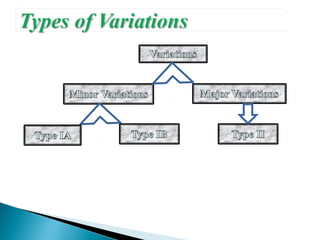
TYPES OF VARIATIONS :
Variations are broadly classified into two categories:
 Minor Variations: These variations are introduced through a notification
procedure. for e.g., TYPE - 1 A, TYPE - 1B Variations.
 Major Variations: These variations are introduced through an approval
procedure. for e.g Type II Variations.
Types of Variations
Type IA variations examples:
Change of MAH holder or the manufacturer or supplier of any starting
material, reagent, intermediate , active substance used in manufacturing
process or finished product.
Change including for an active substance, intermediate or an finished
product, packaging site, manufacturer responsible for batch release, site
where batch control takesplace.
Change where the updated procedure is demonstrated to be atleast
equivalent to the former test procedure.
Type IA VariationsType IA Variations
Type IA Variations:
Type IA variations are the minor variations which have only the minimal
impact or no impact at all , on the quality safety & efficacy of the medicinal
products & do not require prior approval before implementation (“Do and
Tell” procedure).
Such minor variations are classifieds in two subcategories which impact on
their submission:
Type IA variations requiring immediate notification (‘IAIN’)
Type IA variations not requiring immediate notification (‘IA’) (Variations
which do not require immediate notification may be submitted by the
marketing authorization holder (MAH) within 12 month after
implementation).
Type IA VariationsType IA Variations
Type IB Variations:
Commission regulation (EC) No 1234/2008 (‘the variation regulation’)
defines a minor variations or Type IB as a variation which is neither a
Type IA variation nor a Type II variation nor an Extension.
Such minor variation must be notified to the national competent
Authority/European medicines by the marketing authorization
holder(MAH) before implementation, but do not require formal approval
However, the MAH must wait a period of 30 days to ensure that the
notification is deemed acceptable by the agency before implementing the
change(Tell, wait & Do procedure).
Type IB variations examples:
Minor change in the restricted part of an active substance master file.
More than 10-fold increase compared to the currently approved batch
size.
Addition or replacement of an in-process test as a results of a safety or
quality issue.
Extension or introduction of a retest period/storage period supported by
the real time data.
Type II Variations
Commission regulation (EC) No 1234/2008 (‘the variation regulation’)
defines a major variations of Type II as a variation which is not an
extension and which may have a significant impact on the quality,
safety or efficacy of the medicinal product.
Type II variations examples:
Addition of new therapeutic indication or to an modification of an
existing one.
Significant modification of the summary of product characteristics due
in particular to the new quality preclinical, clinical or pharmacovigilance
findings
Changes outside the range of approved specifications, limits or
acceptance criteria.
Substantial changes to the manufacturing process, formulation
,specification or impurity profiles of the active substance or finished
medicinal products.
Extensions Applications:
Changes to the marketing authorization listed in Annex I of commission
regulations (EC) No 1234/2008 are regarded as “extensions of the
marketing authorization.
Extensions applications include the following:
Changes to the active substance(s):
Replacement of chemical active substance by different salt/ester or
chemical derivative, with the same therapeutic moiety, where the
efficacy/safety characteristics are not significantly different.
Changes to strength , pharmaceutical form and route of administration:
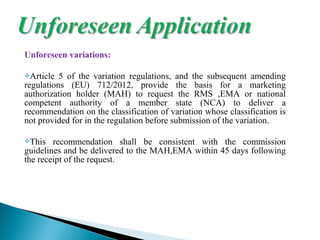
Unforeseen variations:
Article 5 of the variation regulations, and the subsequent amending
regulations (EU) 712/2012, provide the basis for a marketing
authorization holder (MAH) to request the RMS ,EMA or national
competent authority of a member state (NCA) to deliver a
recommendation on the classification of variation whose classification is
not provided for in the regulation before submission of the variation.
This recommendation shall be consistent with the commission
guidelines and be delivered to the MAH,EMA within 45 days following
the receipt of the request.
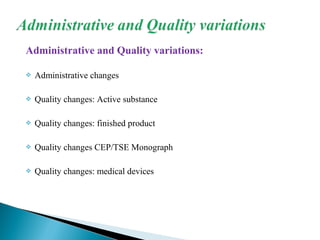
Administrative and Quality variations:
 Administrative changes
 Quality changes: Active substance
 Quality changes: finished product
 Quality changes CEP/TSE Monograph
 Quality changes: medical devices
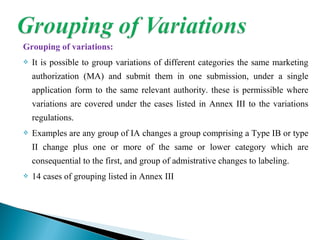
Grouping of variations:
 It is possible to group variations of different categories the same marketing
authorization (MA) and submit them in one submission, under a single
application form to the same relevant authority. these is permissible where
variations are covered under the cases listed in Annex III to the variations
regulations.
 Examples are any group of IA changes a group comprising a Type IB or type
II change plus one or more of the same or lower category which are
consequential to the first, and group of admistrative changes to labeling.
 14 cases of grouping listed in Annex III
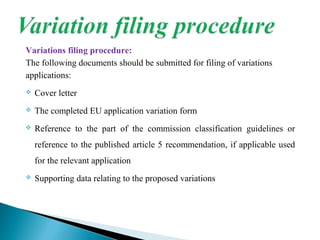
Variations filing procedure:
The following documents should be submitted for filing of variations
applications:
 Cover letter
 The completed EU application variation form
 Reference to the part of the commission classification guidelines or
reference to the published article 5 recommendation, if applicable used
for the relevant application
 Supporting data relating to the proposed variations
 Update or addendum to the detailed critical summaries (quality, safety,
efficacy as appropriate).
 For variations submitted to implement changes requested by the agency or
for generic/hybrid/ biosimilar medicinal products a copy of the request is
required.
 In case of the changes affect SPC, labeling or an package leaflet, the
revised product annexes must be submitted.
 For variation requested by a national competent authority e.g following
assessment of follow up measures, specific obligations & periodic safety
update reports , a copy of the reports should be annexed to the cover letter.
 Write note on Variations.
Classify variations in brief.
Enlist the administrative and quality variations.
Write note on how to file variations.
QUESTIONSQUESTIONS
Variations to Marketing Authorization

Variations to Marketing Authorization

  • 1.
    EU VARIATIONS TOEUVARIATIONS TO MARKETINGMARKETING AUTHORIZATIONAUTHORIZATION PRESENTED BY Mangesh S.Gawade Regulatory Affairs Specialist Galpha Laboratories Limited
  • 2.
    Variation: A variation tothe terms of marketing authorization is an amendment to the contents of the documents referred to in articles 8,9,10,11and Annex 1of directive 2001/83/EC, such that they exist at the moment of the decision on the marketing authorization or after approval/acceptance of any previous variation,except where an extension application must be presented pursuant to Annex II of the regulations(EC) No 1084/2003 or (EC) No 1085/2003. What is mean by variationWhat is mean by variation
  • 3.
     What ismean by variations  Types of variations  Extension Application  Unforeseen application  Administrative & Quality variations  Grouping of variations  Variation filing procedure Contents of presentationContents of presentation
  • 5.
    TYPES OF VARIATIONS: Variations are broadly classified into two categories:  Minor Variations: These variations are introduced through a notification procedure. for e.g., TYPE - 1 A, TYPE - 1B Variations.  Major Variations: These variations are introduced through an approval procedure. for e.g Type II Variations. Types of Variations
  • 6.
    Type IA variationsexamples: Change of MAH holder or the manufacturer or supplier of any starting material, reagent, intermediate , active substance used in manufacturing process or finished product. Change including for an active substance, intermediate or an finished product, packaging site, manufacturer responsible for batch release, site where batch control takesplace. Change where the updated procedure is demonstrated to be atleast equivalent to the former test procedure. Type IA VariationsType IA Variations
  • 7.
    Type IA Variations: TypeIA variations are the minor variations which have only the minimal impact or no impact at all , on the quality safety & efficacy of the medicinal products & do not require prior approval before implementation (“Do and Tell” procedure). Such minor variations are classifieds in two subcategories which impact on their submission: Type IA variations requiring immediate notification (‘IAIN’) Type IA variations not requiring immediate notification (‘IA’) (Variations which do not require immediate notification may be submitted by the marketing authorization holder (MAH) within 12 month after implementation). Type IA VariationsType IA Variations
  • 8.
    Type IB Variations: Commissionregulation (EC) No 1234/2008 (‘the variation regulation’) defines a minor variations or Type IB as a variation which is neither a Type IA variation nor a Type II variation nor an Extension. Such minor variation must be notified to the national competent Authority/European medicines by the marketing authorization holder(MAH) before implementation, but do not require formal approval However, the MAH must wait a period of 30 days to ensure that the notification is deemed acceptable by the agency before implementing the change(Tell, wait & Do procedure).
  • 9.
    Type IB variationsexamples: Minor change in the restricted part of an active substance master file. More than 10-fold increase compared to the currently approved batch size. Addition or replacement of an in-process test as a results of a safety or quality issue. Extension or introduction of a retest period/storage period supported by the real time data.
  • 10.
    Type II Variations Commissionregulation (EC) No 1234/2008 (‘the variation regulation’) defines a major variations of Type II as a variation which is not an extension and which may have a significant impact on the quality, safety or efficacy of the medicinal product.
  • 11.
    Type II variationsexamples: Addition of new therapeutic indication or to an modification of an existing one. Significant modification of the summary of product characteristics due in particular to the new quality preclinical, clinical or pharmacovigilance findings Changes outside the range of approved specifications, limits or acceptance criteria. Substantial changes to the manufacturing process, formulation ,specification or impurity profiles of the active substance or finished medicinal products.
  • 12.
    Extensions Applications: Changes tothe marketing authorization listed in Annex I of commission regulations (EC) No 1234/2008 are regarded as “extensions of the marketing authorization. Extensions applications include the following: Changes to the active substance(s): Replacement of chemical active substance by different salt/ester or chemical derivative, with the same therapeutic moiety, where the efficacy/safety characteristics are not significantly different. Changes to strength , pharmaceutical form and route of administration:
  • 13.
    Unforeseen variations: Article 5of the variation regulations, and the subsequent amending regulations (EU) 712/2012, provide the basis for a marketing authorization holder (MAH) to request the RMS ,EMA or national competent authority of a member state (NCA) to deliver a recommendation on the classification of variation whose classification is not provided for in the regulation before submission of the variation. This recommendation shall be consistent with the commission guidelines and be delivered to the MAH,EMA within 45 days following the receipt of the request.
  • 14.
    Administrative and Qualityvariations:  Administrative changes  Quality changes: Active substance  Quality changes: finished product  Quality changes CEP/TSE Monograph  Quality changes: medical devices
  • 15.
    Grouping of variations: It is possible to group variations of different categories the same marketing authorization (MA) and submit them in one submission, under a single application form to the same relevant authority. these is permissible where variations are covered under the cases listed in Annex III to the variations regulations.  Examples are any group of IA changes a group comprising a Type IB or type II change plus one or more of the same or lower category which are consequential to the first, and group of admistrative changes to labeling.  14 cases of grouping listed in Annex III
  • 16.
    Variations filing procedure: Thefollowing documents should be submitted for filing of variations applications:  Cover letter  The completed EU application variation form  Reference to the part of the commission classification guidelines or reference to the published article 5 recommendation, if applicable used for the relevant application  Supporting data relating to the proposed variations
  • 17.
     Update oraddendum to the detailed critical summaries (quality, safety, efficacy as appropriate).  For variations submitted to implement changes requested by the agency or for generic/hybrid/ biosimilar medicinal products a copy of the request is required.  In case of the changes affect SPC, labeling or an package leaflet, the revised product annexes must be submitted.  For variation requested by a national competent authority e.g following assessment of follow up measures, specific obligations & periodic safety update reports , a copy of the reports should be annexed to the cover letter.
  • 18.
     Write noteon Variations. Classify variations in brief. Enlist the administrative and quality variations. Write note on how to file variations. QUESTIONSQUESTIONS