GLOBAL SUBMISSION OF
ANDA: REGULATORY
AFFAIRS
Presented by: Prachi Pandey, Rahul Pal
M. Pharm (Pharmaceutics)
NIMS Institute of Pharmacy,
NIMS University Jaipur
Abbreviated New Drug Application
 An ‘Abbreviated New Drug Application (ANDA)’ is an application for a U.S. generic
drug approval from FDA under section 505(j) for an existing licensed medication or
approved drug.
 A generic drug product is one that is comparable to a patented drug product in dosage
form, strength, route of administration, quality, performance characteristics and
intended use.
 All approved products, both innovator and generic, are listed in FDA's Approved Drug
Products with Therapeutic Equivalence Evaluations (Orange Book).
 The Orange Book name can be attributed to the Halloween holiday. The first print
publication occurred October 1980, and orange was selected since it was almost
Halloween.
 Generic drug applications are termed "abbreviated" because (in comparison with a New Drug
Application) they are generally not required to include preclinical (animal and in vitro) and
clinical (human) trial data to establish safety and effectiveness. Instead, generic applicants
must scientifically demonstrate that their product is bioequivalent (i.e., performs in the same
manner as the innovator drug).
 The generic version must deliver the same amount of active ingredients into a patient's
bloodstream in the same amount of time as the innovator drug.
 In cases of topically active drugs, the bioequivalence of a drug can be demonstrated by
comparing drugs dissolution or transdermal drug absorption is compared with the innovator
drug. In cases of systemically active drugs, active drug blood concentration of that drug is
compared with the innovator drug.
Hatch-
Waxman Act
 Using bioequivalence as the basis for
approving generic copies of drug products
was established by the Drug Price
Competition and Patent Term Restoration Act
of 1984 (Public Law 98-417) , also known as
the Hatch-Waxman Act.
 The Drug Price Competition and Patent Term
Restoration Act (Public Law 98-417),
informally known as the Hatch-Waxman Act,
established the modern system of
government generic drug regulation in the
United States under section 505(j) of the
FD&C Act.
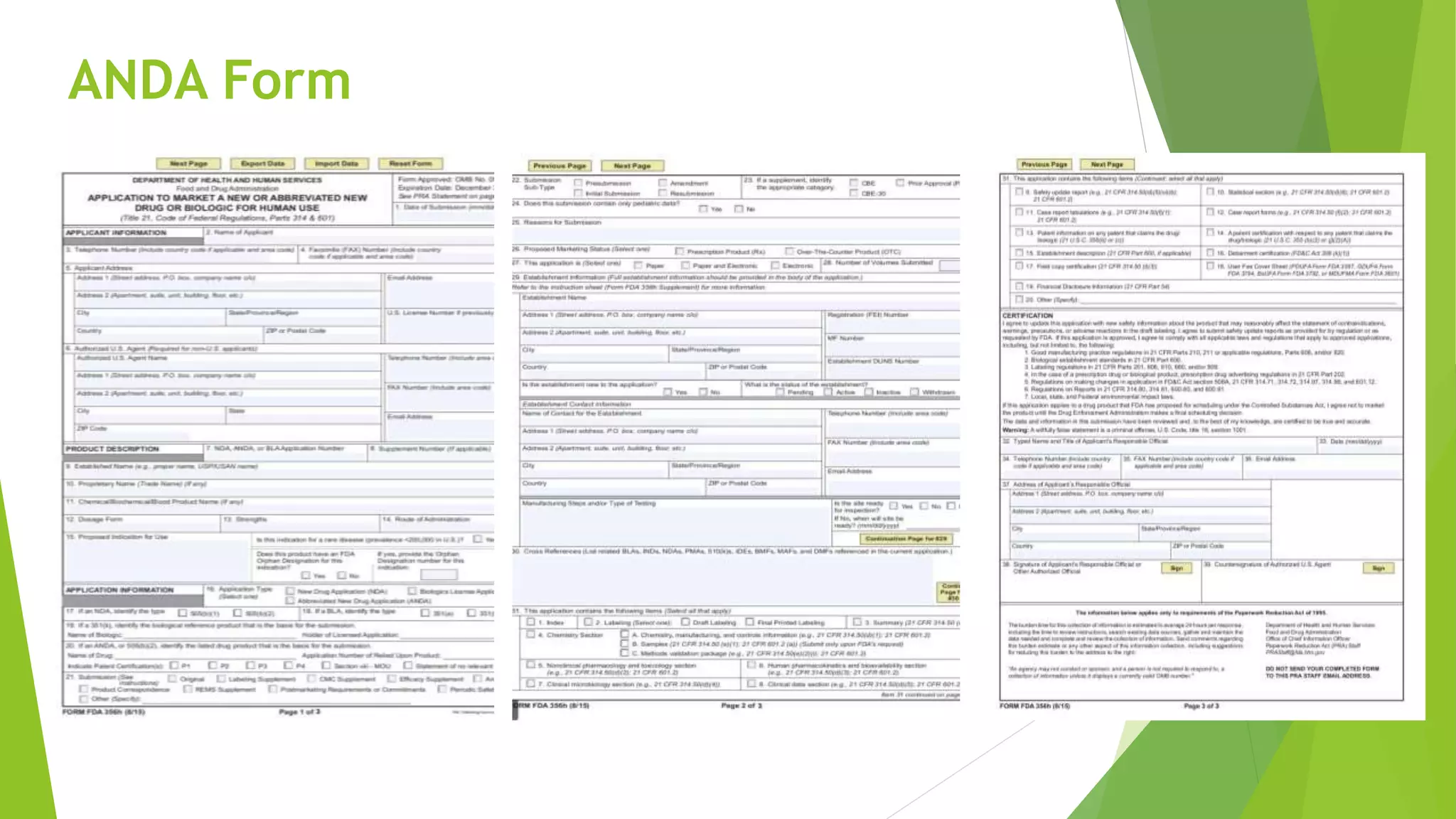
ANDA Form
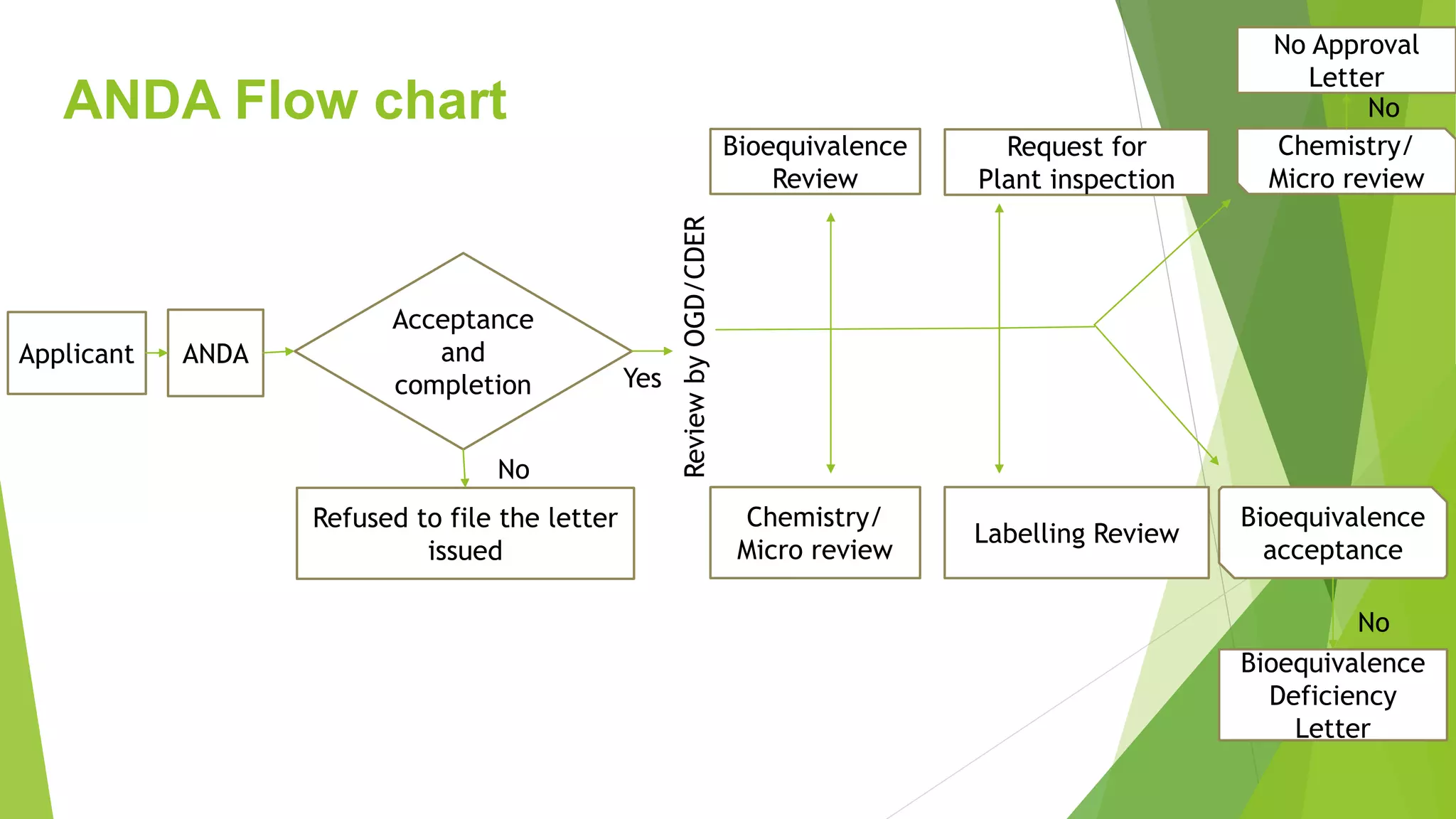
Applicant ANDA
Refused to file the letter
issued
Bioequivalence
Review
Chemistry/
Micro review
Request for
Plant inspection
Acceptance
and
completion
No
Yes
Review
by
OGD/CDER
Labelling Review
Bioequivalence
acceptance
Chemistry/
Micro review
No Approval
Letter
Bioequivalence
Deficiency
Letter
No
No
ANDA Flow chart
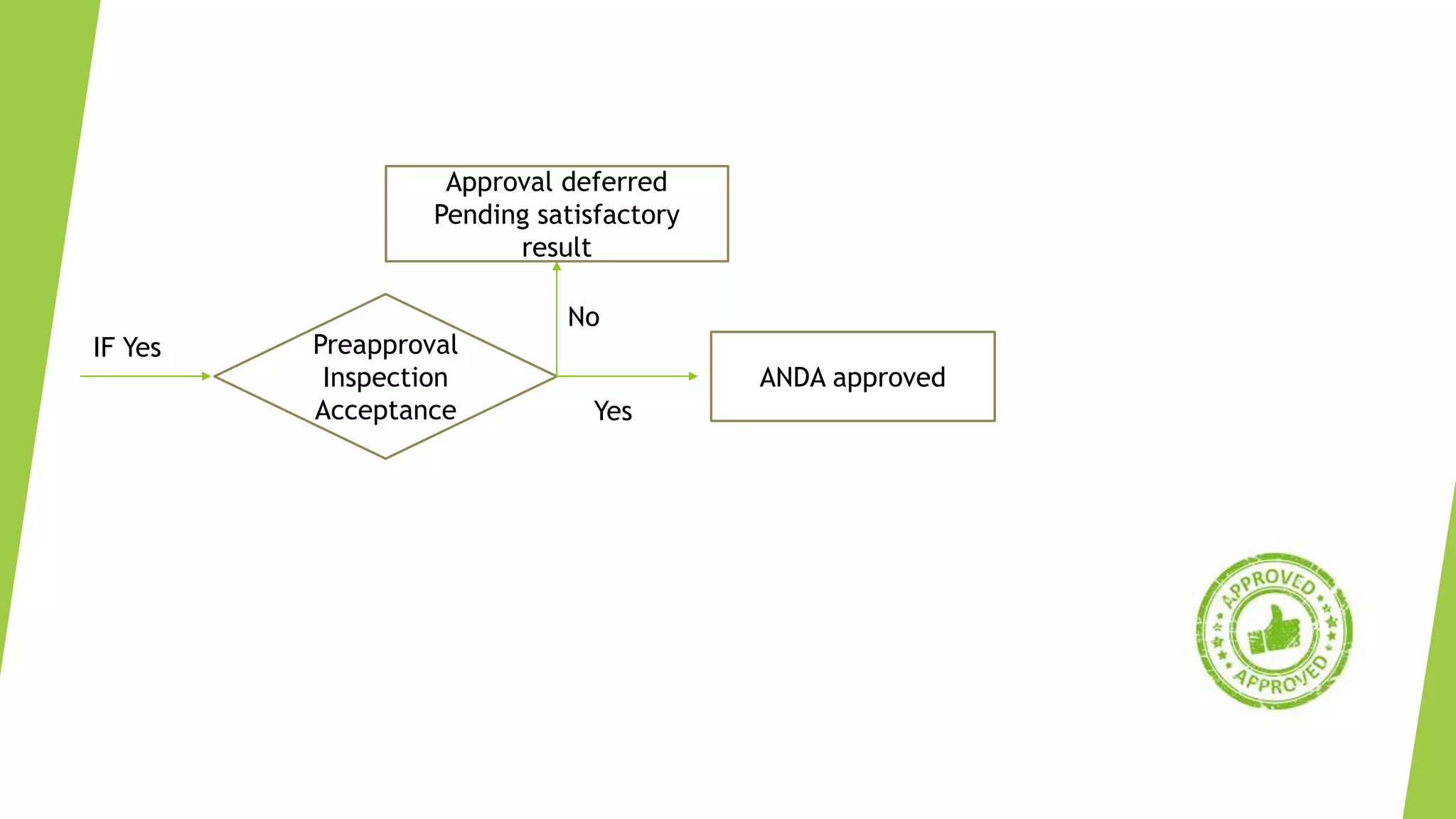
IF Yes Preapproval
Inspection
Acceptance
No
Yes
Approval deferred
Pending satisfactory
result
ANDA approved
 The Center for Drug Evaluation and Research is a division of the U.S. Food and Drug
Administration that monitors most drugs as defined in the Food, Drug, and Cosmetic Act.
Some biological products are also legally considered drugs, but they are covered by the
Center for Biologics Evaluation and Research.
 GDUFA10 was signed into law to speed the delivery of safe and effective generic drugs to
the public and reduce costs to industry.
 Office of generic drug (OGD) strongly encourages submission of bioequivalence, chemistry
and labeling portions of the application in electronic format.
 This guidance details the information that should be provided in each section of the
common technical document (CTD) format for human pharmaceutical product
applications2 and identifies supporting guidance documents and recommendations issued
by FDA to assist applicants in preparing their ANDA submission.
CTD (Common Technical Document)
 The CTD format was developed by the International Council for Harmonization of
Technical Requirements for Pharmaceuticals for Human Use (ICH) to streamline the
submission requirements for Japan, the European Union, and the United States.
 The CTD is comprised of the following modules:
 Module 1: Administrative Information
 Module 2: Summaries
 Module 3: Quality
 Module 4: Nonclinical
 Module 5: Clinical
Format of ANDA
 3 copies of the Abbreviated application are required to be submitted; an
archival copy, a review copy and a field copy. An Archival copy shall contain
the following:
 Application form
 Table of Contents
 Basis for ANDA submission
 Conditions of use
 Active Ingredients
 Route of Administration
 Dosage form and Strength
 Bioequivalence and Bioavailability
 Labeling
 Chemistry, Manufacturing and Controls
 Samples Patent Certification
 Financial Certification or disclosure statement.
 Other Information.
 Under Section 314.94 (a) (12), the patent certification includes one of the
following: I. Paragraph I Certification- That the patent information has not
been submitted to FDA.
 Under Section 314.94 (a) (12), the patent certification includes one of the following:
 I. Paragraph I Certification- That the patent information has not been submitted
to FDA.
 II. Paragraph II Certification- That the patent has expired
 III. Paragraph III Certification- That the patent will expire (on date of marketing)
 IV. Paragraph IV Certification- That the patent is invalid, unenforceable, or will
not be infringed by manufacture, use or sale of generic drug.
Difference between ANDA and NDA
 ➤NDA requires submission of:
 1. Well-controlled clinical studies to demonstrate effectiveness.
 2. Preclinical and clinical data to show safety.
 3. Details of Manufacturing and Packaging.
 4. Proposed annotated Labeling
 ➤ In contrast ANDA requires submission of:
 1. Detailed description of components.
 2. Manufacturing, Controls, Packaging, data to assure bioequivalence and
bioavailability and Labeling. Labeling should be prepared in accordance with DESI
(Drug efficacy study implementation).
EXCLUSIVITY
 Exclusivity is a statutory provision designed to promote a balance between an
Innovator and Generic drug competitor. As long as a drug patent lasts, a reference
listed drug company enjoys a period of market exclusivity or monopoly. Expiration
of patent removes the monopoly of the patent holder.
 TERMS OF EXCLUSIVITY
 Orphan drugs---------- 7 years
 New Chemical Entity----- -5 years
 Pediatric Exclusivity---------6 months additional
 Patent Challenge-180 days.

Global Submission ANDA-.pdf

  • 1.
    GLOBAL SUBMISSION OF ANDA:REGULATORY AFFAIRS Presented by: Prachi Pandey, Rahul Pal M. Pharm (Pharmaceutics) NIMS Institute of Pharmacy, NIMS University Jaipur
  • 2.
    Abbreviated New DrugApplication  An ‘Abbreviated New Drug Application (ANDA)’ is an application for a U.S. generic drug approval from FDA under section 505(j) for an existing licensed medication or approved drug.  A generic drug product is one that is comparable to a patented drug product in dosage form, strength, route of administration, quality, performance characteristics and intended use.  All approved products, both innovator and generic, are listed in FDA's Approved Drug Products with Therapeutic Equivalence Evaluations (Orange Book).  The Orange Book name can be attributed to the Halloween holiday. The first print publication occurred October 1980, and orange was selected since it was almost Halloween.
  • 3.
     Generic drugapplications are termed "abbreviated" because (in comparison with a New Drug Application) they are generally not required to include preclinical (animal and in vitro) and clinical (human) trial data to establish safety and effectiveness. Instead, generic applicants must scientifically demonstrate that their product is bioequivalent (i.e., performs in the same manner as the innovator drug).  The generic version must deliver the same amount of active ingredients into a patient's bloodstream in the same amount of time as the innovator drug.  In cases of topically active drugs, the bioequivalence of a drug can be demonstrated by comparing drugs dissolution or transdermal drug absorption is compared with the innovator drug. In cases of systemically active drugs, active drug blood concentration of that drug is compared with the innovator drug.
  • 4.
    Hatch- Waxman Act  Usingbioequivalence as the basis for approving generic copies of drug products was established by the Drug Price Competition and Patent Term Restoration Act of 1984 (Public Law 98-417) , also known as the Hatch-Waxman Act.  The Drug Price Competition and Patent Term Restoration Act (Public Law 98-417), informally known as the Hatch-Waxman Act, established the modern system of government generic drug regulation in the United States under section 505(j) of the FD&C Act.
  • 5.
  • 6.
    Applicant ANDA Refused tofile the letter issued Bioequivalence Review Chemistry/ Micro review Request for Plant inspection Acceptance and completion No Yes Review by OGD/CDER Labelling Review Bioequivalence acceptance Chemistry/ Micro review No Approval Letter Bioequivalence Deficiency Letter No No ANDA Flow chart
  • 7.
    IF Yes Preapproval Inspection Acceptance No Yes Approvaldeferred Pending satisfactory result ANDA approved
  • 8.
     The Centerfor Drug Evaluation and Research is a division of the U.S. Food and Drug Administration that monitors most drugs as defined in the Food, Drug, and Cosmetic Act. Some biological products are also legally considered drugs, but they are covered by the Center for Biologics Evaluation and Research.  GDUFA10 was signed into law to speed the delivery of safe and effective generic drugs to the public and reduce costs to industry.  Office of generic drug (OGD) strongly encourages submission of bioequivalence, chemistry and labeling portions of the application in electronic format.  This guidance details the information that should be provided in each section of the common technical document (CTD) format for human pharmaceutical product applications2 and identifies supporting guidance documents and recommendations issued by FDA to assist applicants in preparing their ANDA submission.
  • 9.
    CTD (Common TechnicalDocument)  The CTD format was developed by the International Council for Harmonization of Technical Requirements for Pharmaceuticals for Human Use (ICH) to streamline the submission requirements for Japan, the European Union, and the United States.  The CTD is comprised of the following modules:  Module 1: Administrative Information  Module 2: Summaries  Module 3: Quality  Module 4: Nonclinical  Module 5: Clinical
  • 10.
    Format of ANDA 3 copies of the Abbreviated application are required to be submitted; an archival copy, a review copy and a field copy. An Archival copy shall contain the following:  Application form  Table of Contents  Basis for ANDA submission  Conditions of use  Active Ingredients  Route of Administration  Dosage form and Strength  Bioequivalence and Bioavailability
  • 11.
     Labeling  Chemistry,Manufacturing and Controls  Samples Patent Certification  Financial Certification or disclosure statement.  Other Information.  Under Section 314.94 (a) (12), the patent certification includes one of the following: I. Paragraph I Certification- That the patent information has not been submitted to FDA.
  • 12.
     Under Section314.94 (a) (12), the patent certification includes one of the following:  I. Paragraph I Certification- That the patent information has not been submitted to FDA.  II. Paragraph II Certification- That the patent has expired  III. Paragraph III Certification- That the patent will expire (on date of marketing)  IV. Paragraph IV Certification- That the patent is invalid, unenforceable, or will not be infringed by manufacture, use or sale of generic drug.
  • 13.
    Difference between ANDAand NDA  ➤NDA requires submission of:  1. Well-controlled clinical studies to demonstrate effectiveness.  2. Preclinical and clinical data to show safety.  3. Details of Manufacturing and Packaging.  4. Proposed annotated Labeling  ➤ In contrast ANDA requires submission of:  1. Detailed description of components.  2. Manufacturing, Controls, Packaging, data to assure bioequivalence and bioavailability and Labeling. Labeling should be prepared in accordance with DESI (Drug efficacy study implementation).
  • 14.
    EXCLUSIVITY  Exclusivity isa statutory provision designed to promote a balance between an Innovator and Generic drug competitor. As long as a drug patent lasts, a reference listed drug company enjoys a period of market exclusivity or monopoly. Expiration of patent removes the monopoly of the patent holder.  TERMS OF EXCLUSIVITY  Orphan drugs---------- 7 years  New Chemical Entity----- -5 years  Pediatric Exclusivity---------6 months additional  Patent Challenge-180 days.