Eye Interface Technology using
Electrooculography –
A Proposed Model
PRESENTED BY:
SNEHA JOSHI
STJIT
CONTENTS
• Introduction
• Electrooculography
• Keywords
• Eye movements
• EOG detection
• BiDiM-EOG
• EOG signal filtering & acquision system
• Guidance of wheelchair
• Robotic movements
• Advantages & Disadvantages
• Conclusion
Introduction
• Eyes are our window to this large universe.
• It is estimated 150, 00 severely disabled persons able to
control only the muscles of their eyes without any problem.
Electrooculography(EOG)
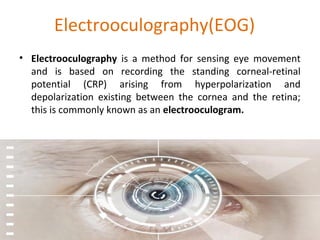
• Electrooculography is a method for sensing eye movement
and is based on recording the standing corneal-retinal
potential (CRP) arising from hyperpolarization and
depolarization existing between the cornea and the retina;
this is commonly known as an electrooculogram.
keywords
• Depolarization
• Hyper polarization
• Corneal-Retinal Potential or
Electrooculographic potential
(ranges from 0.05 to 3.5 mV in human)
Eye Movements
– Four types of eye movements are
– Saccades (rapid simultaneous movement of both eyes in
same direction)
– Smooth pursuit movements (voluntary eye movement as if
they are following an object)
– Vergence movements(simultaneous movement of eye in
opposite direction)
– Vestibulo-ocular movements(stabilizes the eyes, relative to
the external world, thus compensating for the movements)
EOG detection
The EOG is captured by five electrodes(acts as transducer) placed
around the eyes
Horizontal Vertical
Reference
Contnd….
EOG Signals
• HEOG Signals: Obtained from horizontal eye
movements
• Eye movement: from centre to left: +ve voltage spike
from center to right:-ve voltage spike
• VEOG Signals: Obtained from vertical eye
movements
• Eye movement: from centre to top: +ve voltage spike
from centre to bottom: -ve voltage spike
• Blink Signals: Obtained due to blinking of eyes
• Voluntary Blink Signals
• Involuntary Blink Signals
Contnd…
EYE MODEL BASED ON EOG(BIDIM-EOG)
EOG
FILTER USER SAFETY
SACCADIC
MOVEMENTS
DETECTOR
POSITION
CONTROL
OUTPUT
CONTROL
SMOOTH
MOVEMENTS
DETECTOR
SPEED
CONTROL
FEEDBACK
PARAMETERS
ADJUSTMENT
OUTPUT
EOG signal filtering & acquision
system
HOW TO GUIDE A WHEELCHAIR WITH THE HELP OF EYE MOVEMENTS?
The EOG signal is recorded by Ag-Agcl electrode.
By means of a acquisition system , signals are sent to a PC, in which they are processed to calculate the
eye gaze.
The control commands are given to the wheelchair in order to reach the required destination.
There exists a visual feedback in the system by means of tactile screen
that the user has in front of him.
Eg: User wheelchair interface & Trajectory generated
Video demonstration
• Range
• Linearity
• Non-invasive
• Obstacles in front of the eye
• Cost effective
• Eye closure is permissible
• Real Time
In this work we present a system that can be used as a means
of control for allowing the handicapped , especially those with
only eye-motor coordination, to live more independent lives.
This project is a low cost assistive robotic wheel chair system
for disabled people. The total command control based on EOG
permits to wheel chair users to guide it with a enough degree of
comfort ability .
Eye interface technology, Electrooculography – A Proposed Model

Eye interface technology, Electrooculography – A Proposed Model

  • 1.
    Eye Interface Technologyusing Electrooculography – A Proposed Model PRESENTED BY: SNEHA JOSHI STJIT
  • 2.
    CONTENTS • Introduction • Electrooculography •Keywords • Eye movements • EOG detection • BiDiM-EOG • EOG signal filtering & acquision system • Guidance of wheelchair • Robotic movements • Advantages & Disadvantages • Conclusion
  • 3.
    Introduction • Eyes areour window to this large universe. • It is estimated 150, 00 severely disabled persons able to control only the muscles of their eyes without any problem.
  • 4.
    Electrooculography(EOG) • Electrooculography isa method for sensing eye movement and is based on recording the standing corneal-retinal potential (CRP) arising from hyperpolarization and depolarization existing between the cornea and the retina; this is commonly known as an electrooculogram.
  • 5.
    keywords • Depolarization • Hyperpolarization • Corneal-Retinal Potential or Electrooculographic potential (ranges from 0.05 to 3.5 mV in human)
  • 6.
    Eye Movements – Fourtypes of eye movements are – Saccades (rapid simultaneous movement of both eyes in same direction) – Smooth pursuit movements (voluntary eye movement as if they are following an object) – Vergence movements(simultaneous movement of eye in opposite direction) – Vestibulo-ocular movements(stabilizes the eyes, relative to the external world, thus compensating for the movements)
  • 7.
    EOG detection The EOGis captured by five electrodes(acts as transducer) placed around the eyes Horizontal Vertical Reference
  • 8.
  • 9.
    EOG Signals • HEOGSignals: Obtained from horizontal eye movements • Eye movement: from centre to left: +ve voltage spike from center to right:-ve voltage spike • VEOG Signals: Obtained from vertical eye movements • Eye movement: from centre to top: +ve voltage spike from centre to bottom: -ve voltage spike • Blink Signals: Obtained due to blinking of eyes • Voluntary Blink Signals • Involuntary Blink Signals
  • 10.
  • 11.
    EYE MODEL BASEDON EOG(BIDIM-EOG) EOG FILTER USER SAFETY SACCADIC MOVEMENTS DETECTOR POSITION CONTROL OUTPUT CONTROL SMOOTH MOVEMENTS DETECTOR SPEED CONTROL FEEDBACK PARAMETERS ADJUSTMENT OUTPUT
  • 12.
    EOG signal filtering& acquision system
  • 13.
    HOW TO GUIDEA WHEELCHAIR WITH THE HELP OF EYE MOVEMENTS? The EOG signal is recorded by Ag-Agcl electrode. By means of a acquisition system , signals are sent to a PC, in which they are processed to calculate the eye gaze. The control commands are given to the wheelchair in order to reach the required destination. There exists a visual feedback in the system by means of tactile screen that the user has in front of him.
  • 14.
    Eg: User wheelchairinterface & Trajectory generated
  • 15.
  • 16.
    • Range • Linearity •Non-invasive • Obstacles in front of the eye • Cost effective • Eye closure is permissible • Real Time
  • 17.
    In this workwe present a system that can be used as a means of control for allowing the handicapped , especially those with only eye-motor coordination, to live more independent lives. This project is a low cost assistive robotic wheel chair system for disabled people. The total command control based on EOG permits to wheel chair users to guide it with a enough degree of comfort ability .