ELECTRO-DIAGNOSTIC TESTS ( ERG, EOG, VER ) Dr. Ankit M. Punjabi DOMS (final year) Dept. of Ophthalmology, KIMS Hospital Bangalore, Karnataka, INDIA Email: drankitalways@gmail.com
ERG Electric potential generated by retina in response to stimulation of light.  First recorded by  Frithiof Holmgren  (1865) In humans by  Dewar  (1877) Extensive work thereafter by  Riggs  (1941)
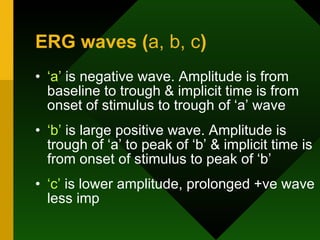
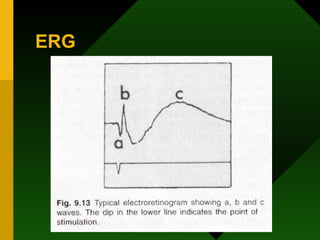
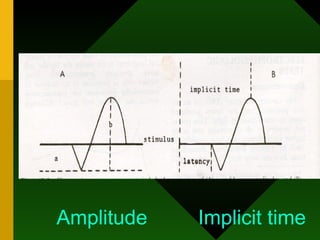
ERG waves ( a, b, c ) ‘ a’  is negative wave. Amplitude is from baseline to trough & implicit time is from onset of stimulus to trough of ‘a’ wave ‘ b’  is large positive wave. Amplitude is trough of ‘a’ to peak of ‘b’ & implicit time is from onset of stimulus to peak of ‘b’ ‘ c’  is lower amplitude, prolonged +ve wave less imp
ERG
ERG ‘ a’  origin  photoreceptors ‘ b’  origin  Muller’s cells + bipolar cells. Mainly from Muller’s in response to increase (ECF) K +  in bipolars ‘ c’  origin   RPE  Oscillatory potentials (small wavelets on ascending limb of ‘b’) from amacrine cells
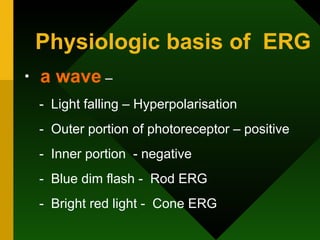
Physiologic basis of  ERG a wave  – -  Light falling – Hyperpolarisation -  Outer portion of photoreceptor – positive -  Inner portion  - negative -  Blue dim flash -  Rod ERG -  Bright red light -  Cone ERG
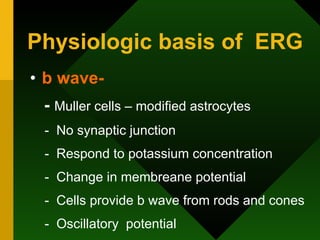
Physiologic basis of  ERG b wave- -  Muller cells – modified astrocytes -  No synaptic junction -  Respond to potassium concentration -  Change in membreane potential -  Cells provide b wave from rods and cones -  Oscillatory  potential
Physiologic basis of  ERG C wave – -  RPE – in response to rod signals only -  Direct contact of rod cells with RPE
Amplitude  Implicit time
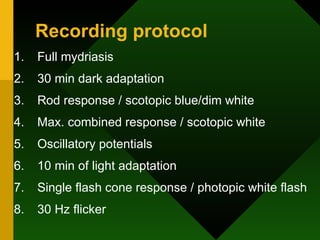
Recording protocol Full mydriasis 30 min dark adaptation Rod response / scotopic blue/dim white Max. combined response / scotopic white Oscillatory potentials 10 min of light adaptation Single flash cone response / photopic white flash 30 Hz flicker
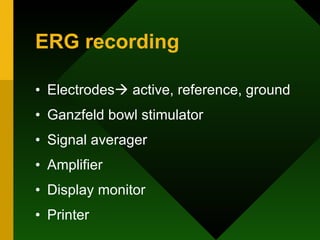
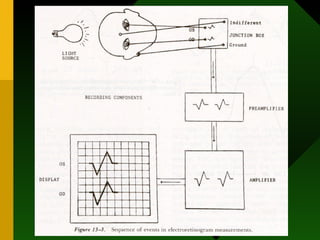
ERG recording Electrodes   active, reference, ground Ganzfeld bowl stimulator Signal averager Amplifier Display monitor Printer
 
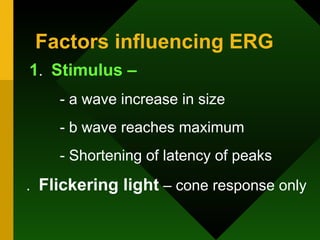
Factors influencing ERG 1 .  Stimulus –   - a wave increase in size - b wave reaches maximum - Shortening of latency of peaks .  Flickering light  – cone response only
Factors influencing ERG 2 .  Recording equipment -   3. Dark  adaptation  –  - ERG increases in size - b wave becomes slower 4. Age and sex – -  small ERG within hr of birth , declines in adults -  Larger in females than males
Cone Rod ERG In light adaptation 6-8 million cones tested In dark- additional 125 million rods contribute In dark adaptation initial 6-8 min majority of response is from cones Orange-red stimulus   cone + rod response White flicker at 30 Hz with intensity constant only cones respond. As the freq increases ‘b’ amplitude decreases
Separation of cone & rod ERG For clinically useful information Cone ERG   flickering stimulus 30-70  Hz (rods upto 50 Hz) Rod ERG   in dark adaptation / blue light
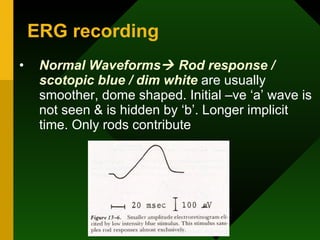
ERG recording Normal Waveforms   Rod response / scotopic blue / dim white  are usually smoother, dome shaped. Initial –ve ‘a’ wave is not seen & is hidden by ‘b’. Longer implicit time. Only rods contribute
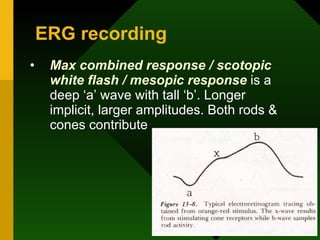
ERG recording Max combined response / scotopic white flash / mesopic response  is a deep ‘a’ wave with tall ‘b’. Longer implicit, larger amplitudes. Both rods & cones contribute
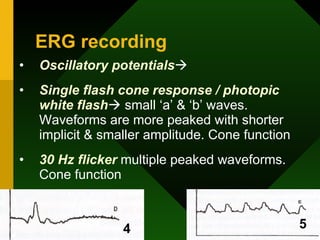
ERG recording Oscillatory potentials    Single flash cone response / photopic white flash   small ‘a’ & ‘b’ waves. Waveforms are more peaked with shorter implicit & smaller amplitude. Cone function 30 Hz flicker  multiple peaked waveforms. Cone function 4 5
Clinical  Applications 1. Diagnosis and prognosis of retinal disorders  – a. Retinitis pigmentosa b. Diabetic retinopathy c. Retinal detachment d. Vascular occlusions of retina e. Toxic and deficiency  status
Clinical  Applications 2.To assess retinal function  when fundus  examination is not possible -  Corneal opacities -  Dense cataract -  Vitreous haemorrhage
EOG
EOG Measurement of resting potential of eye Which exist between cornea and back of the retina during fully light adapted and Fully dark adapted conditions.
EOG First discovered by  Du Bois-Raymond  (1849) Riggs  (1954) &  Francois  worked extensively Arden & Fojas  discovered importance of ratio Records overall mass response only.
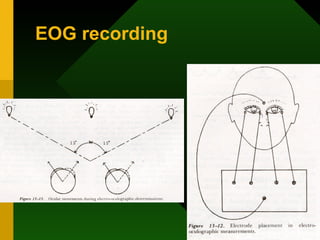
EOG recording Dilate (>3 mm) Skin electrodes near both canthi of BE Ground electrode at forehead.  Lighted room 3 fixation lights 15 o  apart (dim, red) Looks left & right with 30 o  excursion at rate of 15—20 rotations per minute .
EOG recording
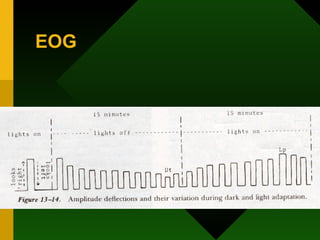
EOG recording Base line. Keep lights on for 5 min Turn  off  the lights. Record for 15 min in dark adapted state Turn  on  the lights. Record for 15 min in light adapted state Recordings sampled at 1 min intervals Response decreases progressively during dark adaptation
EOG Potentials decrease progressively reaching lowest value called  ‘dark trough’  in 8-12 min Light insensitive part of EOG Switch on   record in light adapted state Progressive increase in potential, peak is called  ‘light peak’  in 6—9 min Light sensitive part of EOG
EOG
Arden’s ratio Light peak / dark trough X 100 >180%  Normal 165—180%  Borderline <165%  Subnormal Difference of  >10 % in BE is significant Good pt cooperation is required
Light sensitive  –  [ Light peak ] -  Contributed by rods and cones  B)  Light insensitive  – [ Dark trough ] -  Contributed by RPE , Photoreceptors inner nuclear layer 2 components of EOG
EOG Indications Best dystrophy   markedly reduced with Arden ratio is less than 120% Butterfly pattern dystrophy Chloroquine toxicity Stargardt’s dystrophy
Visually Evoked Potential (Response) VEP / VER
Visual evoked potential Gross electrical signal generated at visual cortex in response to visual stimuli Impulses carried to visual cortex  via  visual pathway Recorded by EEG It is the only objective technique to assess clinical and functional state of visual syst.beyond retinal ganglion cells.
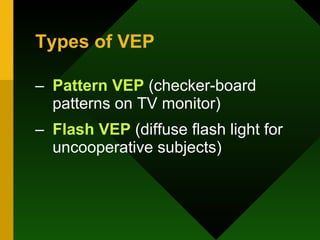
Types of VEP Pattern VEP  (checker-board patterns on TV monitor) Flash VEP  (diffuse flash light for uncooperative subjects)
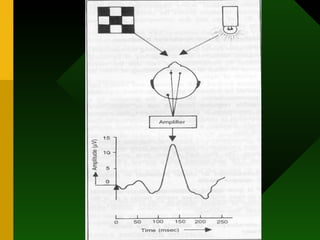
VEP Un-dilated pupils. Sit 1 meter from monitor  Electrodes in midline at forehead, vertex & occipital lobes 2-3 different checker sizes are shown Recording is done
 
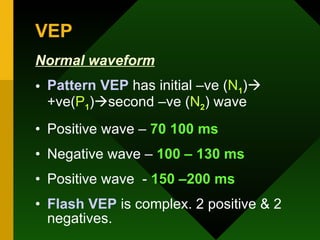
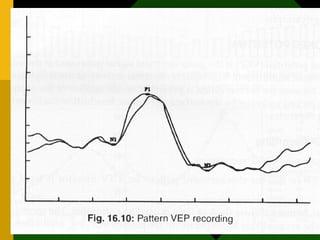
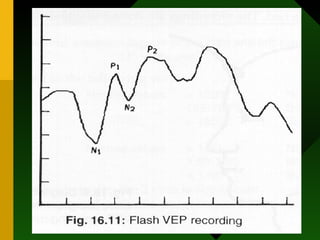
VEP Normal waveform Pattern VEP  has initial –ve ( N 1 )   +ve( P 1 )  second –ve ( N 2 ) wave Positive wave –  70 100 ms Negative wave –  100 – 130 ms Positive wave  -  150 –200 ms Flash VEP  is complex. 2 positive & 2 negatives.
 
 
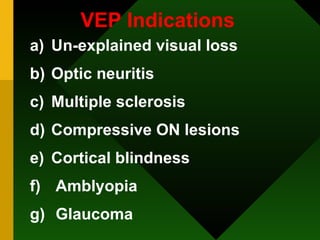
VEP Indications Un-explained visual loss Optic neuritis Multiple sclerosis Compressive ON lesions Cortical blindness Amblyopia  Glaucoma
No one can drive you crazy unless you give them the keys

Electrodiagnostic Tests in Ophthalmology

  • 1.
    ELECTRO-DIAGNOSTIC TESTS (ERG, EOG, VER ) Dr. Ankit M. Punjabi DOMS (final year) Dept. of Ophthalmology, KIMS Hospital Bangalore, Karnataka, INDIA Email: drankitalways@gmail.com
  • 2.
    ERG Electric potentialgenerated by retina in response to stimulation of light. First recorded by Frithiof Holmgren (1865) In humans by Dewar (1877) Extensive work thereafter by Riggs (1941)
  • 3.
    ERG waves (a, b, c ) ‘ a’ is negative wave. Amplitude is from baseline to trough & implicit time is from onset of stimulus to trough of ‘a’ wave ‘ b’ is large positive wave. Amplitude is trough of ‘a’ to peak of ‘b’ & implicit time is from onset of stimulus to peak of ‘b’ ‘ c’ is lower amplitude, prolonged +ve wave less imp
  • 4.
  • 5.
    ERG ‘ a’ origin  photoreceptors ‘ b’ origin  Muller’s cells + bipolar cells. Mainly from Muller’s in response to increase (ECF) K + in bipolars ‘ c’ origin  RPE Oscillatory potentials (small wavelets on ascending limb of ‘b’) from amacrine cells
  • 6.
    Physiologic basis of ERG a wave – - Light falling – Hyperpolarisation - Outer portion of photoreceptor – positive - Inner portion - negative - Blue dim flash - Rod ERG - Bright red light - Cone ERG
  • 7.
    Physiologic basis of ERG b wave- - Muller cells – modified astrocytes - No synaptic junction - Respond to potassium concentration - Change in membreane potential - Cells provide b wave from rods and cones - Oscillatory potential
  • 8.
    Physiologic basis of ERG C wave – - RPE – in response to rod signals only - Direct contact of rod cells with RPE
  • 9.
  • 10.
    Recording protocol Fullmydriasis 30 min dark adaptation Rod response / scotopic blue/dim white Max. combined response / scotopic white Oscillatory potentials 10 min of light adaptation Single flash cone response / photopic white flash 30 Hz flicker
  • 11.
    ERG recording Electrodes active, reference, ground Ganzfeld bowl stimulator Signal averager Amplifier Display monitor Printer
  • 12.
  • 13.
    Factors influencing ERG1 . Stimulus – - a wave increase in size - b wave reaches maximum - Shortening of latency of peaks . Flickering light – cone response only
  • 14.
    Factors influencing ERG2 . Recording equipment - 3. Dark adaptation – - ERG increases in size - b wave becomes slower 4. Age and sex – - small ERG within hr of birth , declines in adults - Larger in females than males
  • 15.
    Cone Rod ERGIn light adaptation 6-8 million cones tested In dark- additional 125 million rods contribute In dark adaptation initial 6-8 min majority of response is from cones Orange-red stimulus  cone + rod response White flicker at 30 Hz with intensity constant only cones respond. As the freq increases ‘b’ amplitude decreases
  • 16.
    Separation of cone& rod ERG For clinically useful information Cone ERG  flickering stimulus 30-70 Hz (rods upto 50 Hz) Rod ERG  in dark adaptation / blue light
  • 17.
    ERG recording NormalWaveforms  Rod response / scotopic blue / dim white are usually smoother, dome shaped. Initial –ve ‘a’ wave is not seen & is hidden by ‘b’. Longer implicit time. Only rods contribute
  • 18.
    ERG recording Maxcombined response / scotopic white flash / mesopic response is a deep ‘a’ wave with tall ‘b’. Longer implicit, larger amplitudes. Both rods & cones contribute
  • 19.
    ERG recording Oscillatorypotentials  Single flash cone response / photopic white flash  small ‘a’ & ‘b’ waves. Waveforms are more peaked with shorter implicit & smaller amplitude. Cone function 30 Hz flicker multiple peaked waveforms. Cone function 4 5
  • 20.
    Clinical Applications1. Diagnosis and prognosis of retinal disorders – a. Retinitis pigmentosa b. Diabetic retinopathy c. Retinal detachment d. Vascular occlusions of retina e. Toxic and deficiency status
  • 21.
    Clinical Applications2.To assess retinal function when fundus examination is not possible - Corneal opacities - Dense cataract - Vitreous haemorrhage
  • 22.
  • 23.
    EOG Measurement ofresting potential of eye Which exist between cornea and back of the retina during fully light adapted and Fully dark adapted conditions.
  • 24.
    EOG First discoveredby Du Bois-Raymond (1849) Riggs (1954) & Francois worked extensively Arden & Fojas discovered importance of ratio Records overall mass response only.
  • 25.
    EOG recording Dilate(>3 mm) Skin electrodes near both canthi of BE Ground electrode at forehead. Lighted room 3 fixation lights 15 o apart (dim, red) Looks left & right with 30 o excursion at rate of 15—20 rotations per minute .
  • 26.
  • 27.
    EOG recording Baseline. Keep lights on for 5 min Turn off the lights. Record for 15 min in dark adapted state Turn on the lights. Record for 15 min in light adapted state Recordings sampled at 1 min intervals Response decreases progressively during dark adaptation
  • 28.
    EOG Potentials decreaseprogressively reaching lowest value called ‘dark trough’ in 8-12 min Light insensitive part of EOG Switch on  record in light adapted state Progressive increase in potential, peak is called ‘light peak’ in 6—9 min Light sensitive part of EOG
  • 29.
  • 30.
    Arden’s ratio Lightpeak / dark trough X 100 >180% Normal 165—180% Borderline <165% Subnormal Difference of >10 % in BE is significant Good pt cooperation is required
  • 31.
    Light sensitive – [ Light peak ] - Contributed by rods and cones B) Light insensitive – [ Dark trough ] - Contributed by RPE , Photoreceptors inner nuclear layer 2 components of EOG
  • 32.
    EOG Indications Bestdystrophy  markedly reduced with Arden ratio is less than 120% Butterfly pattern dystrophy Chloroquine toxicity Stargardt’s dystrophy
  • 33.
    Visually Evoked Potential(Response) VEP / VER
  • 34.
    Visual evoked potentialGross electrical signal generated at visual cortex in response to visual stimuli Impulses carried to visual cortex via visual pathway Recorded by EEG It is the only objective technique to assess clinical and functional state of visual syst.beyond retinal ganglion cells.
  • 35.
    Types of VEPPattern VEP (checker-board patterns on TV monitor) Flash VEP (diffuse flash light for uncooperative subjects)
  • 36.
    VEP Un-dilated pupils.Sit 1 meter from monitor Electrodes in midline at forehead, vertex & occipital lobes 2-3 different checker sizes are shown Recording is done
  • 37.
  • 38.
    VEP Normal waveformPattern VEP has initial –ve ( N 1 )  +ve( P 1 )  second –ve ( N 2 ) wave Positive wave – 70 100 ms Negative wave – 100 – 130 ms Positive wave - 150 –200 ms Flash VEP is complex. 2 positive & 2 negatives.
  • 39.
  • 40.
  • 41.
    VEP Indications Un-explainedvisual loss Optic neuritis Multiple sclerosis Compressive ON lesions Cortical blindness Amblyopia Glaucoma
  • 42.
    No one candrive you crazy unless you give them the keys