


Online Vigilance Analysis Combining Video
and Electrooculography Features
Ruofei Du1, Renjie Liu1, Tianxiang Wu1, Baoliang Lu1234
1 Center for Brain-like Computing and Machine Intelligence
Department of Computer Science and Engineering
2 MOE-Microsoft Key Lab. for Intelligent Computing and Intelligent Systems
3 Shanghai Key Laboratory of Scalable Computing and Systems
4 MOE Key Laboratory of Systems Biomedicine
Shanghai Jiao Tong University
800 Dongchuan Road, Shanghai 200240, China
ICONIP 2012Shanghai Jiao Tong University
Outline
• Motivation
• Introduction
• System Overview
• Video Features
• Electrooculography
• Conclusion and Future Work
ICONIP 2012Shanghai Jiao Tong University
Motivation
• 600, 000 people die from traffic accidents every year, and
• 10,000,000 people get injured throughout the world.
• 60% of adult drivers – about 168 million people – say they have
driven a vehicle while feeling drowsy in 2004 in the U.S. Drowsy
driving results in 550 deaths, 71,000 injuries, and $12.5 billion
in monetary losses.
• In China, 45.7% accidents on the highway are caused by fatigued
driving.
ICONIP 2012Shanghai Jiao Tong University
Introduction
ICONIP 2012Shanghai Jiao Tong University
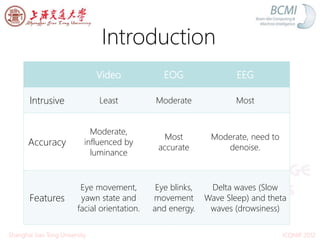
Video EOG EEG
Intrusive Least Moderate Most
Accuracy
Moderate,
influenced by
luminance
Most
accurate
Moderate, need to
denoise.
Features
Eye movement,
yawn state and
facial orientation.
Eye blinks,
movement
and energy.
Delta waves (Slow
Wave Sleep) and theta
waves (drowsiness)
System Overview
ICONIP 2012Shanghai Jiao Tong University
System Overview
ICONIP 2012Shanghai Jiao Tong University
Train Test
System Overview
ICONIP 2012Shanghai Jiao Tong University
Black screen 5~7s
stimulus
500ms
One trial
System Overview
ICONIP 2012Shanghai Jiao Tong University
Visual Features
ICONIP 2012Shanghai Jiao Tong University
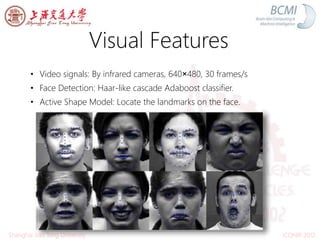
• Video signals: By infrared cameras, 640×480, 30 frames/s
• Face Detection: Haar-like cascade Adaboost classifier.
• Active Shape Model: Locate the landmarks on the face.
Visual Features
ICONIP 2012Shanghai Jiao Tong University
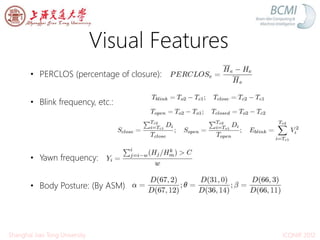
• PERCLOS (percentage of closure):
• Blink frequency, etc.:
• Yawn frequency:
• Body Posture: (By ASM)
Linear Dynamic System
ICONIP 2012Shanghai Jiao Tong University
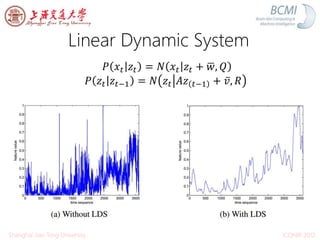
𝑃 𝑥 𝑡 𝑧𝑡 = 𝑁 𝑥 𝑡 𝑧𝑡 + 𝑤, 𝑄
𝑃 𝑧𝑡 𝑧𝑡−1 = 𝑁 𝑧𝑡 𝐴𝑧 𝑡−1 + 𝑣, 𝑅
Electrooculography
ICONIP 2012Shanghai Jiao Tong University
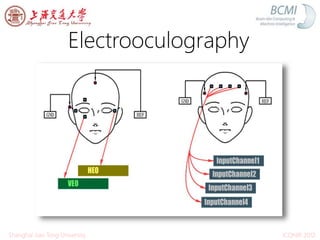
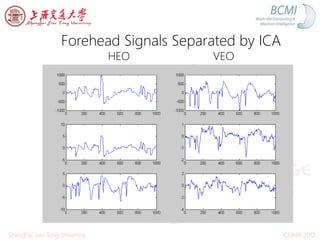
Forehead Signals Separated by ICA
HEO VEO
ICONIP 2012Shanghai Jiao Tong University
Electrooculography
ICONIP 2012Shanghai Jiao Tong University
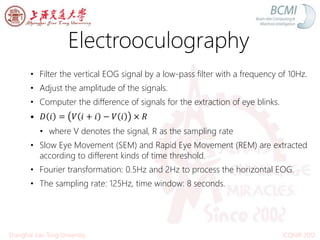
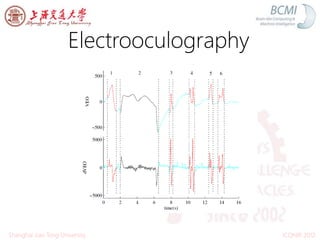
• Filter the vertical EOG signal by a low-pass filter with a frequency of 10Hz.
• Adjust the amplitude of the signals.
• Computer the difference of signals for the extraction of eye blinks.
• 𝐷 𝑖 = 𝑉 𝑖 + 𝑖 − 𝑉 𝑖 × 𝑅
• where V denotes the signal, R as the sampling rate
• Slow Eye Movement (SEM) and Rapid Eye Movement (REM) are extracted
according to different kinds of time threshold.
• Fourier transformation: 0.5Hz and 2Hz to process the horizontal EOG.
• The sampling rate: 125Hz, time window: 8 seconds.
Electrooculography
ICONIP 2012Shanghai Jiao Tong University
Conclusion
ICONIP 2012Shanghai Jiao Tong University
Conclusion
ICONIP 2012Shanghai Jiao Tong University
Future Work
ICONIP 2012Shanghai Jiao Tong University
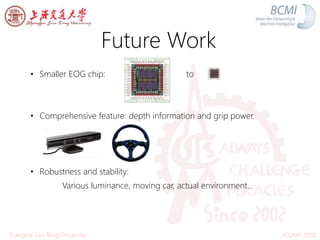
• Smaller EOG chip: to
• Comprehensive feature: depth information and grip power.
• Robustness and stability:
Various luminance, moving car, actual environment...
Thank you
BCMI: We are family!
http://bcmi.sjtu.edu.cn
ICONIP 2012Shanghai Jiao Tong University
Reference
1. May, J., Baldwin, C.: Driver fatigue: The importance of identifying causal factors of fatigue when considering detection and countermeasure
technologies. Transportation Research Part F: Traffic Psychology and Behaviour 12(3) (November 2009) 218–224
2. Stutts, J., Wilkins, J., Vaughn, B.: Why do people have drowsy driving crashes. A Foundation for Traffic Safety (202/638)
3. Wang, Q., Yang, J., Ren, M., Zheng, Y.: Driver fatigue detection: a survey. Intelligent Control and Automation, 2006. WCICA 2006. The Sixth
World Congress on 2 (2006) 8587–8591
4. Ji, Q., Yang, X.: Real-time eye, gaze, and face pose tracking for monitoring driver vigilance. Real-Time Imaging 8(5) (2002) 357–377
5. Dinges, D., Mallis, M., Maislin, G., Powell, I., et al.: Final report: Evaluation of techniques for ocular measurement as an index of fatigue and as
the basis for alertness management. National Highway Traffic Safety Administration (HS 808762) (1998)
6. Fletcher LApostoloffnPeterson L, e.a.: Vision in and out of vehicles. IEEE Trans on Intelligent Transportation Systems 18(3)
7. Ma, J., Shi, L., Lu, B.: Vigilance estimation by using electrooculographic features. Proceedings of 32nd International Conference of the IEEE
Engineering in Medicine and Biology Society (2010) 6591–6594
8. Wei, Z., Lu, B.: Online vigilance anaysis based on electrooculography. International Joint Conference on Neural Networks (2012)
9. Cootes, T., Taylor, C., Cooper, D., Graham, J., et al.: Active shape models - their training and application. Computer Vision and Image
Understanding 61(1) (1995) 38–59
10. Viola, P., Jones, M.: Rapid object detection using a boosted cascade of simple features. Proceedings of Computer Vision and Pattern
Recognition 1 (2001) I–511 – I–51810 Ruo-Fei Du, Ren-Jie Liu, Tian-Xiang Wu, Bao-Liang Lu
11. Delorme, A., Makeig, S.: Eeglab: an open source toolbox for analysis of single-trial eeg dynamics including independent component analysis.
Journal of neuroscience methods 134(1) (2004) 9–21
12. Dinges, D., Grace, R.: Perclos: A valid psychophysiological measure of alertness as assessed by psychomotor vigilance. Federal Highway
Administration. Office of motor carriers, Tech. Rep. MCRT-98-006 (1998)
13. A. Bulling, J. Ward, H.G., Troster, G.: Eye movement analysis for activity recognition using electrooculography. Pattern Analysis and Machine
Intelligence, IEEE Transactions (99) (2011) 1–1
14. Shi, L., Lu, B.: Off-line and on-line vigilance estimation based on linear dynamical system and manifold learning. Engineering in Medicine and
Biology Society (EMBC), 2010 Annual International Conference of the IEEE (September 2010) 6587–6590
15. Chang, C., Lin, C.: Libsvm: a library for support vector machines. ACM Transactions on Intelligent Systems and Technology (TIST) 2(3) (2011) 27
ICONIP 2012Shanghai Jiao Tong University

Online Vigilance Analysis Combining Video and Electrooculography Features

  • 1.
    Online Vigilance AnalysisCombining Video and Electrooculography Features Ruofei Du1, Renjie Liu1, Tianxiang Wu1, Baoliang Lu1234 1 Center for Brain-like Computing and Machine Intelligence Department of Computer Science and Engineering 2 MOE-Microsoft Key Lab. for Intelligent Computing and Intelligent Systems 3 Shanghai Key Laboratory of Scalable Computing and Systems 4 MOE Key Laboratory of Systems Biomedicine Shanghai Jiao Tong University 800 Dongchuan Road, Shanghai 200240, China ICONIP 2012Shanghai Jiao Tong University
  • 2.
    Outline • Motivation • Introduction •System Overview • Video Features • Electrooculography • Conclusion and Future Work ICONIP 2012Shanghai Jiao Tong University
  • 3.
    Motivation • 600, 000people die from traffic accidents every year, and • 10,000,000 people get injured throughout the world. • 60% of adult drivers – about 168 million people – say they have driven a vehicle while feeling drowsy in 2004 in the U.S. Drowsy driving results in 550 deaths, 71,000 injuries, and $12.5 billion in monetary losses. • In China, 45.7% accidents on the highway are caused by fatigued driving. ICONIP 2012Shanghai Jiao Tong University
  • 4.
    Introduction ICONIP 2012Shanghai JiaoTong University Video EOG EEG Intrusive Least Moderate Most Accuracy Moderate, influenced by luminance Most accurate Moderate, need to denoise. Features Eye movement, yawn state and facial orientation. Eye blinks, movement and energy. Delta waves (Slow Wave Sleep) and theta waves (drowsiness)
  • 5.
  • 6.
    System Overview ICONIP 2012ShanghaiJiao Tong University Train Test
  • 7.
    System Overview ICONIP 2012ShanghaiJiao Tong University Black screen 5~7s stimulus 500ms One trial
  • 8.
  • 9.
    Visual Features ICONIP 2012ShanghaiJiao Tong University • Video signals: By infrared cameras, 640×480, 30 frames/s • Face Detection: Haar-like cascade Adaboost classifier. • Active Shape Model: Locate the landmarks on the face.
  • 10.
    Visual Features ICONIP 2012ShanghaiJiao Tong University • PERCLOS (percentage of closure): • Blink frequency, etc.: • Yawn frequency: • Body Posture: (By ASM)
  • 11.
    Linear Dynamic System ICONIP2012Shanghai Jiao Tong University 𝑃 𝑥 𝑡 𝑧𝑡 = 𝑁 𝑥 𝑡 𝑧𝑡 + 𝑤, 𝑄 𝑃 𝑧𝑡 𝑧𝑡−1 = 𝑁 𝑧𝑡 𝐴𝑧 𝑡−1 + 𝑣, 𝑅
  • 12.
  • 13.
    Forehead Signals Separatedby ICA HEO VEO ICONIP 2012Shanghai Jiao Tong University
  • 14.
    Electrooculography ICONIP 2012Shanghai JiaoTong University • Filter the vertical EOG signal by a low-pass filter with a frequency of 10Hz. • Adjust the amplitude of the signals. • Computer the difference of signals for the extraction of eye blinks. • 𝐷 𝑖 = 𝑉 𝑖 + 𝑖 − 𝑉 𝑖 × 𝑅 • where V denotes the signal, R as the sampling rate • Slow Eye Movement (SEM) and Rapid Eye Movement (REM) are extracted according to different kinds of time threshold. • Fourier transformation: 0.5Hz and 2Hz to process the horizontal EOG. • The sampling rate: 125Hz, time window: 8 seconds.
  • 15.
  • 16.
  • 17.
  • 18.
    Future Work ICONIP 2012ShanghaiJiao Tong University • Smaller EOG chip: to • Comprehensive feature: depth information and grip power. • Robustness and stability: Various luminance, moving car, actual environment...
  • 19.
    Thank you BCMI: Weare family! http://bcmi.sjtu.edu.cn ICONIP 2012Shanghai Jiao Tong University
  • 20.
    Reference 1. May, J.,Baldwin, C.: Driver fatigue: The importance of identifying causal factors of fatigue when considering detection and countermeasure technologies. Transportation Research Part F: Traffic Psychology and Behaviour 12(3) (November 2009) 218–224 2. Stutts, J., Wilkins, J., Vaughn, B.: Why do people have drowsy driving crashes. A Foundation for Traffic Safety (202/638) 3. Wang, Q., Yang, J., Ren, M., Zheng, Y.: Driver fatigue detection: a survey. Intelligent Control and Automation, 2006. WCICA 2006. The Sixth World Congress on 2 (2006) 8587–8591 4. Ji, Q., Yang, X.: Real-time eye, gaze, and face pose tracking for monitoring driver vigilance. Real-Time Imaging 8(5) (2002) 357–377 5. Dinges, D., Mallis, M., Maislin, G., Powell, I., et al.: Final report: Evaluation of techniques for ocular measurement as an index of fatigue and as the basis for alertness management. National Highway Traffic Safety Administration (HS 808762) (1998) 6. Fletcher LApostoloffnPeterson L, e.a.: Vision in and out of vehicles. IEEE Trans on Intelligent Transportation Systems 18(3) 7. Ma, J., Shi, L., Lu, B.: Vigilance estimation by using electrooculographic features. Proceedings of 32nd International Conference of the IEEE Engineering in Medicine and Biology Society (2010) 6591–6594 8. Wei, Z., Lu, B.: Online vigilance anaysis based on electrooculography. International Joint Conference on Neural Networks (2012) 9. Cootes, T., Taylor, C., Cooper, D., Graham, J., et al.: Active shape models - their training and application. Computer Vision and Image Understanding 61(1) (1995) 38–59 10. Viola, P., Jones, M.: Rapid object detection using a boosted cascade of simple features. Proceedings of Computer Vision and Pattern Recognition 1 (2001) I–511 – I–51810 Ruo-Fei Du, Ren-Jie Liu, Tian-Xiang Wu, Bao-Liang Lu 11. Delorme, A., Makeig, S.: Eeglab: an open source toolbox for analysis of single-trial eeg dynamics including independent component analysis. Journal of neuroscience methods 134(1) (2004) 9–21 12. Dinges, D., Grace, R.: Perclos: A valid psychophysiological measure of alertness as assessed by psychomotor vigilance. Federal Highway Administration. Office of motor carriers, Tech. Rep. MCRT-98-006 (1998) 13. A. Bulling, J. Ward, H.G., Troster, G.: Eye movement analysis for activity recognition using electrooculography. Pattern Analysis and Machine Intelligence, IEEE Transactions (99) (2011) 1–1 14. Shi, L., Lu, B.: Off-line and on-line vigilance estimation based on linear dynamical system and manifold learning. Engineering in Medicine and Biology Society (EMBC), 2010 Annual International Conference of the IEEE (September 2010) 6587–6590 15. Chang, C., Lin, C.: Libsvm: a library for support vector machines. ACM Transactions on Intelligent Systems and Technology (TIST) 2(3) (2011) 27 ICONIP 2012Shanghai Jiao Tong University

Editor's Notes

  • #2 Good morning, ladies and gentleman: This paper is focus on vigilance analysis. To our knowledge, this paper to the first to combine both video and electrooculography features on online vigilance analysis. In addition, we provide a detailed comparison and combination between both kinds of features. 原稿: 我是杜若飞,来自09级ACM班,目前师从吕宝粮教授,在仿脑计算与人工智能中心的图像组从事计算机视觉与机器学习方向的研究。首先请允许我代表BCMI实验室祝ACM班十周年生日快乐! 本次报告的题目为“基于视频信号与眼电信号的在线警觉度分析”,所谓警觉度,也可以理解为一个人疲劳度。 这次报告一来介绍一下BCMI实验室在2011年中国国际工业博览会上获奖的“多模态司机疲劳检测系统”, 二来为大家简要介绍一下视频信号与眼电信号的基本研究方法。
  • #3 Here is the outline for today’s talk. Firstly, I would like to show why vigilance analysis plays a crucial part in people’s life and what is the motivation of our research. Secondly, I would like to introduce the different characteristics among video signals, EOG signals and EEG signals for vigilance analysis. Then I will talk about the experimental environment of this paper and an overview of our system. Afterwards, the detail of video features and electrooculography would be discussed. The final part talks about the conclusion and future work. 本次报告共分为6个部分,第一部分是研究动机,主要介绍一下我们为什么要研发警觉度分析系统,以及这样一个系统研发的重要意义;然后,简要介绍一下脑电、眼电、视频信号研究的内容与困难;接下来我会对BCMI实验室的司机疲劳度检测系统的训练端与测试端做一个简要介绍。 第四部分和第五部分中,我会从计算机视觉与眼电信号两个方面,简要介绍一下在警觉度系统中我们采取的特征提取的方法。最后我们会放一段演示视频,介绍一下BCMI实验室警觉度课题组未来的工作。 首先进入第一部分,研究动机。
  • #4 据不完全统计,全世界每年死于交通事故的人数约为60万,因车祸受伤的人更多,每年平均约有1000万人。 与此同时,我国的情况更加不容乐观: 目前我国汽车保有量约占全世界的3%,但由于交通事故造成的死亡人数却占全世界的16%,我国城市每万辆车死亡率是美国的17.8倍。 2008年5月12日,四川汶川、北川,8级强震猝然袭来,大地颤抖,山河移位,满目疮痍,生离死别……西南处,国有殇。 这次事故中共有69227名同胞不幸遇难。然而就在2008年,全国共发生道路交通事故265204起,造成73484人死亡、304919人受伤。 毫无疑问,中国是世界上道路交通事故最严重的国家,同时,也是死亡人数最多的国家。 法国国家事故报告表明,因疲劳驾驶而发生车祸的的死亡事故达到了20.6%。 在美国,尽管酒后驾车得到了较好的抑制,然而在恶性汽车事故中,57%的事故是与驾驶员疲劳有关。 英国交通研究实验室认为:疲劳驾驶导致的道路交通事故占全部交通事故的10%。 中国国家统计局表明,在高速公路上,疲劳驾驶占交通事故的比重达到了45.7%。 中国国家统计局表明,在高速公路上,疲劳驾驶占交通事故的比重达到了45.7%。 高速公路是我国建设成就的重要标志,其建设速度还在加快。但是,在高速路上发生车祸,特别是重大交通事故呈逐年上升的趋势,驾驶员疲劳驾驶是车祸的重要原因之一。因此,对于驾驶疲劳的产生机理、定量描述和检测方法的研究己经成为神经科学、认知科学和 智能交通系统研究的一个重要课题,它不但具有极高的理论价值,同时具有重要的现实意义。对于挽救那些不时处于疲劳驾驶而危及生命的动车,高铁驾驶员来说,更是一项刻不容缓的工作。 不幸的是,目前对于疲劳驾驶尚无可靠的检测手段和定量的评价体系。不但执法人员无法对疲劳驾驶采取有效的监管措施,而且科研人员也很难准确、便捷地判断疲劳驾驶。 我们的研究目标就是致力于开发多传感器的警觉度检测系统,从而有效地预防疲劳驾驶,以及为危险品操作人员、警察、士兵等提供疲劳度预测系统。
  • #5 警觉度分析的信号一般分为video, EOG和EEG三类。本文在introduction部分对侵入性,准确性和特征种类上进行了分析与对比。视频角度分析警觉度是完全非侵入性的,然而结果容易受光照等环境因素的影响。与此同时,视频角度可以获知驾驶员的哈欠频率,头部朝向等特征。EOG结果较准确,但很难从EOG信号中提取yawn frequency等特征。EEG使用起来setup时间较长,而且具有一定侵入性(intrusive),从EOG提取的delta和theta波对于分析警觉度具有重要意义。
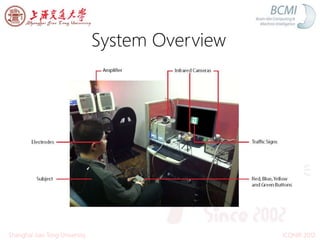
  • #6 The experimental environment of our vigilance analysis system is illustrated in Fig. 1. The video signals are extracted from infrared cameras in the front. Meanwhile, the EOG signals are extracted by 8 electrodes and recorded by the NeuroScan system 1. There are 2 vertical and 2 horizontal electrodes on the forehead.
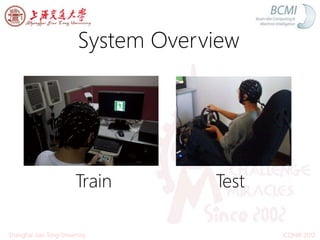
  • #7 The left side illustrates the training environment while the test side illustrates the test environment.
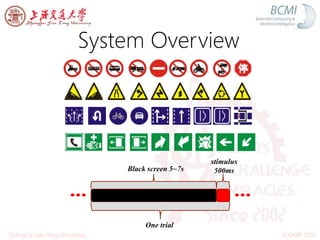
  • #8 Different traffic signs in four colors (red, green, blue and yellow) are displayed on the screen every 6 seconds and each sign lasts for only 0.5 seconds. Meanwhile, the subject is ought to press the button with the same color as the signs flashed on the screen. Therefore, not only the actions of the subjects could be recorded but the actual error rate could be calculated for further analysis.
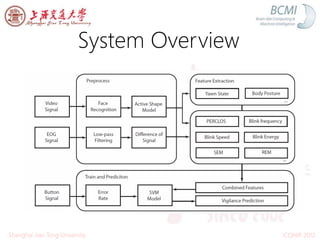
  • #9 Here is the flowchart of our system.
  • #12 动力系统是一个数学模型。在这个模型中,空间中的点随时间的变化状况存在着固定规则。线性动力系统是动力系统中的一种,线性动力系统中的观测变量和隐变量都是符合高斯分布的连续变量。可以对有噪声的信号进行处理。
  • #13 对于眼电信号,我们实验室采用了一项创新性的设计,就是改变了传统眼电电极的位置。因为传统的EOG测量需要的电极,两个是放在眼角外侧,测的是水平眼电,另外两个是放在一只眼睛的眼眶上下,用来测垂直眼电,这种电极位置不太适合一个实际穿戴的装置。所以我们考虑把电极放在额头上,这样比较适合装置的穿戴,只要用一条头带就可以了。那么这4个额头电极测到的信号也是一个混合信号,它混合了水平眼电、垂直眼电、还可能有一些肌电。
  • #14 我们可以用 independent component analysis 来把需要的水平眼电和垂直眼电分离出来
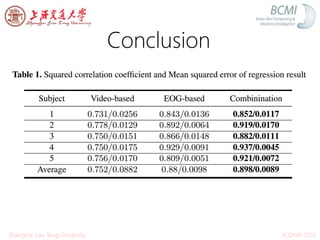
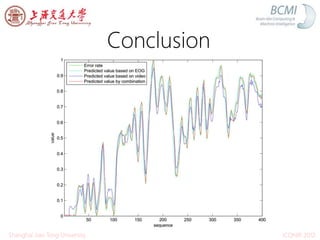
  • #17 There are totally five healthy subjects for our experiments, including four men and 1 woman, all of whom are around 23 years old. Particularly, we ensure that none of the subjects is color-blind. Each subject is asked to have sufficient sleep at night and get up early in the morning. Each experiment is conducted after lunch and lasts for 67 minutes so that the subject behaves sober at first and sleepy after a period of about half an hour in the experiment. The room is in silence and the light is soft. As is stated in Section 2, the subject is asked to press the button with the same color as the traffic sign displayed on the screen. With the help of NeuroScan Stim Software, we can collect error rate data and EOG signals, as well as video images from the infrared camera. Here is the result of correlation and squared between different prediction methods.
  • #18 From the experimental results, we can arrive at the conclusion that our new system offers a good prediction of the actual vigilance level. Moreover, this method outperforms the existing approaches using either video features or EOG features alone, since our proposed method utilizes both the accuracy of EOG signals but the yawn state and body postures provided by video as well.
  • #19 The experimental environment of our vigilance analysis system is illustrated in Fig. 1. The video signals are extracted from infrared cameras in the front. Meanwhile, the EOG signals are extracted by 8 electrodes and recorded by the NeuroScan system 1. There are 2 vertical and 2 horizontal electrodes on the forehead. Different traffic signs in four colors (red, green, blue and yellow) are displayed on the screen every 6 seconds and each sign lasts for only 0.5 seconds. Meanwhile, the subject is ought to press the button with the same color as the signs flashed on the screen. Therefore, not only the actions of the subjects could be recorded but the actual error rate could be calculated for further analysis.
  • #20 Author website: http://bcmi.sjtu.edu.cn/~duruofei Contact: xiaoxinghai@gmail.com
  • #21 Author website: http://bcmi.sjtu.edu.cn/~duruofei Contact: xiaoxinghai@gmail.com