LOW VISION AIDS
PRESENTER : Dr. KRATI GUPTA
MODERATOR: Dr. DAMARIS MAGDALENE
•DEFINITION OF LOW VISION
•CLASSIFICATION OF LOW VISION
INTRODUCTION
• For the diseases of the eye, the patient is more concerned with the functional
disabilities than the disease itself.
• In fact the patient seeks medical help due to some functional loss.
• If the affected function can be restored, the patient may not worry about the
disease .
Management of vision impairment (low vision, vision enhancement and vision rehabilitation)
FIVE COMPONENTS OF VISION
• There are totally five components of vision—
1. Visual acuity
2. Visual field
3. Contrast Sensitivity
4. Color vision
5. Stereopsis (Stereo vision).
Management of vision impairment (low vision, vision enhancement and vision rehabilitation)
FIVE COMPONENTS OF VISION
• All the 5 components play their parts in the quality of vision of an individual.
• In every ocular disorder, one or more of these is affected, hampering a person’s
ability to perform certain activities.
• When the condition is not curable, there is vision impairment in varying degrees.
• Understanding the specific ocular conditions and their effects helps in studying
the symptoms and in planning possible management of the vision loss.
Management of vision impairment (low vision, vision enhancement and vision rehabilitation)
DEFINITION OF LOW VISION
WHAT IS LOW VISION?
Low vision is insufficient vision, despite wearing the best possible corrective lenses
or contact lenses or in other words, to be unable to do the things you want to do.
Or
Vision loss that cannot be corrected by ordinary glasses, contact lenses, medication
or surgery is called “low vision.”
Or
Low vision is the vision which interferes with the daily performance of the
individual.
Or
Low vision refers to a significant reduction of visual function that cannot be
corrected to normal range by ordinary glasses, contact lens, medical treatment or
surgery.
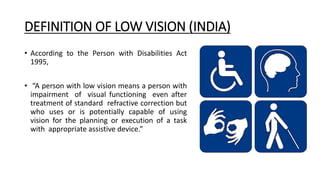
DEFINITION OF LOW VISION (INDIA)
• According to the Person with Disabilities Act
1995,
• “A person with low vision means a person with
impairment of visual functioning even after
treatment of standard refractive correction but
who uses or is potentially capable of using
vision for the planning or execution of a task
with appropriate assistive device.”
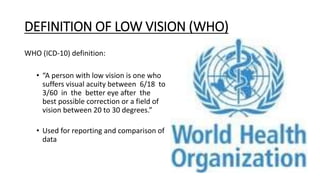
DEFINITION OF LOW VISION (WHO)
WHO (ICD-10) definition:
• “A person with low vision is one who
suffers visual acuity between 6/18 to
3/60 in the better eye after the
best possible correction or a field of
vision between 20 to 30 degrees.”
• Used for reporting and comparison of
data
THE WHO WORKING DEFINITION OF LOW VISION
(BANGKOK DEFINITION, 1992)
• “A person with low vision is one who has impairment of visual functioning
even after treatment, and/ or standard refractive correction, and has a visual
acuity of less than 6/18 to light perception or a visual field of less than 10
degrees from the point of fixation, but who uses, or is potentially able to use,
vision for the planning and/or execution of a task .”
• Defines population in need of low vision services
Community Eye Health Vol 17 No. 49 2004
IMPORTANT DEFINATIONS
Normal Vision
• A person is able to perform all close and distant visual tasks that are normally
expected in his community. Refractive correction (e.g. glasses) may be needed to
give ‘normal’ vision.
• A person with ‘normal’ vision is someone who has between 6/6 and 6/12 (20/20
and 20/40) vision.
Blindness
• It is defined as, no usable vision with exception of light perception.
IMPORTANT DEFINATIONS
Economic Blindness
• It is defined as, visual performance with distance visual acuity of 6/60 or less in the
better eye with best ophthalmic correction or as a defect in visual field so that the
widest diameter of vision subtends an angle no greater than 20 degrees.
Legal Blindness
• It is the legal definition used to determine whether an individual with vision
impairment is eligible for government benefits.
• It is 6/60 or less with best correction or a visual field of 20 degrees or less in the
widest meridian of the better eye.
IMPORTANT DEFINATIONS
Travel Vision
• When vision is 3/60 or better.
• Peripheral field of vision is at least 50 degrees in the widest diameter.
Partially-Sighted Child
• One who has distance VA between 6/24 to 6/60 in the better eye with the best
correction.
IMPORTANT DEFINATIONS
Visual function
• It is defined as ability to perform important task that require vision.
Visual dysfunction
• Certain terminologies have been described in relation to visual dysfunction .
IMPORTANT DEFINATIONS
Visual dysfunction
1. VISUAL DISORDER
• It refers to deviation from normal visual structure by:
 Disease
Injury
Anomaly affecting vision.
IMPORTANT DEFINATIONS
Visual dysfunction
2. VISUAL IMPAIRMENT
• It refers to reduction of visual function i.e :
Visual acuity
Visual field
And/or contrast sensitivity.
IMPORTANT DEFINATIONS
Visual dysfunction
3. VISUAL DISABILITY
• It refers to reduced ability to perform certain tasks eg.
To read
Write
Orientation
Mobility
IMPORTANT DEFINATIONS
Visual dysfunction
4. VISUAL HANDICAP
• It refers to non performance of tasks related to individual .
• It includes non fulfillment of social expectation because of visual disability
IMPORTANT DEFINATIONS
Functional Vision
• This refers to the use of vision for a particular purpose.
• Even small amounts of vision can be useful, for example to recognize a person or
to avoid objects.
• The use of vision depends on a person’s experiences and can vary with different
conditions.
• Functional vision may be improved with refractive correction, low vision devices
or instruction in the use of vision.
IMPORTANT DEFINATIONS
Vision Rehabilitation
• Are services provided to both who are partially sighted and those who are blind.
• These services include mobility training, adaptive skills training, low vision
instruction career services and training, psychological counseling and others.
CLASSIFICATION OF LOW VISION
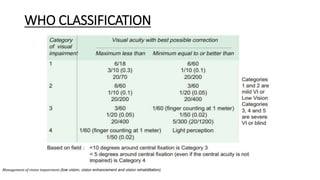
WHO CLASSIFICATION
Management of vision impairment (low vision, vision enhancement and vision rehabilitation)
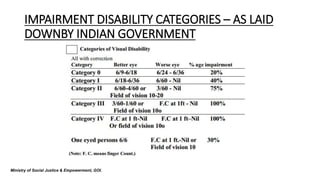
IMPAIRMENT DISABILITY CATEGORIES – AS LAID
DOWNBY INDIAN GOVERNMENT
Ministry of Social Justice & Empowerment, GOI.
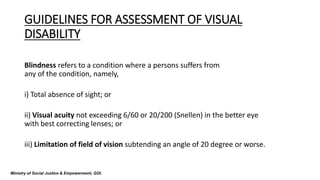
GUIDELINES FOR ASSESSMENT OF VISUAL
DISABILITY
Blindness refers to a condition where a persons suffers from
any of the condition, namely,
i) Total absence of sight; or
ii) Visual acuity not exceeding 6/60 or 20/200 (Snellen) in the better eye
with best correcting lenses; or
iii) Limitation of field of vision subtending an angle of 20 degree or worse.
Ministry of Social Justice & Empowerment, GOI.
GUIDELINES FOR ASSESSMENT OF VISUAL
DISABILITY
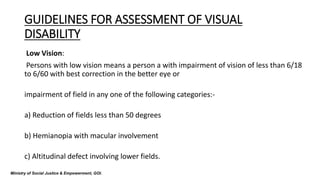
Low Vision:
Persons with low vision means a person a with impairment of vision of less than 6/18
to 6/60 with best correction in the better eye or
impairment of field in any one of the following categories:-
a) Reduction of fields less than 50 degrees
b) Hemianopia with macular involvement
c) Altitudinal defect involving lower fields.
Ministry of Social Justice & Empowerment, GOI.
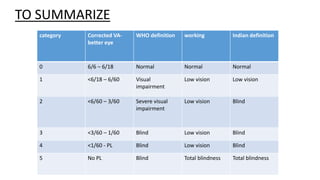
category Corrected VA-
better eye
WHO definition working Indian definition
0 6/6 – 6/18 Normal Normal Normal
1 <6/18 – 6/60 Visual
impairment
Low vision Low vision
2 <6/60 – 3/60 Severe visual
impairment
Low vision Blind
3 <3/60 – 1/60 Blind Low vision Blind
4 <1/60 - PL Blind Low vision Blind
5 No PL Blind Total blindness Total blindness
TO SUMMARIZE
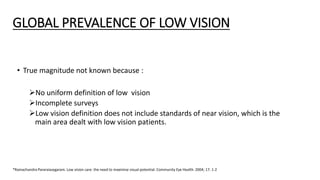
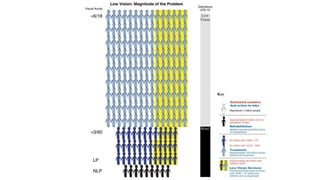
GLOBAL PREVALENCE OF LOW VISION
• True magnitude not known because :
No uniform definition of low vision
Incomplete surveys
Low vision definition does not include standards of near vision, which is the
main area dealt with low vision patients.
*Ramachandra Pararaiasegaram. Low vision care: the need to maximise visual potential. Community Eye Health. 2004; 17: 1-2
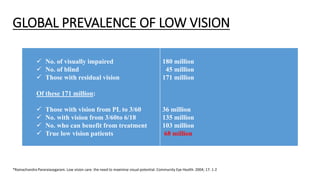
GLOBAL PREVALENCE OF LOW VISION
*Ramachandra Pararaiasegaram. Low vision care: the need to maximise visual potential. Community Eye Health. 2004; 17: 1-2
 No. of visually impaired
 No. of blind
 Those with residual vision
Of these 171 million:
 Those with vision from PL to 3/60
 No. with vision from 3/60to 6/18
 No. who can benefit from treatment
 True low vision patients
180 million
45 million
171 million
36 million
135 million
103 million
68 million
CATEGORIES OF VISION LOSS
• Vision loss occurs in varying degrees and also is subjective.
Based on symptoms manifest, it can be categorized into three types:
1. Overall blurred vision
2. Central field loss
3. Peripheral field loss.
• Various permutations and combinations may occur when other disabilities like
contrast sensitivity, loss of color vision and loss of stereo vision are present.
Management of vision impairment (low vision, vision enhancement and vision rehabilitation)
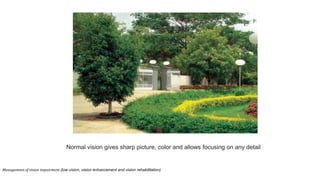
Normal vision gives sharp picture, color and allows focusing on any detail
Management of vision impairment (low vision, vision enhancement and vision rehabilitation)
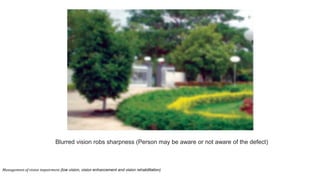
Blurred vision robs sharpness (Person may be aware or not aware of the defect)
Management of vision impairment (low vision, vision enhancement and vision rehabilitation)
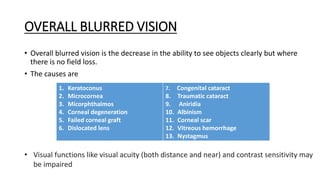
OVERALL BLURRED VISION
• Overall blurred vision is the decrease in the ability to see objects clearly but where
there is no field loss.
• The causes are
• Visual functions like visual acuity (both distance and near) and contrast sensitivity may
be impaired
1. Keratoconus
2. Microcornea
3. Micorphthalmos
4. Corneal degeneration
5. Failed corneal graft
6. Dislocated lens
7. Congenital cataract
8. Traumatic cataract
9. Aniridia
10. Albinism
11. Corneal scar
12. Vitreous hemorrhage
13. Nystagmus
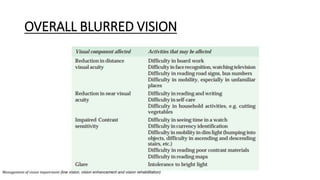
OVERALL BLURRED VISION
Management of vision impairment (low vision, vision enhancement and vision rehabilitation)
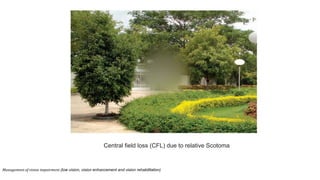
Central field loss (CFL) due to relative Scotoma
Management of vision impairment (low vision, vision enhancement and vision rehabilitation)
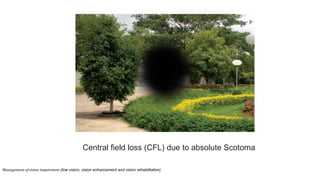
Central field loss (CFL) due to absolute Scotoma
Management of vision impairment (low vision, vision enhancement and vision rehabilitation)
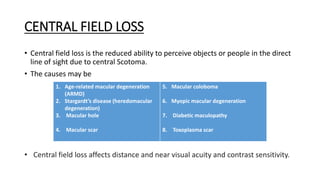
CENTRAL FIELD LOSS
• Central field loss is the reduced ability to perceive objects or people in the direct
line of sight due to central Scotoma.
• The causes may be
1. Age-related macular degeneration
(ARMD)
2. Stargardt’s disease (heredomacular
degeneration)
3. Macular hole
4. Macular scar
5. Macular coloboma
6. Myopic macular degeneration
7. Diabetic maculopathy
8. Toxoplasma scar
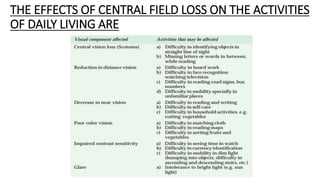
• Central field loss affects distance and near visual acuity and contrast sensitivity.
THE EFFECTS OF CENTRAL FIELD LOSS ON THE ACTIVITIES
OF DAILY LIVING ARE
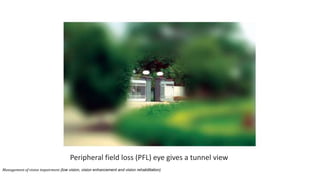
Peripheral field loss (PFL) eye gives a tunnel view
Management of vision impairment (low vision, vision enhancement and vision rehabilitation)
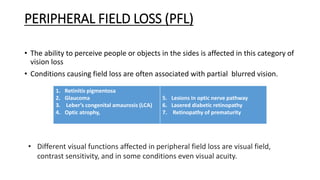
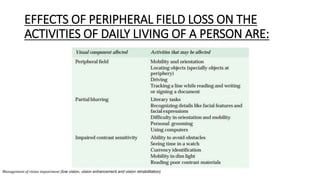
PERIPHERAL FIELD LOSS (PFL)
• The ability to perceive people or objects in the sides is affected in this category of
vision loss
• Conditions causing field loss are often associated with partial blurred vision.
1. Retinitis pigmentosa
2. Glaucoma
3. Leber’s congenital amaurosis (LCA)
4. Optic atrophy,
5. Lesions in optic nerve pathway
6. Lasered diabetic retinopathy
7. Retinopathy of prematurity
• Different visual functions affected in peripheral field loss are visual field,
contrast sensitivity, and in some conditions even visual acuity.
EFFECTS OF PERIPHERAL FIELD LOSS ON THE
ACTIVITIES OF DAILY LIVING OF A PERSON ARE:
Management of vision impairment (low vision, vision enhancement and vision rehabilitation)
THANK YOU

Low vision aids

  • 1.
    LOW VISION AIDS PRESENTER: Dr. KRATI GUPTA MODERATOR: Dr. DAMARIS MAGDALENE
  • 2.
    •DEFINITION OF LOWVISION •CLASSIFICATION OF LOW VISION
  • 3.
    INTRODUCTION • For thediseases of the eye, the patient is more concerned with the functional disabilities than the disease itself. • In fact the patient seeks medical help due to some functional loss. • If the affected function can be restored, the patient may not worry about the disease . Management of vision impairment (low vision, vision enhancement and vision rehabilitation)
  • 4.
    FIVE COMPONENTS OFVISION • There are totally five components of vision— 1. Visual acuity 2. Visual field 3. Contrast Sensitivity 4. Color vision 5. Stereopsis (Stereo vision). Management of vision impairment (low vision, vision enhancement and vision rehabilitation)
  • 5.
    FIVE COMPONENTS OFVISION • All the 5 components play their parts in the quality of vision of an individual. • In every ocular disorder, one or more of these is affected, hampering a person’s ability to perform certain activities. • When the condition is not curable, there is vision impairment in varying degrees. • Understanding the specific ocular conditions and their effects helps in studying the symptoms and in planning possible management of the vision loss. Management of vision impairment (low vision, vision enhancement and vision rehabilitation)
  • 6.
  • 7.
    WHAT IS LOWVISION? Low vision is insufficient vision, despite wearing the best possible corrective lenses or contact lenses or in other words, to be unable to do the things you want to do. Or Vision loss that cannot be corrected by ordinary glasses, contact lenses, medication or surgery is called “low vision.” Or Low vision is the vision which interferes with the daily performance of the individual. Or Low vision refers to a significant reduction of visual function that cannot be corrected to normal range by ordinary glasses, contact lens, medical treatment or surgery.
  • 8.
    DEFINITION OF LOWVISION (INDIA) • According to the Person with Disabilities Act 1995, • “A person with low vision means a person with impairment of visual functioning even after treatment of standard refractive correction but who uses or is potentially capable of using vision for the planning or execution of a task with appropriate assistive device.”
  • 9.
    DEFINITION OF LOWVISION (WHO) WHO (ICD-10) definition: • “A person with low vision is one who suffers visual acuity between 6/18 to 3/60 in the better eye after the best possible correction or a field of vision between 20 to 30 degrees.” • Used for reporting and comparison of data
  • 10.
    THE WHO WORKINGDEFINITION OF LOW VISION (BANGKOK DEFINITION, 1992) • “A person with low vision is one who has impairment of visual functioning even after treatment, and/ or standard refractive correction, and has a visual acuity of less than 6/18 to light perception or a visual field of less than 10 degrees from the point of fixation, but who uses, or is potentially able to use, vision for the planning and/or execution of a task .” • Defines population in need of low vision services Community Eye Health Vol 17 No. 49 2004
  • 11.
    IMPORTANT DEFINATIONS Normal Vision •A person is able to perform all close and distant visual tasks that are normally expected in his community. Refractive correction (e.g. glasses) may be needed to give ‘normal’ vision. • A person with ‘normal’ vision is someone who has between 6/6 and 6/12 (20/20 and 20/40) vision. Blindness • It is defined as, no usable vision with exception of light perception.
  • 12.
    IMPORTANT DEFINATIONS Economic Blindness •It is defined as, visual performance with distance visual acuity of 6/60 or less in the better eye with best ophthalmic correction or as a defect in visual field so that the widest diameter of vision subtends an angle no greater than 20 degrees. Legal Blindness • It is the legal definition used to determine whether an individual with vision impairment is eligible for government benefits. • It is 6/60 or less with best correction or a visual field of 20 degrees or less in the widest meridian of the better eye.
  • 13.
    IMPORTANT DEFINATIONS Travel Vision •When vision is 3/60 or better. • Peripheral field of vision is at least 50 degrees in the widest diameter. Partially-Sighted Child • One who has distance VA between 6/24 to 6/60 in the better eye with the best correction.
  • 14.
    IMPORTANT DEFINATIONS Visual function •It is defined as ability to perform important task that require vision. Visual dysfunction • Certain terminologies have been described in relation to visual dysfunction .
  • 15.
    IMPORTANT DEFINATIONS Visual dysfunction 1.VISUAL DISORDER • It refers to deviation from normal visual structure by:  Disease Injury Anomaly affecting vision.
  • 16.
    IMPORTANT DEFINATIONS Visual dysfunction 2.VISUAL IMPAIRMENT • It refers to reduction of visual function i.e : Visual acuity Visual field And/or contrast sensitivity.
  • 17.
    IMPORTANT DEFINATIONS Visual dysfunction 3.VISUAL DISABILITY • It refers to reduced ability to perform certain tasks eg. To read Write Orientation Mobility
  • 18.
    IMPORTANT DEFINATIONS Visual dysfunction 4.VISUAL HANDICAP • It refers to non performance of tasks related to individual . • It includes non fulfillment of social expectation because of visual disability
  • 19.
    IMPORTANT DEFINATIONS Functional Vision •This refers to the use of vision for a particular purpose. • Even small amounts of vision can be useful, for example to recognize a person or to avoid objects. • The use of vision depends on a person’s experiences and can vary with different conditions. • Functional vision may be improved with refractive correction, low vision devices or instruction in the use of vision.
  • 20.
    IMPORTANT DEFINATIONS Vision Rehabilitation •Are services provided to both who are partially sighted and those who are blind. • These services include mobility training, adaptive skills training, low vision instruction career services and training, psychological counseling and others.
  • 21.
  • 22.
    WHO CLASSIFICATION Management ofvision impairment (low vision, vision enhancement and vision rehabilitation)
  • 23.
    IMPAIRMENT DISABILITY CATEGORIES– AS LAID DOWNBY INDIAN GOVERNMENT Ministry of Social Justice & Empowerment, GOI.
  • 24.
    GUIDELINES FOR ASSESSMENTOF VISUAL DISABILITY Blindness refers to a condition where a persons suffers from any of the condition, namely, i) Total absence of sight; or ii) Visual acuity not exceeding 6/60 or 20/200 (Snellen) in the better eye with best correcting lenses; or iii) Limitation of field of vision subtending an angle of 20 degree or worse. Ministry of Social Justice & Empowerment, GOI.
  • 25.
    GUIDELINES FOR ASSESSMENTOF VISUAL DISABILITY Low Vision: Persons with low vision means a person a with impairment of vision of less than 6/18 to 6/60 with best correction in the better eye or impairment of field in any one of the following categories:- a) Reduction of fields less than 50 degrees b) Hemianopia with macular involvement c) Altitudinal defect involving lower fields. Ministry of Social Justice & Empowerment, GOI.
  • 26.
    category Corrected VA- bettereye WHO definition working Indian definition 0 6/6 – 6/18 Normal Normal Normal 1 <6/18 – 6/60 Visual impairment Low vision Low vision 2 <6/60 – 3/60 Severe visual impairment Low vision Blind 3 <3/60 – 1/60 Blind Low vision Blind 4 <1/60 - PL Blind Low vision Blind 5 No PL Blind Total blindness Total blindness TO SUMMARIZE
  • 27.
    GLOBAL PREVALENCE OFLOW VISION • True magnitude not known because : No uniform definition of low vision Incomplete surveys Low vision definition does not include standards of near vision, which is the main area dealt with low vision patients. *Ramachandra Pararaiasegaram. Low vision care: the need to maximise visual potential. Community Eye Health. 2004; 17: 1-2
  • 28.
    GLOBAL PREVALENCE OFLOW VISION *Ramachandra Pararaiasegaram. Low vision care: the need to maximise visual potential. Community Eye Health. 2004; 17: 1-2  No. of visually impaired  No. of blind  Those with residual vision Of these 171 million:  Those with vision from PL to 3/60  No. with vision from 3/60to 6/18  No. who can benefit from treatment  True low vision patients 180 million 45 million 171 million 36 million 135 million 103 million 68 million
  • 30.
    CATEGORIES OF VISIONLOSS • Vision loss occurs in varying degrees and also is subjective. Based on symptoms manifest, it can be categorized into three types: 1. Overall blurred vision 2. Central field loss 3. Peripheral field loss. • Various permutations and combinations may occur when other disabilities like contrast sensitivity, loss of color vision and loss of stereo vision are present. Management of vision impairment (low vision, vision enhancement and vision rehabilitation)
  • 31.
    Normal vision givessharp picture, color and allows focusing on any detail Management of vision impairment (low vision, vision enhancement and vision rehabilitation)
  • 32.
    Blurred vision robssharpness (Person may be aware or not aware of the defect) Management of vision impairment (low vision, vision enhancement and vision rehabilitation)
  • 33.
    OVERALL BLURRED VISION •Overall blurred vision is the decrease in the ability to see objects clearly but where there is no field loss. • The causes are • Visual functions like visual acuity (both distance and near) and contrast sensitivity may be impaired 1. Keratoconus 2. Microcornea 3. Micorphthalmos 4. Corneal degeneration 5. Failed corneal graft 6. Dislocated lens 7. Congenital cataract 8. Traumatic cataract 9. Aniridia 10. Albinism 11. Corneal scar 12. Vitreous hemorrhage 13. Nystagmus
  • 34.
    OVERALL BLURRED VISION Managementof vision impairment (low vision, vision enhancement and vision rehabilitation)
  • 35.
    Central field loss(CFL) due to relative Scotoma Management of vision impairment (low vision, vision enhancement and vision rehabilitation)
  • 36.
    Central field loss(CFL) due to absolute Scotoma Management of vision impairment (low vision, vision enhancement and vision rehabilitation)
  • 37.
    CENTRAL FIELD LOSS •Central field loss is the reduced ability to perceive objects or people in the direct line of sight due to central Scotoma. • The causes may be 1. Age-related macular degeneration (ARMD) 2. Stargardt’s disease (heredomacular degeneration) 3. Macular hole 4. Macular scar 5. Macular coloboma 6. Myopic macular degeneration 7. Diabetic maculopathy 8. Toxoplasma scar • Central field loss affects distance and near visual acuity and contrast sensitivity.
  • 38.
    THE EFFECTS OFCENTRAL FIELD LOSS ON THE ACTIVITIES OF DAILY LIVING ARE
  • 39.
    Peripheral field loss(PFL) eye gives a tunnel view Management of vision impairment (low vision, vision enhancement and vision rehabilitation)
  • 40.
    PERIPHERAL FIELD LOSS(PFL) • The ability to perceive people or objects in the sides is affected in this category of vision loss • Conditions causing field loss are often associated with partial blurred vision. 1. Retinitis pigmentosa 2. Glaucoma 3. Leber’s congenital amaurosis (LCA) 4. Optic atrophy, 5. Lesions in optic nerve pathway 6. Lasered diabetic retinopathy 7. Retinopathy of prematurity • Different visual functions affected in peripheral field loss are visual field, contrast sensitivity, and in some conditions even visual acuity.
  • 41.
    EFFECTS OF PERIPHERALFIELD LOSS ON THE ACTIVITIES OF DAILY LIVING OF A PERSON ARE: Management of vision impairment (low vision, vision enhancement and vision rehabilitation)
  • 42.

Editor's Notes

  • #28 Prevalance Community Eye Health. 2004; 17(49): 1–2. Ramachandra Pararajasegaram
  • #29 Prevalance Community Eye Health. 2004; 17(49): 1–2. Ramachandra Pararajasegaram