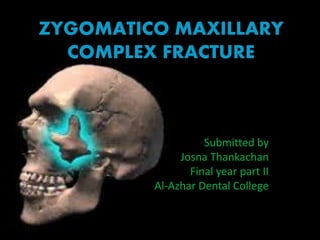
ZYGOMATICO MAXILLARY
COMPLEX FRACTURE
Submitted by
Josna Thankachan
Final year part II
Al-Azhar Dental College
CONTENTS
• Introduction
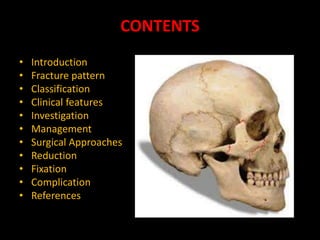
• Fracture pattern
• Classification
• Clinical features
• Investigation
• Management
• Surgical Approaches
• Reduction
• Fixation
• Complication
• References
INTRODUCTION
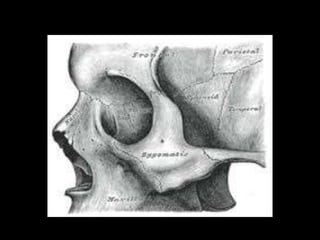
• Zygoma is a major buttress of facial skeleton is
the principle structure of lateral midface.
• It is equivalent of a four sided pyramid.
• It has temporal process which articulates with
temporal process which articulates with
sphenoid bone, maxillary process which
articulates with maxillary bone and frontal
process which articulates with frontal bone.
• Fracture of zygoma is usually not present
alone, it finds mostly in conjunction with
adjacent structures ie, antrum, orbital floor.
This structure makes up the
zygomaticomaxillary complex.
FRACTURE PATTERN
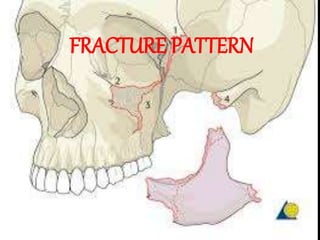
• Fracture pattern follows a line which
commence at frontozygomatic suture,passes
downward close to or between the greater
wing of sphenoid and the frontal process of
zygomatic bone to reach anterior limit of
inferior orbital fissure and then turns
anteromedially to cross the inferior orbital
margin above or in close proximity to the
infraorbital canal.
• From this point the fracture continues
inferolaterally to cross the outer wall of
antrum and pass beneath the zygomatic
buttress turning upward across the posterior
wall of antrum to rejoin the anterior limit of
inferior orbital fissure.
Inferior orbital fissure is the key to remembering
the usual lines of zygomaticomaxillary
complex fracture 3 lines extending from
inferior orbital fissure in 3 direction-
anteromedially
superolaterally
inferiorly
• One fracture line extend from inferior orbital
fissure anteromedially along orbital floor
mostly through orbital process of maxilla
towards the infraorbital rim.
• Second line of fracture run from inferior
orbital fissure to inferiorly towards the
posterior aspect of maxilla(infra temporal)and
joins the fracture from the anterior aspect of
maxilla under the zygomatic buttress.
• Third line of fracture extend superiorly from
the inferior orbital fissure along the lateral
orbital wall posterior to the rim,usually
separating the zygomatico sphenoid suture.
• An additional fracture line runs through the
zygomatic arch.
• frequently ; however 3 fracture lines exist
through the arch,producing 2 free segments
when the fracture are complete.
CLASSIFICATION
I. Row and Killey classification(1968)
Type I – no significant displacement
Type II – Fracture of zygomatic arch
Type III – rotation around horizontal axis (inward or outward
displacement)
Type IV – rotation around vertical axis(medial or lateral
displacement)
Type V – displacement of complex enblock
Type VI – displacement of orbitoantral partition
Type VII – displacement of orbital rim segment
Type VIII – isolated fracture of orbital wall
II. Spiessel and Schroll(1972)
Type I – zygomatic arch fracture
Type II – zygomatic complex fracture;no significant
displacement
Type III - zygomatic complex fracture;partial medial
displacement
Type IV - zygomatic complex fracture;total medial
displacement
Type V - zygomatic complex fracture; dorsal displacement
Type VI - zygomatic complex fracture; inferior displacement
Type VII - zygomatic complex fracture; comminuted fracture
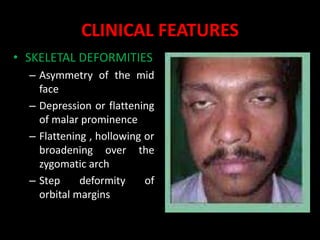
CLINICAL FEATURES
• SKELETAL DEFORMITIES
– Asymmetry of the mid
face
– Depression or flattening
of malar prominence
– Flattening , hollowing or
broadening over the
zygomatic arch
– Step deformity of
orbital margins
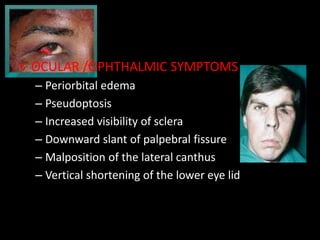
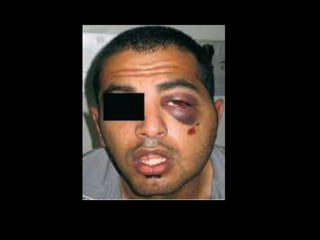
• OCULAR /OPHTHALMIC SYMPTOMS
– Periorbital edema
– Pseudoptosis
– Increased visibility of sclera
– Downward slant of palpebral fissure
– Malposition of the lateral canthus
– Vertical shortening of the lower eye lid
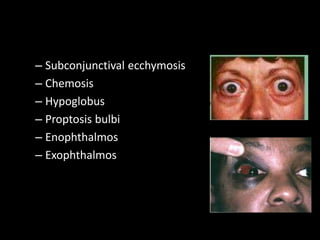
– Subconjunctival ecchymosis
– Chemosis
– Hypoglobus
– Proptosis bulbi
– Enophthalmos
– Exophthalmos
– Subcutaneous periorbital air emphysema
– Pneumoexophthalmos
– Amaurosis
– Superior orbital fissure syndrome
– Diplopia
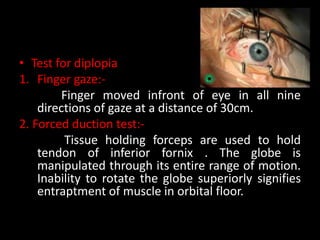
• Test for diplopia
1. Finger gaze:-
Finger moved infront of eye in all nine
directions of gaze at a distance of 30cm.
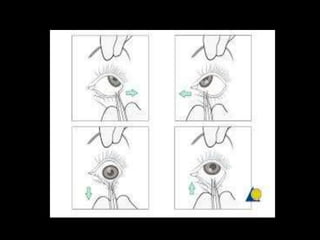
2. Forced duction test:-
Tissue holding forceps are used to hold
tendon of inferior fornix . The globe is
manipulated through its entire range of motion.
Inability to rotate the globe superiorly signifies
entraptment of muscle in orbital floor.
• NEUROLOGICAL SYMPTOMS
– Paresthesia of infraorbital nerve
– Parethesia of supra orbital and supra trochlear
nerve
– Paresthesia of zygomatico temporal and
zygomatico facial nerve
– Paresis of facial nerve
– Paresis of extraocular muscles
• ORAL SYMPTOMS
– Ecchymosis in the buccal sulcus of maxillary arch
– Deformity of zygomatic buttress of maxilla
– Trismus
– Pain
– Impacted /flattened zygomatic arch
• NASAL SYMPTOMS
– Ipsilateral epistaxis
– Ipsilateral hematosinus
INVESTIGATIONS
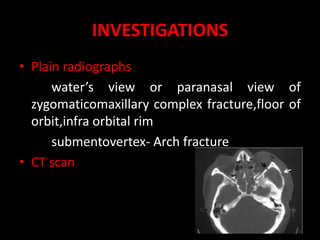
• Plain radiographs
water’s view or paranasal view of
zygomaticomaxillary complex fracture,floor of
orbit,infra orbital rim
submentovertex- Arch fracture
• CT scan
MANAGEMENT
• Surgical approach:-
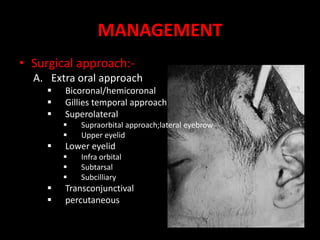
A. Extra oral approach
 Bicoronal/hemicoronal
 Gillies temporal approach
 Superolateral
 Supraorbital approach;lateral eyebrow
 Upper eyelid
 Lower eyelid
 Infra orbital
 Subtarsal
 Subcilliary
 Transconjunctival
 percutaneous
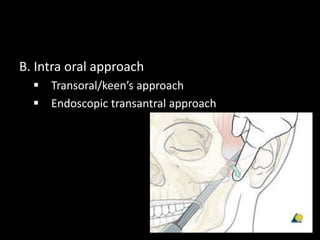
B. Intra oral approach
 Transoral/keen’s approach
 Endoscopic transantral approach
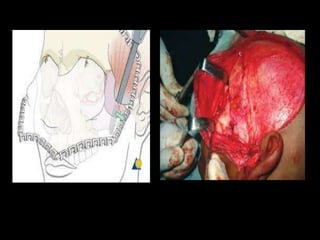
Bicoronal/hemicoronal approach
• The zygoma fracture reduction is complete if
the sphenozygomatic suture is reduced. This
suture can be visualized only by this
approach. Moreover, this approach is ideal in
zygomatic complex fracture involving the
frontal bone,orbital roof reconstruction ,arch
fracture requiring fixation and laterally
displaced zygoma fracture requiring 3 or 4
point fixation.
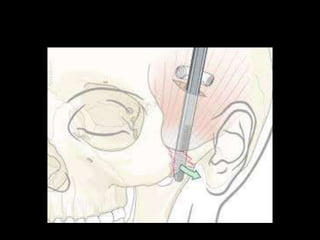
Gillies temporal approach(1927)
• An incision about 2.5cm length is made
between the two branches of the superficial
temporal artery at an angle of 45˚ to the
upper limit of the attachment of the external
ear.
• Dissection is carried out till the temporal
fascia. A Bristow’s elevator is passed down
through this incision beneath the zygomatic
bone which is then gradually reduced to its
position.
• The incision is then closed in layers.
• Rowe pattern zygomatic elevator is also used
in this approach for the reduction of the
zygomatic fracture.
• Bristow’s elevator has adisadvantage of using
the temporal bone as fulcrum causing risk of
fracturing the temporal bone during the
procedure. This was overcome by the design
in Rowe zygoma elevator.
Transoral/keen’s approach
• Also known as buccal sulcus incision /lateral
maxillary vestibular incision
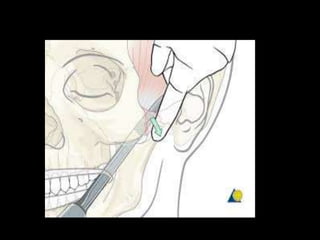
• A bone hook can be passed from a transverse
incision made in the region of buccal sulcus
and the fractured segment can be reduced.
• An incision 1cm in length is made in the buccal
sulcus behind the zygomatic buttress.
• A bone hook or curved elevator is passed
behind supraperiosteally,to contact the deep
part of the zygomatic bone.here an upward
outward and forward pressure is exerted.
• The advantage of this method is that less
amount of force is required for reduction.
REDUCTION
• Indirect method
– Gillies temporal approach
– Keen’s approach
– Percutaneous approach
• Direct method
– Coronal/bicoronal approach
– Supraorbital eyebrow approach
– Lower eyelid approach
• Fixation
– 1 point fixation
– 2 point fixation
– 3 point fixation
– 4 point fixation
• One point fixation
– Indication
• Undisplaced fracture at frontozygomatic suture
• Simple non comminuted zygomatic complex fracture
– Approach
• Frontozygomatic suture approached through supraorbital
eyebrow approach.
• Zygomaticomaxillary buttress approached through maxillary
vestibular approach.
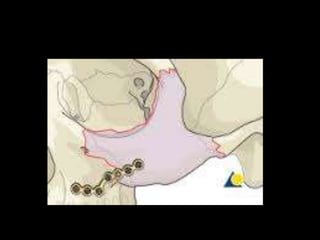
• One point fixation with miniplates in the zygomatico
maxillary butress region can avoid unsightly scars and give
high satisfaction with surgical outcome in selected patients
with zygoma fractures.
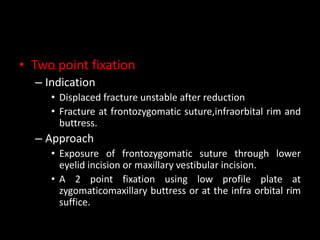
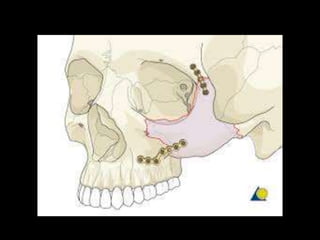
• Two point fixation
– Indication
• Displaced fracture unstable after reduction
• Fracture at frontozygomatic suture,infraorbital rim and
buttress.
– Approach
• Exposure of frontozygomatic suture through lower
eyelid incision or maxillary vestibular incision.
• A 2 point fixation using low profile plate at
zygomaticomaxillary buttress or at the infra orbital rim
suffice.
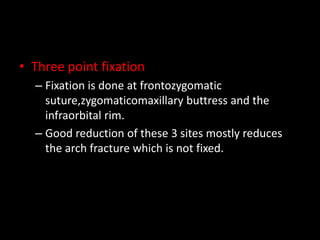
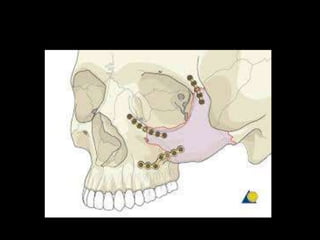
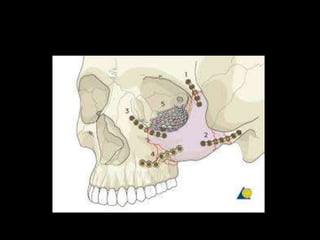
• Three point fixation
– Fixation is done at frontozygomatic
suture,zygomaticomaxillary buttress and the
infraorbital rim.
– Good reduction of these 3 sites mostly reduces
the arch fracture which is not fixed.
• Four point fixation
– Unique from 3 point technique in that the surgeon
visualizes the zygomatic arch. The order of
placement of the plates will be dependant on the
least damaged landmarks. The zygomatic arch is
an excellent reference to restore proper
anteroposterior projection of the midface.
• Fixation is again of two types:
i. Direct fixation
• Transosseous wiring
ii. Indirect fixation
• Internal pin fixation
• Transfixation with kirshner wire
COMPLICATIONS
• Complication of periorbital incision
• Infraorbital nerve paresthesia
• Implant extrusion/displacement and infection
• Persistent diplopia
• Enophthalmosis
• Blindness
• Retrobulbar hemorrhage
• Ankylosis of zygoma to coronoid
• Malunion
• Orbital dystopia
REFERENCES
1. Clinical handbook of oral and maxillofacial
surgery- Laskins
2. Textbook of oral and maxillofacial surgery;2nd
edition- S.M Balaji
3. Textbook of oral and maxillofacial surgery;3rd
edition- Neelima Mallik

Zygomatic maxillary complex fracture

  • 1.
    ZYGOMATICO MAXILLARY COMPLEX FRACTURE Submittedby Josna Thankachan Final year part II Al-Azhar Dental College
  • 2.
    CONTENTS • Introduction • Fracturepattern • Classification • Clinical features • Investigation • Management • Surgical Approaches • Reduction • Fixation • Complication • References
  • 3.
    INTRODUCTION • Zygoma isa major buttress of facial skeleton is the principle structure of lateral midface. • It is equivalent of a four sided pyramid. • It has temporal process which articulates with temporal process which articulates with sphenoid bone, maxillary process which articulates with maxillary bone and frontal process which articulates with frontal bone.
  • 5.
    • Fracture ofzygoma is usually not present alone, it finds mostly in conjunction with adjacent structures ie, antrum, orbital floor. This structure makes up the zygomaticomaxillary complex.
  • 6.
  • 7.
    • Fracture patternfollows a line which commence at frontozygomatic suture,passes downward close to or between the greater wing of sphenoid and the frontal process of zygomatic bone to reach anterior limit of inferior orbital fissure and then turns anteromedially to cross the inferior orbital margin above or in close proximity to the infraorbital canal.
  • 8.
    • From thispoint the fracture continues inferolaterally to cross the outer wall of antrum and pass beneath the zygomatic buttress turning upward across the posterior wall of antrum to rejoin the anterior limit of inferior orbital fissure.
  • 9.
    Inferior orbital fissureis the key to remembering the usual lines of zygomaticomaxillary complex fracture 3 lines extending from inferior orbital fissure in 3 direction- anteromedially superolaterally inferiorly
  • 10.
    • One fractureline extend from inferior orbital fissure anteromedially along orbital floor mostly through orbital process of maxilla towards the infraorbital rim. • Second line of fracture run from inferior orbital fissure to inferiorly towards the posterior aspect of maxilla(infra temporal)and joins the fracture from the anterior aspect of maxilla under the zygomatic buttress.
  • 11.
    • Third lineof fracture extend superiorly from the inferior orbital fissure along the lateral orbital wall posterior to the rim,usually separating the zygomatico sphenoid suture. • An additional fracture line runs through the zygomatic arch. • frequently ; however 3 fracture lines exist through the arch,producing 2 free segments when the fracture are complete.
  • 12.
    CLASSIFICATION I. Row andKilley classification(1968) Type I – no significant displacement Type II – Fracture of zygomatic arch Type III – rotation around horizontal axis (inward or outward displacement) Type IV – rotation around vertical axis(medial or lateral displacement) Type V – displacement of complex enblock Type VI – displacement of orbitoantral partition Type VII – displacement of orbital rim segment Type VIII – isolated fracture of orbital wall
  • 13.
    II. Spiessel andSchroll(1972) Type I – zygomatic arch fracture Type II – zygomatic complex fracture;no significant displacement Type III - zygomatic complex fracture;partial medial displacement Type IV - zygomatic complex fracture;total medial displacement Type V - zygomatic complex fracture; dorsal displacement Type VI - zygomatic complex fracture; inferior displacement Type VII - zygomatic complex fracture; comminuted fracture
  • 14.
    CLINICAL FEATURES • SKELETALDEFORMITIES – Asymmetry of the mid face – Depression or flattening of malar prominence – Flattening , hollowing or broadening over the zygomatic arch – Step deformity of orbital margins
  • 15.
    • OCULAR /OPHTHALMICSYMPTOMS – Periorbital edema – Pseudoptosis – Increased visibility of sclera – Downward slant of palpebral fissure – Malposition of the lateral canthus – Vertical shortening of the lower eye lid
  • 16.
    – Subconjunctival ecchymosis –Chemosis – Hypoglobus – Proptosis bulbi – Enophthalmos – Exophthalmos
  • 17.
    – Subcutaneous periorbitalair emphysema – Pneumoexophthalmos – Amaurosis – Superior orbital fissure syndrome – Diplopia
  • 19.
    • Test fordiplopia 1. Finger gaze:- Finger moved infront of eye in all nine directions of gaze at a distance of 30cm. 2. Forced duction test:- Tissue holding forceps are used to hold tendon of inferior fornix . The globe is manipulated through its entire range of motion. Inability to rotate the globe superiorly signifies entraptment of muscle in orbital floor.
  • 21.
    • NEUROLOGICAL SYMPTOMS –Paresthesia of infraorbital nerve – Parethesia of supra orbital and supra trochlear nerve – Paresthesia of zygomatico temporal and zygomatico facial nerve – Paresis of facial nerve – Paresis of extraocular muscles
  • 22.
    • ORAL SYMPTOMS –Ecchymosis in the buccal sulcus of maxillary arch – Deformity of zygomatic buttress of maxilla – Trismus – Pain – Impacted /flattened zygomatic arch • NASAL SYMPTOMS – Ipsilateral epistaxis – Ipsilateral hematosinus
  • 23.
    INVESTIGATIONS • Plain radiographs water’sview or paranasal view of zygomaticomaxillary complex fracture,floor of orbit,infra orbital rim submentovertex- Arch fracture • CT scan
  • 24.
    MANAGEMENT • Surgical approach:- A.Extra oral approach  Bicoronal/hemicoronal  Gillies temporal approach  Superolateral  Supraorbital approach;lateral eyebrow  Upper eyelid  Lower eyelid  Infra orbital  Subtarsal  Subcilliary  Transconjunctival  percutaneous
  • 25.
    B. Intra oralapproach  Transoral/keen’s approach  Endoscopic transantral approach
  • 26.
    Bicoronal/hemicoronal approach • Thezygoma fracture reduction is complete if the sphenozygomatic suture is reduced. This suture can be visualized only by this approach. Moreover, this approach is ideal in zygomatic complex fracture involving the frontal bone,orbital roof reconstruction ,arch fracture requiring fixation and laterally displaced zygoma fracture requiring 3 or 4 point fixation.
  • 28.
    Gillies temporal approach(1927) •An incision about 2.5cm length is made between the two branches of the superficial temporal artery at an angle of 45˚ to the upper limit of the attachment of the external ear.
  • 30.
    • Dissection iscarried out till the temporal fascia. A Bristow’s elevator is passed down through this incision beneath the zygomatic bone which is then gradually reduced to its position. • The incision is then closed in layers. • Rowe pattern zygomatic elevator is also used in this approach for the reduction of the zygomatic fracture.
  • 31.
    • Bristow’s elevatorhas adisadvantage of using the temporal bone as fulcrum causing risk of fracturing the temporal bone during the procedure. This was overcome by the design in Rowe zygoma elevator.
  • 32.
    Transoral/keen’s approach • Alsoknown as buccal sulcus incision /lateral maxillary vestibular incision • A bone hook can be passed from a transverse incision made in the region of buccal sulcus and the fractured segment can be reduced. • An incision 1cm in length is made in the buccal sulcus behind the zygomatic buttress.
  • 34.
    • A bonehook or curved elevator is passed behind supraperiosteally,to contact the deep part of the zygomatic bone.here an upward outward and forward pressure is exerted. • The advantage of this method is that less amount of force is required for reduction.
  • 35.
    REDUCTION • Indirect method –Gillies temporal approach – Keen’s approach – Percutaneous approach • Direct method – Coronal/bicoronal approach – Supraorbital eyebrow approach – Lower eyelid approach
  • 36.
    • Fixation – 1point fixation – 2 point fixation – 3 point fixation – 4 point fixation
  • 37.
    • One pointfixation – Indication • Undisplaced fracture at frontozygomatic suture • Simple non comminuted zygomatic complex fracture – Approach • Frontozygomatic suture approached through supraorbital eyebrow approach. • Zygomaticomaxillary buttress approached through maxillary vestibular approach. • One point fixation with miniplates in the zygomatico maxillary butress region can avoid unsightly scars and give high satisfaction with surgical outcome in selected patients with zygoma fractures.
  • 39.
    • Two pointfixation – Indication • Displaced fracture unstable after reduction • Fracture at frontozygomatic suture,infraorbital rim and buttress. – Approach • Exposure of frontozygomatic suture through lower eyelid incision or maxillary vestibular incision. • A 2 point fixation using low profile plate at zygomaticomaxillary buttress or at the infra orbital rim suffice.
  • 41.
    • Three pointfixation – Fixation is done at frontozygomatic suture,zygomaticomaxillary buttress and the infraorbital rim. – Good reduction of these 3 sites mostly reduces the arch fracture which is not fixed.
  • 43.
    • Four pointfixation – Unique from 3 point technique in that the surgeon visualizes the zygomatic arch. The order of placement of the plates will be dependant on the least damaged landmarks. The zygomatic arch is an excellent reference to restore proper anteroposterior projection of the midface.
  • 45.
    • Fixation isagain of two types: i. Direct fixation • Transosseous wiring ii. Indirect fixation • Internal pin fixation • Transfixation with kirshner wire
  • 46.
    COMPLICATIONS • Complication ofperiorbital incision • Infraorbital nerve paresthesia • Implant extrusion/displacement and infection • Persistent diplopia • Enophthalmosis • Blindness • Retrobulbar hemorrhage • Ankylosis of zygoma to coronoid • Malunion • Orbital dystopia
  • 47.
    REFERENCES 1. Clinical handbookof oral and maxillofacial surgery- Laskins 2. Textbook of oral and maxillofacial surgery;2nd edition- S.M Balaji 3. Textbook of oral and maxillofacial surgery;3rd edition- Neelima Mallik