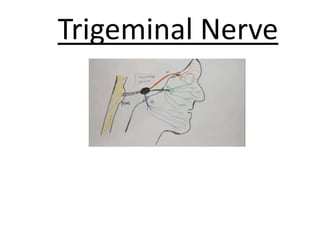
Trigeminal Nerve
Index
• Introduction
• Location
• Roots and Nuclei
• Divisions
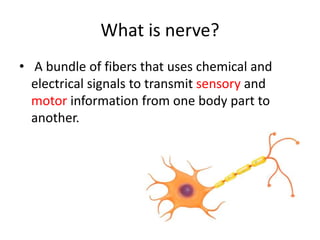
What is nerve?
• A bundle of fibers that uses chemical and
electrical signals to transmit sensory and
motor information from one body part to
another.
What are Sensory or Motor fibers?
Or
What are Afferent or Efferent fibers?
Sensory/Afferent
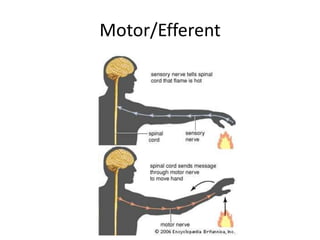
Motor/Efferent
• Sensory fibers as the name suggests carry all
the senses.
• While Motor fibers brings about movement.
M- Motor.
M- Movement.
Trigeminal Nerve
• It is the largest cranial nerve.
• Contains both Sensory and Motor fibers
(mixed).
• Has two roots: Sensory and Motor.
• General Somatic Afferent fibers:
Proprioceptive and Exteroceptive impulses.
• Special Visceral Efferent fibers:
Afferent fibers constitute Sensory root while
Efferent fibers form the smaller Motor root.
Where it is located?
Roots of Trigeminal Nerve
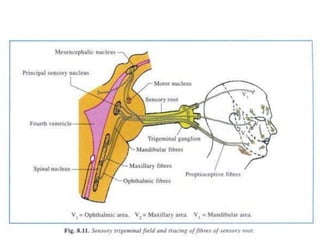
• Sensory Root.
• Motor Root.
• Mesencephalic Root.
What is Ganglion?
• It is a structure containing a number of nerve
cell bodies, typically linked by synapses, and
often forming a swelling on a nerve fiber.
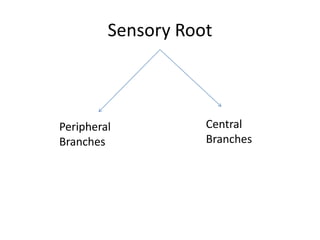
Sensory Root
Peripheral
Branches
Central
Branches
Motor Root
• Contains the fibers that have their origin in
the motor nucleus located in the upper pons.
• Passes through the foramen ovale to join
mandibular nerve.
• It is often called as the Masticator Nerve.
Mesencephalic Root
• Consists of the afferent fibers that accompany
the motor root.
• Serves as the afferent station that receives
proprioceptive impulses from the
temperomandibular joint, periodontal
membrane, maxillary and mandibular teeth
and hard palate.
• It also receives afferent impulses from stretch
receptors in the muscles of mastication. These
fibers are concerned with perfect
synchronization in controlling the biting force
of the jaw.
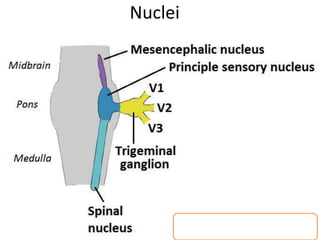
Nuclei
• 4 Nuclei: 3 Sensory
1 Motor
• Sensory Nuclei: 1. Mesencephalic Nucleus
2. Principle Pontine Nucleus
3. Spinal Nucleus
Nuclei
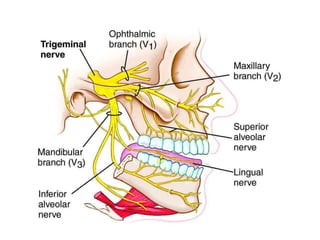
Divisions
1. The Opthalmic Nerve (V 1)
2. The Maxillary Nerve (V 2)
3. The Mandibular Nerve (V 3)
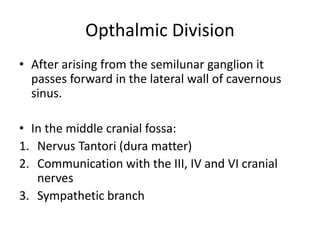
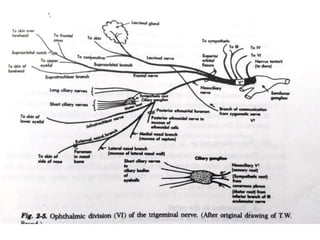
Opthalmic Division
• After arising from the semilunar ganglion it
passes forward in the lateral wall of cavernous
sinus.
• In the middle cranial fossa:
1. Nervus Tantori (dura matter)
2. Communication with the III, IV and VI cranial
nerves
3. Sympathetic branch
After exiting Middle Cranial Fossa and
Cavernous Sinus:
1. Lacrimal Nerve (smallest branch)
2. Frontal Nerve (largest branch)
3. Nasocilliary Nerve.
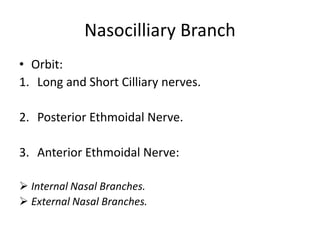
Nasocilliary Branch
• Orbit:
1. Long and Short Cilliary nerves.
2. Posterior Ethmoidal Nerve.
3. Anterior Ethmoidal Nerve:
 Internal Nasal Branches.
 External Nasal Branches.
• Branches arising in the nasal cavity:
 Supplies the lining mucosa of nasal cavity.
• Terminal Branch:
 Infratrochlear Nerve supplying skin of lower eyelid,
lacrimal sac and lacrimal caruncle.
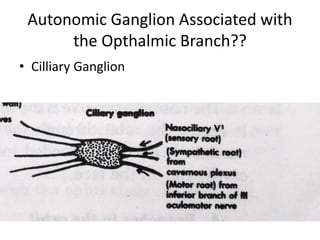
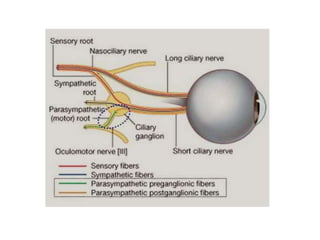
Autonomic Ganglion Associated with
the Opthalmic Branch??
• Cilliary Ganglion
Maxillary Division
Journey:
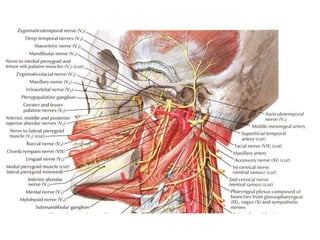
• Arises from the middle part of the semilunar
ganglion Continues in the lower part of
the cavernous sinus Leaves the middle
cranial fossa through Foramen Rotundum to
enter Pterygopalatine fossa Goes into
orbital cavity through Inferior Orbital Fissure
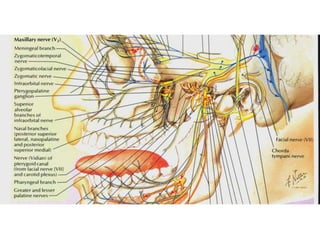
Journey Continues-
• turns laterally onto a groove in the
orbital surface of maxilla, called Infraorbital
Groove Emerges on the anterior surface
of maxilla through Infra-orbital Foramen.
Branches
• Middle Cranial Fossa
• Pterygopalatine Fossa
• Infraorbital Groove and Canal
• Terminal Branches on the face.
 Middle Cranial Fossa:
Middle Meningeal Nerve.
 Pterygopalatine Fossa:
Zygomatic Nerve.
Pterygopalatine Nerves.
Posterior Superior Alveolar Nerve.
 Infraorbital Groove and Canal:
Middle Superior Alveolar Nerve
Anterior Superior Alveolar Nerve.
 Terminal Branches on Face:
Inferior Palebral.
External Nasal.
Superior Labial.
Autonomic Ganglion of Maxillary
Division:
Mandibular Division
• Largest of three divisions.
• Formed by union of sensory and motor fibers.
• Sensory fibers are the peripheral branches
from the Semilunar Ganglion while Motor
fibers arise from the Motor nucleus in the
Pons.
Branches
• Undivided Nerve (Main trunk):
Nervus Spinosus
Nerve to Internal Pterygoid Tensor
tympani, Tensor veli palatini.
• Divided Nerve:
Anterior Division
Posterior Division.
Anterior Division
• Branch to external pterygoid muscle.
• Branch to masseter muscle.
• Branches to temporal muscles:
 Anterior and Posterior Deep Temporal Muscles
• Long Buccal Nerve
Posterior Division
• Auriculotemporal Nerve
 Communicating Branches.
 Parotid branches.
 Articular branches.
 Auricular branches.
 Terminal branches.
• Lingual Nerve
• Inferior Alveolar Nerve:
 Mental Branch.
 Incisive Branch
 Mylohyoid Branch
Trigeminal nerve
Trigeminal nerve

Trigeminal nerve

  • 1.
  • 2.
    Index • Introduction • Location •Roots and Nuclei • Divisions
  • 3.
    What is nerve? •A bundle of fibers that uses chemical and electrical signals to transmit sensory and motor information from one body part to another.
  • 4.
    What are Sensoryor Motor fibers? Or What are Afferent or Efferent fibers?
  • 5.
  • 6.
  • 7.
    • Sensory fibersas the name suggests carry all the senses. • While Motor fibers brings about movement. M- Motor. M- Movement.
  • 8.
    Trigeminal Nerve • Itis the largest cranial nerve. • Contains both Sensory and Motor fibers (mixed). • Has two roots: Sensory and Motor.
  • 10.
    • General SomaticAfferent fibers: Proprioceptive and Exteroceptive impulses. • Special Visceral Efferent fibers: Afferent fibers constitute Sensory root while Efferent fibers form the smaller Motor root.
  • 11.
    Where it islocated?
  • 14.
    Roots of TrigeminalNerve • Sensory Root. • Motor Root. • Mesencephalic Root.
  • 16.
    What is Ganglion? •It is a structure containing a number of nerve cell bodies, typically linked by synapses, and often forming a swelling on a nerve fiber.
  • 18.
  • 19.
    Motor Root • Containsthe fibers that have their origin in the motor nucleus located in the upper pons. • Passes through the foramen ovale to join mandibular nerve. • It is often called as the Masticator Nerve.
  • 21.
    Mesencephalic Root • Consistsof the afferent fibers that accompany the motor root. • Serves as the afferent station that receives proprioceptive impulses from the temperomandibular joint, periodontal membrane, maxillary and mandibular teeth and hard palate.
  • 22.
    • It alsoreceives afferent impulses from stretch receptors in the muscles of mastication. These fibers are concerned with perfect synchronization in controlling the biting force of the jaw.
  • 23.
    Nuclei • 4 Nuclei:3 Sensory 1 Motor • Sensory Nuclei: 1. Mesencephalic Nucleus 2. Principle Pontine Nucleus 3. Spinal Nucleus
  • 24.
  • 25.
    Divisions 1. The OpthalmicNerve (V 1) 2. The Maxillary Nerve (V 2) 3. The Mandibular Nerve (V 3)
  • 28.
    Opthalmic Division • Afterarising from the semilunar ganglion it passes forward in the lateral wall of cavernous sinus. • In the middle cranial fossa: 1. Nervus Tantori (dura matter) 2. Communication with the III, IV and VI cranial nerves 3. Sympathetic branch
  • 29.
    After exiting MiddleCranial Fossa and Cavernous Sinus: 1. Lacrimal Nerve (smallest branch) 2. Frontal Nerve (largest branch) 3. Nasocilliary Nerve.
  • 30.
    Nasocilliary Branch • Orbit: 1.Long and Short Cilliary nerves. 2. Posterior Ethmoidal Nerve. 3. Anterior Ethmoidal Nerve:  Internal Nasal Branches.  External Nasal Branches.
  • 31.
    • Branches arisingin the nasal cavity:  Supplies the lining mucosa of nasal cavity. • Terminal Branch:  Infratrochlear Nerve supplying skin of lower eyelid, lacrimal sac and lacrimal caruncle.
  • 34.
    Autonomic Ganglion Associatedwith the Opthalmic Branch?? • Cilliary Ganglion
  • 36.
    Maxillary Division Journey: • Arisesfrom the middle part of the semilunar ganglion Continues in the lower part of the cavernous sinus Leaves the middle cranial fossa through Foramen Rotundum to enter Pterygopalatine fossa Goes into orbital cavity through Inferior Orbital Fissure
  • 37.
    Journey Continues- • turnslaterally onto a groove in the orbital surface of maxilla, called Infraorbital Groove Emerges on the anterior surface of maxilla through Infra-orbital Foramen.
  • 38.
    Branches • Middle CranialFossa • Pterygopalatine Fossa • Infraorbital Groove and Canal • Terminal Branches on the face.
  • 41.
     Middle CranialFossa: Middle Meningeal Nerve.  Pterygopalatine Fossa: Zygomatic Nerve. Pterygopalatine Nerves. Posterior Superior Alveolar Nerve.
  • 42.
     Infraorbital Grooveand Canal: Middle Superior Alveolar Nerve Anterior Superior Alveolar Nerve.  Terminal Branches on Face: Inferior Palebral. External Nasal. Superior Labial.
  • 43.
    Autonomic Ganglion ofMaxillary Division:
  • 44.
    Mandibular Division • Largestof three divisions. • Formed by union of sensory and motor fibers. • Sensory fibers are the peripheral branches from the Semilunar Ganglion while Motor fibers arise from the Motor nucleus in the Pons.
  • 45.
    Branches • Undivided Nerve(Main trunk): Nervus Spinosus Nerve to Internal Pterygoid Tensor tympani, Tensor veli palatini. • Divided Nerve: Anterior Division Posterior Division.
  • 46.
    Anterior Division • Branchto external pterygoid muscle. • Branch to masseter muscle. • Branches to temporal muscles:  Anterior and Posterior Deep Temporal Muscles • Long Buccal Nerve
  • 47.
    Posterior Division • AuriculotemporalNerve  Communicating Branches.  Parotid branches.  Articular branches.  Auricular branches.  Terminal branches. • Lingual Nerve
  • 48.
    • Inferior AlveolarNerve:  Mental Branch.  Incisive Branch  Mylohyoid Branch