1
Contents
2
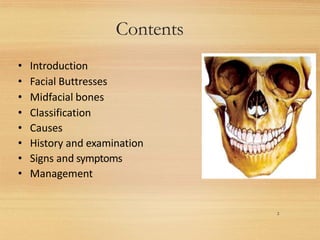
• Introduction
• Facial Buttresses
• Midfacial bones
• Classification
• Causes
• History and examination
• Signs and symptoms
• Management
Introduction
3
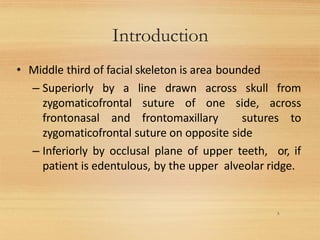
• Middle third of facial skeleton is area bounded
– Superiorly by a line drawn across skull from
zygomaticofrontal suture of one side, across
frontonasal and frontomaxillary sutures to
zygomaticofrontal suture on opposite side
– Inferiorly by occlusal plane of upper teeth, or, if
patient is edentulous, by the upper alveolar ridge.
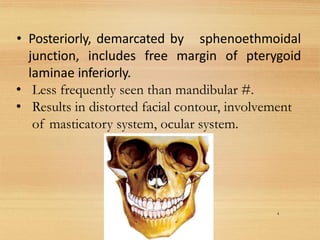
• Posteriorly, demarcated by sphenoethmoidal
junction, includes free margin of pterygoid
laminae inferiorly.
• Less frequently seen than mandibular #.
• Results in distorted facial contour, involvement
of masticatory system, ocular system.
4
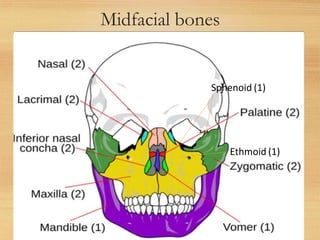
Midfacial bones
5
Sphenoid (1)
Ethmoid (1)
Facial buttresses
6
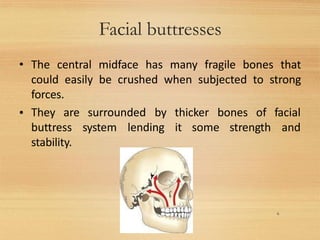
• The central midface has many fragile bones that
could easily be crushed when subjected to strong
forces.
• They are surrounded by thicker bones of facial
buttress system lending it some strength and
stability.
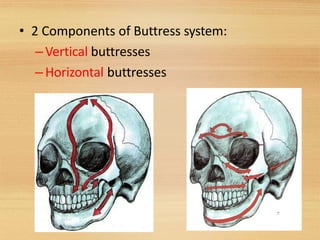
• 2 Components of Buttress system:
–Vertical buttresses
–Horizontal buttresses
7
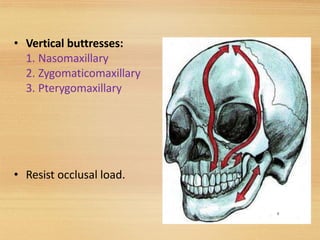
• Vertical buttresses:
1. Nasomaxillary
2. Zygomaticomaxillary
3. Pterygomaxillary
• Resist occlusal load.
8
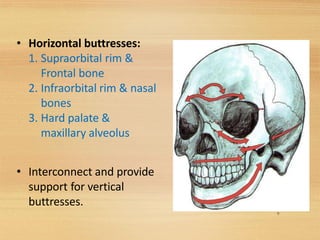
• Horizontal buttresses:
1. Supraorbital rim &
Frontal bone
2. Infraorbital rim & nasal
bones
3. Hard palate &
maxillary alveolus
• Interconnect and provide
support for vertical
buttresses.
9
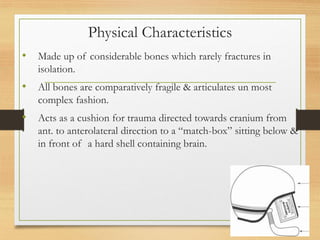
Physical Characteristics
• Made up of considerable bones which rarely fractures in
isolation.
• All bones are comparatively fragile & articulates un most
complex fashion.
• Acts as a cushion for trauma directed towards cranium from
ant. to anterolateral direction to a “match-box” sitting below &
in front of a hard shell containing brain.
10
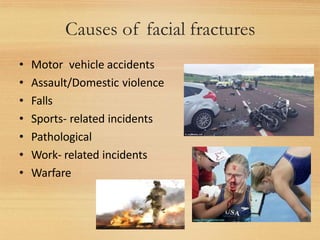
Causes of facial fractures
11
• Motor vehicle accidents
• Assault/Domestic violence
• Falls
• Sports- related incidents
• Pathological
• Work- related incidents
• Warfare
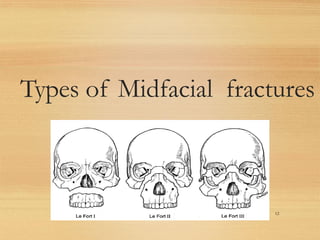
Types of Midfacial fractures
12
Classifications
13
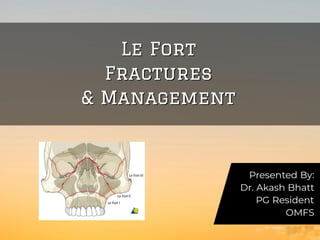
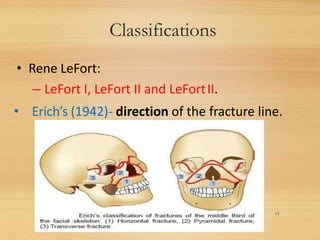
• Rene LeFort:
– LeFort I, LeFort II and LeFortII.
• Erich’s (1942)- direction of the fracture line.
14
• Based on relationship of the fracture line to
the zygomatic bone -
–Subzygomatic fractures
–Suprazygomatic fracture
• Based on level of a fracture line
–Low level fracture
–Mid level fracture
–High level fracture
• Rowe’s & William (1985)
• A. Not involving Occlusion
➢ Central Region
▪ # of nasal bone/septum – Lateral/ Anterior nasal injuries
▪ # of frontal process of maxilla
▪ # extends to the ethmoid bone involving or not involving occlusion.
▪ # extends to the frontal bone involving or not involving occlusion.
➢ Lateral Region
▪ # involving zygomatic bone, arch& maxilla excluding dentoalveolar
segment.
• B. Fractures involving occlusion
• Dentoalveolar
• Subzygomatic
• Suprazygomatic
15
Marciani Modification (1993)
• Le Fort I : Low Maxillary fracture
• Le Fort Ia : Low Maxillary fracture/ multiple segments.
• Le Fort II : Pyramidal fractures
• Le Fort IIa :Pyramidal fractures+ Nasal Fractures
• Le Fort IIb :Pyramidal fractures+ NOE Fractures
• Le Fort III : Craniofacial dysjunction
• Le Fort IIIa: Craniofacial dysjunction + Nasal Fractures
• Le Fort IIIb: Craniofacial dysjunction + NOE Fractures
• Le Fort IV : Le Fort II & III + Cranial base fracture
• Le Fort IVa: Le Fort II & III + Cranial base # + Supraorbital rim #
• Le Fort IVb: Le Fort II & III + Cranial base # + Ant. Cranial base #
• Le Fort IVc: Le Fort II & III + Cranial base # + Ant. Cranial fossa
& Orbital Wall #
16
LeFort I fracture
17
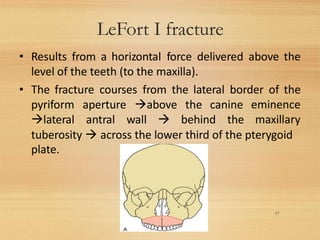
• Results from a horizontal force delivered above the
level of the teeth (to the maxilla).
• The fracture courses from the lateral border of the
pyriform aperture →above the canine
→lateral antral wall → behind the
eminence
maxillary
tuberosity → across the lower third of the pterygoid
plate.
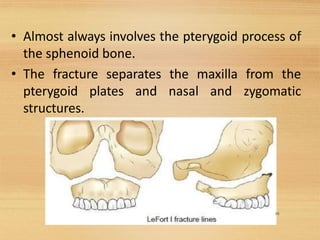
• Almost always involves the pterygoid process of
the sphenoid bone.
• The fracture separates the maxilla from the
pterygoid plates and nasal and zygomatic
structures.
18
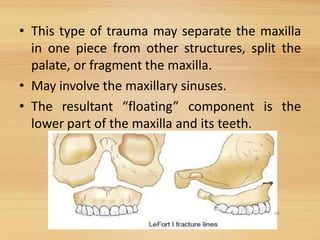
• This type of trauma may separate the maxilla
in one piece from other structures, split the
palate, or fragment the maxilla.
• May involve the maxillary sinuses.
• The resultant “floating” component is the
lower part of the maxilla and its teeth.
19
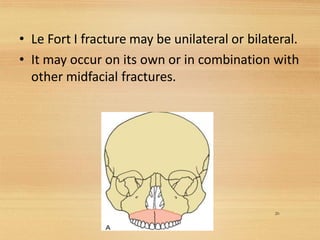
• Le Fort I fracture may be unilateral or bilateral.
• It may occur on its own or in combination with
other midfacial fractures.
20
Clinical signs & symptoms:
21
• Swelling of the upper lip and lower part of face.
• Ecchymosis in labial & buccal vestibule.
• Laceration of upper lip & mucosa.
• Bilateral epistaxis.
• Mobility of upper dentoalveolar segment.
• Malocclusion.
• Pain in speaking & moving the jaw.
• Upward displacement of entire fragment – Telescopic #
• Classic ant. Open bite.
• Percussion of maxi. teeth: Dull Cracked cup sound.
LeFort II
fracture
22
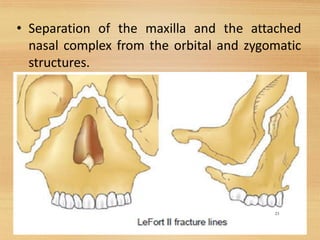
• Results from a force delivered at a level of the
nasal bones in superior direction.
• The fracture line occurs along the nasofrontal
suture
orbital
→ lacrimal bone → across the infra-
rim in the region of the zygomatico-
maxillary suture → above the canine eminence
→ inferiorly and distally along the lateral antral
wall, but at a higher level than Le Fort type I →
across the pterygoid plate at its middle.
• Separation of the maxilla and the attached
nasal complex from the orbital and zygomatic
structures.
23
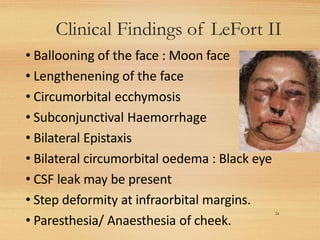
Clinical Findings of LeFort II
24
• Ballooning of the face : Moon face
• Lengthenening of the face
• Circumorbital ecchymosis
• Subconjunctival Haemorrhage
• Bilateral Epistaxis
• Bilateral circumorbital oedema : Black eye
• CSF leak may be present
• Step deformity at infraorbital margins.
• Paresthesia/ Anaesthesia of cheek.
LeFort
III
25
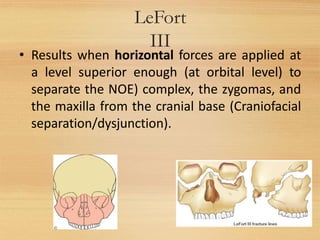
• Results when horizontal forces are applied at
a level superior enough (at orbital level) to
separate the NOE) complex, the zygomas, and
the maxilla from the cranial base (Craniofacial
separation/dysjunction).
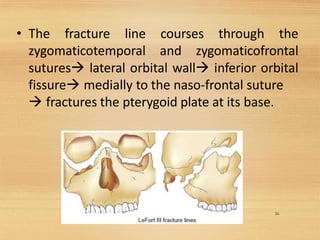
• The fracture line courses through the
zygomaticotemporal and zygomaticofrontal
sutures→ lateral orbital wall→ inferior orbital
fissure→ medially to the naso-frontal suture
→ fractures the pterygoid plate at its base.
26
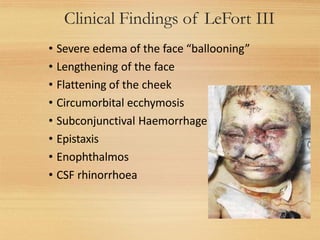
Clinical Findings of LeFort III
27
• Severe edema of the face “ballooning”
• Lengthening of the face
• Flattening of the cheek
• Circumorbital ecchymosis
• Subconjunctival Haemorrhage
• Epistaxis
• Enophthalmos
• CSF rhinorrhoea
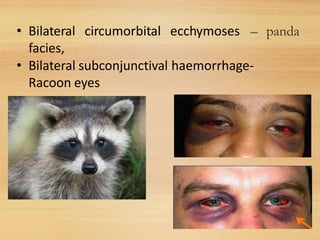
• Bilateral circumorbital ecchymoses
facies,
• Bilateral subconjunctival haemorrhage-
Racoon eyes
– panda
28
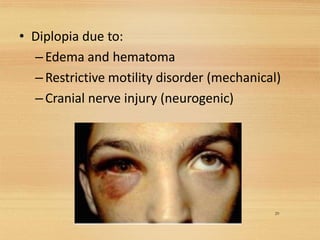
• Diplopia due to:
–Edema and hematoma
–Restrictive motility disorder (mechanical)
–Cranial nerve injury (neurogenic)
29
Radiographs needed
30
• Occipito-mental view (Water’s View)
• CT scan
–Axial scan
–Coronal scan
–Sagittal
–3 dimensional
Treatment for LeFort fractures
31
• First aid and Preliminary treatment
• Definitive treatment
–Reduction
–Immobilization
32
• The principles of definitive
LeFort fractures consist of
treatment of
reduction and
fixation of the fractured bones to one another
and to the skull
–achieved by either conservative or
operative methods.
33
• The sooner the treatment is carried out, the
better the prognosis.
• Restoration of the occlusion is a must.
• The bony framework and buttresses of the
midface must also be repositioned or restored
and fixed.
Methods of reduction for
LeFort fractures
34
• Manual reduction
– Simple manipulation by hand
– Dental compound on impression tray
– Gauze or rubber catheters
– Special instruments
• Reduction by traction
– Conservative treatment
– Supervised spontaneous healing
– Open reduction
Manual reduction
• Simple manipulation by hand is possible in fresh fractures,
maxilla is held between the index finger and thumb and brought
into normal occlusion.
• Another method is to fix two double wires encircling the first
and second maxillary molars and twisting them individually on
either sides.
35
36
• Both the twisted wire ends are held by means
of wire holders or hemostats and
simultaneously downward movement of the
maxilla will help to achieve the normal
occlusion.
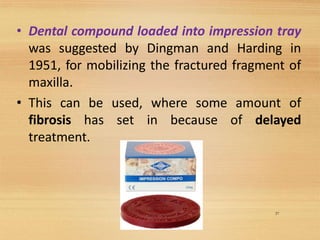
• Dental compound loaded into impression tray
was suggested by Dingman and Harding in
1951, for mobilizing the fractured fragment of
maxilla.
• This can be used, where some amount of
fibrosis has set in because of delayed
treatment.
37
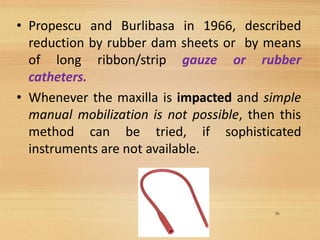
• Propescu and Burlibasa in 1966, described
reduction by rubber dam sheets or by means
of long ribbon/strip gauze or rubber
catheters.
• Whenever the maxilla is impacted and simple
manual mobilization is not possible, then this
method can be tried, if sophisticated
instruments are not available.
38
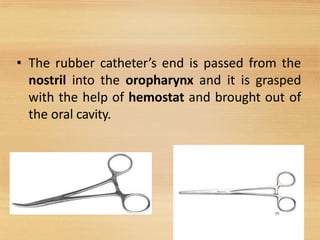
• The rubber catheter’s end is passed from the
nostril into the oropharynx and it is grasped
with the help of hemostat and brought out of
the oral cavity.
39
40
• So, you have one end coming out from nostril
and other end through the oral cavity, same
procedure is repeated on the other side
through the nostril.
• After grasping all four ends of the catheter
and stabilizing the head, maxilla can be
rocked into the normal occlusion.
41
• Reduction by using special instruments—
Specially constructed disimpaction forceps can
be used to take firm grasp of the maxilla and
reduce it into the position.
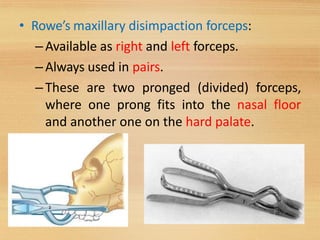
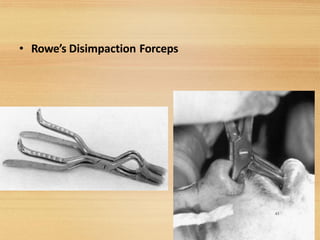
• Rowe’s maxillary disimpaction forceps:
–Available as right and left forceps.
–Always used in pairs.
–These are two pronged (divided) forceps,
where one prong fits into the nasal floor
and another one on the hard palate.
42
• Rowe’s Disimpaction Forceps
43
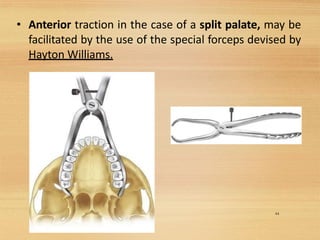
• Anterior traction in the case of a split palate, may be
facilitated by the use of the special forceps devised by
Hayton Williams.
44
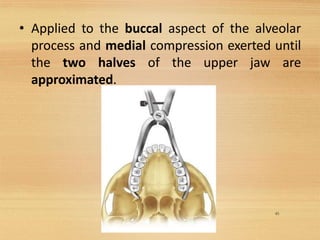
• Applied to the buccal aspect of the alveolar
process and medial compression exerted until
the two halves of the upper jaw are
approximated.
45
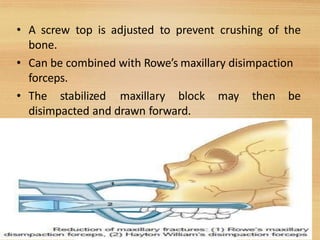
• A screw top is adjusted to prevent crushing of the
bone.
• Can be combined with Rowe’s maxillary disimpaction
forceps.
• The stabilized maxillary block may then be
disimpacted and drawn forward.
46
Reduction by traction
47
– Repositioning the fractures that are already
in a state of partial fusion OR when
attempted manual reduction is met with
failure, then reduction by elastic traction is
tried to interdigitate the fractured
fragments.
48
• Mainly used in delayed cases, where the
fracture is 10 to 14 days old and no longer
sufficiently mobile.
–Intraoral elastic traction.
–Extraoral elastic traction with appropriate
extension bars and side bars.
• Intraoral intermaxillary elastic traction may be
used in an appropriate direction to restore
normal occlusion then replaced by IMF.
49
• Conservative Treatment
–Reduction and fixation of the fractured
midface is indicated in cases, where surgery
is not possible due to poor general
condition of the patient or where there is
extensive comminution with tissue loss,
making internal skeletal fixation impossible.
–Also used as a supplementary measure with
the surgical treatment of midfacial fracture.
50
• Supervised Spontaneous Healing
–Where mobility at the fractured maxilla is
only slight, and occlusion is not disturbed.
–Progress of healing is merely supervised.
–The patient should avoid chewing during
the first 2 to 3 weeks and should take a
liquid/semisolid diet.
51
❖Monomaxillary fixation:
–Method used when tooth bearing section
of the maxilla is not fractured and therefore
can serve as fixation point.
–Arch bar or palatal acrylic plates can be
used.
–Can be used for unilateral fractures of
maxilla or higher fractures without occlusal
discrepancies.
–Maintained for 6 weeks.
52
❖Intermaxillary fixation (IMF):
❖Maintained for 3 to 4 weeks and at the end
of this period IMF wires and the lower arch
bars are removed.
53
❖Internal skeletal wire suspension:
❖Many times in addition to IMF, additional
support is required for immobilization of
the jaws.
❖Craniomaxillary or craniomandibular
suspension can be carried out using stable
point above fracture line.
❖Selection of site for suspension wire will be
dependent on the level of fracture line.
54
❖The procedure for internal skeletal wire
suspension is done through a minor surgery.
• Application of arch bars
• Reduction of fracture by closed method -
occlusion is checked
• Fixation of the midface to base of skull by
suspension wires.
55
• Fixation of the midface by tightening the
suspensory wires and intermaxillary
fixation.
• For edentulous patients, available
prosthesis or Gunning splint is used.
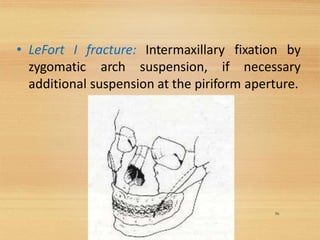
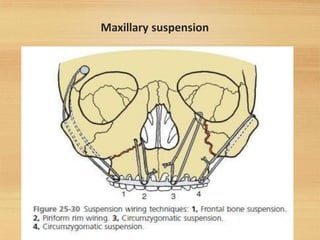
• LeFort I fracture: Intermaxillary fixation by
zygomatic arch suspension, if necessary
additional suspension at the piriform aperture.
56
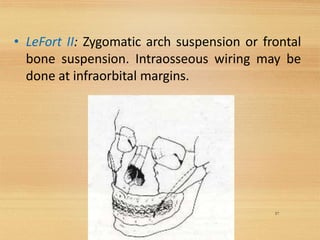
• LeFort II: Zygomatic arch suspension or frontal
bone suspension. Intraosseous wiring may be
done at infraorbital margins.
57
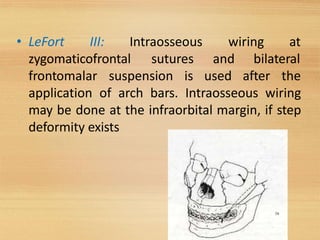
• LeFort III: Intraosseous wiring at
zygomaticofrontal sutures
frontomalar suspension is
and bilateral
used after the
application of arch bars. Intraosseous wiring
may be done at the infraorbital margin, if step
deformity exists
58
Maxillary suspension
59
60
• Open Reduction
– Carried out under endotracheal anesthesia with
nasal intubation.
– Intraoral vestibular incision is taken from first
molar to first molar region on either side.
– Mucoperiosteal flap is reflected to expose the
fracture line.
– After identifying the fracture line, in old fractures,
an osteotome is inserted to mobilize the fragment.
61
– Disimpaction forceps can be used and the
fragment is brought into normal occlusion by
manipulation.
carried out and fracture– Temporary IMF is
fragments are fixed under direct vision by
intraosseous wiring or minibone plates with
screws.
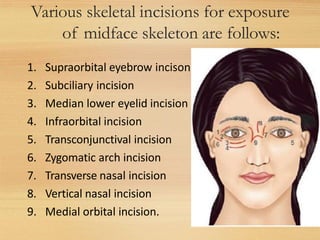
Various skeletal incisions for exposure
of midface skeleton are follows:
62
1. Supraorbital eyebrow incison
2. Subciliary incision
3. Median lower eyelid incision
4. Infraorbital incision
5. Transconjunctival incision
6. Zygomatic arch incision
7. Transverse nasal incision
8. Vertical nasal incision
9. Medial orbital incision.
Treatment protocol Le Fort I
• Undisplaced Le Fort I with minimal occlusal discrepancy-
Simple MMF -4 wks or direct fixation with no MMF.
• Displaced Mobile Le Fort I with ant. Open bite – Direct
fixation or indirect suspension with MMF.
• Communited # not treated with plate or wire fixation -
MMF & suspension.
• Edentulous patient- Same treatment but intraosseous fixation
not feasible, a custom acrylic occlusal splint made & MMF is done.
63
Treatment protocol Le Fort II
• Undisplaced Le Fort II with minimal occlusal discrepancy -
Circumzygomatic suspension + MMF- 4 wks or direct fixation at
zygomaticomaxillary buttress.
• Displaced mobile Le Fort II with Ant. Open bite – Direct/ Indirect
fixation with MMF.
• Communited # not amenable to plate/wire – MMF.
64
References
65
• Contemporary Oral and Maxillofacial Surgery 6th
Edition – Hupp, James (Chapter 25 Management of
facial fractures)
• Maxillofacial injuries – A synopsis of Basic Principles,
Diagnosis and Management - George Dimitroulis,
Brian Avery (Chapter 6 ).
• https://sites.google.com/site/drtbalusotolaryngology
/rhinology/buttress-system-of-midface ‘Buttress
system of midface’. Accessed on 14.2.2016.
• Textbook of Oral and Maxillofacial Surgery 3rd Edition
– Neelima Anil Malik (Chapter 29 + 30).
66
Thanks

Le Fort Fractures

  • 1.
  • 2.
    Contents 2 • Introduction • FacialButtresses • Midfacial bones • Classification • Causes • History and examination • Signs and symptoms • Management
  • 3.
    Introduction 3 • Middle thirdof facial skeleton is area bounded – Superiorly by a line drawn across skull from zygomaticofrontal suture of one side, across frontonasal and frontomaxillary sutures to zygomaticofrontal suture on opposite side – Inferiorly by occlusal plane of upper teeth, or, if patient is edentulous, by the upper alveolar ridge.
  • 4.
    • Posteriorly, demarcatedby sphenoethmoidal junction, includes free margin of pterygoid laminae inferiorly. • Less frequently seen than mandibular #. • Results in distorted facial contour, involvement of masticatory system, ocular system. 4
  • 5.
  • 6.
    Facial buttresses 6 • Thecentral midface has many fragile bones that could easily be crushed when subjected to strong forces. • They are surrounded by thicker bones of facial buttress system lending it some strength and stability.
  • 7.
    • 2 Componentsof Buttress system: –Vertical buttresses –Horizontal buttresses 7
  • 8.
    • Vertical buttresses: 1.Nasomaxillary 2. Zygomaticomaxillary 3. Pterygomaxillary • Resist occlusal load. 8
  • 9.
    • Horizontal buttresses: 1.Supraorbital rim & Frontal bone 2. Infraorbital rim & nasal bones 3. Hard palate & maxillary alveolus • Interconnect and provide support for vertical buttresses. 9
  • 10.
    Physical Characteristics • Madeup of considerable bones which rarely fractures in isolation. • All bones are comparatively fragile & articulates un most complex fashion. • Acts as a cushion for trauma directed towards cranium from ant. to anterolateral direction to a “match-box” sitting below & in front of a hard shell containing brain. 10
  • 11.
    Causes of facialfractures 11 • Motor vehicle accidents • Assault/Domestic violence • Falls • Sports- related incidents • Pathological • Work- related incidents • Warfare
  • 12.
    Types of Midfacialfractures 12
  • 13.
    Classifications 13 • Rene LeFort: –LeFort I, LeFort II and LeFortII. • Erich’s (1942)- direction of the fracture line.
  • 14.
    14 • Based onrelationship of the fracture line to the zygomatic bone - –Subzygomatic fractures –Suprazygomatic fracture • Based on level of a fracture line –Low level fracture –Mid level fracture –High level fracture
  • 15.
    • Rowe’s &William (1985) • A. Not involving Occlusion ➢ Central Region ▪ # of nasal bone/septum – Lateral/ Anterior nasal injuries ▪ # of frontal process of maxilla ▪ # extends to the ethmoid bone involving or not involving occlusion. ▪ # extends to the frontal bone involving or not involving occlusion. ➢ Lateral Region ▪ # involving zygomatic bone, arch& maxilla excluding dentoalveolar segment. • B. Fractures involving occlusion • Dentoalveolar • Subzygomatic • Suprazygomatic 15
  • 16.
    Marciani Modification (1993) •Le Fort I : Low Maxillary fracture • Le Fort Ia : Low Maxillary fracture/ multiple segments. • Le Fort II : Pyramidal fractures • Le Fort IIa :Pyramidal fractures+ Nasal Fractures • Le Fort IIb :Pyramidal fractures+ NOE Fractures • Le Fort III : Craniofacial dysjunction • Le Fort IIIa: Craniofacial dysjunction + Nasal Fractures • Le Fort IIIb: Craniofacial dysjunction + NOE Fractures • Le Fort IV : Le Fort II & III + Cranial base fracture • Le Fort IVa: Le Fort II & III + Cranial base # + Supraorbital rim # • Le Fort IVb: Le Fort II & III + Cranial base # + Ant. Cranial base # • Le Fort IVc: Le Fort II & III + Cranial base # + Ant. Cranial fossa & Orbital Wall # 16
  • 17.
    LeFort I fracture 17 •Results from a horizontal force delivered above the level of the teeth (to the maxilla). • The fracture courses from the lateral border of the pyriform aperture →above the canine →lateral antral wall → behind the eminence maxillary tuberosity → across the lower third of the pterygoid plate.
  • 18.
    • Almost alwaysinvolves the pterygoid process of the sphenoid bone. • The fracture separates the maxilla from the pterygoid plates and nasal and zygomatic structures. 18
  • 19.
    • This typeof trauma may separate the maxilla in one piece from other structures, split the palate, or fragment the maxilla. • May involve the maxillary sinuses. • The resultant “floating” component is the lower part of the maxilla and its teeth. 19
  • 20.
    • Le FortI fracture may be unilateral or bilateral. • It may occur on its own or in combination with other midfacial fractures. 20
  • 21.
    Clinical signs &symptoms: 21 • Swelling of the upper lip and lower part of face. • Ecchymosis in labial & buccal vestibule. • Laceration of upper lip & mucosa. • Bilateral epistaxis. • Mobility of upper dentoalveolar segment. • Malocclusion. • Pain in speaking & moving the jaw. • Upward displacement of entire fragment – Telescopic # • Classic ant. Open bite. • Percussion of maxi. teeth: Dull Cracked cup sound.
  • 22.
    LeFort II fracture 22 • Resultsfrom a force delivered at a level of the nasal bones in superior direction. • The fracture line occurs along the nasofrontal suture orbital → lacrimal bone → across the infra- rim in the region of the zygomatico- maxillary suture → above the canine eminence → inferiorly and distally along the lateral antral wall, but at a higher level than Le Fort type I → across the pterygoid plate at its middle.
  • 23.
    • Separation ofthe maxilla and the attached nasal complex from the orbital and zygomatic structures. 23
  • 24.
    Clinical Findings ofLeFort II 24 • Ballooning of the face : Moon face • Lengthenening of the face • Circumorbital ecchymosis • Subconjunctival Haemorrhage • Bilateral Epistaxis • Bilateral circumorbital oedema : Black eye • CSF leak may be present • Step deformity at infraorbital margins. • Paresthesia/ Anaesthesia of cheek.
  • 25.
    LeFort III 25 • Results whenhorizontal forces are applied at a level superior enough (at orbital level) to separate the NOE) complex, the zygomas, and the maxilla from the cranial base (Craniofacial separation/dysjunction).
  • 26.
    • The fractureline courses through the zygomaticotemporal and zygomaticofrontal sutures→ lateral orbital wall→ inferior orbital fissure→ medially to the naso-frontal suture → fractures the pterygoid plate at its base. 26
  • 27.
    Clinical Findings ofLeFort III 27 • Severe edema of the face “ballooning” • Lengthening of the face • Flattening of the cheek • Circumorbital ecchymosis • Subconjunctival Haemorrhage • Epistaxis • Enophthalmos • CSF rhinorrhoea
  • 28.
    • Bilateral circumorbitalecchymoses facies, • Bilateral subconjunctival haemorrhage- Racoon eyes – panda 28
  • 29.
    • Diplopia dueto: –Edema and hematoma –Restrictive motility disorder (mechanical) –Cranial nerve injury (neurogenic) 29
  • 30.
    Radiographs needed 30 • Occipito-mentalview (Water’s View) • CT scan –Axial scan –Coronal scan –Sagittal –3 dimensional
  • 31.
    Treatment for LeFortfractures 31 • First aid and Preliminary treatment • Definitive treatment –Reduction –Immobilization
  • 32.
    32 • The principlesof definitive LeFort fractures consist of treatment of reduction and fixation of the fractured bones to one another and to the skull –achieved by either conservative or operative methods.
  • 33.
    33 • The soonerthe treatment is carried out, the better the prognosis. • Restoration of the occlusion is a must. • The bony framework and buttresses of the midface must also be repositioned or restored and fixed.
  • 34.
    Methods of reductionfor LeFort fractures 34 • Manual reduction – Simple manipulation by hand – Dental compound on impression tray – Gauze or rubber catheters – Special instruments • Reduction by traction – Conservative treatment – Supervised spontaneous healing – Open reduction
  • 35.
    Manual reduction • Simplemanipulation by hand is possible in fresh fractures, maxilla is held between the index finger and thumb and brought into normal occlusion. • Another method is to fix two double wires encircling the first and second maxillary molars and twisting them individually on either sides. 35
  • 36.
    36 • Both thetwisted wire ends are held by means of wire holders or hemostats and simultaneously downward movement of the maxilla will help to achieve the normal occlusion.
  • 37.
    • Dental compoundloaded into impression tray was suggested by Dingman and Harding in 1951, for mobilizing the fractured fragment of maxilla. • This can be used, where some amount of fibrosis has set in because of delayed treatment. 37
  • 38.
    • Propescu andBurlibasa in 1966, described reduction by rubber dam sheets or by means of long ribbon/strip gauze or rubber catheters. • Whenever the maxilla is impacted and simple manual mobilization is not possible, then this method can be tried, if sophisticated instruments are not available. 38
  • 39.
    • The rubbercatheter’s end is passed from the nostril into the oropharynx and it is grasped with the help of hemostat and brought out of the oral cavity. 39
  • 40.
    40 • So, youhave one end coming out from nostril and other end through the oral cavity, same procedure is repeated on the other side through the nostril. • After grasping all four ends of the catheter and stabilizing the head, maxilla can be rocked into the normal occlusion.
  • 41.
    41 • Reduction byusing special instruments— Specially constructed disimpaction forceps can be used to take firm grasp of the maxilla and reduce it into the position.
  • 42.
    • Rowe’s maxillarydisimpaction forceps: –Available as right and left forceps. –Always used in pairs. –These are two pronged (divided) forceps, where one prong fits into the nasal floor and another one on the hard palate. 42
  • 43.
  • 44.
    • Anterior tractionin the case of a split palate, may be facilitated by the use of the special forceps devised by Hayton Williams. 44
  • 45.
    • Applied tothe buccal aspect of the alveolar process and medial compression exerted until the two halves of the upper jaw are approximated. 45
  • 46.
    • A screwtop is adjusted to prevent crushing of the bone. • Can be combined with Rowe’s maxillary disimpaction forceps. • The stabilized maxillary block may then be disimpacted and drawn forward. 46
  • 47.
    Reduction by traction 47 –Repositioning the fractures that are already in a state of partial fusion OR when attempted manual reduction is met with failure, then reduction by elastic traction is tried to interdigitate the fractured fragments.
  • 48.
    48 • Mainly usedin delayed cases, where the fracture is 10 to 14 days old and no longer sufficiently mobile. –Intraoral elastic traction. –Extraoral elastic traction with appropriate extension bars and side bars. • Intraoral intermaxillary elastic traction may be used in an appropriate direction to restore normal occlusion then replaced by IMF.
  • 49.
    49 • Conservative Treatment –Reductionand fixation of the fractured midface is indicated in cases, where surgery is not possible due to poor general condition of the patient or where there is extensive comminution with tissue loss, making internal skeletal fixation impossible. –Also used as a supplementary measure with the surgical treatment of midfacial fracture.
  • 50.
    50 • Supervised SpontaneousHealing –Where mobility at the fractured maxilla is only slight, and occlusion is not disturbed. –Progress of healing is merely supervised. –The patient should avoid chewing during the first 2 to 3 weeks and should take a liquid/semisolid diet.
  • 51.
    51 ❖Monomaxillary fixation: –Method usedwhen tooth bearing section of the maxilla is not fractured and therefore can serve as fixation point. –Arch bar or palatal acrylic plates can be used. –Can be used for unilateral fractures of maxilla or higher fractures without occlusal discrepancies. –Maintained for 6 weeks.
  • 52.
    52 ❖Intermaxillary fixation (IMF): ❖Maintainedfor 3 to 4 weeks and at the end of this period IMF wires and the lower arch bars are removed.
  • 53.
    53 ❖Internal skeletal wiresuspension: ❖Many times in addition to IMF, additional support is required for immobilization of the jaws. ❖Craniomaxillary or craniomandibular suspension can be carried out using stable point above fracture line. ❖Selection of site for suspension wire will be dependent on the level of fracture line.
  • 54.
    54 ❖The procedure forinternal skeletal wire suspension is done through a minor surgery. • Application of arch bars • Reduction of fracture by closed method - occlusion is checked • Fixation of the midface to base of skull by suspension wires.
  • 55.
    55 • Fixation ofthe midface by tightening the suspensory wires and intermaxillary fixation. • For edentulous patients, available prosthesis or Gunning splint is used.
  • 56.
    • LeFort Ifracture: Intermaxillary fixation by zygomatic arch suspension, if necessary additional suspension at the piriform aperture. 56
  • 57.
    • LeFort II:Zygomatic arch suspension or frontal bone suspension. Intraosseous wiring may be done at infraorbital margins. 57
  • 58.
    • LeFort III:Intraosseous wiring at zygomaticofrontal sutures frontomalar suspension is and bilateral used after the application of arch bars. Intraosseous wiring may be done at the infraorbital margin, if step deformity exists 58
  • 59.
  • 60.
    60 • Open Reduction –Carried out under endotracheal anesthesia with nasal intubation. – Intraoral vestibular incision is taken from first molar to first molar region on either side. – Mucoperiosteal flap is reflected to expose the fracture line. – After identifying the fracture line, in old fractures, an osteotome is inserted to mobilize the fragment.
  • 61.
    61 – Disimpaction forcepscan be used and the fragment is brought into normal occlusion by manipulation. carried out and fracture– Temporary IMF is fragments are fixed under direct vision by intraosseous wiring or minibone plates with screws.
  • 62.
    Various skeletal incisionsfor exposure of midface skeleton are follows: 62 1. Supraorbital eyebrow incison 2. Subciliary incision 3. Median lower eyelid incision 4. Infraorbital incision 5. Transconjunctival incision 6. Zygomatic arch incision 7. Transverse nasal incision 8. Vertical nasal incision 9. Medial orbital incision.
  • 63.
    Treatment protocol LeFort I • Undisplaced Le Fort I with minimal occlusal discrepancy- Simple MMF -4 wks or direct fixation with no MMF. • Displaced Mobile Le Fort I with ant. Open bite – Direct fixation or indirect suspension with MMF. • Communited # not treated with plate or wire fixation - MMF & suspension. • Edentulous patient- Same treatment but intraosseous fixation not feasible, a custom acrylic occlusal splint made & MMF is done. 63
  • 64.
    Treatment protocol LeFort II • Undisplaced Le Fort II with minimal occlusal discrepancy - Circumzygomatic suspension + MMF- 4 wks or direct fixation at zygomaticomaxillary buttress. • Displaced mobile Le Fort II with Ant. Open bite – Direct/ Indirect fixation with MMF. • Communited # not amenable to plate/wire – MMF. 64
  • 65.
    References 65 • Contemporary Oraland Maxillofacial Surgery 6th Edition – Hupp, James (Chapter 25 Management of facial fractures) • Maxillofacial injuries – A synopsis of Basic Principles, Diagnosis and Management - George Dimitroulis, Brian Avery (Chapter 6 ). • https://sites.google.com/site/drtbalusotolaryngology /rhinology/buttress-system-of-midface ‘Buttress system of midface’. Accessed on 14.2.2016. • Textbook of Oral and Maxillofacial Surgery 3rd Edition – Neelima Anil Malik (Chapter 29 + 30).
  • 66.