DR DAVIS NADAKKAVUKARAN
READER MALABAR DENTAL COLLEGE
 Introduction
 Classification
 Investigations
 Etiology
 Clinical examination
 Principles of treatment
 Treatment
 Complications
 Condylar fractures constitute 26-40 % of all mandibular
fractures
 Fracture of the condyle can cause significant pain and
limitation of jaw movement ,thus restricting important
functions of mastication
 This injury should be recognized early and treated promptly
to minimize discomfort to the patient
 Fractures of the condyle may results from similar cause of
other mandibular fractures such as vehicle accidents, fall or
assaults
 The fracture of the condyle may be associated with other
injuries such as facial nerve injury, cervical spine injury,
damage to middle cranial fossa and injuries to the external
auditory canal
 It is thus necessary to remember the important anatomical
structures surrounding the joint
 Incidence :- unilateral fracture of the condyle occurs at least 3
times more frequently than bilateral condylar fractures
 Bilateral fractures of the condyle are also not uncommon
 Arterial supply of the condylar region:-
 The blood supply of the condyle is largely from the
attachement of the lateral pterygoid muscle and from arteries
such as deep temporal artery, posterior tympanic artery,
superficial temporal artery and the transverse facial artery
 It is important to know the arterial supply of the condyle
when performing surgery in this region
 Unilateral and bilateral fractures
 Intracapsular fractures and extracapsular fractures
 Simple, compound or comminuted fractures of the condyle
 Lindhal’s classification
Based on anatomic location of the fracture(level of condylar
fracture)
 Condylar head
 Condylar neck
 Subcondylar
Based on the relationship of the condylar segment to the
mandibular fragment
 Non displaced
 Deviated
 Dispaced with medial or lateral overlap
 Displacement with anterior or posterior overlap
 No contact between the fracture segments
Based on the relationship between the condylar head and the
glenoid fossa
 Non displaced
 Displacement
 Dislocation
MacLennan system
 Non displaced
 Frcture deviation
 Fracture displacement
 Fracture dislocation
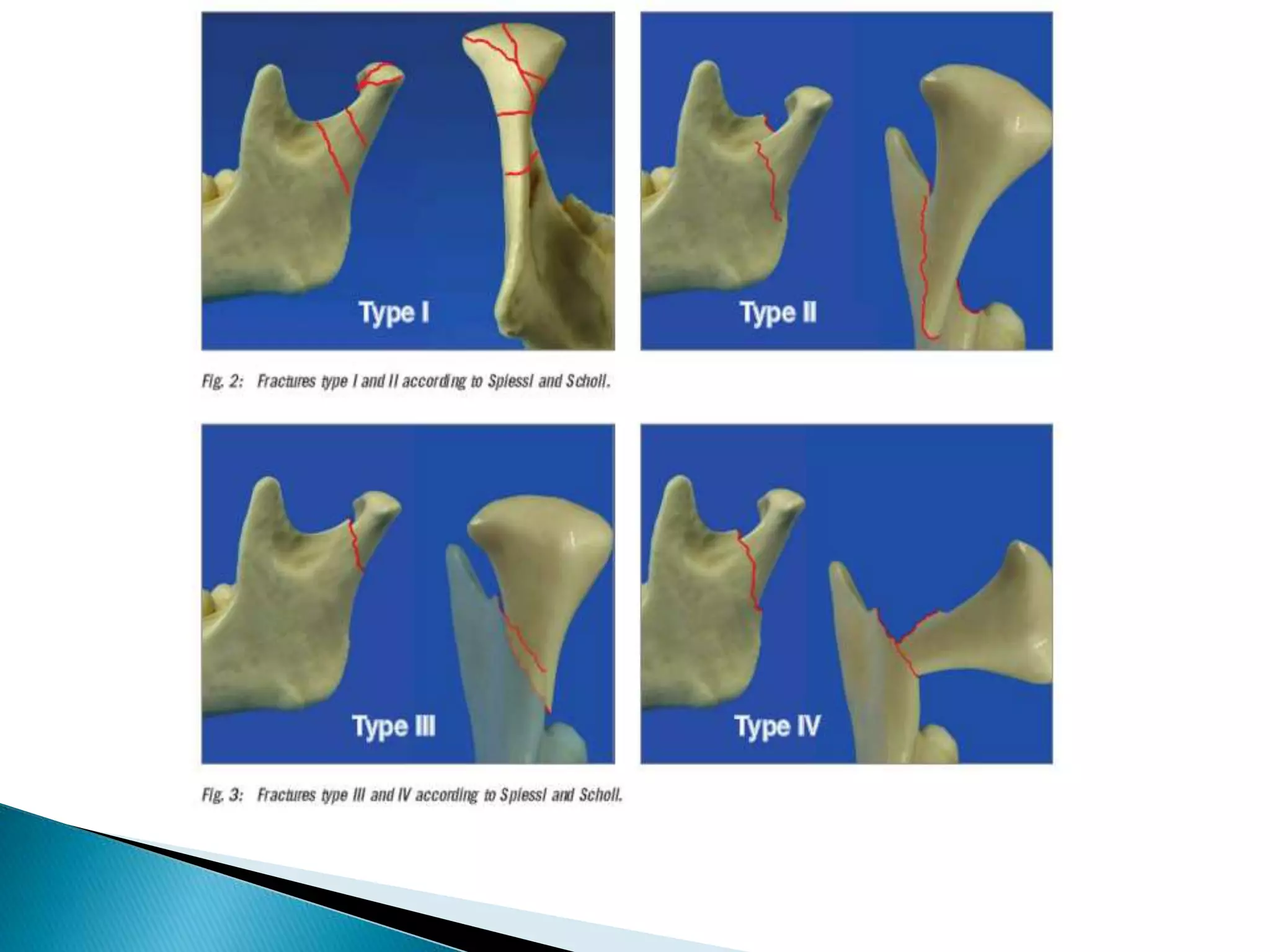
Classification of collum fractures according to
Spiessl and Schroll
 Type I: Collum fractures without considerable displacement
 (Fig. 2)
 Type II: Deep collum fractures with displacement
 (Fig. 2)
 Type III: High collum fractures with displacement
 (Fig. 3)
 Type IV: Deep collum fractures with dislocation
 (Fig. 3)
 Type V: High collum fractures with dislocation
 (Fig. 4)
 Type VI: Intracapsular/diacapitular fractures
 (Fig. 4)
 Injury caused by a moving object as in case of first
injury,violence,sports etc.
 Injury caused when an individual falls or hits a surface while
in motion as in case of parade ground fracture where the
soldier falls on the ground from an upright position due to
syncope without making any effort to protect the face
 Injury resulting due to the combined forces of the above
mentioned causes
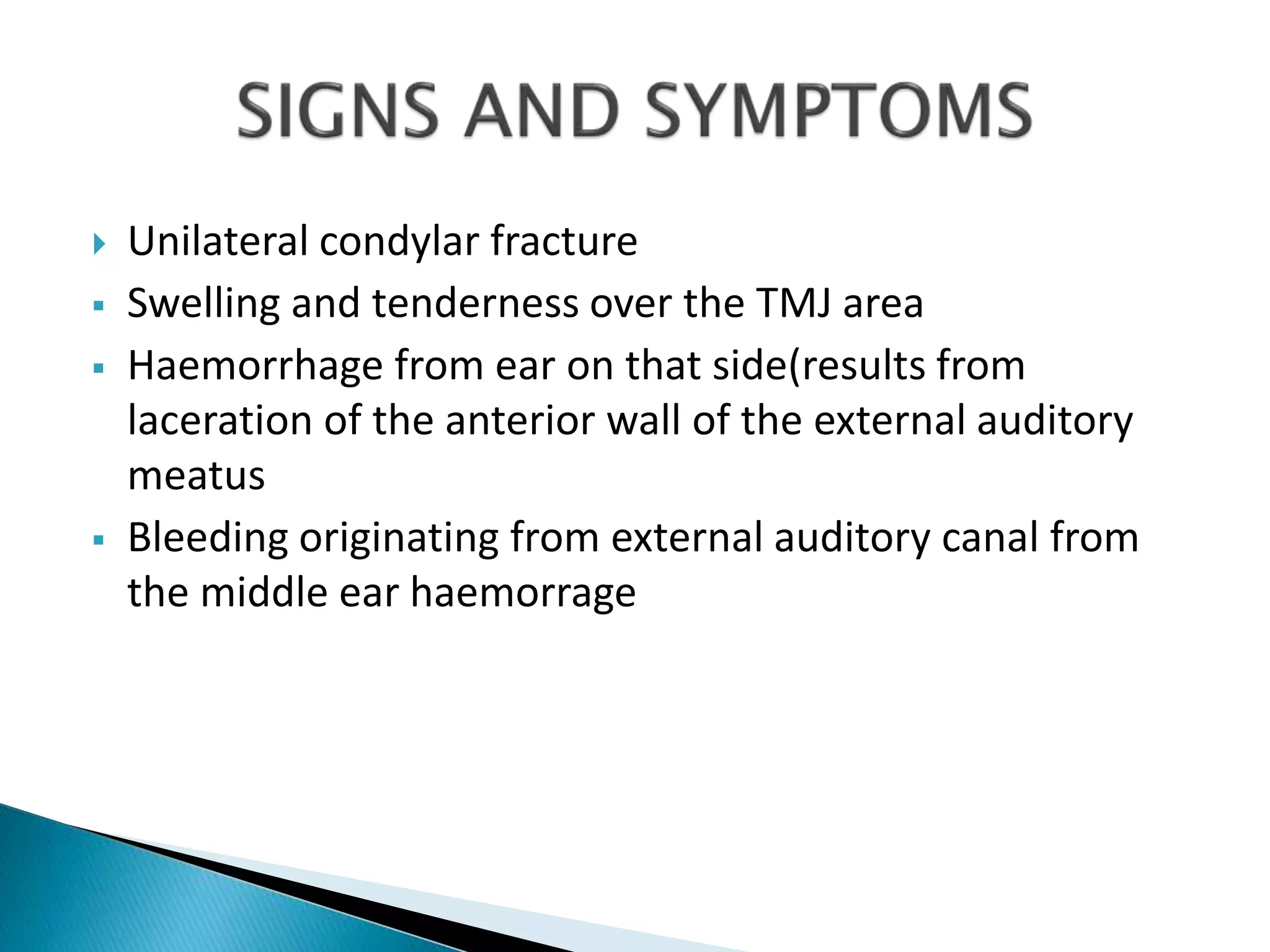
 Unilateral condylar fracture
 Swelling and tenderness over the TMJ area
 Haemorrhage from ear on that side(results from
laceration of the anterior wall of the external auditory
meatus
 Bleeding originating from external auditory canal from
the middle ear haemorrage
Ecchymosis of the skin just below the mastiod process of
the same side.This particular physical signs also occur
with fracture of the base of the skull when it is known as ’
Battle’s sign’
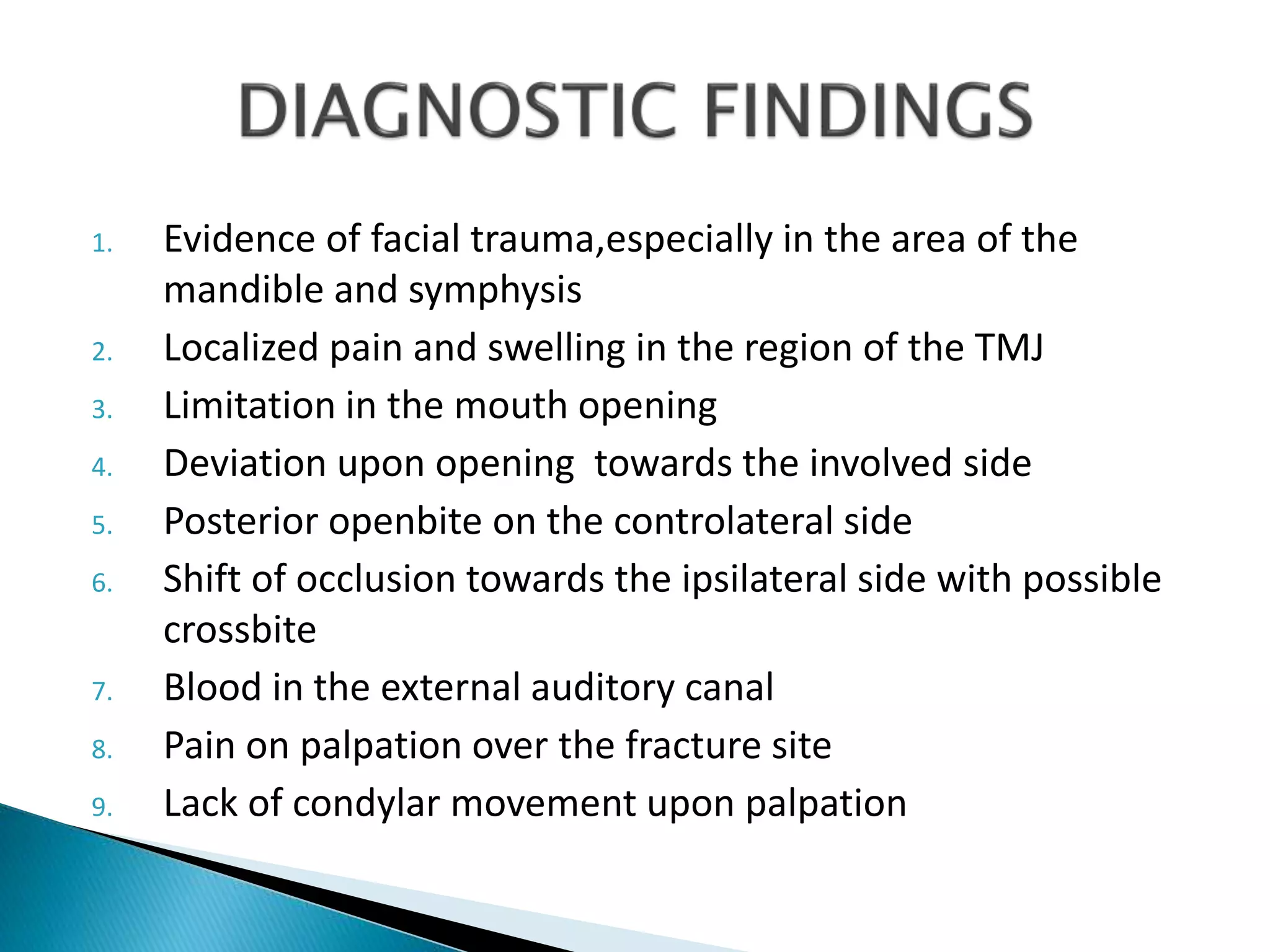
1. Evidence of facial trauma,especially in the area of the
mandible and symphysis
2. Localized pain and swelling in the region of the TMJ
3. Limitation in the mouth opening
4. Deviation upon opening towards the involved side
5. Posterior openbite on the controlateral side
6. Shift of occlusion towards the ipsilateral side with possible
crossbite
7. Blood in the external auditory canal
8. Pain on palpation over the fracture site
9. Lack of condylar movement upon palpation
 Difficulty in lateral excursions as well as protrusion
 The occurence of anterior openbite with bilateral
subcondylar fracture.this is associated with posterior
gagging of the occlusion
 Persistent cerebrospinal fluid leak through the ear is
indicative of an associated fracture of the middle cranial
fossa(otorrhea)
 The diagnosis of the fracture of the condyle is usually made
on clinical examination and confirmed by radiographic
findings
 Clinically, it will be noted that there is asymmetry of the
face on the involved side due to shifting of the mandible
posteriorly and laterally towards the affected side
 Plain films
1. OPG:- to diagnose bilateral condylar fracture
2. Lateral oblique:- to view the condylar and subcondylar
areas
3. Transorbital, transpharyngeal and transcranial radiographic
methods
4. Reverse towne’s view:-help to assess the anterioposterior
and mediolateral displacement of the fracture
 CT Scan:- useful to diagnose intracapsular fracture of the
condyle
 MRI
 Principles of treatment for condylar fracture
 Conservative
 Functional
 surgical
Non surgical management
1. Condylar fracture without displacement, with minimum
displacement,without much occlusal disturbance do not
require any active treatment
 Restriction of movement
 Semisolid soft diet intake for 10-15 days followed by active
movement
2. In case of condylar fragment overriding with alteration in
ramus hight, producing malocclusion,
 Initially elastic traction to correct malocclusion
 Followed by IMF for 2-3 weeks
3. In case of young children early mobilisation is advocated to
prevent TMJ ankylosis
 Closed technique(conservative treatment)
 Unilateral or bilateral fracture
 Active jaw movement
 Excessive pain or gross malocclusion is present, IMF is
recommended
CLOSED REDUCTION
INDIATION
 Fracture of the condylar neck that are not displaced
 Fractures of the condyle in children
 Intracapsular fractures
Closed reduction basically consists of,
 Manipulations of the joint carefully to obtain a satisfactory
occlusion
 IMF for a period of 10 days or upto 3-4 weeks in case of
dislocated condylar fracture
 After 10 days the IMF is removed and mobilisation of the jaw
is started
 The patient is reviwed periodically to ensure adequate
rehabilitation and no functional loss
 Mastication and occlusion should be satisfactory
 Occlusal guidance and physical therapy must be monitored
OPEN REDUCTION
 The objective of surgical treatment is achieved by exposure of
the condylar fragment , reduction to the normal relationship
and fixation in that position
Absolute indications
 To restore vertical and anterioposterior facial dimension
 Dislocation of the condyle into middle cranial fossa
 Compound fracture of the condyle due to gun shot wounds or
Invation of the foreign objects
 Inability to achieve occlusion by closed reduction
 Lateral extracapsular displacement
Relative indications
 Edentulous jaws
 Uncontrolled seizure disorders
 Status asthmaticus
 Psycologic compromise
Approaches to the TMJ
 The joint may be approached by various incisions
 Periauricular incision
 Retromandibular incision
 Risdon’s incision
 Intraorally mandibular vestibular incision followed by the use
of an endoscope to visualise the joint
 After exposing the joint and anatomically aligning the
fragments, different method of fixation may be used
 miniplate osteosynthesis
 wire osteosynthesis
 lag screw osteosynthesis
 use of Kirschner wire for fixation
OPEN REDUCTION
Method of open reducion includes,
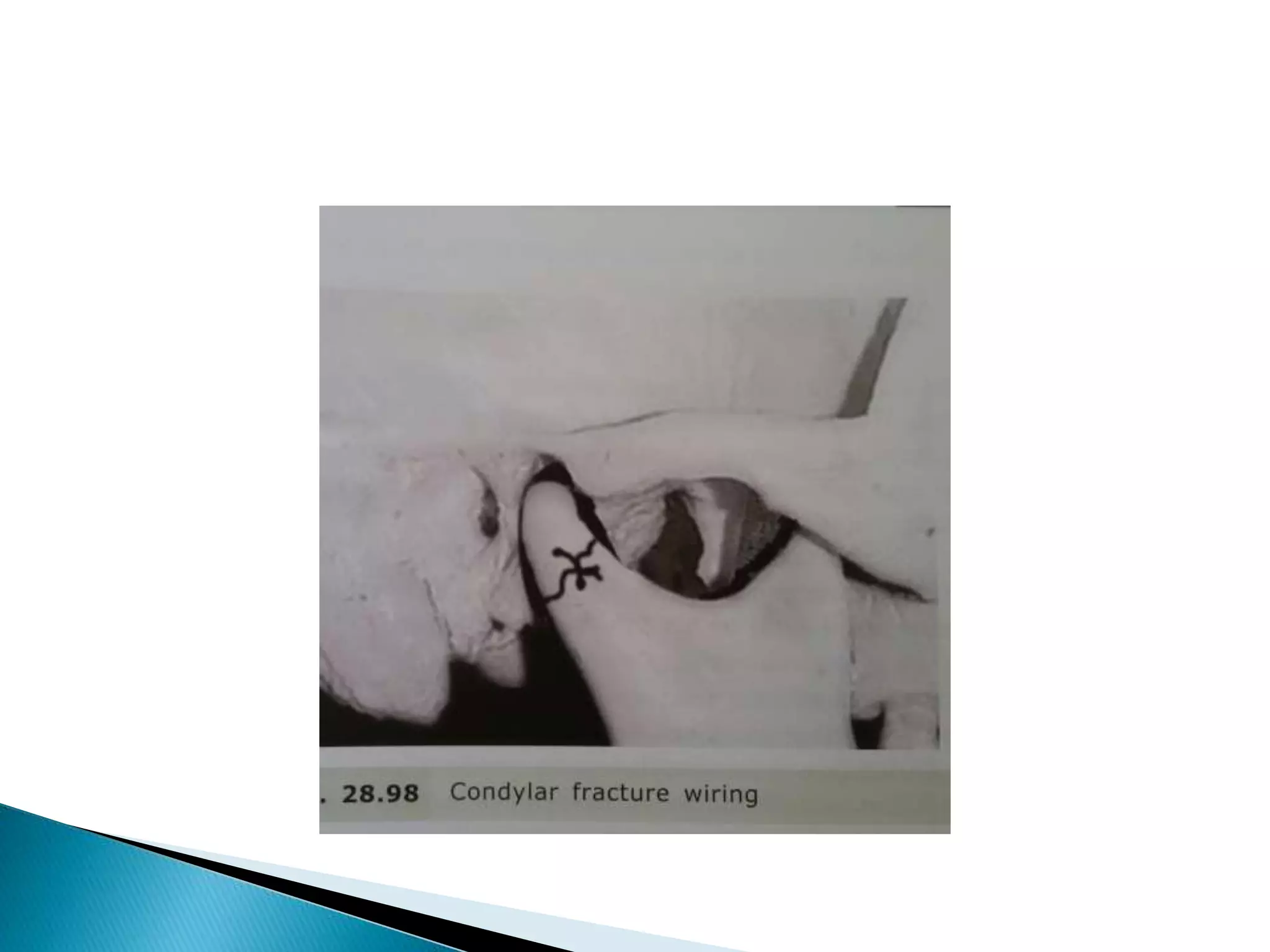
 Exposure of condyle
 Detachement of fractured condylar head of all its muscular
attachments
 Reinserting & fixation in a desired position.
In this procedure condylar head act as a free graft.
There are chances of avascular necrosis of this fragment due to
lack of blood supply.
Open reduction
Retromandibular approach
 A risdon type submandibular incision gives good access of low
sub condylar fracture
 Osteosynthesis with wire ligature or miniplates may be
accomplished
 Pre auricular approach
 An incision of the Alkayat & Bramley type for high condylar
and neck fracture
 Choice of whether open or closed reduction is to be done
also depends on other factors such as:
o Age of patient
o Age of fracture
o Position of condyle
o Presence or absence of other injuries
o Medical condition of patient
o History of previous joint disease
o Patients willingness for the procedure
 COMPLICATIONS
 Ankylosis of TMJ
 Nerve injury
 infections
 malunion
 Nonunion
 delayed union
 Managment of condylar fracture is a controversial topic with
different openions regarding the closed & open methord
 The decision to treat the patient in either way is the
surgeon’s choice depends on the case
 The case however not complete till the patient has a stable
occlusion & function therefore regardless of method of
treatment, active physiotherapy must be encouraged.
 Text book of oral and maxillofacial surgery- Neelima anil malik
 Text book of oral and maxillofacial surgery- Chithra
chakravarthi

CONDYLAR FRACTURE.pptx

  • 1.
    DR DAVIS NADAKKAVUKARAN READERMALABAR DENTAL COLLEGE
  • 2.
     Introduction  Classification Investigations  Etiology  Clinical examination  Principles of treatment  Treatment  Complications
  • 3.
     Condylar fracturesconstitute 26-40 % of all mandibular fractures  Fracture of the condyle can cause significant pain and limitation of jaw movement ,thus restricting important functions of mastication  This injury should be recognized early and treated promptly to minimize discomfort to the patient  Fractures of the condyle may results from similar cause of other mandibular fractures such as vehicle accidents, fall or assaults
  • 4.
     The fractureof the condyle may be associated with other injuries such as facial nerve injury, cervical spine injury, damage to middle cranial fossa and injuries to the external auditory canal  It is thus necessary to remember the important anatomical structures surrounding the joint  Incidence :- unilateral fracture of the condyle occurs at least 3 times more frequently than bilateral condylar fractures  Bilateral fractures of the condyle are also not uncommon
  • 5.
     Arterial supplyof the condylar region:-  The blood supply of the condyle is largely from the attachement of the lateral pterygoid muscle and from arteries such as deep temporal artery, posterior tympanic artery, superficial temporal artery and the transverse facial artery  It is important to know the arterial supply of the condyle when performing surgery in this region
  • 6.
     Unilateral andbilateral fractures  Intracapsular fractures and extracapsular fractures  Simple, compound or comminuted fractures of the condyle
  • 7.
     Lindhal’s classification Basedon anatomic location of the fracture(level of condylar fracture)  Condylar head  Condylar neck  Subcondylar Based on the relationship of the condylar segment to the mandibular fragment  Non displaced  Deviated  Dispaced with medial or lateral overlap
  • 8.
     Displacement withanterior or posterior overlap  No contact between the fracture segments Based on the relationship between the condylar head and the glenoid fossa  Non displaced  Displacement  Dislocation MacLennan system  Non displaced  Frcture deviation  Fracture displacement  Fracture dislocation
  • 9.
    Classification of collumfractures according to Spiessl and Schroll  Type I: Collum fractures without considerable displacement  (Fig. 2)  Type II: Deep collum fractures with displacement  (Fig. 2)  Type III: High collum fractures with displacement  (Fig. 3)  Type IV: Deep collum fractures with dislocation  (Fig. 3)  Type V: High collum fractures with dislocation  (Fig. 4)  Type VI: Intracapsular/diacapitular fractures  (Fig. 4)
  • 11.
     Injury causedby a moving object as in case of first injury,violence,sports etc.  Injury caused when an individual falls or hits a surface while in motion as in case of parade ground fracture where the soldier falls on the ground from an upright position due to syncope without making any effort to protect the face  Injury resulting due to the combined forces of the above mentioned causes
  • 12.
     Unilateral condylarfracture  Swelling and tenderness over the TMJ area  Haemorrhage from ear on that side(results from laceration of the anterior wall of the external auditory meatus  Bleeding originating from external auditory canal from the middle ear haemorrage
  • 13.
    Ecchymosis of theskin just below the mastiod process of the same side.This particular physical signs also occur with fracture of the base of the skull when it is known as ’ Battle’s sign’
  • 14.
    1. Evidence offacial trauma,especially in the area of the mandible and symphysis 2. Localized pain and swelling in the region of the TMJ 3. Limitation in the mouth opening 4. Deviation upon opening towards the involved side 5. Posterior openbite on the controlateral side 6. Shift of occlusion towards the ipsilateral side with possible crossbite 7. Blood in the external auditory canal 8. Pain on palpation over the fracture site 9. Lack of condylar movement upon palpation
  • 15.
     Difficulty inlateral excursions as well as protrusion  The occurence of anterior openbite with bilateral subcondylar fracture.this is associated with posterior gagging of the occlusion  Persistent cerebrospinal fluid leak through the ear is indicative of an associated fracture of the middle cranial fossa(otorrhea)  The diagnosis of the fracture of the condyle is usually made on clinical examination and confirmed by radiographic findings  Clinically, it will be noted that there is asymmetry of the face on the involved side due to shifting of the mandible posteriorly and laterally towards the affected side
  • 16.
     Plain films 1.OPG:- to diagnose bilateral condylar fracture 2. Lateral oblique:- to view the condylar and subcondylar areas 3. Transorbital, transpharyngeal and transcranial radiographic methods 4. Reverse towne’s view:-help to assess the anterioposterior and mediolateral displacement of the fracture  CT Scan:- useful to diagnose intracapsular fracture of the condyle  MRI
  • 17.
     Principles oftreatment for condylar fracture  Conservative  Functional  surgical
  • 18.
    Non surgical management 1.Condylar fracture without displacement, with minimum displacement,without much occlusal disturbance do not require any active treatment  Restriction of movement  Semisolid soft diet intake for 10-15 days followed by active movement 2. In case of condylar fragment overriding with alteration in ramus hight, producing malocclusion,  Initially elastic traction to correct malocclusion  Followed by IMF for 2-3 weeks 3. In case of young children early mobilisation is advocated to prevent TMJ ankylosis
  • 19.
     Closed technique(conservativetreatment)  Unilateral or bilateral fracture  Active jaw movement  Excessive pain or gross malocclusion is present, IMF is recommended
  • 20.
    CLOSED REDUCTION INDIATION  Fractureof the condylar neck that are not displaced  Fractures of the condyle in children  Intracapsular fractures
  • 21.
    Closed reduction basicallyconsists of,  Manipulations of the joint carefully to obtain a satisfactory occlusion  IMF for a period of 10 days or upto 3-4 weeks in case of dislocated condylar fracture  After 10 days the IMF is removed and mobilisation of the jaw is started  The patient is reviwed periodically to ensure adequate rehabilitation and no functional loss  Mastication and occlusion should be satisfactory  Occlusal guidance and physical therapy must be monitored
  • 23.
    OPEN REDUCTION  Theobjective of surgical treatment is achieved by exposure of the condylar fragment , reduction to the normal relationship and fixation in that position
  • 24.
    Absolute indications  Torestore vertical and anterioposterior facial dimension  Dislocation of the condyle into middle cranial fossa  Compound fracture of the condyle due to gun shot wounds or Invation of the foreign objects  Inability to achieve occlusion by closed reduction  Lateral extracapsular displacement
  • 25.
    Relative indications  Edentulousjaws  Uncontrolled seizure disorders  Status asthmaticus  Psycologic compromise
  • 26.
    Approaches to theTMJ  The joint may be approached by various incisions  Periauricular incision  Retromandibular incision  Risdon’s incision  Intraorally mandibular vestibular incision followed by the use of an endoscope to visualise the joint  After exposing the joint and anatomically aligning the fragments, different method of fixation may be used  miniplate osteosynthesis  wire osteosynthesis  lag screw osteosynthesis  use of Kirschner wire for fixation
  • 30.
    OPEN REDUCTION Method ofopen reducion includes,  Exposure of condyle  Detachement of fractured condylar head of all its muscular attachments  Reinserting & fixation in a desired position. In this procedure condylar head act as a free graft. There are chances of avascular necrosis of this fragment due to lack of blood supply.
  • 31.
    Open reduction Retromandibular approach A risdon type submandibular incision gives good access of low sub condylar fracture  Osteosynthesis with wire ligature or miniplates may be accomplished
  • 34.
     Pre auricularapproach  An incision of the Alkayat & Bramley type for high condylar and neck fracture
  • 35.
     Choice ofwhether open or closed reduction is to be done also depends on other factors such as: o Age of patient o Age of fracture o Position of condyle o Presence or absence of other injuries o Medical condition of patient o History of previous joint disease o Patients willingness for the procedure
  • 36.
     COMPLICATIONS  Ankylosisof TMJ  Nerve injury  infections  malunion  Nonunion  delayed union
  • 37.
     Managment ofcondylar fracture is a controversial topic with different openions regarding the closed & open methord  The decision to treat the patient in either way is the surgeon’s choice depends on the case  The case however not complete till the patient has a stable occlusion & function therefore regardless of method of treatment, active physiotherapy must be encouraged.
  • 38.
     Text bookof oral and maxillofacial surgery- Neelima anil malik  Text book of oral and maxillofacial surgery- Chithra chakravarthi