Unit-2
International Code of
Zoological Nomenclature
(ICZN)
CONCEPTS AND PREAMBLE
Dr. Sandeep Kumar Raghuvanshi
Assistant Professor
Department of Zoology, Bareilly College, Bareilly (U.P.)
What is ICZN?
• Widely accepted convention of Zoology
that rule the formal scientific naming of
animals.
• Published by International Commission
on Zoological Nomenclature takes its
power from International union of
Biological Sciences (IUBS).
• Ensures that every animal has a unique
and universally accepted scientific name.
PREAMBLE
“The objects of the Code are to
promote stability and universality in
the scientific names of animals and to
ensure that the name of each taxon is
unique and distinct”.
Fundamental Goal
• System of rules and recommendations
• Provide maximum continuity in the naming
of all animals with-
 Uniqueness
 Universality
 Stability
• Guide only the nomenclature of animals,
leaves zoologist the freedom in classifying
new taxa.
Brief History
• First introduced by a British Zoologist Hugh E.
Strickland, who conceived a code for
introducing uniformity in International
nomenclature.
• It was modified and evolved to the present
systems.
• 1st
edition-1961
• 4th
edition-1999
• ICZN is independent from other nomenclature
systems like botanical nomenclature (ICBN).
Parts of ICZN
• Consist of three main parts:
 The Code Proper
Includes ‘Preamble’ followed by 90 consecutively
numbered ‘Articles’ grouped in 18 chapters.
 Appendices
3 appendices, first 2 having status of
recommendations and 3rd
is the constitution of the
commission.
 Glossary
Terms used in the text are clearly defined in the
‘Glossary’.
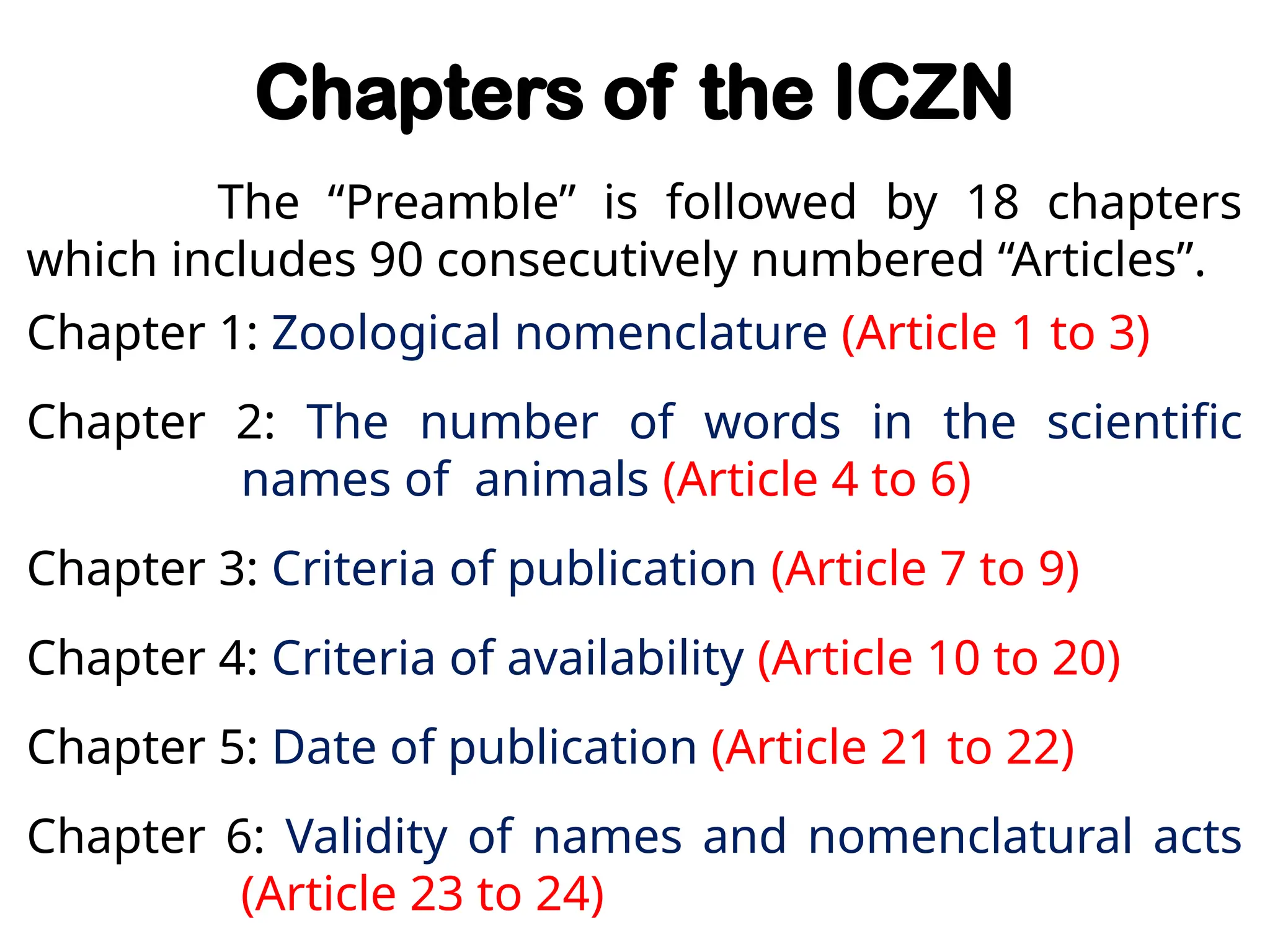
Chapters of the ICZN
The “Preamble” is followed by 18 chapters
which includes 90 consecutively numbered “Articles”.
Chapter 1: Zoological nomenclature (Article 1 to 3)
Chapter 2: The number of words in the scientific
names of animals (Article 4 to 6)
Chapter 3: Criteria of publication (Article 7 to 9)
Chapter 4: Criteria of availability (Article 10 to 20)
Chapter 5: Date of publication (Article 21 to 22)
Chapter 6: Validity of names and nomenclatural acts
(Article 23 to 24)
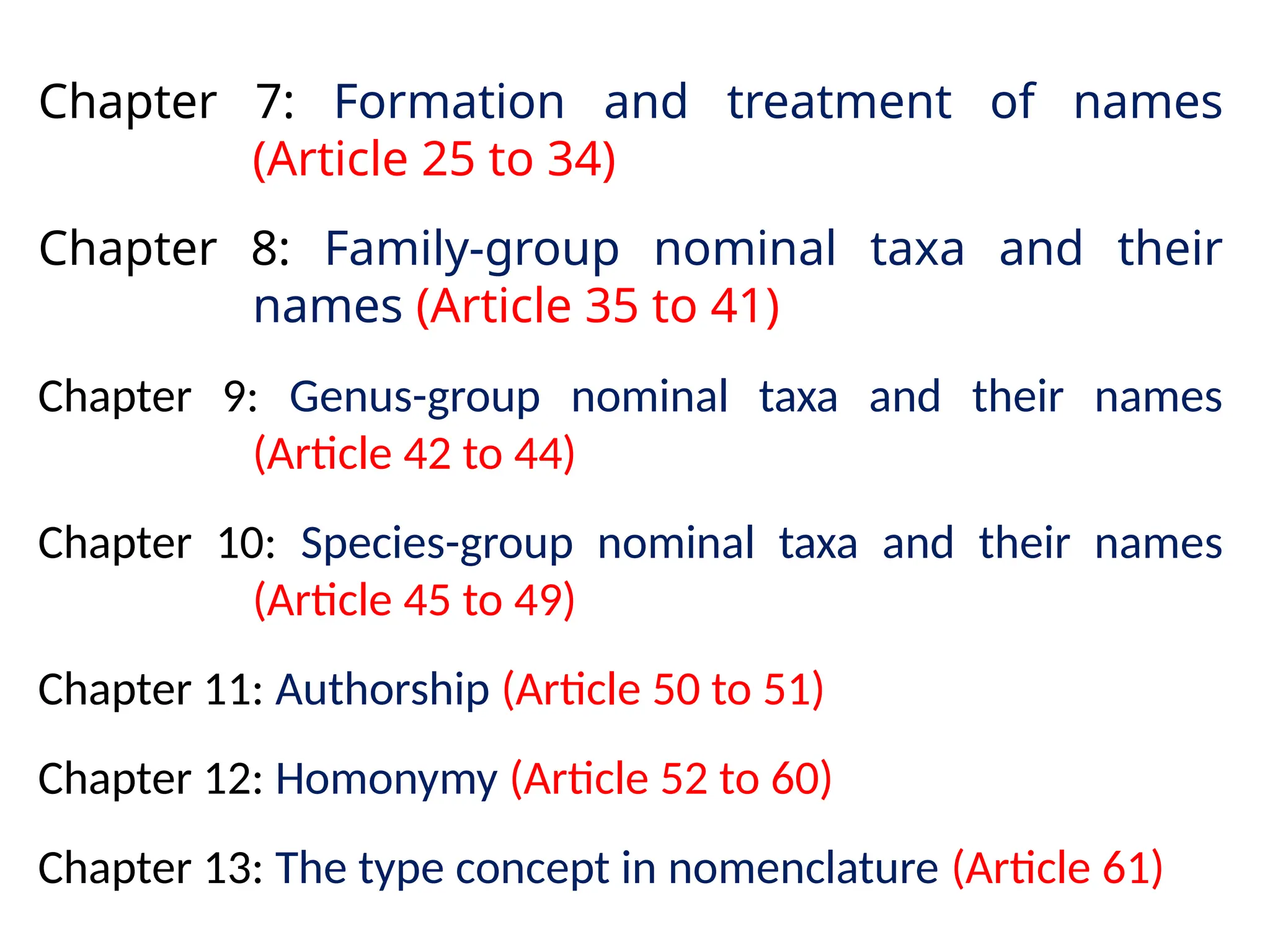
Chapter 7: Formation and treatment of names
(Article 25 to 34)
Chapter 8: Family-group nominal taxa and their
names (Article 35 to 41)
Chapter 9: Genus-group nominal taxa and their names
(Article 42 to 44)
Chapter 10: Species-group nominal taxa and their names
(Article 45 to 49)
Chapter 11: Authorship (Article 50 to 51)
Chapter 12: Homonymy (Article 52 to 60)
Chapter 13: The type concept in nomenclature (Article 61)
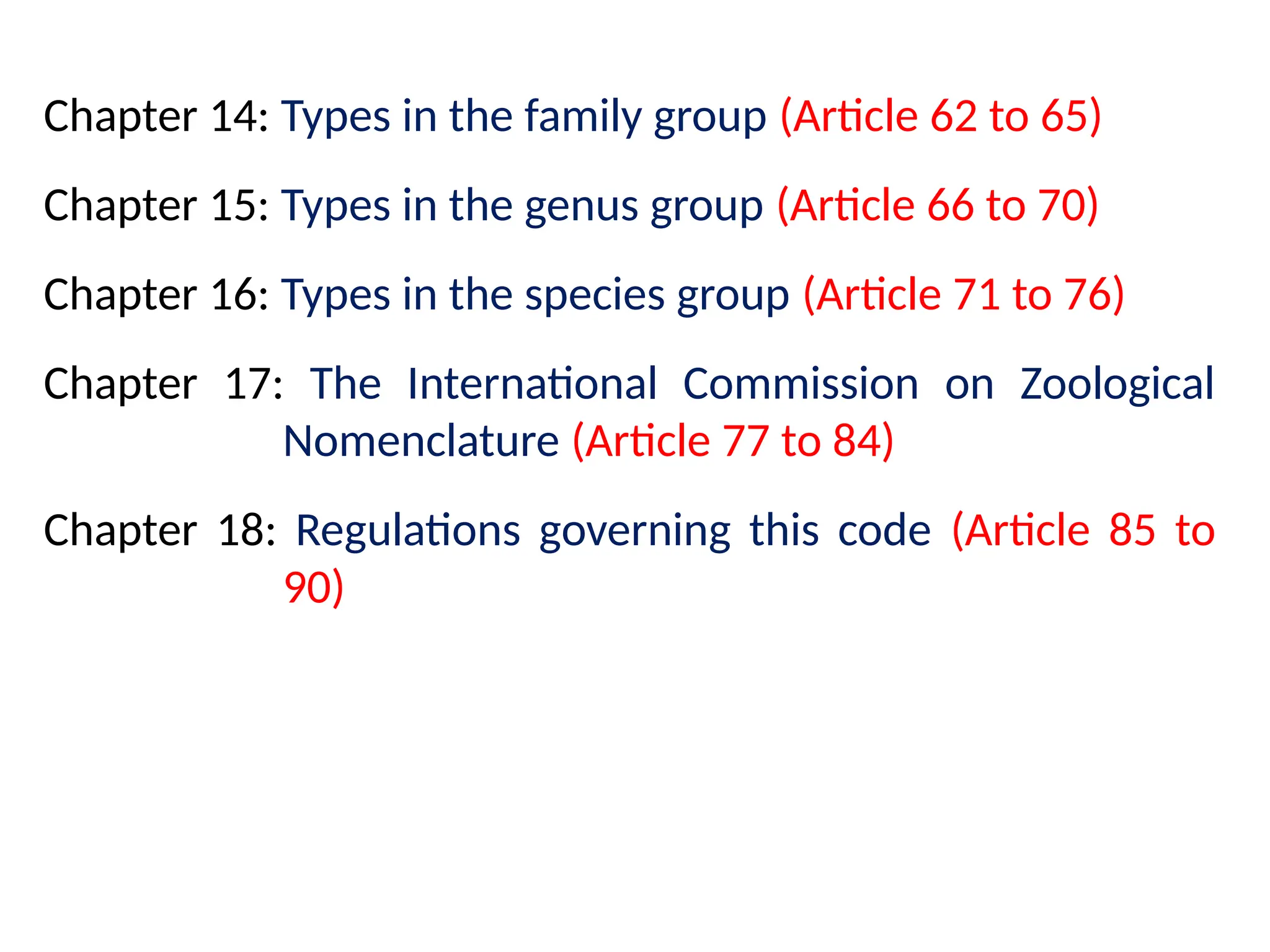
Chapter 14: Types in the family group (Article 62 to 65)
Chapter 15: Types in the genus group (Article 66 to 70)
Chapter 16: Types in the species group (Article 71 to 76)
Chapter 17: The International Commission on Zoological
Nomenclature (Article 77 to 84)
Chapter 18: Regulations governing this code (Article 85 to
90)
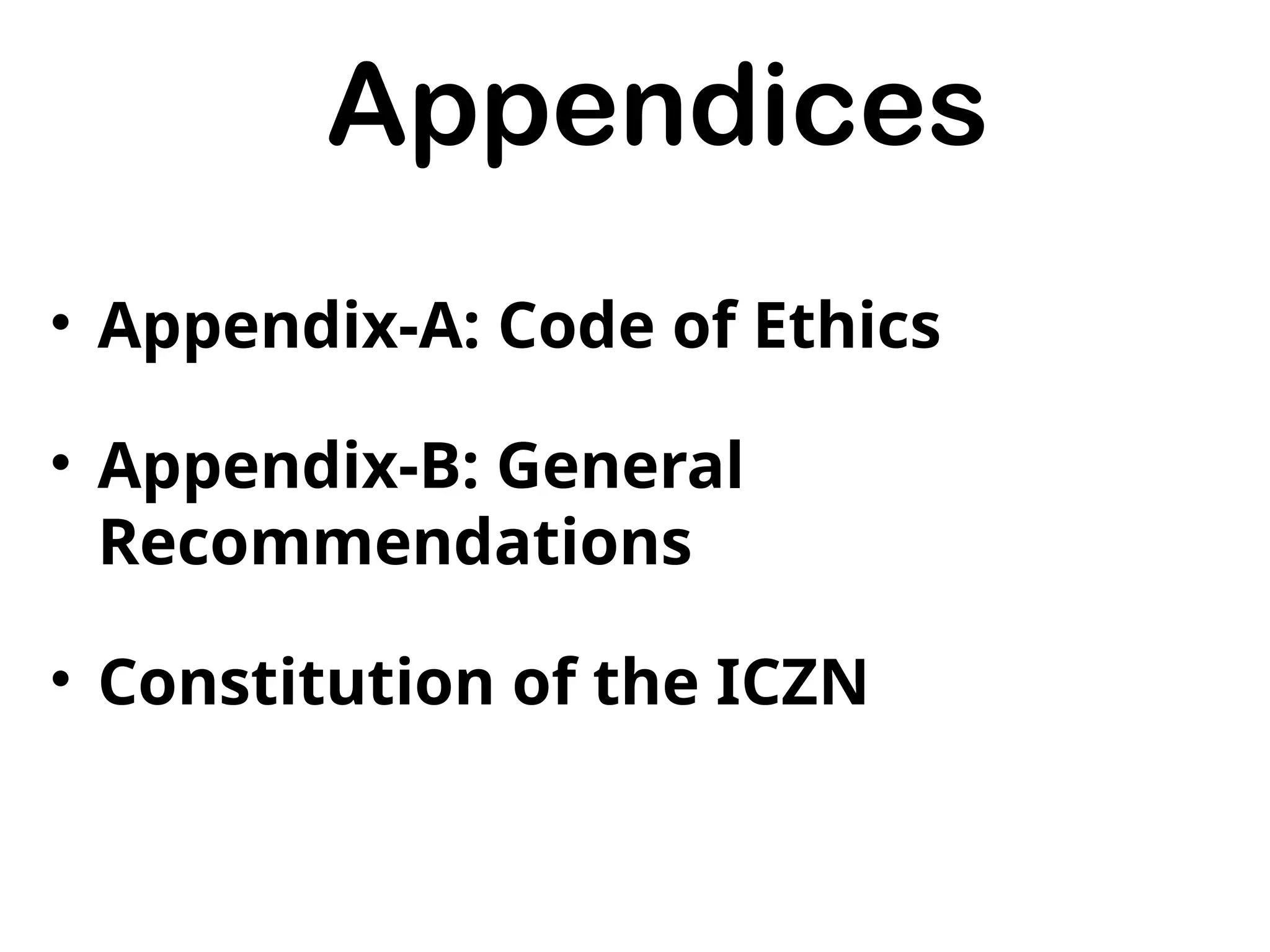
Appendices
• Appendix-A: Code of Ethics
• Appendix-B: General
Recommendations
• Constitution of the ICZN
Principles of ICZN
• The rules principally regulate:
• How names are correctly established in
the frame of binomial nomenclature?
• Which name must be used in case of
name conflict?
• How scientific literature must cite
names?
Principles of ICZN
• There are six basic principles:
1. Principle of binomial nomenclature
2. Principle of priority
3. Principle of co-ordination
4. Principle of the first reviser
5. Principle of homonymy
6. Principle of typification
Principle of Binomial Nomenclature
• Name of species is composed of a combination of two names
(Binomen).
o Generic name
o Specific Epithet
e.g. Homo sapiens
• Rules for binomial nomenclature
 Names must either be Latin or Latinised.
 First letter of genus name- Capital
 First letter of species name- small
 While typing- names italicized.
 When written with free hands- names separately underlined.
Principle of Priority
• Fist formulated in 1842.
• Correct formal scientific name for an animal taxon is the
oldest available valid name.
 1815 George Ord named a species of Pronghorn-
Antilocapra americana
 1855 John Edward Gray published same species-
Antilocapra anteflexa.
 Here, based on principle of priority the name Antilocapra
americana takes priority and Antilocapra anteflexa
becomes a junior synonym.
Principle of Coordination
• Publishing a new zoological name automatically
and simultaneously establishes all
corresponding names in the relevant other
ranks with the same type.
• E.g.1. Publishing a species name (binomen)-
Homo sapiens also establishes the sub-species
name (trinomen)- Homo sapiens sapiens
• E.g.2. Publishing a family name –Giraffidae also
establishes the super-family name- Giraffoidea
and the sub-family name- Giraffinae.
Principle of the First Reviser
• Supplements the Principle of Priority.
• Deals with situations that can not be resolved by
priority.
• Two or more different names for same taxon-
 In 1758, Linnaeus established Strix scandiaca and
Strix noctua as two different species of aves.
 Both taxa later turned out a same species, the
snowy owl.
 In 1931, Lonnberg acted as first reviser and
selected Strix scandiaca to have precedence.
Principle of Homonymy
• The name of each taxon must be unique.
• A name that is homonym of another name must
not be used as a valid name.
• E.g.-In 1773 Drury established Cerambyx
maculatus (Coleoptera) for a species from Jamaica.
In 1775 Fueblin established Cerambyx maculatus
for a different species from Switzerland.
• Principle of Priority apply here and Drury’s name
gets precedence and Fueblin’s name becomes
homonym.
Principle of Typification
• Any family group name must have a type
genus.
• Any genus group name must have a type
species.
• Any species group name can (not must)
have one or more type specimens usually
deposited in a museum collection.
Role of Proteins and
Nucleic Acids in
Modern Taxonomy
Biological unit of Classification
1. Taxonomic Identification
-Morphological characters
-Breeding Process
-Biology
-Host plant etc.
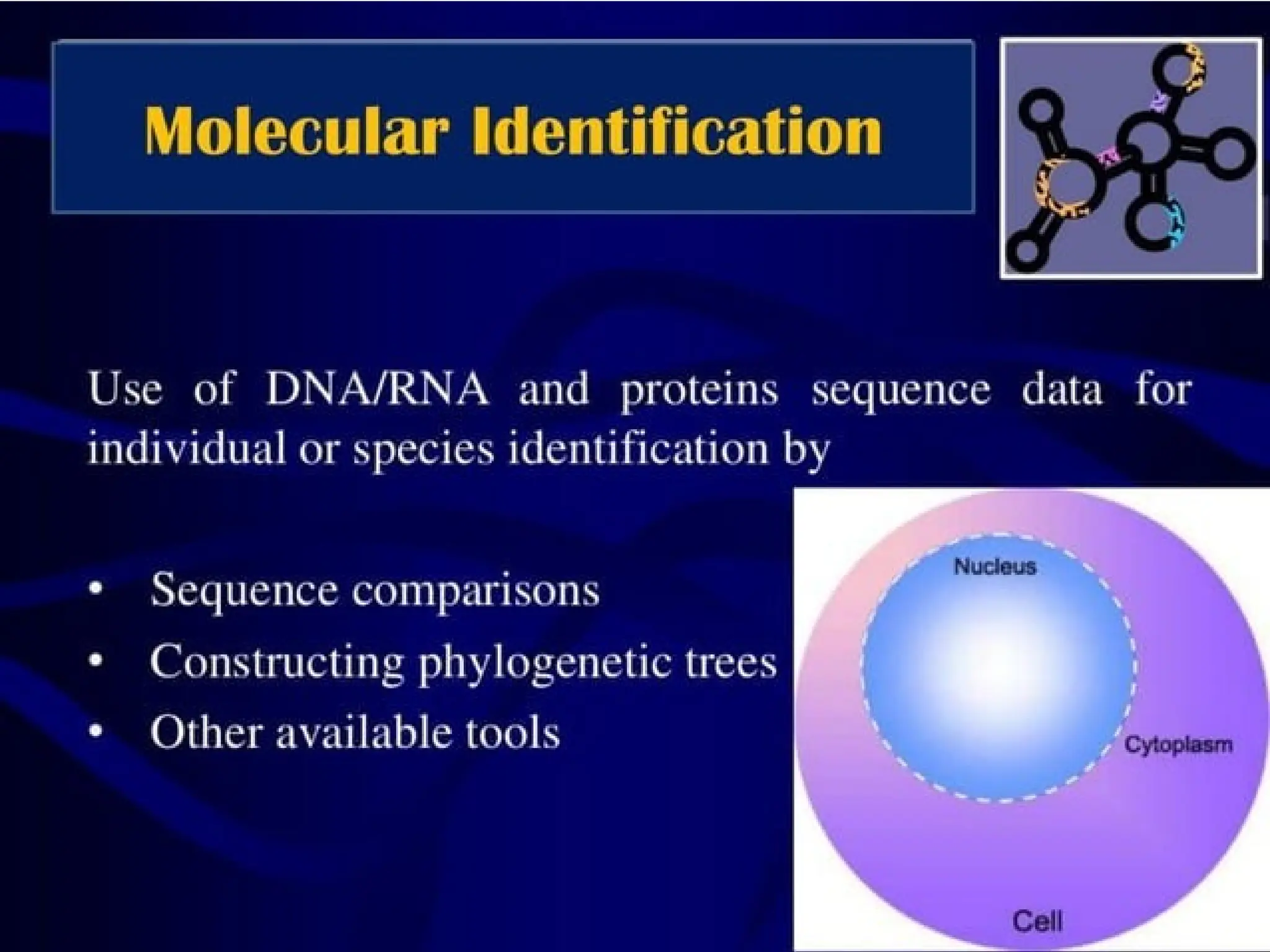
2. Molecular identification
-RNA/DNA nucleotide data
-Protein analysis
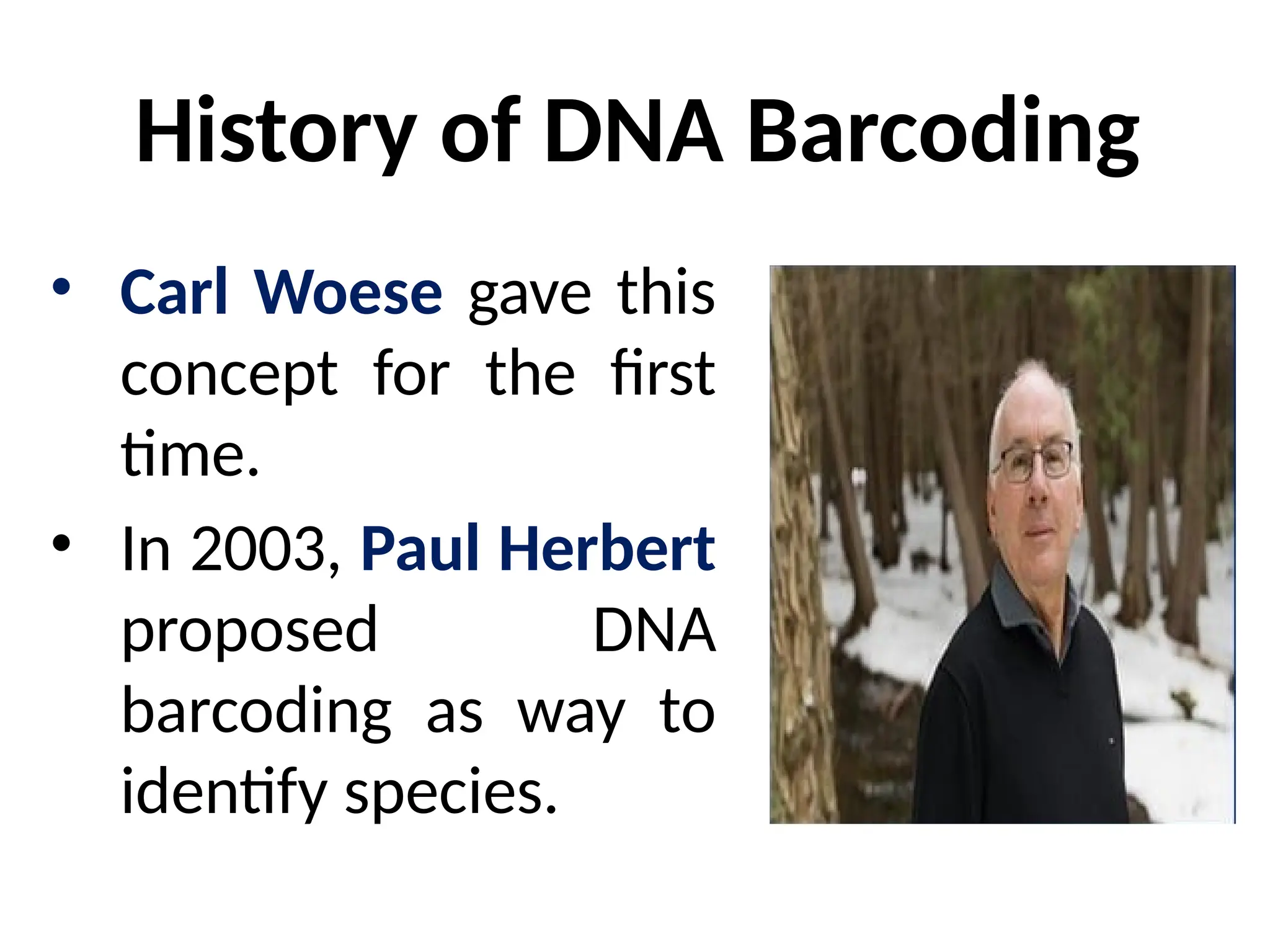
History of DNA Barcoding
• Carl Woese gave this
concept for the first
time.
• In 2003, Paul Herbert
proposed DNA
barcoding as way to
identify species.
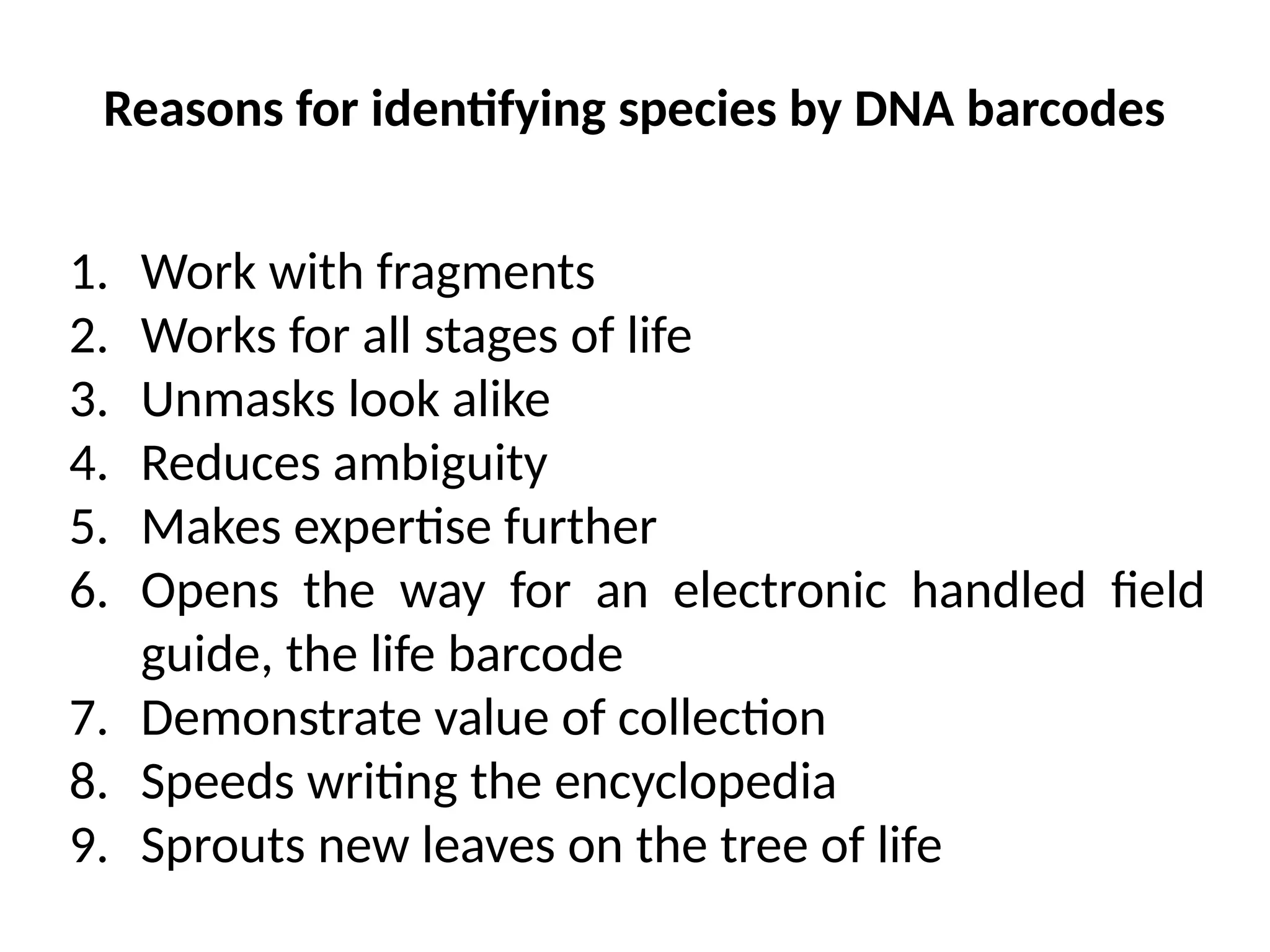
Reasons for identifying species by DNA barcodes
1. Work with fragments
2. Works for all stages of life
3. Unmasks look alike
4. Reduces ambiguity
5. Makes expertise further
6. Opens the way for an electronic handled field
guide, the life barcode
7. Demonstrate value of collection
8. Speeds writing the encyclopedia
9. Sprouts new leaves on the tree of life
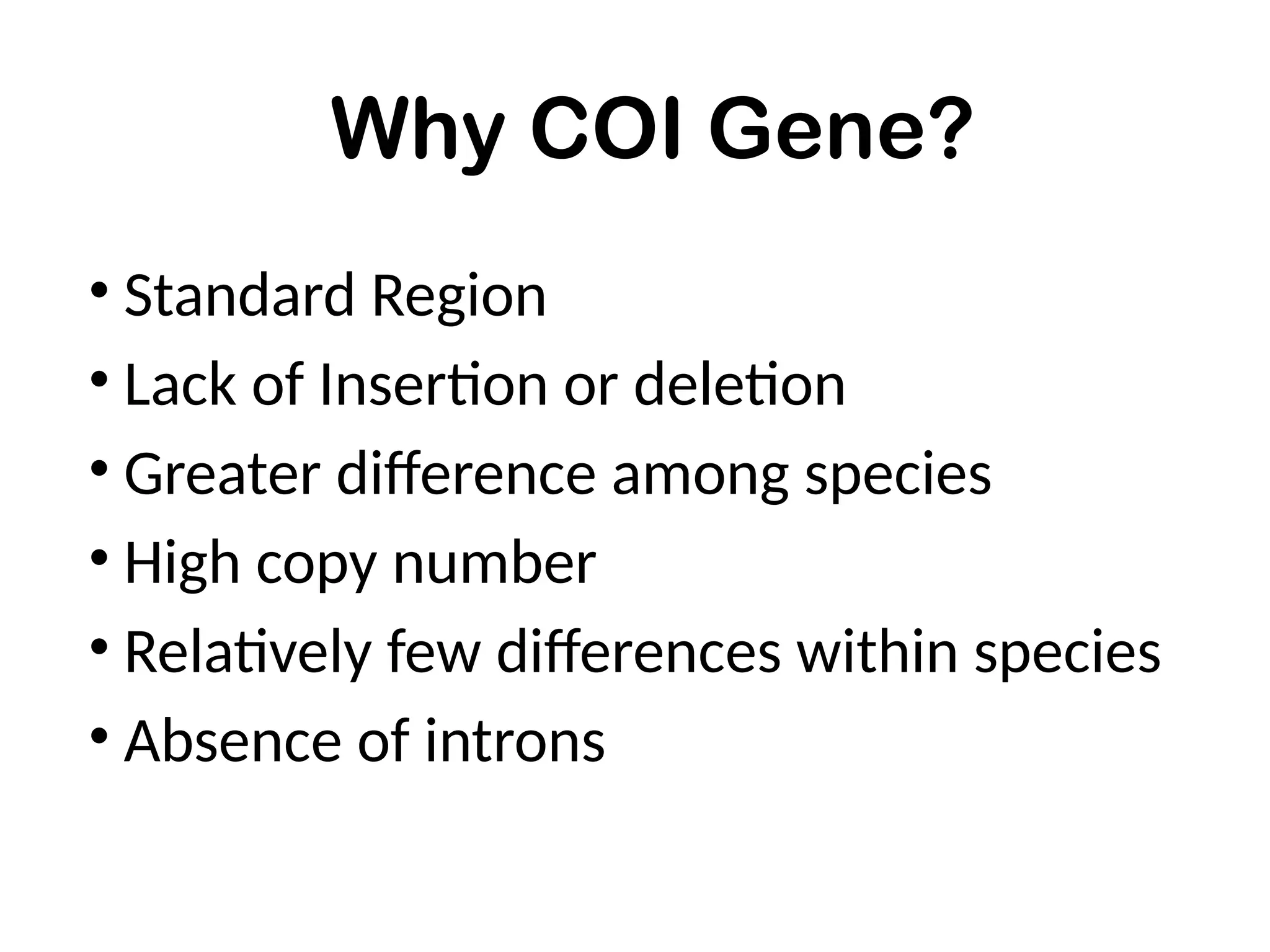
Why COI Gene?
• Standard Region
• Lack of Insertion or deletion
• Greater difference among species
• High copy number
• Relatively few differences within species
• Absence of introns
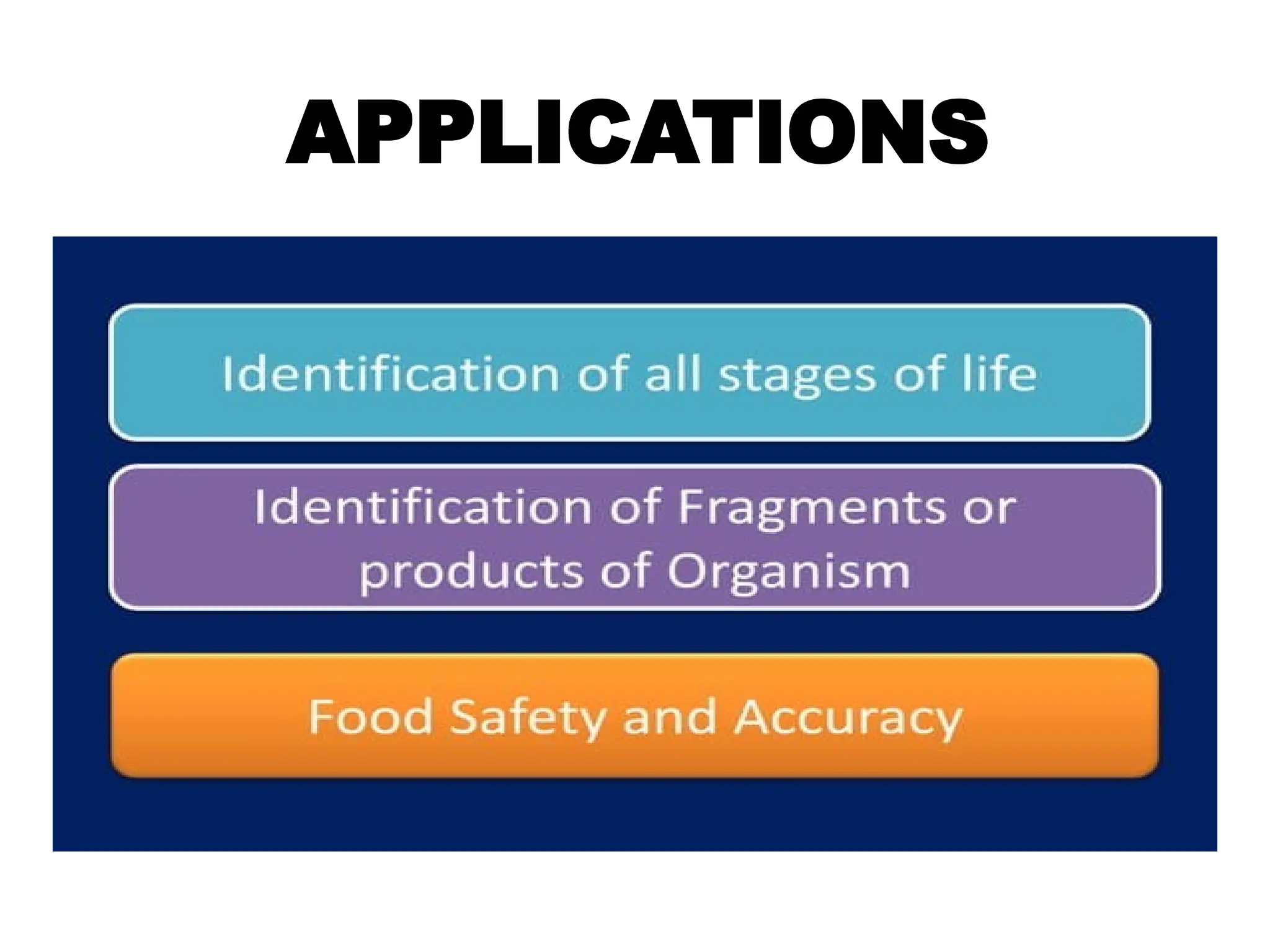
APPLICATIONS
Other Applications
• Custom control
• Invasive species
• Police
• Agriculture
• Conservation
• Education
ICZN and its global responsibility and functions.pptx

ICZN and its global responsibility and functions.pptx

  • 1.
    Unit-2 International Code of ZoologicalNomenclature (ICZN) CONCEPTS AND PREAMBLE Dr. Sandeep Kumar Raghuvanshi Assistant Professor Department of Zoology, Bareilly College, Bareilly (U.P.)
  • 2.
    What is ICZN? •Widely accepted convention of Zoology that rule the formal scientific naming of animals. • Published by International Commission on Zoological Nomenclature takes its power from International union of Biological Sciences (IUBS). • Ensures that every animal has a unique and universally accepted scientific name.
  • 3.
    PREAMBLE “The objects ofthe Code are to promote stability and universality in the scientific names of animals and to ensure that the name of each taxon is unique and distinct”.
  • 4.
    Fundamental Goal • Systemof rules and recommendations • Provide maximum continuity in the naming of all animals with-  Uniqueness  Universality  Stability • Guide only the nomenclature of animals, leaves zoologist the freedom in classifying new taxa.
  • 5.
    Brief History • Firstintroduced by a British Zoologist Hugh E. Strickland, who conceived a code for introducing uniformity in International nomenclature. • It was modified and evolved to the present systems. • 1st edition-1961 • 4th edition-1999 • ICZN is independent from other nomenclature systems like botanical nomenclature (ICBN).
  • 6.
    Parts of ICZN •Consist of three main parts:  The Code Proper Includes ‘Preamble’ followed by 90 consecutively numbered ‘Articles’ grouped in 18 chapters.  Appendices 3 appendices, first 2 having status of recommendations and 3rd is the constitution of the commission.  Glossary Terms used in the text are clearly defined in the ‘Glossary’.
  • 7.
    Chapters of theICZN The “Preamble” is followed by 18 chapters which includes 90 consecutively numbered “Articles”. Chapter 1: Zoological nomenclature (Article 1 to 3) Chapter 2: The number of words in the scientific names of animals (Article 4 to 6) Chapter 3: Criteria of publication (Article 7 to 9) Chapter 4: Criteria of availability (Article 10 to 20) Chapter 5: Date of publication (Article 21 to 22) Chapter 6: Validity of names and nomenclatural acts (Article 23 to 24)
  • 8.
    Chapter 7: Formationand treatment of names (Article 25 to 34) Chapter 8: Family-group nominal taxa and their names (Article 35 to 41) Chapter 9: Genus-group nominal taxa and their names (Article 42 to 44) Chapter 10: Species-group nominal taxa and their names (Article 45 to 49) Chapter 11: Authorship (Article 50 to 51) Chapter 12: Homonymy (Article 52 to 60) Chapter 13: The type concept in nomenclature (Article 61)
  • 9.
    Chapter 14: Typesin the family group (Article 62 to 65) Chapter 15: Types in the genus group (Article 66 to 70) Chapter 16: Types in the species group (Article 71 to 76) Chapter 17: The International Commission on Zoological Nomenclature (Article 77 to 84) Chapter 18: Regulations governing this code (Article 85 to 90)
  • 10.
    Appendices • Appendix-A: Codeof Ethics • Appendix-B: General Recommendations • Constitution of the ICZN
  • 11.
    Principles of ICZN •The rules principally regulate: • How names are correctly established in the frame of binomial nomenclature? • Which name must be used in case of name conflict? • How scientific literature must cite names?
  • 12.
    Principles of ICZN •There are six basic principles: 1. Principle of binomial nomenclature 2. Principle of priority 3. Principle of co-ordination 4. Principle of the first reviser 5. Principle of homonymy 6. Principle of typification
  • 13.
    Principle of BinomialNomenclature • Name of species is composed of a combination of two names (Binomen). o Generic name o Specific Epithet e.g. Homo sapiens • Rules for binomial nomenclature  Names must either be Latin or Latinised.  First letter of genus name- Capital  First letter of species name- small  While typing- names italicized.  When written with free hands- names separately underlined.
  • 14.
    Principle of Priority •Fist formulated in 1842. • Correct formal scientific name for an animal taxon is the oldest available valid name.  1815 George Ord named a species of Pronghorn- Antilocapra americana  1855 John Edward Gray published same species- Antilocapra anteflexa.  Here, based on principle of priority the name Antilocapra americana takes priority and Antilocapra anteflexa becomes a junior synonym.
  • 15.
    Principle of Coordination •Publishing a new zoological name automatically and simultaneously establishes all corresponding names in the relevant other ranks with the same type. • E.g.1. Publishing a species name (binomen)- Homo sapiens also establishes the sub-species name (trinomen)- Homo sapiens sapiens • E.g.2. Publishing a family name –Giraffidae also establishes the super-family name- Giraffoidea and the sub-family name- Giraffinae.
  • 16.
    Principle of theFirst Reviser • Supplements the Principle of Priority. • Deals with situations that can not be resolved by priority. • Two or more different names for same taxon-  In 1758, Linnaeus established Strix scandiaca and Strix noctua as two different species of aves.  Both taxa later turned out a same species, the snowy owl.  In 1931, Lonnberg acted as first reviser and selected Strix scandiaca to have precedence.
  • 17.
    Principle of Homonymy •The name of each taxon must be unique. • A name that is homonym of another name must not be used as a valid name. • E.g.-In 1773 Drury established Cerambyx maculatus (Coleoptera) for a species from Jamaica. In 1775 Fueblin established Cerambyx maculatus for a different species from Switzerland. • Principle of Priority apply here and Drury’s name gets precedence and Fueblin’s name becomes homonym.
  • 18.
    Principle of Typification •Any family group name must have a type genus. • Any genus group name must have a type species. • Any species group name can (not must) have one or more type specimens usually deposited in a museum collection.
  • 19.
    Role of Proteinsand Nucleic Acids in Modern Taxonomy
  • 20.
    Biological unit ofClassification 1. Taxonomic Identification -Morphological characters -Breeding Process -Biology -Host plant etc. 2. Molecular identification -RNA/DNA nucleotide data -Protein analysis
  • 22.
    History of DNABarcoding • Carl Woese gave this concept for the first time. • In 2003, Paul Herbert proposed DNA barcoding as way to identify species.
  • 26.
    Reasons for identifyingspecies by DNA barcodes 1. Work with fragments 2. Works for all stages of life 3. Unmasks look alike 4. Reduces ambiguity 5. Makes expertise further 6. Opens the way for an electronic handled field guide, the life barcode 7. Demonstrate value of collection 8. Speeds writing the encyclopedia 9. Sprouts new leaves on the tree of life
  • 36.
    Why COI Gene? •Standard Region • Lack of Insertion or deletion • Greater difference among species • High copy number • Relatively few differences within species • Absence of introns
  • 37.
  • 38.
    Other Applications • Customcontrol • Invasive species • Police • Agriculture • Conservation • Education