Presented by:
Shobhini Chandel
M.Pharm
Pharmacology
1stsemester
Submitted to:
Dr. Salahuddin
Head of Department
Pharmaceutical Chemistry
NIET(Pharmacy Institute)
Zinc Finger Protein
 Introduction
 ZNF structure and classification
 ZNF’s molecular functions
 Physiological role of ZNFs
 Role of ZNFs in diseases
 Role of ZNFs in neurodegenerative diseases
 Zinc-finger proteins (ZNFs) are one of the most abundant groups of
proteins and have a wide range of molecular functions.
 Given the wide variety of zinc-finger domains, ZNFs are able to interact
with DNA, RNA, PAR (poly-ADP-ribose) and other proteins.
 Thus, ZNFs are involved in the regulation of several cellular processes.
 In fact, ZNFs are implicated in transcriptional regulation, ubiquitin-
mediated protein degradation, signal transduction, actin targeting, DNA
repair, cell migration, and numerous other processes.
 ZNFs have key role in development and differentiation of several tissues.
 ZNFs are involved in tumorigenesis, cancer progression and metastasis
formation.
 Alterations in ZNFs are involved in the development of several of diseases
such as neurodegeneration, skin disease and diabetes.
 The first ZNF was identified in the late 1980s was Transcription Factor
IIIa (TFIIIa) from Xenopus laevis.
 This gave rise to the discovery of a new group of transcriptional activator
proteins with a 30 amino acid repeating region.
 This new class of proteins was able to bind specific sequences of DNA.
 The zinc-finger structure is maintained by the zinc ion, which coordinates
cysteine and histidine in different combinations.
 In classical C2H2 zinc-finger proteins, two cysteines in one chain and two
histidines in other one are coordinated by a zinc ion. Crystallographic
studies revealed that classical zinc-finger domains have two β-sheets and
one α-helix.
 Non-classical types of zinc-finger differ in cysteine/histidine
combinations, such as C2–H2, C2–CH, and C2–C2. Currently, 30 types of
ZNFs are approved by The HUGO Gene Nomenclature Committee and
ZNF classification is based on the zinc-finger domain structure.
 The most important and abundant types of zinc-finger domain proteins
include C2H2, really interesting new gene (RING), plant
homeodomain (PHD), and Lin-ll, Isl-1, and Mec-3 (LIM domains).
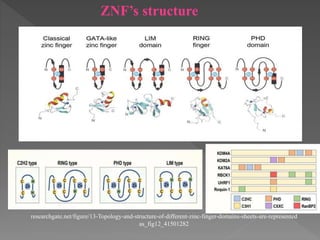
researchgate.net/figure/13-Topology-and-structure-of-different-zinc-finger-domains-sheets-are-represented
as_fig12_41501282
ZNF’s structure
 C2H2 ZNFs, there are a large number of transcription factors with the C-
x-C-x-H-x-H motif, which mediates direct interaction with DNA. One of
the C2H2 members, ZNF217, contains multiple C2H2 domains. These
domains bind a specific DNA sequence (T/A)(G/A)CAGAA(T/G/C),
repressing the expression of target genes.
 The group of RING domain proteins include numerous E3-ubiquitin
ligases. The RING-motif structure is C-x-C-x-C-x-H-x-C-x-C-x-C-x-C.
One of the most important E3-ubiquitin ligases, Mouse Double Minute 2
(MDM2), which is involved in cancer progression, has a RING domain.
This domain mediates its interaction with itself and Mouse Double Minute
4 (MDM4). This domain is also important for E3-ubiquitin ligase activity.
 The PHD zinc-finger domains are involved in the regulation of epigenetic
modifications via their chromatin-remodelling ability. The PHD motif has
the following primary structure: C-x-C-x-C-x-C-x-H-x-C-x-C-x-C. One of
the ZNFs with a PHD domain is Lysine Demethylase 2A (KDM2A),
which mediates nucleosome recognition.
 Currently, LIM-type class of ZNFs contains proteins important for actin
targeting, cytoskeleton interaction, and focal adhesion. One important
member, Paxillin, has four LIM motifs. The LIM motif structure is C-x-C-
x-H-x-C-x-C-x-C-x-C-x-(C,H,D). The zinc-finger domain of Paxillin
mediates β-catenin interaction at focal adhesion sites and stress fibers.
1. Skin : Through their ability to regulate gene expression, ZNF proteins
participate in numerous physiological processes, including cell
proliferation, differentiation, and apoptosis, thereby maintaining tissue
homeostasis.
2. Intestine : ZNF proteins are also involved in intestinal epithelium
biology. KLF4 also has a key role in the intestines. In intestinal
epithelium , KLF4 is expressed in the terminally differentiated epithelial
cells (luminal surface) and goblet cells (crypts), where it promotes
differentiation and inhibits proliferation.
3. Muscle : ZNFs have a regulatory function in muscle differentiation.
SET and MYND Domain Containing 1 (SMYD1), which is specifically
expressed in striated muscle, acts as an essential regulator of myogenesis.
SMYD1 deletion impaired myoblast differentiation, decreasing myofibre
formation and reducing muscle-specific gene expression.
4. Adipose tissue : An increased number of ZNFs as key transcriptional
regulators involved in adipogenesis. ZNF638 seems to positively regulate this
process given that its expression increases during preadipocyte differentiation.
Indeed, ectopic expression of ZNF638 results in increased adipogenesis in
vitro.
On the other hand, inhibition of ZNF638 expression decreases differentiation
by inhibiting the expression of adipocyte-specific genes.
Specifically, ZNF638 promotes adipogenesis by acting as a transcriptional co-
factor of CCAAT/enhancer-binding protein (C/EBP) and results in the
expression of peroxisome proliferator-activated receptor γ (PPARG), which
regulates adipocyte differentiation
 Tumour suppressor and oncogenic functions of ZNFs
Recent findings have highlighted the importance of ZNFs in cancer onset and
progression. The zinc-finger family includes both tumour suppressor genes
and oncogenes. ZNFs are involved in all the principal pathways of cancer
progression from carcinogenesis to metastasis formation. Furthermore, ZNFs
are involved in cancer via their transcription factor function. In addition,
emerging evidence indicates the importance of zinc-finger proteins as
recruiters of chromatin modifiers or as structural proteins that regulate cancer
cell migration and invasion.
e.g.
ZNF281
ZNF750
ZNF185
ZBP89
MDM2
ZEB1
 In recent years, ZNFs have been demonstrated to have an important role in
the pathogenesis of neuronal diseases. Spinal muscular atrophy (SMA) is
a rare neuromuscular disorder characterized by loss of α-motor neurons in
the anterior horn of the spinal cord and progressive muscle wasting, often
leading to early death.The cause of the disease is a mutation in
the Survival Motor Neurons 1 (SMN1) gene that results in reduced
expression of the full-length SMN protein, which is necessary for survival
of motor neurons.
e.g.
ZPR1 - important role in the pathogenesis of neuronal diseases (SMA)
ZNF179 - a possible role in the central nervous system
ZNF746 - in the pathogenesis of Parkinson’s disease
ZNF750 - important roles of ZNFs in psoriasis. Psoriasis is a chronic
inflammatory disorder of the skin
 Zinc fingerprint that recognize novel DNA sequences are the basis of a
powerful technology platform with many uses in drug discovery and
therapeutics
 Zinc fingerprints mediated regulation of endogenous gene could make it
possible to use gene in the drug discovery application that would
otherwise required securing in the actual property right for a
corresponding complementary DNA sequence
 Zinc fingerprint transcription factor are made by combining the ZNF with
domain that either activate or repress genes.
 ZFP TF’s are used in drug disc cavity regulate gene for target validation
high throughput screening and human therapeutics
 The most common application for engineered zinc finger arrays include
zinc finger transcription factor and zinc finger nucleases
 https://www.ncbi.nlm.nih.gov/pmc/articles/PMC3801298/
 https://www.nature.com/articles/cddiscovery201771
 https://www.slideshare.net/YgGoyat/zinc-finger-protein
ZINC FINGER PROTEIN.pptx

ZINC FINGER PROTEIN.pptx

  • 1.
    Presented by: Shobhini Chandel M.Pharm Pharmacology 1stsemester Submittedto: Dr. Salahuddin Head of Department Pharmaceutical Chemistry NIET(Pharmacy Institute) Zinc Finger Protein
  • 2.
     Introduction  ZNFstructure and classification  ZNF’s molecular functions  Physiological role of ZNFs  Role of ZNFs in diseases  Role of ZNFs in neurodegenerative diseases
  • 3.
     Zinc-finger proteins(ZNFs) are one of the most abundant groups of proteins and have a wide range of molecular functions.  Given the wide variety of zinc-finger domains, ZNFs are able to interact with DNA, RNA, PAR (poly-ADP-ribose) and other proteins.  Thus, ZNFs are involved in the regulation of several cellular processes.  In fact, ZNFs are implicated in transcriptional regulation, ubiquitin- mediated protein degradation, signal transduction, actin targeting, DNA repair, cell migration, and numerous other processes.
  • 4.
     ZNFs havekey role in development and differentiation of several tissues.  ZNFs are involved in tumorigenesis, cancer progression and metastasis formation.  Alterations in ZNFs are involved in the development of several of diseases such as neurodegeneration, skin disease and diabetes.
  • 5.
     The firstZNF was identified in the late 1980s was Transcription Factor IIIa (TFIIIa) from Xenopus laevis.  This gave rise to the discovery of a new group of transcriptional activator proteins with a 30 amino acid repeating region.  This new class of proteins was able to bind specific sequences of DNA.  The zinc-finger structure is maintained by the zinc ion, which coordinates cysteine and histidine in different combinations.
  • 6.
     In classicalC2H2 zinc-finger proteins, two cysteines in one chain and two histidines in other one are coordinated by a zinc ion. Crystallographic studies revealed that classical zinc-finger domains have two β-sheets and one α-helix.  Non-classical types of zinc-finger differ in cysteine/histidine combinations, such as C2–H2, C2–CH, and C2–C2. Currently, 30 types of ZNFs are approved by The HUGO Gene Nomenclature Committee and ZNF classification is based on the zinc-finger domain structure.  The most important and abundant types of zinc-finger domain proteins include C2H2, really interesting new gene (RING), plant homeodomain (PHD), and Lin-ll, Isl-1, and Mec-3 (LIM domains).
  • 7.
  • 8.
     C2H2 ZNFs,there are a large number of transcription factors with the C- x-C-x-H-x-H motif, which mediates direct interaction with DNA. One of the C2H2 members, ZNF217, contains multiple C2H2 domains. These domains bind a specific DNA sequence (T/A)(G/A)CAGAA(T/G/C), repressing the expression of target genes.  The group of RING domain proteins include numerous E3-ubiquitin ligases. The RING-motif structure is C-x-C-x-C-x-H-x-C-x-C-x-C-x-C. One of the most important E3-ubiquitin ligases, Mouse Double Minute 2 (MDM2), which is involved in cancer progression, has a RING domain. This domain mediates its interaction with itself and Mouse Double Minute 4 (MDM4). This domain is also important for E3-ubiquitin ligase activity.
  • 9.
     The PHDzinc-finger domains are involved in the regulation of epigenetic modifications via their chromatin-remodelling ability. The PHD motif has the following primary structure: C-x-C-x-C-x-C-x-H-x-C-x-C-x-C. One of the ZNFs with a PHD domain is Lysine Demethylase 2A (KDM2A), which mediates nucleosome recognition.  Currently, LIM-type class of ZNFs contains proteins important for actin targeting, cytoskeleton interaction, and focal adhesion. One important member, Paxillin, has four LIM motifs. The LIM motif structure is C-x-C- x-H-x-C-x-C-x-C-x-C-x-(C,H,D). The zinc-finger domain of Paxillin mediates β-catenin interaction at focal adhesion sites and stress fibers.
  • 10.
    1. Skin :Through their ability to regulate gene expression, ZNF proteins participate in numerous physiological processes, including cell proliferation, differentiation, and apoptosis, thereby maintaining tissue homeostasis. 2. Intestine : ZNF proteins are also involved in intestinal epithelium biology. KLF4 also has a key role in the intestines. In intestinal epithelium , KLF4 is expressed in the terminally differentiated epithelial cells (luminal surface) and goblet cells (crypts), where it promotes differentiation and inhibits proliferation. 3. Muscle : ZNFs have a regulatory function in muscle differentiation. SET and MYND Domain Containing 1 (SMYD1), which is specifically expressed in striated muscle, acts as an essential regulator of myogenesis. SMYD1 deletion impaired myoblast differentiation, decreasing myofibre formation and reducing muscle-specific gene expression.
  • 11.
    4. Adipose tissue: An increased number of ZNFs as key transcriptional regulators involved in adipogenesis. ZNF638 seems to positively regulate this process given that its expression increases during preadipocyte differentiation. Indeed, ectopic expression of ZNF638 results in increased adipogenesis in vitro. On the other hand, inhibition of ZNF638 expression decreases differentiation by inhibiting the expression of adipocyte-specific genes. Specifically, ZNF638 promotes adipogenesis by acting as a transcriptional co- factor of CCAAT/enhancer-binding protein (C/EBP) and results in the expression of peroxisome proliferator-activated receptor γ (PPARG), which regulates adipocyte differentiation
  • 12.
     Tumour suppressorand oncogenic functions of ZNFs Recent findings have highlighted the importance of ZNFs in cancer onset and progression. The zinc-finger family includes both tumour suppressor genes and oncogenes. ZNFs are involved in all the principal pathways of cancer progression from carcinogenesis to metastasis formation. Furthermore, ZNFs are involved in cancer via their transcription factor function. In addition, emerging evidence indicates the importance of zinc-finger proteins as recruiters of chromatin modifiers or as structural proteins that regulate cancer cell migration and invasion. e.g. ZNF281 ZNF750 ZNF185 ZBP89 MDM2 ZEB1
  • 13.
     In recentyears, ZNFs have been demonstrated to have an important role in the pathogenesis of neuronal diseases. Spinal muscular atrophy (SMA) is a rare neuromuscular disorder characterized by loss of α-motor neurons in the anterior horn of the spinal cord and progressive muscle wasting, often leading to early death.The cause of the disease is a mutation in the Survival Motor Neurons 1 (SMN1) gene that results in reduced expression of the full-length SMN protein, which is necessary for survival of motor neurons. e.g. ZPR1 - important role in the pathogenesis of neuronal diseases (SMA) ZNF179 - a possible role in the central nervous system ZNF746 - in the pathogenesis of Parkinson’s disease ZNF750 - important roles of ZNFs in psoriasis. Psoriasis is a chronic inflammatory disorder of the skin
  • 14.
     Zinc fingerprintthat recognize novel DNA sequences are the basis of a powerful technology platform with many uses in drug discovery and therapeutics  Zinc fingerprints mediated regulation of endogenous gene could make it possible to use gene in the drug discovery application that would otherwise required securing in the actual property right for a corresponding complementary DNA sequence  Zinc fingerprint transcription factor are made by combining the ZNF with domain that either activate or repress genes.  ZFP TF’s are used in drug disc cavity regulate gene for target validation high throughput screening and human therapeutics  The most common application for engineered zinc finger arrays include zinc finger transcription factor and zinc finger nucleases
  • 15.