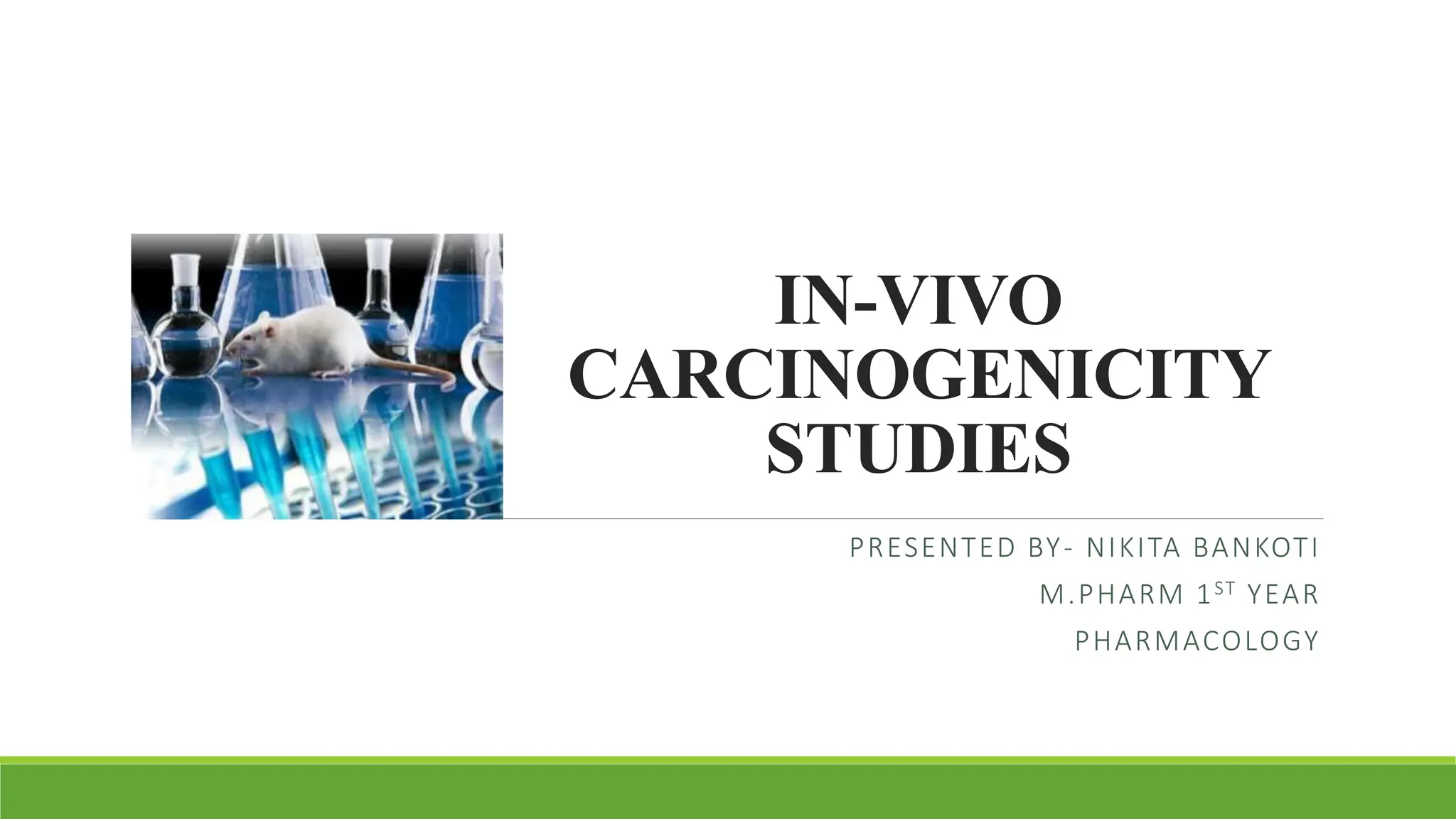
IN-VIVO
CARCINOGENICITY
STUDIES
PRESENTED BY- NIKITA BANKOTI
M.PHARM 1ST YEAR
PHARMACOLOGY
Introduction
Toxicity studies- is the scientific study of adverse/toxic/ lethal effects of the chemical that occur in
living organism.
Carcinogenicity- test involves the identification of carcinogenic effects of the substances.
Carcinogens- the substances which induce cancer or increase its incidence. “Cancer inducing
substance”.
Carcinogens are classified according to their mode of action as genotoxic or nongenotoxic carcinogens.
Genotoxic carcinogens- initiate carcinogenesis by direct interaction with DNA, resulting in DNA
damage or chromosomal aberrations that can be detected by genotoxicity tests. E.g. radiations,
benzo[a]pyrene and aflatoxin B1.
Nongenotoxic carcinogens- are agents that do not directly interact with DNA and are believed to
enchance tumor development by affecting gene expression, signal transduction, or cell proliferation.
E.g. phenobarbital, carbon tetrachloride or diethylstillbestrol.
OECD Guidline for Carcinogenicity Studies.
oThe original Test Guideline 451 on Carcinogenicity Studies was adopted in
1981.
o Development of a revised TG 451 was considered necessary, in order to reflect
recent developments in the field of animal welfare and regulatory requirements.
oThe updating of TG 451 has been carried out in parallel with revisions of the
Test Guidelines 452, Chronic Toxicity Studies, and 453, Combined Chronic
ToxicityCarcinogenicity Studies, and with the objective of obtaining additional
information from the animals used in the study and providing further detail on
dose selection.
oThis Test Guideline is designed to be used in the testing of a broad range of
chemicals, including pesticides and industrial chemicals.
oTest guidelines 451 for carcinogenicity studies are mainly carried out in rodent
species.
oThis guidelines 451 together with those outlined in OECD TG 409, Repeated
dose 90-day oral toxicity study will be conducted for non-rodents species.
oThe three main routes of administration used in carcinogenicity studies are oral,
dermal and inhalation.
o The choice of the route of administration depends on the physical and chemical
characteristics of the test chemical and the predominant route of exposure of
humans.
oThis Guideline mainly focuses on exposure via the oral route, the route most
commonly used in carcinogenicity studies.
oThe study will provide information on the toxic effects of the substance
including potential carcinogenicity, and may indicate target organs and the
possibility of accumulation.
The Objective of Carcinogenicity studies
oThe identification of the carcinogenic properties of a chemical, resulting in an
increased incidence of neoplasms, increased proportion of malignant neoplasms
or a reduction in the time to appearance of neoplasms, compared with concurrent
control groups.
oThe identification of target organ(s) of carcinogenicity.
o The identification of the time to appearance of neoplasms.
oCharacterisation of the tumour dose-response relationship.
oIdentification of a no-observed-adverse-effect level (NOAEL) or point of
departure for establishment of a Benchmark Dose (BMD).
oExtrapolation of carcinogenic effects to low dose human exposure levels.
Principle of the test
oThe test chemical is administered daily in graduated doses to several groups of
test animals for the majority of their life span, normally by the oral route.
o Testing by the inhalation or dermal route may also be appropriate.
oThe animals are observed closely for signs of toxicity and for the development
of neoplastic lesions.
o Animals which die or are killed during the test are necropsied and, at the
conclusion of the test, surviving animals are killed and necropsied.
Description of method
Selection of animal species-
oThis Guideline primarily covers assessment and evaluation of carcinogenicity in
rodents.
oRats and mice have been preferred experimental models because of their relatively short
life span, their widespread use in pharmacological and toxicological studies, their
susceptibility to tumour induction, and the availability of sufficiently characterised
strains.
oYoung healthy adult animals are commonly used.
oThe females should be nulliparous and non-pregnant.
oThe use of non-rodent species may be considered when available data suggest that they
are more relevant for the prediction of health effects in humans.
Housing and feeding-
oAnimals may be housed individually, or be caged in small groups of the same
sex; individual housing should be considered only if scientifically justified.
oThe temperature in the experimental animal room should be 22C (± 3C).
oThe relative humidity should be at least 30% and preferably not exceed 70%.
oLighting should be artificial, the sequence being 12 hours light, 12 hours dark.
oFor feeding, conventional laboratory diets may be used with an unlimited supply
of drinking water.
Preparation of animals-
oHealthy animals which have been acclimated to laboratory conditions for at least 7 days
and have not been subjected to previous experimental procedures, should be used.
oIn the case of rodents, dosing of the animals should begin as soon as possible after
weaning and acclimatisation and preferably before the animals are 8 weeks old.
oThe weight variation for each sex of animal used should be minimal and not exceed ±
20 % of the mean weight of all the animals within the study.
oAnimals should be randomly assigned to the control and treatment groups.
oEach animal should be assigned a unique identification number, after division of
animals in separate gropus.
Procedure
Number and sex of animals-
oBoth sexes should be used.
oA sufficient number of animals should be used so that a thorough biological and
statistical evaluation is possible.
oEach dose group and concurrent control group should therefore contain at least
50 animals of each sex.
Provision for interim kills and satellite (sentinel) groups-
oDuring test study there is a chance that animals may die due to development of
neoplasms(like 10 animals per sex), so to increase the statistical data accuracy
animals will be added (minimum of 5 animals per sex)
Dose groups and dosage-
oAt least three dose levels and concurrent control should be used.
Preparation of doses and administration of test chemical-
oThe test chemical is normally administered orally, via the diet or drinking water, or by gavage.
oThe route and method of administration is dependent on the purpose of the study, the
physical/chemical properties of the test chemical, its bioavailability and the predominant route
and method of exposure of humans.
oWhere necessary, the test chemical is dissolved or suspended in a suitable vehicle. Consideration
should be given to the following characteristics of the vehicle and other additives, as appropriate:
effects on the absorption, distribution, metabolism, or retention of the test chemical; effects on the
chemical properties of the test chemical which may alter its toxic characteristics; and effects on
the food or water consumption or the nutritional status of the animals.
oFor substances administered via the diet or drinking water it is important to
ensure that the quantities of the test chemical involved do not interfere with
normal nutrition or water balance. In long-term toxicity studies using dietary
administration, the concentration of the chemical in the feed should not normally
exceed an upper limit of 5% of the total diet, in order to avoid nutritional
imbalances.
oIn the case of oral administration, the animals are dosed with the test chemical
daily (seven days per week), normally for a period of 24 months for rodents.
oWhen the test chemical is administered by gavage to the animals, this should be
done using a stomach tube or a suitable intubation cannula, at similar times each
day.
oFor dermal administration the test group is treated for at least 6hrs per day, 7
days per week for a period of 24 months.
oFor inhalation route the test group is exposed for 6hrs per day, 7 days per week,
but exposure for 5 days per week may also be used, if justified for a period of 24
months.
Duration of study-
oThe duration of the study will normally be 24 months for rodents.
oShorter or longer study durations may be used, dependent on the lifespan of the strain of the
animal species in the study, but should be justified.
o For specific strains of mice, e.g., AKR/J, C3H/J or C57BL/6J strains a duration of 18 months
may be more appropriate.
oTermination of the study should be considered when the number of survivors in the lower dose
groups or the control group falls below 25 per cent.
oIn the case where only the high dose group dies prematurely due to toxicity, this should not
trigger termination of the study.
oSurvival of each sex should be considered separately.
Observation
oAll animals should be checked for morbidity or mortality, usually at the beginning and the end of
each day, including at weekends and holidays.
oParticular attention should be paid to tumour development; and the time of tumour onset,
location, dimensions, appearance, and progression of each grossly visible or palpable tumour
should be recorded.
Body weight, food/water consumption and food efficiency
oAll animals should be weighed at the start of treatment, at least once a week for the first 13
weeks and at least monthly thereafter.
o Measurements of food consumption and food efficiency should be made at least weekly for the
first 13 weeks and at least monthly thereafter.
o Water consumption should be measured at least weekly for the first 13 weeks and at least
monthly thereafter when the substance is administered in drinking water.
oAnalysis of blood samples and urine samples has to be done.
oGross necropsy has to be done for test and control groups for careful observation of surface of
body, all orifices, the cranial, thoracic and abdominal cavities and their contents.
oHistopathology-
oAll tissues from higher dose and control groups,
oAll tissues of animals dying or killed during study has to be done.
o All tissues showing macroscopic abnormalities including tumours;
oWhen treatment-related histopathological changes are observed in the high dose group, those
same tissues are to be examined from all animals in all other dose groups;
oIn the case of paired organs, e.g., kidney, adrenal, both organs should be examined.
Data And Reporting
oIndividual animal data should be provided for all parameters evaluated.
o Additionally, all data should be summarised in tabular form showing for each
test group the number of animals at the start of the test, the number of animals
found dead during the test or killed for humane reasons and the time of any death
or humane kill, the number showing signs of toxicity, a description of the signs of
toxicity observed, including time of onset, duration, and severity of any toxic
effects, the number of animals showing lesions, the type of lesions and the
percentage of animals displaying each type of lesion.
Test Report
oThe test report should include the following information:
Test chemical:
o physical nature, purity, and physicochemical properties
oidentification data
osource of substance
obatch number
ocertificate of chemical analysis
Test animals:
ospecies/strain used and justification for choice made
onumber, age, and sex of animals at start of test
osource, housing conditions, diet, etc.
oindividual weights of animals at the start of the test
Vehicle (if appropriate):
ojustification for choice of vehicle (if other than water)
Test conditions:
orationale for route of administration and dose selection
o when applicable, the statistical methods used to analyse the data
o details of test chemical formulation/diet preparation.
o route of administration and details of the administration of the test chemical
o actual doses (mg/kg body weight/day), and conversion factor from diet/drinking water
test chemical concentration (mg/kg or ppm) to the actual dose, if applicable
o details of food and water quality
Results- (summary tabulated data and individual animal data should be presented)
IN-VIVO CARCINOGENICITY STUDIES.pptx TG451

IN-VIVO CARCINOGENICITY STUDIES.pptx TG451

  • 1.
    IN-VIVO CARCINOGENICITY STUDIES PRESENTED BY- NIKITABANKOTI M.PHARM 1ST YEAR PHARMACOLOGY
  • 2.
    Introduction Toxicity studies- isthe scientific study of adverse/toxic/ lethal effects of the chemical that occur in living organism. Carcinogenicity- test involves the identification of carcinogenic effects of the substances. Carcinogens- the substances which induce cancer or increase its incidence. “Cancer inducing substance”. Carcinogens are classified according to their mode of action as genotoxic or nongenotoxic carcinogens. Genotoxic carcinogens- initiate carcinogenesis by direct interaction with DNA, resulting in DNA damage or chromosomal aberrations that can be detected by genotoxicity tests. E.g. radiations, benzo[a]pyrene and aflatoxin B1. Nongenotoxic carcinogens- are agents that do not directly interact with DNA and are believed to enchance tumor development by affecting gene expression, signal transduction, or cell proliferation. E.g. phenobarbital, carbon tetrachloride or diethylstillbestrol.
  • 3.
    OECD Guidline forCarcinogenicity Studies. oThe original Test Guideline 451 on Carcinogenicity Studies was adopted in 1981. o Development of a revised TG 451 was considered necessary, in order to reflect recent developments in the field of animal welfare and regulatory requirements. oThe updating of TG 451 has been carried out in parallel with revisions of the Test Guidelines 452, Chronic Toxicity Studies, and 453, Combined Chronic ToxicityCarcinogenicity Studies, and with the objective of obtaining additional information from the animals used in the study and providing further detail on dose selection. oThis Test Guideline is designed to be used in the testing of a broad range of chemicals, including pesticides and industrial chemicals.
  • 4.
    oTest guidelines 451for carcinogenicity studies are mainly carried out in rodent species. oThis guidelines 451 together with those outlined in OECD TG 409, Repeated dose 90-day oral toxicity study will be conducted for non-rodents species. oThe three main routes of administration used in carcinogenicity studies are oral, dermal and inhalation. o The choice of the route of administration depends on the physical and chemical characteristics of the test chemical and the predominant route of exposure of humans. oThis Guideline mainly focuses on exposure via the oral route, the route most commonly used in carcinogenicity studies. oThe study will provide information on the toxic effects of the substance including potential carcinogenicity, and may indicate target organs and the possibility of accumulation.
  • 5.
    The Objective ofCarcinogenicity studies oThe identification of the carcinogenic properties of a chemical, resulting in an increased incidence of neoplasms, increased proportion of malignant neoplasms or a reduction in the time to appearance of neoplasms, compared with concurrent control groups. oThe identification of target organ(s) of carcinogenicity. o The identification of the time to appearance of neoplasms. oCharacterisation of the tumour dose-response relationship. oIdentification of a no-observed-adverse-effect level (NOAEL) or point of departure for establishment of a Benchmark Dose (BMD). oExtrapolation of carcinogenic effects to low dose human exposure levels.
  • 6.
    Principle of thetest oThe test chemical is administered daily in graduated doses to several groups of test animals for the majority of their life span, normally by the oral route. o Testing by the inhalation or dermal route may also be appropriate. oThe animals are observed closely for signs of toxicity and for the development of neoplastic lesions. o Animals which die or are killed during the test are necropsied and, at the conclusion of the test, surviving animals are killed and necropsied.
  • 7.
    Description of method Selectionof animal species- oThis Guideline primarily covers assessment and evaluation of carcinogenicity in rodents. oRats and mice have been preferred experimental models because of their relatively short life span, their widespread use in pharmacological and toxicological studies, their susceptibility to tumour induction, and the availability of sufficiently characterised strains. oYoung healthy adult animals are commonly used. oThe females should be nulliparous and non-pregnant. oThe use of non-rodent species may be considered when available data suggest that they are more relevant for the prediction of health effects in humans.
  • 8.
    Housing and feeding- oAnimalsmay be housed individually, or be caged in small groups of the same sex; individual housing should be considered only if scientifically justified. oThe temperature in the experimental animal room should be 22C (± 3C). oThe relative humidity should be at least 30% and preferably not exceed 70%. oLighting should be artificial, the sequence being 12 hours light, 12 hours dark. oFor feeding, conventional laboratory diets may be used with an unlimited supply of drinking water.
  • 9.
    Preparation of animals- oHealthyanimals which have been acclimated to laboratory conditions for at least 7 days and have not been subjected to previous experimental procedures, should be used. oIn the case of rodents, dosing of the animals should begin as soon as possible after weaning and acclimatisation and preferably before the animals are 8 weeks old. oThe weight variation for each sex of animal used should be minimal and not exceed ± 20 % of the mean weight of all the animals within the study. oAnimals should be randomly assigned to the control and treatment groups. oEach animal should be assigned a unique identification number, after division of animals in separate gropus.
  • 10.
    Procedure Number and sexof animals- oBoth sexes should be used. oA sufficient number of animals should be used so that a thorough biological and statistical evaluation is possible. oEach dose group and concurrent control group should therefore contain at least 50 animals of each sex. Provision for interim kills and satellite (sentinel) groups- oDuring test study there is a chance that animals may die due to development of neoplasms(like 10 animals per sex), so to increase the statistical data accuracy animals will be added (minimum of 5 animals per sex)
  • 11.
    Dose groups anddosage- oAt least three dose levels and concurrent control should be used. Preparation of doses and administration of test chemical- oThe test chemical is normally administered orally, via the diet or drinking water, or by gavage. oThe route and method of administration is dependent on the purpose of the study, the physical/chemical properties of the test chemical, its bioavailability and the predominant route and method of exposure of humans. oWhere necessary, the test chemical is dissolved or suspended in a suitable vehicle. Consideration should be given to the following characteristics of the vehicle and other additives, as appropriate: effects on the absorption, distribution, metabolism, or retention of the test chemical; effects on the chemical properties of the test chemical which may alter its toxic characteristics; and effects on the food or water consumption or the nutritional status of the animals.
  • 12.
    oFor substances administeredvia the diet or drinking water it is important to ensure that the quantities of the test chemical involved do not interfere with normal nutrition or water balance. In long-term toxicity studies using dietary administration, the concentration of the chemical in the feed should not normally exceed an upper limit of 5% of the total diet, in order to avoid nutritional imbalances. oIn the case of oral administration, the animals are dosed with the test chemical daily (seven days per week), normally for a period of 24 months for rodents.
  • 13.
    oWhen the testchemical is administered by gavage to the animals, this should be done using a stomach tube or a suitable intubation cannula, at similar times each day. oFor dermal administration the test group is treated for at least 6hrs per day, 7 days per week for a period of 24 months. oFor inhalation route the test group is exposed for 6hrs per day, 7 days per week, but exposure for 5 days per week may also be used, if justified for a period of 24 months.
  • 14.
    Duration of study- oTheduration of the study will normally be 24 months for rodents. oShorter or longer study durations may be used, dependent on the lifespan of the strain of the animal species in the study, but should be justified. o For specific strains of mice, e.g., AKR/J, C3H/J or C57BL/6J strains a duration of 18 months may be more appropriate. oTermination of the study should be considered when the number of survivors in the lower dose groups or the control group falls below 25 per cent. oIn the case where only the high dose group dies prematurely due to toxicity, this should not trigger termination of the study. oSurvival of each sex should be considered separately.
  • 15.
    Observation oAll animals shouldbe checked for morbidity or mortality, usually at the beginning and the end of each day, including at weekends and holidays. oParticular attention should be paid to tumour development; and the time of tumour onset, location, dimensions, appearance, and progression of each grossly visible or palpable tumour should be recorded. Body weight, food/water consumption and food efficiency oAll animals should be weighed at the start of treatment, at least once a week for the first 13 weeks and at least monthly thereafter. o Measurements of food consumption and food efficiency should be made at least weekly for the first 13 weeks and at least monthly thereafter. o Water consumption should be measured at least weekly for the first 13 weeks and at least monthly thereafter when the substance is administered in drinking water.
  • 16.
    oAnalysis of bloodsamples and urine samples has to be done. oGross necropsy has to be done for test and control groups for careful observation of surface of body, all orifices, the cranial, thoracic and abdominal cavities and their contents. oHistopathology- oAll tissues from higher dose and control groups, oAll tissues of animals dying or killed during study has to be done. o All tissues showing macroscopic abnormalities including tumours; oWhen treatment-related histopathological changes are observed in the high dose group, those same tissues are to be examined from all animals in all other dose groups; oIn the case of paired organs, e.g., kidney, adrenal, both organs should be examined.
  • 17.
    Data And Reporting oIndividualanimal data should be provided for all parameters evaluated. o Additionally, all data should be summarised in tabular form showing for each test group the number of animals at the start of the test, the number of animals found dead during the test or killed for humane reasons and the time of any death or humane kill, the number showing signs of toxicity, a description of the signs of toxicity observed, including time of onset, duration, and severity of any toxic effects, the number of animals showing lesions, the type of lesions and the percentage of animals displaying each type of lesion.
  • 18.
    Test Report oThe testreport should include the following information: Test chemical: o physical nature, purity, and physicochemical properties oidentification data osource of substance obatch number ocertificate of chemical analysis
  • 19.
    Test animals: ospecies/strain usedand justification for choice made onumber, age, and sex of animals at start of test osource, housing conditions, diet, etc. oindividual weights of animals at the start of the test Vehicle (if appropriate): ojustification for choice of vehicle (if other than water)
  • 20.
    Test conditions: orationale forroute of administration and dose selection o when applicable, the statistical methods used to analyse the data o details of test chemical formulation/diet preparation. o route of administration and details of the administration of the test chemical o actual doses (mg/kg body weight/day), and conversion factor from diet/drinking water test chemical concentration (mg/kg or ppm) to the actual dose, if applicable o details of food and water quality Results- (summary tabulated data and individual animal data should be presented)