IN SILICO LEAD DISCOVERY
TECHNIQUES
SIRAJUDDIN MOLLA
Research scholar
DEPARTMENT OF PHARMACOLOGY
SPER, JAMIA HAMDARD
 Introduction
 Properties of lead
 Choosing disease & drug target
 Identifying a bioassay
 Finding a lead compound
 Isolation & purification
 Structure determination
 SAR
 Identification of pharmacophore
CONTENTS
 Once a target & a testing system has been chosen, the next is to find a
“Lead Compound” which shows the desired pharmaceutical activity.
 It is a new chemical entity that could potentially be developed into a new
drug by optimizing its beneficial effects and minimizing its side effects.
 Lead compounds are typically used as starting points in the drug design to
give new drug entities
 Drug Design strategies can be used to improve the compounds
pharmacodynamics and pharmacokinetics properties.
 The resulting compounds from drug design go through a series of
preclinical studies and become clinical candidates if the compounds do not
exhibit adverse effects or toxicity during in vitro and in vivo studies.
 After going through marketing obstacles and clinical trials, compounds
that pass are released in the market as new drug entities.
INTRODUCTION
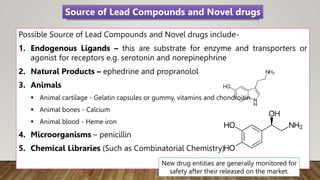
Possible Source of Lead Compounds and Novel drugs include-
1. Endogenous Ligands – this are substrate for enzyme and transporters or
agonist for receptors e.g. serotonin and norepinephrine
2. Natural Products – ephedrine and propranolol
3. Animals
 Animal cartilage - Gelatin capsules or gummy, vitamins and chondroitin
 Animal bones - Calcium
 Animal blood - Heme iron
4. Microorganisms – penicillin
5. Chemical Libraries (Such as Combinatorial Chemistry)
Source of Lead Compounds and Novel drugs
New drug entities are generally monitored for
safety after their released on the market.
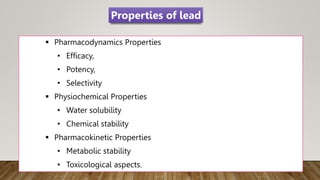
 Pharmacodynamics Properties
• Efficacy,
• Potency,
• Selectivity
 Physiochemical Properties
• Water solubility
• Chemical stability
 Pharmacokinetic Properties
• Metabolic stability
• Toxicological aspects.
Properties of lead
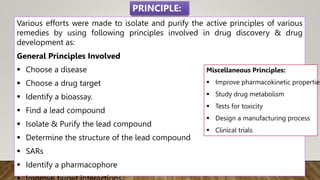
Various efforts were made to isolate and purify the active principles of various
remedies by using following principles involved in drug discovery & drug
development as:
General Principles Involved
 Choose a disease
 Choose a drug target
 Identify a bioassay.
 Find a lead compound
 Isolate & Purify the lead compound
 Determine the structure of the lead compound
 SARs
 Identify a pharmacophore
PRINCIPLE:
Miscellaneous Principles:
 Improve pharmacokinetic properties
 Study drug metabolism
 Tests for toxicity
 Design a manufacturing process
 Clinical trials
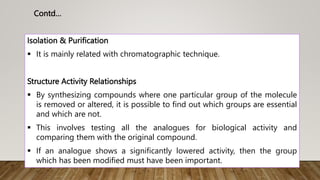
Isolation & Purification
 It is mainly related with chromatographic technique.
Structure Activity Relationships
 By synthesizing compounds where one particular group of the molecule
is removed or altered, it is possible to find out which groups are essential
and which are not.
 This involves testing all the analogues for biological activity and
comparing them with the original compound.
 If an analogue shows a significantly lowered activity, then the group
which has been modified must have been important.
Contd…
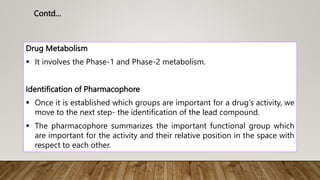
Drug Metabolism
 It involves the Phase-1 and Phase-2 metabolism.
Identification of Pharmacophore
 Once it is established which groups are important for a drug's activity, we
move to the next step- the identification of the lead compound.
 The pharmacophore summarizes the important functional group which
are important for the activity and their relative position in the space with
respect to each other.
Contd…
 Before the drugs move for the clinical trials it is tested for: its toxicity.
 Safety assessment starts with in vitro and in vivo testing on
genetically engineered cell culture or transgenic mice to examine any
effects on the cell reproduction and to identify potential carcinogens.
 Toxicity of a drug used to measured by its LD-50 value (the lethal
dose required to kill the 50% of a group of animals).
 For e.g., UK-47265, an antifungal agent was an extremely promising
one, but in vivo tests on mice, dogs and rats showed that it had liver
toxicity and was potentially teratogenic agent.
Toxicity Testing
There are four phases of clinical trials:
 Phase-1: Healthy volunteers take the drug to test whether the drug has the
effect claimed including desired potency, its pharmacokinetics, side effects.
• Patients may also be used.
 Phase-2: Testing of drugs on a small group of patients
 Phase-3: Drug is to be tested on a much larger sample of patients and
compared with other available treatments, i.e. they may be compared with
placebo (a preparation which has no effect at all).
• There is random selection of the patients.
 Phase-4: The drug is now placed on the market and can be prescribed.
 However, the drug is still monitored for its effectiveness & for any unexpected
side-effects.
Clinical Trials
 Random Screening
 Non-random Screening
 High-Throughput Screening
 Structure based drug design
Method of lead identification
 This method was followed before 1970.“
 All compounds including synthetic chemicals, natural products of plant,
marine and microbial origin from a given series are tested.
 Inspite of budgetary and manpower overuse, this method may be used
to discover drugs or leads that have unexpected activities.
 Antibiotics like, streptomycin and tetracyclines were found out by this
method.
Random or targeted Screening method
 After 1970 this method was used.
 It is a modified form of random screening which was developed because
of budgetary and man power restrictions.
 In this method, only such compounds having similar structural skeletons
with that of lead are tested.
Non-random Screening method
 Test thousands of compounds against the target to identify any that
might be promising natural product and synthetic compound libraries
with millions of compounds are screened using a test assay.
 In theory generating the entire ‘chemical space’ for drug molecules and
testing them would be an elegant approach to drug discover
High-Throughput Screening method
 Three dimensional structures of compounds from virtual or physically
existing libraries are docked into binding sites of target proteins with
known or predicted structure.
 Scoring functions evaluate the steric and electrostatic complementarity
between compounds and the target protein.
 The highest ranked compounds are then suggested for biological testing.
Structure based drug design
REFERENCES
• JP Hughes; S Rees; SB Kalindjian; KL Philpott (2011). Principles of early drug
discovery. , 162(6), 1239–1249. doi:10.1111/j.1476-5381.2010.01127.x
• Macalino, Stephani Joy Y.; Gosu, Vijayakumar; Hong, Sunhye; Choi, Sun (2015).
Role of computer-aided drug design in modern drug discovery. Archives of
Pharmacal Research, 38(9), 1686–1701. doi:10.1007/s12272-015-0640-5
• Batool, Maria; Ahmad, Bilal; Choi, Sangdun (2019). A Structure-Based Drug
Discovery Paradigm. International Journal of Molecular Sciences, 20(11), 2783–.
doi:10.3390/ijms20112783
• Daiki Erikawa, MERMAID : an open source automated hit to lead method based
on deep reinforcement learning, journal of Cheminformatics, 2021 pg.2-10.
• William L. Jorgensen, Efficient Drug Lead Discovery and Optimization, Accounts
of chemical research, 2009 pg. 724-733.
In silico lead discovery technique.pptx

In silico lead discovery technique.pptx

  • 1.
    IN SILICO LEADDISCOVERY TECHNIQUES SIRAJUDDIN MOLLA Research scholar DEPARTMENT OF PHARMACOLOGY SPER, JAMIA HAMDARD
  • 2.
     Introduction  Propertiesof lead  Choosing disease & drug target  Identifying a bioassay  Finding a lead compound  Isolation & purification  Structure determination  SAR  Identification of pharmacophore CONTENTS
  • 3.
     Once atarget & a testing system has been chosen, the next is to find a “Lead Compound” which shows the desired pharmaceutical activity.  It is a new chemical entity that could potentially be developed into a new drug by optimizing its beneficial effects and minimizing its side effects.  Lead compounds are typically used as starting points in the drug design to give new drug entities  Drug Design strategies can be used to improve the compounds pharmacodynamics and pharmacokinetics properties.  The resulting compounds from drug design go through a series of preclinical studies and become clinical candidates if the compounds do not exhibit adverse effects or toxicity during in vitro and in vivo studies.  After going through marketing obstacles and clinical trials, compounds that pass are released in the market as new drug entities. INTRODUCTION
  • 4.
    Possible Source ofLead Compounds and Novel drugs include- 1. Endogenous Ligands – this are substrate for enzyme and transporters or agonist for receptors e.g. serotonin and norepinephrine 2. Natural Products – ephedrine and propranolol 3. Animals  Animal cartilage - Gelatin capsules or gummy, vitamins and chondroitin  Animal bones - Calcium  Animal blood - Heme iron 4. Microorganisms – penicillin 5. Chemical Libraries (Such as Combinatorial Chemistry) Source of Lead Compounds and Novel drugs New drug entities are generally monitored for safety after their released on the market.
  • 5.
     Pharmacodynamics Properties •Efficacy, • Potency, • Selectivity  Physiochemical Properties • Water solubility • Chemical stability  Pharmacokinetic Properties • Metabolic stability • Toxicological aspects. Properties of lead
  • 6.
    Various efforts weremade to isolate and purify the active principles of various remedies by using following principles involved in drug discovery & drug development as: General Principles Involved  Choose a disease  Choose a drug target  Identify a bioassay.  Find a lead compound  Isolate & Purify the lead compound  Determine the structure of the lead compound  SARs  Identify a pharmacophore PRINCIPLE: Miscellaneous Principles:  Improve pharmacokinetic properties  Study drug metabolism  Tests for toxicity  Design a manufacturing process  Clinical trials
  • 7.
    Isolation & Purification It is mainly related with chromatographic technique. Structure Activity Relationships  By synthesizing compounds where one particular group of the molecule is removed or altered, it is possible to find out which groups are essential and which are not.  This involves testing all the analogues for biological activity and comparing them with the original compound.  If an analogue shows a significantly lowered activity, then the group which has been modified must have been important. Contd…
  • 8.
    Drug Metabolism  Itinvolves the Phase-1 and Phase-2 metabolism. Identification of Pharmacophore  Once it is established which groups are important for a drug's activity, we move to the next step- the identification of the lead compound.  The pharmacophore summarizes the important functional group which are important for the activity and their relative position in the space with respect to each other. Contd…
  • 9.
     Before thedrugs move for the clinical trials it is tested for: its toxicity.  Safety assessment starts with in vitro and in vivo testing on genetically engineered cell culture or transgenic mice to examine any effects on the cell reproduction and to identify potential carcinogens.  Toxicity of a drug used to measured by its LD-50 value (the lethal dose required to kill the 50% of a group of animals).  For e.g., UK-47265, an antifungal agent was an extremely promising one, but in vivo tests on mice, dogs and rats showed that it had liver toxicity and was potentially teratogenic agent. Toxicity Testing
  • 10.
    There are fourphases of clinical trials:  Phase-1: Healthy volunteers take the drug to test whether the drug has the effect claimed including desired potency, its pharmacokinetics, side effects. • Patients may also be used.  Phase-2: Testing of drugs on a small group of patients  Phase-3: Drug is to be tested on a much larger sample of patients and compared with other available treatments, i.e. they may be compared with placebo (a preparation which has no effect at all). • There is random selection of the patients.  Phase-4: The drug is now placed on the market and can be prescribed.  However, the drug is still monitored for its effectiveness & for any unexpected side-effects. Clinical Trials
  • 11.
     Random Screening Non-random Screening  High-Throughput Screening  Structure based drug design Method of lead identification
  • 12.
     This methodwas followed before 1970.“  All compounds including synthetic chemicals, natural products of plant, marine and microbial origin from a given series are tested.  Inspite of budgetary and manpower overuse, this method may be used to discover drugs or leads that have unexpected activities.  Antibiotics like, streptomycin and tetracyclines were found out by this method. Random or targeted Screening method
  • 13.
     After 1970this method was used.  It is a modified form of random screening which was developed because of budgetary and man power restrictions.  In this method, only such compounds having similar structural skeletons with that of lead are tested. Non-random Screening method
  • 14.
     Test thousandsof compounds against the target to identify any that might be promising natural product and synthetic compound libraries with millions of compounds are screened using a test assay.  In theory generating the entire ‘chemical space’ for drug molecules and testing them would be an elegant approach to drug discover High-Throughput Screening method
  • 15.
     Three dimensionalstructures of compounds from virtual or physically existing libraries are docked into binding sites of target proteins with known or predicted structure.  Scoring functions evaluate the steric and electrostatic complementarity between compounds and the target protein.  The highest ranked compounds are then suggested for biological testing. Structure based drug design
  • 16.
    REFERENCES • JP Hughes;S Rees; SB Kalindjian; KL Philpott (2011). Principles of early drug discovery. , 162(6), 1239–1249. doi:10.1111/j.1476-5381.2010.01127.x • Macalino, Stephani Joy Y.; Gosu, Vijayakumar; Hong, Sunhye; Choi, Sun (2015). Role of computer-aided drug design in modern drug discovery. Archives of Pharmacal Research, 38(9), 1686–1701. doi:10.1007/s12272-015-0640-5 • Batool, Maria; Ahmad, Bilal; Choi, Sangdun (2019). A Structure-Based Drug Discovery Paradigm. International Journal of Molecular Sciences, 20(11), 2783–. doi:10.3390/ijms20112783 • Daiki Erikawa, MERMAID : an open source automated hit to lead method based on deep reinforcement learning, journal of Cheminformatics, 2021 pg.2-10. • William L. Jorgensen, Efficient Drug Lead Discovery and Optimization, Accounts of chemical research, 2009 pg. 724-733.