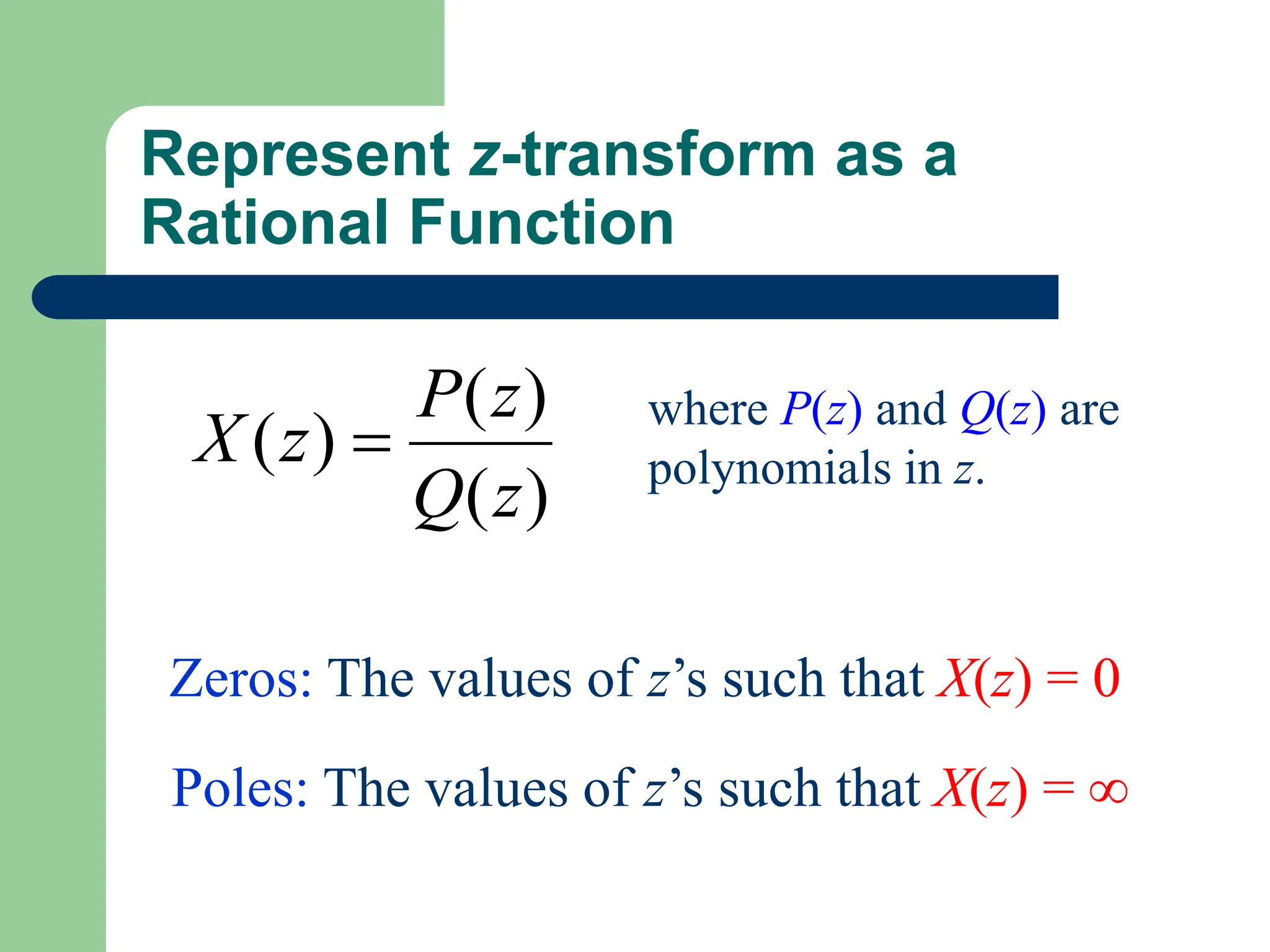
The document discusses the z-transform, which is a generalization of the Fourier transform used to analyze discrete-time signals and systems. It defines the z-transform, explains why it is used instead of the Fourier transform, and discusses its region of convergence and properties of poles and zeros. Examples are provided to illustrate key concepts such as how the region of convergence is determined by the signal type (left-sided, right-sided, two-sided). Important z-transform pairs are also summarized.
Content
Introduction
z-Transform
Zeros and Poles
Region of Convergence
Important z-Transform Pairs
Inverse z-Transform
z-Transform Theorems and Properties
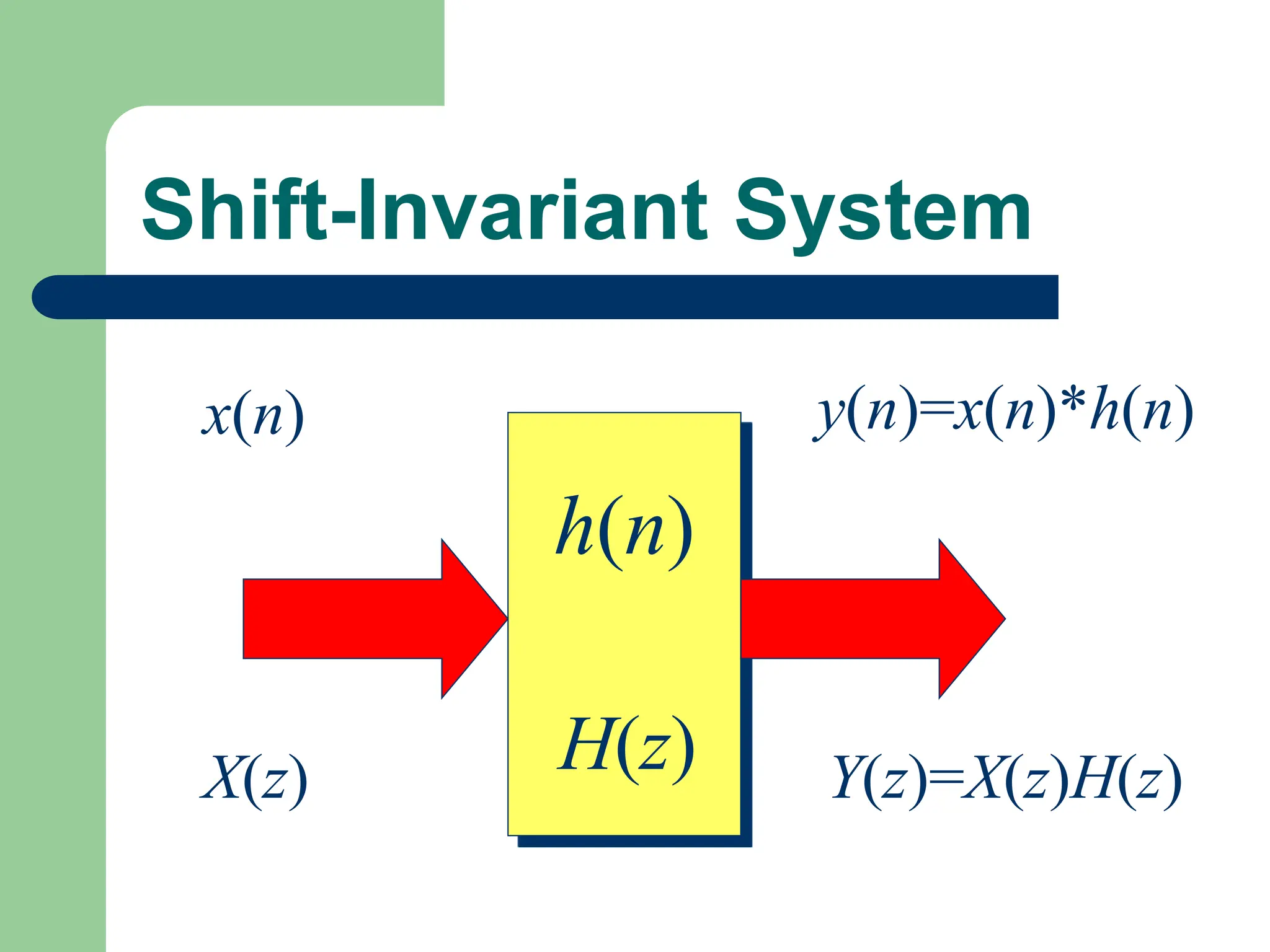
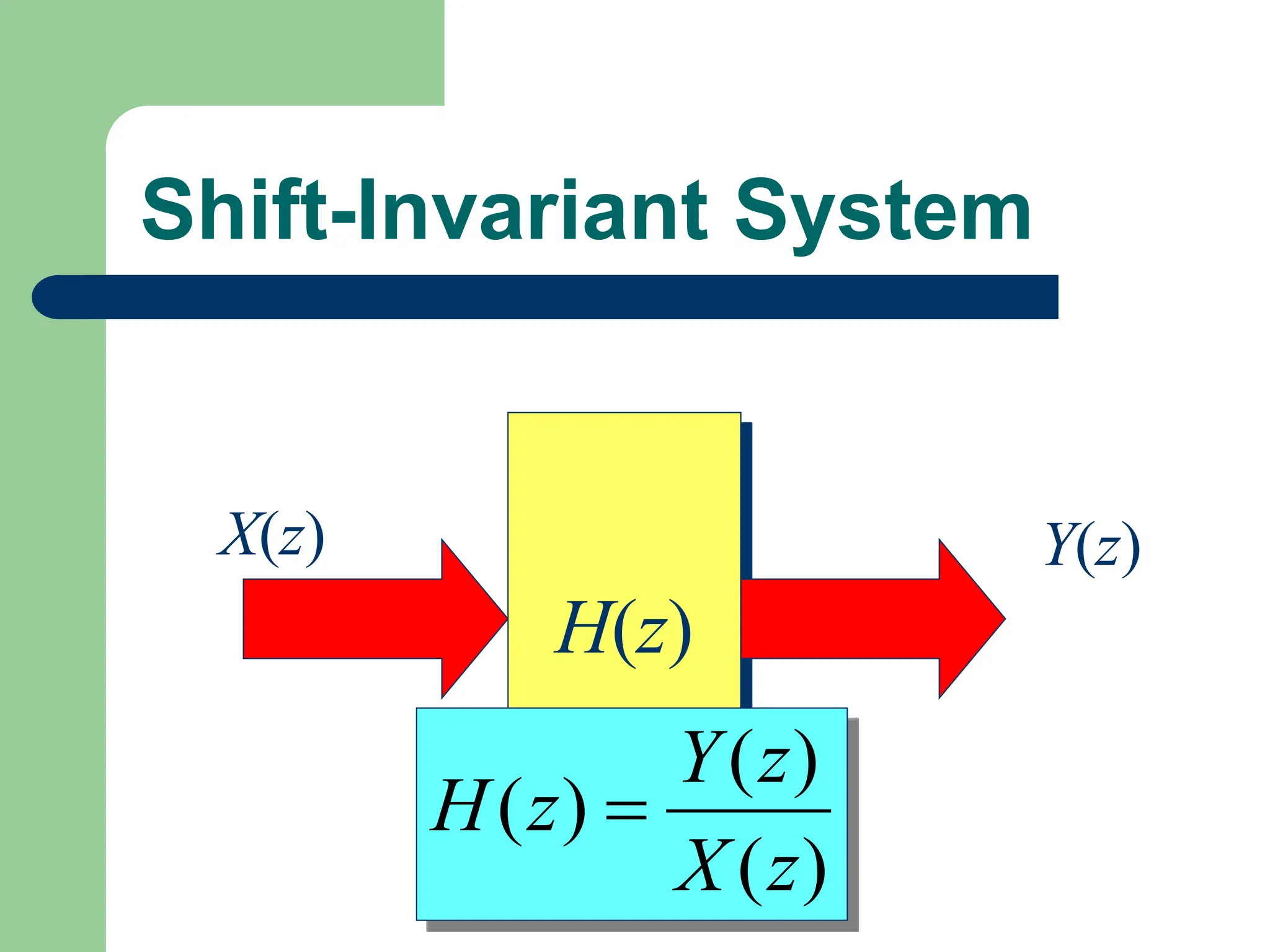
System Function
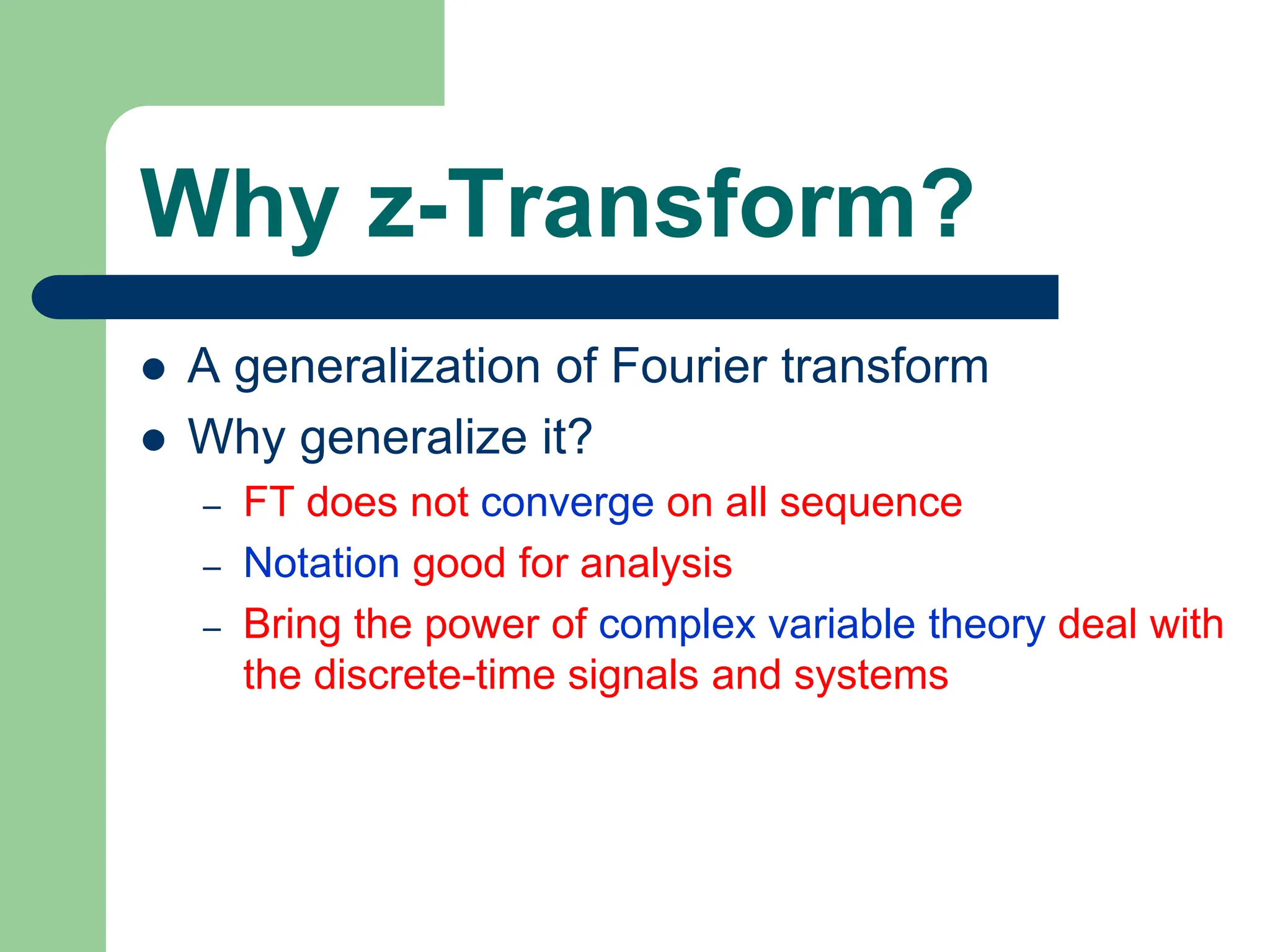
Why z-Transform?
Ageneralization of Fourier transform
Why generalize it?
– FT does not converge on all sequence
– Notation good for analysis
– Bring the power of complex variable theory deal with
the discrete-time signals and systems
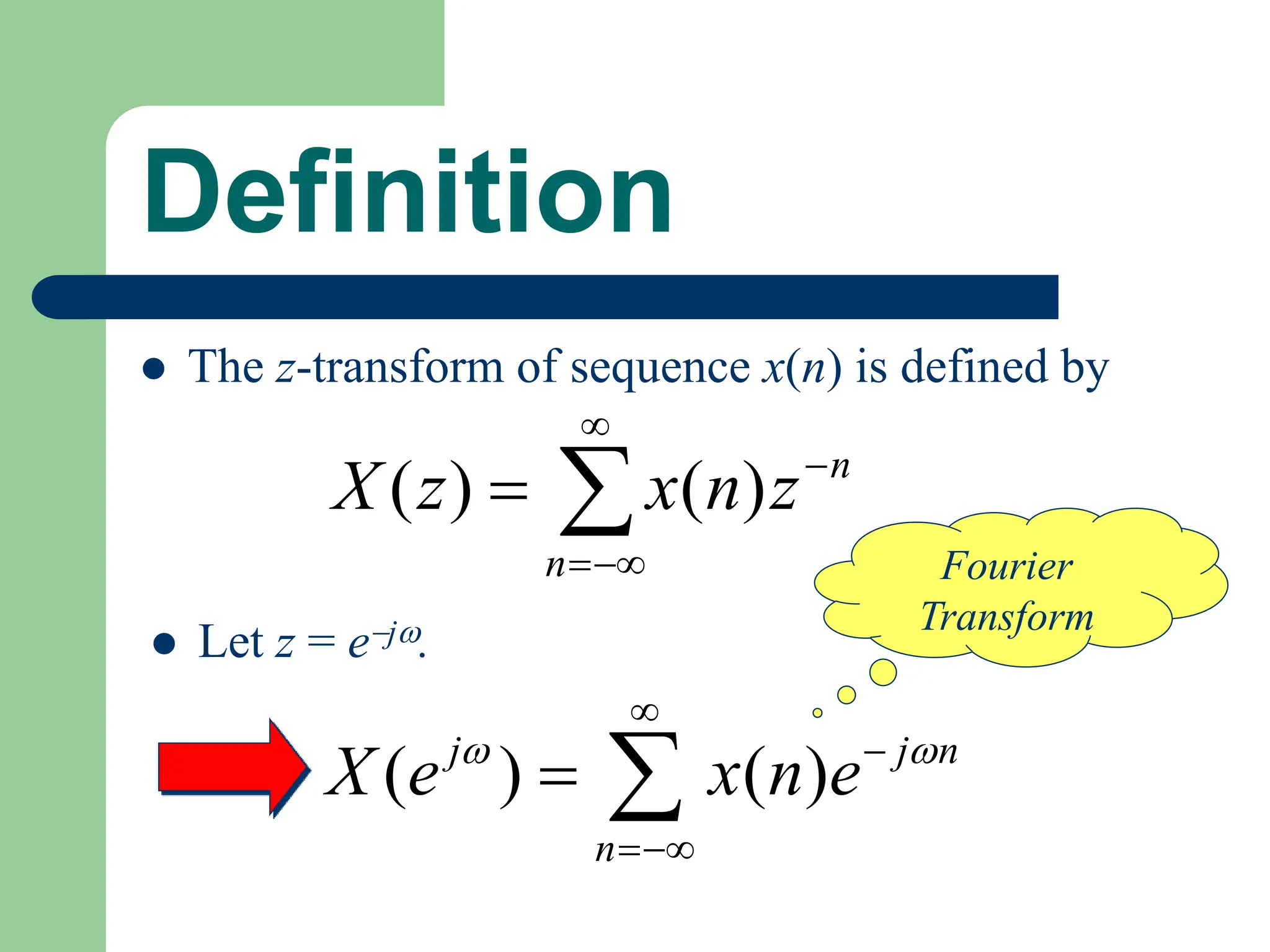
Definition
The z-transformof sequence x(n) is defined by
n
n
z
n
x
z
X )
(
)
(
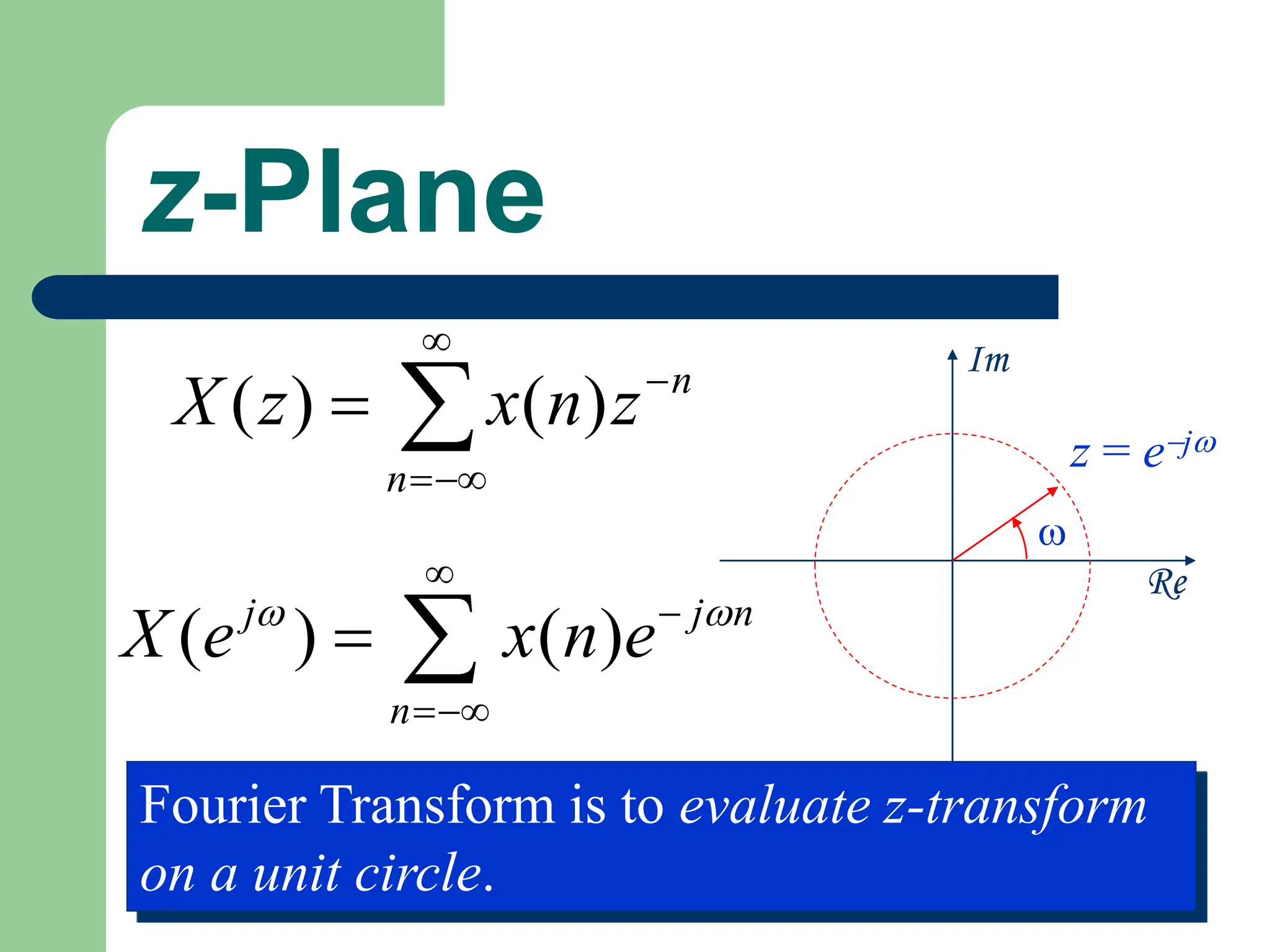
Let z = ej.
( ) ( )
j j n
n
X e x n e
Fourier
Transform
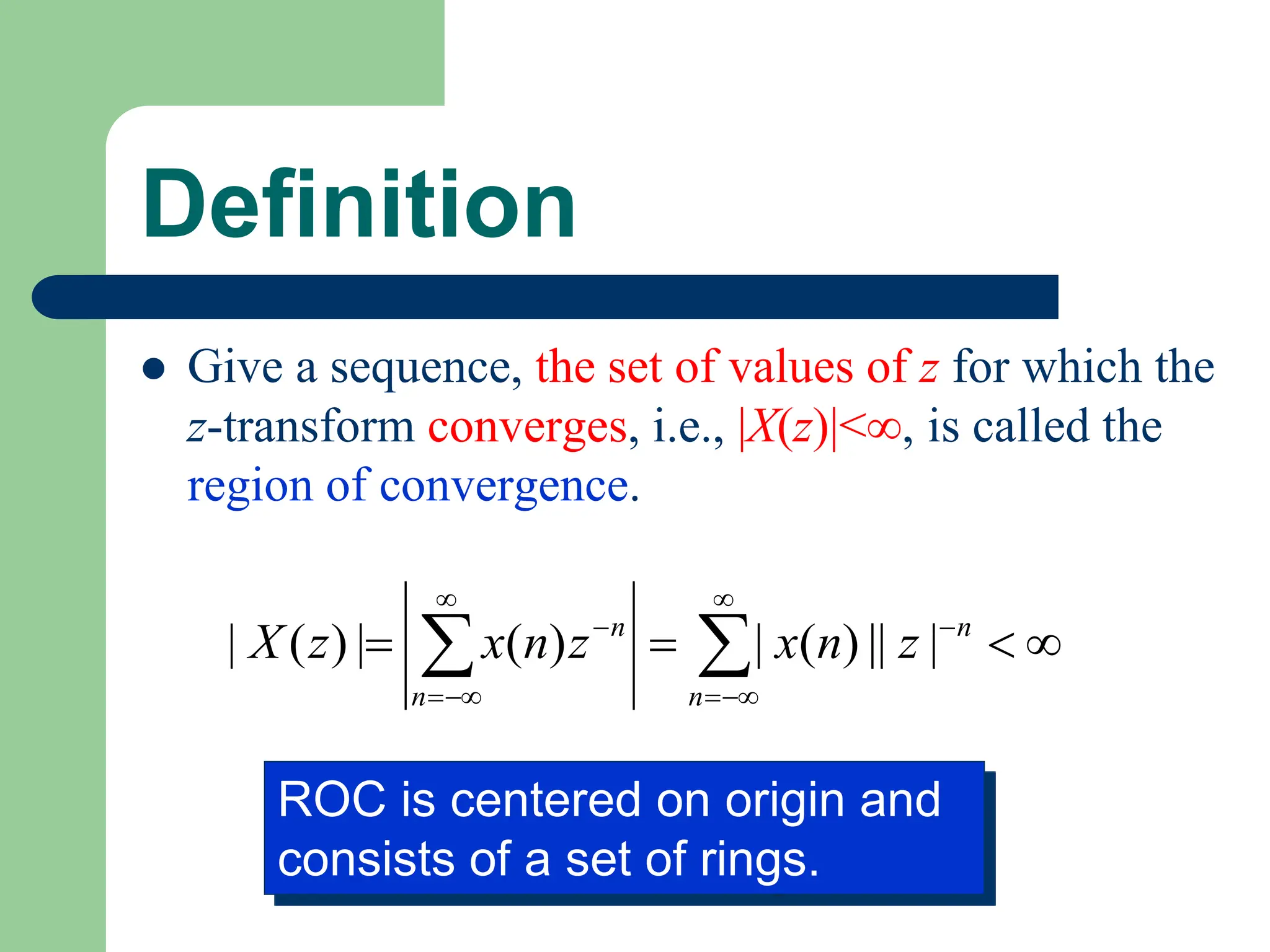
Definition
Give asequence, the set of values of z for which the
z-transform converges, i.e., |X(z)|<, is called the
region of convergence.
n
n
n
n
z
n
x
z
n
x
z
X |
||
)
(
|
)
(
|
)
(
|
ROC is centered on origin and
consists of a set of rings.
13.
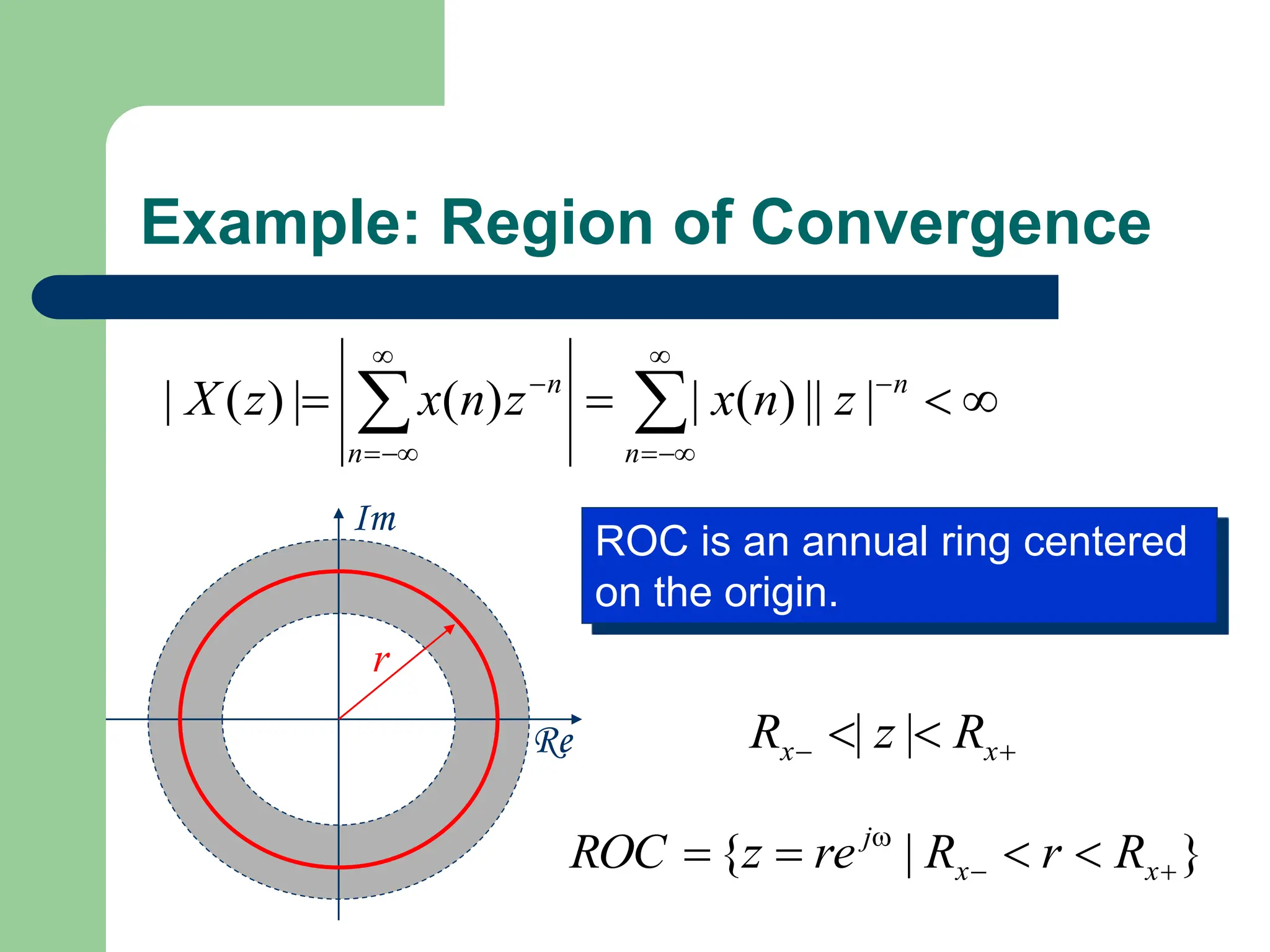
Example: Region ofConvergence
Re
Im
n
n
n
n
z
n
x
z
n
x
z
X |
||
)
(
|
)
(
|
)
(
|
ROC is an annual ring centered
on the origin.
x
x R
z
R |
|
r
}
|
{
x
x
j
R
r
R
re
z
ROC
14.
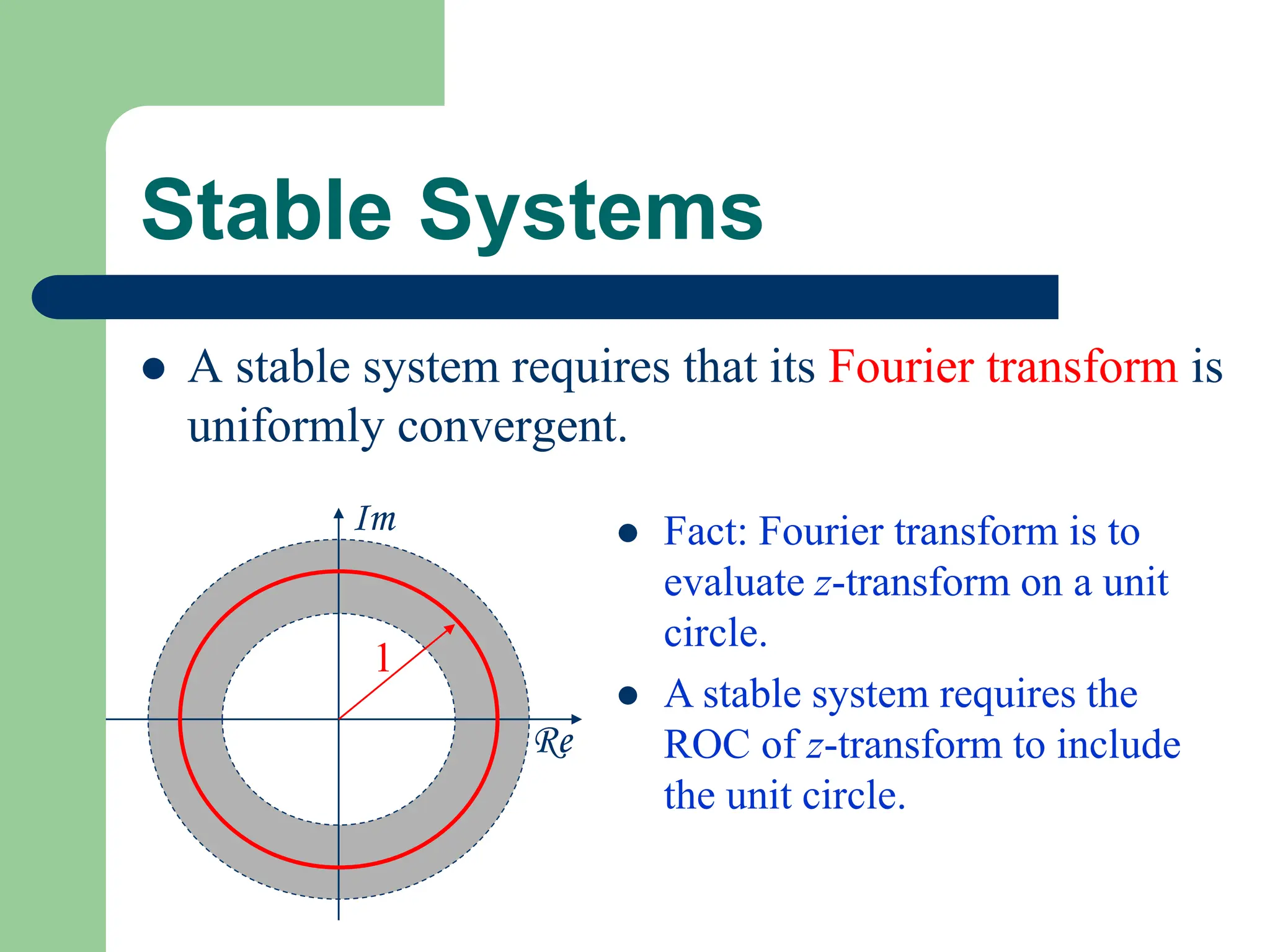
Stable Systems
Re
Im
1
Astable system requires that its Fourier transform is
uniformly convergent.
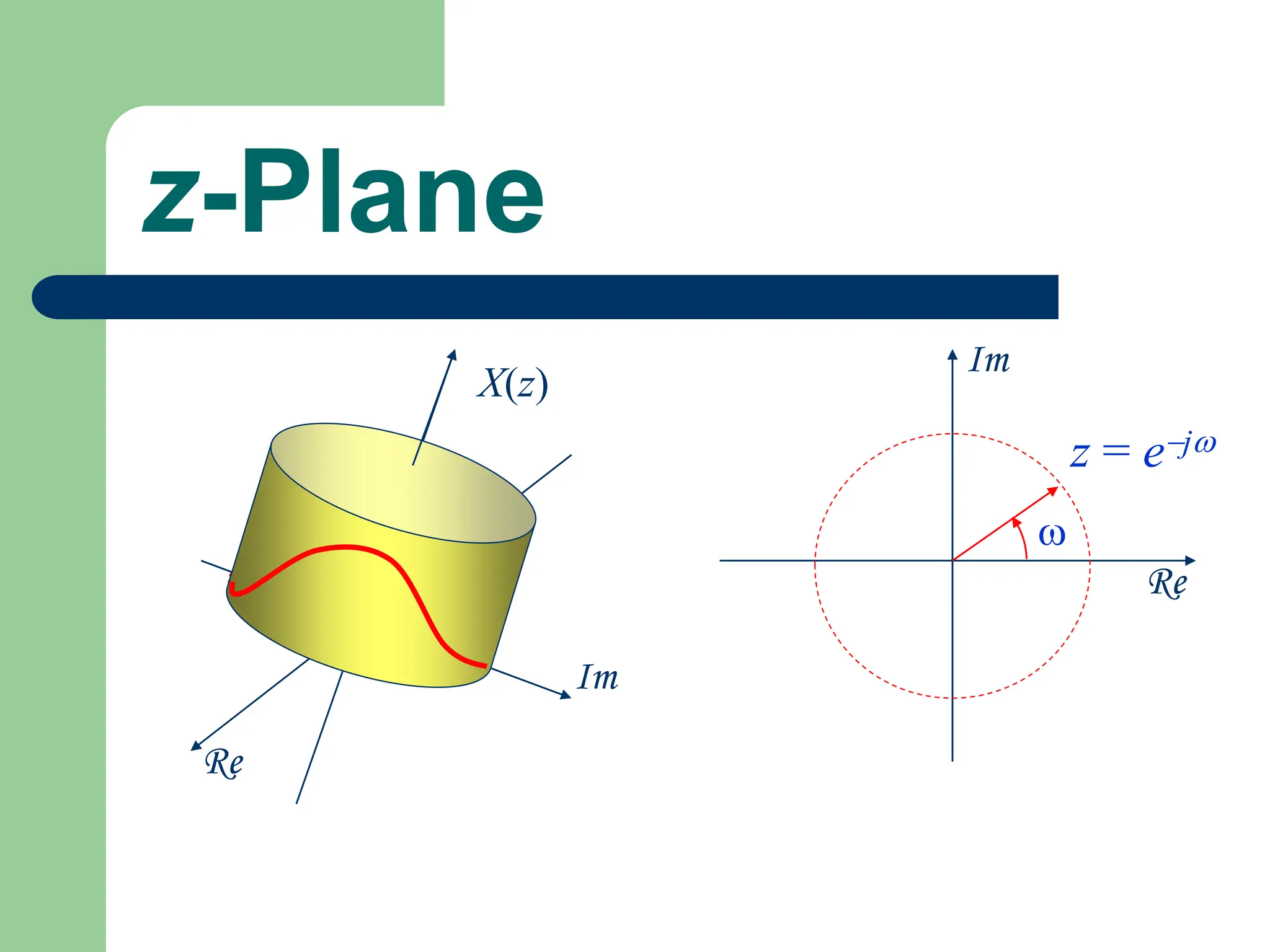
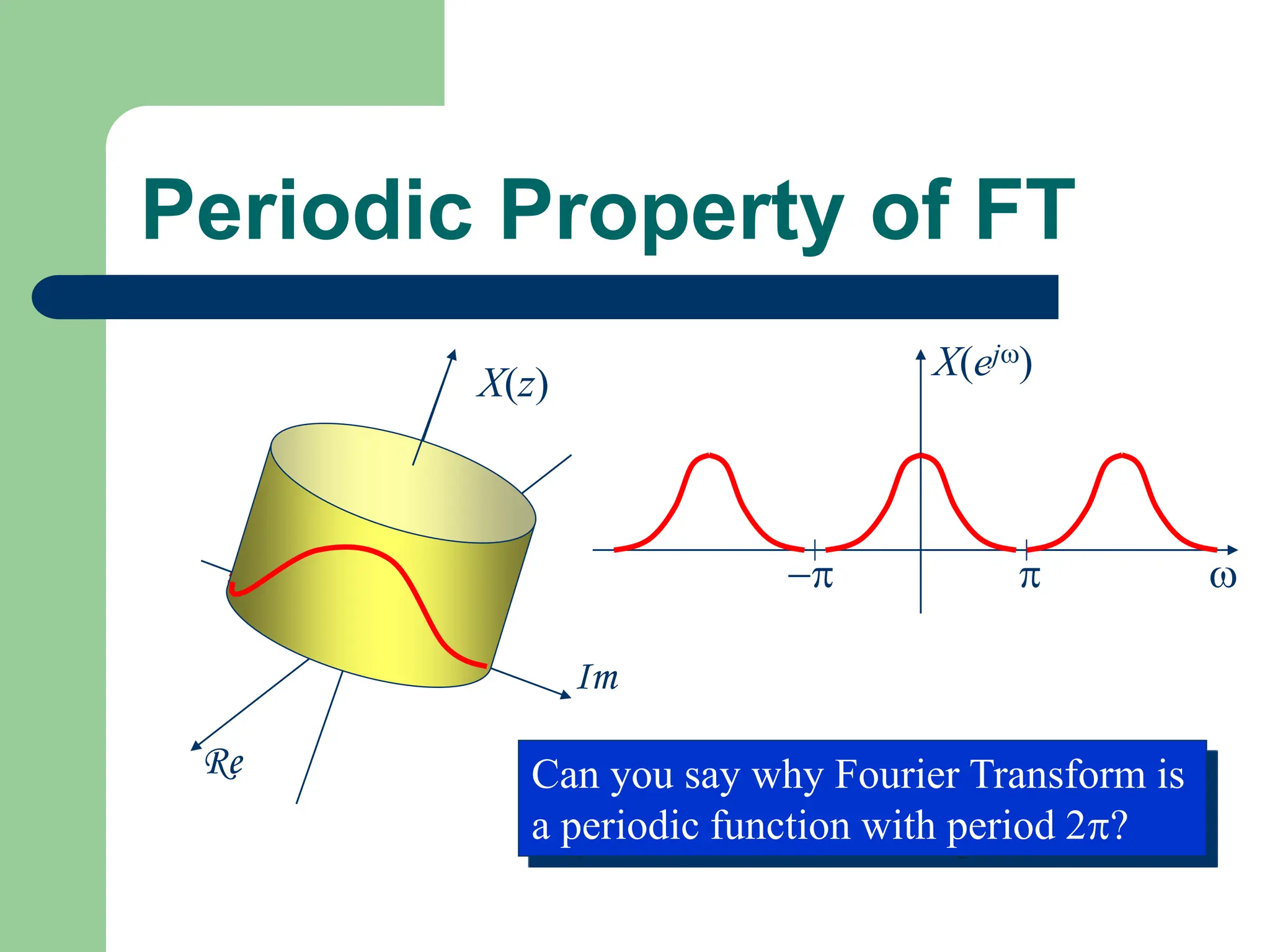
Fact: Fourier transform is to
evaluate z-transform on a unit
circle.
A stable system requires the
ROC of z-transform to include
the unit circle.
15.
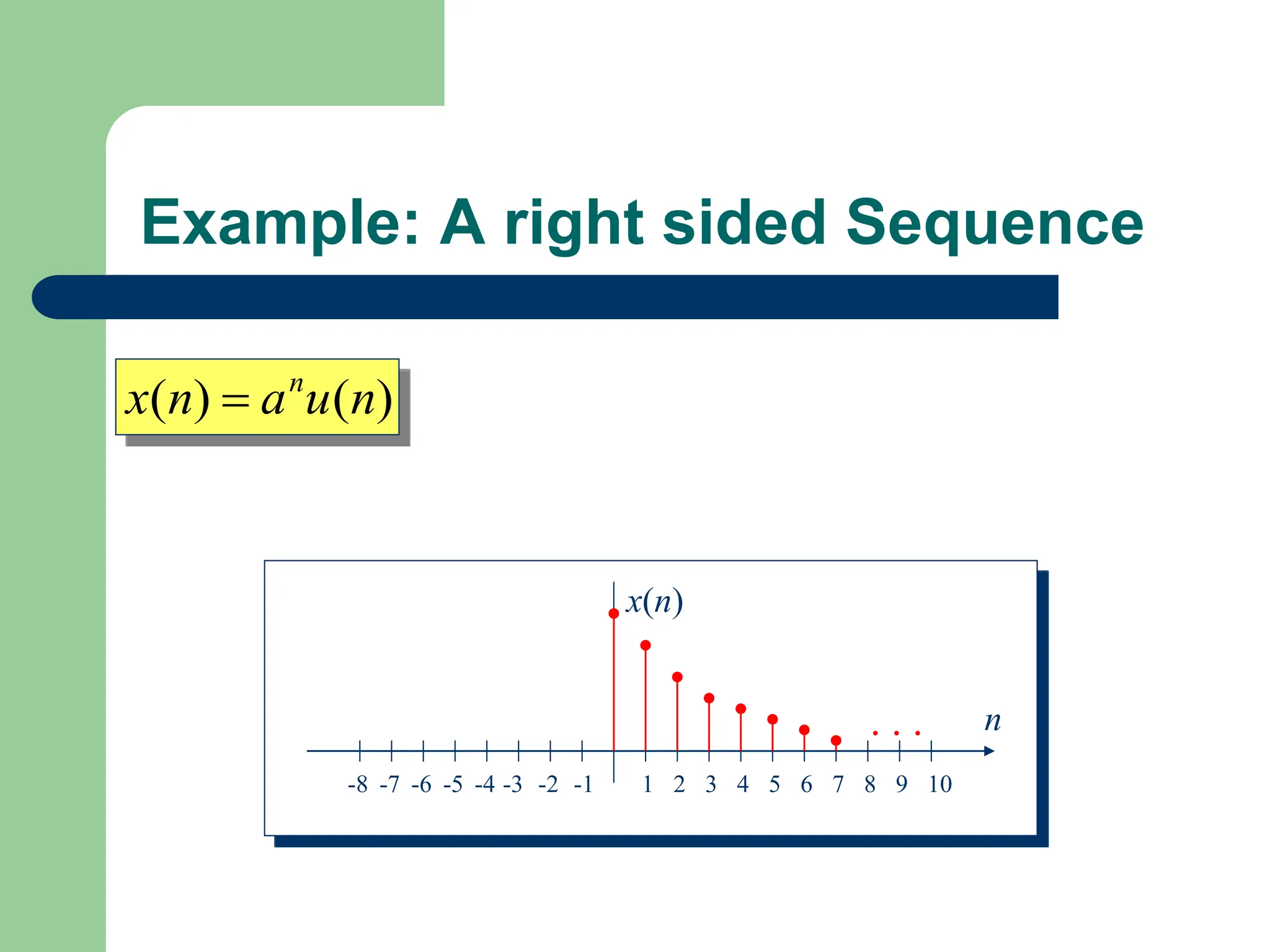
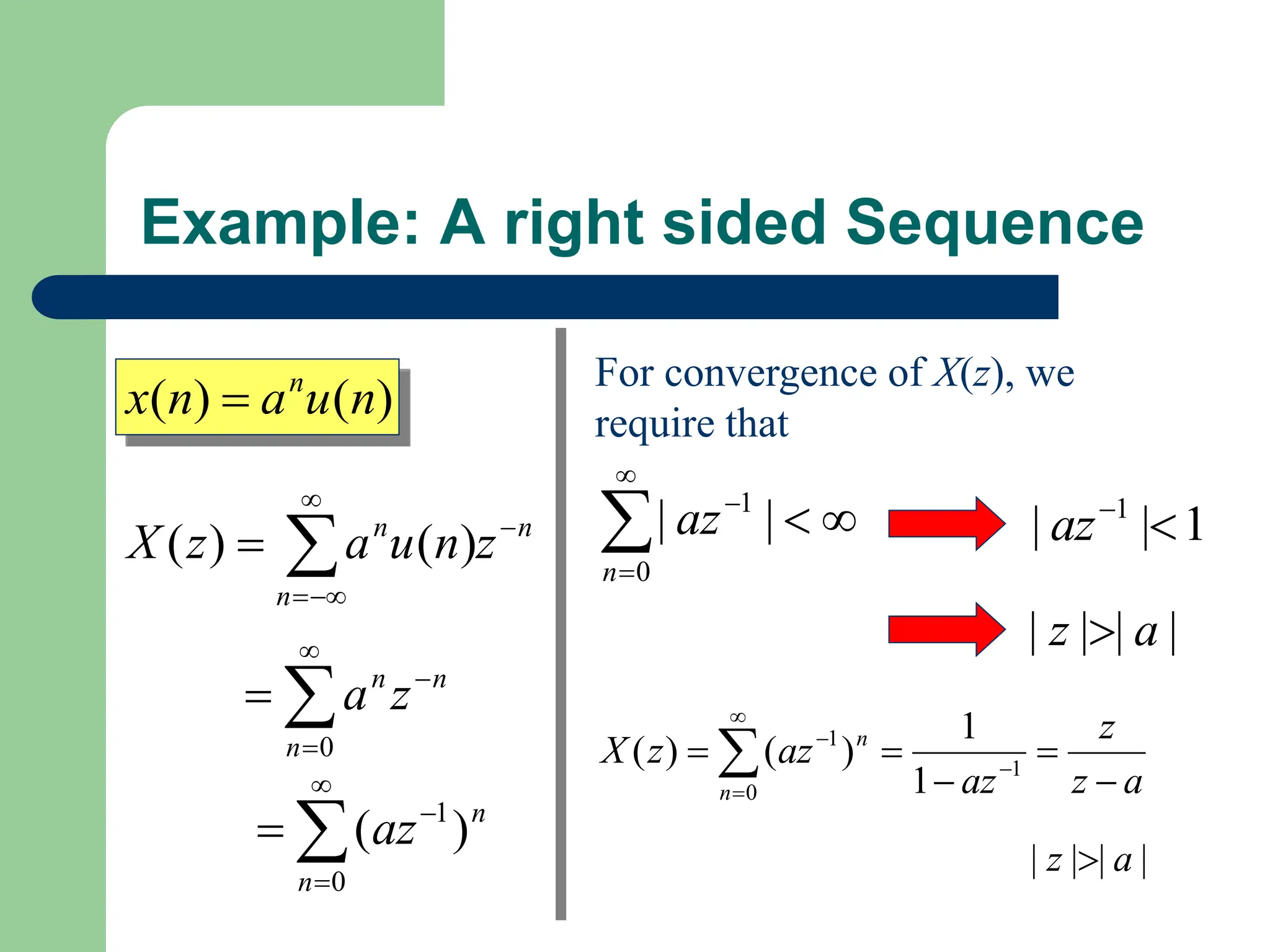
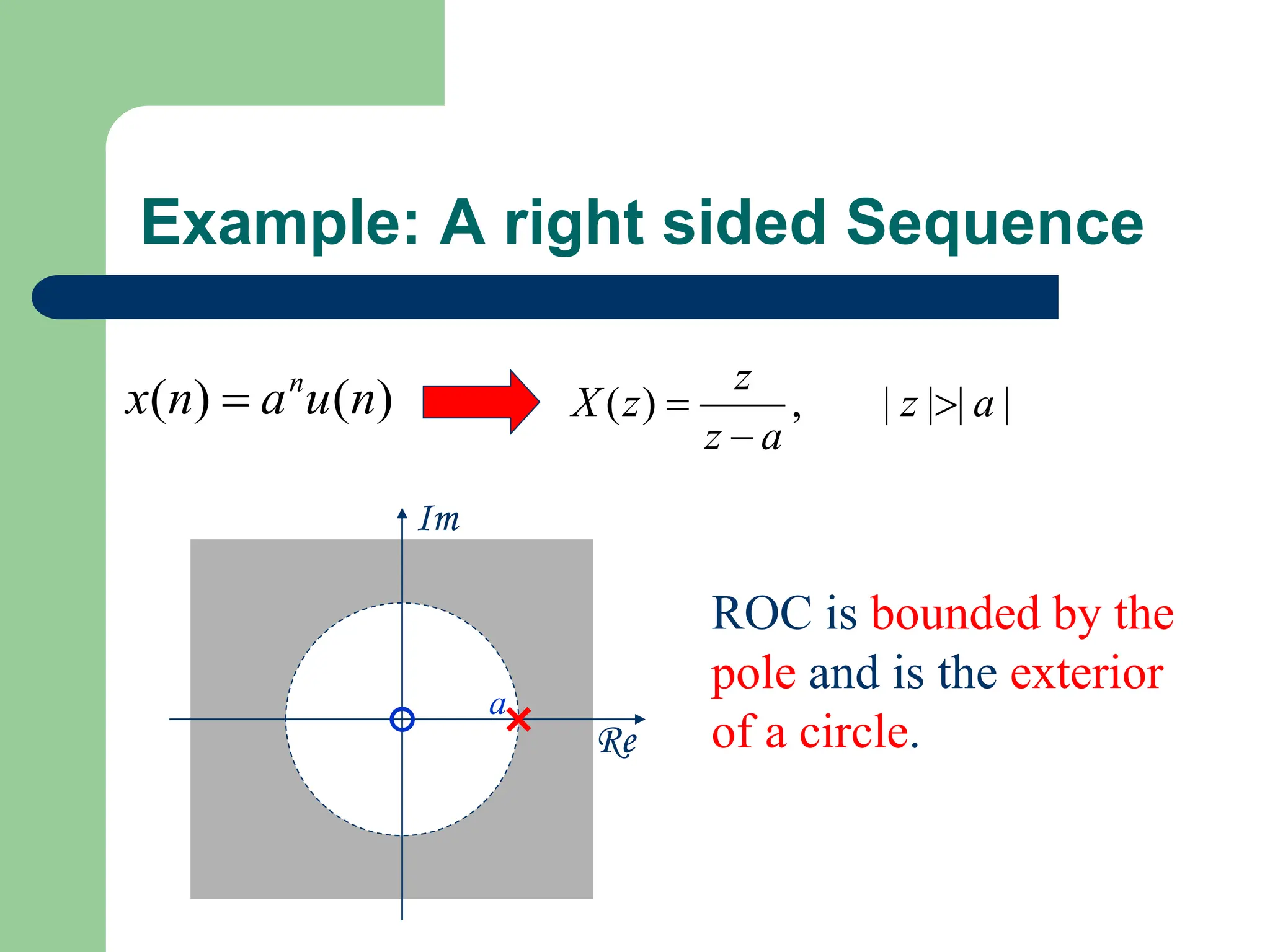
Example: A rightsided Sequence
)
(
)
( n
u
a
n
x n
1 2 3 4 5 6 7 8 9 10
-1
-2
-3
-4
-5
-6
-7
-8
n
x(n)
. . .
16.
Example: A rightsided Sequence
)
(
)
( n
u
a
n
x n
n
n
n
z
n
u
a
z
X
)
(
)
(
0
n
n
n
z
a
0
1
)
(
n
n
az
For convergence of X(z), we
require that
0
1
|
|
n
az 1
|
| 1
az
|
|
|
| a
z
a
z
z
az
az
z
X
n
n
1
0
1
1
1
)
(
)
(
|
|
|
| a
z
17.
a
a
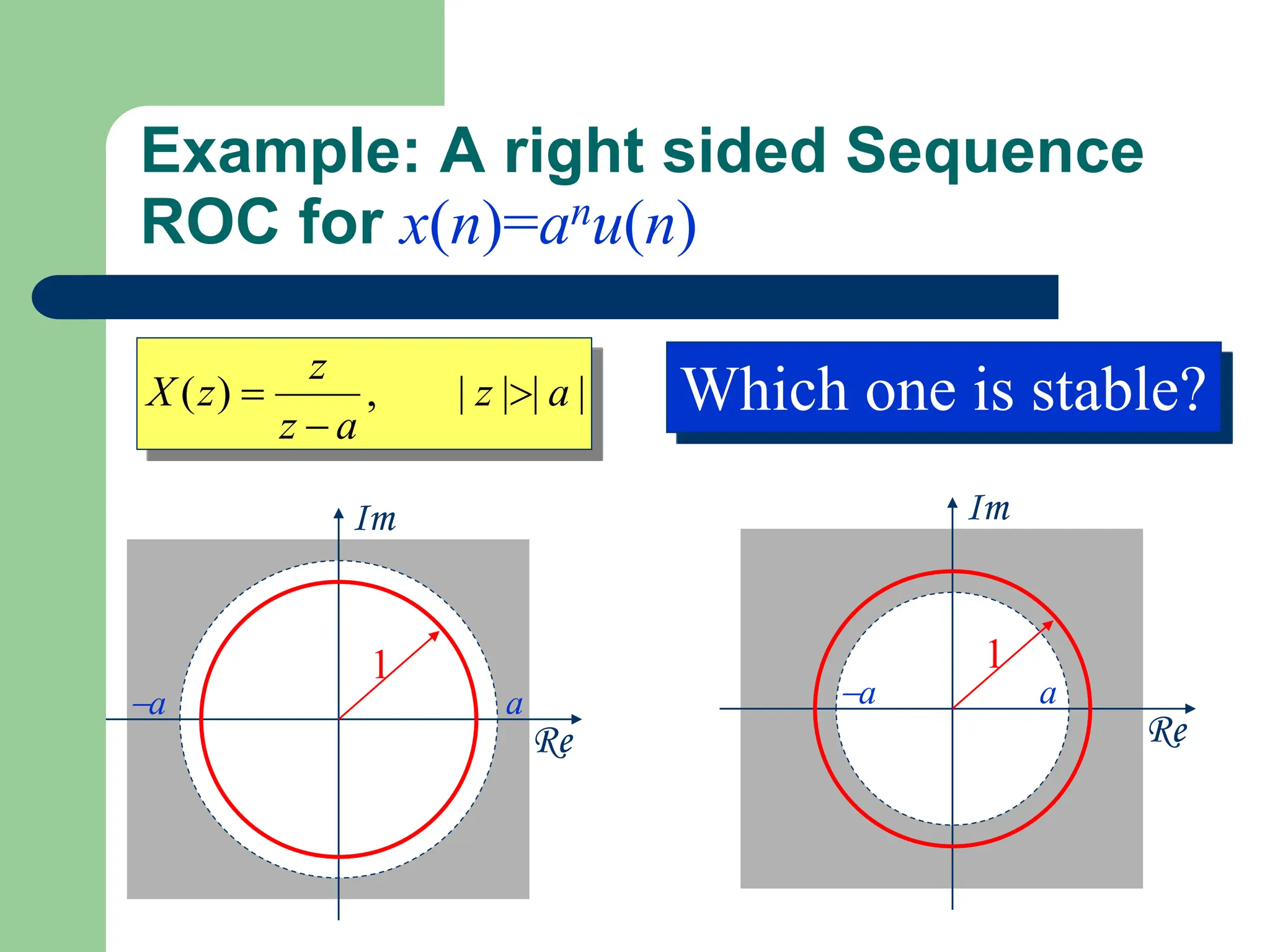
Example: A rightsided Sequence
ROC for x(n)=anu(n)
|
|
|
|
,
)
( a
z
a
z
z
z
X
Re
Im
1
a
a
Re
Im
1
Which one is stable?
18.
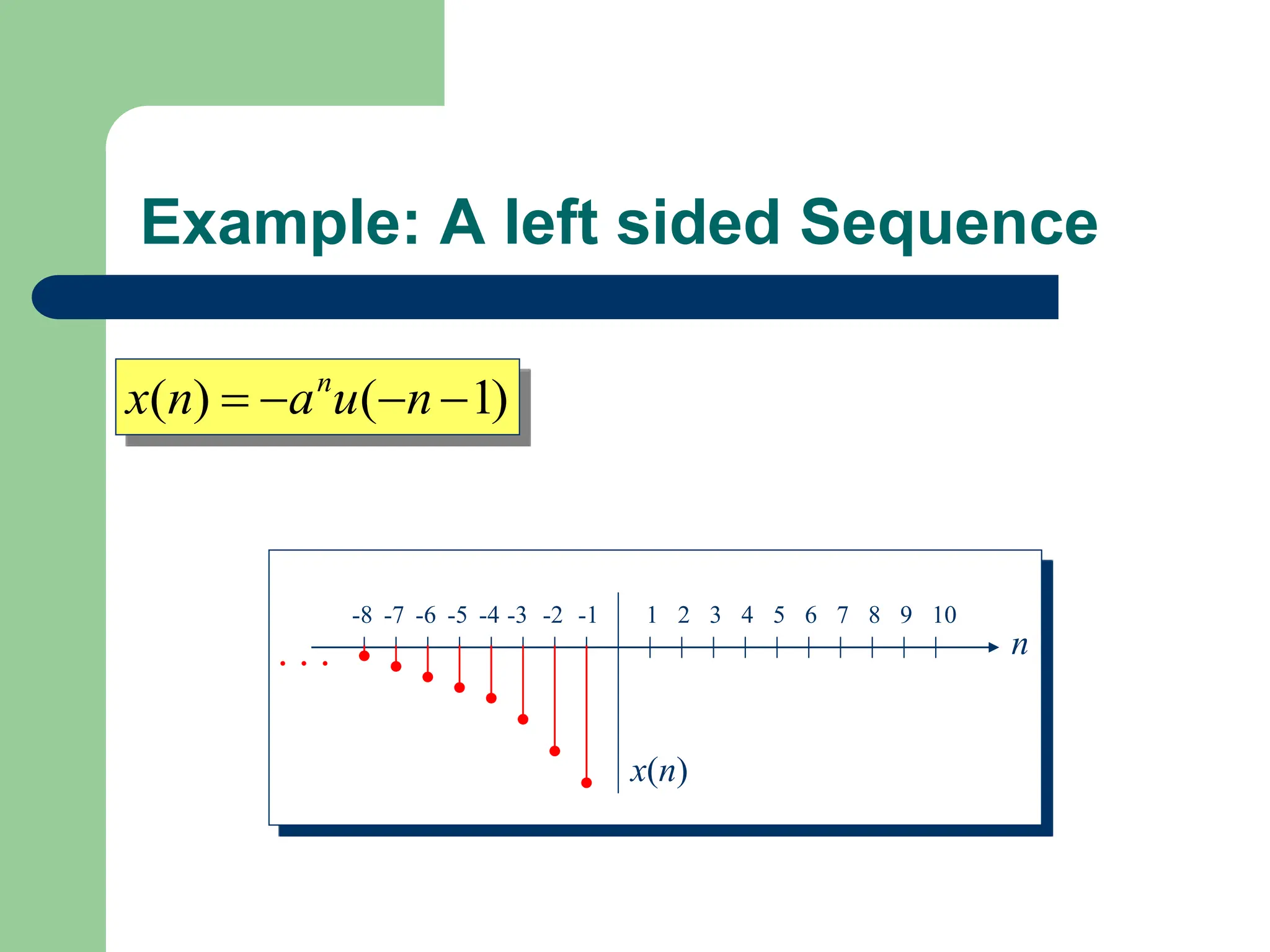
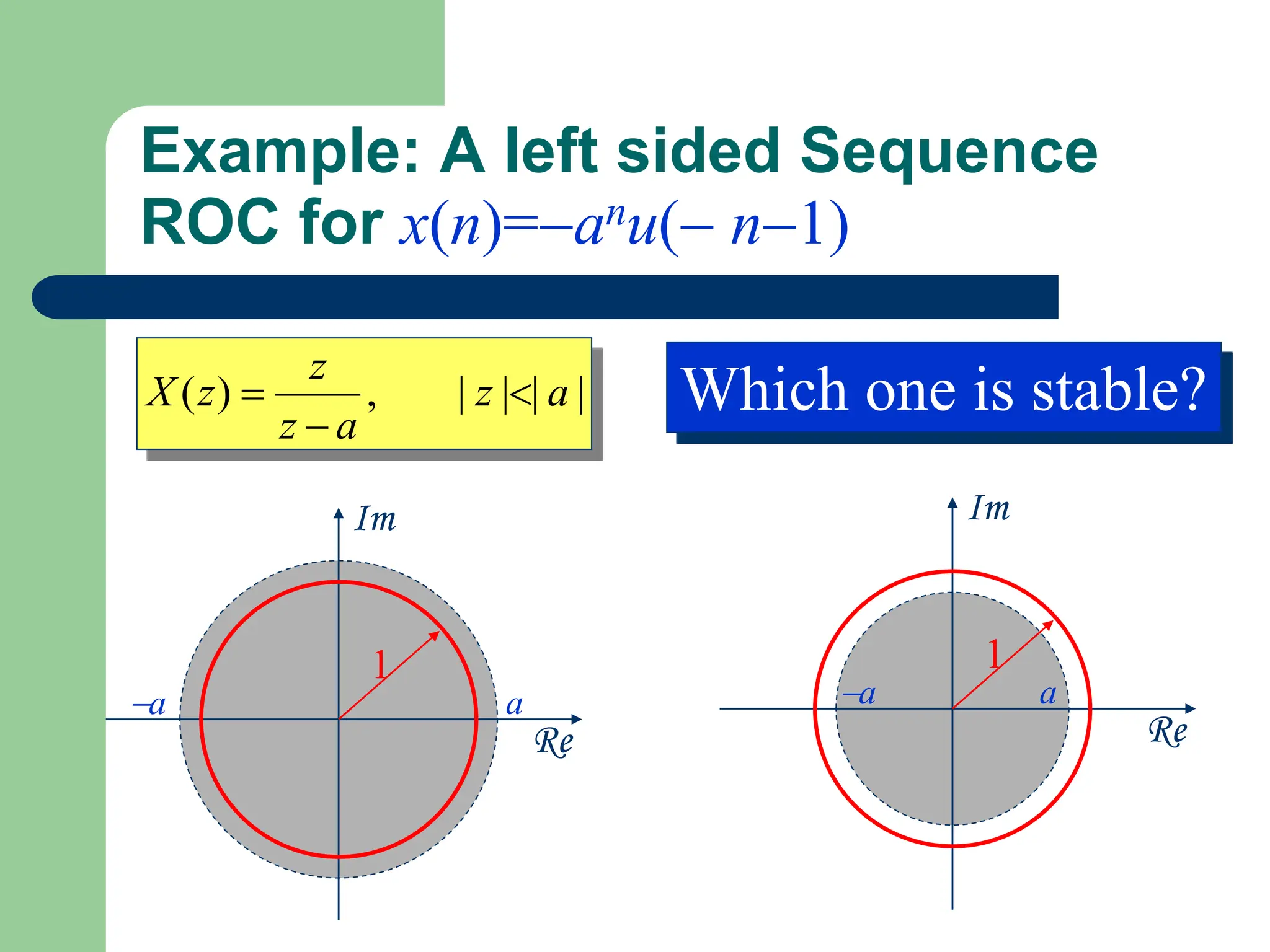
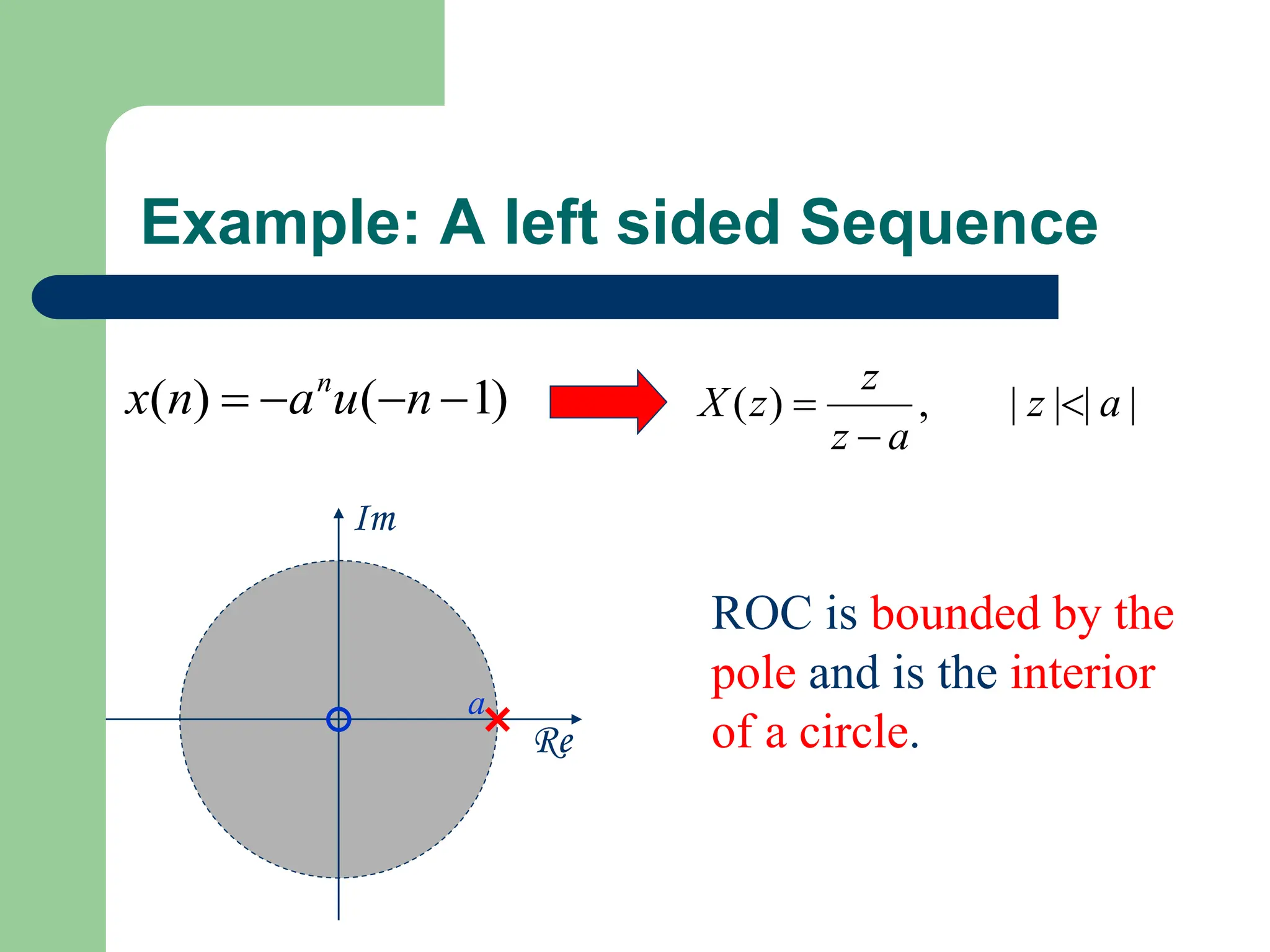
Example: A leftsided Sequence
)
1
(
)
(
n
u
a
n
x n
1 2 3 4 5 6 7 8 9 10
-1
-2
-3
-4
-5
-6
-7
-8
n
x(n)
.
.
.
19.
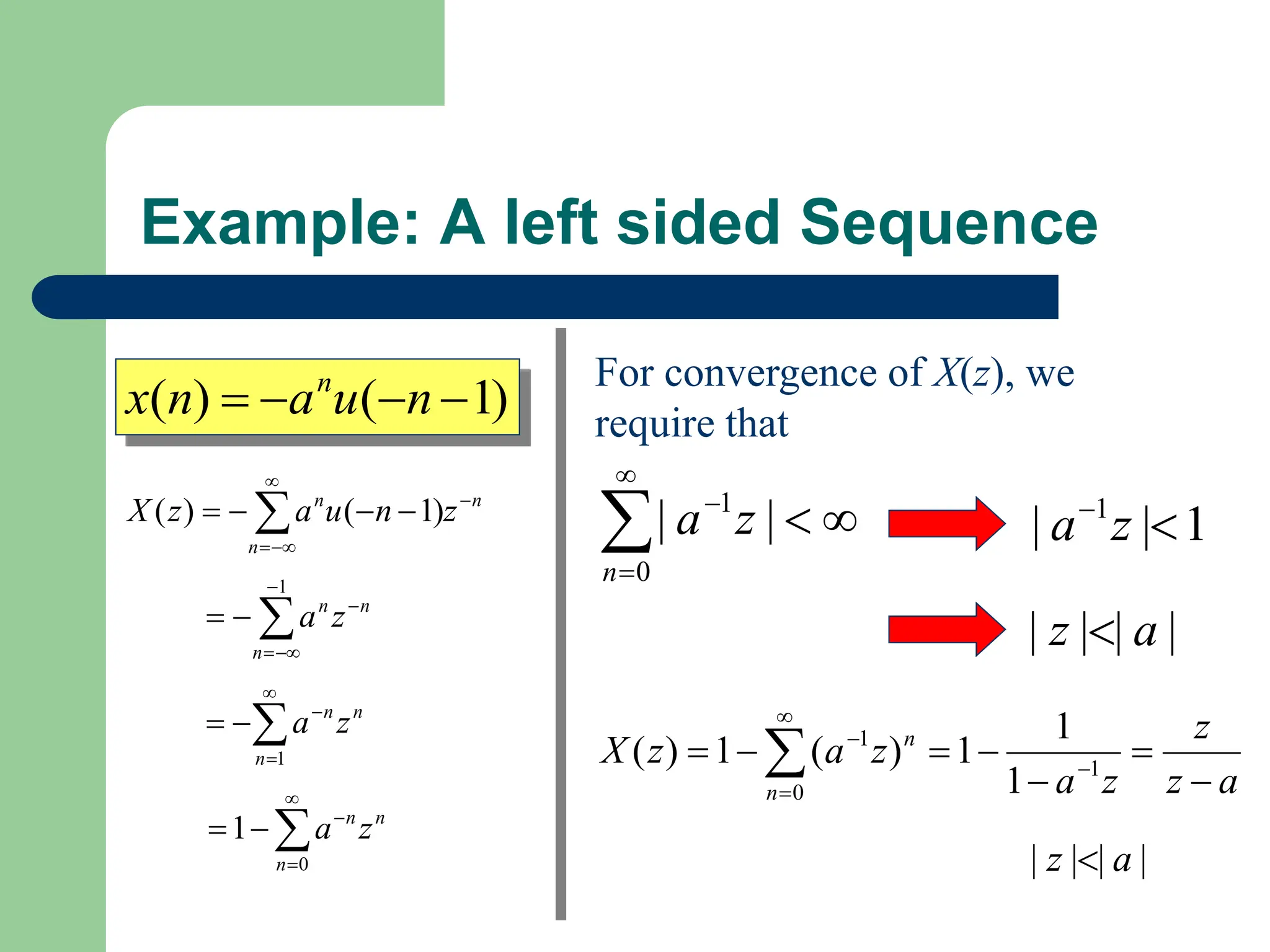
Example: A leftsided Sequence
)
1
(
)
(
n
u
a
n
x n
n
n
n
z
n
u
a
z
X
)
1
(
)
(
For convergence of X(z), we
require that
0
1
|
|
n
z
a 1
|
| 1
z
a
|
|
|
| a
z
a
z
z
z
a
z
a
z
X
n
n
1
0
1
1
1
1
)
(
1
)
(
|
|
|
| a
z
n
n
n
z
a
1
n
n
n
z
a
1
n
n
n
z
a
0
1
20.
a
a
Example: A leftsided Sequence
ROC for x(n)=anu( n1)
|
|
|
|
,
)
( a
z
a
z
z
z
X
Re
Im
1
a
a
Re
Im
1
Which one is stable?
Represent z-transform asa
Rational Function
)
(
)
(
)
(
z
Q
z
P
z
X
where P(z) and Q(z) are
polynomials in z.
Zeros: The values of z’s such that X(z) = 0
Poles: The values of z’s such that X(z) =
23.
Example: A rightsided Sequence
)
(
)
( n
u
a
n
x n
|
|
|
|
,
)
( a
z
a
z
z
z
X
Re
Im
a
ROC is bounded by the
pole and is the exterior
of a circle.
24.
Example: A leftsided Sequence
)
1
(
)
(
n
u
a
n
x n
|
|
|
|
,
)
( a
z
a
z
z
z
X
Re
Im
a
ROC is bounded by the
pole and is the interior
of a circle.
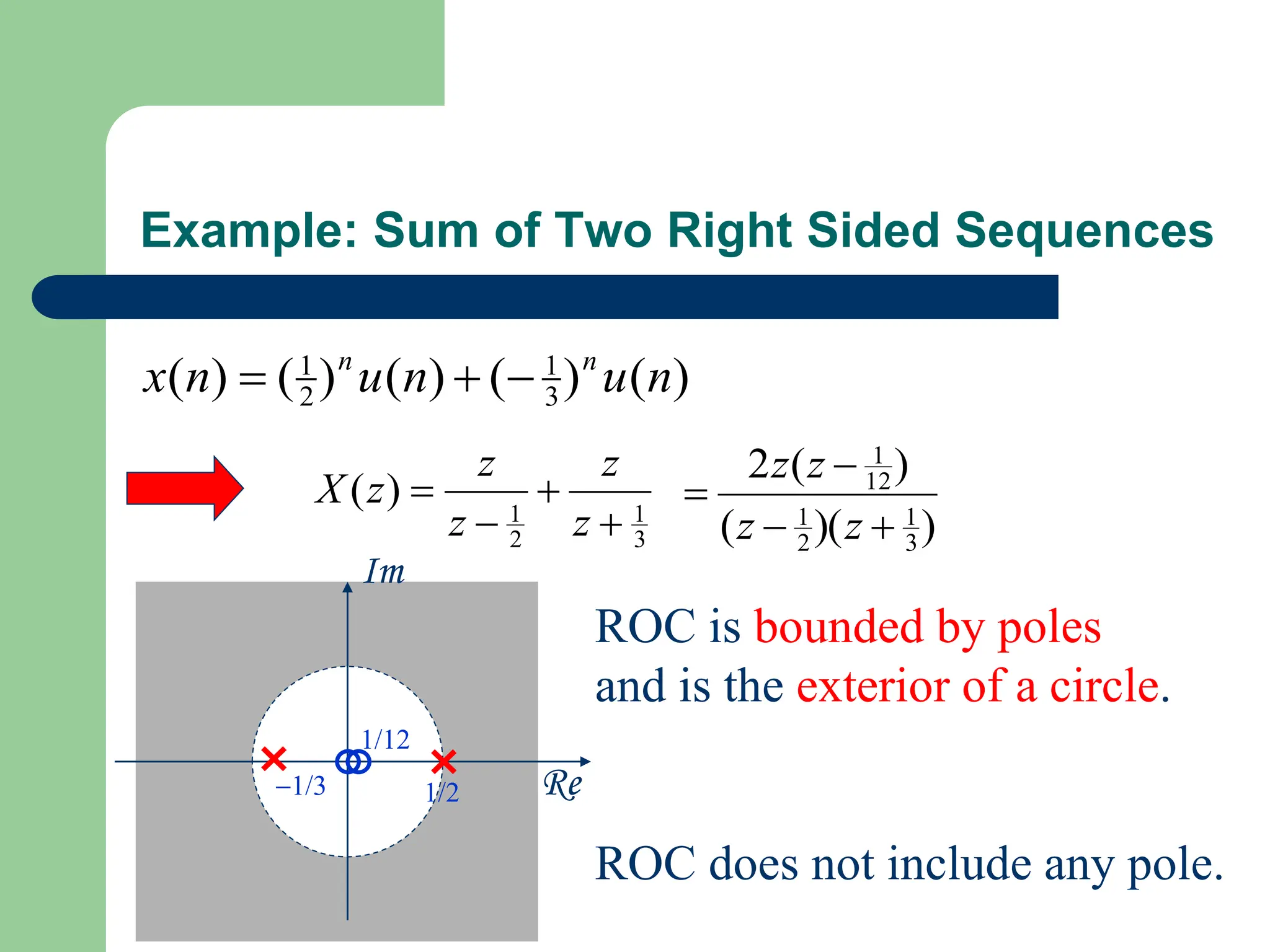
25.
Example: Sum ofTwo Right Sided Sequences
)
(
)
(
)
(
)
(
)
( 3
1
2
1
n
u
n
u
n
x n
n
3
1
2
1
)
(
z
z
z
z
z
X
Re
Im
1/2
)
)(
(
)
(
2
3
1
2
1
12
1
z
z
z
z
1/3
1/12
ROC is bounded by poles
and is the exterior of a circle.
ROC does not include any pole.
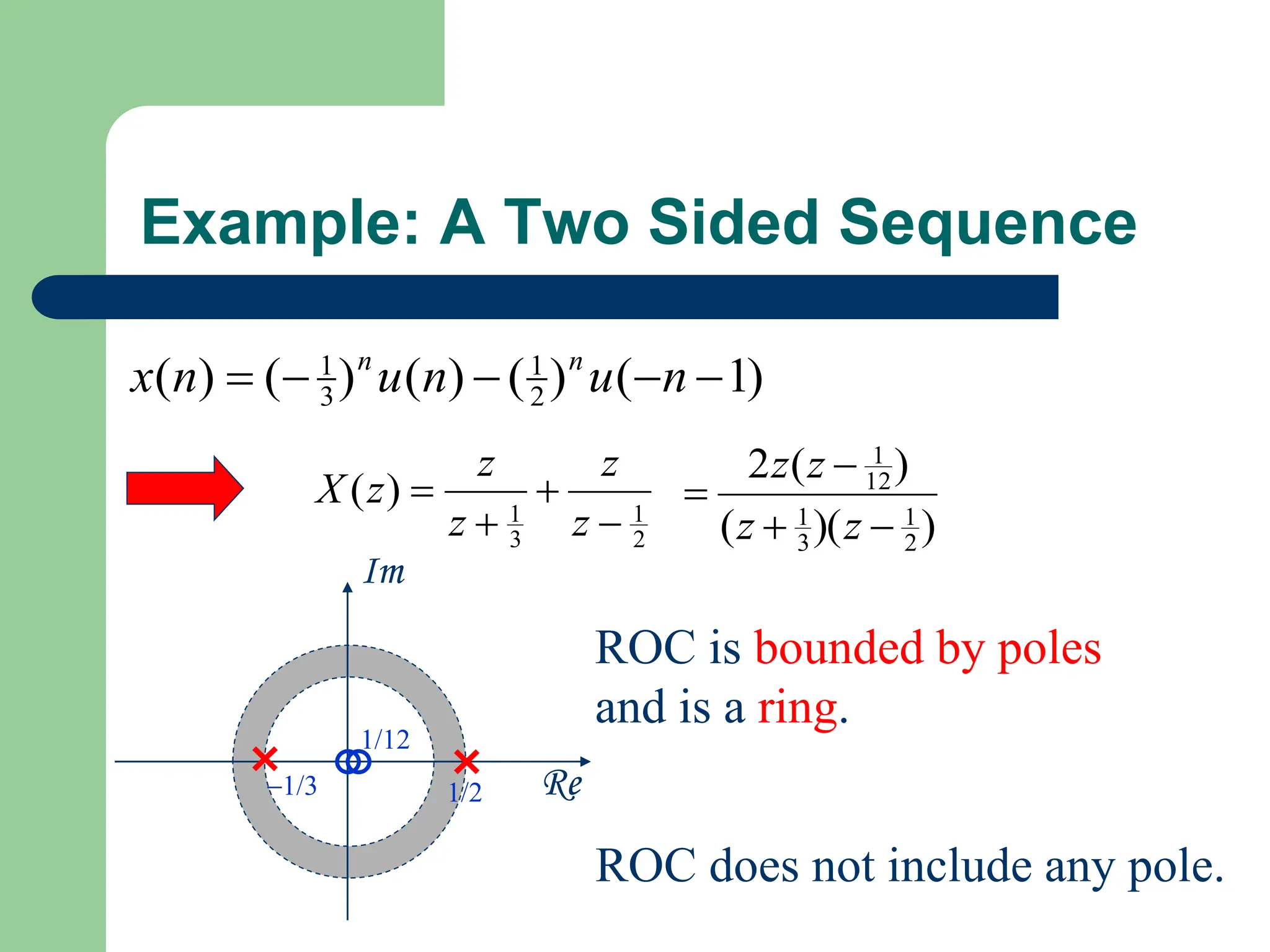
26.
Example: A TwoSided Sequence
)
1
(
)
(
)
(
)
(
)
( 2
1
3
1
n
u
n
u
n
x n
n
2
1
3
1
)
(
z
z
z
z
z
X
Re
Im
1/2
)
)(
(
)
(
2
2
1
3
1
12
1
z
z
z
z
1/3
1/12
ROC is bounded by poles
and is a ring.
ROC does not include any pole.
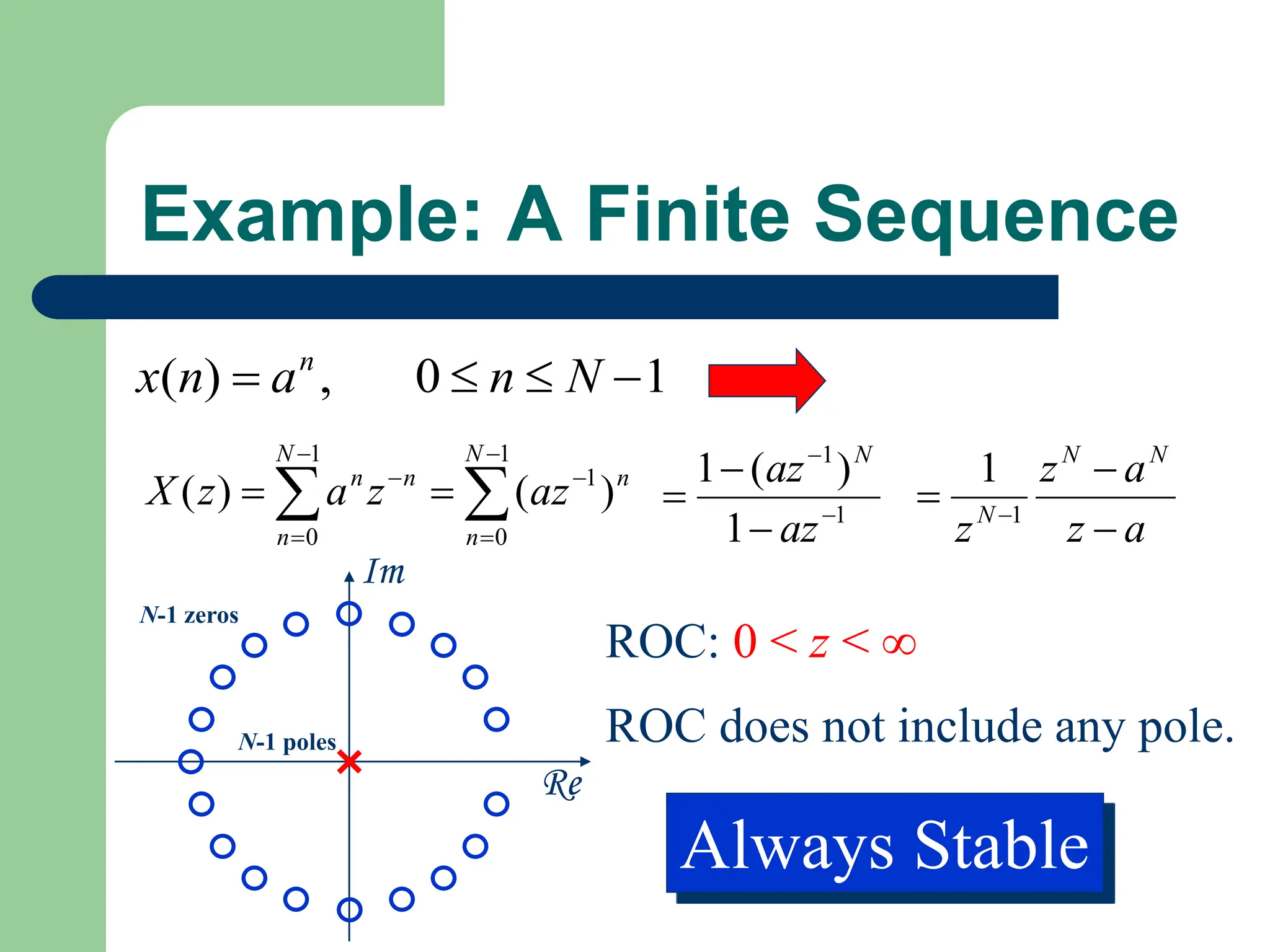
27.
Example: A FiniteSequence
1
0
,
)
(
N
n
a
n
x n
n
N
n
n
N
n
n
z
a
z
a
z
X )
(
)
( 1
1
0
1
0
Re
Im
ROC: 0 < z <
ROC does not include any pole.
1
1
1
)
(
1
az
az N
a
z
a
z
z
N
N
N
1
1
N-1 poles
N-1 zeros
Always Stable
28.
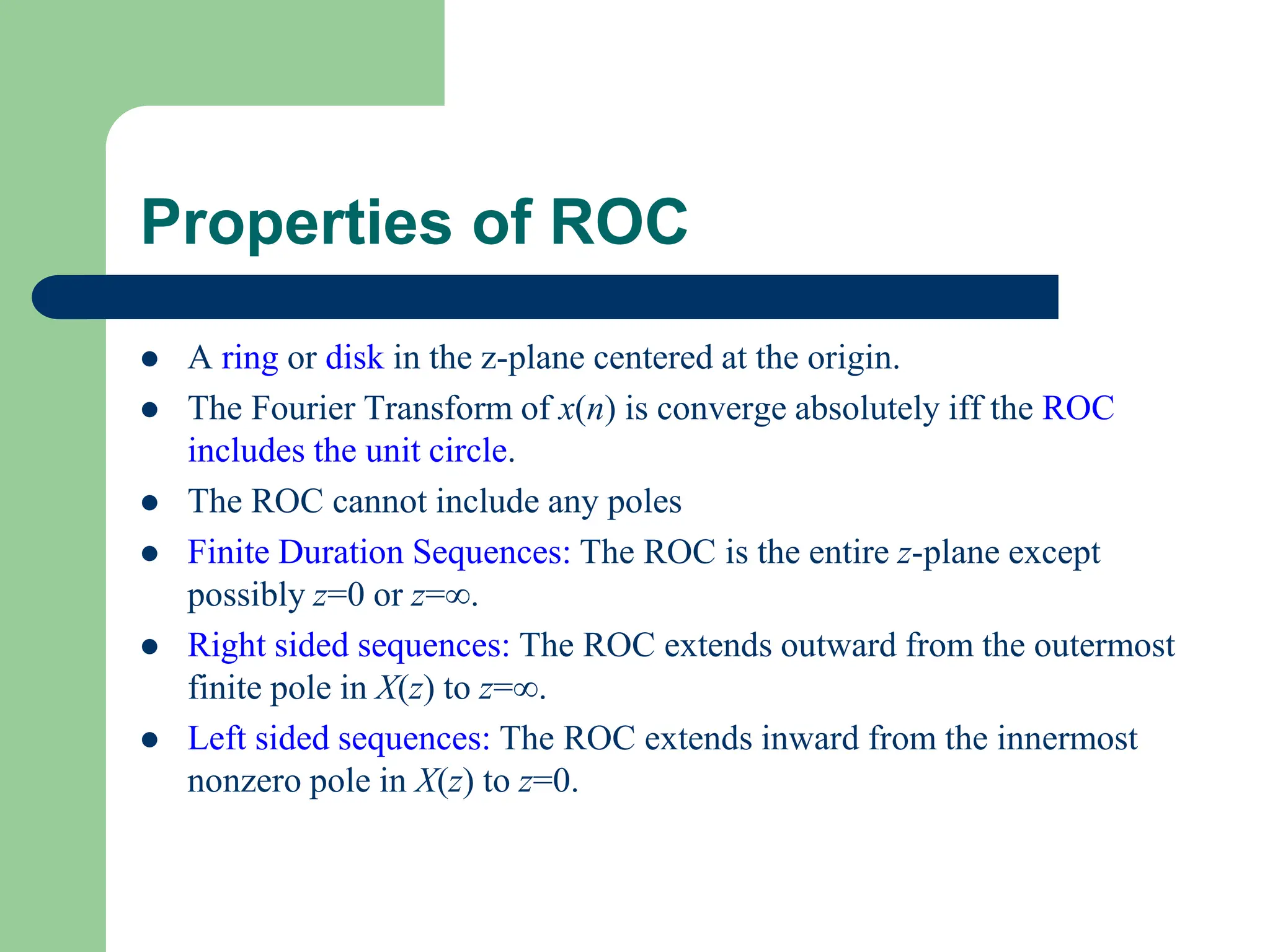
Properties of ROC
A ring or disk in the z-plane centered at the origin.
The Fourier Transform of x(n) is converge absolutely iff the ROC
includes the unit circle.
The ROC cannot include any poles
Finite Duration Sequences: The ROC is the entire z-plane except
possibly z=0 or z=.
Right sided sequences: The ROC extends outward from the outermost
finite pole in X(z) to z=.
Left sided sequences: The ROC extends inward from the innermost
nonzero pole in X(z) to z=0.
29.
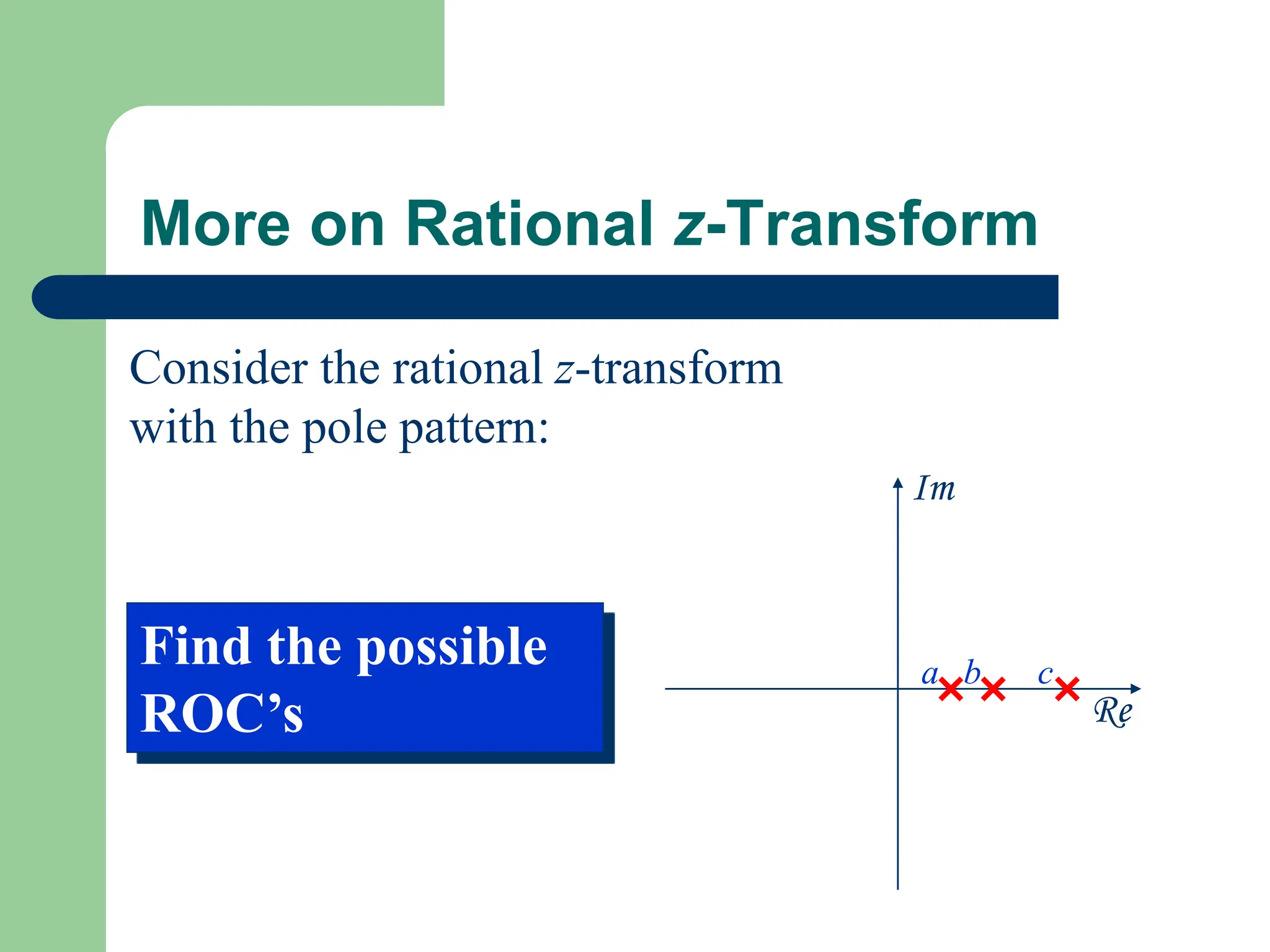
More on Rationalz-Transform
Re
Im
a b c
Consider the rational z-transform
with the pole pattern:
Find the possible
ROC’s
30.
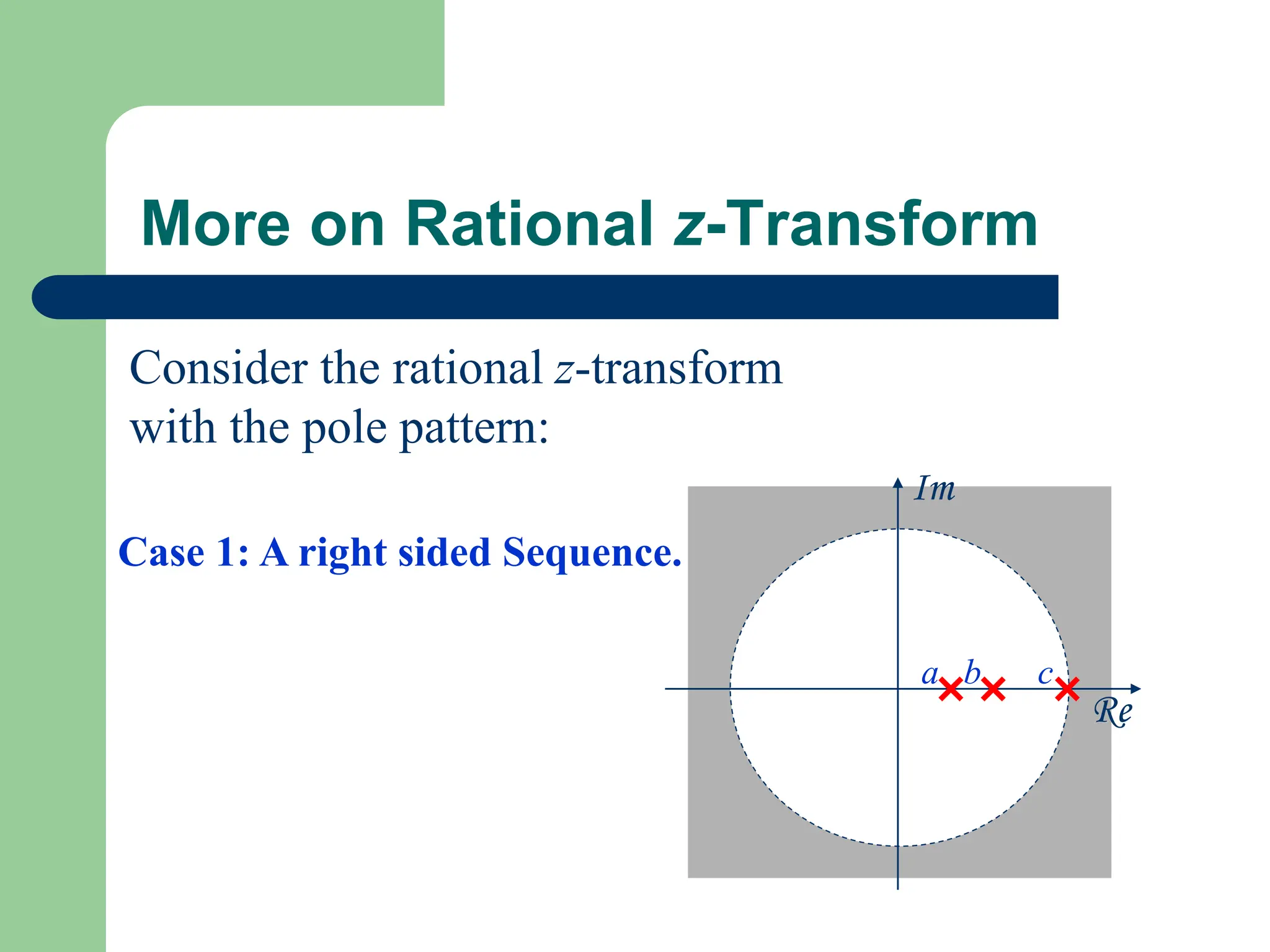
More on Rationalz-Transform
Re
Im
a b c
Consider the rational z-transform
with the pole pattern:
Case 1: A right sided Sequence.
31.
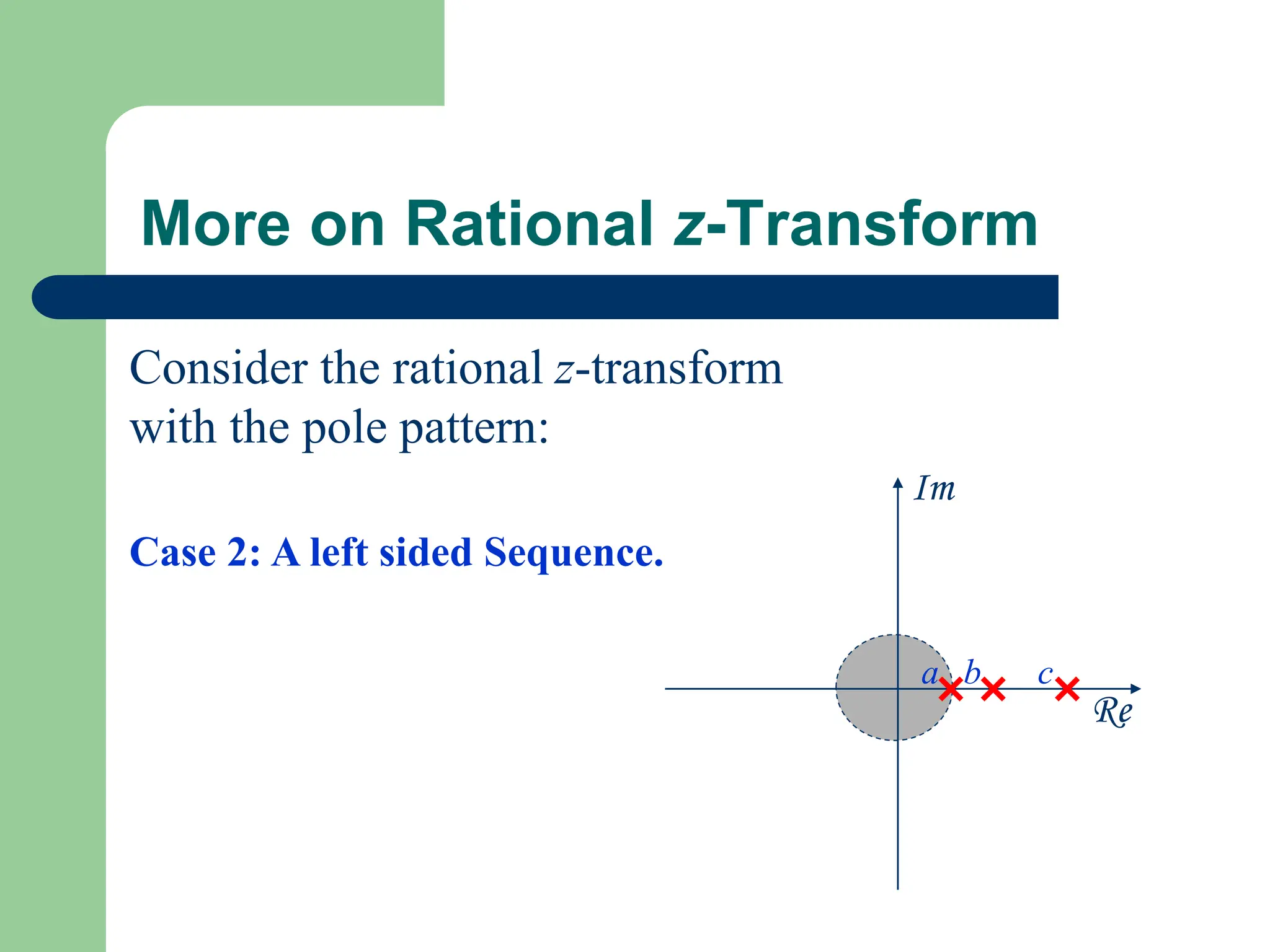
More on Rationalz-Transform
Re
Im
a b c
Consider the rational z-transform
with the pole pattern:
Case 2: A left sided Sequence.
32.
More on Rationalz-Transform
Re
Im
a b c
Consider the rational z-transform
with the pole pattern:
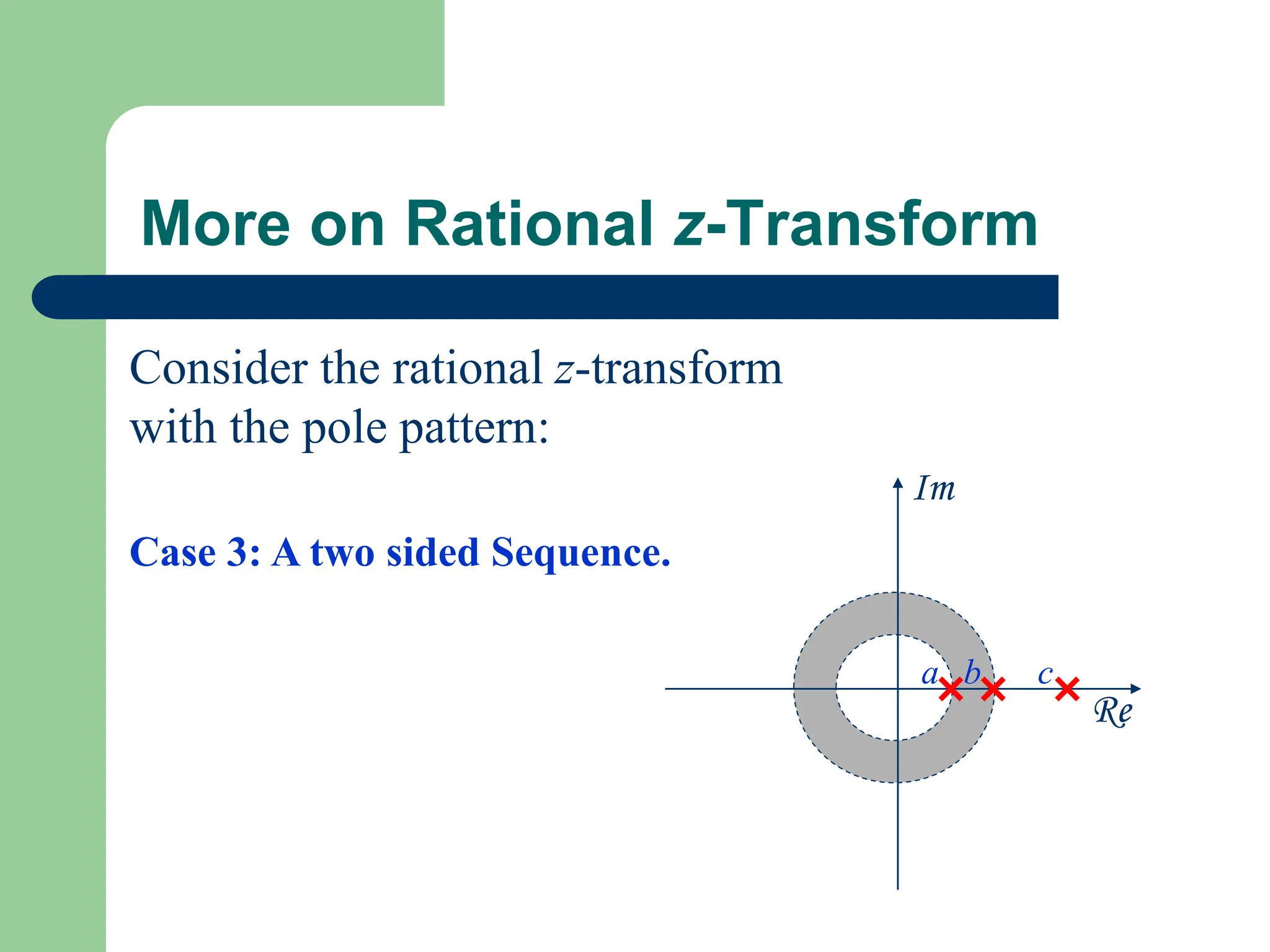
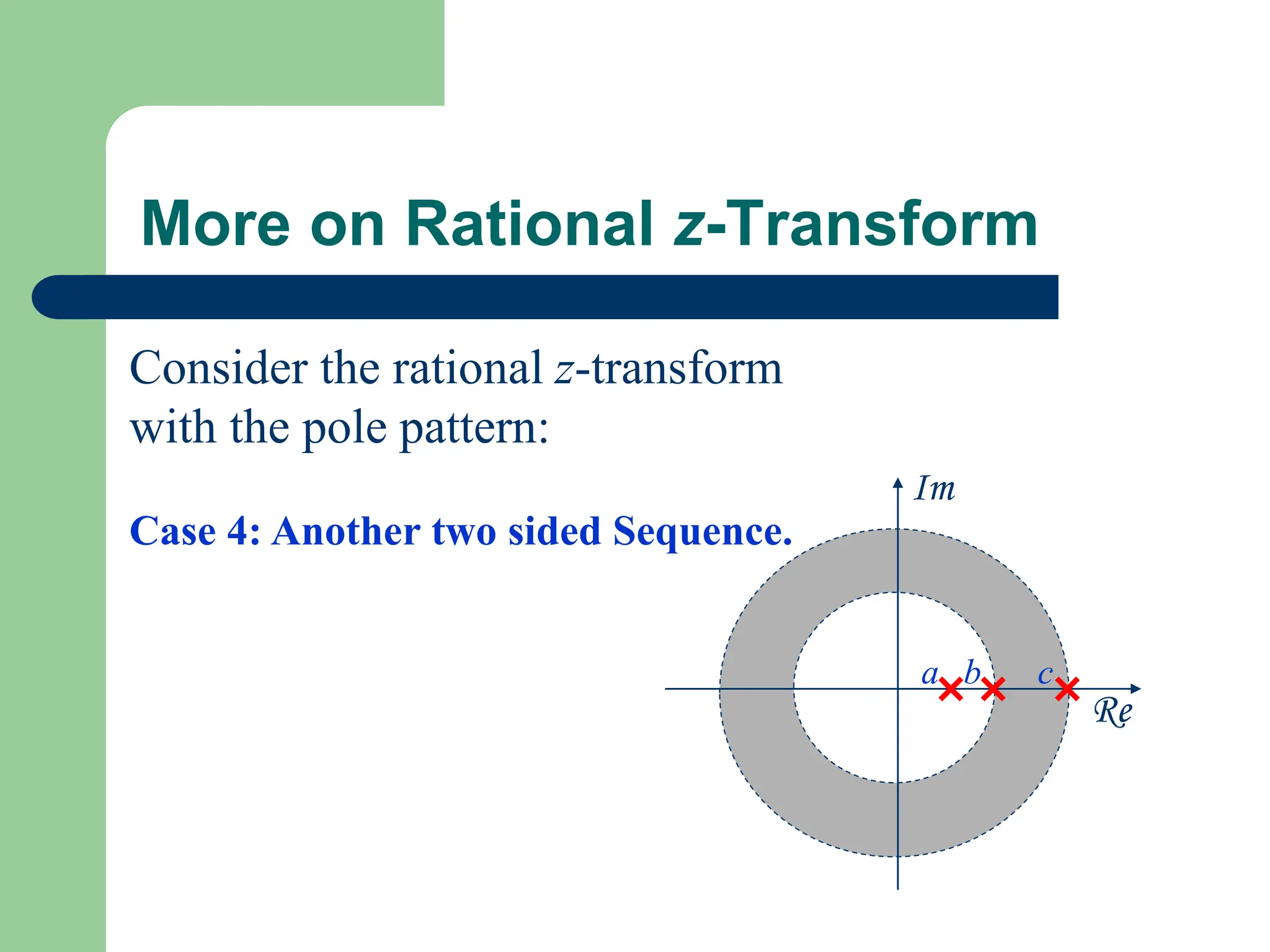
Case 3: A two sided Sequence.
33.
More on Rationalz-Transform
Re
Im
a b c
Consider the rational z-transform
with the pole pattern:
Case 4: Another two sided Sequence.
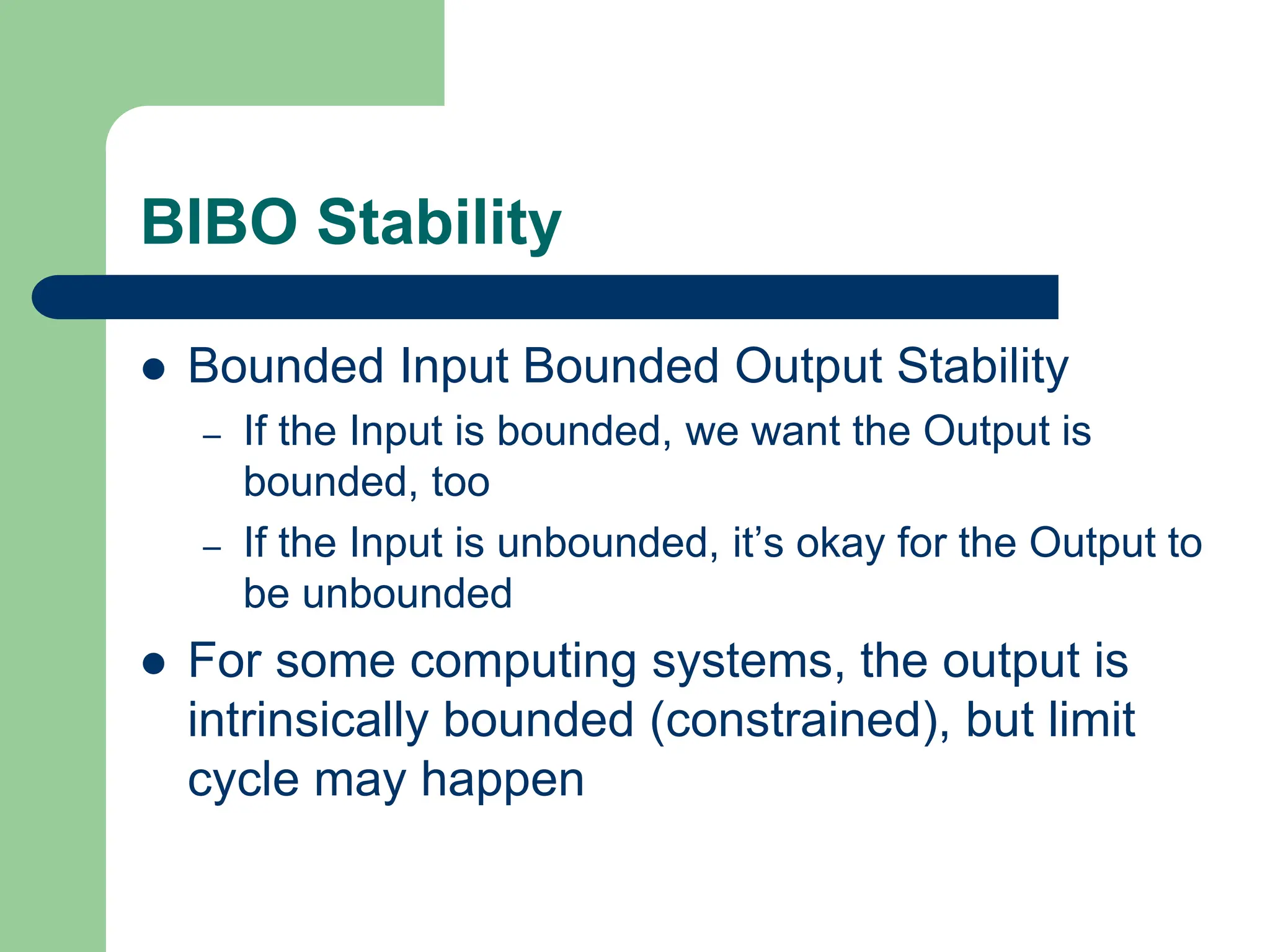
BIBO Stability
BoundedInput Bounded Output Stability
– If the Input is bounded, we want the Output is
bounded, too
– If the Input is unbounded, it’s okay for the Output to
be unbounded
For some computing systems, the output is
intrinsically bounded (constrained), but limit
cycle may happen
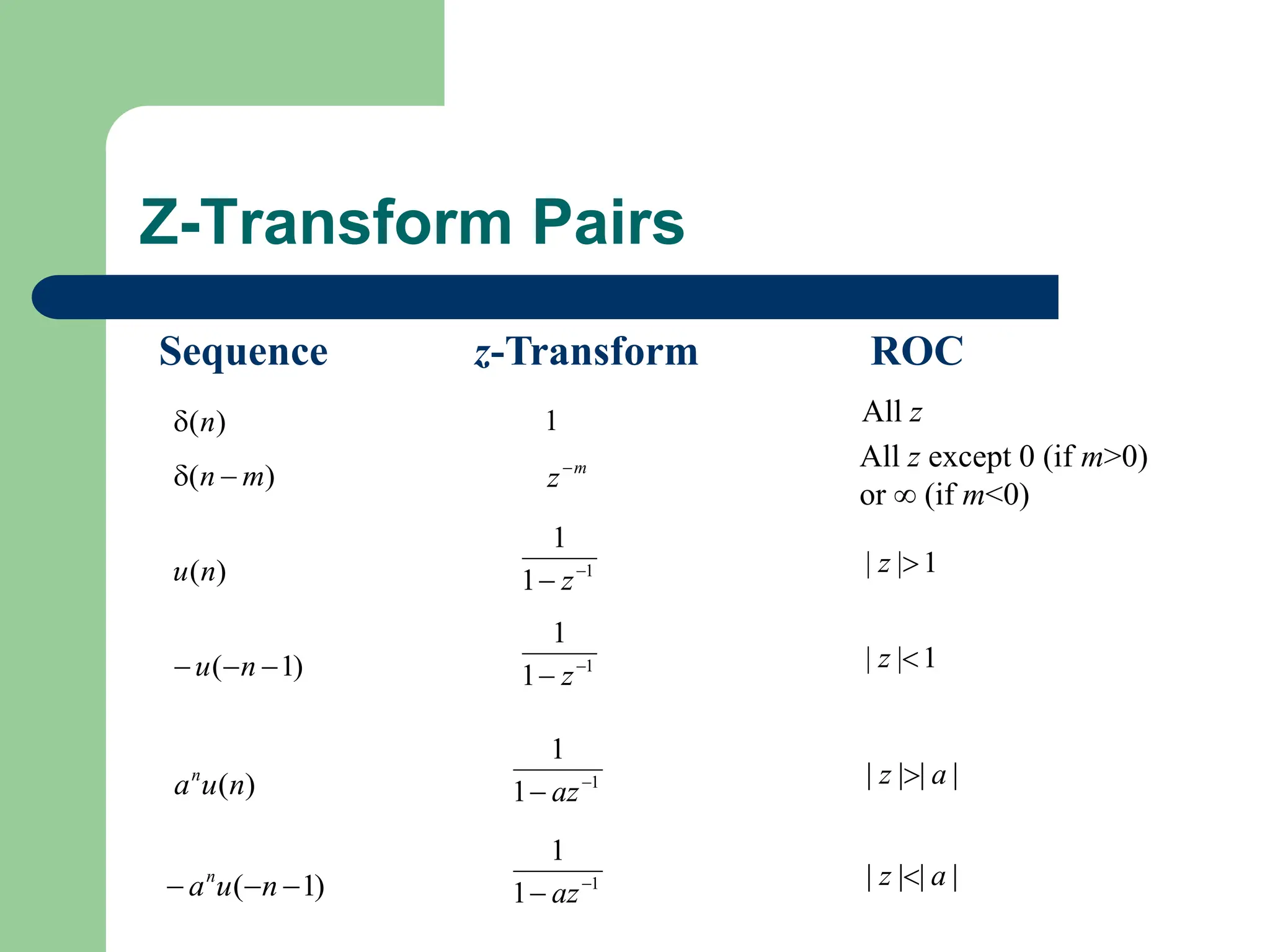
Z-Transform Pairs
Sequence z-TransformROC
)
(n
1 All z
)
( m
n
m
z All z except 0 (if m>0)
or (if m<0)
)
(n
u 1
1
1
z
1
|
|
z
)
1
(
n
u 1
1
1
z
1
|
|
z
)
(n
u
an 1
1
1
az
|
|
|
| a
z
)
1
(
n
u
an 1
1
1
az
|
|
|
| a
z
38.
Z-Transform Pairs
Sequence z-TransformROC
)
(
]
[cos 0 n
u
n
2
1
0
1
0
]
cos
2
[
1
]
[cos
1
z
z
z
1
|
|
z
)
(
]
[sin 0 n
u
n
2
1
0
1
0
]
cos
2
[
1
]
[sin
z
z
z
1
|
|
z
)
(
]
cos
[ 0 n
u
n
rn
2
2
1
0
1
0
]
cos
2
[
1
]
cos
[
1
z
r
z
r
z
r
r
z
|
|
)
(
]
sin
[ 0 n
u
n
rn
2
2
1
0
1
0
]
cos
2
[
1
]
sin
[
z
r
z
r
z
r
r
z
|
|
otherwise
0
1
0 N
n
an
1
1
1
az
z
a N
N
0
|
|
z
39.
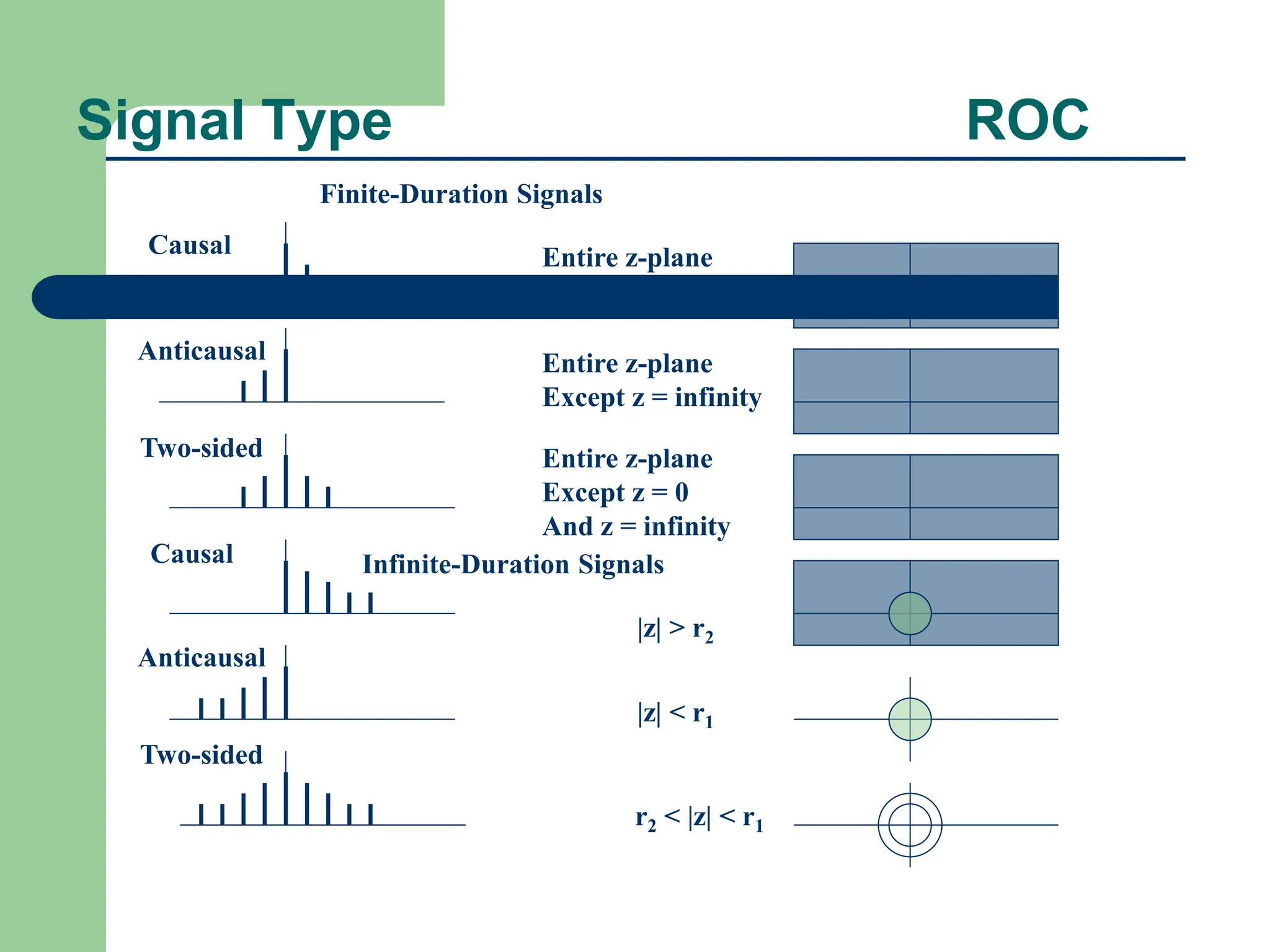
Signal Type ROC
Finite-DurationSignals
Infinite-Duration Signals
Causal
Anticausal
Two-sided
Causal
Anticausal
Two-sided
Entire z-plane
Except z = 0
Entire z-plane
Except z = infinity
Entire z-plane
Except z = 0
And z = infinity
|z| < r1
|z| > r2
r2 < |z| < r1
40.
Some Common z-TransformPairs
Sequence Transform ROC
1. [n] 1 all z
2. u[n] z/(z-1) |z|>1
3. -u[-n-1] z/(z-1) |z|<1
4. [n-m] z-m all z except 0 if m>0 or ฅ if m<0
5. anu[n] z/(z-a) |z|>|a|
6. -anu[-n-1] z/(z-a) |z|<|a|
7. nanu[n] az/(z-a)2 |z|>|a|
8. -nanu[-n-1] az/(z-a)2 |z|<|a|
9. [cos0n]u[n] (z2-[cos0]z)/(z2-[2cos0]z+1) |z|>1
10. [sin0n]u[n] [sin0]z)/(z2-[2cos0]z+1) |z|>1
11. [rncos0n]u[n] (z2-[rcos0]z)/(z2-[2rcos0]z+r2) |z|>r
12. [rnsin0n]u[n] [rsin0]z)/(z2-[2rcos0]z+r2) |z|>r
13. anu[n] - anu[n-N] (zN-aN)/zN-1(z-a) |z|>0
Inverse Z-Transform byPartial Fraction
Expansion
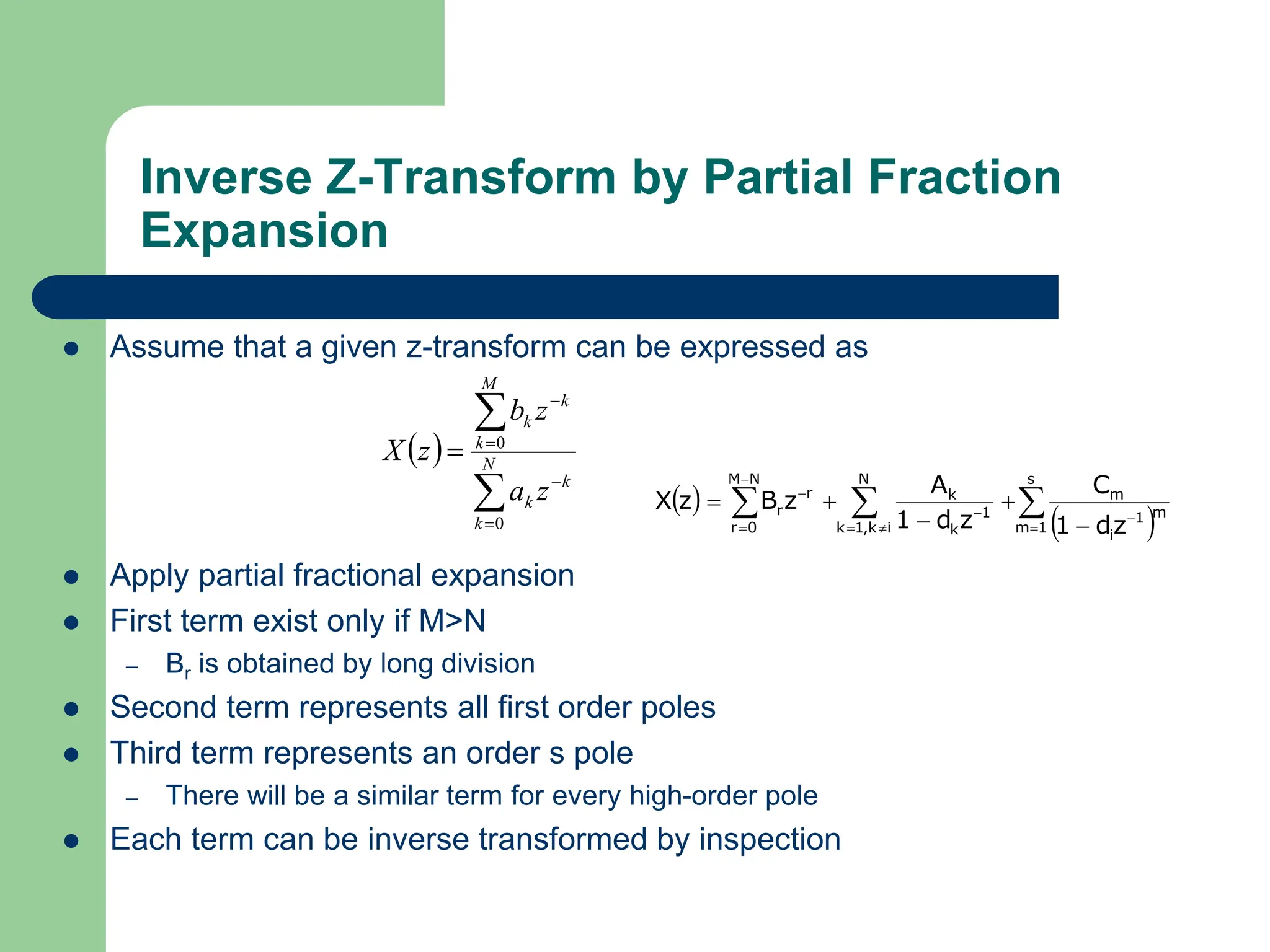
Assume that a given z-transform can be expressed as
Apply partial fractional expansion
First term exist only if M>N
– Br is obtained by long division
Second term represents all first order poles
Third term represents an order s pole
– There will be a similar term for every high-order pole
Each term can be inverse transformed by inspection
N
k
k
k
M
k
k
k
z
a
z
b
z
X
0
0
s
1
m
m
1
i
m
N
i
k
,
1
k
1
k
k
N
M
0
r
r
r
z
d
1
C
z
d
1
A
z
B
z
X
43.
Partial Fractional Expression
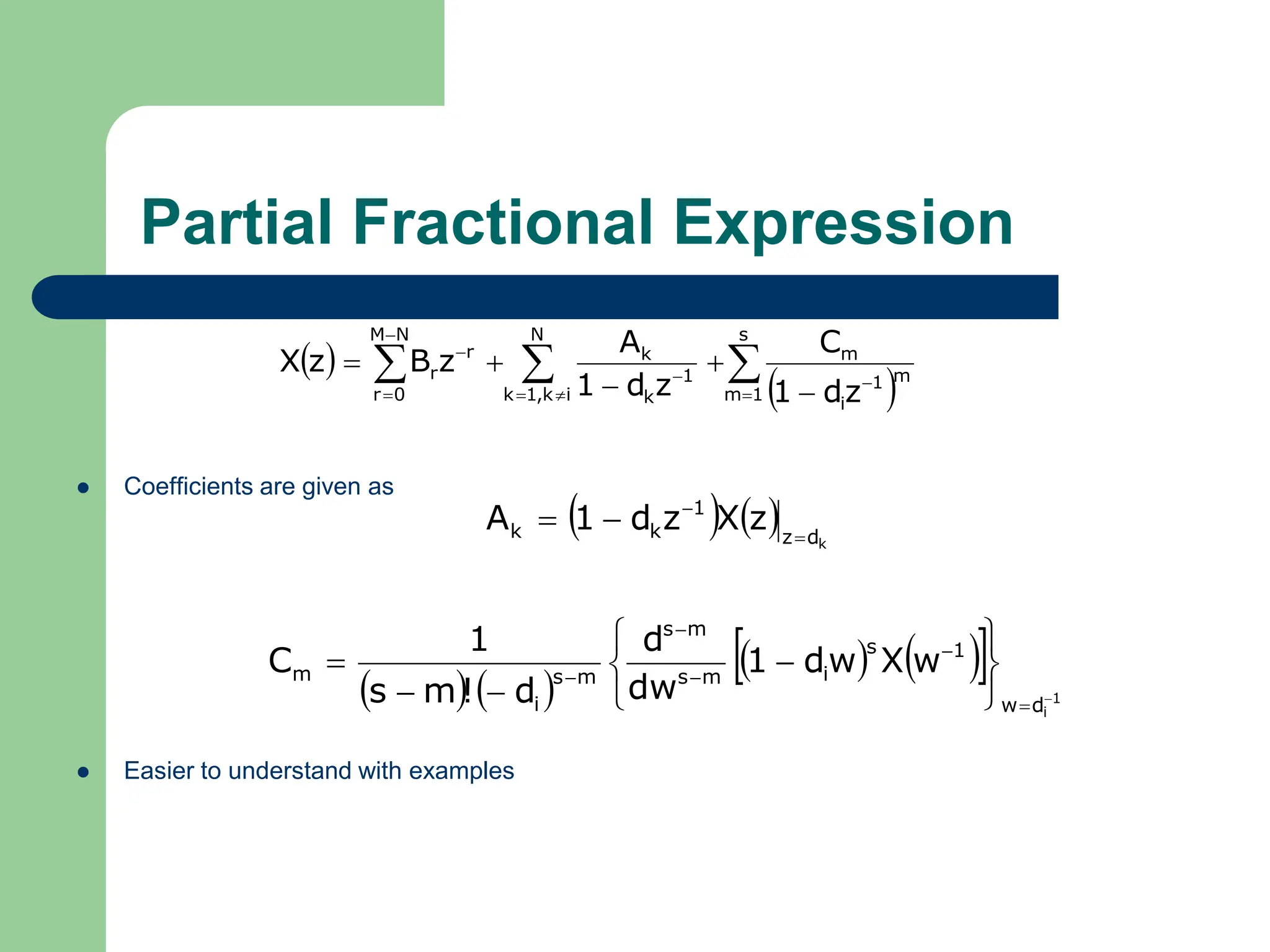
Coefficients are given as
Easier to understand with examples
s
1
m
m
1
i
m
N
i
k
,
1
k
1
k
k
N
M
0
r
r
r
z
d
1
C
z
d
1
A
z
B
z
X
k
d
z
1
k
k z
X
z
d
1
A
1
i
d
w
1
s
i
m
s
m
s
m
s
i
m w
X
w
d
1
dw
d
d
!
m
s
1
C
44.
Example: 2nd OrderZ-Transform
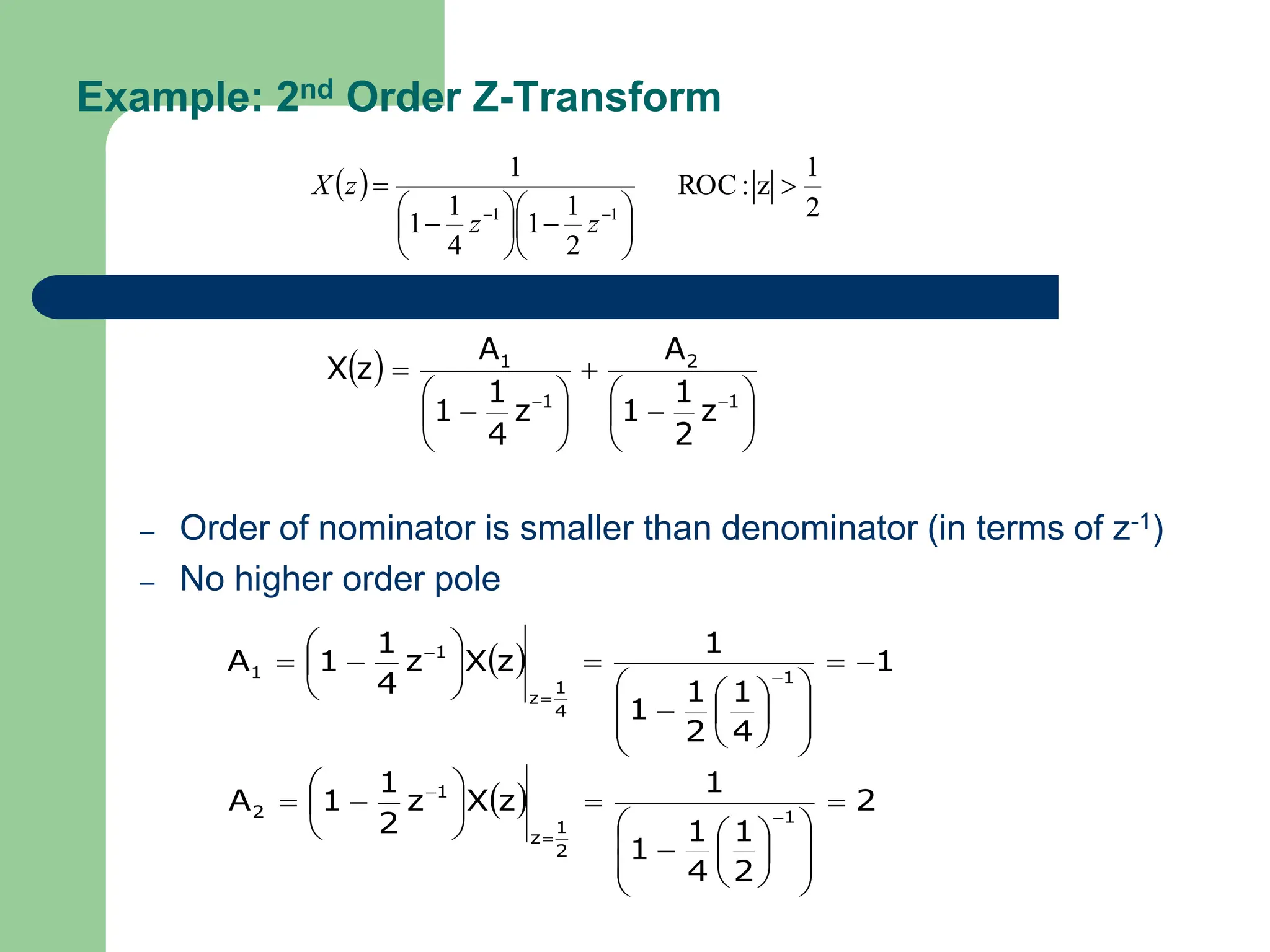
– Order of nominator is smaller than denominator (in terms of z-1)
– No higher order pole
2
1
z
:
ROC
2
1
1
4
1
1
1
1
1
z
z
z
X
1
2
1
1
z
2
1
1
A
z
4
1
1
A
z
X
1
4
1
2
1
1
1
z
X
z
4
1
1
A 1
4
1
z
1
1
2
2
1
4
1
1
1
z
X
z
2
1
1
A 1
2
1
z
1
2
45.
Example Continued
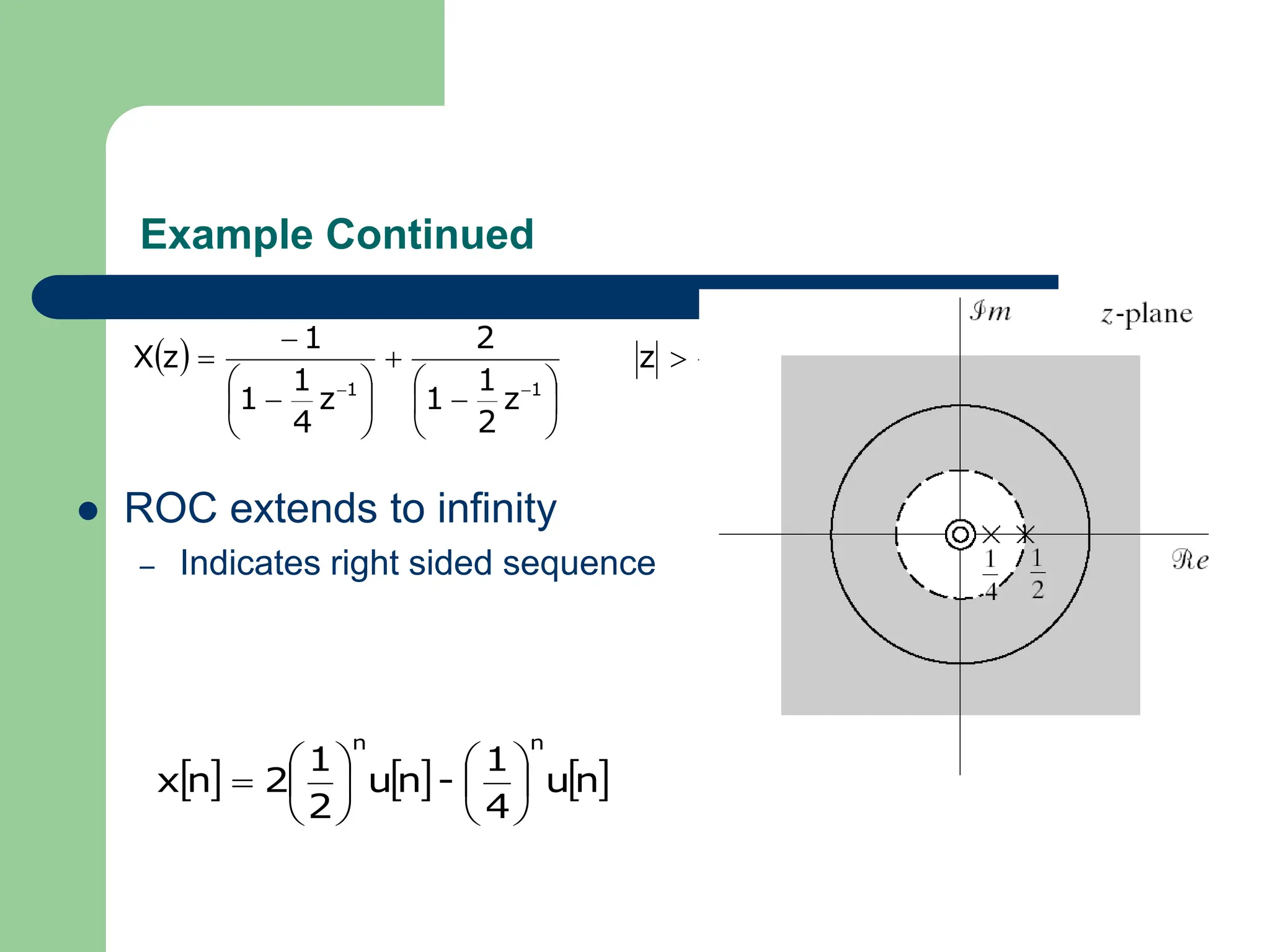
ROCextends to infinity
– Indicates right sided sequence
2
1
z
z
2
1
1
2
z
4
1
1
1
z
X
1
1
n
u
4
1
-
n
u
2
1
2
n
x
n
n
46.
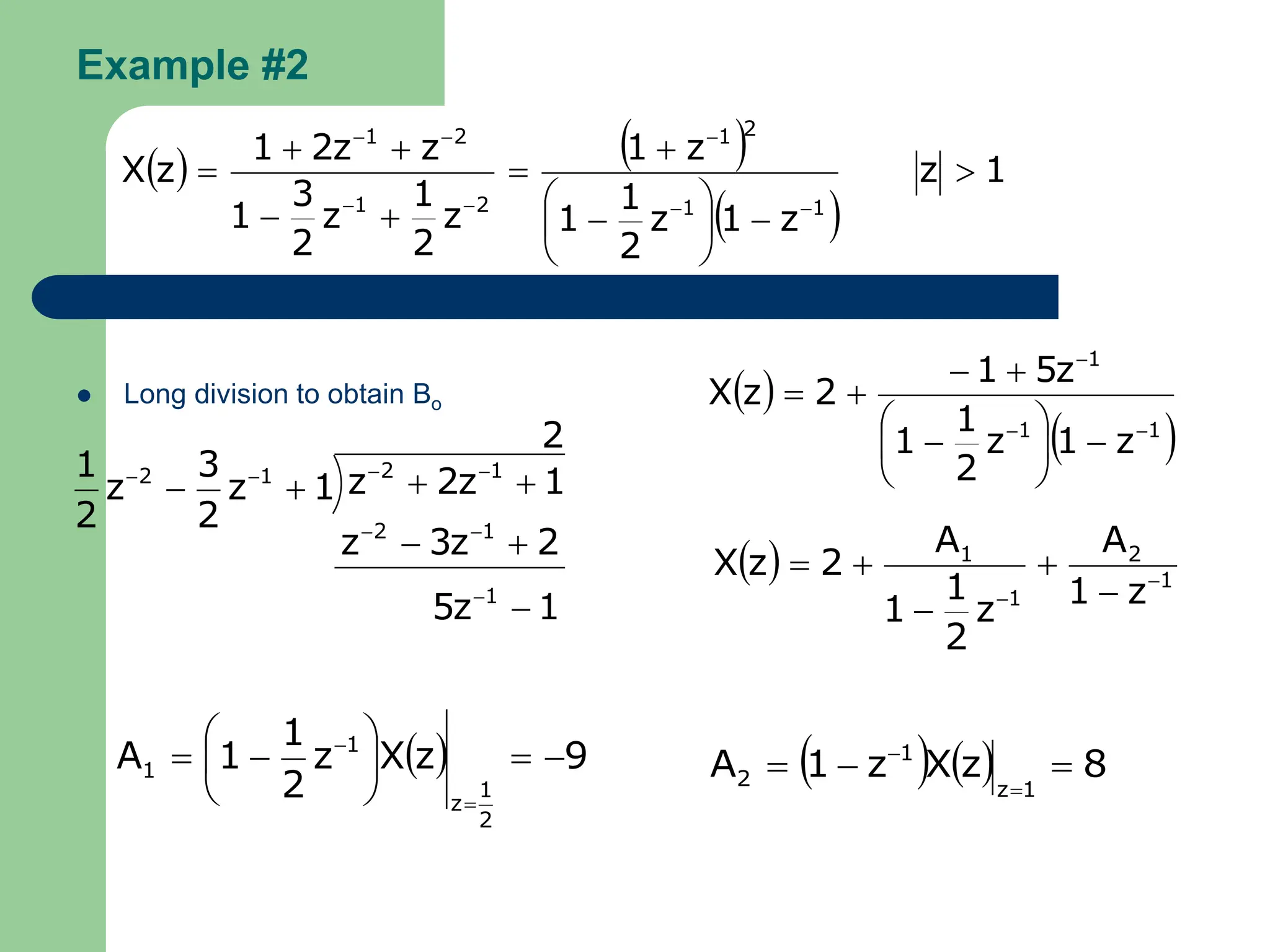
Example #2
Longdivision to obtain Bo
1
z
z
1
z
2
1
1
z
1
z
2
1
z
2
3
1
z
z
2
1
z
X
1
1
2
1
2
1
2
1
1
z
5
2
z
3
z
2
1
z
2
z
1
z
2
3
z
2
1
1
1
2
1
2
1
2
1
1
1
z
1
z
2
1
1
z
5
1
2
z
X
1
2
1
1
z
1
A
z
2
1
1
A
2
z
X
9
z
X
z
2
1
1
A
2
1
z
1
1
8
z
X
z
1
A
1
z
1
2
47.
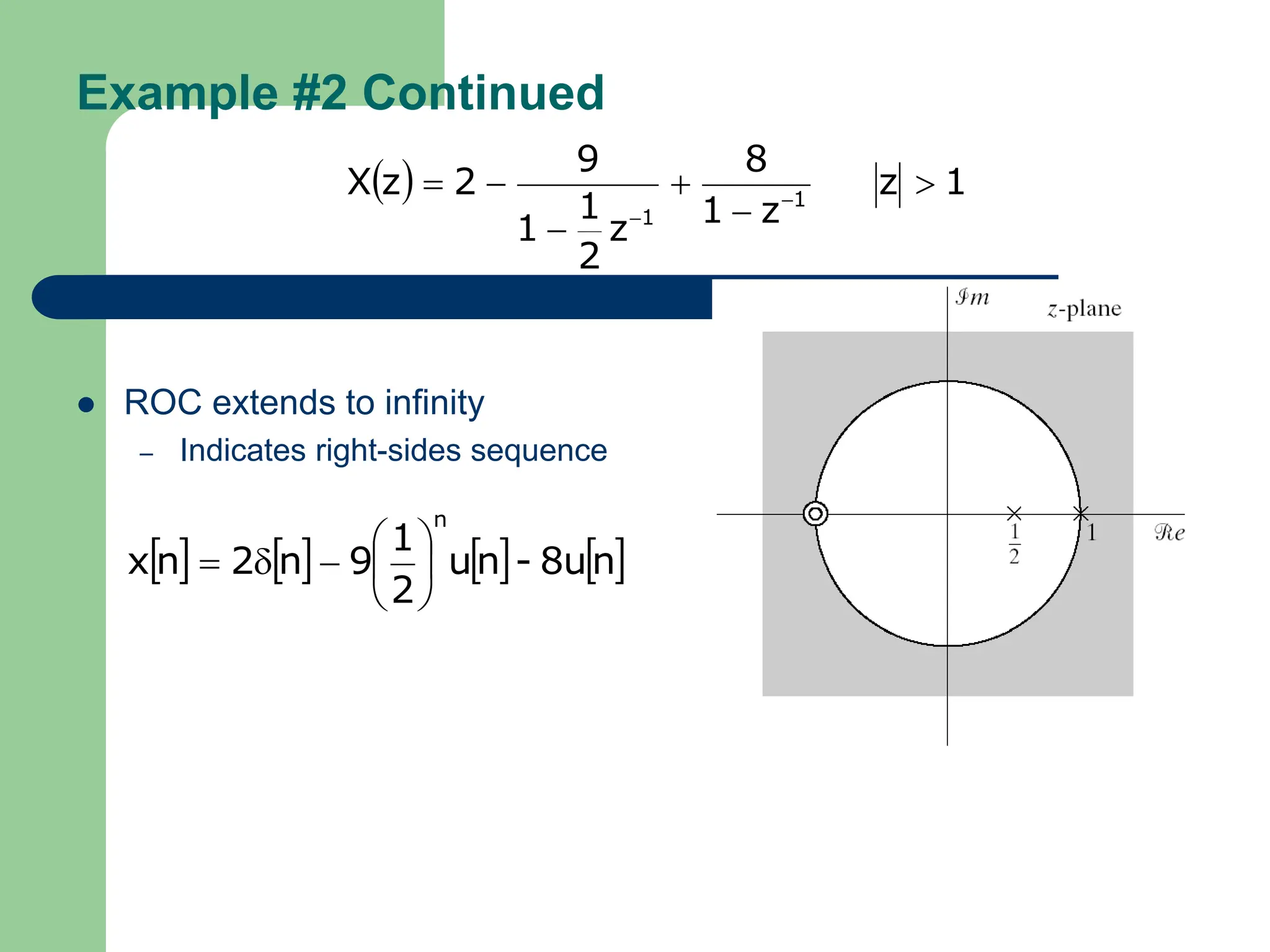
Example #2 Continued
ROC extends to infinity
– Indicates right-sides sequence
1
z
z
1
8
z
2
1
1
9
2
z
X 1
1
n
8u
-
n
u
2
1
9
n
2
n
x
n
48.
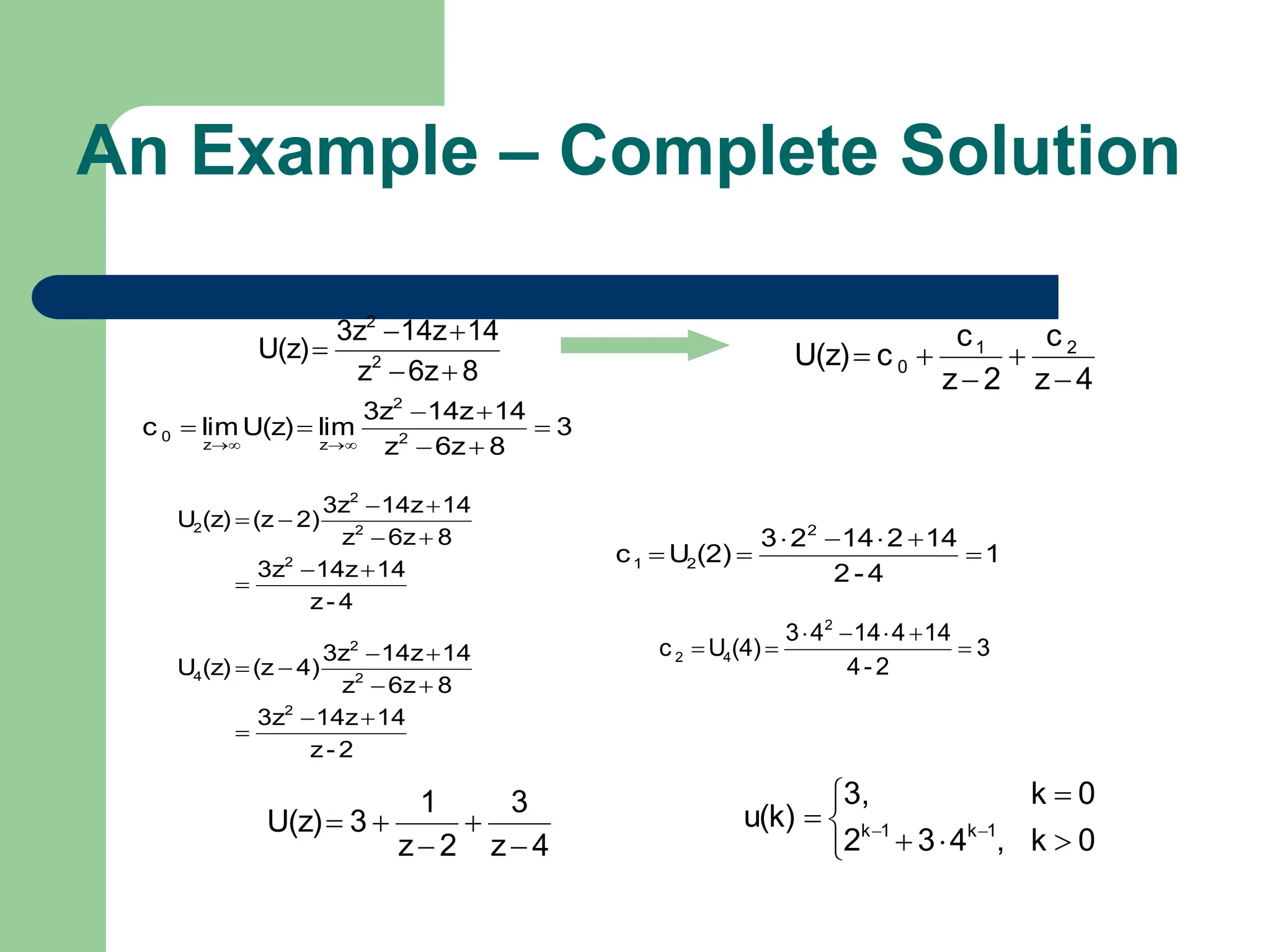
An Example –Complete Solution
3
8
6z
z
14
14z
3z
lim
U(z)
lim
c 2
2
z
z
0
4
-
z
14
14z
3z
8
6z
z
14
14z
3z
2)
(z
(z)
U
2
2
2
2
2
-
z
14
14z
3z
8
6z
z
14
14z
3z
4)
(z
(z)
U
2
2
2
4
8
6z
z
14
14z
3z
U(z) 2
2
4
z
c
2
z
c
c
U(z) 2
1
0
1
4
-
2
14
2
14
2
3
(2)
U
c
2
2
1
3
2
-
4
14
4
14
4
3
(4)
U
c
2
4
2
4
z
3
2
z
1
3
U(z)
0
k
,
4
3
2
0
k
3,
u(k) 1
k
1
k
49.
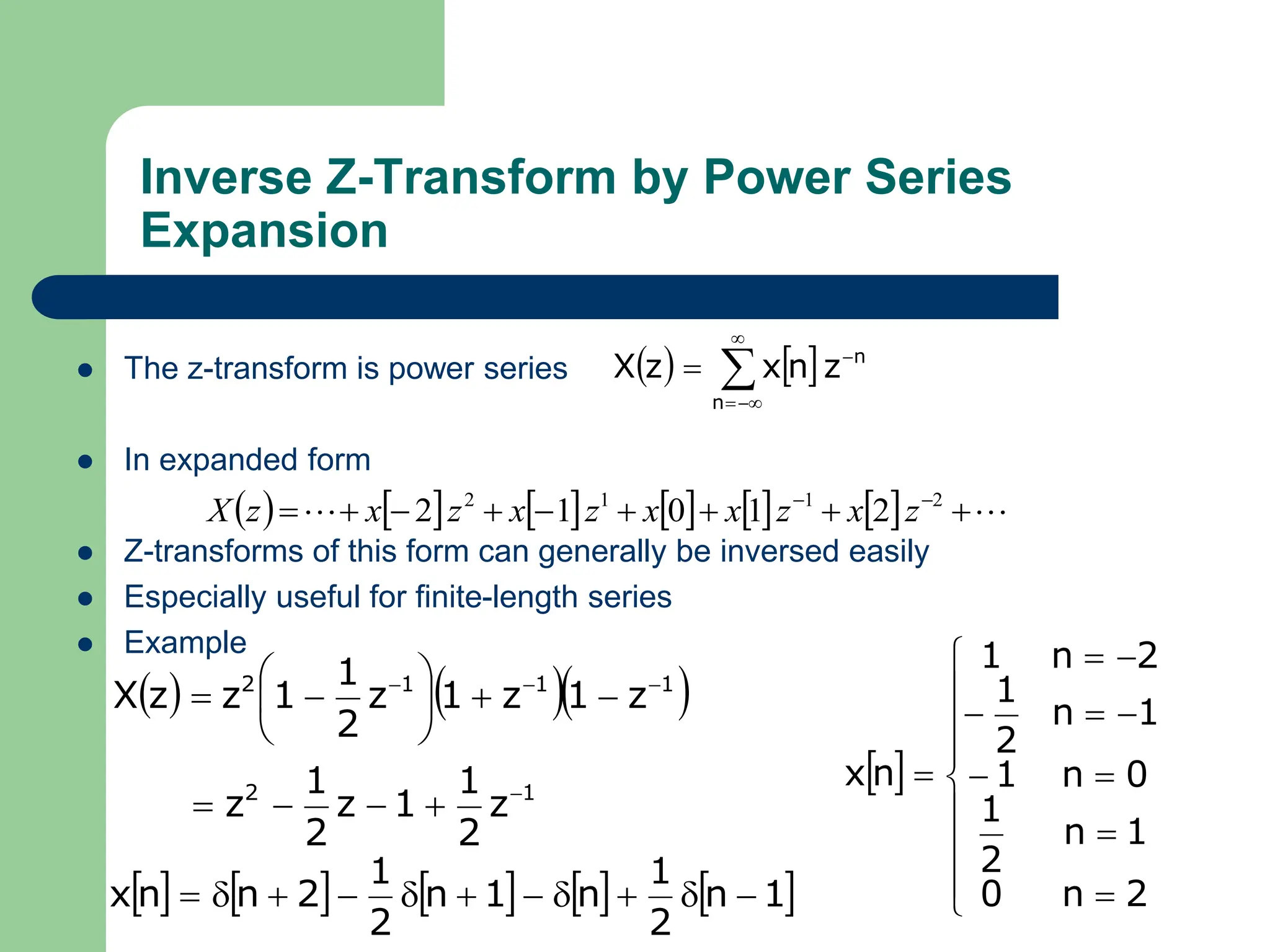
Inverse Z-Transform byPower Series
Expansion
The z-transform is power series
In expanded form
Z-transforms of this form can generally be inversed easily
Especially useful for finite-length series
Example
n
n
z
n
x
z
X
2
1
1
2
2
1
0
1
2 z
x
z
x
x
z
x
z
x
z
X
1
2
1
1
1
2
z
2
1
1
z
2
1
z
z
1
z
1
z
2
1
1
z
z
X
1
n
2
1
n
1
n
2
1
2
n
n
x
2
n
0
1
n
2
1
0
n
1
1
n
2
1
2
n
1
n
x
50.
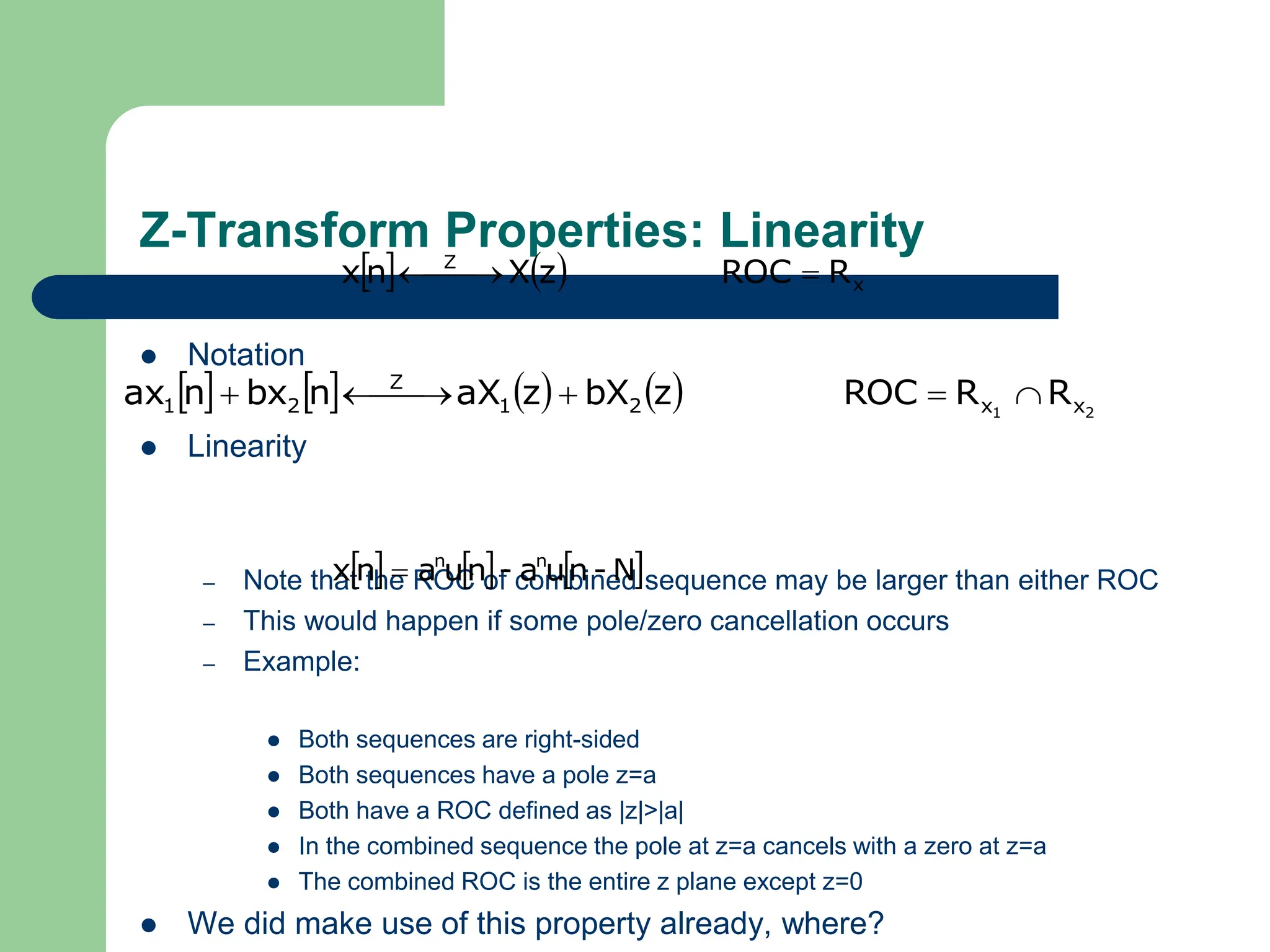
Z-Transform Properties: Linearity
Notation
Linearity
– Note that the ROC of combined sequence may be larger than either ROC
– This would happen if some pole/zero cancellation occurs
– Example:
Both sequences are right-sided
Both sequences have a pole z=a
Both have a ROC defined as |z|>|a|
In the combined sequence the pole at z=a cancels with a zero at z=a
The combined ROC is the entire z plane except z=0
We did make use of this property already, where?
x
Z
R
ROC
z
X
n
x
2
1 x
x
2
1
Z
2
1 R
R
ROC
z
bX
z
aX
n
bx
n
ax
N
-
n
u
a
-
n
u
a
n
x n
n
51.
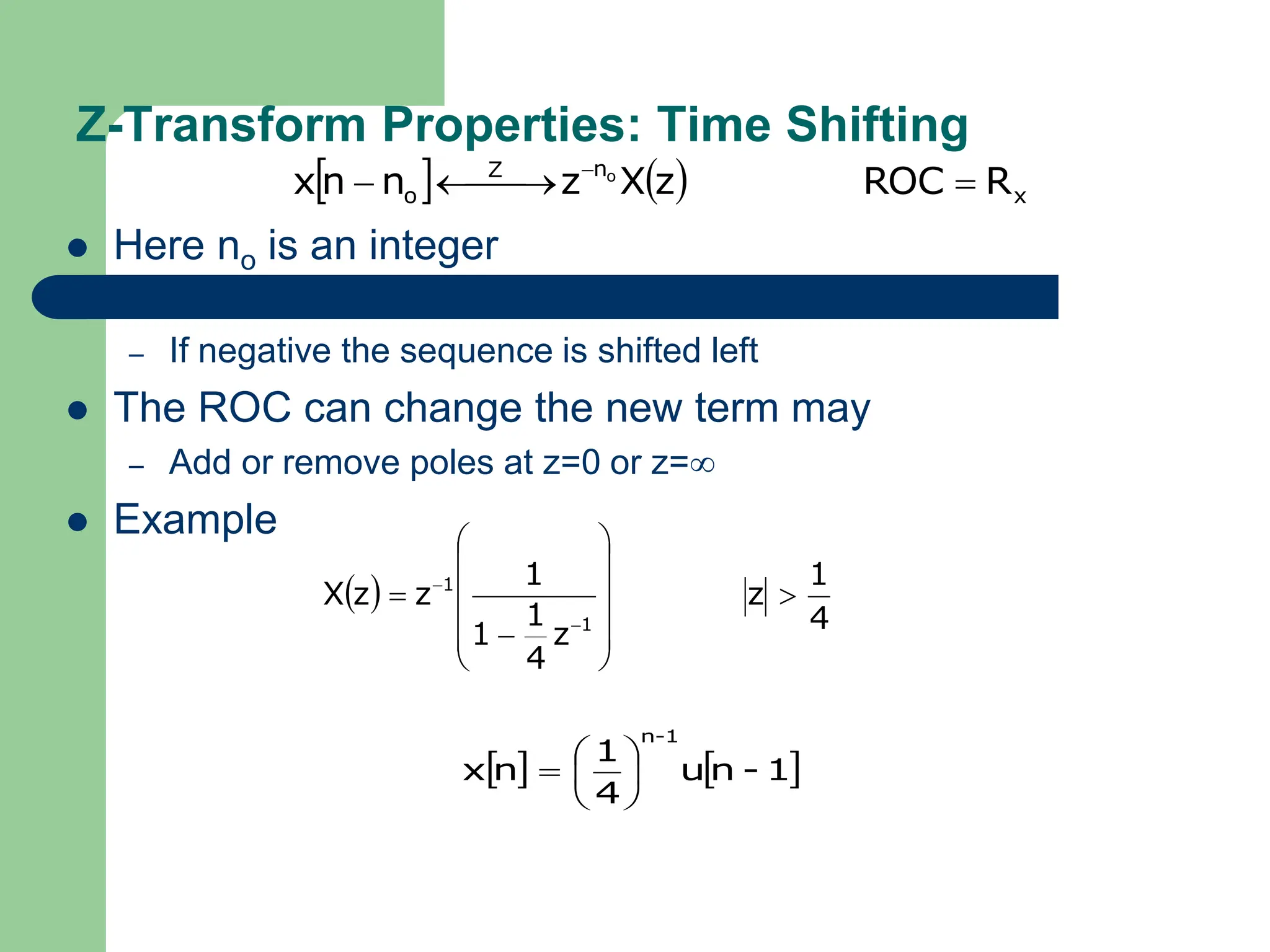
Z-Transform Properties: TimeShifting
Here no is an integer
– If positive the sequence is shifted right
– If negative the sequence is shifted left
The ROC can change the new term may
– Add or remove poles at z=0 or z=
Example
x
n
Z
o R
ROC
z
X
z
n
n
x o
4
1
z
z
4
1
1
1
z
z
X
1
1
1
-
n
u
4
1
n
x
1
-
n
52.
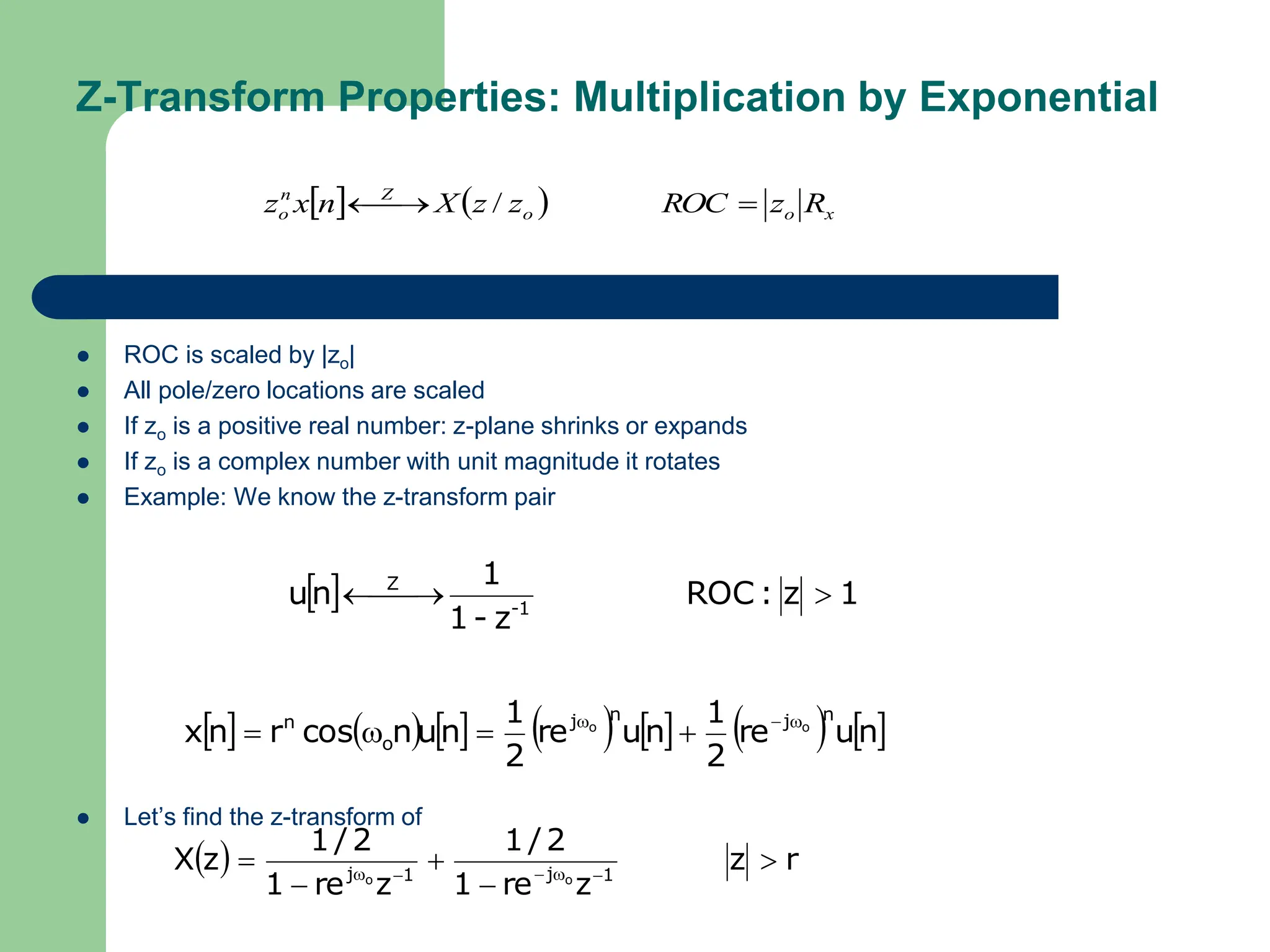
Z-Transform Properties: Multiplicationby Exponential
ROC is scaled by |zo|
All pole/zero locations are scaled
If zo is a positive real number: z-plane shrinks or expands
If zo is a complex number with unit magnitude it rotates
Example: We know the z-transform pair
Let’s find the z-transform of
x
o
o
Z
n
o R
z
ROC
z
z
X
n
x
z
/
1
z
:
ROC
z
-
1
1
n
u 1
-
Z
n
u
re
2
1
n
u
re
2
1
n
u
n
cos
r
n
x
n
j
n
j
o
n o
o
r
z
z
re
1
2
/
1
z
re
1
2
/
1
z
X 1
j
1
j o
o
53.
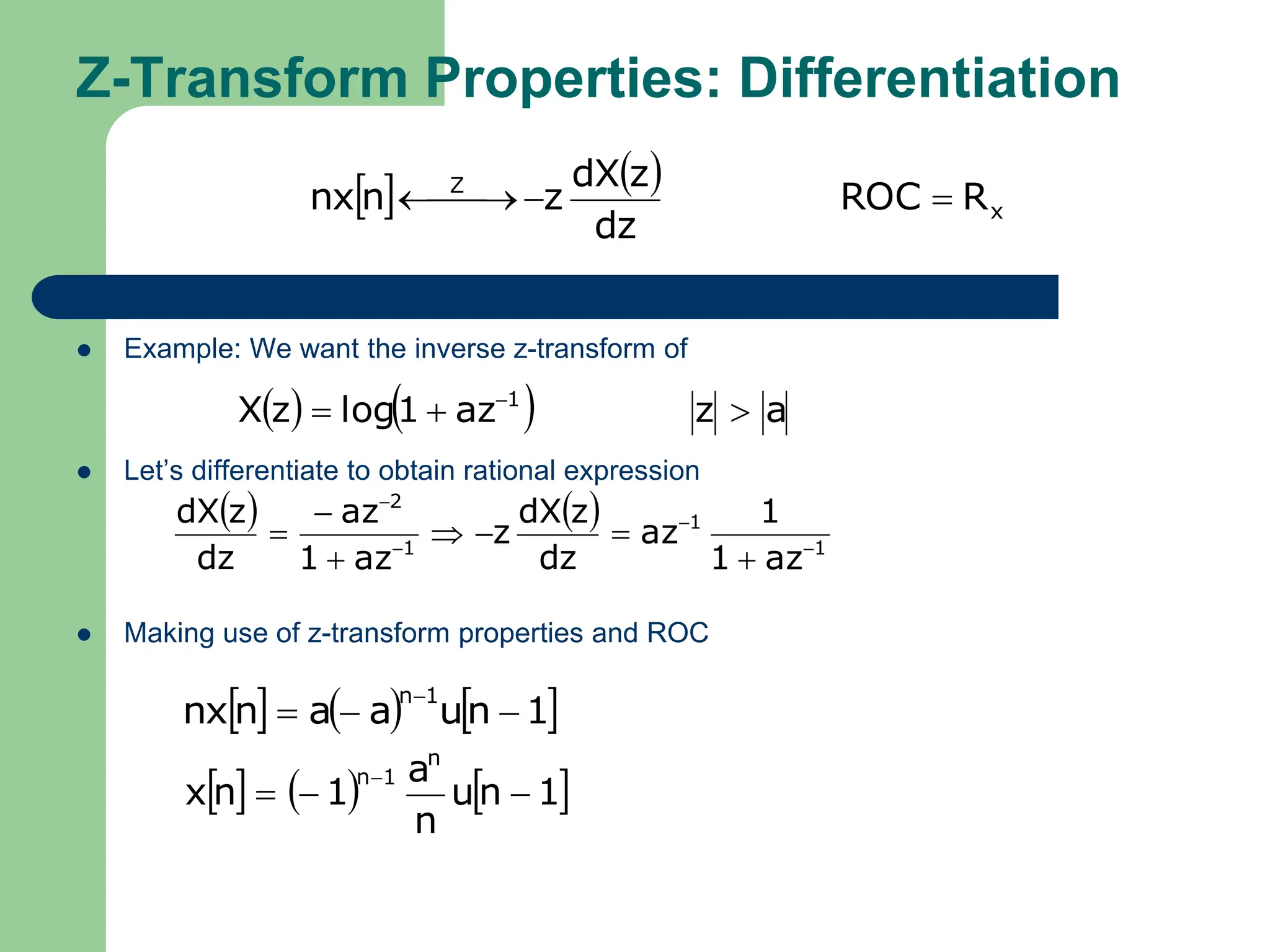
Z-Transform Properties: Differentiation
Example: We want the inverse z-transform of
Let’s differentiate to obtain rational expression
Making use of z-transform properties and ROC
x
Z
R
ROC
dz
z
dX
z
n
nx
a
z
az
1
log
z
X 1
1
1
1
2
az
1
1
az
dz
z
dX
z
az
1
az
dz
z
dX
1
n
u
a
a
n
nx
1
n
1
n
u
n
a
1
n
x
n
1
n
54.
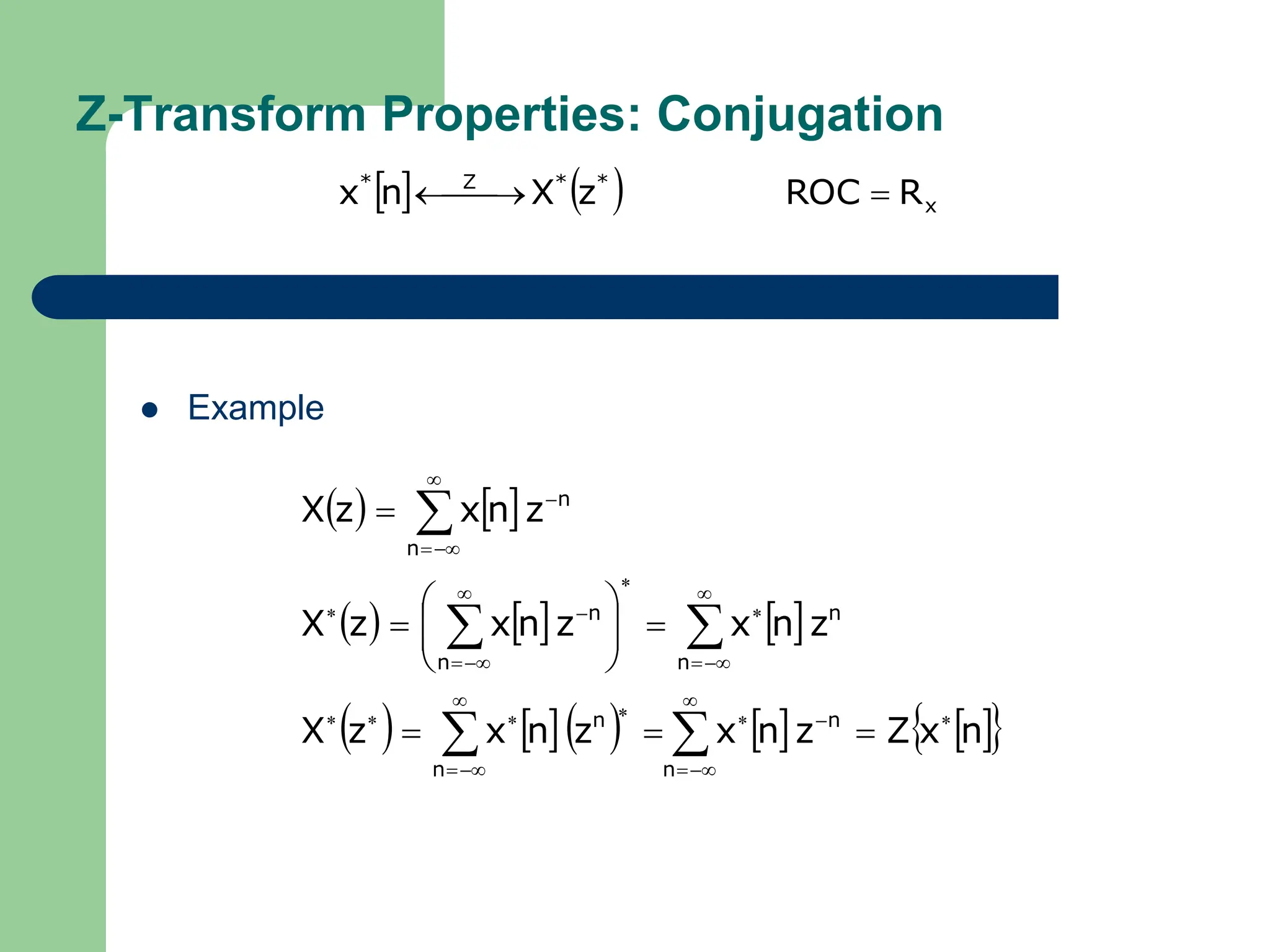
Z-Transform Properties: Conjugation
Example
x
*
*
Z
*
R
ROC
z
X
n
x
n
x
Z
z
n
x
z
n
x
z
X
z
n
x
z
n
x
z
X
z
n
x
z
X
n
n
n
n
n
n
n
n
n
n
55.
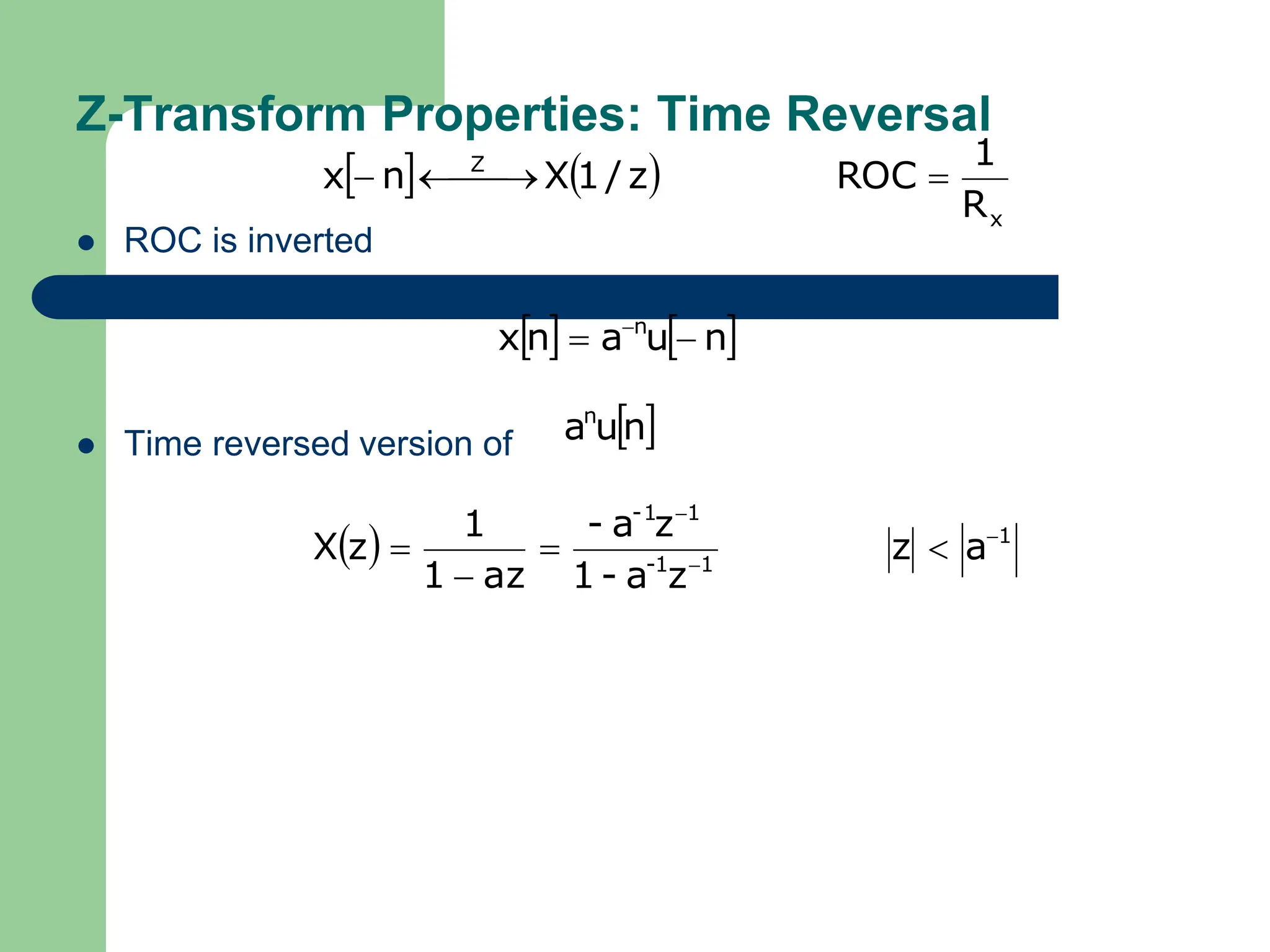
Z-Transform Properties: TimeReversal
ROC is inverted
Example:
Time reversed version of
x
Z
R
1
ROC
z
/
1
X
n
x
n
u
a
n
x n
n
u
an
1
1
1
-
1
-1
a
z
z
a
-
1
z
a
-
az
1
1
z
X
56.
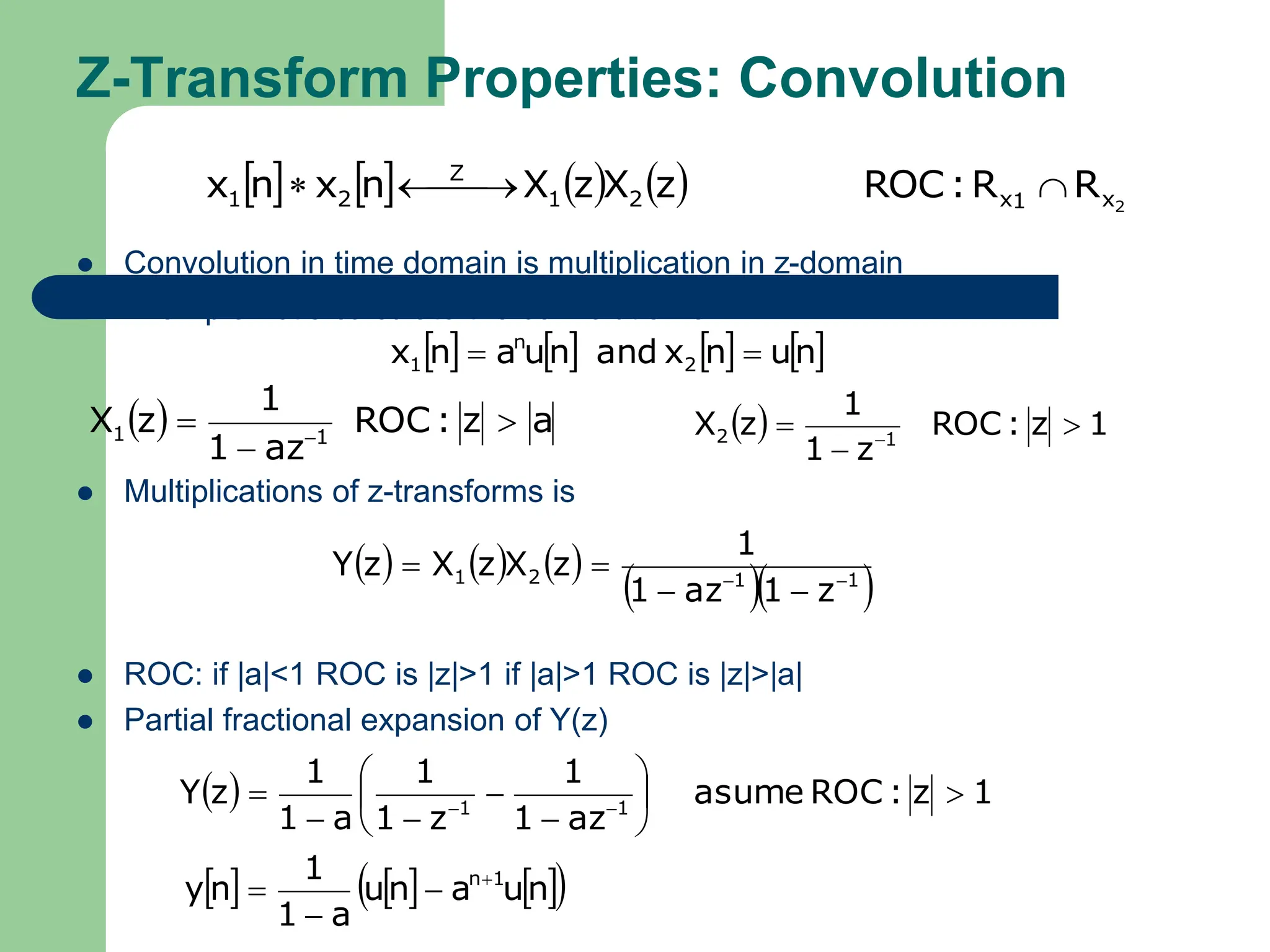
Z-Transform Properties: Convolution
Convolution in time domain is multiplication in z-domain
Example:Let’s calculate the convolution of
Multiplications of z-transforms is
ROC: if |a|<1 ROC is |z|>1 if |a|>1 ROC is |z|>|a|
Partial fractional expansion of Y(z)
2
x
1
x
2
1
Z
2
1 R
R
:
ROC
z
X
z
X
n
x
n
x
n
u
n
x
and
n
u
a
n
x 2
n
1
a
z
:
ROC
az
1
1
z
X 1
1
1
z
:
ROC
z
1
1
z
X 1
2
1
1
2
1
z
1
az
1
1
z
X
z
X
z
Y
1
z
:
ROC
asume
az
1
1
z
1
1
a
1
1
z
Y 1
1
n
u
a
n
u
a
1
1
n
y 1
n
Real and ImaginaryParts
x
R
z
z
X
n
x
),
(
)]
(
[
Z
x
R
z
z
X
z
X
n
x
e
*)]
(
*
)
(
[
)]
(
[ 2
1
R
x
j R
z
z
X
z
X
n
x
*)]
(
*
)
(
[
)]
(
[ 2
1
Im
Convolution of Sequences
k
k
n
y
k
x
n
y
n
x)
(
)
(
)
(
*
)
(
n
n
k
z
k
n
y
k
x
n
y
n
x )
(
)
(
)]
(
*
)
(
[
Z
k
n
n
z
k
n
y
k
x )
(
)
(
k
n
n
k
z
n
y
z
k
x )
(
)
(
)
(
)
( z
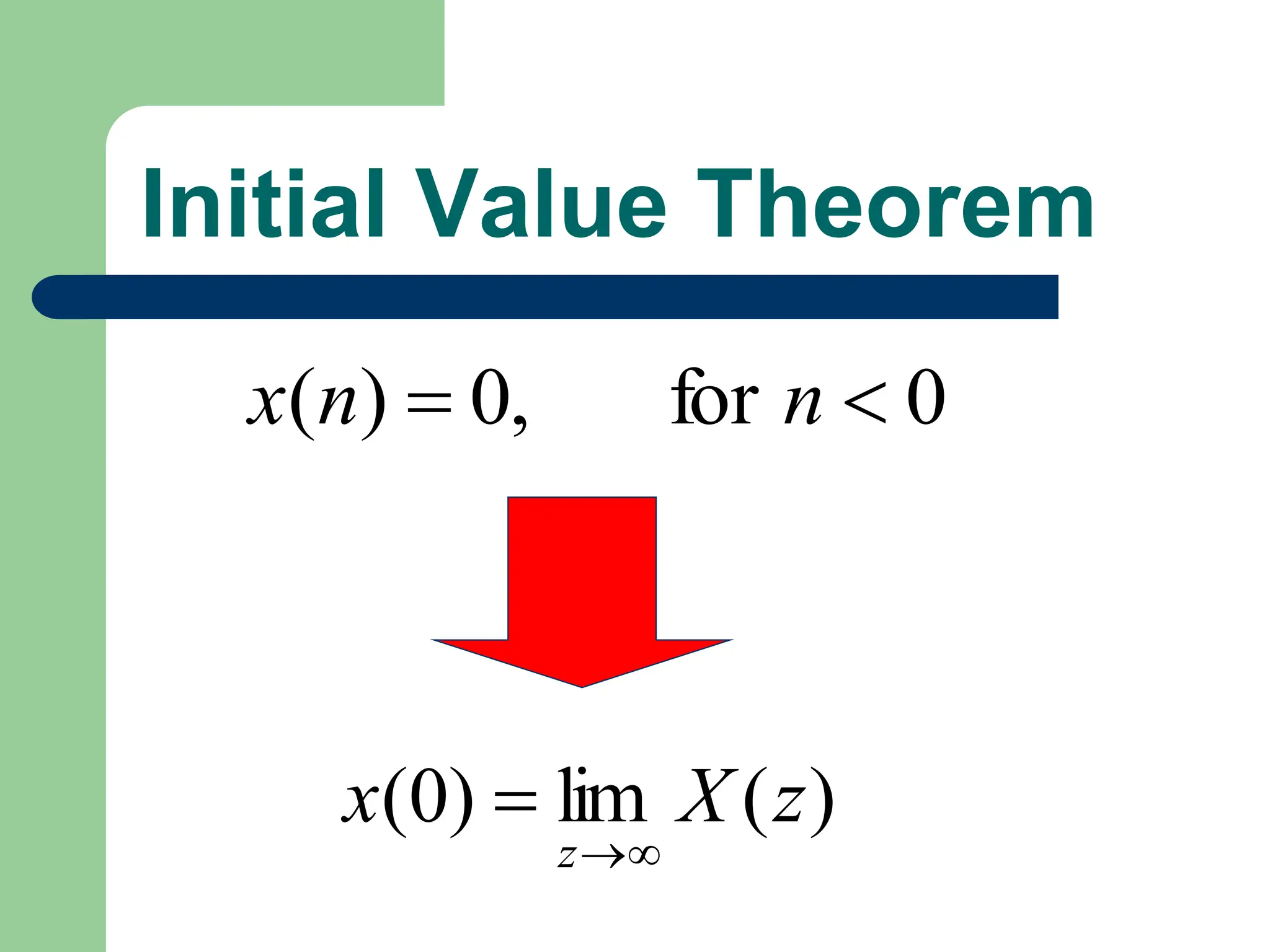
Y
z
X
Signal Characteristics fromZ-
Transform
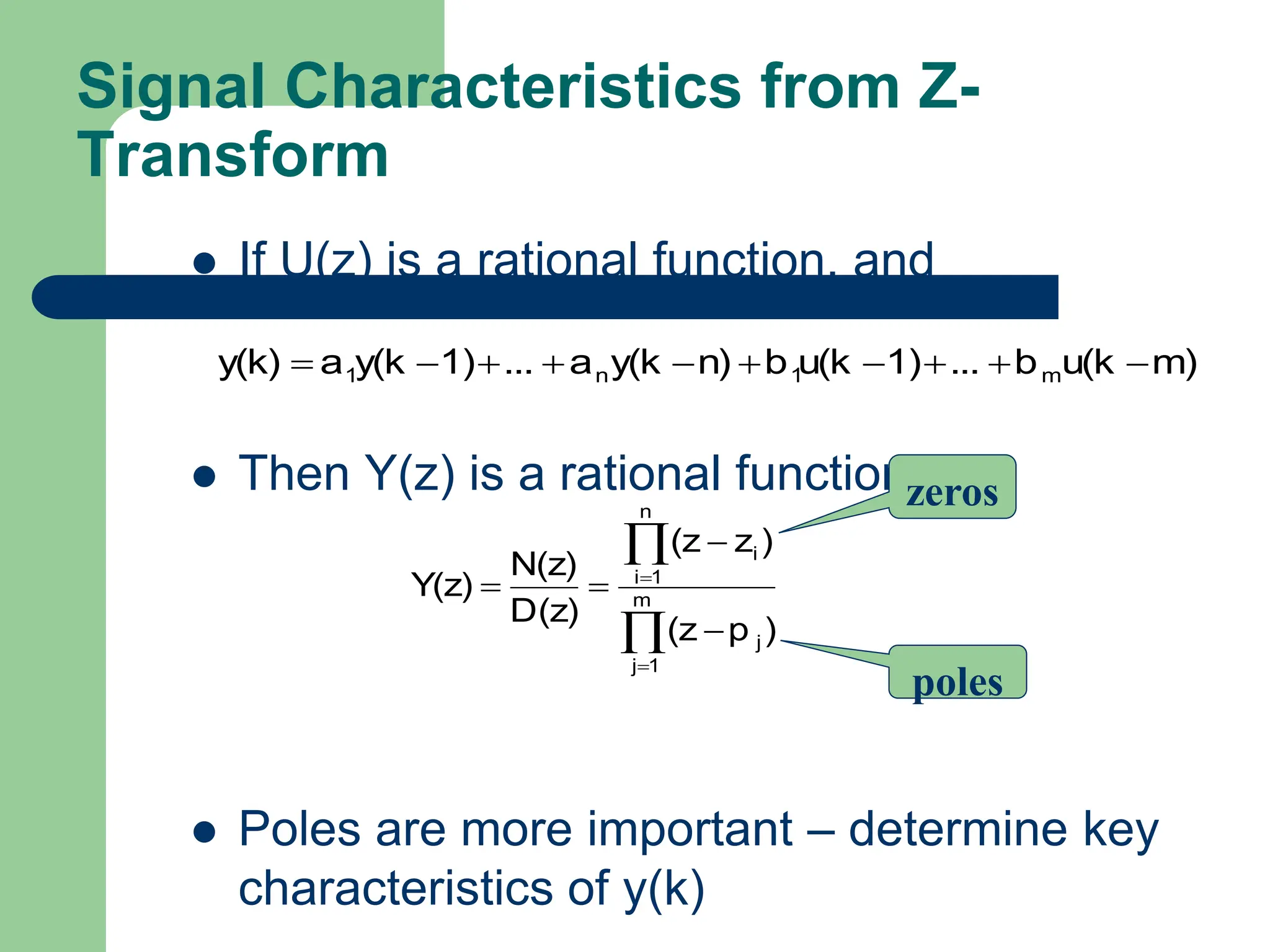
If U(z) is a rational function, and
Then Y(z) is a rational function, too
Poles are more important – determine key
characteristics of y(k)
m)
u(k
b
...
1)
u(k
b
n)
y(k
a
...
1)
y(k
a
y(k) m
1
n
1
m
1
j
j
n
1
i
i
)
p
(z
)
z
(z
D(z)
N(z)
Y(z)
zeros
poles
70.
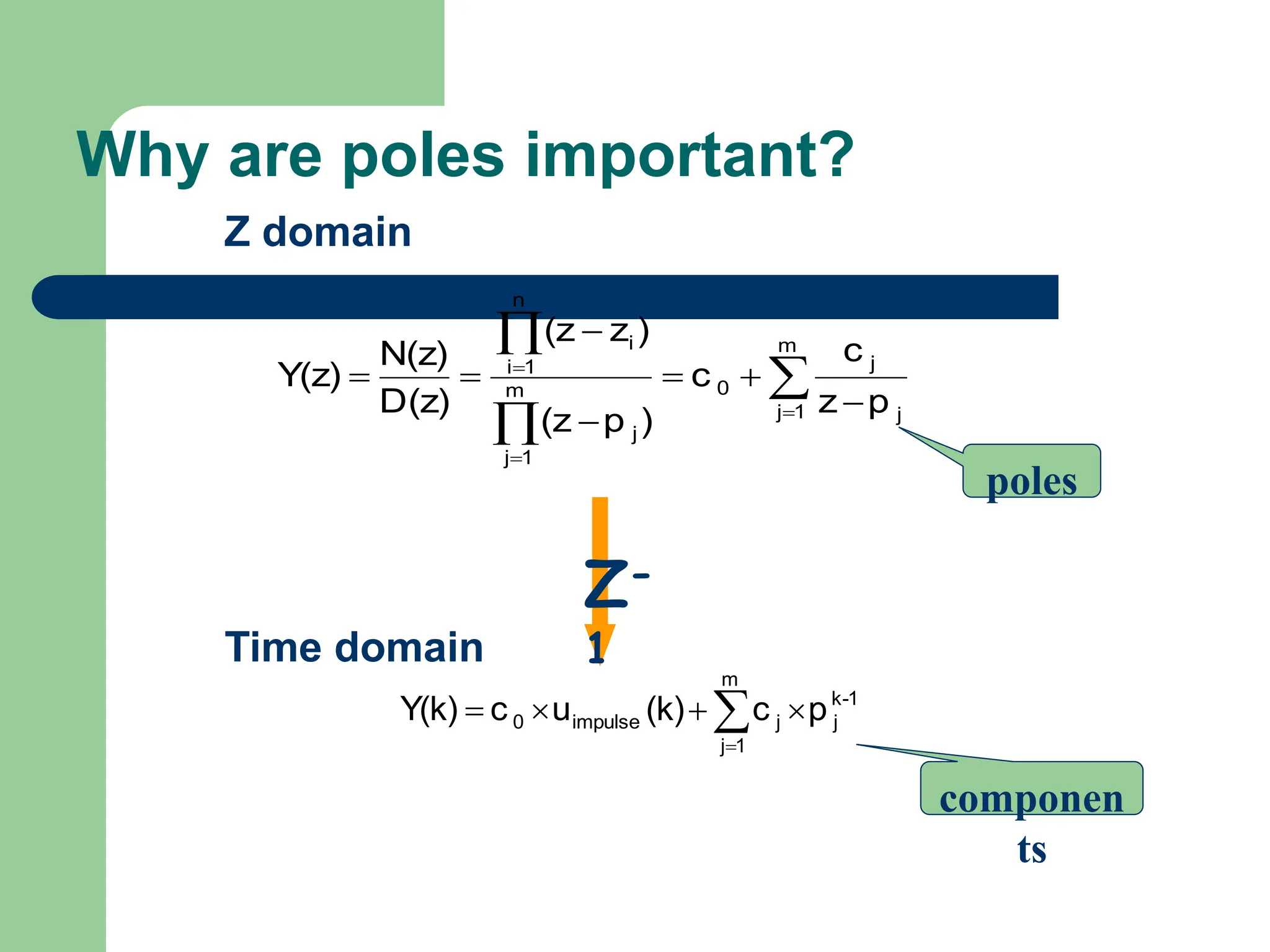
Why are polesimportant?
m
1
j j
j
0
m
1
j
j
n
1
i
i
p
z
c
c
)
p
(z
)
z
(z
D(z)
N(z)
Y(z)
m
1
j
1
-
k
j
j
impulse
0 p
c
(k)
u
c
Y(k)
Z-
1
Z domain
Time domain
poles
componen
ts
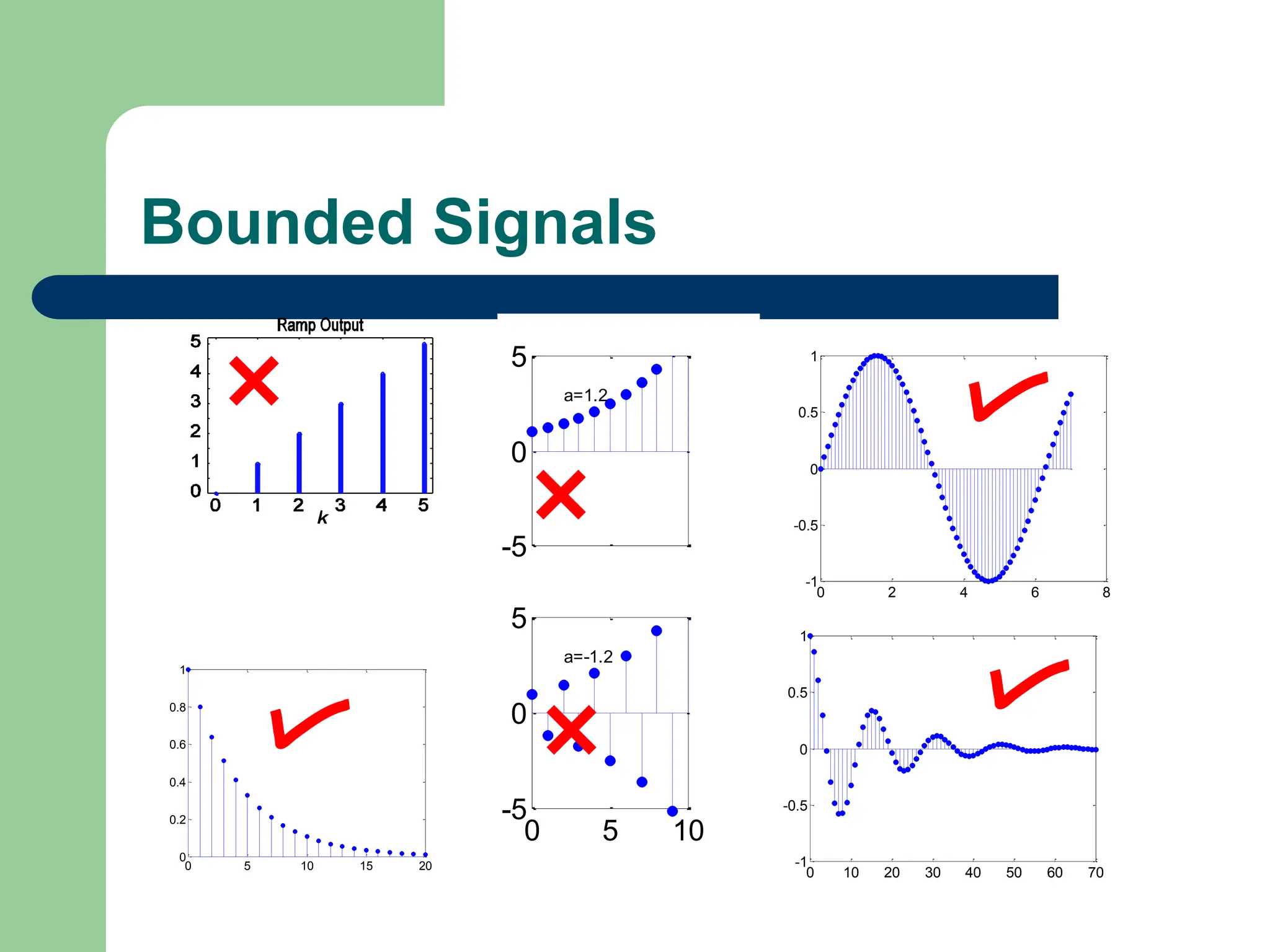
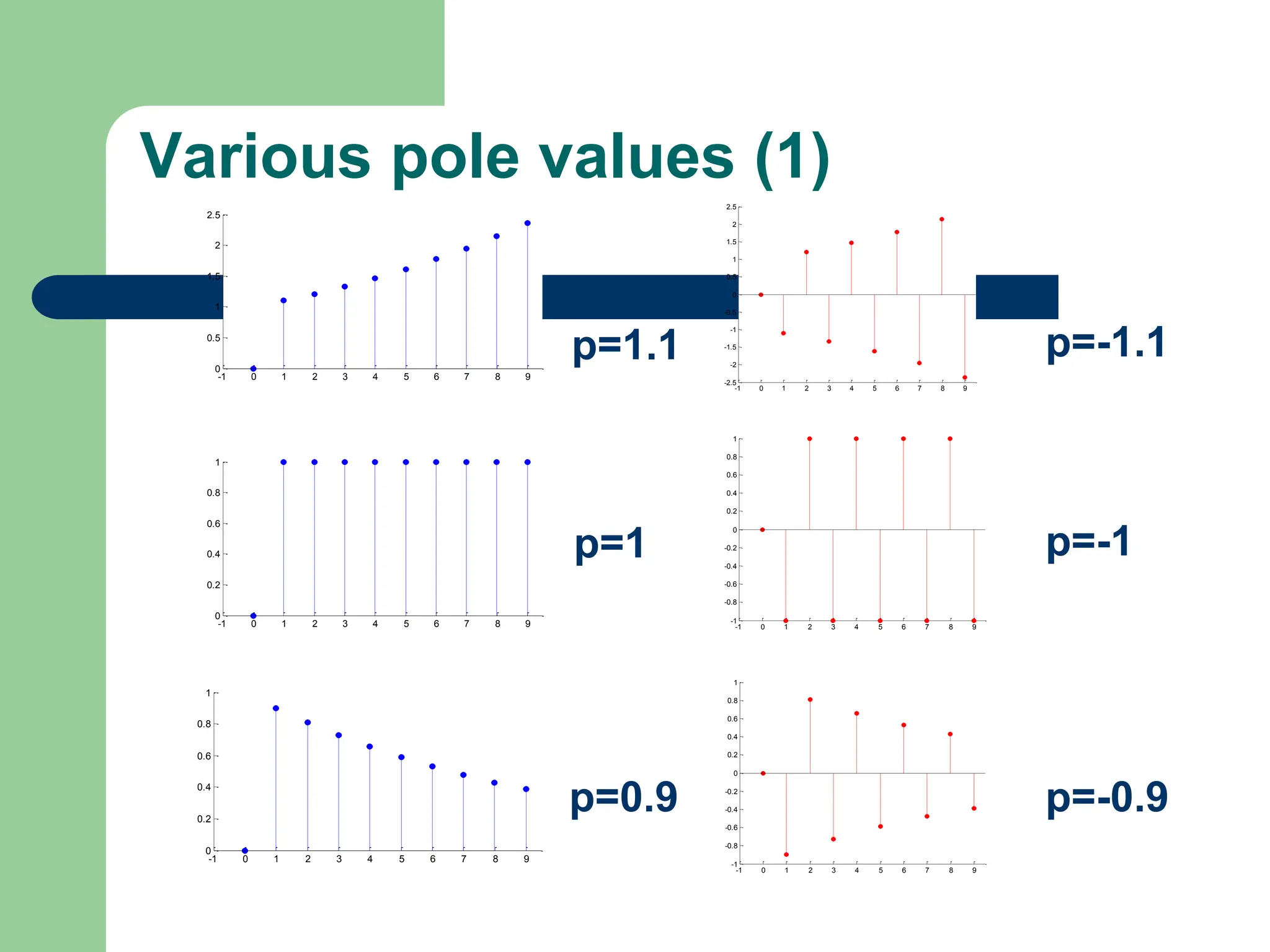
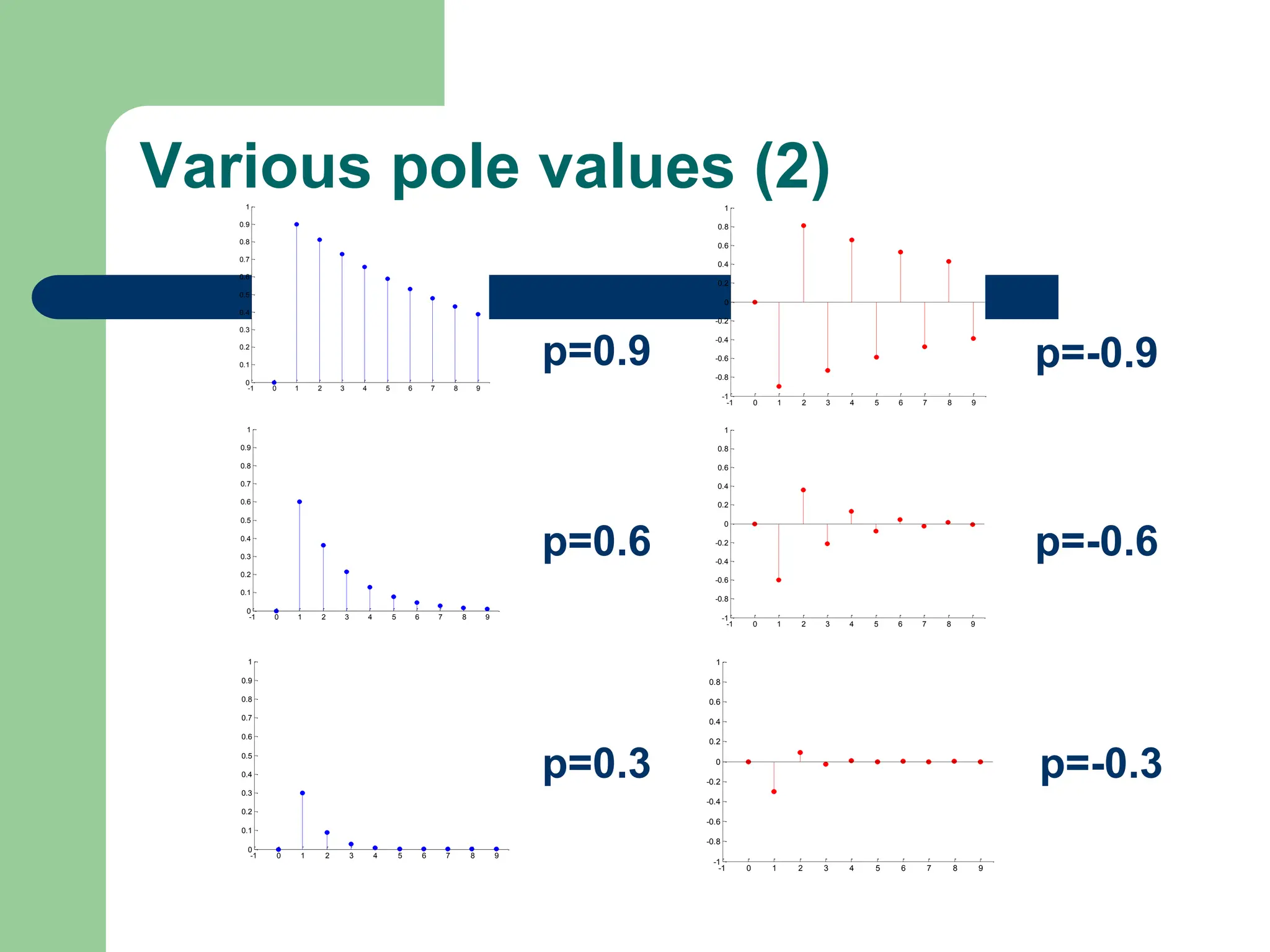
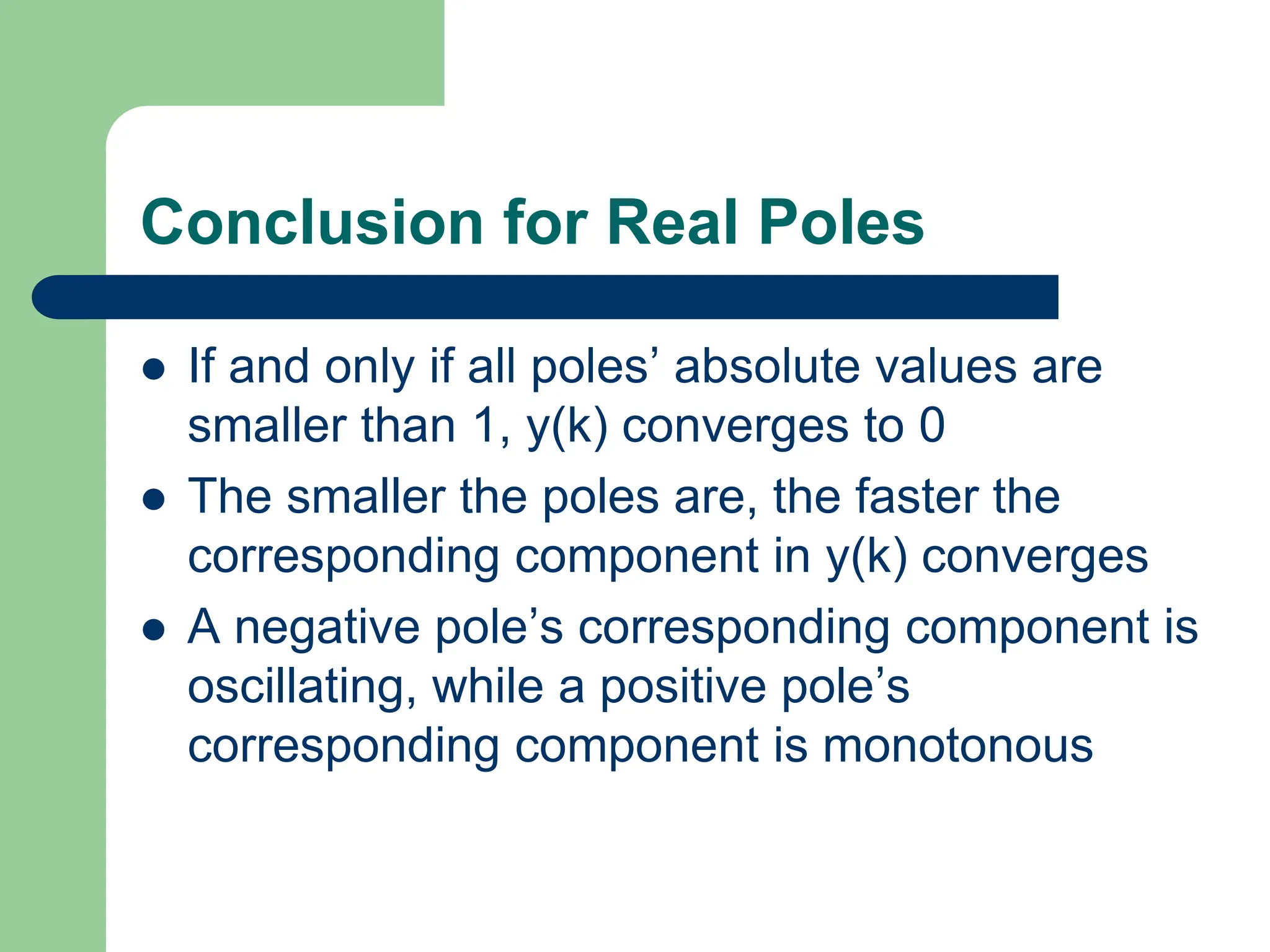
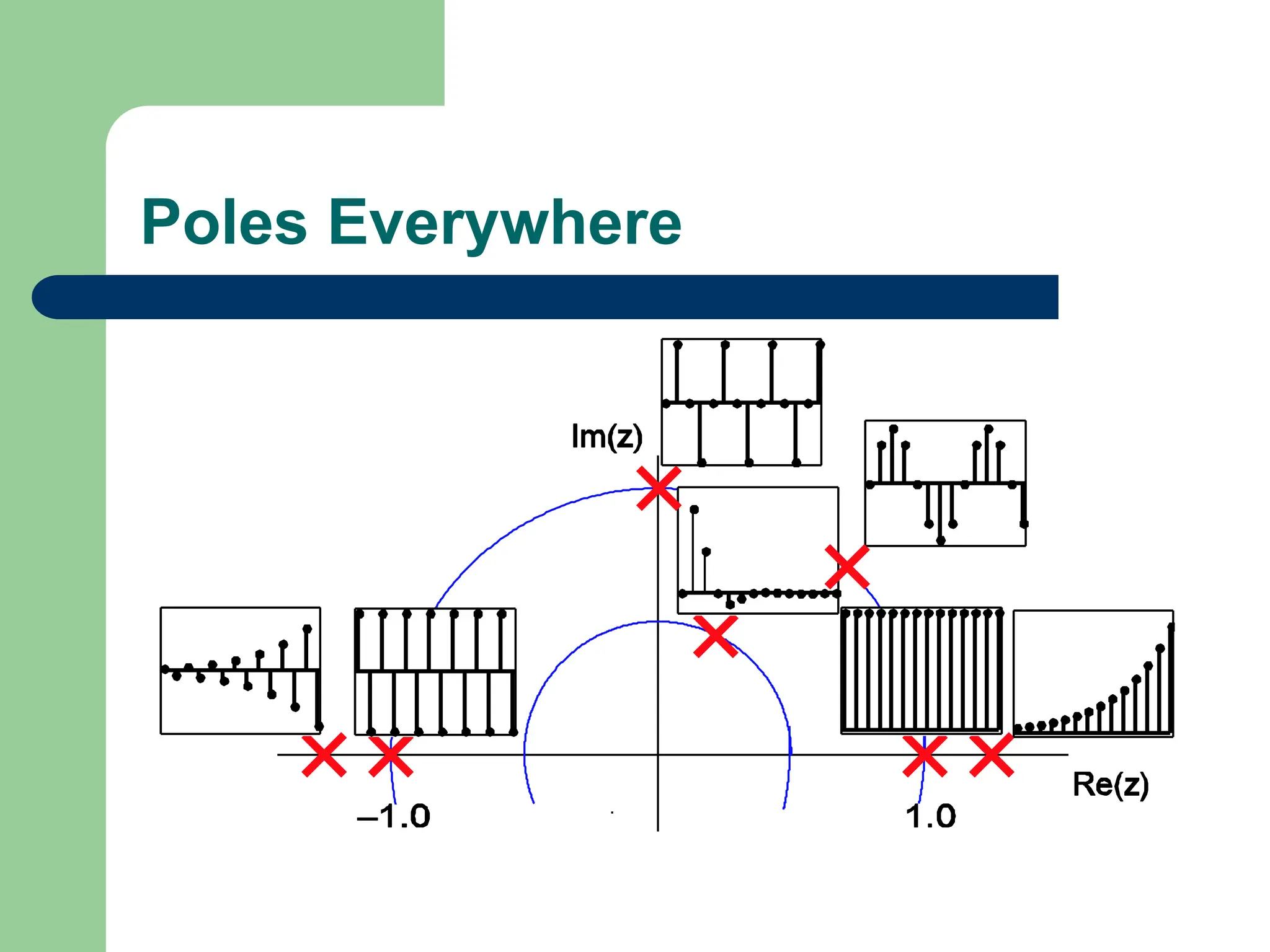
Conclusion for RealPoles
If and only if all poles’ absolute values are
smaller than 1, y(k) converges to 0
The smaller the poles are, the faster the
corresponding component in y(k) converges
A negative pole’s corresponding component is
oscillating, while a positive pole’s
corresponding component is monotonous
74.
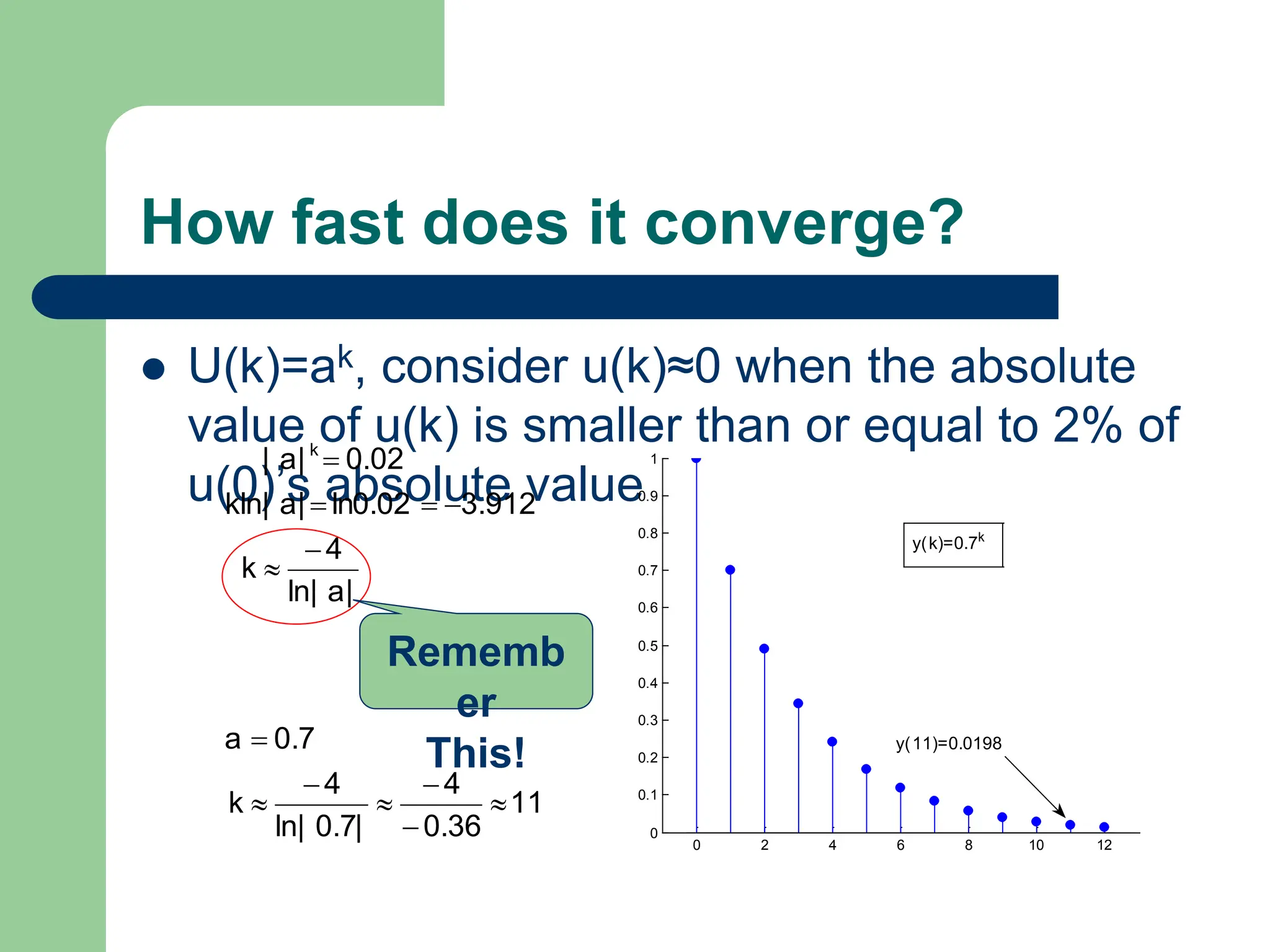
How fast doesit converge?
U(k)=ak, consider u(k)≈0 when the absolute
value of u(k) is smaller than or equal to 2% of
u(0)’s absolute value
|
a
|
ln
4
k
3.912
ln0.02
|
a
|
kln
0.02
|
a
| k
11
0.36
4
|
0.7
|
ln
4
k
0.7
a
Rememb
er
This!
0 2 4 6 8 10 12
0
0.1
0.2
0.3
0.4
0.5
0.6
0.7
0.8
0.9
1
y(k)=0.7k
y(11)=0.0198
75.
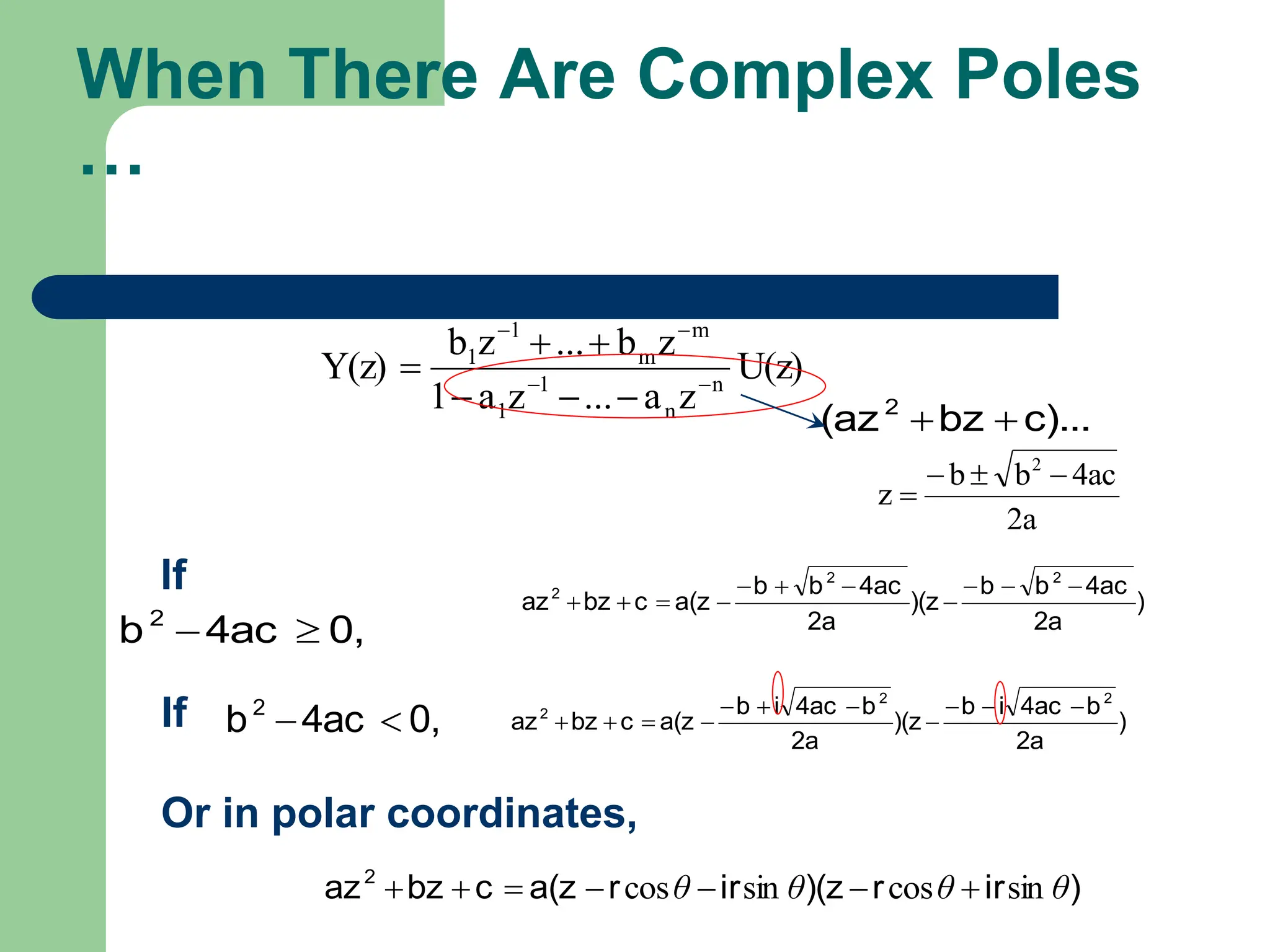
When There AreComplex Poles
…
U(z)
z
a
...
z
a
1
z
b
...
z
b
Y(z) n
n
1
1
m
m
1
1
c)...
bz
(az2
2a
4ac
b
b
z
2
0,
4ac
b2
)
2a
4ac
b
b
)(z
2a
4ac
b
b
a(z
c
bz
az
2
2
2
0,
4ac
b2
)
2a
b
4ac
i
b
)(z
2a
b
4ac
i
b
a(z
c
bz
az
2
2
2
If
If
Or in polar coordinates,
)
ir
r
)(z
ir
r
a(z
c
bz
az2
θ
θ
θ
θ sin
cos
sin
cos
76.
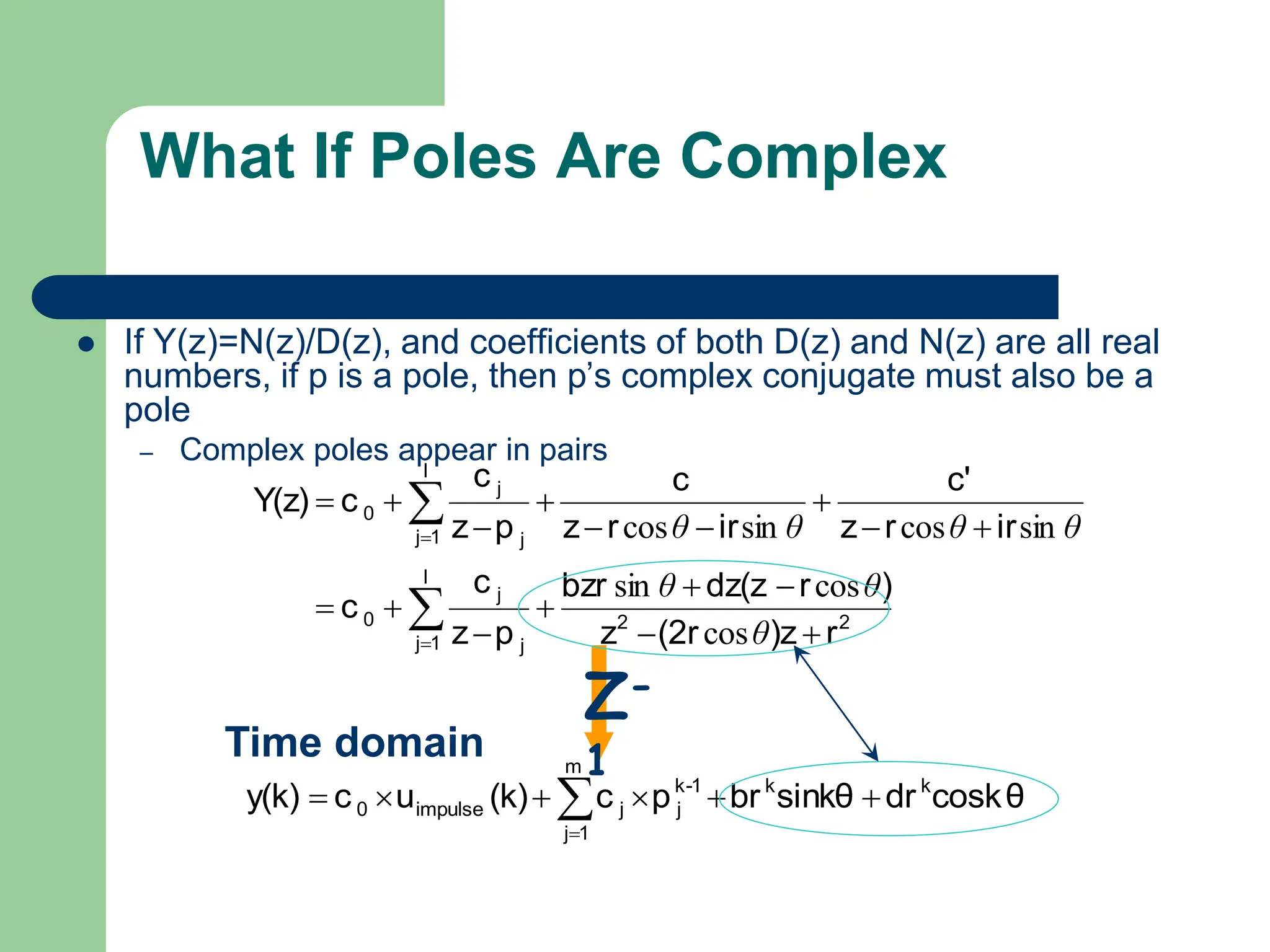
What If PolesAre Complex
If Y(z)=N(z)/D(z), and coefficients of both D(z) and N(z) are all real
numbers, if p is a pole, then p’s complex conjugate must also be a
pole
– Complex poles appear in pairs
l
1
j
2
2
j
j
0
l
1
j j
j
0
r
)z
(2r
z
)
r
dz(z
bzr
p
z
c
c
ir
r
z
c'
ir
r
z
c
p
z
c
c
Y(z)
θ
θ
θ
θ
θ
θ
θ
cos
cos
sin
sin
cos
sin
cos
coskθ
dr
sinkθ
br
p
c
(k)
u
c
y(k) k
k
m
1
j
1
-
k
j
j
impulse
0
Z-
1
Time domain
77.
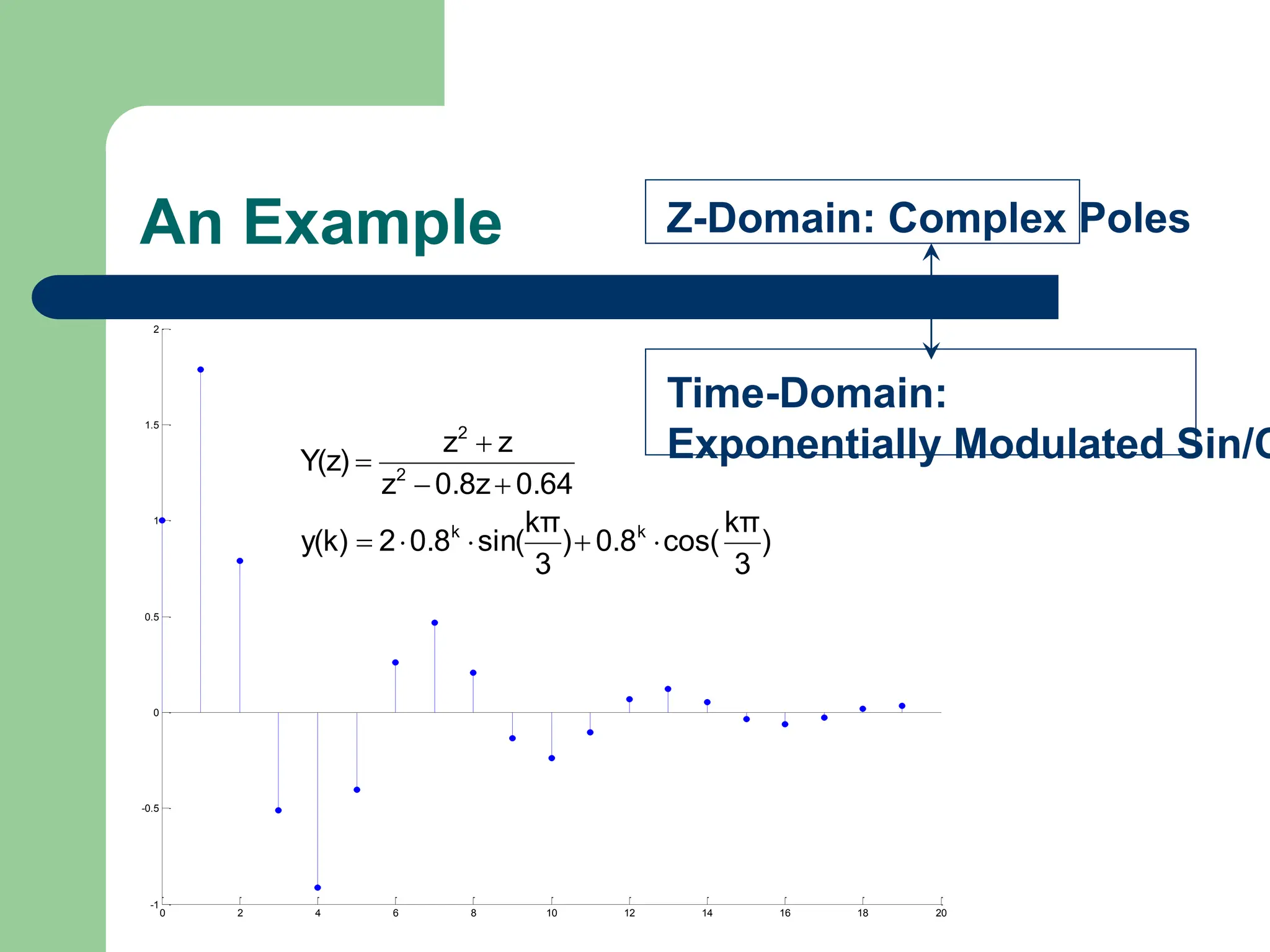
An Example
0 24 6 8 10 12 14 16 18 20
-1
-0.5
0
0.5
1
1.5
2
)
3
kπ
cos(
0.8
)
3
kπ
sin(
0.8
2
y(k)
0.64
0.8z
z
z
z
Y(z)
k
k
2
2
Z-Domain: Complex Poles
Time-Domain:
Exponentially Modulated Sin/C
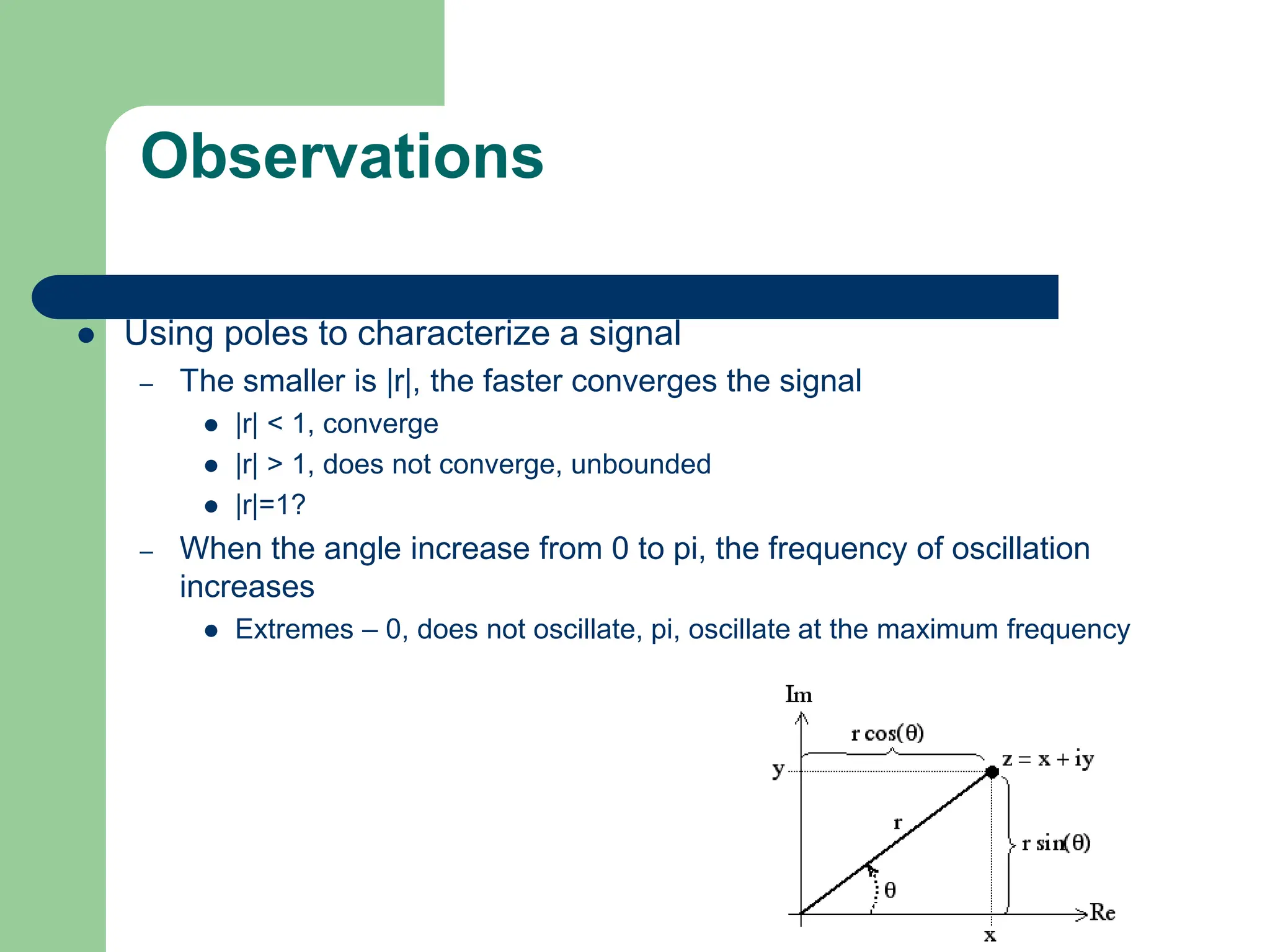
Observations
Using polesto characterize a signal
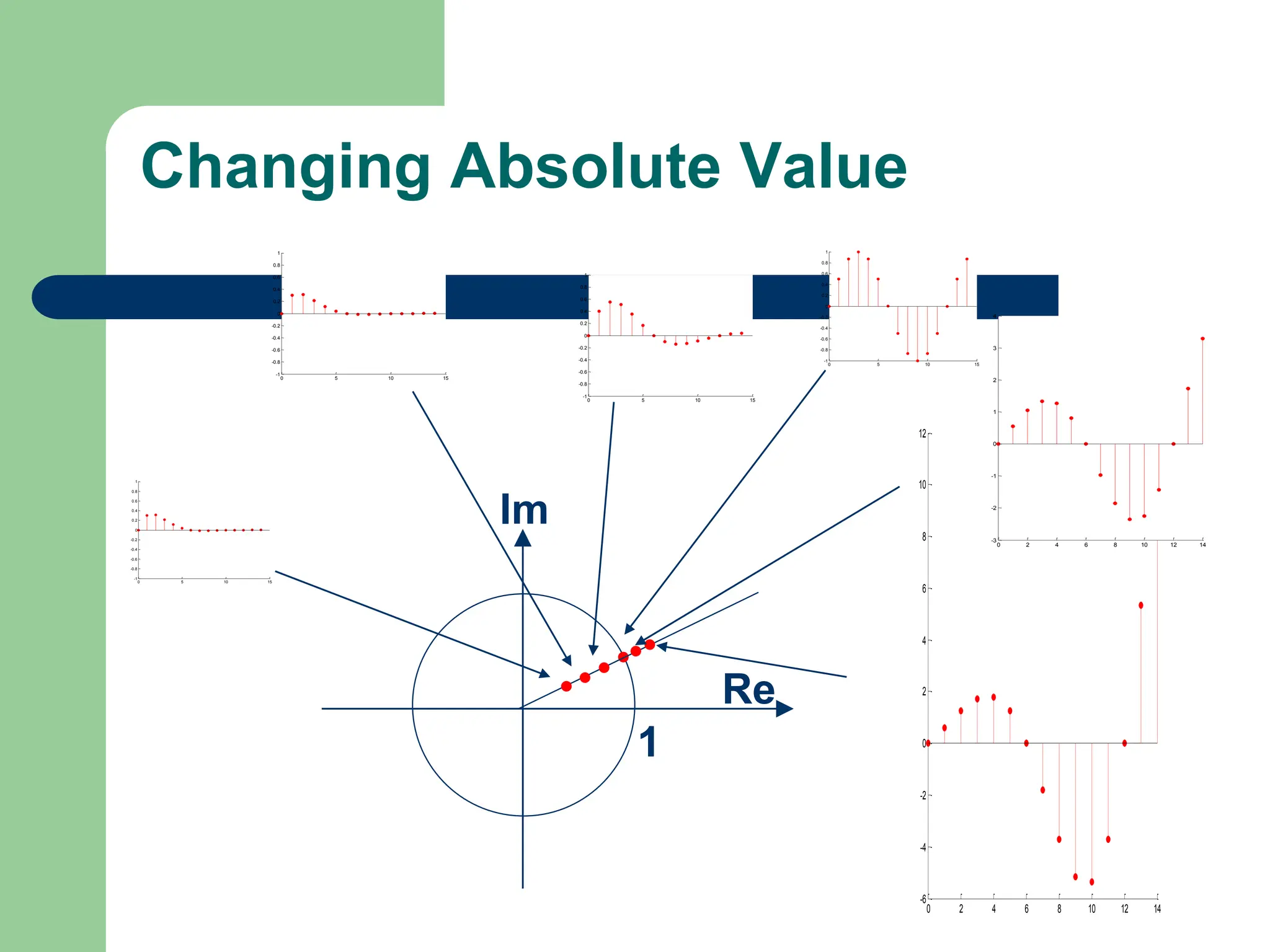
– The smaller is |r|, the faster converges the signal
|r| < 1, converge
|r| > 1, does not converge, unbounded
|r|=1?
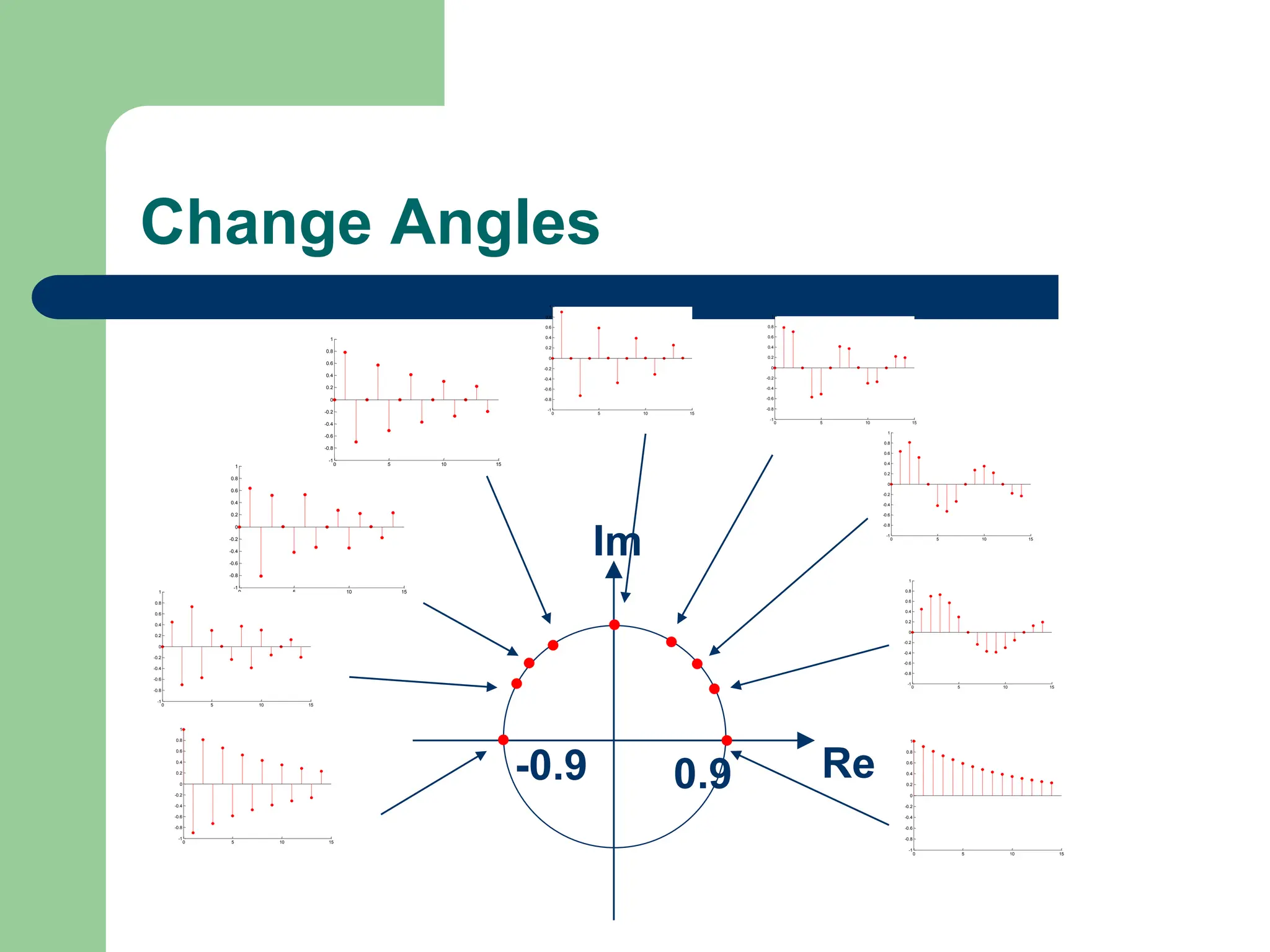
– When the angle increase from 0 to pi, the frequency of oscillation
increases
Extremes – 0, does not oscillate, pi, oscillate at the maximum frequency
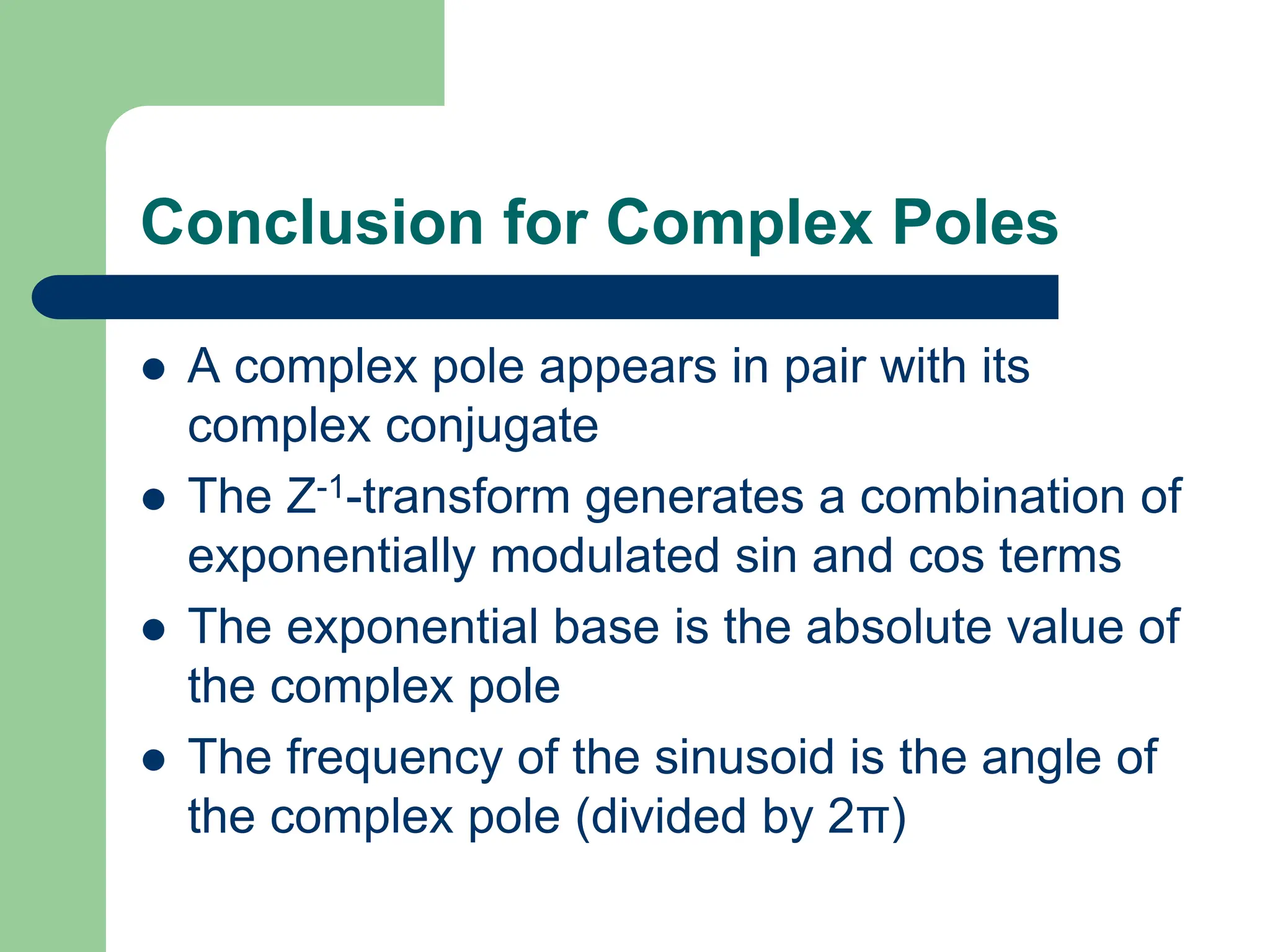
Conclusion for ComplexPoles
A complex pole appears in pair with its
complex conjugate
The Z-1-transform generates a combination of
exponentially modulated sin and cos terms
The exponential base is the absolute value of
the complex pole
The frequency of the sinusoid is the angle of
the complex pole (divided by 2π)
83.
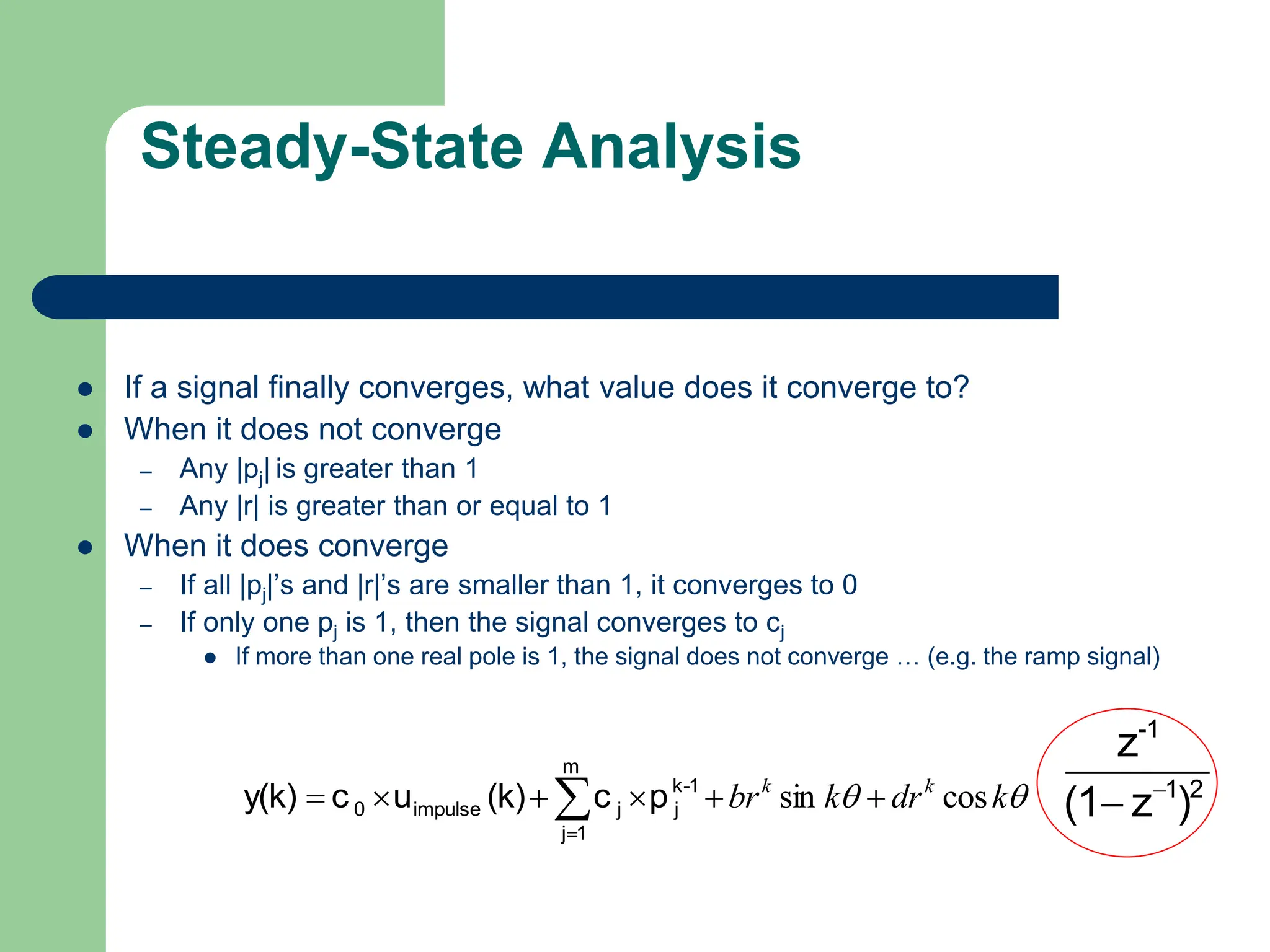
Steady-State Analysis
Ifa signal finally converges, what value does it converge to?
When it does not converge
– Any |pj| is greater than 1
– Any |r| is greater than or equal to 1
When it does converge
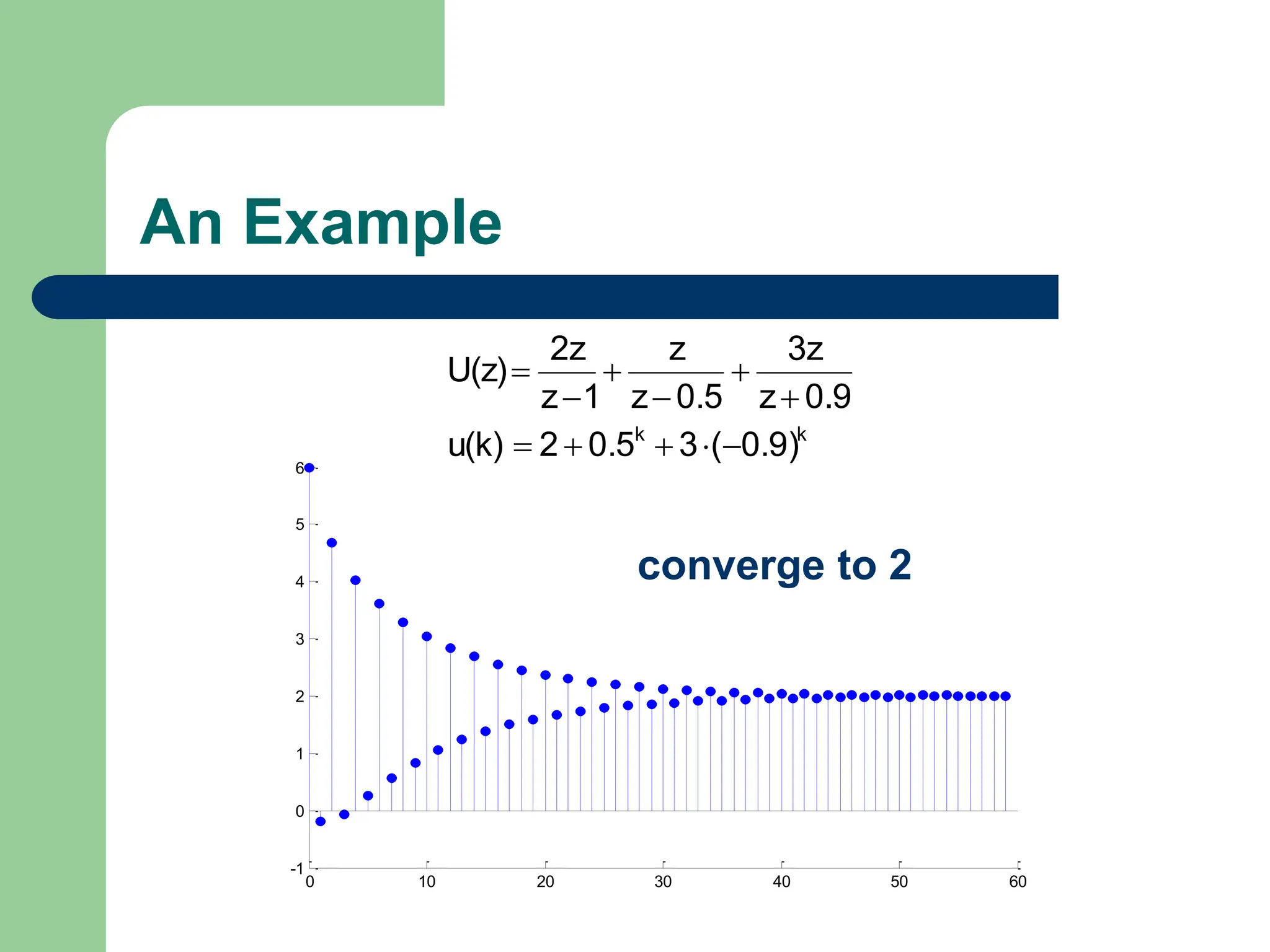
– If all |pj|’s and |r|’s are smaller than 1, it converges to 0
– If only one pj is 1, then the signal converges to cj
If more than one real pole is 1, the signal does not converge … (e.g. the ramp signal)
k
dr
k
br k
k
cos
sin
m
1
j
1
-
k
j
j
impulse
0 p
c
(k)
u
c
y(k) 2
1
-1
)
z
(1
z
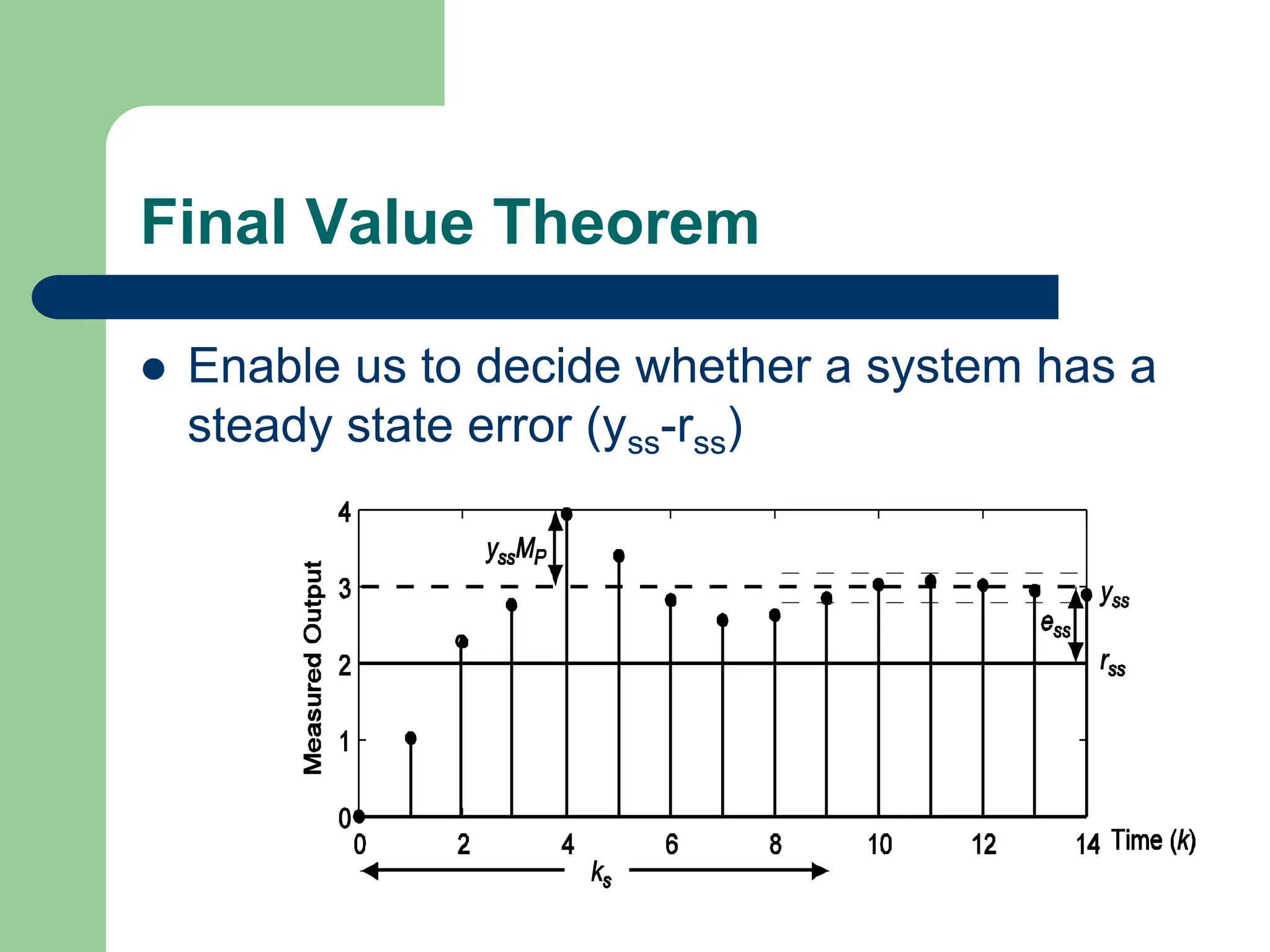
Final Value Theorem
Enable us to decide whether a system has a
steady state error (yss-rss)
86.
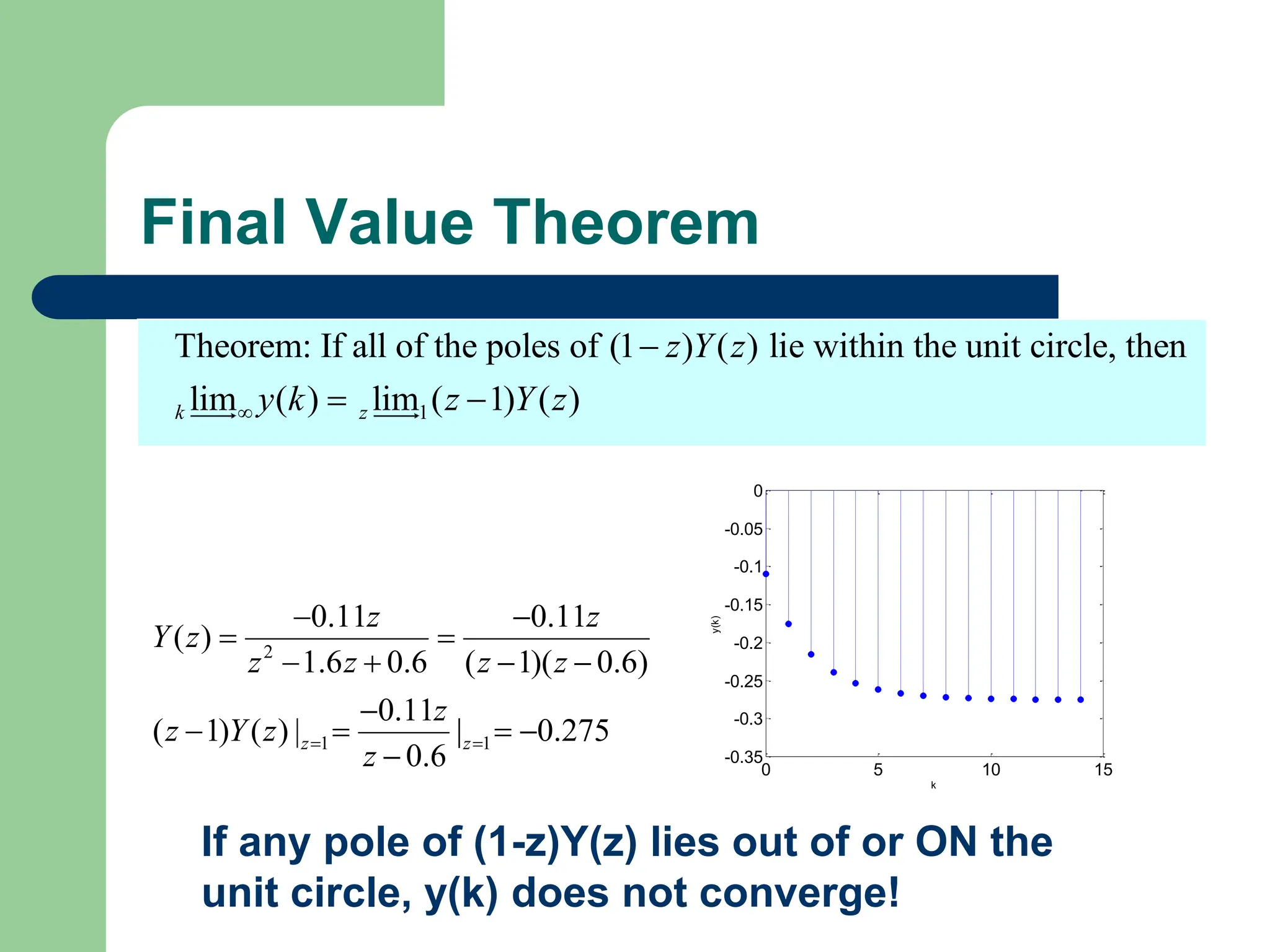
Final Value Theorem
1
Theorem:If all of the poles of (1 ) ( ) lie within the unit circle, then
lim ( ) lim ( 1) ( )
k z
z Y z
y k z Y z
2
1 1
0.11 0.11
( )
1.6 0.6 ( 1)( 0.6)
0.11
( 1) ( ) | | 0.275
0.6
z z
z z
Y z
z z z z
z
z Y z
z
0 5 10 15
-0.35
-0.3
-0.25
-0.2
-0.15
-0.1
-0.05
0
k
y(k)
If any pole of (1-z)Y(z) lies out of or ON the
unit circle, y(k) does not converge!
87.
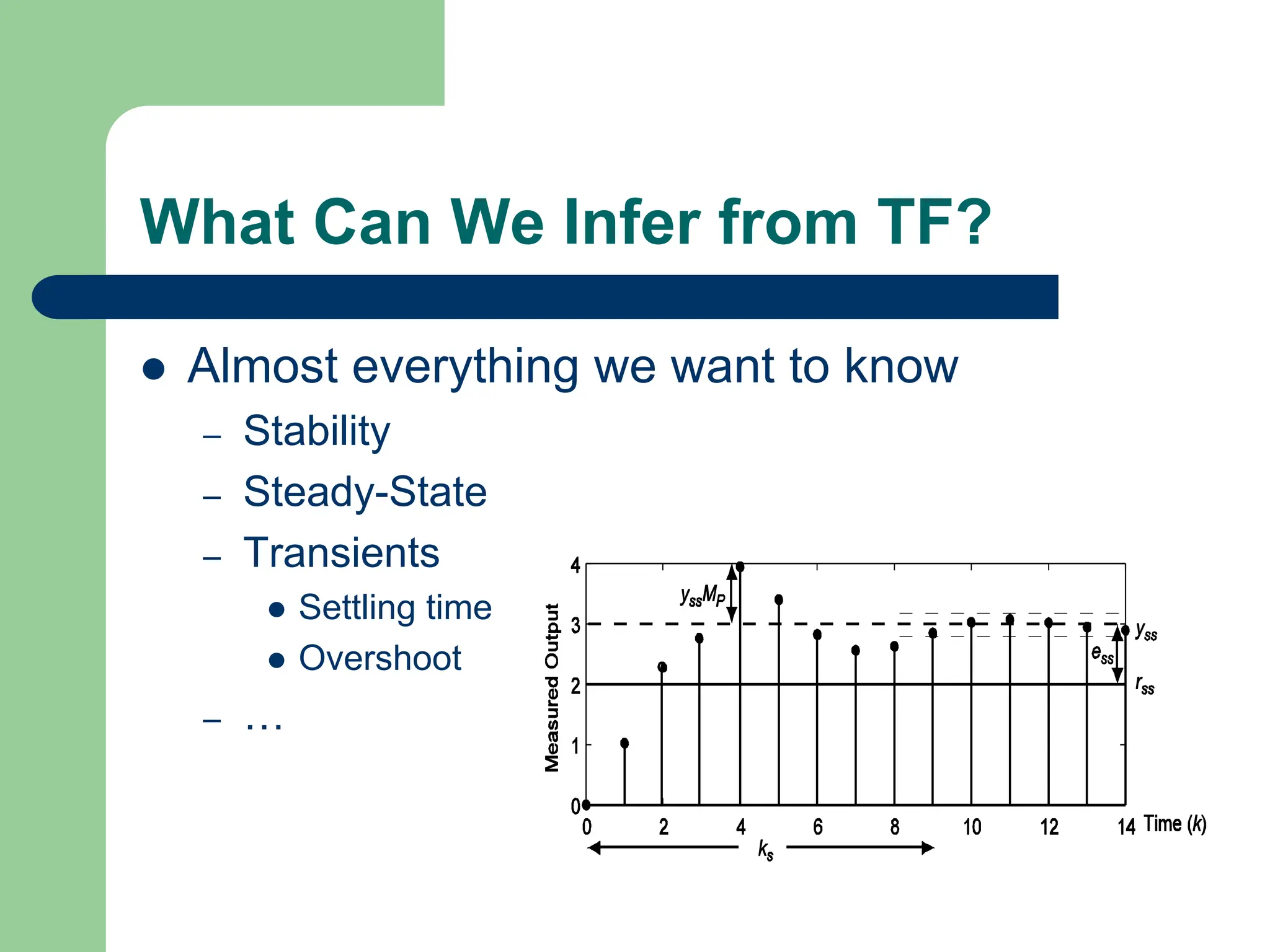
What Can WeInfer from TF?
Almost everything we want to know
– Stability
– Steady-State
– Transients
Settling time
Overshoot
– …
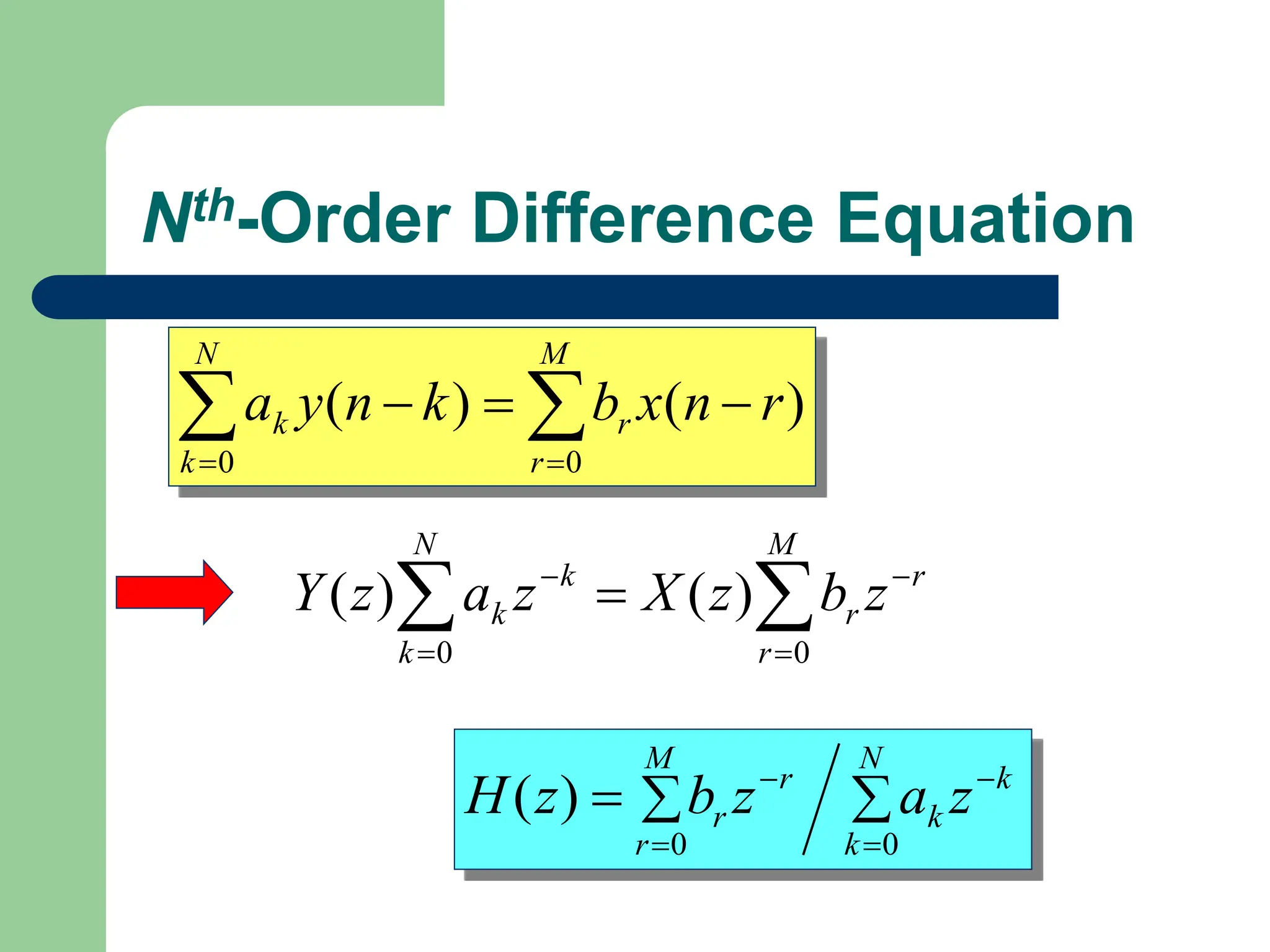
Nth-Order Difference Equation
M
r
r
N
k
k r
n
x
b
k
n
y
a
0
0
)
(
)
(
M
r
r
r
N
k
k
k z
b
z
X
z
a
z
Y
0
0
)
(
)
(
N
k
k
k
M
r
r
r z
a
z
b
z
H
0
0
)
(
91.
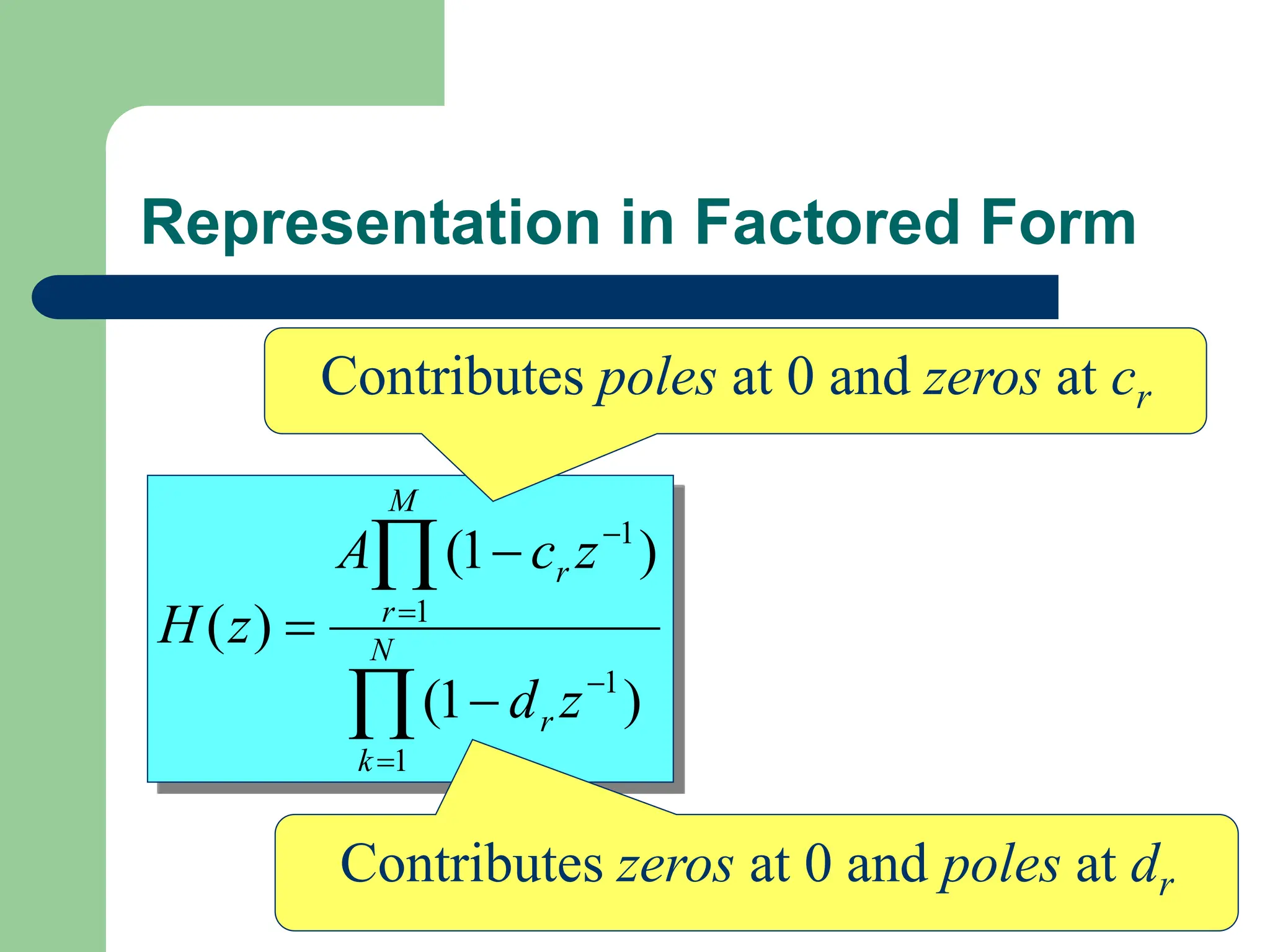
Representation in FactoredForm
N
k
r
M
r
r
z
d
z
c
A
z
H
1
1
1
1
)
1
(
)
1
(
)
(
Contributes poles at 0 and zeros at cr
Contributes zeros at 0 and poles at dr
92.
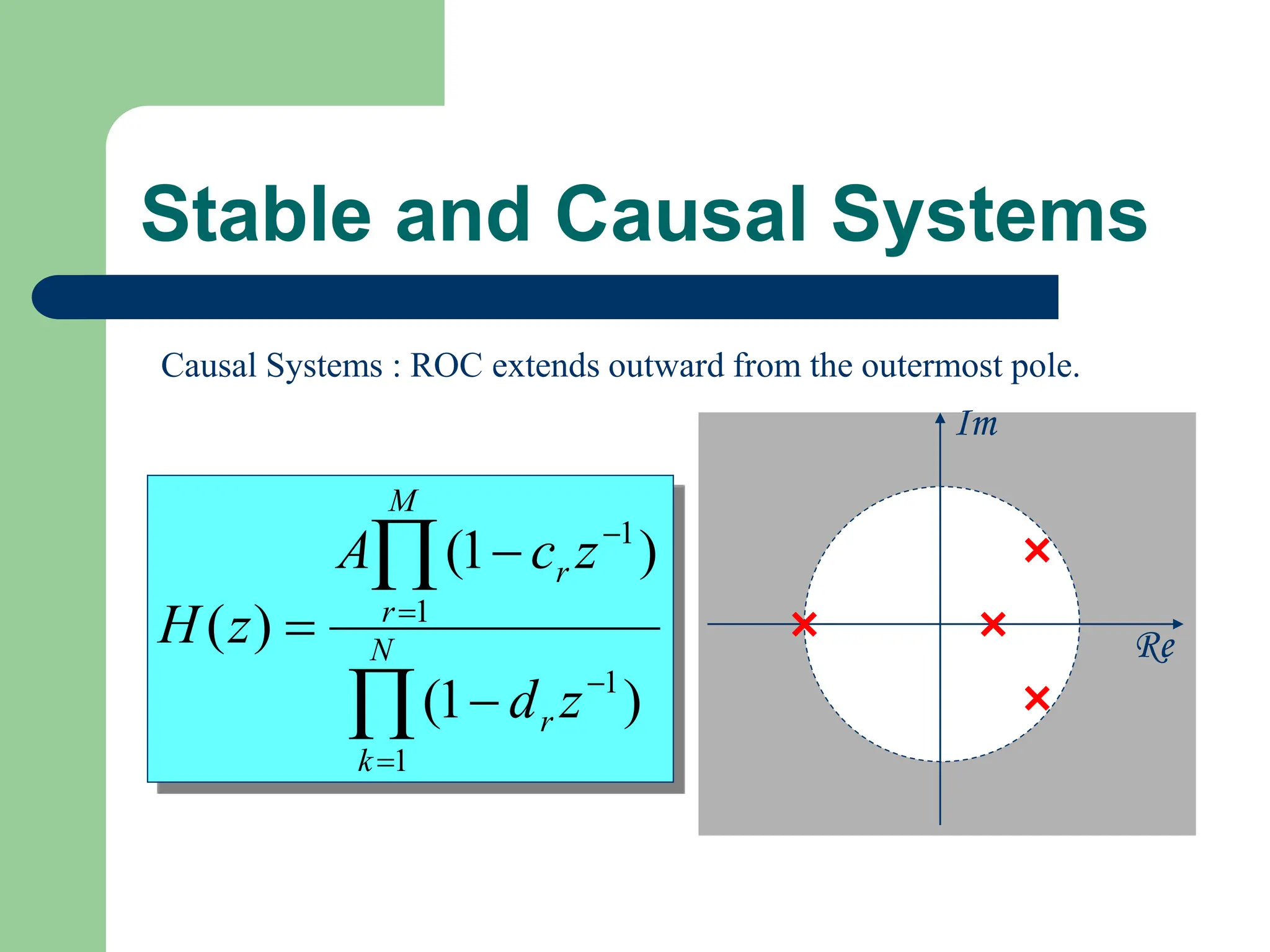
Stable and CausalSystems
N
k
r
M
r
r
z
d
z
c
A
z
H
1
1
1
1
)
1
(
)
1
(
)
( Re
Im
Causal Systems : ROC extends outward from the outermost pole.
93.
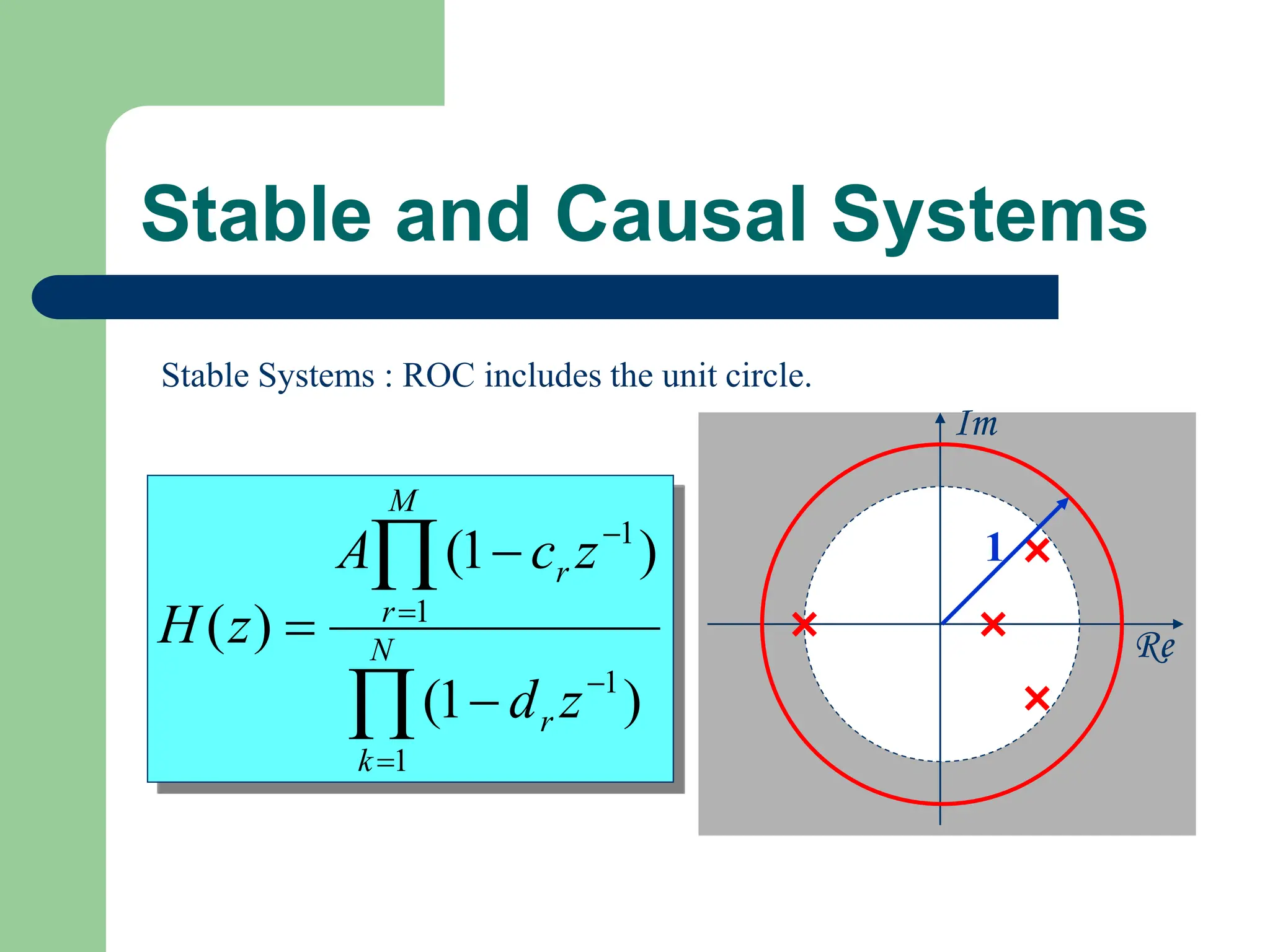
Stable and CausalSystems
N
k
r
M
r
r
z
d
z
c
A
z
H
1
1
1
1
)
1
(
)
1
(
)
( Re
Im
Stable Systems : ROC includes the unit circle.
1
94.
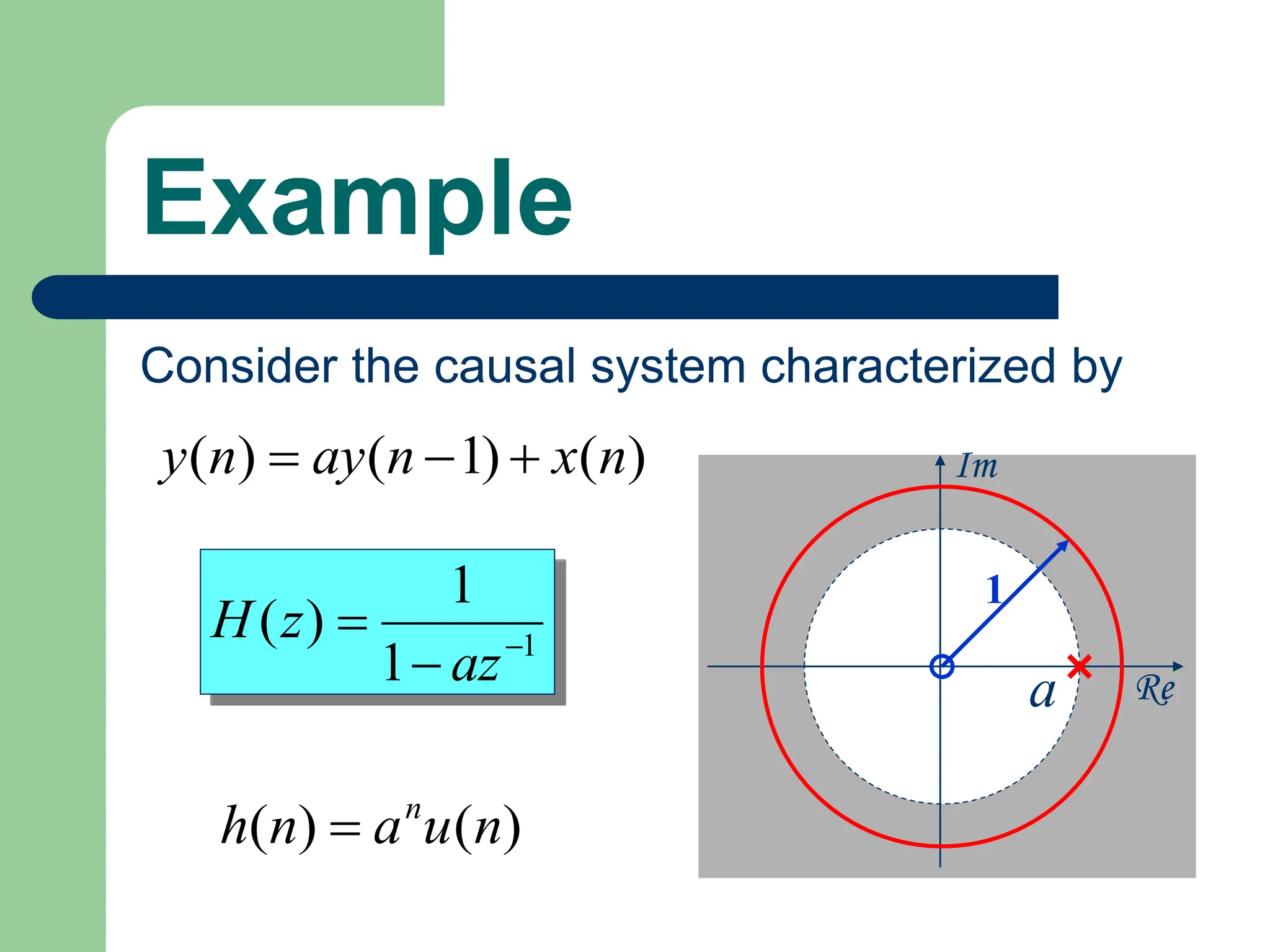
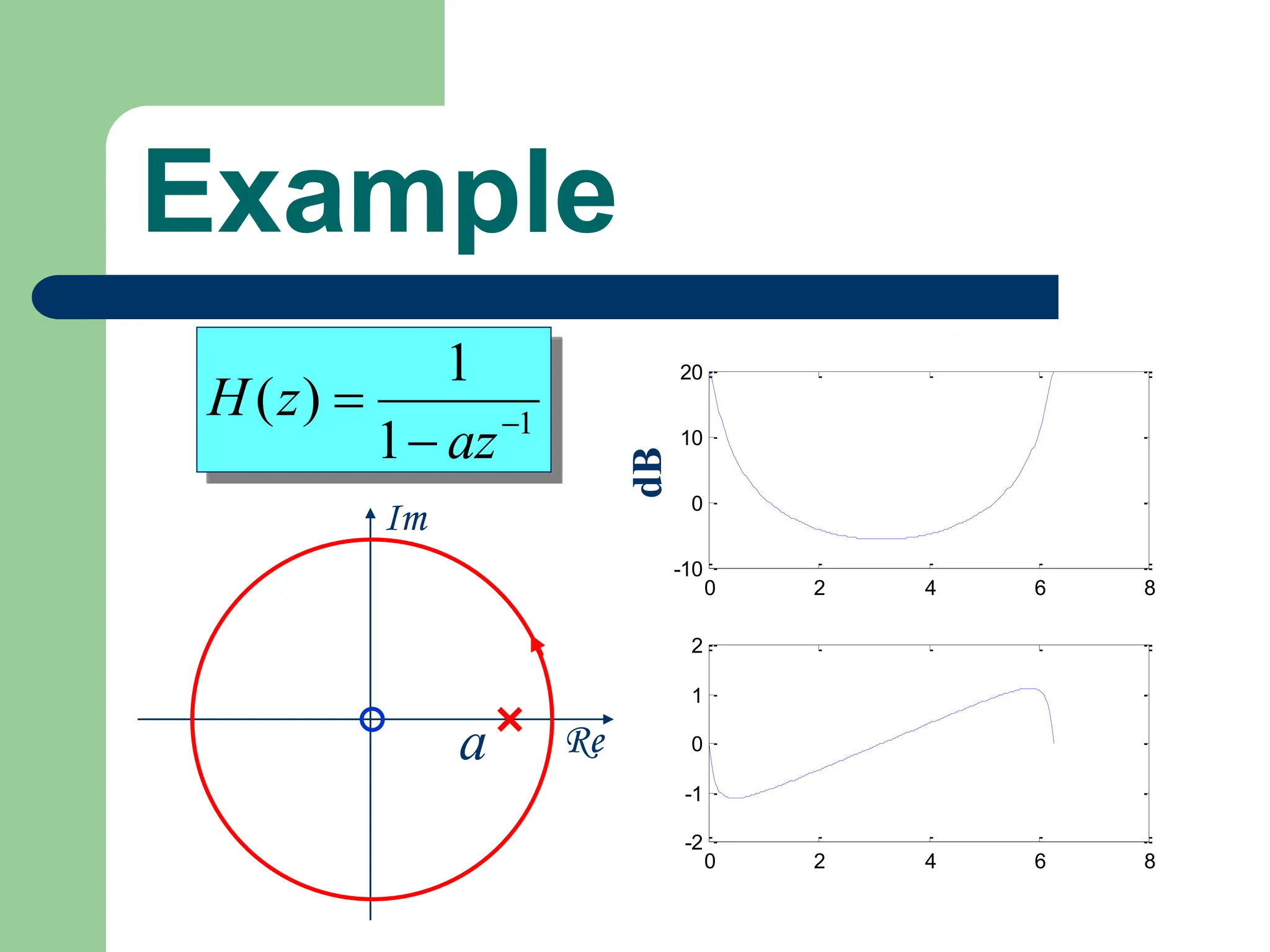
Example
Consider the causalsystem characterized by
)
(
)
1
(
)
( n
x
n
ay
n
y
1
1
1
)
(
az
z
H
Re
Im
1
a
)
(
)
( n
u
a
n
h n
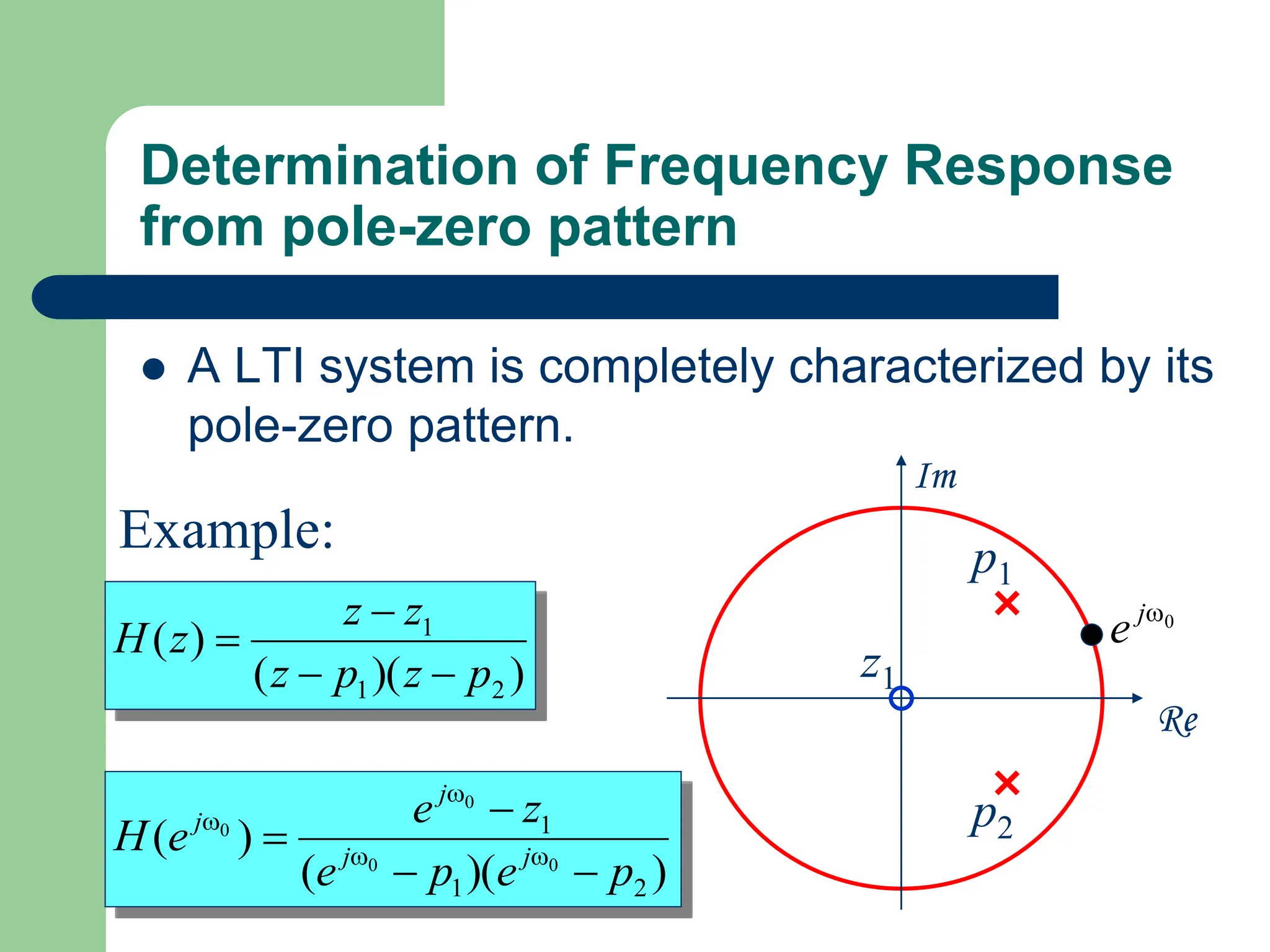
95.
Determination of FrequencyResponse
from pole-zero pattern
A LTI system is completely characterized by its
pole-zero pattern.
)
)(
(
)
(
2
1
1
p
z
p
z
z
z
z
H
Example:
)
)(
(
)
(
2
1
1
0
0
0
0
p
e
p
e
z
e
e
H j
j
j
j
0
j
e
Re
Im
z1
p1
p2
96.
Determination of FrequencyResponse
from pole-zero pattern
A LTI system is completely characterized by its
pole-zero pattern.
)
)(
(
)
(
2
1
1
p
z
p
z
z
z
z
H
Example:
)
)(
(
)
(
2
1
1
0
0
0
0
p
e
p
e
z
e
e
H j
j
j
j
0
j
e
Re
Im
z1
p1
p2
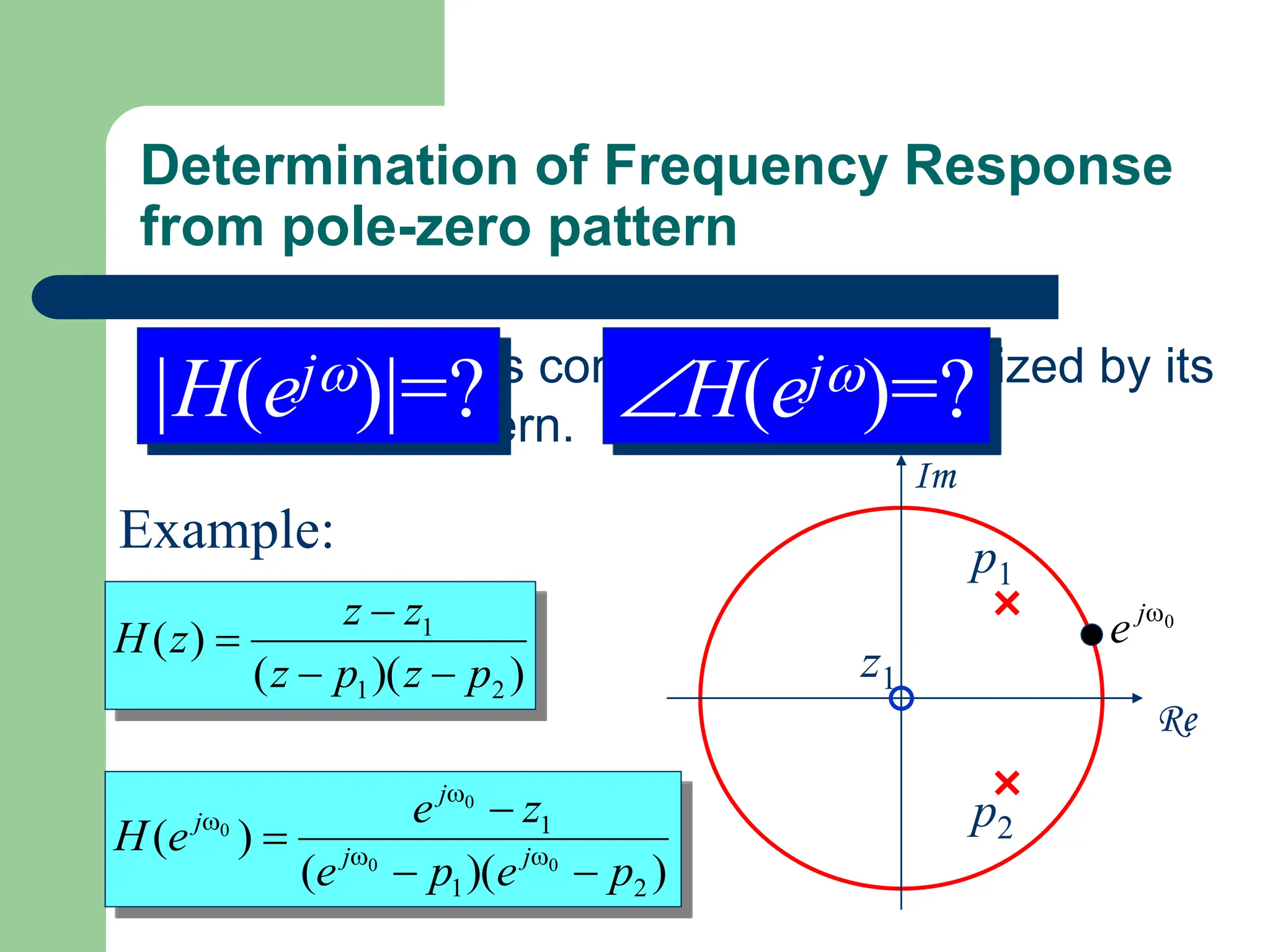
|H(ej)|=? H(ej)=?
97.
Determination of FrequencyResponse
from pole-zero pattern
A LTI system is completely characterized by its
pole-zero pattern.
Example:
0
j
e
Re
Im
z1
p1
p2
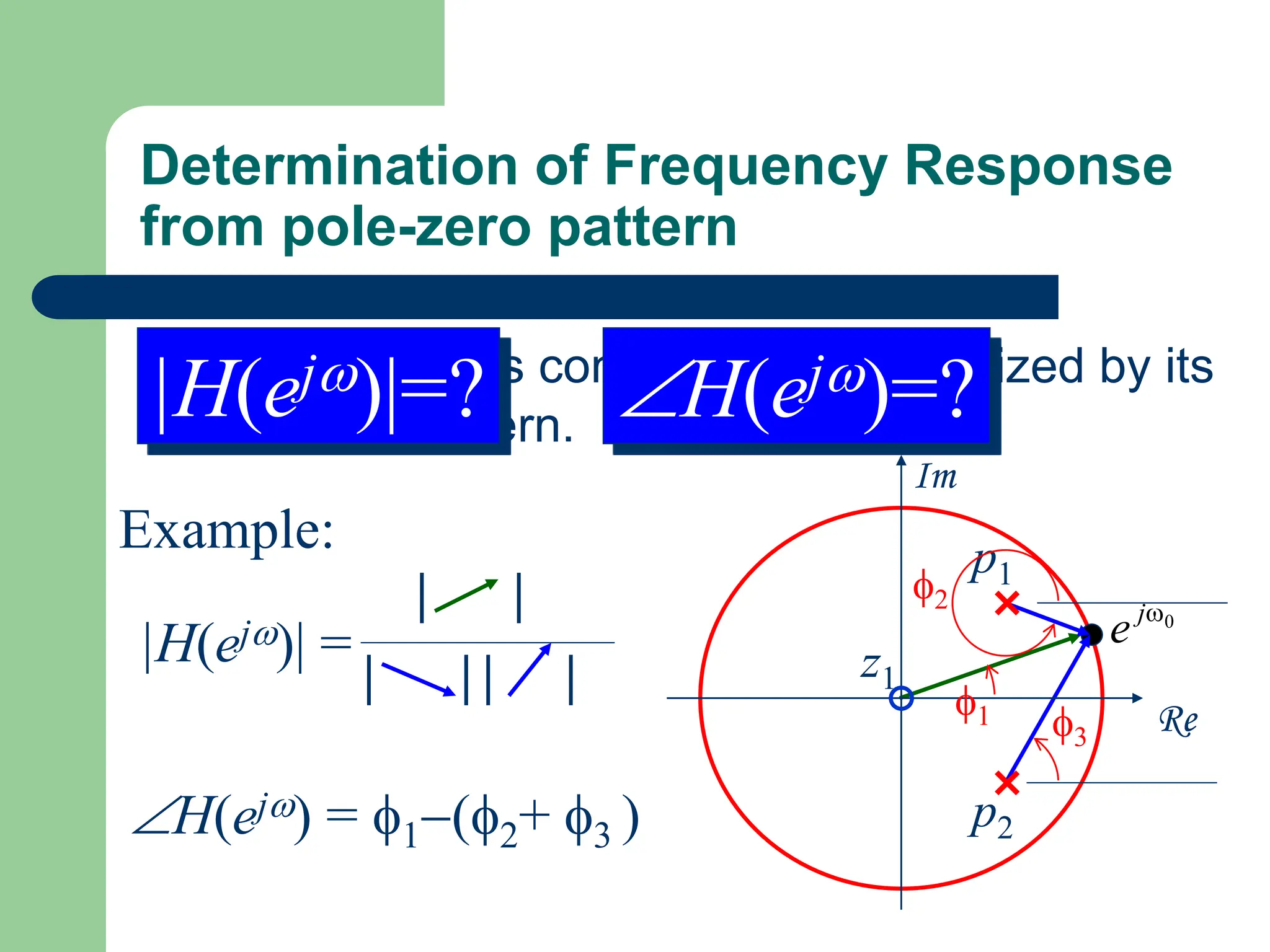
|H(ej)|=? H(ej)=?
|H(ej)| =
| |
| | | | 1
2
3
H(ej) = 1(2+ 3 )



![Z-Transform Pairs
Sequence z-Transform ROC
)
(
]
[cos 0 n
u
n
2
1
0
1
0
]
cos
2
[
1
]
[cos
1
z
z
z
1
|
|
z
)
(
]
[sin 0 n
u
n
2
1
0
1
0
]
cos
2
[
1
]
[sin
z
z
z
1
|
|
z
)
(
]
cos
[ 0 n
u
n
rn
2
2
1
0
1
0
]
cos
2
[
1
]
cos
[
1
z
r
z
r
z
r
r
z
|
|
)
(
]
sin
[ 0 n
u
n
rn
2
2
1
0
1
0
]
cos
2
[
1
]
sin
[
z
r
z
r
z
r
r
z
|
|
otherwise
0
1
0 N
n
an
1
1
1
az
z
a N
N
0
|
|
z](https://image.slidesharecdn.com/dsp3-240121105122-26df687e/75/Digital-Signal-Processing-and-the-z-transform-38-2048.jpg)
![Some Common z-Transform Pairs
Sequence Transform ROC
1. [n] 1 all z
2. u[n] z/(z-1) |z|>1
3. -u[-n-1] z/(z-1) |z|<1
4. [n-m] z-m all z except 0 if m>0 or ฅ if m<0
5. anu[n] z/(z-a) |z|>|a|
6. -anu[-n-1] z/(z-a) |z|<|a|
7. nanu[n] az/(z-a)2 |z|>|a|
8. -nanu[-n-1] az/(z-a)2 |z|<|a|
9. [cos0n]u[n] (z2-[cos0]z)/(z2-[2cos0]z+1) |z|>1
10. [sin0n]u[n] [sin0]z)/(z2-[2cos0]z+1) |z|>1
11. [rncos0n]u[n] (z2-[rcos0]z)/(z2-[2rcos0]z+r2) |z|>r
12. [rnsin0n]u[n] [rsin0]z)/(z2-[2rcos0]z+r2) |z|>r
13. anu[n] - anu[n-N] (zN-aN)/zN-1(z-a) |z|>0](https://image.slidesharecdn.com/dsp3-240121105122-26df687e/75/Digital-Signal-Processing-and-the-z-transform-40-2048.jpg)
![Linearity
x
R
z
z
X
n
x
),
(
)]
(
[
Z
y
R
z
z
Y
n
y
),
(
)]
(
[
Z
y
x R
R
z
z
bY
z
aX
n
by
n
ax
),
(
)
(
)]
(
)
(
[
Z
Overlay of
the above two
ROC’s](https://image.slidesharecdn.com/dsp3-240121105122-26df687e/75/Digital-Signal-Processing-and-the-z-transform-58-2048.jpg)
![Shift
x
R
z
z
X
n
x
),
(
)]
(
[
Z
x
n
R
z
z
X
z
n
n
x
)
(
)]
(
[ 0
0
Z](https://image.slidesharecdn.com/dsp3-240121105122-26df687e/75/Digital-Signal-Processing-and-the-z-transform-59-2048.jpg)
![Multiplication by an Exponential Sequence
x
x- R
z
R
z
X
n
x |
|
),
(
)]
(
[
Z
x
n
R
a
z
z
a
X
n
x
a
|
|
)
(
)]
(
[ 1
Z](https://image.slidesharecdn.com/dsp3-240121105122-26df687e/75/Digital-Signal-Processing-and-the-z-transform-60-2048.jpg)
![Differentiation of X(z)
x
R
z
z
X
n
x
),
(
)]
(
[
Z
x
R
z
dz
z
dX
z
n
nx
)
(
)]
(
[
Z](https://image.slidesharecdn.com/dsp3-240121105122-26df687e/75/Digital-Signal-Processing-and-the-z-transform-61-2048.jpg)
![Conjugation
x
R
z
z
X
n
x
),
(
)]
(
[
Z
x
R
z
z
X
n
x
*)
(
*
)]
(
*
[
Z](https://image.slidesharecdn.com/dsp3-240121105122-26df687e/75/Digital-Signal-Processing-and-the-z-transform-62-2048.jpg)
![Reversal
x
R
z
z
X
n
x
),
(
)]
(
[
Z
x
R
z
z
X
n
x /
1
)
(
)]
(
[ 1
Z](https://image.slidesharecdn.com/dsp3-240121105122-26df687e/75/Digital-Signal-Processing-and-the-z-transform-63-2048.jpg)
![Real and Imaginary Parts
x
R
z
z
X
n
x
),
(
)]
(
[
Z
x
R
z
z
X
z
X
n
x
e
*)]
(
*
)
(
[
)]
(
[ 2
1
R
x
j R
z
z
X
z
X
n
x
*)]
(
*
)
(
[
)]
(
[ 2
1
Im](https://image.slidesharecdn.com/dsp3-240121105122-26df687e/75/Digital-Signal-Processing-and-the-z-transform-64-2048.jpg)
![Convolution of Sequences
x
R
z
z
X
n
x
),
(
)]
(
[
Z
y
R
z
z
Y
n
y
),
(
)]
(
[
Z
y
x R
R
z
z
Y
z
X
n
y
n
x
)
(
)
(
)]
(
*
)
(
[
Z](https://image.slidesharecdn.com/dsp3-240121105122-26df687e/75/Digital-Signal-Processing-and-the-z-transform-66-2048.jpg)
![Convolution of Sequences
k
k
n
y
k
x
n
y
n
x )
(
)
(
)
(
*
)
(
n
n
k
z
k
n
y
k
x
n
y
n
x )
(
)
(
)]
(
*
)
(
[
Z
k
n
n
z
k
n
y
k
x )
(
)
(
k
n
n
k
z
n
y
z
k
x )
(
)
(
)
(
)
( z
Y
z
X
](https://image.slidesharecdn.com/dsp3-240121105122-26df687e/75/Digital-Signal-Processing-and-the-z-transform-67-2048.jpg)


![Digital Signal Processing[ECEG-3171]-Ch1_L03](https://cdn.slidesharecdn.com/ss_thumbnails/dspl3-180427094423-thumbnail.jpg?width=640&height=640&fit=bounds)


