EC533: Digital Signal Processing
  5          l      l

             Lecture 6
The Z-Transform and its application in
          signal processing
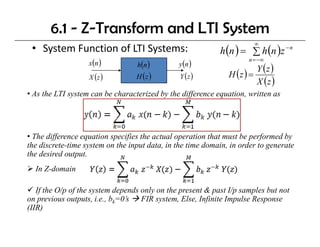
6.1 - Z-Transform and LTI System
                                                                          ∞
 • S t
   System Function of LTI Systems:
          F ti      f LTI S t                               h (n ) = ∑ h (n )z − n
                   x(n )
                                                                     n = −∞
                                  h(n )        y (n )
                                                                          Y (z )
                   X (z )         H (z )        Y (z )         H (z ) =
                                                                          X (z )
• As the LTI system can be characterized by the difference equation, written as


• The diffe ence equation specifies the actual operation that must be performed by
   he difference                               ope ation              pe fo med
the discrete-time system on the input data, in the time domain, in order to generate
the desired output.
  In Z domain
     Z-domain

   If the O/p of the system depends only on the present & past I/p samples but not
on previous outputs, i.e., bk=0’s FIR system, Else, Infinite Impulse Response
                              0s
(IIR)
6.1.1 - LTI System Transfer Function


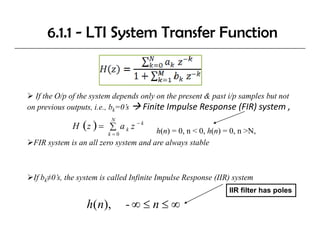
  If the O/p of the system depends only on the present & past i/p samples but not
on previous outputs i.e., bk=0’s
            outputs, i e     0s     Finite Impulse Response (FIR) system ,
                                    Finite Impulse Response (FIR) system
             H (z ) = ∑ a k z − k
                           N

                        k =0           h(n) = 0, n < 0, h(n) = 0, n >N,
 FIR system is an all zero system and are always stable


 If bk≠0’s, the system is called Infinite Impulse Response (IIR) system
                                                               IIR filter has poles

                  h( n)
                      ),       -∞ ≤ n ≤ ∞
6.1.2 - Properties of LTI Systems Using the Z-
                       Transform
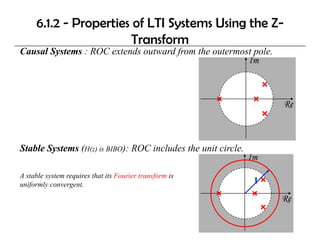
Causal Systems : ROC extends outward from the outermost pole.
                                                      Im


                                                                    R
                                                                    Re


Stable Systems (H(z) is BIBO): ROC includes the unit circle.
                                                               Im
A stable system requires that its Fourier transform is
uniformly convergent.                                           1
                                                                    Re
6.2 - Z-transform and Frequency Response
                                   Estimation
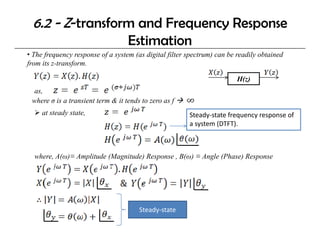
• The frequency response of a system (as digital filter spectrum) can be readily obtained
from its z-transform.

                                                                        H(z)
                                                                        H( )
 as,
 where σ is a transient term & it tends to zero as f
     at steady state,                                   Steady‐state frequency response of 
                                                        a system (DTFT).


  where, A(ω)≡ Amplitude (Magnitude) Response , B(ω) ≡ Angle (Phase) Response


                                       Steady‐state
6.2 - Frequency Response Estimation – cont.

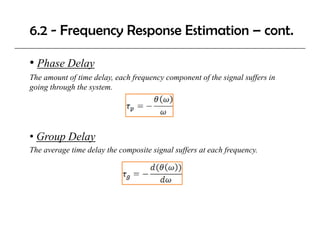
• Phase Delay
The amount of time delay, each frequency component of the signal suffers in
                    delay
going through the system.


• Group Delay
The average time delay the composite signal suffers at each frequency.
6.3 - Inverse Z-Transform

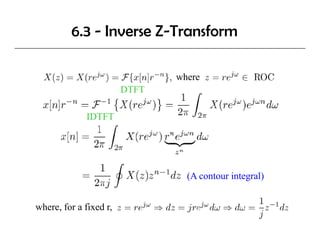
                               where
                        DTFT

             IDTFT


                                 (A contour integral)


where, for a fixed r,
6.3 - The Inverse Z-Transform – cont.
•   There is an inversion integral for the z transform,

                              1
                     x[n ] =       X(z)z n−1dz
                             j2π ∫
                                 C


    but doing it requires integration in the complex plane and
    it is rarely used in engineering practice.


•   There are two other common methods,

        Power series method (long division method)
        Partial-Fraction Expansion
                           p
6.3.1 - Power Series (Long Division) Method
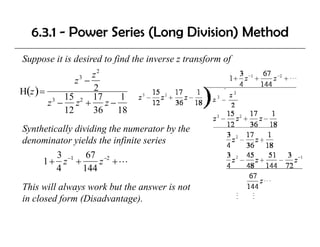
Suppose it is desired to find the inverse z transform of
                   z2
              z3 −
H(z ) =            2
           15 2 17     1
        z − z + z−
         3

           12      36 18
Synthetically dividing the numerator by the
denominator yields the infinite series
d     i t      i ld th i fi it     i
         3 −1 67 −2
     1+ z +          z +L
         4      144
This will always work but the answer is not
in closed form (Disadvantage).
6.3.2 - Partial-Fraction Expansion

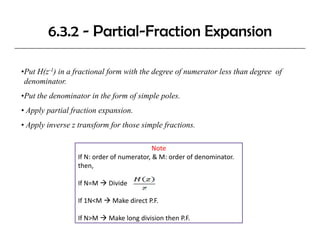
•Put H(z-1) in a fractional form with the degree of numerator less than degree of
 denominator.
•Put the denominator in the form of simple poles.
• A l partial fraction expansion.
  Apply   i lf     i         i
• Apply inverse z transform for those simple fractions.

                                           Note
                 If N: order of numerator, & M: order of denominator.
                 then,

                 If N=M     Divide

                 If 1N<M 
                 If 1N<M     Make direct P.F.
                             Make direct P F

                 If N>M     Make long division then P.F.
Example 1:

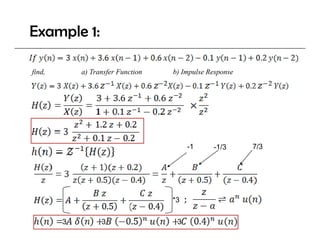
find,       a) Transfer Function   b) Impulse Response


                                        -1     -1/3      7/3


                                   *3
                                    3


        3         3                 3
Example 2:
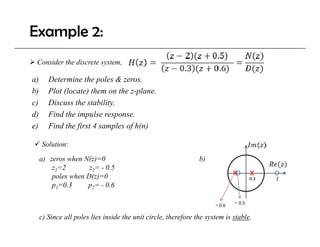
 Consider the discrete system,

a)
 )      Determine the poles & zeros.
        D            h     l
b)      Plot (locate) them on the z-plane.
c)      Discuss the stability.
d)      Find the impulse response.
e)      Find the first 4 samples of h(n)

     Solution:

     a) zeros when N(z)=0                                       b)
         z1=2        z2= - 0.5
         poles when D(z)=0                                                    xo x          o
                                                                                      0.3   2
         p1=0.3     p2= - 0.6

                                                                      ‐ 0.6   ‐ 0.5

     c) Since all poles lies inside the unit circle, therefore the system is stable.
Example 2 – cont.
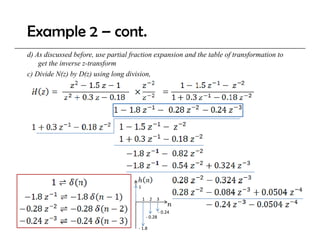
d) As discussed before, use partial fraction expansion and the table of transformation to
    get the inverse z-transform
c) Divide N(z) by D(z) using long division,
 )           () y ()        g    g         ,


                                      1

                                          1 2 3

                                                    ‐ 0.24
                                           ‐ 0.28

                                      ‐ 1.8
Example 3:
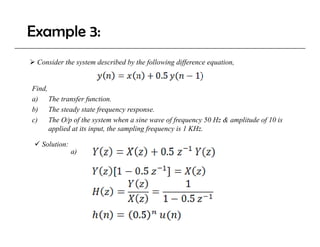
 Consider the system described by the following difference equation,


Find,
a) The transfer function.
b) Th steady state frequency response.
      The t d t t f
c) The O/p of the system when a sine wave of frequency 50 Hz & amplitude of 10 is
      applied at its input, the sampling frequency is 1 KHz.

   Solution:
               a)
Example 3– cont.
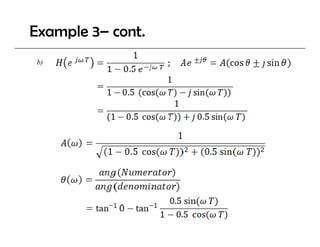
 b)
Example 3– cont.
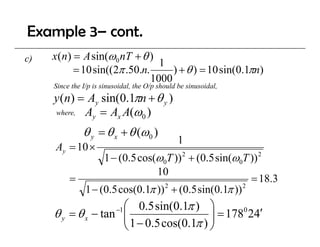
c)   x(n) = A sin(ω0 nT + θ )
                                1
          = 10 sin((2π .50.n.      ) + θ ) = 10 sin(0.1πn)
                              1000
     Since the I/p is sinusoidal, the O/p should be sinusoidal,
     y (n) = Ay sin(0.1πn + θ y )
     where, A = A A(ω )
              y    x    0

               θ y = θ x + θ (ω0 )
                                                1
     Ay = 10 ×
                 1 − (0.5 cos(ω0T )) 2 + (0.5 sin(ω0T )) 2
                              10
          =                                             = 18.3
            1 − (0.5 cos(0.1π )) 2 + (0.5 sin(0.1π )) 2
                     ⎛ 0.5 sin(0.1π ) ⎞
     θ y = θ x − tan ⎜     −1
                                          ⎟ = 1780 24′
                     ⎜ 1 − 0.5 cos(0.1π ) ⎟
                     ⎝                    ⎠
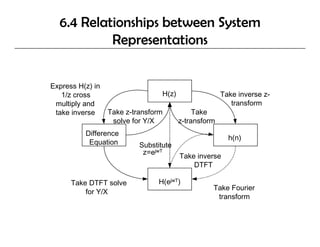
6.4 Relationships between System
           Representations
              p


Express H(z) in
   1/z cross                      H(z)                 Take inverse z-
 multiply and                                             transform
 take inverse     Take z-transform            Take
                   solve for Y/X         z-transform
          Difference
                                                         h(n)
           Equation        Substitute
                            z=ejwT
                                         Take inverse
                                             DTFT

      Take DTFT solve            H(ejwT)
                                                   Take Fourier
          for Y/X
                                                    transform

Dsp U Lec06 The Z Transform And Its Application

  • 1.
    EC533: Digital Signal Processing 5 l l Lecture 6 The Z-Transform and its application in signal processing
  • 2.
    6.1 - Z-Transformand LTI System ∞ • S t System Function of LTI Systems: F ti f LTI S t h (n ) = ∑ h (n )z − n x(n ) n = −∞ h(n ) y (n ) Y (z ) X (z ) H (z ) Y (z ) H (z ) = X (z ) • As the LTI system can be characterized by the difference equation, written as • The diffe ence equation specifies the actual operation that must be performed by he difference ope ation pe fo med the discrete-time system on the input data, in the time domain, in order to generate the desired output. In Z domain Z-domain If the O/p of the system depends only on the present & past I/p samples but not on previous outputs, i.e., bk=0’s FIR system, Else, Infinite Impulse Response 0s (IIR)
  • 3.
    6.1.1 - LTISystem Transfer Function If the O/p of the system depends only on the present & past i/p samples but not on previous outputs i.e., bk=0’s outputs, i e 0s Finite Impulse Response (FIR) system , Finite Impulse Response (FIR) system H (z ) = ∑ a k z − k N k =0 h(n) = 0, n < 0, h(n) = 0, n >N, FIR system is an all zero system and are always stable If bk≠0’s, the system is called Infinite Impulse Response (IIR) system IIR filter has poles h( n) ), -∞ ≤ n ≤ ∞
  • 4.
    6.1.2 - Propertiesof LTI Systems Using the Z- Transform Causal Systems : ROC extends outward from the outermost pole. Im R Re Stable Systems (H(z) is BIBO): ROC includes the unit circle. Im A stable system requires that its Fourier transform is uniformly convergent. 1 Re
  • 5.
    6.2 - Z-transformand Frequency Response Estimation • The frequency response of a system (as digital filter spectrum) can be readily obtained from its z-transform. H(z) H( ) as, where σ is a transient term & it tends to zero as f at steady state, Steady‐state frequency response of  a system (DTFT). where, A(ω)≡ Amplitude (Magnitude) Response , B(ω) ≡ Angle (Phase) Response Steady‐state
  • 6.
    6.2 - FrequencyResponse Estimation – cont. • Phase Delay The amount of time delay, each frequency component of the signal suffers in delay going through the system. • Group Delay The average time delay the composite signal suffers at each frequency.
  • 7.
    6.3 - InverseZ-Transform where DTFT IDTFT (A contour integral) where, for a fixed r,
  • 8.
    6.3 - TheInverse Z-Transform – cont. • There is an inversion integral for the z transform, 1 x[n ] = X(z)z n−1dz j2π ∫ C but doing it requires integration in the complex plane and it is rarely used in engineering practice. • There are two other common methods, Power series method (long division method) Partial-Fraction Expansion p
  • 9.
    6.3.1 - PowerSeries (Long Division) Method Suppose it is desired to find the inverse z transform of z2 z3 − H(z ) = 2 15 2 17 1 z − z + z− 3 12 36 18 Synthetically dividing the numerator by the denominator yields the infinite series d i t i ld th i fi it i 3 −1 67 −2 1+ z + z +L 4 144 This will always work but the answer is not in closed form (Disadvantage).
  • 10.
    6.3.2 - Partial-FractionExpansion •Put H(z-1) in a fractional form with the degree of numerator less than degree of denominator. •Put the denominator in the form of simple poles. • A l partial fraction expansion. Apply i lf i i • Apply inverse z transform for those simple fractions. Note If N: order of numerator, & M: order of denominator. then, If N=M  Divide If 1N<M  If 1N<M Make direct P.F. Make direct P F If N>M  Make long division then P.F.
  • 11.
    Example 1: find, a) Transfer Function b) Impulse Response -1 -1/3 7/3 *3 3 3 3 3
  • 12.
    Example 2: Considerthe discrete system, a) ) Determine the poles & zeros. D h l b) Plot (locate) them on the z-plane. c) Discuss the stability. d) Find the impulse response. e) Find the first 4 samples of h(n) Solution: a) zeros when N(z)=0 b) z1=2 z2= - 0.5 poles when D(z)=0 xo x o 0.3 2 p1=0.3 p2= - 0.6 ‐ 0.6 ‐ 0.5 c) Since all poles lies inside the unit circle, therefore the system is stable.
  • 13.
    Example 2 –cont. d) As discussed before, use partial fraction expansion and the table of transformation to get the inverse z-transform c) Divide N(z) by D(z) using long division, ) () y () g g , 1 1 2 3 ‐ 0.24 ‐ 0.28 ‐ 1.8
  • 14.
    Example 3: Considerthe system described by the following difference equation, Find, a) The transfer function. b) Th steady state frequency response. The t d t t f c) The O/p of the system when a sine wave of frequency 50 Hz & amplitude of 10 is applied at its input, the sampling frequency is 1 KHz. Solution: a)
  • 15.
  • 16.
    Example 3– cont. c) x(n) = A sin(ω0 nT + θ ) 1 = 10 sin((2π .50.n. ) + θ ) = 10 sin(0.1πn) 1000 Since the I/p is sinusoidal, the O/p should be sinusoidal, y (n) = Ay sin(0.1πn + θ y ) where, A = A A(ω ) y x 0 θ y = θ x + θ (ω0 ) 1 Ay = 10 × 1 − (0.5 cos(ω0T )) 2 + (0.5 sin(ω0T )) 2 10 = = 18.3 1 − (0.5 cos(0.1π )) 2 + (0.5 sin(0.1π )) 2 ⎛ 0.5 sin(0.1π ) ⎞ θ y = θ x − tan ⎜ −1 ⎟ = 1780 24′ ⎜ 1 − 0.5 cos(0.1π ) ⎟ ⎝ ⎠
  • 17.
    6.4 Relationships betweenSystem Representations p Express H(z) in 1/z cross H(z) Take inverse z- multiply and transform take inverse Take z-transform Take solve for Y/X z-transform Difference h(n) Equation Substitute z=ejwT Take inverse DTFT Take DTFT solve H(ejwT) Take Fourier for Y/X transform