Presented by
Samarakoon Bandara
 Marks awarded by counting the number of
correct answers on a test script are known
as raw marks.
 Chandralatha got 16 marks out of 20 for
Psychology at the monthly test.
 Is it a high mark or a low mark? What do
you think?
 It may appear a high mark, but in fact the
statement is virtually meaningless on its
own.
 16 may be the lowest mark of a particular
group of scores. If the test was difficult, 16
may well be a very high mark.
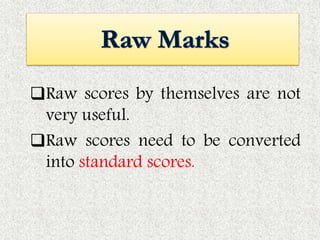
Raw scores by themselves are not
very useful.
Raw scores need to be converted
into standard scores.
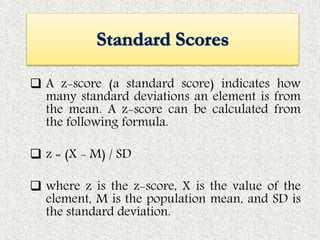
 A z-score (a standard score) indicates how
many standard deviations an element is from
the mean. A z-score can be calculated from
the following formula.
 z = (X - M) / SD
 where z is the z-score, X is the value of the
element, M is the population mean, and SD is
the standard deviation.
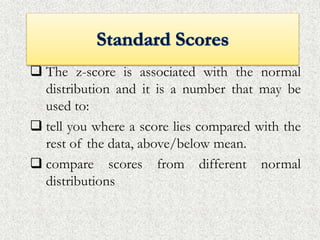
 The z-score is associated with the normal
distribution and it is a number that may be
used to:
 tell you where a score lies compared with the
rest of the data, above/below mean.
 compare scores from different normal
distributions
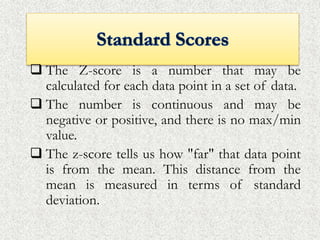
 The Z-score is a number that may be
calculated for each data point in a set of data.
 The number is continuous and may be
negative or positive, and there is no max/min
value.
 The z-score tells us how "far" that data point
is from the mean. This distance from the
mean is measured in terms of standard
deviation.
 We may make statements such as "the data
point(score) is 1 standard deviation above the
mean" and "the score is 3 standard deviations
above the mean", which means the latter
score is three times further from the mean.
 The Mean for a set of scores is 50 while the
SD is 10.
 What can we say about someone with a score
of
 50?
 The z-score is (50-50)/10 = 0.
 Interpretation: student score is 0 distance (in
units of SD) from the mean, so the student
has scored average.
 60?
 The z-score is (60-50)/10 = 1.
 Interpretation: student has scored above
average - a distance of 1 standard deviation
above the mean.
 69.6?
 The z-score is (69.6-50)/10 = 1.96.
Interpretation: The student has scored above
average - a distance of 1.96 above the average
score.
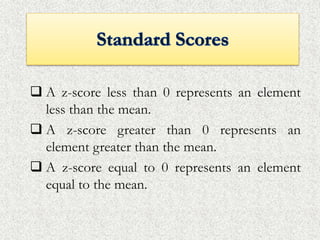
 A z-score less than 0 represents an element
less than the mean.
 A z-score greater than 0 represents an
element greater than the mean.
 A z-score equal to 0 represents an element
equal to the mean.
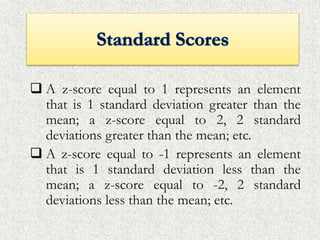
 A z-score equal to 1 represents an element
that is 1 standard deviation greater than the
mean; a z-score equal to 2, 2 standard
deviations greater than the mean; etc.
 A z-score equal to -1 represents an element
that is 1 standard deviation less than the
mean; a z-score equal to -2, 2 standard
deviations less than the mean; etc.
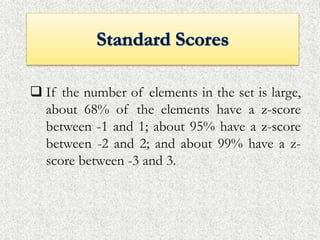
 If the number of elements in the set is large,
about 68% of the elements have a z-score
between -1 and 1; about 95% have a z-score
between -2 and 2; and about 99% have a z-
score between -3 and 3.
Z scores

Z scores

  • 1.
  • 2.
     Marks awardedby counting the number of correct answers on a test script are known as raw marks.  Chandralatha got 16 marks out of 20 for Psychology at the monthly test.  Is it a high mark or a low mark? What do you think?
  • 3.
     It mayappear a high mark, but in fact the statement is virtually meaningless on its own.  16 may be the lowest mark of a particular group of scores. If the test was difficult, 16 may well be a very high mark.
  • 4.
    Raw scores bythemselves are not very useful. Raw scores need to be converted into standard scores.
  • 5.
     A z-score(a standard score) indicates how many standard deviations an element is from the mean. A z-score can be calculated from the following formula.  z = (X - M) / SD  where z is the z-score, X is the value of the element, M is the population mean, and SD is the standard deviation.
  • 6.
     The z-scoreis associated with the normal distribution and it is a number that may be used to:  tell you where a score lies compared with the rest of the data, above/below mean.  compare scores from different normal distributions
  • 7.
     The Z-scoreis a number that may be calculated for each data point in a set of data.  The number is continuous and may be negative or positive, and there is no max/min value.  The z-score tells us how "far" that data point is from the mean. This distance from the mean is measured in terms of standard deviation.
  • 8.
     We maymake statements such as "the data point(score) is 1 standard deviation above the mean" and "the score is 3 standard deviations above the mean", which means the latter score is three times further from the mean.
  • 9.
     The Meanfor a set of scores is 50 while the SD is 10.  What can we say about someone with a score of  50?  The z-score is (50-50)/10 = 0.  Interpretation: student score is 0 distance (in units of SD) from the mean, so the student has scored average.
  • 10.
     60?  Thez-score is (60-50)/10 = 1.  Interpretation: student has scored above average - a distance of 1 standard deviation above the mean.
  • 11.
     69.6?  Thez-score is (69.6-50)/10 = 1.96. Interpretation: The student has scored above average - a distance of 1.96 above the average score.
  • 12.
     A z-scoreless than 0 represents an element less than the mean.  A z-score greater than 0 represents an element greater than the mean.  A z-score equal to 0 represents an element equal to the mean.
  • 13.
     A z-scoreequal to 1 represents an element that is 1 standard deviation greater than the mean; a z-score equal to 2, 2 standard deviations greater than the mean; etc.  A z-score equal to -1 represents an element that is 1 standard deviation less than the mean; a z-score equal to -2, 2 standard deviations less than the mean; etc.
  • 14.
     If thenumber of elements in the set is large, about 68% of the elements have a z-score between -1 and 1; about 95% have a z-score between -2 and 2; and about 99% have a z- score between -3 and 3.