FIBRE TESTING
INTRODUCTION
Testing has never been more important in textile industry
than at present, with the increasing accent and premium
on high quality products, whether it is for domestic markets
or export trade
Textile testing is carried out in fibre, yarn, fabric and
sometimes in garment stage.
There are numerous testing techniques in use throughout
the textile industry.
For any technique selection of a sample to be tested
is very important
SAMPLING:
The selection of small quantity of material to be tested
is known as sampling. As textile testing is both
time consuming and destructive in nature in many cases,
it is necessary that we select samples for conducting
tests for various quality characteristics
Sampling Procedure:
Since only a small sample from a lot is tested for estimating
the properties of the lot, it is essential that the sample
so drawn should be truly representative of the lot.
In the Textile Industry, sampling of cotton has to be carried out
at three distinct stages 1. Bulk Samples
2. Basic Samples
3. Laboratory samples
B
u
l
k
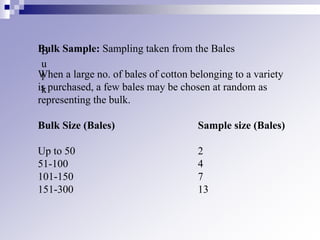
Bulk Sample: Sampling taken from the Bales
When a large no. of bales of cotton belonging to a variety
is purchased, a few bales may be chosen at random as
representing the bulk.
Bulk Size (Bales) Sample size (Bales)
Up to 50 2
51-100 4
101-150 7
151-300 13
Basic Sample:
Basic sample is prepared from the chosen bales
Draw handful of cotton from different places of the bales
so that a representative sample is drawn. These tufts of fibres
may be mixed up thoroughly to form a homogenous sample.
Finally homogenous samples prepared from all the bales
are pooled together to form one representative sample of the
Whole bulk.
The total quantity of sample prepared should be about 1 Kg.
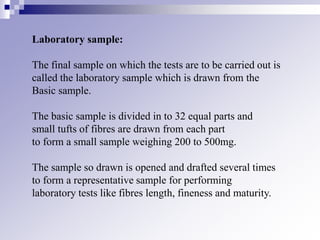
Laboratory sample:
The final sample on which the tests are to be carried out is
called the laboratory sample which is drawn from the
Basic sample.
The basic sample is divided in to 32 equal parts and
small tufts of fibres are drawn from each part
to form a small sample weighing 200 to 500mg.
The sample so drawn is opened and drafted several times
to form a representative sample for performing
laboratory tests like fibres length, fineness and maturity.
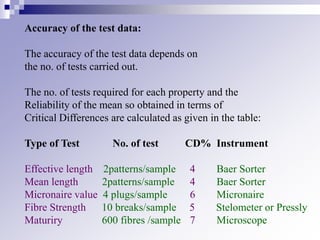
Accuracy of the test data:
The accuracy of the test data depends on
the no. of tests carried out.
The no. of tests required for each property and the
Reliability of the mean so obtained in terms of
Critical Differences are calculated as given in the table:
Type of Test No. of test CD% Instrument
Effective length 2patterns/sample 4 Baer Sorter
Mean length 2patterns/sample 4 Baer Sorter
Micronaire value 4 plugs/sample 6 Micronaire
Fibre Strength 10 breaks/sample 5 Stelometer or Pressly
Maturiry 600 fibres /sample 7 Microscope
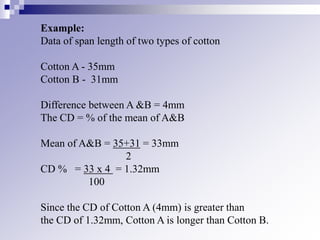
Example:
Data of span length of two types of cotton
Cotton A - 35mm
Cotton B - 31mm
Difference between A &B = 4mm
The CD = % of the mean of A&B
Mean of A&B = 35+31 = 33mm
2
CD % = 33 x 4 = 1.32mm
100
Since the CD of Cotton A (4mm) is greater than
the CD of 1.32mm, Cotton A is longer than Cotton B.
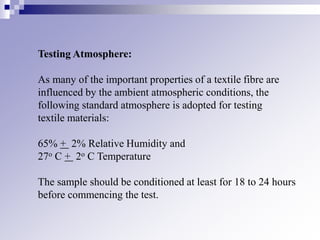
Testing Atmosphere:
As many of the important properties of a textile fibre are
influenced by the ambient atmospheric conditions, the
following standard atmosphere is adopted for testing
textile materials:
65% + 2% Relative Humidity and
27o C + 2o C Temperature
The sample should be conditioned at least for 18 to 24 hours
before commencing the test.
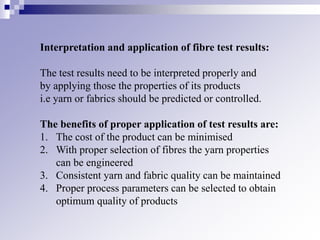
Interpretation and application of fibre test results:
The test results need to be interpreted properly and
by applying those the properties of its products
i.e yarn or fabrics should be predicted or controlled.
The benefits of proper application of test results are:
1. The cost of the product can be minimised
2. With proper selection of fibres the yarn properties
can be engineered
3. Consistent yarn and fabric quality can be maintained
4. Proper process parameters can be selected to obtain
optimum quality of products
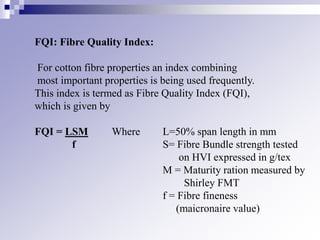
FQI: Fibre Quality Index:
For cotton fibre properties an index combining
most important properties is being used frequently.
This index is termed as Fibre Quality Index (FQI),
which is given by
FQI = LSM Where L=50% span length in mm
f S= Fibre Bundle strength tested
on HVI expressed in g/tex
M = Maturity ration measured by
Shirley FMT
f = Fibre fineness
(maicronaire value)
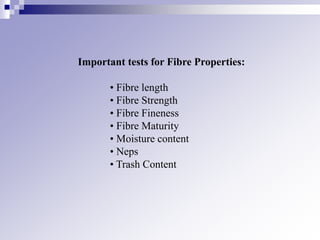
Important tests for Fibre Properties:
• Fibre length
• Fibre Strength
• Fibre Fineness
• Fibre Maturity
• Moisture content
• Neps
• Trash Content
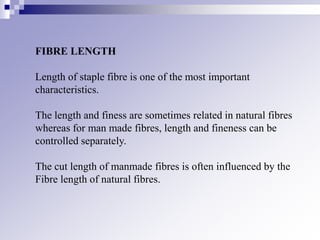
FIBRE LENGTH
Length of staple fibre is one of the most important
characteristics.
The length and finess are sometimes related in natural fibres
whereas for man made fibres, length and fineness can be
controlled separately.
The cut length of manmade fibres is often influenced by the
Fibre length of natural fibres.
The measurement of natural fibres is a task as there is
a greater variation in the length of different types of
same material and even within the same type.
The properties of cotton fibre vary
•for different varieties of cotton
•for different growth areas
• for different climatic conditions
• from year to year
Measurement of individual fibre length:
A representative sample is taken and the individual
fibre length is measured. These values are arranged
accordingly and the mean & coefficient of variation
are calculated.
This method is mainly used for the man made staple fibres
as the variation in length is not much.
The fibres are straightened and placed on an oil plate
and the individual length of fibres (around 300-500)
is measured
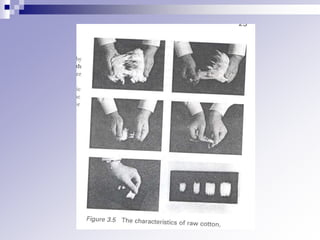
Stapling Method: (Group of fibres)
An earlier method used by classers to make a rough estimate
of staple length
With the right hand a layer of fibres are drawn from
the cotton held in the left hand.
The same operation is repeated 4-5 times and the layers of
fibres are placed one on top of each other on a black velvet
board.
Block off the ends of the fibres with a cotton stapling rule
so as to indicate the length of the bulk of fibres and
distance between the blocked off ends is measured
Combsorter Method:
This is the method in which distribution of
different length groups of fibres,
can be judged visually and numerically.
It is much less laborious than single fibre method
but gives a fairly accurate measurement when followed
properly.
In this method, a cotton sample of around 15gm is chosen
to represent the bulk. Generally in 15gm of cotton there are
around 3000 hairs.
The instruments used are 1. Baer sorter
2. Comb sorter
Where, the working principle is the same for both.
The instrument consists of a bed of 9 bottom combs
and 8 top combs which control the fibres and enable
the sample to be fractionalised in to length groups
The hairs are pulled down from the tufts by means of grip,
the longest first, the combs being successively dropped
as required and combed, straightened and laid down
on velvet pad with the straight edge against the marked line.
Analysis of Sorter Diagram:
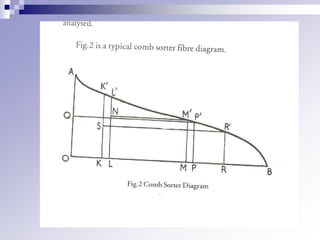
From the comb sorter diagram, various parameters
can be analysed.
Mean length:
To determine the area of the comb sorter diagram using
either the special transparent scale or a planimeter.
Divide the area expressed in square mm by
the length of the base in mm to obtain mean fibre length.
Area of comb sorter diagram (mm)
Mean fibre length (mm) = -----------------------------------------
Length of the base (mm)
Maximum length:
The length OA can be measured by scale from the tracing.
Effective length:
A geometric construction over the area of sorter diagram
will give the effective length of the fibre. It is the length which
contributes more effectively in the yarn formation.
Percent short fibres:
Percent short fibres = RB x 100, where OB is the total
length of the OB diagram.
Other advanced test methods include:
• Optical scanning method using Digital fibro graph:
It is an optical instrument which scans a randomly
Aligned tuft of fibres and to ensure the length of specification
of the length frequency distribution. It employs a totally new
Concept of fibre length called “Span length”
• High Volume Instrument (HVI)
• The WIRA fibre diagram machine (Wool Industries Research
Association)
• Advanced fibre information system
FIBRE STRENGTH:
Fibre strength is generally considered to be next to
fibre length and fineness in the order of importance amongst
fibre properties.
Fibre strength denotes the maximum tension the
fibre is able to sustain before breaking.
It can be expressed as breaking strength or load, tenacity etc.
Elongation denotes elongation percentage of fibre at break.
Factors affecting the strength of fibres:
• Molecular structure
• No. and intensity of weak places
• Coarseness or fineness of fibre
• Relative humidity
• Elasticity
The strength or tenacity is expressed as breaking load for
unit fineness of the fibres
The tensile testing instruments can be classified in to three
groups depending on their working principle.
• Constant Rate of Load
• Constant Rate of Extension
• Constant Rate of Traverse
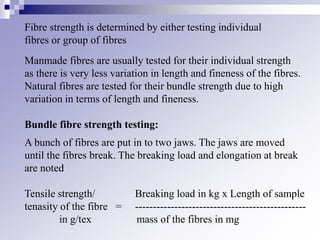
Fibre strength is determined by either testing individual
fibres or group of fibres
Manmade fibres are usually tested for their individual strength
as there is very less variation in length and fineness of the fibres.
Natural fibres are tested for their bundle strength due to high
variation in terms of length and fineness.
Bundle fibre strength testing:
A bunch of fibres are put in to two jaws. The jaws are moved
until the fibres break. The breaking load and elongation at break
are noted
Tensile strength/ Breaking load in kg x Length of sample
tenasity of the fibre = ------------------------------------------------
in g/tex mass of the fibres in mg
Bundle strength of cotton:
The “Stelo”meter – the name coined from strength and elongation
which functions on pendulum lever principle.
Pressley fibre strength tester - functions on pivoted beam balance
principle.
Uster spinlab High Volume Instrument:
FIBRE FINENESS:
The mass of a known length of fibre is termed as
linear density and this can be expressed as weight per
unit length.
Widely used units are:
• Micron – Microgram /Inch
• Denier – Weight in grams of 9000meters
• Tex – Weight in grams of 1000 meters
• Decitex – Weight in grams of 10,000meters.
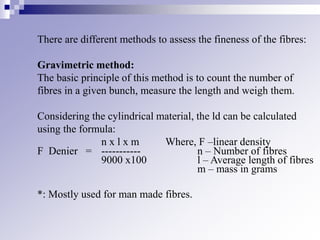
There are different methods to assess the fineness of the fibres:
Gravimetric method:
The basic principle of this method is to count the number of
fibres in a given bunch, measure the length and weigh them.
Considering the cylindrical material, the ld can be calculated
using the formula:
n x l x m Where, F –linear density
F Denier = ----------- n – Number of fibres
9000 x100 l – Average length of fibres
m – mass in grams
*: Mostly used for man made fibres.
Microscopic method:
In this method, fibres are mounted on the microscope and the
diameter is measured after magnification. This methos is
widely used for wool fibres and man made fibres having
circular diameter.
To avoid error due to swelling, the mounting medium like
Liquid paraffin can be used for effective results.
The latest instruments can measure the diameters of
5000-10000 samples in a minute by using micro processor.
It can calculate linear density also along with fineness.
Air flow method: based on air flow principle.
A sample of known weight is compressed in a cylinder of
known volume and subjected to an air of known pressure.
The rate of air flow through the compressed fibres is measured.
The rate of air flow will depend much on the
surface area of the material.

Most commonly used instruments are Micronaire, HVI etc.
The resistance of the specimen to the flow of air is related to
The average fineness of fibre in the specimen. The rate of flow
of air is indicated on a scale graduated in absolute units of
micronaire value, a combined measure of fineness and maturity.
FIBRE MATURITY:
A measure to express the development of cotton fibres.
The maturity can vary within fibres of the same seed.
A cotton fibre consists of a cuticle, a primary wall and
secondary wall surrounding the lumen or central canal.
The growth of secondary cell wall i.e., deposition of
cellulose in a fibre is the reason for variation in maturity.
This growth is dependent on the fertilizer used in cotton plant,
weather etc.
The material with higher number of immature fibres causes
fibre damages during processing causing
higher number of neps and irregular absorption of dyes.
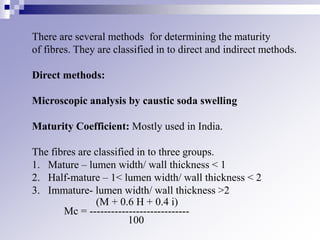
There are several methods for determining the maturity
of fibres. They are classified in to direct and indirect methods.
Direct methods:
Microscopic analysis by caustic soda swelling
Maturity Coefficient: Mostly used in India.
The fibres are classified in to three groups.
1. Mature – lumen width/ wall thickness < 1
2. Half-mature – 1< lumen width/ wall thickness < 2
3. Immature- lumen width/ wall thickness >2
(M + 0.6 H + 0.4 i)
Mc = ----------------------------
100
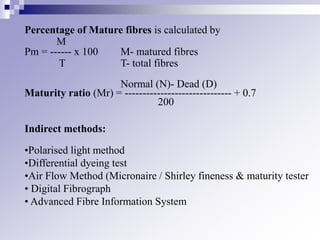
Percentage of Mature fibres is calculated by
M
Pm = ------ x 100 M- matured fibres
T T- total fibres
Normal (N)- Dead (D)
Maturity ratio (Mr) = ------------------------------ + 0.7
200
Indirect methods:
•Polarised light method
•Differential dyeing test
•Air Flow Method (Micronaire / Shirley fineness & maturity tester
• Digital Fibrograph
• Advanced Fibre Information System
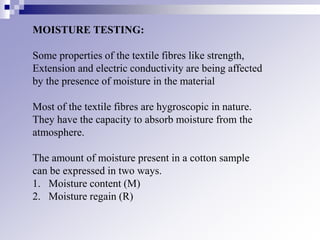
MOISTURE TESTING:
Some properties of the textile fibres like strength,
Extension and electric conductivity are being affected
by the presence of moisture in the material
Most of the textile fibres are hygroscopic in nature.
They have the capacity to absorb moisture from the
atmosphere.
The amount of moisture present in a cotton sample
can be expressed in two ways.
1. Moisture content (M)
2. Moisture regain (R)
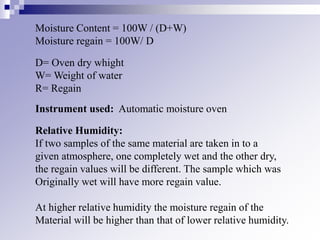
Moisture Content = 100W / (D+W)
Moisture regain = 100W/ D
D= Oven dry whight
W= Weight of water
R= Regain
Instrument used: Automatic moisture oven
Relative Humidity:
If two samples of the same material are taken in to a
given atmosphere, one completely wet and the other dry,
the regain values will be different. The sample which was
Originally wet will have more regain value.
At higher relative humidity the moisture regain of the
Material will be higher than that of lower relative humidity.
THANK YOU

fdocuments.in_fibre-testing.ppt

  • 1.
  • 2.
    INTRODUCTION Testing has neverbeen more important in textile industry than at present, with the increasing accent and premium on high quality products, whether it is for domestic markets or export trade Textile testing is carried out in fibre, yarn, fabric and sometimes in garment stage. There are numerous testing techniques in use throughout the textile industry. For any technique selection of a sample to be tested is very important
  • 3.
    SAMPLING: The selection ofsmall quantity of material to be tested is known as sampling. As textile testing is both time consuming and destructive in nature in many cases, it is necessary that we select samples for conducting tests for various quality characteristics Sampling Procedure: Since only a small sample from a lot is tested for estimating the properties of the lot, it is essential that the sample so drawn should be truly representative of the lot. In the Textile Industry, sampling of cotton has to be carried out at three distinct stages 1. Bulk Samples 2. Basic Samples 3. Laboratory samples
  • 4.
    B u l k Bulk Sample: Samplingtaken from the Bales When a large no. of bales of cotton belonging to a variety is purchased, a few bales may be chosen at random as representing the bulk. Bulk Size (Bales) Sample size (Bales) Up to 50 2 51-100 4 101-150 7 151-300 13
  • 5.
    Basic Sample: Basic sampleis prepared from the chosen bales Draw handful of cotton from different places of the bales so that a representative sample is drawn. These tufts of fibres may be mixed up thoroughly to form a homogenous sample. Finally homogenous samples prepared from all the bales are pooled together to form one representative sample of the Whole bulk. The total quantity of sample prepared should be about 1 Kg.
  • 6.
    Laboratory sample: The finalsample on which the tests are to be carried out is called the laboratory sample which is drawn from the Basic sample. The basic sample is divided in to 32 equal parts and small tufts of fibres are drawn from each part to form a small sample weighing 200 to 500mg. The sample so drawn is opened and drafted several times to form a representative sample for performing laboratory tests like fibres length, fineness and maturity.
  • 7.
    Accuracy of thetest data: The accuracy of the test data depends on the no. of tests carried out. The no. of tests required for each property and the Reliability of the mean so obtained in terms of Critical Differences are calculated as given in the table: Type of Test No. of test CD% Instrument Effective length 2patterns/sample 4 Baer Sorter Mean length 2patterns/sample 4 Baer Sorter Micronaire value 4 plugs/sample 6 Micronaire Fibre Strength 10 breaks/sample 5 Stelometer or Pressly Maturiry 600 fibres /sample 7 Microscope
  • 8.
    Example: Data of spanlength of two types of cotton Cotton A - 35mm Cotton B - 31mm Difference between A &B = 4mm The CD = % of the mean of A&B Mean of A&B = 35+31 = 33mm 2 CD % = 33 x 4 = 1.32mm 100 Since the CD of Cotton A (4mm) is greater than the CD of 1.32mm, Cotton A is longer than Cotton B.
  • 9.
    Testing Atmosphere: As manyof the important properties of a textile fibre are influenced by the ambient atmospheric conditions, the following standard atmosphere is adopted for testing textile materials: 65% + 2% Relative Humidity and 27o C + 2o C Temperature The sample should be conditioned at least for 18 to 24 hours before commencing the test.
  • 10.
    Interpretation and applicationof fibre test results: The test results need to be interpreted properly and by applying those the properties of its products i.e yarn or fabrics should be predicted or controlled. The benefits of proper application of test results are: 1. The cost of the product can be minimised 2. With proper selection of fibres the yarn properties can be engineered 3. Consistent yarn and fabric quality can be maintained 4. Proper process parameters can be selected to obtain optimum quality of products
  • 11.
    FQI: Fibre QualityIndex: For cotton fibre properties an index combining most important properties is being used frequently. This index is termed as Fibre Quality Index (FQI), which is given by FQI = LSM Where L=50% span length in mm f S= Fibre Bundle strength tested on HVI expressed in g/tex M = Maturity ration measured by Shirley FMT f = Fibre fineness (maicronaire value)
  • 12.
    Important tests forFibre Properties: • Fibre length • Fibre Strength • Fibre Fineness • Fibre Maturity • Moisture content • Neps • Trash Content
  • 13.
    FIBRE LENGTH Length ofstaple fibre is one of the most important characteristics. The length and finess are sometimes related in natural fibres whereas for man made fibres, length and fineness can be controlled separately. The cut length of manmade fibres is often influenced by the Fibre length of natural fibres.
  • 14.
    The measurement ofnatural fibres is a task as there is a greater variation in the length of different types of same material and even within the same type. The properties of cotton fibre vary •for different varieties of cotton •for different growth areas • for different climatic conditions • from year to year
  • 15.
    Measurement of individualfibre length: A representative sample is taken and the individual fibre length is measured. These values are arranged accordingly and the mean & coefficient of variation are calculated. This method is mainly used for the man made staple fibres as the variation in length is not much. The fibres are straightened and placed on an oil plate and the individual length of fibres (around 300-500) is measured
  • 16.
    Stapling Method: (Groupof fibres) An earlier method used by classers to make a rough estimate of staple length With the right hand a layer of fibres are drawn from the cotton held in the left hand. The same operation is repeated 4-5 times and the layers of fibres are placed one on top of each other on a black velvet board. Block off the ends of the fibres with a cotton stapling rule so as to indicate the length of the bulk of fibres and distance between the blocked off ends is measured
  • 18.
    Combsorter Method: This isthe method in which distribution of different length groups of fibres, can be judged visually and numerically. It is much less laborious than single fibre method but gives a fairly accurate measurement when followed properly. In this method, a cotton sample of around 15gm is chosen to represent the bulk. Generally in 15gm of cotton there are around 3000 hairs.
  • 19.
    The instruments usedare 1. Baer sorter 2. Comb sorter Where, the working principle is the same for both. The instrument consists of a bed of 9 bottom combs and 8 top combs which control the fibres and enable the sample to be fractionalised in to length groups The hairs are pulled down from the tufts by means of grip, the longest first, the combs being successively dropped as required and combed, straightened and laid down on velvet pad with the straight edge against the marked line.
  • 21.
    Analysis of SorterDiagram: From the comb sorter diagram, various parameters can be analysed. Mean length: To determine the area of the comb sorter diagram using either the special transparent scale or a planimeter. Divide the area expressed in square mm by the length of the base in mm to obtain mean fibre length. Area of comb sorter diagram (mm) Mean fibre length (mm) = ----------------------------------------- Length of the base (mm)
  • 22.
    Maximum length: The lengthOA can be measured by scale from the tracing. Effective length: A geometric construction over the area of sorter diagram will give the effective length of the fibre. It is the length which contributes more effectively in the yarn formation. Percent short fibres: Percent short fibres = RB x 100, where OB is the total length of the OB diagram.
  • 23.
    Other advanced testmethods include: • Optical scanning method using Digital fibro graph: It is an optical instrument which scans a randomly Aligned tuft of fibres and to ensure the length of specification of the length frequency distribution. It employs a totally new Concept of fibre length called “Span length” • High Volume Instrument (HVI) • The WIRA fibre diagram machine (Wool Industries Research Association) • Advanced fibre information system
  • 24.
    FIBRE STRENGTH: Fibre strengthis generally considered to be next to fibre length and fineness in the order of importance amongst fibre properties. Fibre strength denotes the maximum tension the fibre is able to sustain before breaking. It can be expressed as breaking strength or load, tenacity etc. Elongation denotes elongation percentage of fibre at break.
  • 25.
    Factors affecting thestrength of fibres: • Molecular structure • No. and intensity of weak places • Coarseness or fineness of fibre • Relative humidity • Elasticity The strength or tenacity is expressed as breaking load for unit fineness of the fibres The tensile testing instruments can be classified in to three groups depending on their working principle. • Constant Rate of Load • Constant Rate of Extension • Constant Rate of Traverse
  • 26.
    Fibre strength isdetermined by either testing individual fibres or group of fibres Manmade fibres are usually tested for their individual strength as there is very less variation in length and fineness of the fibres. Natural fibres are tested for their bundle strength due to high variation in terms of length and fineness. Bundle fibre strength testing: A bunch of fibres are put in to two jaws. The jaws are moved until the fibres break. The breaking load and elongation at break are noted Tensile strength/ Breaking load in kg x Length of sample tenasity of the fibre = ------------------------------------------------ in g/tex mass of the fibres in mg
  • 27.
    Bundle strength ofcotton: The “Stelo”meter – the name coined from strength and elongation which functions on pendulum lever principle. Pressley fibre strength tester - functions on pivoted beam balance principle. Uster spinlab High Volume Instrument:
  • 28.
    FIBRE FINENESS: The massof a known length of fibre is termed as linear density and this can be expressed as weight per unit length. Widely used units are: • Micron – Microgram /Inch • Denier – Weight in grams of 9000meters • Tex – Weight in grams of 1000 meters • Decitex – Weight in grams of 10,000meters.
  • 29.
    There are differentmethods to assess the fineness of the fibres: Gravimetric method: The basic principle of this method is to count the number of fibres in a given bunch, measure the length and weigh them. Considering the cylindrical material, the ld can be calculated using the formula: n x l x m Where, F –linear density F Denier = ----------- n – Number of fibres 9000 x100 l – Average length of fibres m – mass in grams *: Mostly used for man made fibres.
  • 30.
    Microscopic method: In thismethod, fibres are mounted on the microscope and the diameter is measured after magnification. This methos is widely used for wool fibres and man made fibres having circular diameter. To avoid error due to swelling, the mounting medium like Liquid paraffin can be used for effective results. The latest instruments can measure the diameters of 5000-10000 samples in a minute by using micro processor. It can calculate linear density also along with fineness.
  • 31.
    Air flow method:based on air flow principle. A sample of known weight is compressed in a cylinder of known volume and subjected to an air of known pressure. The rate of air flow through the compressed fibres is measured. The rate of air flow will depend much on the surface area of the material. Most commonly used instruments are Micronaire, HVI etc. The resistance of the specimen to the flow of air is related to The average fineness of fibre in the specimen. The rate of flow of air is indicated on a scale graduated in absolute units of micronaire value, a combined measure of fineness and maturity.
  • 32.
    FIBRE MATURITY: A measureto express the development of cotton fibres. The maturity can vary within fibres of the same seed. A cotton fibre consists of a cuticle, a primary wall and secondary wall surrounding the lumen or central canal. The growth of secondary cell wall i.e., deposition of cellulose in a fibre is the reason for variation in maturity. This growth is dependent on the fertilizer used in cotton plant, weather etc. The material with higher number of immature fibres causes fibre damages during processing causing higher number of neps and irregular absorption of dyes.
  • 33.
    There are severalmethods for determining the maturity of fibres. They are classified in to direct and indirect methods. Direct methods: Microscopic analysis by caustic soda swelling Maturity Coefficient: Mostly used in India. The fibres are classified in to three groups. 1. Mature – lumen width/ wall thickness < 1 2. Half-mature – 1< lumen width/ wall thickness < 2 3. Immature- lumen width/ wall thickness >2 (M + 0.6 H + 0.4 i) Mc = ---------------------------- 100
  • 34.
    Percentage of Maturefibres is calculated by M Pm = ------ x 100 M- matured fibres T T- total fibres Normal (N)- Dead (D) Maturity ratio (Mr) = ------------------------------ + 0.7 200 Indirect methods: •Polarised light method •Differential dyeing test •Air Flow Method (Micronaire / Shirley fineness & maturity tester • Digital Fibrograph • Advanced Fibre Information System
  • 35.
    MOISTURE TESTING: Some propertiesof the textile fibres like strength, Extension and electric conductivity are being affected by the presence of moisture in the material Most of the textile fibres are hygroscopic in nature. They have the capacity to absorb moisture from the atmosphere. The amount of moisture present in a cotton sample can be expressed in two ways. 1. Moisture content (M) 2. Moisture regain (R)
  • 36.
    Moisture Content =100W / (D+W) Moisture regain = 100W/ D D= Oven dry whight W= Weight of water R= Regain Instrument used: Automatic moisture oven Relative Humidity: If two samples of the same material are taken in to a given atmosphere, one completely wet and the other dry, the regain values will be different. The sample which was Originally wet will have more regain value. At higher relative humidity the moisture regain of the Material will be higher than that of lower relative humidity.
  • 37.