YARN REALISATION
-A critical
analysis
by
A.Kanthimathinathan,
CEO,WINSYS SMC
Learning goalsLearning goals
 Role played by Moisture contentRole played by Moisture content
 Expectation from Openers/CleanersExpectation from Openers/Cleaners
 Expectation in a CardExpectation in a Card
 Expectation from CombersExpectation from Combers
 Understanding CustomerUnderstanding Customer
requirementsrequirements
YARN REALISATIONYARN REALISATION
 How best mills has used the resourceHow best mills has used the resource
called `RAW MATERIAL`called `RAW MATERIAL`
 Ratio of `output of yarn vs input ofRatio of `output of yarn vs input of
Mixing`Mixing`
Deciding factors-YRDeciding factors-YR
 Customer SpecificationCustomer Specification
 Raw material QualityRaw material Quality
 Type of MachineryType of Machinery
Customer SpecificationCustomer Specification
 Yarn Imperfections in terms ofYarn Imperfections in terms of
Periodical imperfections/ClassimatPeriodical imperfections/Classimat
faultsfaults
 Yarn HairinessYarn Hairiness
 Yarn unwinding PerformanceYarn unwinding Performance
 Yarn Strength in CSP/RkmYarn Strength in CSP/Rkm
 Yarn ElongationYarn Elongation
Raw Material QualityRaw Material Quality
 2.5% Span length/Mean Length2.5% Span length/Mean Length
 FinenessFineness
 Fiber strengthFiber strength
 Fiber MaturityFiber Maturity
 Trash ContentTrash Content
 SFC(n)-Ignored by majority of the millsSFC(n)-Ignored by majority of the mills
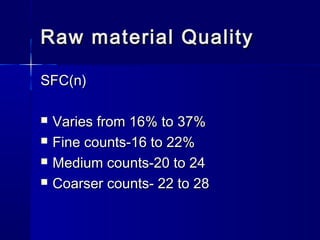
Raw material QualityRaw material Quality
SFC(n)SFC(n)
 Varies from 16% to 37%Varies from 16% to 37%
 Fine counts-16 to 22%Fine counts-16 to 22%
 Medium counts-20 to 24Medium counts-20 to 24
 Coarser counts- 22 to 28Coarser counts- 22 to 28
Raw material QualityRaw material Quality
 For other parameters mills know theFor other parameters mills know the
level of the specifications they requirelevel of the specifications they require
to spin their Yarn meeting customerto spin their Yarn meeting customer
requirementsrequirements
Raw Material QualityRaw Material Quality
Role of LengthRole of Length
 Spinning performance and contributionSpinning performance and contribution
to Yarn strengthto Yarn strength
Role of finenessRole of fineness
 Feel of theFeel of the
fabric/Hairiness/Strength/Runningfabric/Hairiness/Strength/Running
performanceperformance
Raw material QualityRaw material Quality
Impact of Trash contentImpact of Trash content
 When ginning is done properly, MillsWhen ginning is done properly, Mills
will get a `clean cotton ` with Leastwill get a `clean cotton ` with Least
trashtrash
 In Imported PIMA we have only 1.2%In Imported PIMA we have only 1.2%
trash contenttrash content
 Indian Ginneries fool their VendorsIndian Ginneries fool their Vendors
Raw Material QualityRaw Material Quality
 Indian Government has taken so manyIndian Government has taken so many
measures to improve Ginneriesmeasures to improve Ginneries
 Precleaning/Post cleaning/AutomationPrecleaning/Post cleaning/Automation
etcetc
 Ginneries take commercial stand andGinneries take commercial stand and
they don’t use Pre/post cleaners whichthey don’t use Pre/post cleaners which
are established practices across theare established practices across the
worldworld
Handling Trash ContentHandling Trash Content
 Removal of trash from compressedRemoval of trash from compressed
bales require proper opening(takencbales require proper opening(takenc
are of by first openers likeare of by first openers like
MBO/CLP/AFC/MC/SC/UC/VCMBO/CLP/AFC/MC/SC/UC/VC
 Seed trap removes full and BrokenSeed trap removes full and Broken
seedsseeds
 Final beaters remove fine trashFinal beaters remove fine trash
particlesparticles
Handling Trash ContentHandling Trash Content
 Cards take the role of removing fineCards take the role of removing fine
trash embedded with Bunches as welltrash embedded with Bunches as well
as Individual fibersas Individual fibers
 Role of each segment in CardsRole of each segment in Cards
Role of LickerinRole of Lickerin
 To remove leafy/broken seeds/heavyTo remove leafy/broken seeds/heavy
particles if anyparticles if any
 Preferentially no damage to the fiberPreferentially no damage to the fiber
 To individualize the fiberTo individualize the fiber
Role of SFLRole of SFL
 Remove fine fragmented seedRemove fine fragmented seed
particles clinging with short fiber asparticles clinging with short fiber as
well as loose trashwell as loose trash
Role of Flat topsRole of Flat tops
 Preferential Removal of finePreferential Removal of fine
fragmented seeds/Leafy husks/Shortfragmented seeds/Leafy husks/Short
fiber associated with trashy particlesfiber associated with trashy particles
 Does the job without damage to fiberDoes the job without damage to fiber
Customer RequirementsCustomer Requirements
Yarn ImperfectionsYarn Imperfections
--Waste level at BR/CardsWaste level at BR/Cards
-Type of Machinery/Drafting-Type of Machinery/Drafting
-Type of process-Type of process
-Fineness of cotton-Fineness of cotton
-Mixing neps-Mixing neps
-Noil level-Noil level
-Type of Autoconer-Type of Autoconer
Customer RequirementsCustomer Requirements
Yarn StrengthYarn Strength
 Twist levelTwist level
 Fiber length/Fiber finenessFiber length/Fiber fineness
 SFC(n) in Drawing sliverSFC(n) in Drawing sliver
 RH in departmentsRH in departments
 Drafting QualityDrafting Quality
Customer RequirementsCustomer Requirements
Yarn HairinessYarn Hairiness
 Type of SpinningType of Spinning
 Type of YarnType of Yarn
 Type of Traveller/RingType of Traveller/Ring
 LiftLift
 Lappet diaLappet dia
 Fiber FinenessFiber Fineness
Customer RequirementsCustomer Requirements
Yarn Classimat FaultsYarn Classimat Faults
 Type of SpinningType of Spinning
 Fiber opening efficiencyFiber opening efficiency
 Sliver trash contentSliver trash content
 Exhaust QualityExhaust Quality
 OHTC performanceOHTC performance
Mixing PrecautionsMixing Precautions
 Incoming bales moisture contentIncoming bales moisture content
should be 7 to 7.5%. If high there willshould be 7 to 7.5%. If high there will
be loss.be loss.
 Avoid Storage in outside areas.Avoid Storage in outside areas.
 Cotton godown roof spraying duringCotton godown roof spraying during
summer/24 Hours conditioning undersummer/24 Hours conditioning under
fog master in Blow roomfog master in Blow room
 Good cotton in yellow pickingGood cotton in yellow picking
BLOWROOMBLOWROOM
 No. of beating points depends onNo. of beating points depends on
trash %, mic. Etc.trash %, mic. Etc.
 White waste in droppings.White waste in droppings.
 Beater chocking.Beater chocking.
 Bales moisture conditioning in B/RBales moisture conditioning in B/R
department.department.
BLOWROOMBLOWROOM
 Lint loss in BRD while new mixing,Lint loss in BRD while new mixing,
setting changessetting changes
 Proper synchronization of B/R m/cs.Proper synchronization of B/R m/cs.
(ERM luminar duct should not be(ERM luminar duct should not be
empty)empty)
 Excessive suction in AWES and cottonExcessive suction in AWES and cotton
goes in suction.goes in suction.
 Micro dust exhausts suction too high.Micro dust exhausts suction too high.
CARDINGCARDING
 Lint in droppings.Lint in droppings.
 Chute beater chockingChute beater chocking
 Between card, with in card wasteBetween card, with in card waste
variation.variation.
(b/w cards variation + OR – 0.5%)(b/w cards variation + OR – 0.5%)
 Excessive suction in AWES and webExcessive suction in AWES and web
goes in suction.goes in suction.
CARDINGCARDING
 B/R & Carding set the waste % initiallyB/R & Carding set the waste % initially
while new mixing and maintain uptowhile new mixing and maintain upto
exhaust of mixing. (Visual inspection,exhaust of mixing. (Visual inspection,
Periodical waste % checking)Periodical waste % checking)
 Chute micro dust exhausts suction tooChute micro dust exhausts suction too
high.high.
 Running cards in slow speed (like DKRunning cards in slow speed (like DK
series) cause high wasteseries) cause high waste
COMBERCOMBER
 Between heads noils % variation.Between heads noils % variation.
 Higher noils % than STD.Higher noils % than STD.
 SFC based noils %.SFC based noils %.
 Possibilities to reduce noils % with outPossibilities to reduce noils % with out
compromising quality.compromising quality.
DRAWINGDRAWING
 White waste in blower waste.White waste in blower waste.
 Excessive positive clearer waste.Excessive positive clearer waste.
SIMPLEXSIMPLEX
 Excessive positive clearer waste.Excessive positive clearer waste.
 Excessive roving waste.Excessive roving waste.
SPINNINGSPINNING
 Double gaiting.Double gaiting.
 Use of damaged ring tubes.Use of damaged ring tubes.
 Poor work practice by doffersPoor work practice by doffers
(like delayed doffing and cause top(like delayed doffing and cause top
adoss, low clearance in bottom)adoss, low clearance in bottom)
 Under winding coils (4-5 coils).Under winding coils (4-5 coils).
 Low cop content. (Ring dia. & Lift)Low cop content. (Ring dia. & Lift)
WINDING /WINDING /
AUTOCONERAUTOCONER
 Excessive hand hard waste.Excessive hand hard waste.
 Rogue EYCRogue EYC
 Improper clearance curve.Improper clearance curve.
 Poor paper cones.Poor paper cones.
 Oil stained / removal of yarn fromOil stained / removal of yarn from
heavy weight cones.heavy weight cones.
GENERALGENERAL
 Daily monitoring of BRD, Card waste &Daily monitoring of BRD, Card waste &
Noils % by quantity extracted VsNoils % by quantity extracted Vs
production out put.production out put.
 Maintaining proper R.H% in allMaintaining proper R.H% in all
departments.departments.
(Prep – 55 to 60%, Spg – 50-55%,(Prep – 55 to 60%, Spg – 50-55%,
A/C – 60-65%)A/C – 60-65%)
 Variations in Month end closing stock.Variations in Month end closing stock.
GENERAL (Contd.)GENERAL (Contd.)
 Excess gives away in finished goods.Excess gives away in finished goods.
(Cone, hanks)(Cone, hanks)
 Error in weighing scale. (InsufficientError in weighing scale. (Insufficient
calibration)calibration)
 Excess in II quality.Excess in II quality.
 Installing YCP.Installing YCP.
GENERAL (Contd.)GENERAL (Contd.)
 Using mixing oil for flies control &Using mixing oil for flies control &
reducing invisible loss.reducing invisible loss.
 Allowed invisible loss 0.8 to 1.0% dueAllowed invisible loss 0.8 to 1.0% due
to variation in incoming cotton andto variation in incoming cotton and
despatch yarn.despatch yarn.
 Container, Lorry before & after loadingContainer, Lorry before & after loading
weight checking.weight checking.
GENERAL (Contd.)GENERAL (Contd.)
 Excessive soft waste causeExcessive soft waste cause
reprocessing and further loss in backreprocessing and further loss in back
process.process.
 BRD, Card waste % increase andBRD, Card waste % increase and
reduce comber noils.reduce comber noils.
 Customer based yarn quality (notCustomer based yarn quality (not
giving big importance forgiving big importance for
imperfections) based on fabric quality.imperfections) based on fabric quality.
 UQC settings based on fabric qualityUQC settings based on fabric quality
in terms of contamination & faults.in terms of contamination & faults.
GENERAL (Contd.)GENERAL (Contd.)
 Trend charts display for Y.R%, DeptTrend charts display for Y.R%, Dept
wise waste %, and Soft waste %.wise waste %, and Soft waste %.
 High hard waste, soft waste andHigh hard waste, soft waste and
sweepings due to negligence ofsweepings due to negligence of
workers, rough handling of materials,workers, rough handling of materials,
bad storage and poor workingbad storage and poor working
conditions.conditions.
Yarn Realisation-40s C-Yarn Realisation-40s C-
CompComp
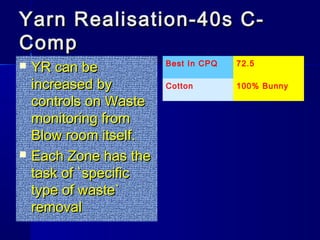
 YR can beYR can be
increased byincreased by
controls on Wastecontrols on Waste
monitoring frommonitoring from
Blow room itself.Blow room itself.
 Each Zone has theEach Zone has the
task of `specifictask of `specific
type of waste`type of waste`
removalremoval
Best In CPQ 72.5
Cotton 100% Bunny
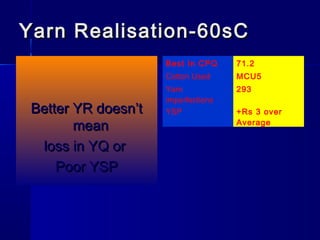
Yarn Realisation-60sCYarn Realisation-60sC
Better YR doesn’tBetter YR doesn’t
meanmean
loss in YQ orloss in YQ or
Poor YSPPoor YSP
Best In CPQ 71.2
Cotton Used MCU5
Yarn
imperfections
293
YSP +Rs 3 over
Average
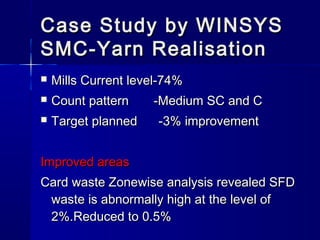
 Mills Current level-74%Mills Current level-74%
 Count pattern -Medium SC and CCount pattern -Medium SC and C
 Target planned -3% improvementTarget planned -3% improvement
Improved areasImproved areas
Card waste Zonewise analysis revealed SFDCard waste Zonewise analysis revealed SFD
waste is abnormally high at the level ofwaste is abnormally high at the level of
2%.Reduced to 0.5%2%.Reduced to 0.5%
Case Study by WINSYSCase Study by WINSYS
SMC-Yarn RealisationSMC-Yarn Realisation
 Hard Waste:Retrained the workforceHard Waste:Retrained the workforce
and reduced the hard waste from 0.9and reduced the hard waste from 0.9
to 0.6%to 0.6%
 In Semi combed Variety mills has notIn Semi combed Variety mills has not
done Conditioning. Effectivelydone Conditioning. Effectively
restarted.restarted.
 Sweepings found to be 0.8%-Sweepings found to be 0.8%-
Unusually high.On checking it is aUnusually high.On checking it is a
mixture of Usable waste .Reducedmixture of Usable waste .Reduced
the same to 0.5% levelthe same to 0.5% level
Case Study by WINSYSCase Study by WINSYS
SMC-YarnSMC-Yarn RealisationRealisation
 Finally the mills is able to exceed itsFinally the mills is able to exceed its
expected target of 3 and achievedexpected target of 3 and achieved
3.5%.3.5%.
 Final YR -77.5%Final YR -77.5%
Case Study-YR contd..Case Study-YR contd..
 Monitoring & Maintaining MoistureMonitoring & Maintaining Moisture
content in Mixing and outgoing yarncontent in Mixing and outgoing yarn
 Monitoring and Maintaining MoistureMonitoring and Maintaining Moisture
content in Saleable wastecontent in Saleable waste
 Strict monitoring and control of AWESStrict monitoring and control of AWES
waste level by visual checks inwaste level by visual checks in
Compactors-weeklyCompactors-weekly
Efforts taken on other YREfforts taken on other YR
studiesstudies
 Tare weight control in PackingTare weight control in Packing
 Weighment of Mixing at the time ofWeighment of Mixing at the time of
LayingLaying
 Ensuring 65 to 70 % in PackingEnsuring 65 to 70 % in Packing
departmentdepartment
Efforts taken on other YREfforts taken on other YR
studiesstudies
 THANK YOUTHANK YOU

Yarn realisation in spinning mills

  • 1.
  • 2.
    Learning goalsLearning goals Role played by Moisture contentRole played by Moisture content  Expectation from Openers/CleanersExpectation from Openers/Cleaners  Expectation in a CardExpectation in a Card  Expectation from CombersExpectation from Combers  Understanding CustomerUnderstanding Customer requirementsrequirements
  • 3.
    YARN REALISATIONYARN REALISATION YARNREALISATIONYARN REALISATION  How best mills has used the resourceHow best mills has used the resource called `RAW MATERIAL`called `RAW MATERIAL`  Ratio of `output of yarn vs input ofRatio of `output of yarn vs input of Mixing`Mixing`
  • 4.
    Deciding factors-YRDeciding factors-YR Customer SpecificationCustomer Specification  Raw material QualityRaw material Quality  Type of MachineryType of Machinery
  • 5.
    Customer SpecificationCustomer Specification Yarn Imperfections in terms ofYarn Imperfections in terms of Periodical imperfections/ClassimatPeriodical imperfections/Classimat faultsfaults  Yarn HairinessYarn Hairiness  Yarn unwinding PerformanceYarn unwinding Performance  Yarn Strength in CSP/RkmYarn Strength in CSP/Rkm  Yarn ElongationYarn Elongation
  • 6.
    Raw Material QualityRawMaterial Quality  2.5% Span length/Mean Length2.5% Span length/Mean Length  FinenessFineness  Fiber strengthFiber strength  Fiber MaturityFiber Maturity  Trash ContentTrash Content  SFC(n)-Ignored by majority of the millsSFC(n)-Ignored by majority of the mills
  • 7.
    Raw material QualityRawmaterial Quality SFC(n)SFC(n)  Varies from 16% to 37%Varies from 16% to 37%  Fine counts-16 to 22%Fine counts-16 to 22%  Medium counts-20 to 24Medium counts-20 to 24  Coarser counts- 22 to 28Coarser counts- 22 to 28
  • 8.
    Raw material QualityRawmaterial Quality  For other parameters mills know theFor other parameters mills know the level of the specifications they requirelevel of the specifications they require to spin their Yarn meeting customerto spin their Yarn meeting customer requirementsrequirements
  • 9.
    Raw Material QualityRawMaterial Quality Role of LengthRole of Length  Spinning performance and contributionSpinning performance and contribution to Yarn strengthto Yarn strength Role of finenessRole of fineness  Feel of theFeel of the fabric/Hairiness/Strength/Runningfabric/Hairiness/Strength/Running performanceperformance
  • 10.
    Raw material QualityRawmaterial Quality Impact of Trash contentImpact of Trash content  When ginning is done properly, MillsWhen ginning is done properly, Mills will get a `clean cotton ` with Leastwill get a `clean cotton ` with Least trashtrash  In Imported PIMA we have only 1.2%In Imported PIMA we have only 1.2% trash contenttrash content  Indian Ginneries fool their VendorsIndian Ginneries fool their Vendors
  • 11.
    Raw Material QualityRawMaterial Quality  Indian Government has taken so manyIndian Government has taken so many measures to improve Ginneriesmeasures to improve Ginneries  Precleaning/Post cleaning/AutomationPrecleaning/Post cleaning/Automation etcetc  Ginneries take commercial stand andGinneries take commercial stand and they don’t use Pre/post cleaners whichthey don’t use Pre/post cleaners which are established practices across theare established practices across the worldworld
  • 12.
    Handling Trash ContentHandlingTrash Content  Removal of trash from compressedRemoval of trash from compressed bales require proper opening(takencbales require proper opening(takenc are of by first openers likeare of by first openers like MBO/CLP/AFC/MC/SC/UC/VCMBO/CLP/AFC/MC/SC/UC/VC  Seed trap removes full and BrokenSeed trap removes full and Broken seedsseeds  Final beaters remove fine trashFinal beaters remove fine trash particlesparticles
  • 13.
    Handling Trash ContentHandlingTrash Content  Cards take the role of removing fineCards take the role of removing fine trash embedded with Bunches as welltrash embedded with Bunches as well as Individual fibersas Individual fibers  Role of each segment in CardsRole of each segment in Cards
  • 14.
    Role of LickerinRoleof Lickerin  To remove leafy/broken seeds/heavyTo remove leafy/broken seeds/heavy particles if anyparticles if any  Preferentially no damage to the fiberPreferentially no damage to the fiber  To individualize the fiberTo individualize the fiber
  • 15.
    Role of SFLRoleof SFL  Remove fine fragmented seedRemove fine fragmented seed particles clinging with short fiber asparticles clinging with short fiber as well as loose trashwell as loose trash
  • 16.
    Role of FlattopsRole of Flat tops  Preferential Removal of finePreferential Removal of fine fragmented seeds/Leafy husks/Shortfragmented seeds/Leafy husks/Short fiber associated with trashy particlesfiber associated with trashy particles  Does the job without damage to fiberDoes the job without damage to fiber
  • 17.
    Customer RequirementsCustomer Requirements YarnImperfectionsYarn Imperfections --Waste level at BR/CardsWaste level at BR/Cards -Type of Machinery/Drafting-Type of Machinery/Drafting -Type of process-Type of process -Fineness of cotton-Fineness of cotton -Mixing neps-Mixing neps -Noil level-Noil level -Type of Autoconer-Type of Autoconer
  • 18.
    Customer RequirementsCustomer Requirements YarnStrengthYarn Strength  Twist levelTwist level  Fiber length/Fiber finenessFiber length/Fiber fineness  SFC(n) in Drawing sliverSFC(n) in Drawing sliver  RH in departmentsRH in departments  Drafting QualityDrafting Quality
  • 19.
    Customer RequirementsCustomer Requirements YarnHairinessYarn Hairiness  Type of SpinningType of Spinning  Type of YarnType of Yarn  Type of Traveller/RingType of Traveller/Ring  LiftLift  Lappet diaLappet dia  Fiber FinenessFiber Fineness
  • 20.
    Customer RequirementsCustomer Requirements YarnClassimat FaultsYarn Classimat Faults  Type of SpinningType of Spinning  Fiber opening efficiencyFiber opening efficiency  Sliver trash contentSliver trash content  Exhaust QualityExhaust Quality  OHTC performanceOHTC performance
  • 21.
    Mixing PrecautionsMixing Precautions Incoming bales moisture contentIncoming bales moisture content should be 7 to 7.5%. If high there willshould be 7 to 7.5%. If high there will be loss.be loss.  Avoid Storage in outside areas.Avoid Storage in outside areas.  Cotton godown roof spraying duringCotton godown roof spraying during summer/24 Hours conditioning undersummer/24 Hours conditioning under fog master in Blow roomfog master in Blow room  Good cotton in yellow pickingGood cotton in yellow picking
  • 22.
    BLOWROOMBLOWROOM  No. ofbeating points depends onNo. of beating points depends on trash %, mic. Etc.trash %, mic. Etc.  White waste in droppings.White waste in droppings.  Beater chocking.Beater chocking.  Bales moisture conditioning in B/RBales moisture conditioning in B/R department.department.
  • 23.
    BLOWROOMBLOWROOM  Lint lossin BRD while new mixing,Lint loss in BRD while new mixing, setting changessetting changes  Proper synchronization of B/R m/cs.Proper synchronization of B/R m/cs. (ERM luminar duct should not be(ERM luminar duct should not be empty)empty)  Excessive suction in AWES and cottonExcessive suction in AWES and cotton goes in suction.goes in suction.  Micro dust exhausts suction too high.Micro dust exhausts suction too high.
  • 24.
    CARDINGCARDING  Lint indroppings.Lint in droppings.  Chute beater chockingChute beater chocking  Between card, with in card wasteBetween card, with in card waste variation.variation. (b/w cards variation + OR – 0.5%)(b/w cards variation + OR – 0.5%)  Excessive suction in AWES and webExcessive suction in AWES and web goes in suction.goes in suction.
  • 25.
    CARDINGCARDING  B/R &Carding set the waste % initiallyB/R & Carding set the waste % initially while new mixing and maintain uptowhile new mixing and maintain upto exhaust of mixing. (Visual inspection,exhaust of mixing. (Visual inspection, Periodical waste % checking)Periodical waste % checking)  Chute micro dust exhausts suction tooChute micro dust exhausts suction too high.high.  Running cards in slow speed (like DKRunning cards in slow speed (like DK series) cause high wasteseries) cause high waste
  • 26.
    COMBERCOMBER  Between headsnoils % variation.Between heads noils % variation.  Higher noils % than STD.Higher noils % than STD.  SFC based noils %.SFC based noils %.  Possibilities to reduce noils % with outPossibilities to reduce noils % with out compromising quality.compromising quality.
  • 27.
    DRAWINGDRAWING  White wastein blower waste.White waste in blower waste.  Excessive positive clearer waste.Excessive positive clearer waste.
  • 28.
    SIMPLEXSIMPLEX  Excessive positiveclearer waste.Excessive positive clearer waste.  Excessive roving waste.Excessive roving waste.
  • 29.
    SPINNINGSPINNING  Double gaiting.Doublegaiting.  Use of damaged ring tubes.Use of damaged ring tubes.  Poor work practice by doffersPoor work practice by doffers (like delayed doffing and cause top(like delayed doffing and cause top adoss, low clearance in bottom)adoss, low clearance in bottom)  Under winding coils (4-5 coils).Under winding coils (4-5 coils).  Low cop content. (Ring dia. & Lift)Low cop content. (Ring dia. & Lift)
  • 30.
    WINDING /WINDING / AUTOCONERAUTOCONER Excessive hand hard waste.Excessive hand hard waste.  Rogue EYCRogue EYC  Improper clearance curve.Improper clearance curve.  Poor paper cones.Poor paper cones.  Oil stained / removal of yarn fromOil stained / removal of yarn from heavy weight cones.heavy weight cones.
  • 31.
    GENERALGENERAL  Daily monitoringof BRD, Card waste &Daily monitoring of BRD, Card waste & Noils % by quantity extracted VsNoils % by quantity extracted Vs production out put.production out put.  Maintaining proper R.H% in allMaintaining proper R.H% in all departments.departments. (Prep – 55 to 60%, Spg – 50-55%,(Prep – 55 to 60%, Spg – 50-55%, A/C – 60-65%)A/C – 60-65%)  Variations in Month end closing stock.Variations in Month end closing stock.
  • 32.
    GENERAL (Contd.)GENERAL (Contd.) Excess gives away in finished goods.Excess gives away in finished goods. (Cone, hanks)(Cone, hanks)  Error in weighing scale. (InsufficientError in weighing scale. (Insufficient calibration)calibration)  Excess in II quality.Excess in II quality.  Installing YCP.Installing YCP.
  • 33.
    GENERAL (Contd.)GENERAL (Contd.) Using mixing oil for flies control &Using mixing oil for flies control & reducing invisible loss.reducing invisible loss.  Allowed invisible loss 0.8 to 1.0% dueAllowed invisible loss 0.8 to 1.0% due to variation in incoming cotton andto variation in incoming cotton and despatch yarn.despatch yarn.  Container, Lorry before & after loadingContainer, Lorry before & after loading weight checking.weight checking.
  • 34.
    GENERAL (Contd.)GENERAL (Contd.) Excessive soft waste causeExcessive soft waste cause reprocessing and further loss in backreprocessing and further loss in back process.process.  BRD, Card waste % increase andBRD, Card waste % increase and reduce comber noils.reduce comber noils.  Customer based yarn quality (notCustomer based yarn quality (not giving big importance forgiving big importance for imperfections) based on fabric quality.imperfections) based on fabric quality.  UQC settings based on fabric qualityUQC settings based on fabric quality in terms of contamination & faults.in terms of contamination & faults.
  • 35.
    GENERAL (Contd.)GENERAL (Contd.) Trend charts display for Y.R%, DeptTrend charts display for Y.R%, Dept wise waste %, and Soft waste %.wise waste %, and Soft waste %.  High hard waste, soft waste andHigh hard waste, soft waste and sweepings due to negligence ofsweepings due to negligence of workers, rough handling of materials,workers, rough handling of materials, bad storage and poor workingbad storage and poor working conditions.conditions.
  • 36.
    Yarn Realisation-40s C-YarnRealisation-40s C- CompComp  YR can beYR can be increased byincreased by controls on Wastecontrols on Waste monitoring frommonitoring from Blow room itself.Blow room itself.  Each Zone has theEach Zone has the task of `specifictask of `specific type of waste`type of waste` removalremoval Best In CPQ 72.5 Cotton 100% Bunny
  • 37.
    Yarn Realisation-60sCYarn Realisation-60sC BetterYR doesn’tBetter YR doesn’t meanmean loss in YQ orloss in YQ or Poor YSPPoor YSP Best In CPQ 71.2 Cotton Used MCU5 Yarn imperfections 293 YSP +Rs 3 over Average
  • 38.
     Mills Currentlevel-74%Mills Current level-74%  Count pattern -Medium SC and CCount pattern -Medium SC and C  Target planned -3% improvementTarget planned -3% improvement Improved areasImproved areas Card waste Zonewise analysis revealed SFDCard waste Zonewise analysis revealed SFD waste is abnormally high at the level ofwaste is abnormally high at the level of 2%.Reduced to 0.5%2%.Reduced to 0.5% Case Study by WINSYSCase Study by WINSYS SMC-Yarn RealisationSMC-Yarn Realisation
  • 39.
     Hard Waste:Retrainedthe workforceHard Waste:Retrained the workforce and reduced the hard waste from 0.9and reduced the hard waste from 0.9 to 0.6%to 0.6%  In Semi combed Variety mills has notIn Semi combed Variety mills has not done Conditioning. Effectivelydone Conditioning. Effectively restarted.restarted.  Sweepings found to be 0.8%-Sweepings found to be 0.8%- Unusually high.On checking it is aUnusually high.On checking it is a mixture of Usable waste .Reducedmixture of Usable waste .Reduced the same to 0.5% levelthe same to 0.5% level Case Study by WINSYSCase Study by WINSYS SMC-YarnSMC-Yarn RealisationRealisation
  • 40.
     Finally themills is able to exceed itsFinally the mills is able to exceed its expected target of 3 and achievedexpected target of 3 and achieved 3.5%.3.5%.  Final YR -77.5%Final YR -77.5% Case Study-YR contd..Case Study-YR contd..
  • 41.
     Monitoring &Maintaining MoistureMonitoring & Maintaining Moisture content in Mixing and outgoing yarncontent in Mixing and outgoing yarn  Monitoring and Maintaining MoistureMonitoring and Maintaining Moisture content in Saleable wastecontent in Saleable waste  Strict monitoring and control of AWESStrict monitoring and control of AWES waste level by visual checks inwaste level by visual checks in Compactors-weeklyCompactors-weekly Efforts taken on other YREfforts taken on other YR studiesstudies
  • 42.
     Tare weightcontrol in PackingTare weight control in Packing  Weighment of Mixing at the time ofWeighment of Mixing at the time of LayingLaying  Ensuring 65 to 70 % in PackingEnsuring 65 to 70 % in Packing departmentdepartment Efforts taken on other YREfforts taken on other YR studiesstudies
  • 43.