MODAL
INTRODUCTION
*Viscose rayon has a disadvantage that its wet strength is
less than dry strength.
*A Japanese researcher, S.Tachikawa, modified the viscose
process to develop a fibre with a physical structure more
like that of cotton.
*These rayons are known as high-wet-modulus(HWM) rayons.
*It is stronger, more dimensionally stable than viscose rayon,
but it is less absorbent.
*The term modulus refers to resistance to stress
and strain.
*HWM means that it resists deformation when
wet.
*HWM rayon, which is sometimes referred to as
high-performance(HP) or Polynosic rayon,
resembles cotton more than it does viscose.
*Modal is an European generic name for HWM
rayon.
*The manufacturing process of HWM rayon is a
modified process of viscose rayon.
* The purification process of raw material is
similar to that of viscose rayon.
* The blotter like sheets of purified cellulose is
steeped in weaker caustic soda and squeezed.
* Then the shredder crumbles the sheets.
CLASSIFICATION
*Modal comes under the category of man-made fibre .
*Under man-made fibre it comes in the category of
regenerated or semi-synthetic fibre.
*Semi-synthetic fibres are made from raw materials
with naturally long - chain polymer structure and are
only modified and partially degraded by chemical
process in contrast to completely synthetic fibres
such as nylon.
SOURCE/ORIGIN
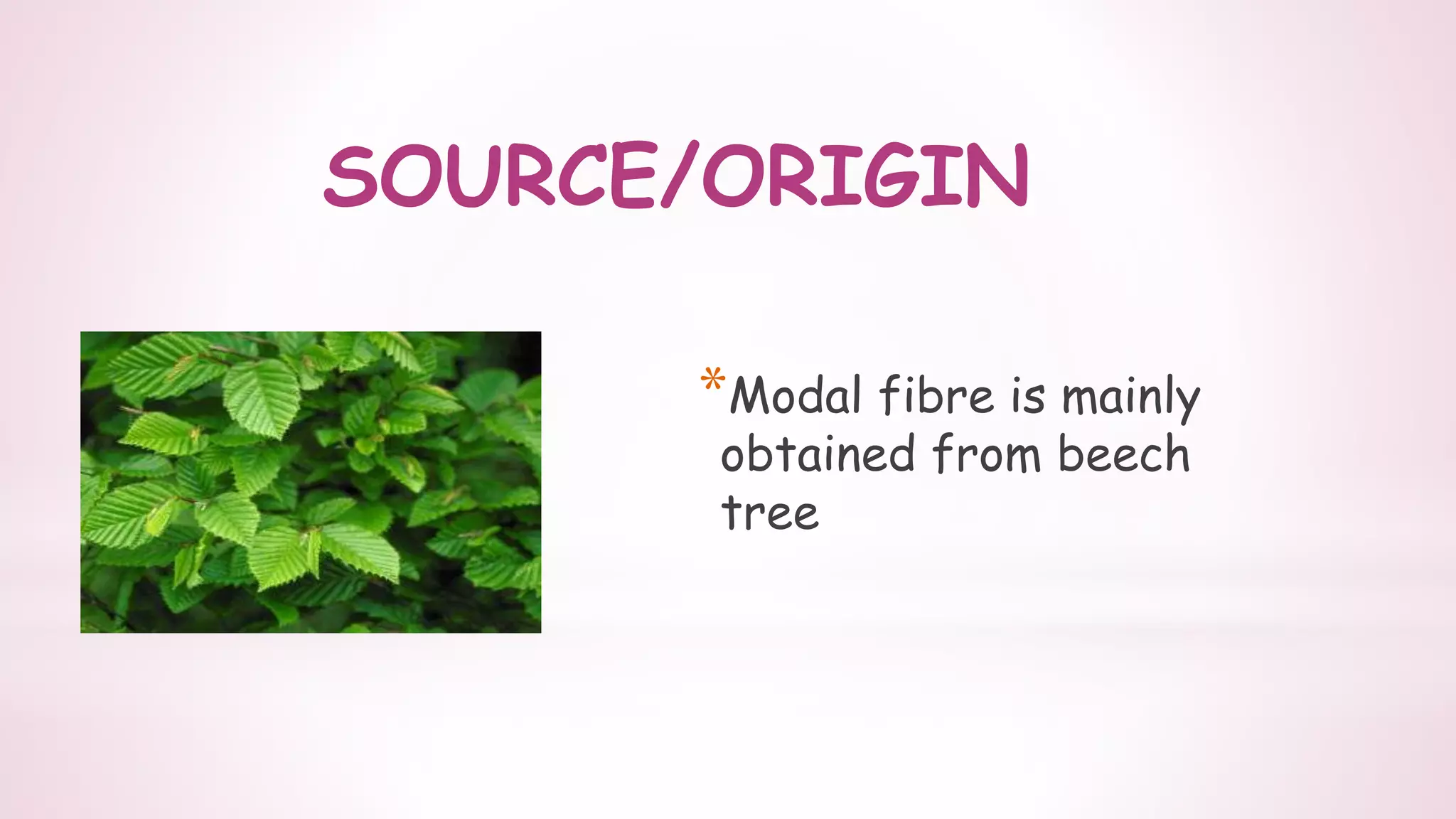
*Modal fibre is mainly
obtained from beech
tree
PHYSICAL PROPERTIES
*High breaking strength
*Modal fibre may be fading at one stage but flat to
stretching and pilling.
*Fabric made from modal fibres are shrinkage
resistance .
*Modal are very soft ,shiny ,natural and silky feel
than mercerized cotton.
*Stone deposits from firm water never set down on
the fabric structure.
*Modal fabrics should be washed at slighter
temperature only.
*Modal fabrics can be often ironed after washing
like cotton.
*Modal fibre are dimensionally constant and do
not reduce in their size , or get away from their
shape.
*The aging is eliminated and the molecular chains
are not shortened as much .
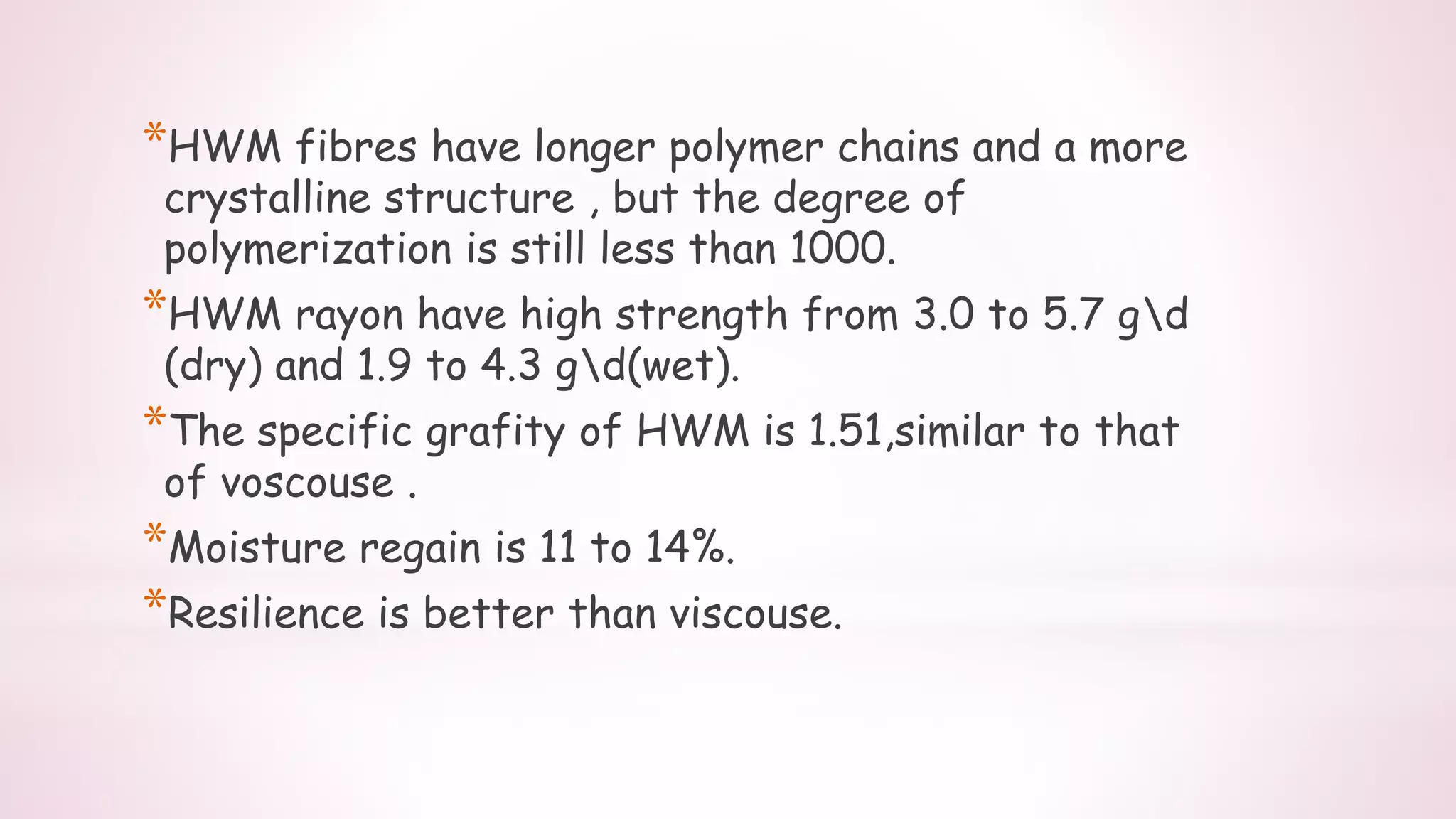
*HWM fibres have longer polymer chains and a more
crystalline structure , but the degree of
polymerization is still less than 1000.
*HWM rayon have high strength from 3.0 to 5.7 gd
(dry) and 1.9 to 4.3 gd(wet).
*The specific grafity of HWM is 1.51,similar to that
of voscouse .
*Moisture regain is 11 to 14%.
*Resilience is better than viscouse.
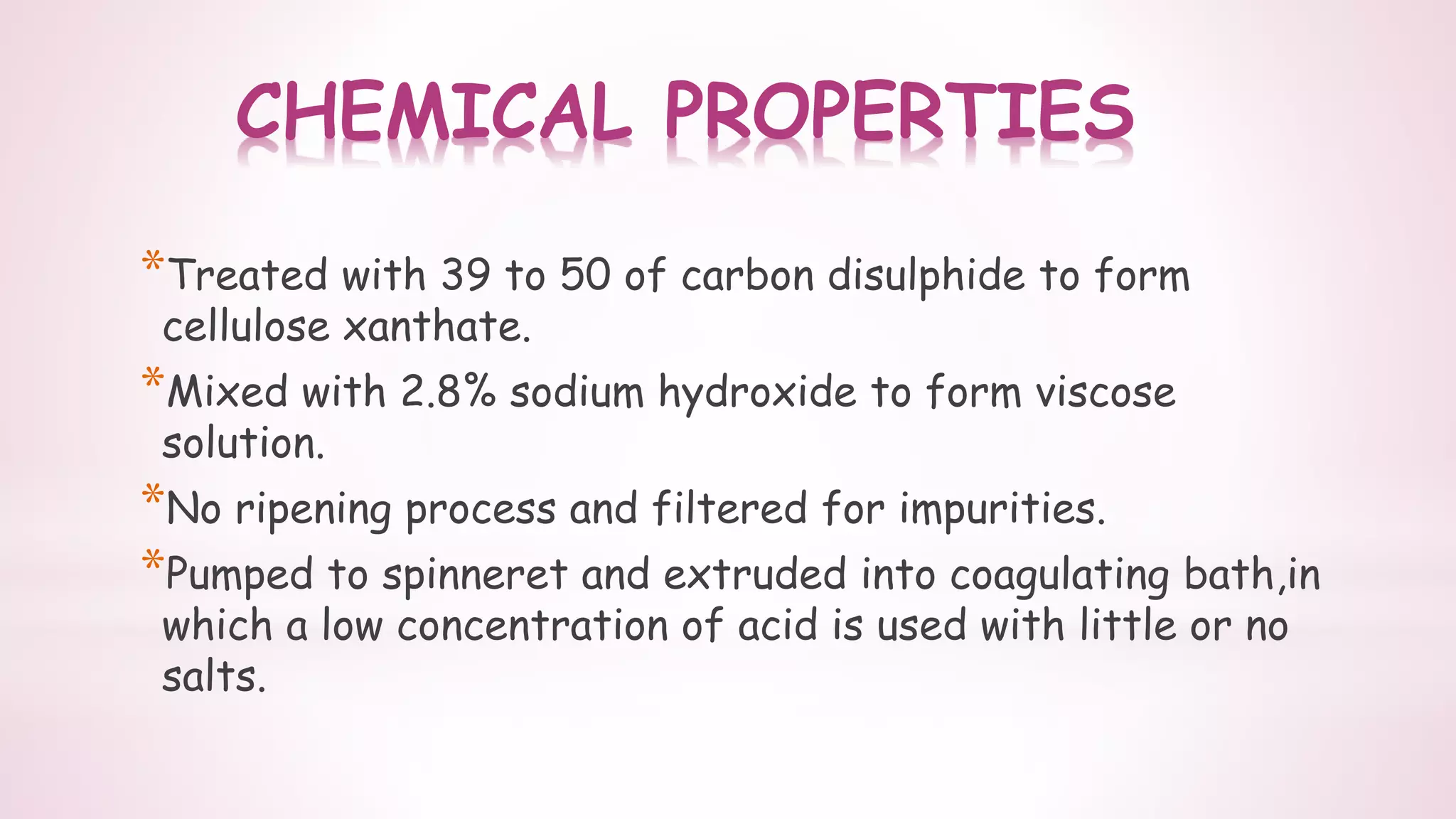
CHEMICAL PROPERTIES
*Treated with 39 to 50 of carbon disulphide to form
cellulose xanthate.
*Mixed with 2.8% sodium hydroxide to form viscose
solution.
*No ripening process and filtered for impurities.
*Pumped to spinneret and extruded into coagulating bath,in
which a low concentration of acid is used with little or no
salts.
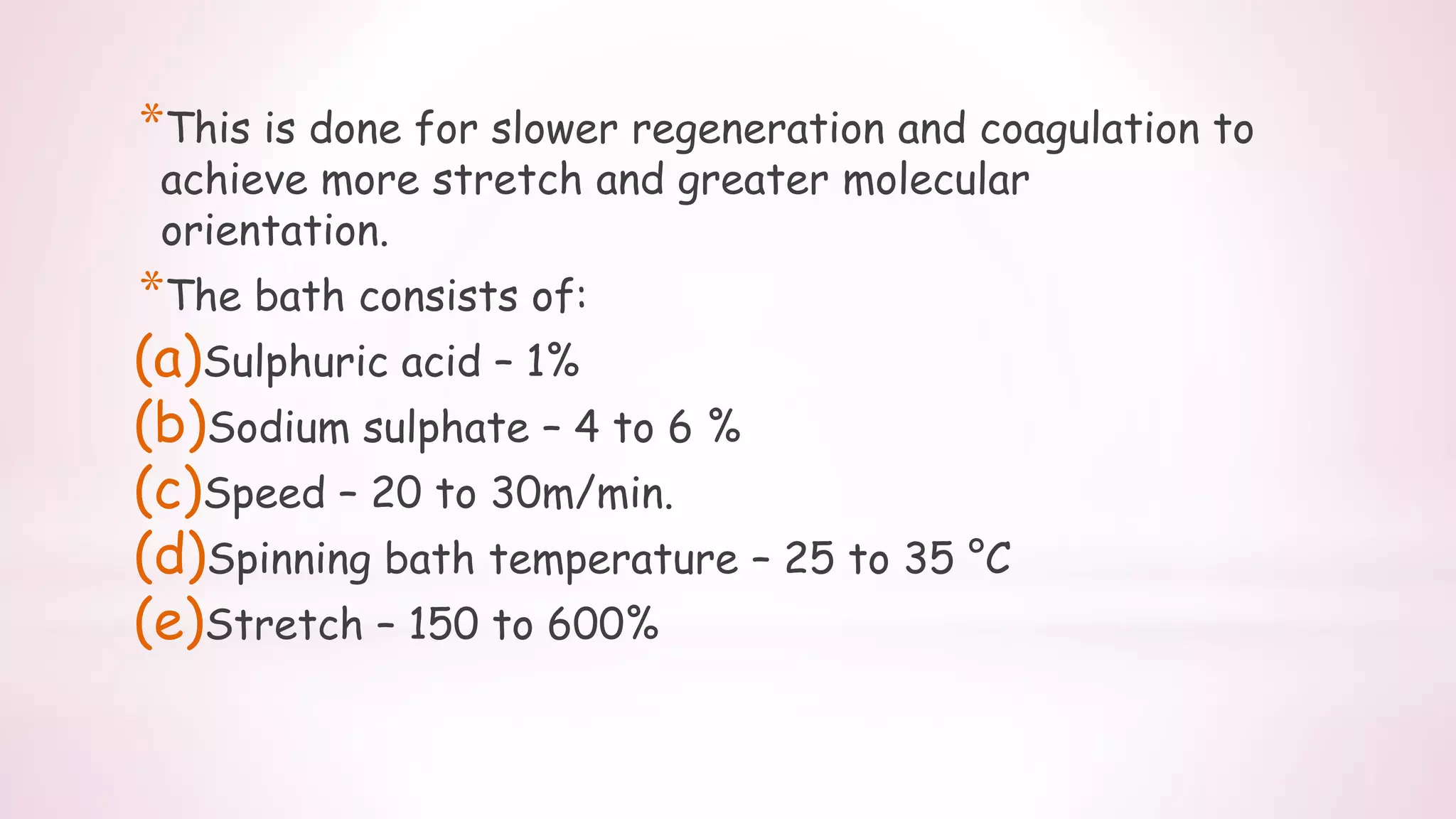
*This is done for slower regeneration and coagulation to
achieve more stretch and greater molecular
orientation.
*The bath consists of:
(a)Sulphuric acid – 1%
(b)Sodium sulphate – 4 to 6 %
(c)Speed – 20 to 30m/min.
(d)Spinning bath temperature – 25 to 35 °C
(e)Stretch – 150 to 600%
*Conductivity to heat and electricity is good.
*Damaged by silverfish.
*Long exposure to sun light causes some loss
of strength.
*Resistance to strong acids is poor.
*Resistance to strong base is excellent.
*Resistance against oxidising agents and
solvents is good.
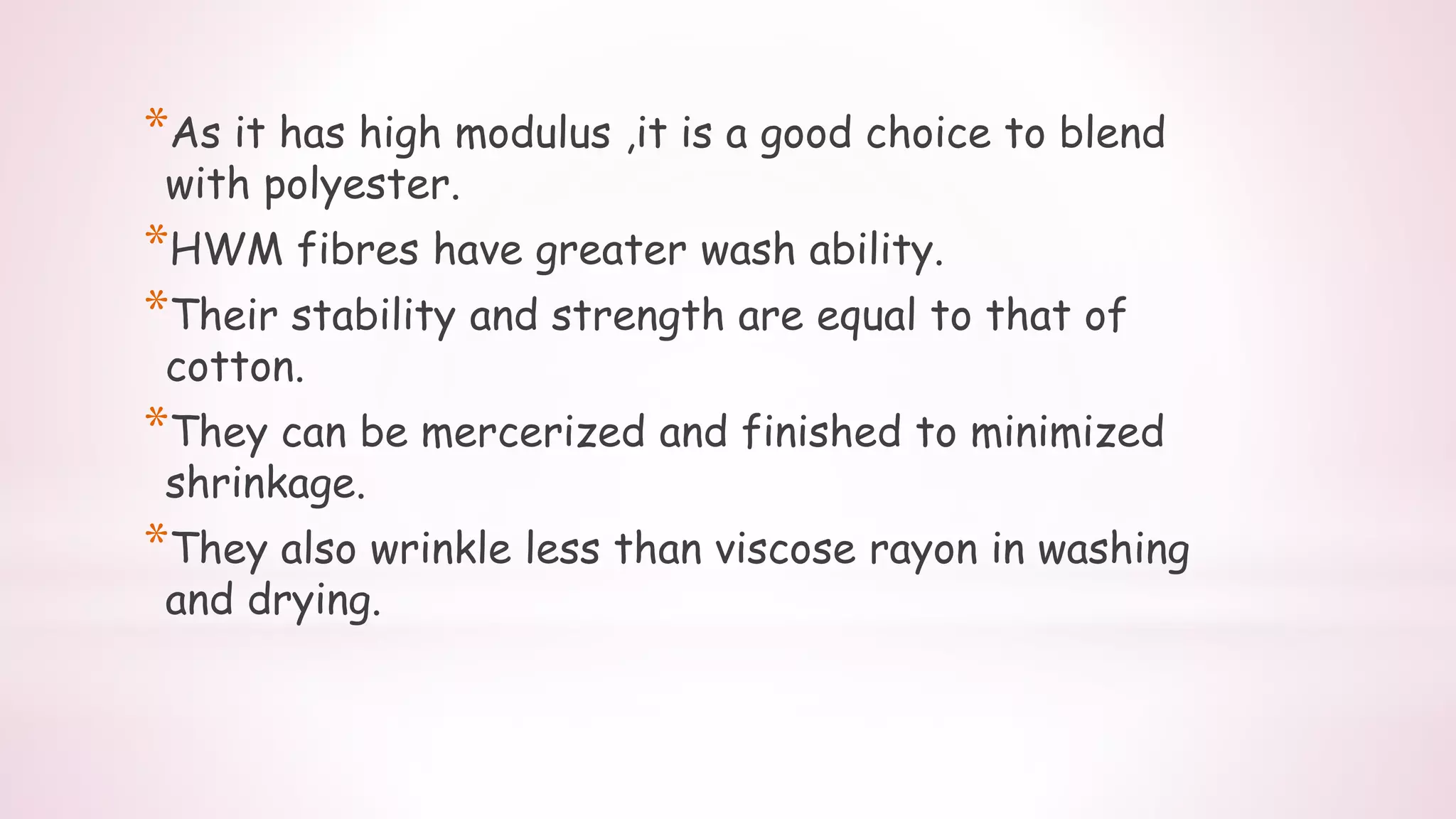
*As it has high modulus ,it is a good choice to blend
with polyester.
*HWM fibres have greater wash ability.
*Their stability and strength are equal to that of
cotton.
*They can be mercerized and finished to minimized
shrinkage.
*They also wrinkle less than viscose rayon in washing
and drying.
*The cross-section of HWM rayon is
round.
*Modal fibres are blended with cotton for
knits and towels.
*It is exclusively produced as staple fibre
in order to primarily blended with cotton
or polyester .
USES
*Modal is used single or blend with other fibres
like cotton or elasthan in domestic items such as
towels , bed sheets etc.
*Modal fibres were at first produced in the
1930’s for industrial purposes such as exhausters
,conveyor belts and washing pipes.
*Modal fibres are used in wide range of textile
industries like clothing , outwear , changing the
spinning conditions ,chemical solutions and
stretching series of rayon fibre.
*Modal can be produced with greater
strength and crystallinity than rayon
fibres.
*Modal fibres are very suitable comfort for
body aware clothing like cherished apparel.
*Modal fibres are extremely absorbent and
rapidly immerse up in water so that it
mostly feels waterless even when holding a
substantial quantity of water.

MODAL FIBER

  • 1.
  • 2.
    INTRODUCTION *Viscose rayon hasa disadvantage that its wet strength is less than dry strength. *A Japanese researcher, S.Tachikawa, modified the viscose process to develop a fibre with a physical structure more like that of cotton. *These rayons are known as high-wet-modulus(HWM) rayons. *It is stronger, more dimensionally stable than viscose rayon, but it is less absorbent.
  • 3.
    *The term modulusrefers to resistance to stress and strain. *HWM means that it resists deformation when wet. *HWM rayon, which is sometimes referred to as high-performance(HP) or Polynosic rayon, resembles cotton more than it does viscose. *Modal is an European generic name for HWM rayon.
  • 4.
    *The manufacturing processof HWM rayon is a modified process of viscose rayon. * The purification process of raw material is similar to that of viscose rayon. * The blotter like sheets of purified cellulose is steeped in weaker caustic soda and squeezed. * Then the shredder crumbles the sheets.
  • 5.
    CLASSIFICATION *Modal comes underthe category of man-made fibre . *Under man-made fibre it comes in the category of regenerated or semi-synthetic fibre. *Semi-synthetic fibres are made from raw materials with naturally long - chain polymer structure and are only modified and partially degraded by chemical process in contrast to completely synthetic fibres such as nylon.
  • 6.
    SOURCE/ORIGIN *Modal fibre ismainly obtained from beech tree
  • 7.
    PHYSICAL PROPERTIES *High breakingstrength *Modal fibre may be fading at one stage but flat to stretching and pilling. *Fabric made from modal fibres are shrinkage resistance . *Modal are very soft ,shiny ,natural and silky feel than mercerized cotton. *Stone deposits from firm water never set down on the fabric structure.
  • 8.
    *Modal fabrics shouldbe washed at slighter temperature only. *Modal fabrics can be often ironed after washing like cotton. *Modal fibre are dimensionally constant and do not reduce in their size , or get away from their shape. *The aging is eliminated and the molecular chains are not shortened as much .
  • 9.
    *HWM fibres havelonger polymer chains and a more crystalline structure , but the degree of polymerization is still less than 1000. *HWM rayon have high strength from 3.0 to 5.7 gd (dry) and 1.9 to 4.3 gd(wet). *The specific grafity of HWM is 1.51,similar to that of voscouse . *Moisture regain is 11 to 14%. *Resilience is better than viscouse.
  • 10.
    CHEMICAL PROPERTIES *Treated with39 to 50 of carbon disulphide to form cellulose xanthate. *Mixed with 2.8% sodium hydroxide to form viscose solution. *No ripening process and filtered for impurities. *Pumped to spinneret and extruded into coagulating bath,in which a low concentration of acid is used with little or no salts.
  • 11.
    *This is donefor slower regeneration and coagulation to achieve more stretch and greater molecular orientation. *The bath consists of: (a)Sulphuric acid – 1% (b)Sodium sulphate – 4 to 6 % (c)Speed – 20 to 30m/min. (d)Spinning bath temperature – 25 to 35 °C (e)Stretch – 150 to 600%
  • 12.
    *Conductivity to heatand electricity is good. *Damaged by silverfish. *Long exposure to sun light causes some loss of strength. *Resistance to strong acids is poor. *Resistance to strong base is excellent. *Resistance against oxidising agents and solvents is good.
  • 13.
    *As it hashigh modulus ,it is a good choice to blend with polyester. *HWM fibres have greater wash ability. *Their stability and strength are equal to that of cotton. *They can be mercerized and finished to minimized shrinkage. *They also wrinkle less than viscose rayon in washing and drying.
  • 14.
    *The cross-section ofHWM rayon is round. *Modal fibres are blended with cotton for knits and towels. *It is exclusively produced as staple fibre in order to primarily blended with cotton or polyester .
  • 15.
    USES *Modal is usedsingle or blend with other fibres like cotton or elasthan in domestic items such as towels , bed sheets etc. *Modal fibres were at first produced in the 1930’s for industrial purposes such as exhausters ,conveyor belts and washing pipes. *Modal fibres are used in wide range of textile industries like clothing , outwear , changing the spinning conditions ,chemical solutions and stretching series of rayon fibre.
  • 16.
    *Modal can beproduced with greater strength and crystallinity than rayon fibres. *Modal fibres are very suitable comfort for body aware clothing like cherished apparel. *Modal fibres are extremely absorbent and rapidly immerse up in water so that it mostly feels waterless even when holding a substantial quantity of water.