Fabric defects
Contents
• Introduction
• Reasons of fabric defects
• Knitted fabric defects & remedies
• Woven fabric defects & remedies
• Dyeing defects & remedies
• Printing defects & remedies
What is a fabric defect?
A fabric defect is any abnormality in the fabric
that hinders its acceptability by the consumer.
REASONS OF FABRIC DEFECTS
 Yarn manufacturing defects
 Fabric manufacturing defects
 Fabric processing defects : dyeing
faults, printing and finishing faults.
Knitted fabric defects
DIFFERENT TYPES OF KNITTING DEFECTS
 BARRINESS
 IMPERFECTIONS
 CONTAMINATIONS
 OIL LINES
 SPIRALITY
 DROP STITCHES
 NEEDLE LINES
 HOLES
 SNAGGING
 TUCK LOOP
BARRINESS
horizontal stripes of uniform or variable width.
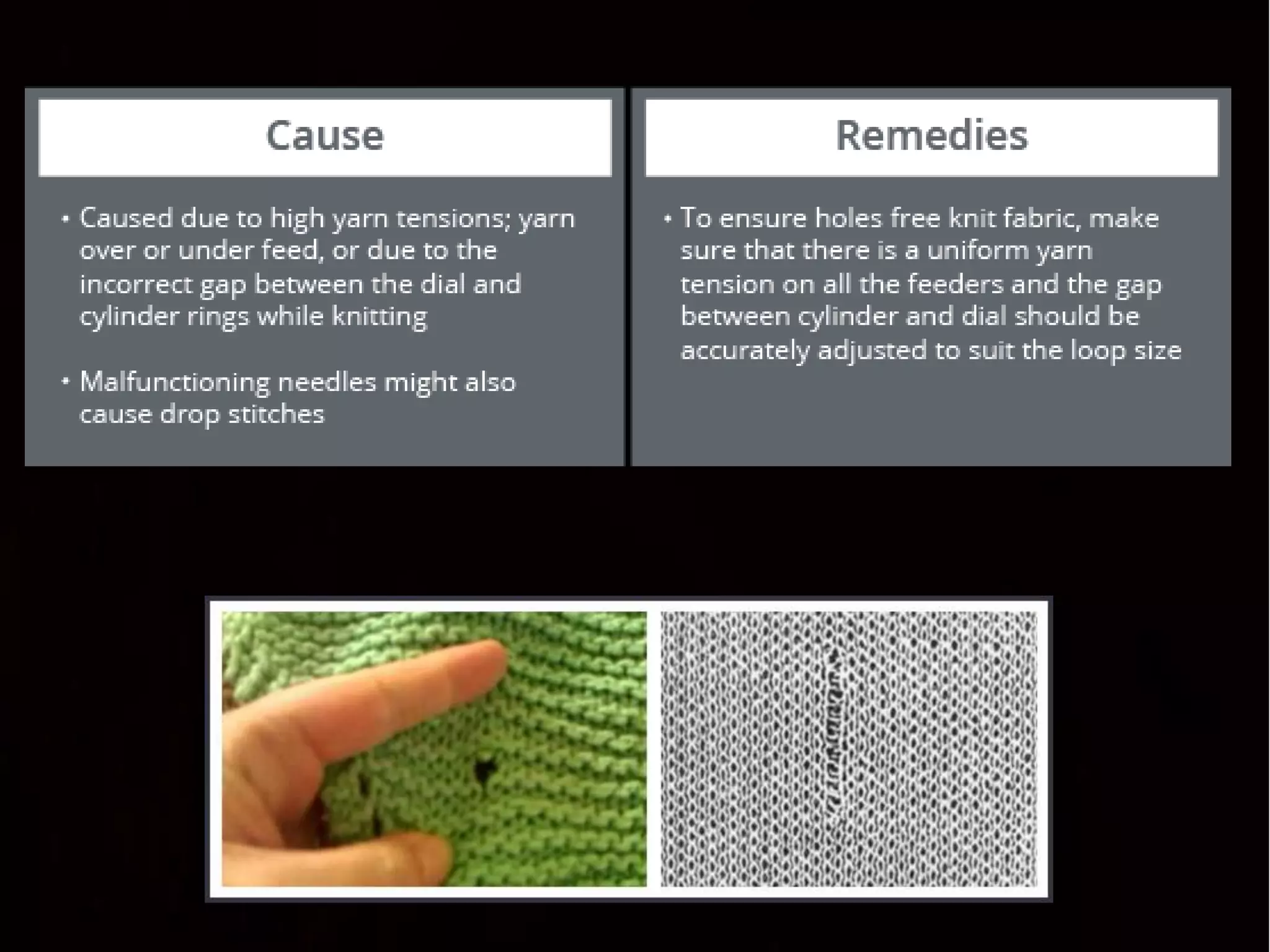
DROPSTITCHES
These are the unlinked knitted loops.
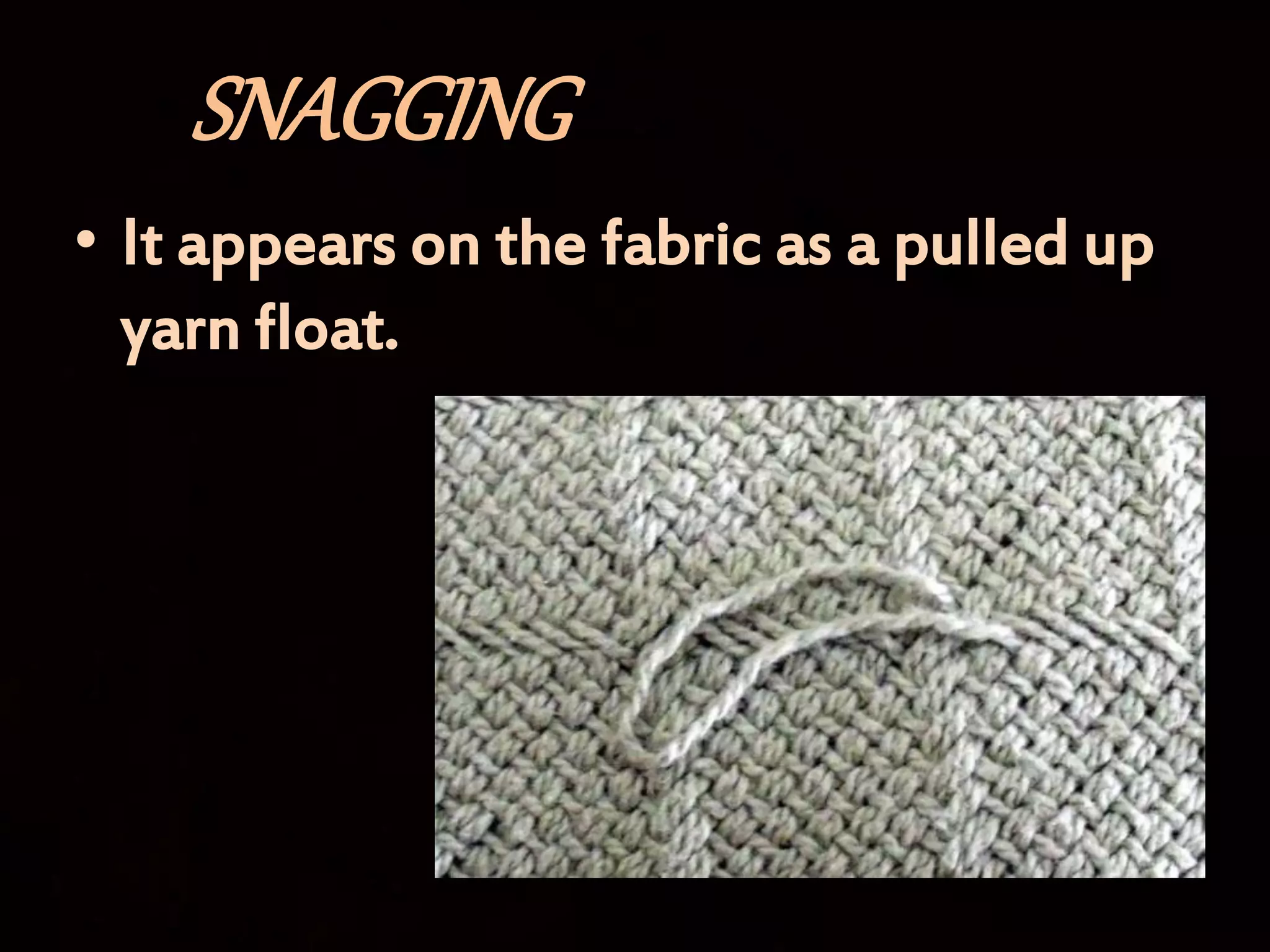
SNAGGING
• It appears on the fabric as a pulled up
yarn float.
Causes:
During knitting all mechanical influences, caused by rough
surfaces on yarn guide elements, yarn feeders, needles, fabric
take-up, etc. have to be avoided. Even after knitting some
snags can appear especially during fabric setting, if its storage
and further processing has not been undertaken carefully.
Causes
TUCKLOOP
A tuck stich is composed of a held loop, one or
more tuck loops and knitted loops. It is
produced when a needle holding its loop also
receives the new loop.
IMPERFeCTIONS
Imperfections are the occurrence of knots,
Slubs, neps, Thick & Thin places in the yarn.
CONTAMINATIONS
Contaminations appear in the form of foreign matter such
as; dyed fibers, husk, dead fibers etc. in the staple spun
yarn or embedded in the knitted fabric structure.
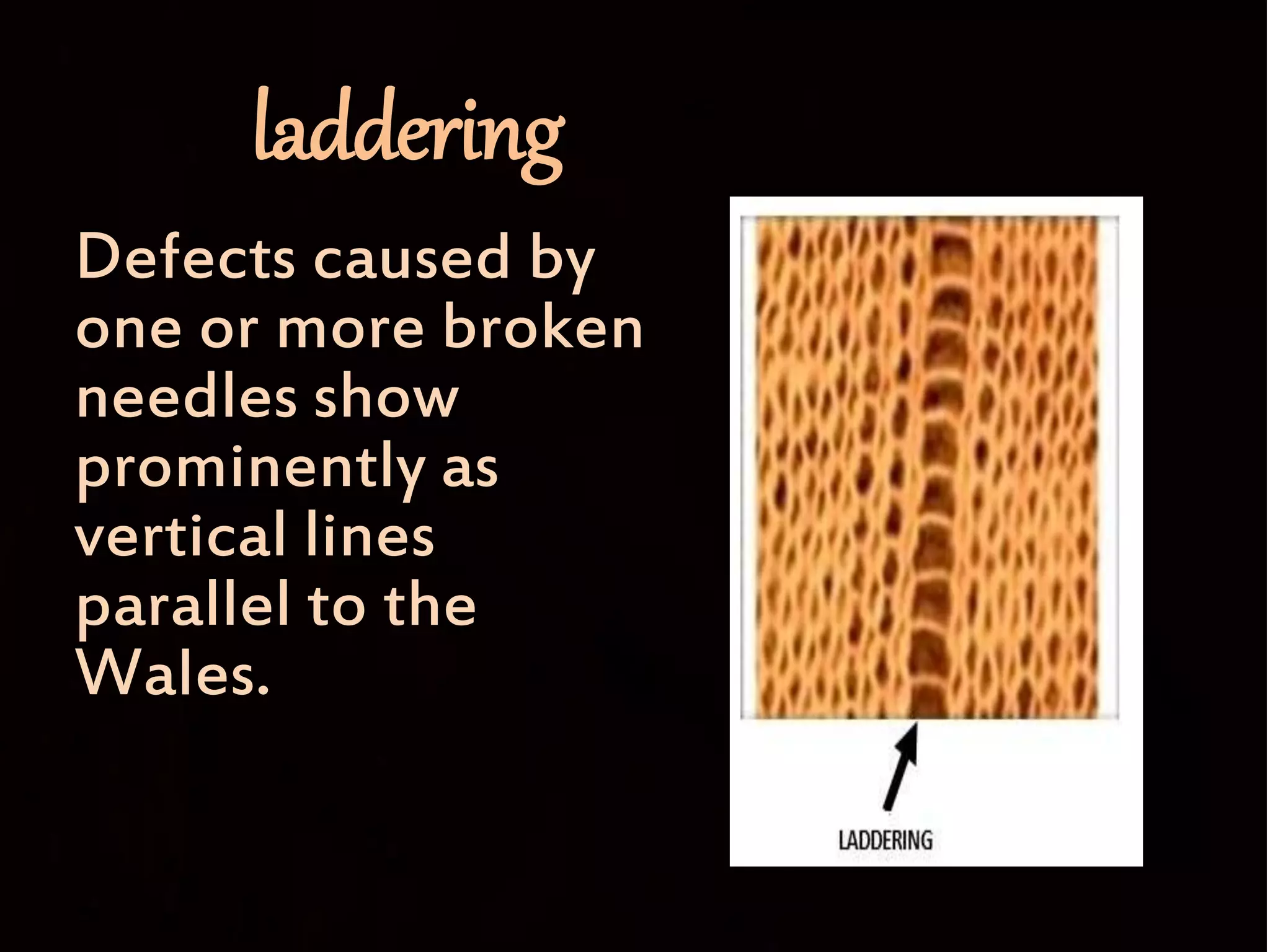
laddering
Defects caused by
one or more broken
needles show
prominently as
vertical lines
parallel to the
Wales.
OIL LINES
Oil lines are prominent vertical lines which
appear along the length of the knitted
fabric tube.
Woven Fabric defects
Woven Fabric defects can be categorized into 3:
1. YarnRelatedDefect
2.Warpdirectiondefect
3.Weftdirectiondefect
Yarn related defects
• Snarling
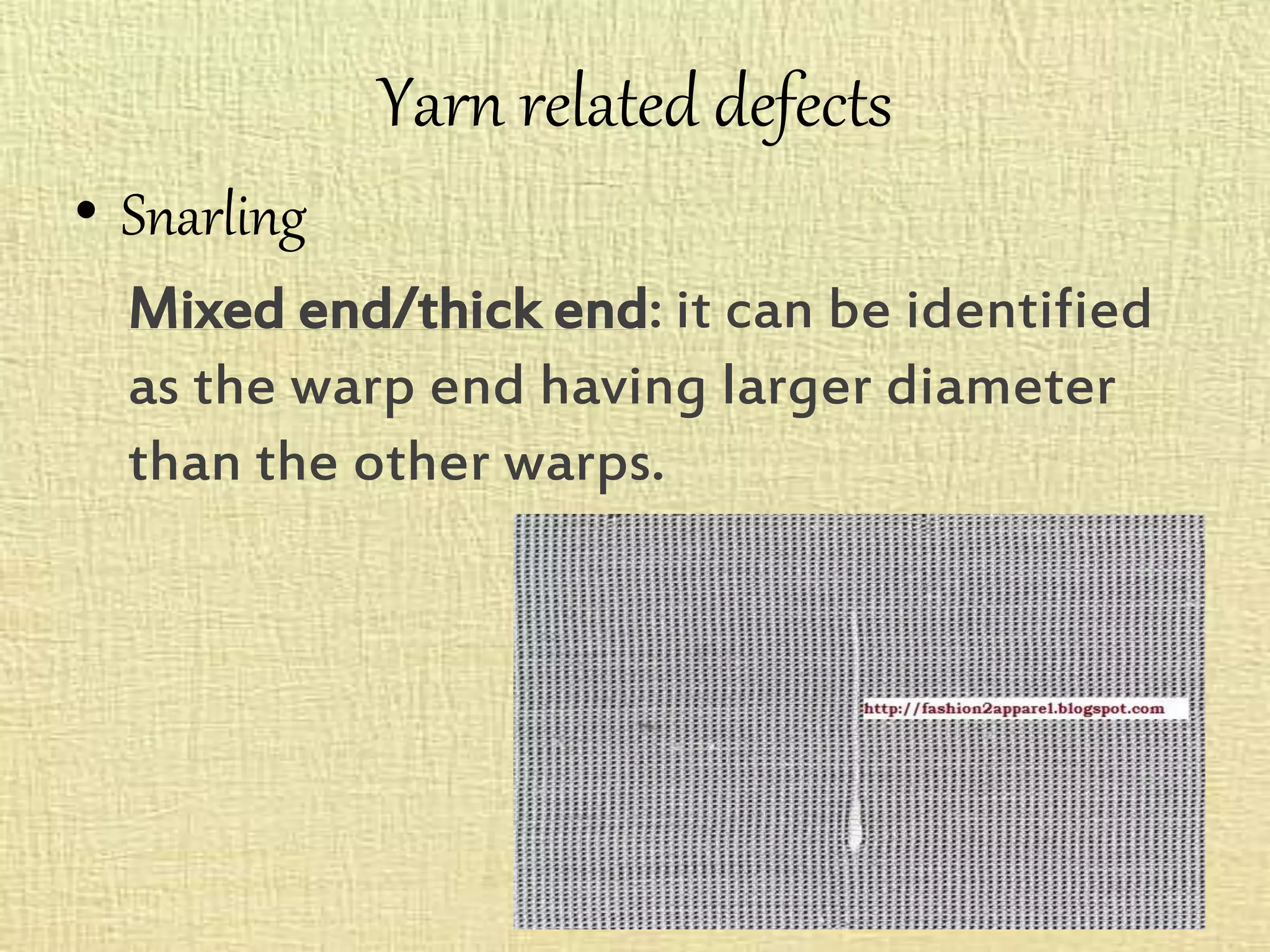
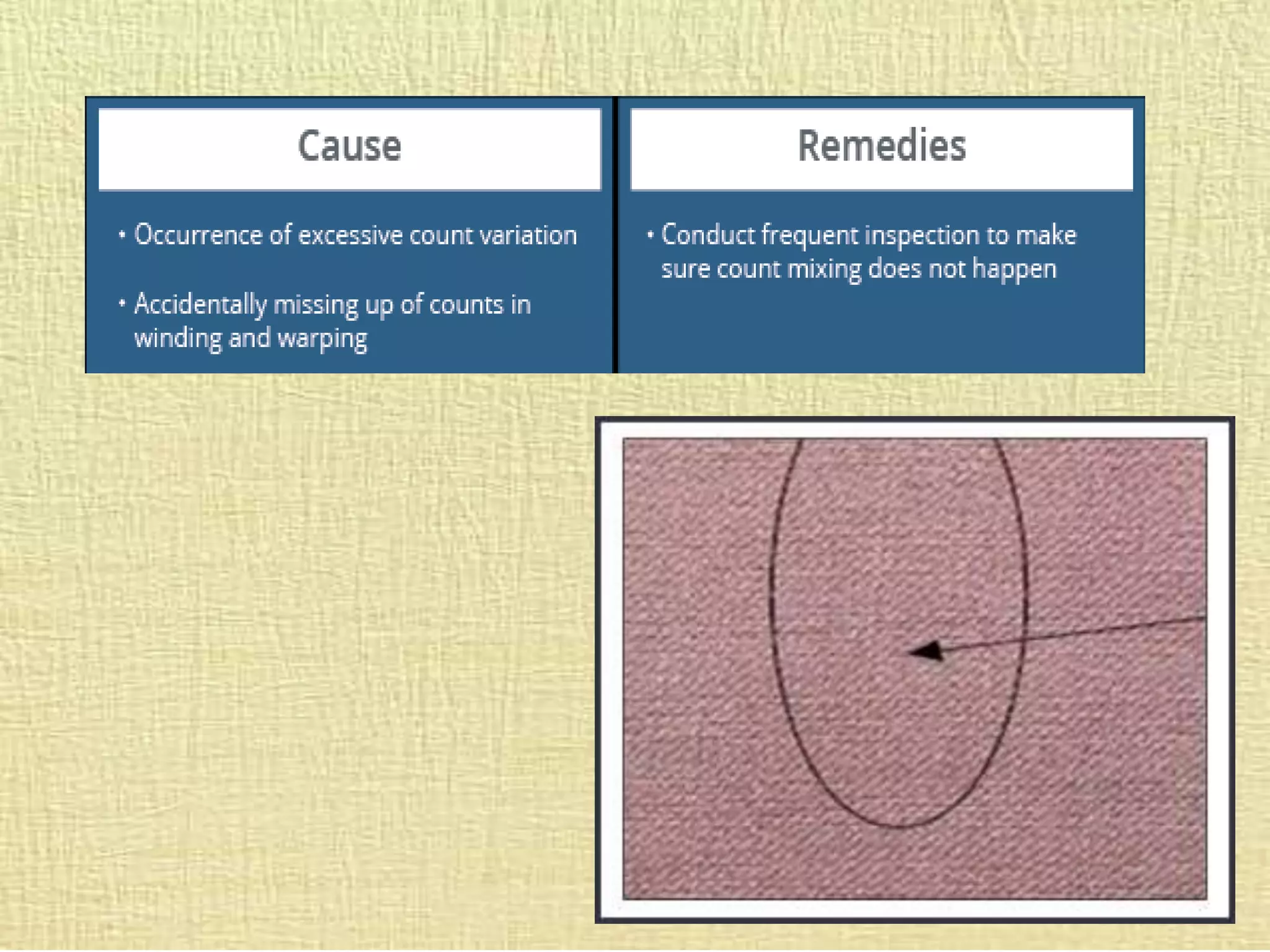
Mixed end/thick end: it can be identified
as the warp end having larger diameter
than the other warps.
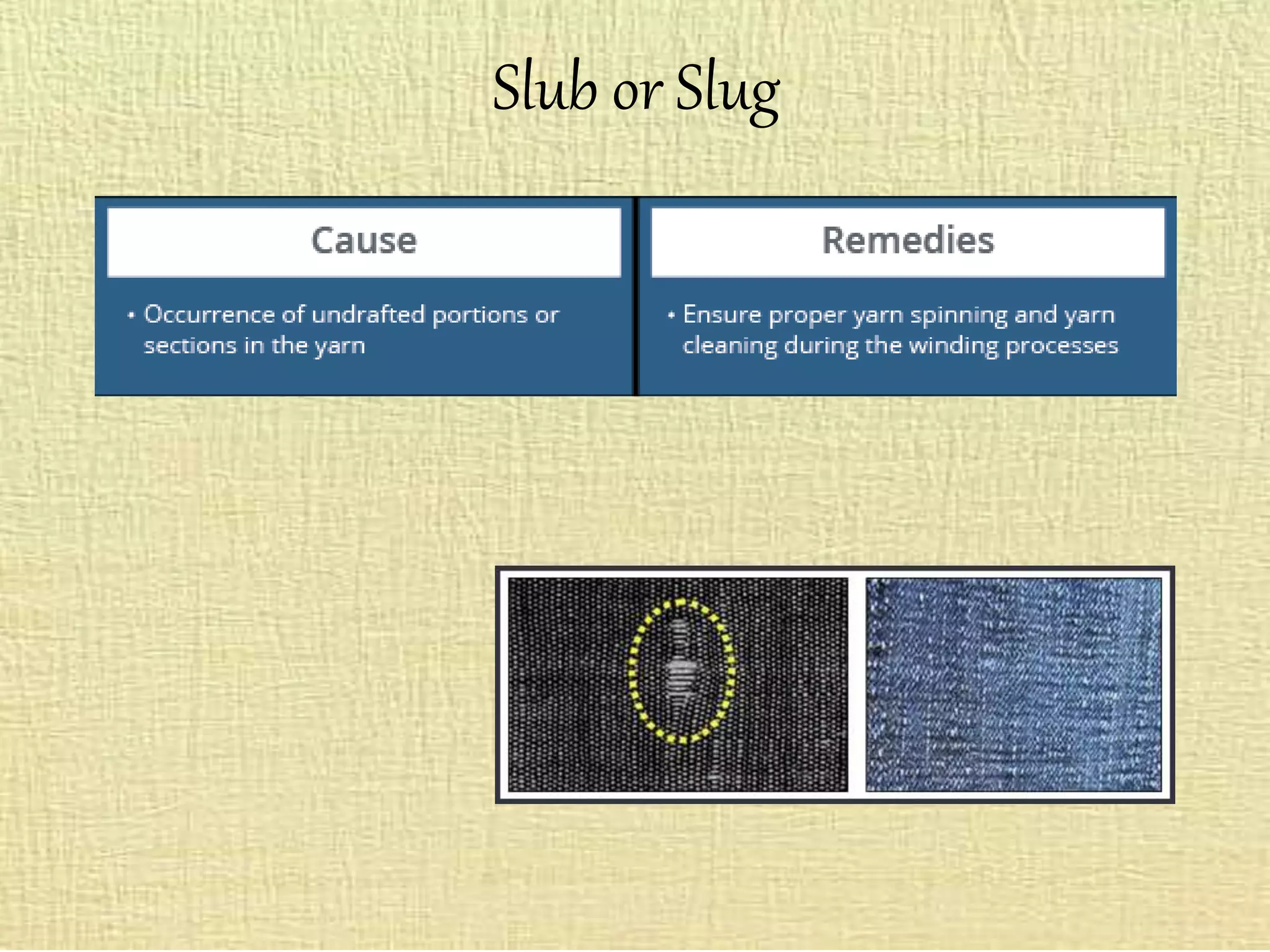
Abnormally thick
place occurring
in the yarn that
affects the
fabric's
appearance.
Slub or slug
Slub or Slug
Warp direction defects
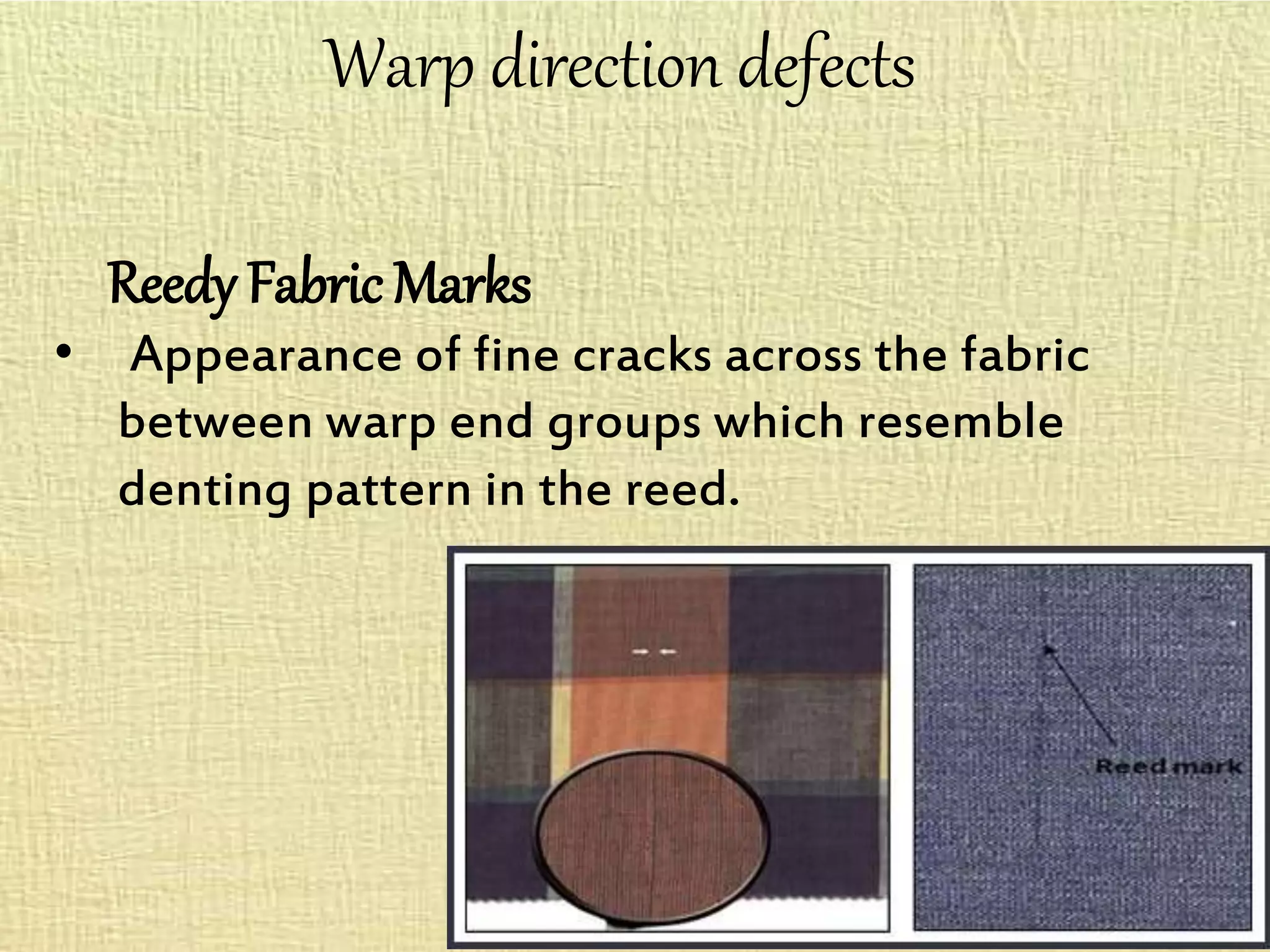
Reedy Fabric Marks
• Appearance of fine cracks across the fabric
between warp end groups which resemble
denting pattern in the reed.
• Broken/ missing end
• Broken/ missing end: it can be identified as the
space created in the fabric when a yarn partially
or completely is missing from the fabric.
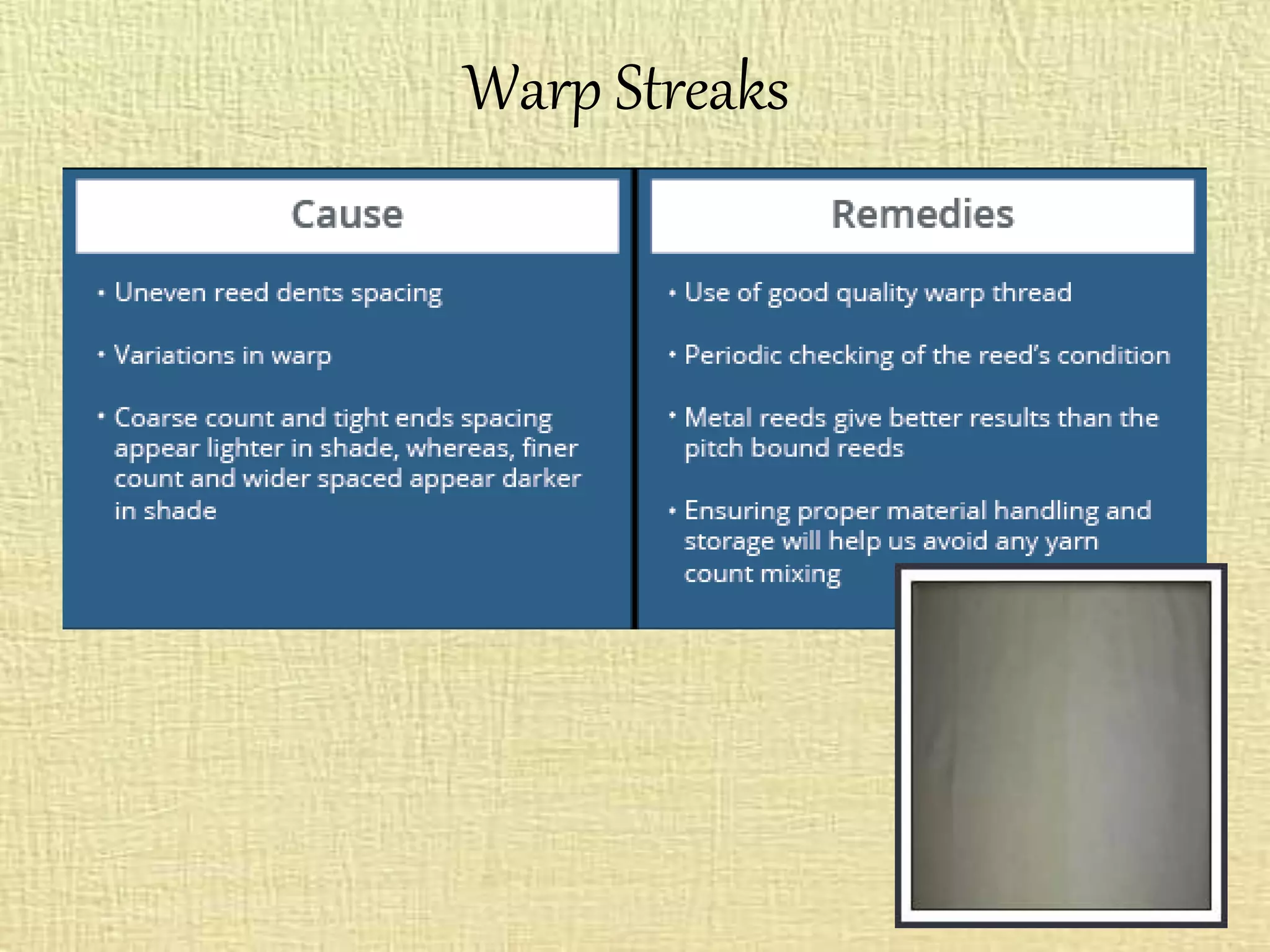
• Warp Streaks
• Warp streaks can
be identified as the
warp way stripes of
shade variations
occurring between
groups of threads.
Warp Streaks
A crack is seen along the length of the fabric
between the stripes woven with different
weaves.
•Warp way crack defect
Weft direction defects
• Gout
Appearance of foreign matter or
contamination like lint , waste , etc woven
into the fabric.
• Sloughing Off
• When a bunch of
or coil of yarn slips
from the pirn during
weaving then thick
yarn bunches or
coils appear on the
fabric.
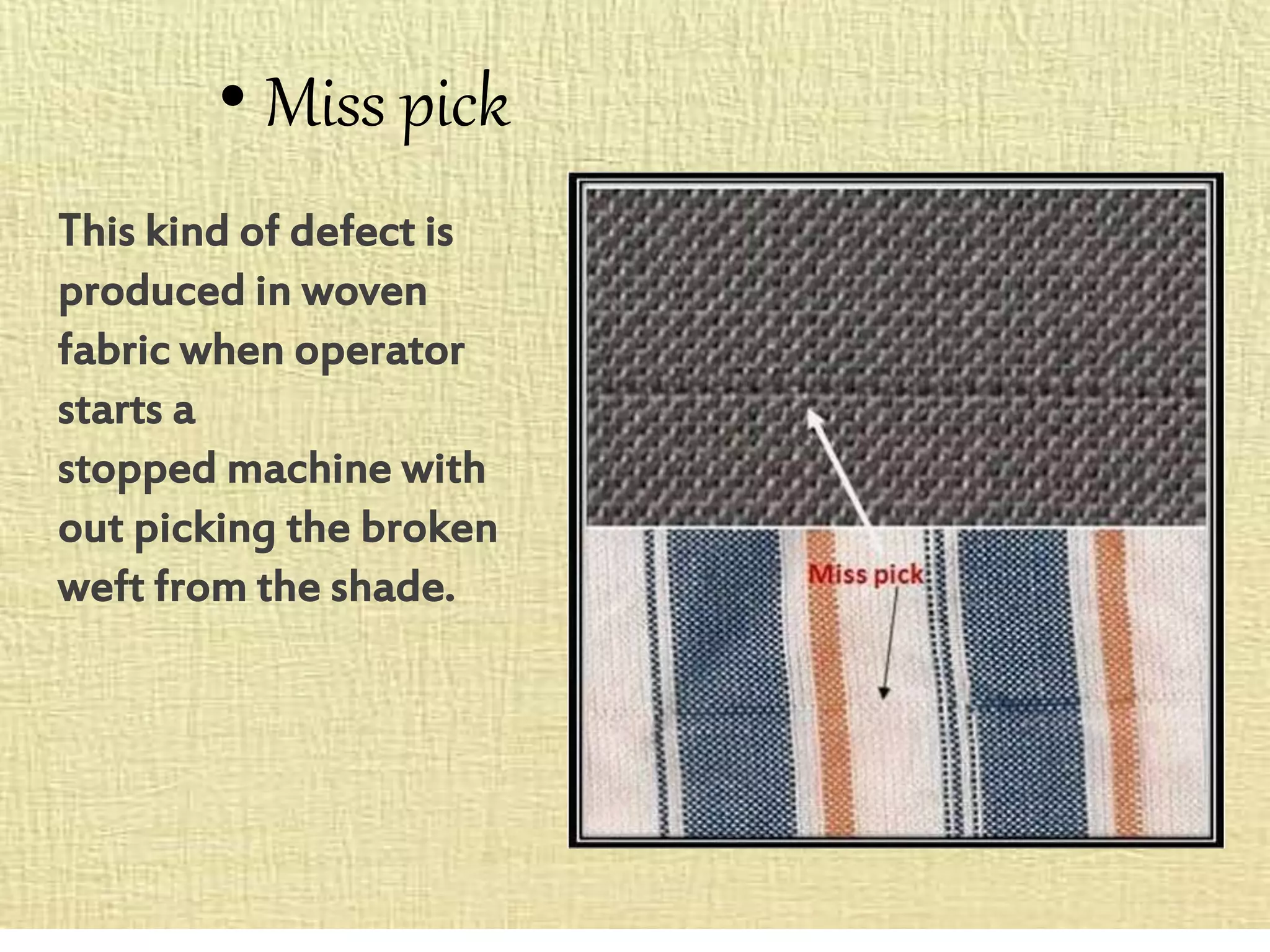
• Miss pick
This kind of defect is
produced in woven
fabric when operator
starts a
stopped machine with
out picking the broken
weft from the shade.
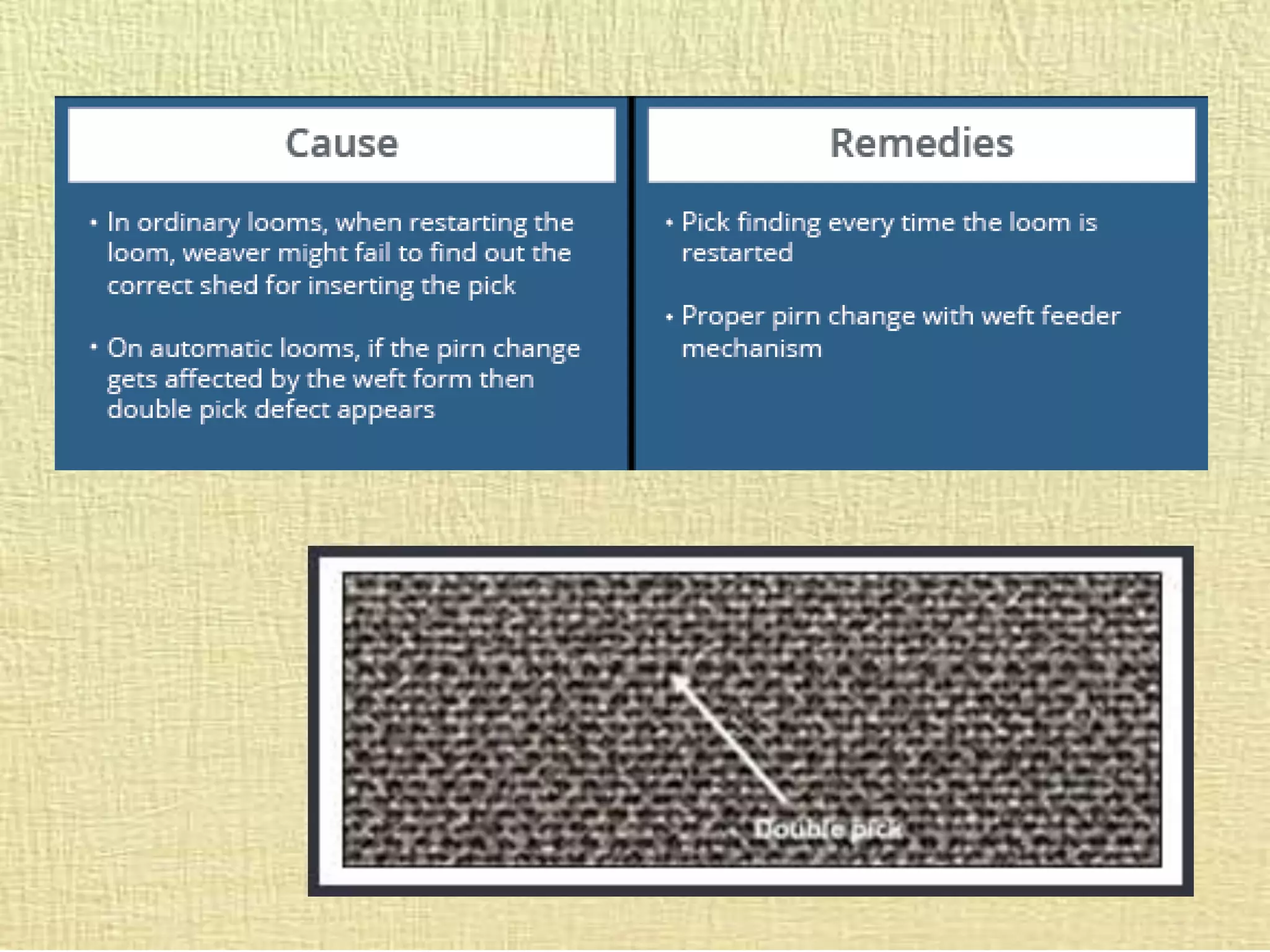
• Double Pick
• This defect happens when more than one pick
is inserted in the single shed.
• Starting marks and cracks
• A higher pick density than the normal is referred
to as starting mark while a lower pick density is
referred to as crack.
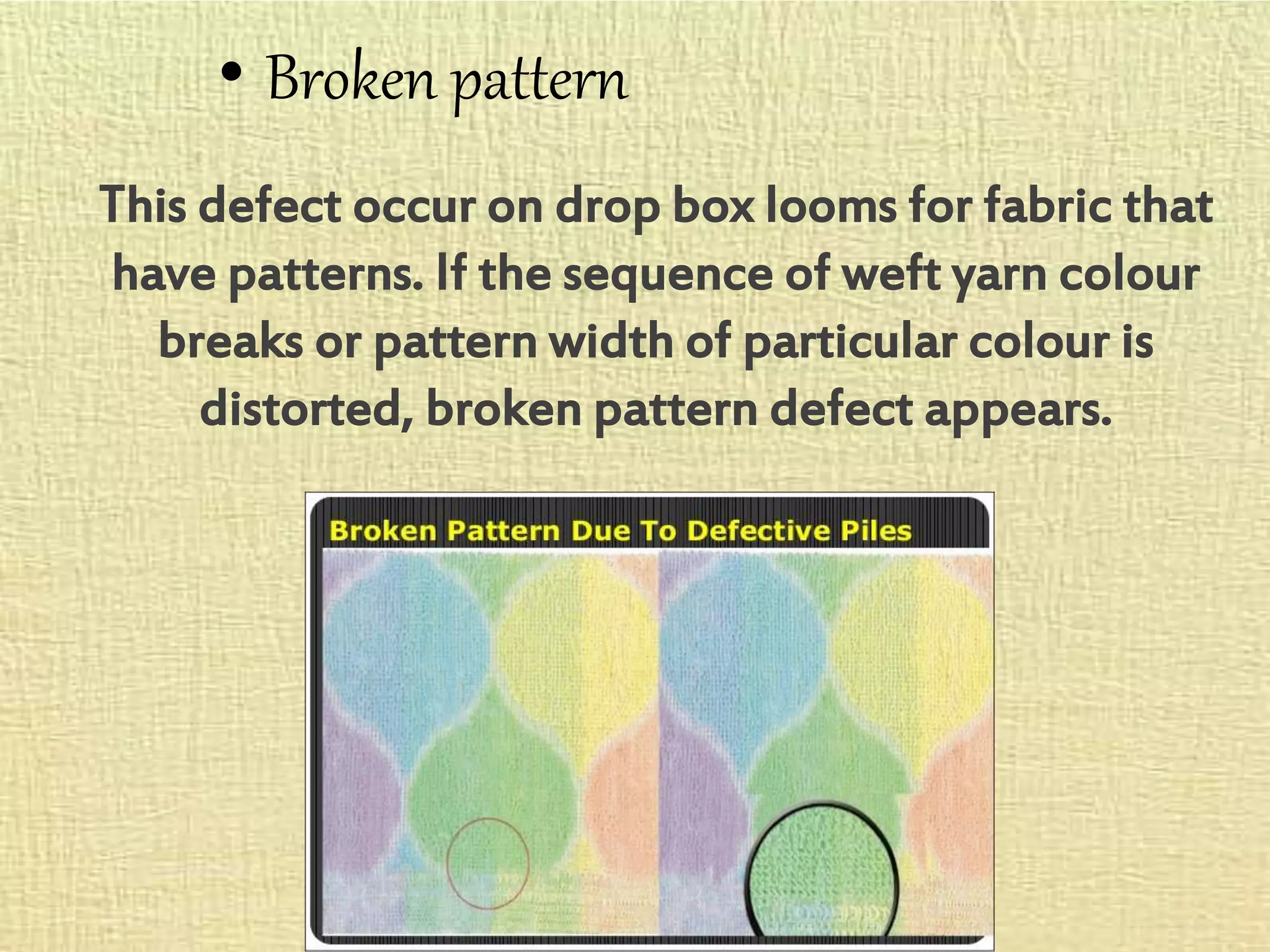
• Broken pattern
This defect occur on drop box looms for fabric that
have patterns. If the sequence of weft yarn colour
breaks or pattern width of particular colour is
distorted, broken pattern defect appears.
Broken Pattern
Dyeing defects
UNLEVELLED /CLOUDY DYEING
BARRINESS
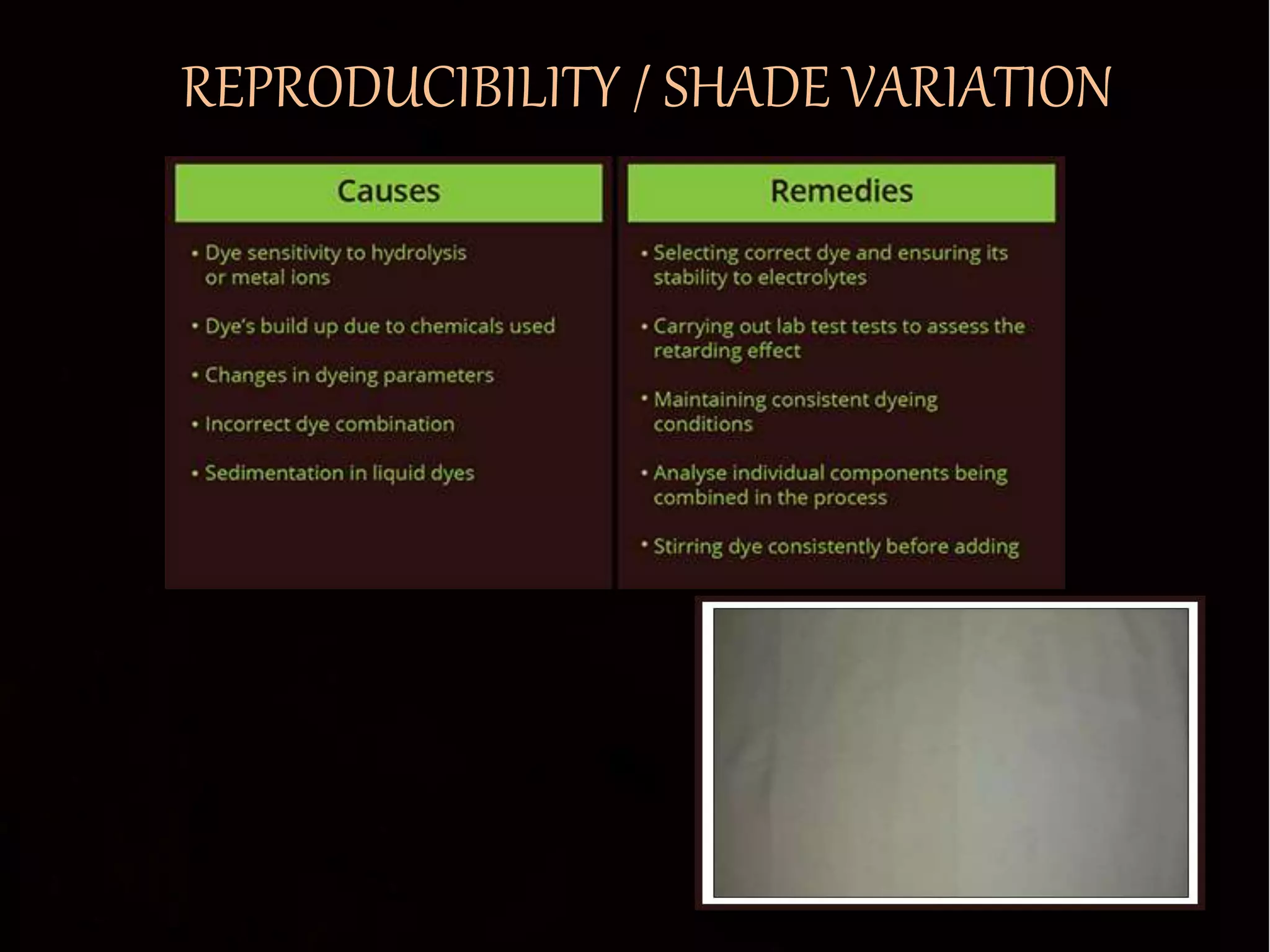
REPRODUCIBILITY / SHADE VARIATION
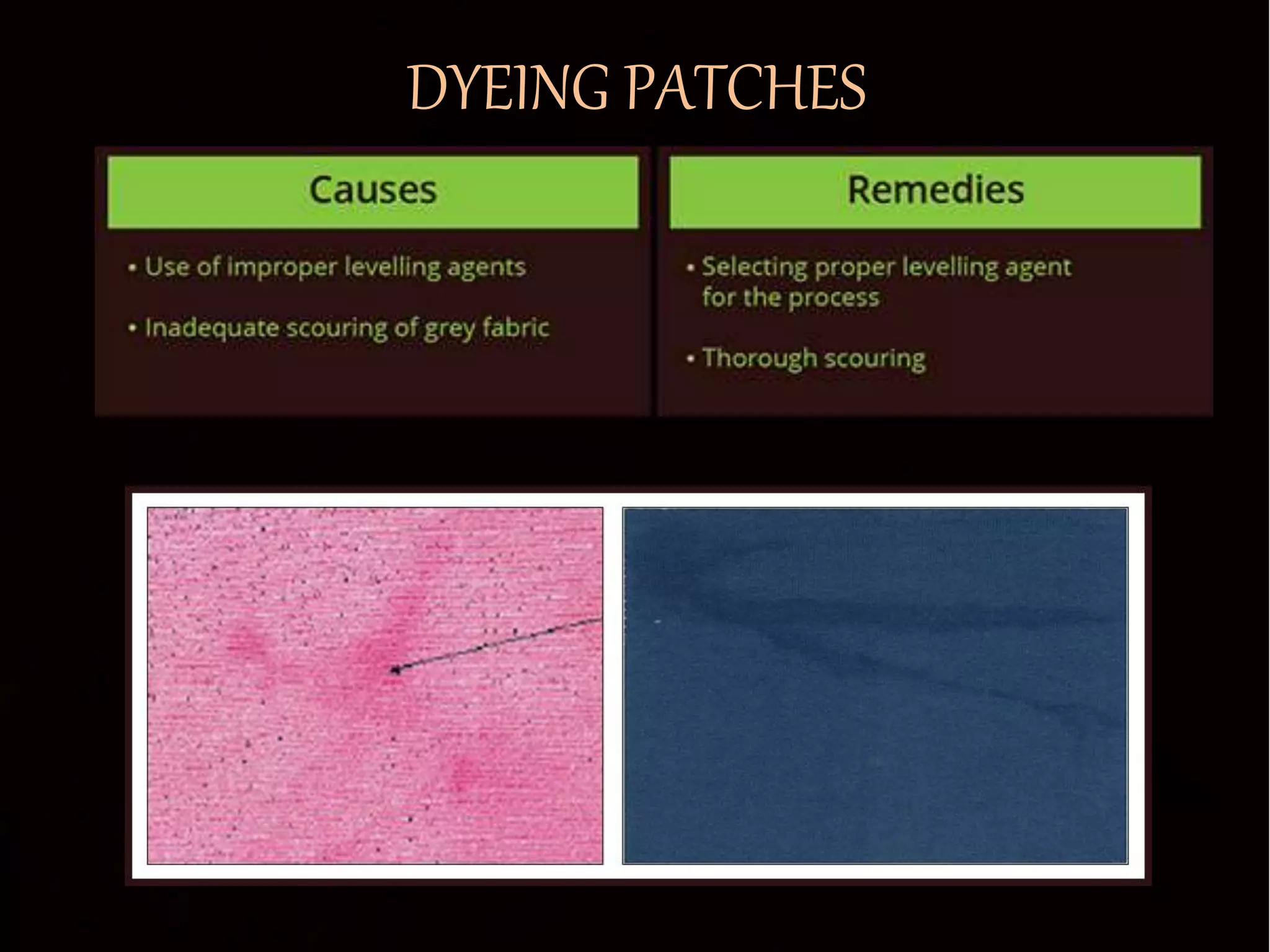
DYEING PATCHES
SOFTENER MARKS
TONAL VARIATION
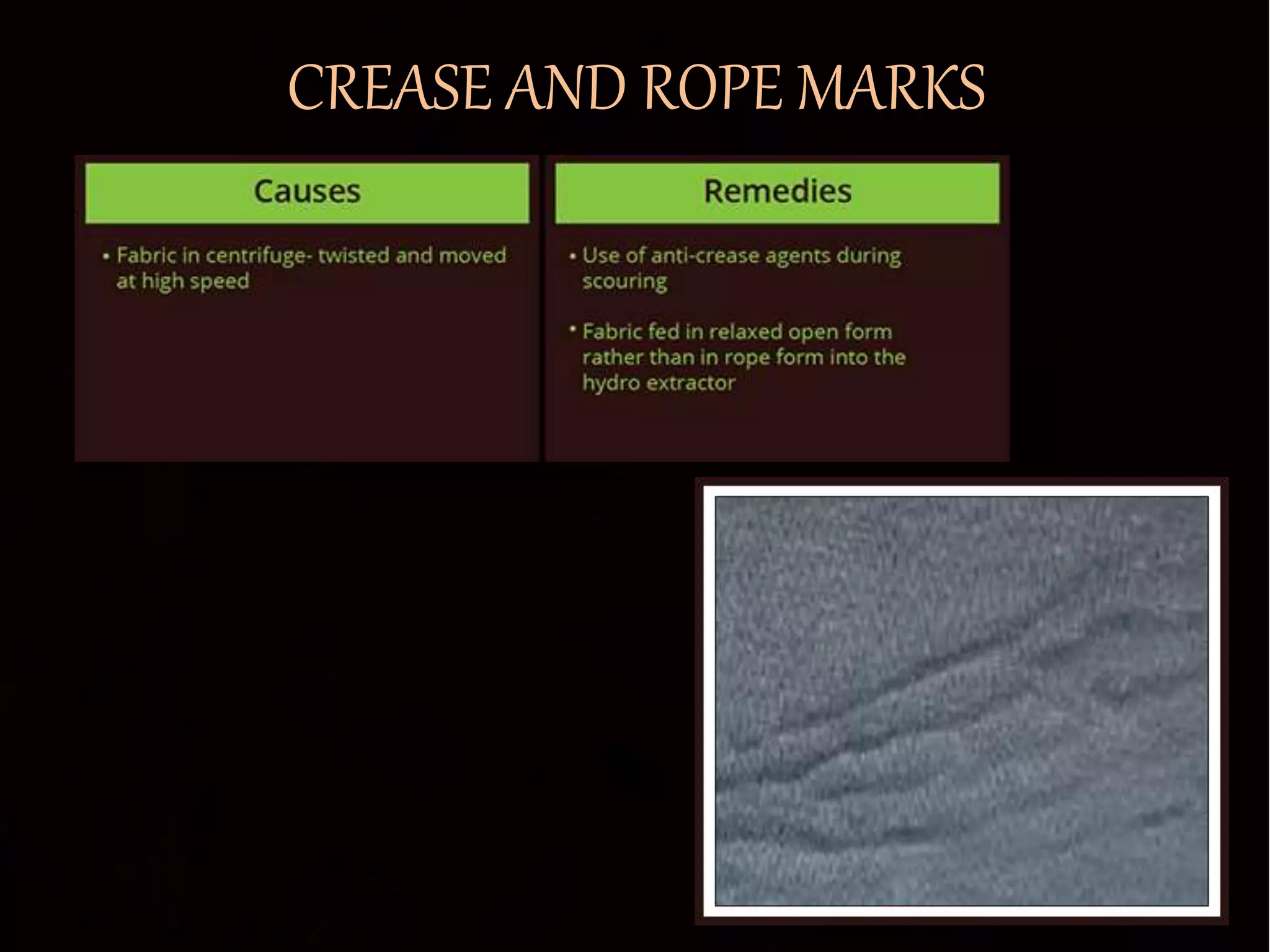
CREASE AND ROPE MARKS
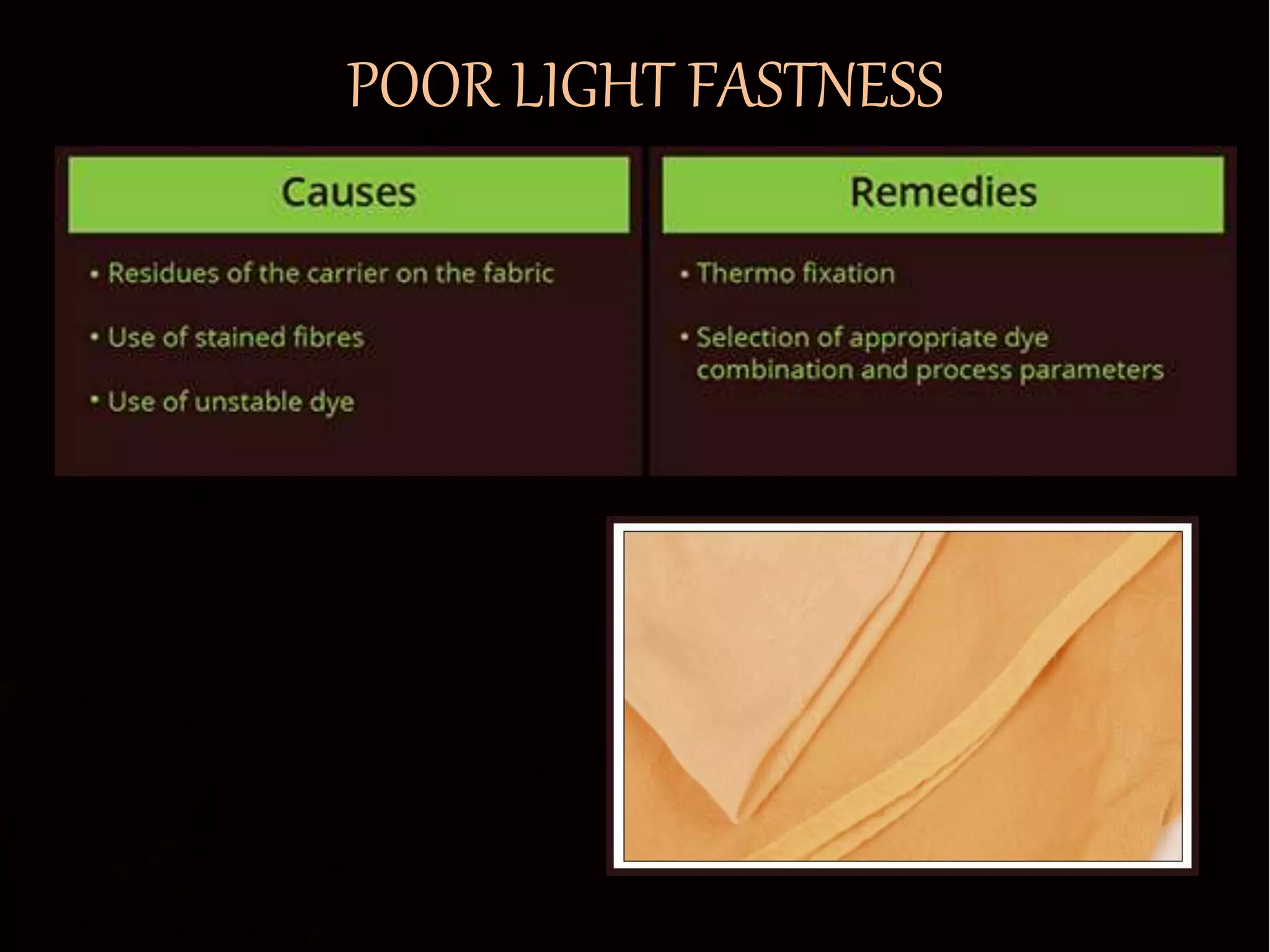
POOR LIGHT FASTNESS
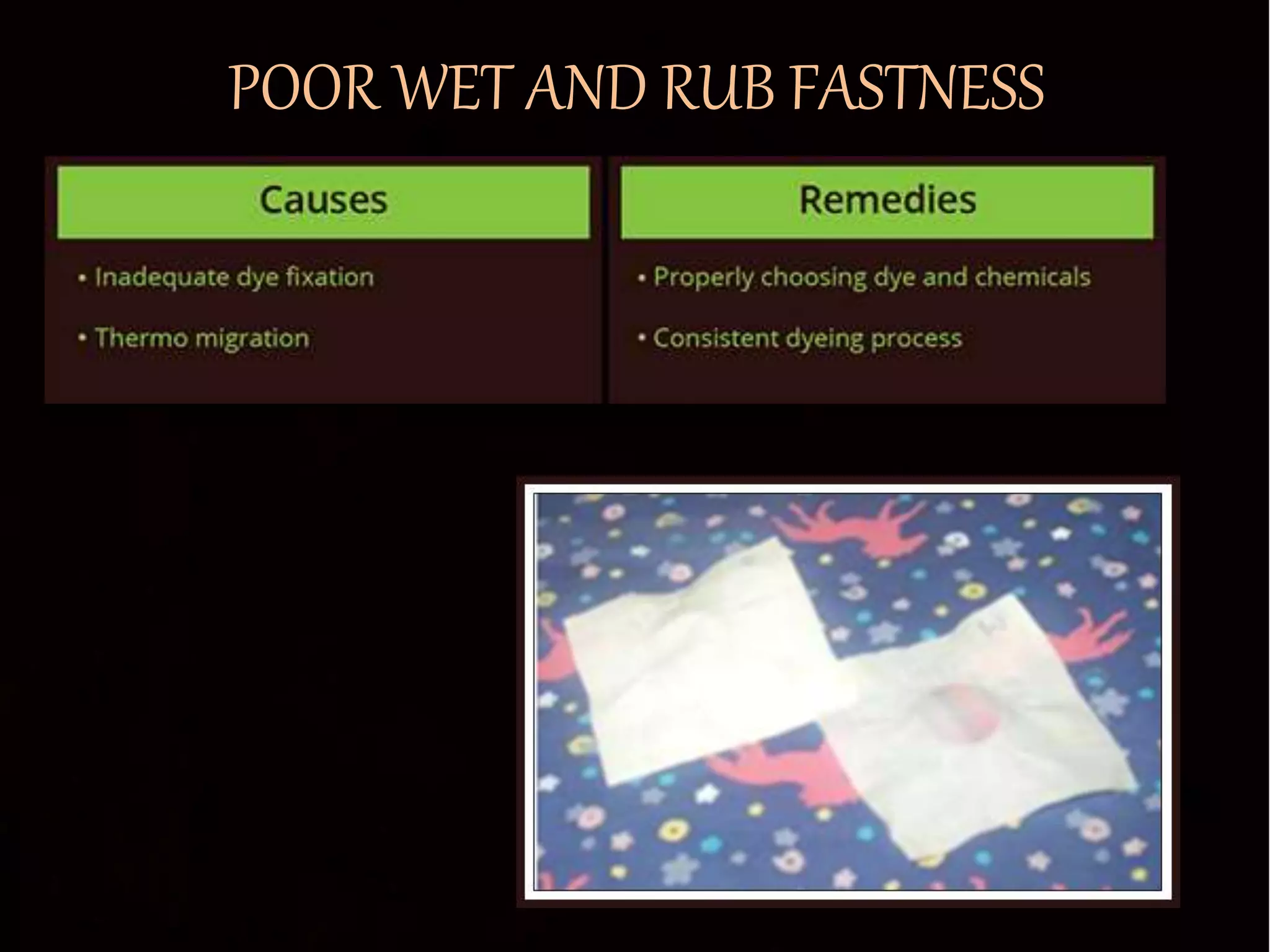
POOR WET AND RUB FASTNESS
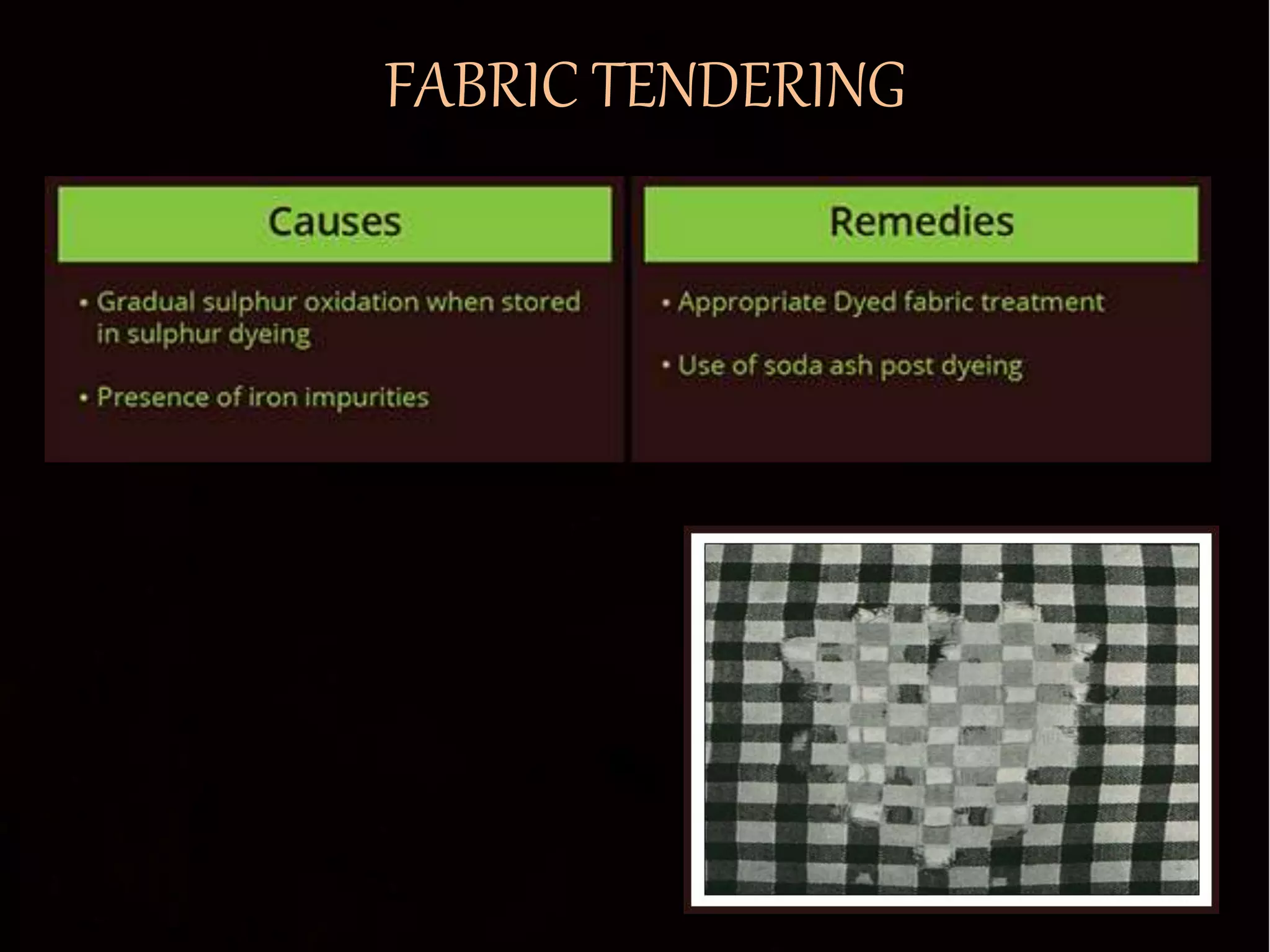
FABRIC TENDERING
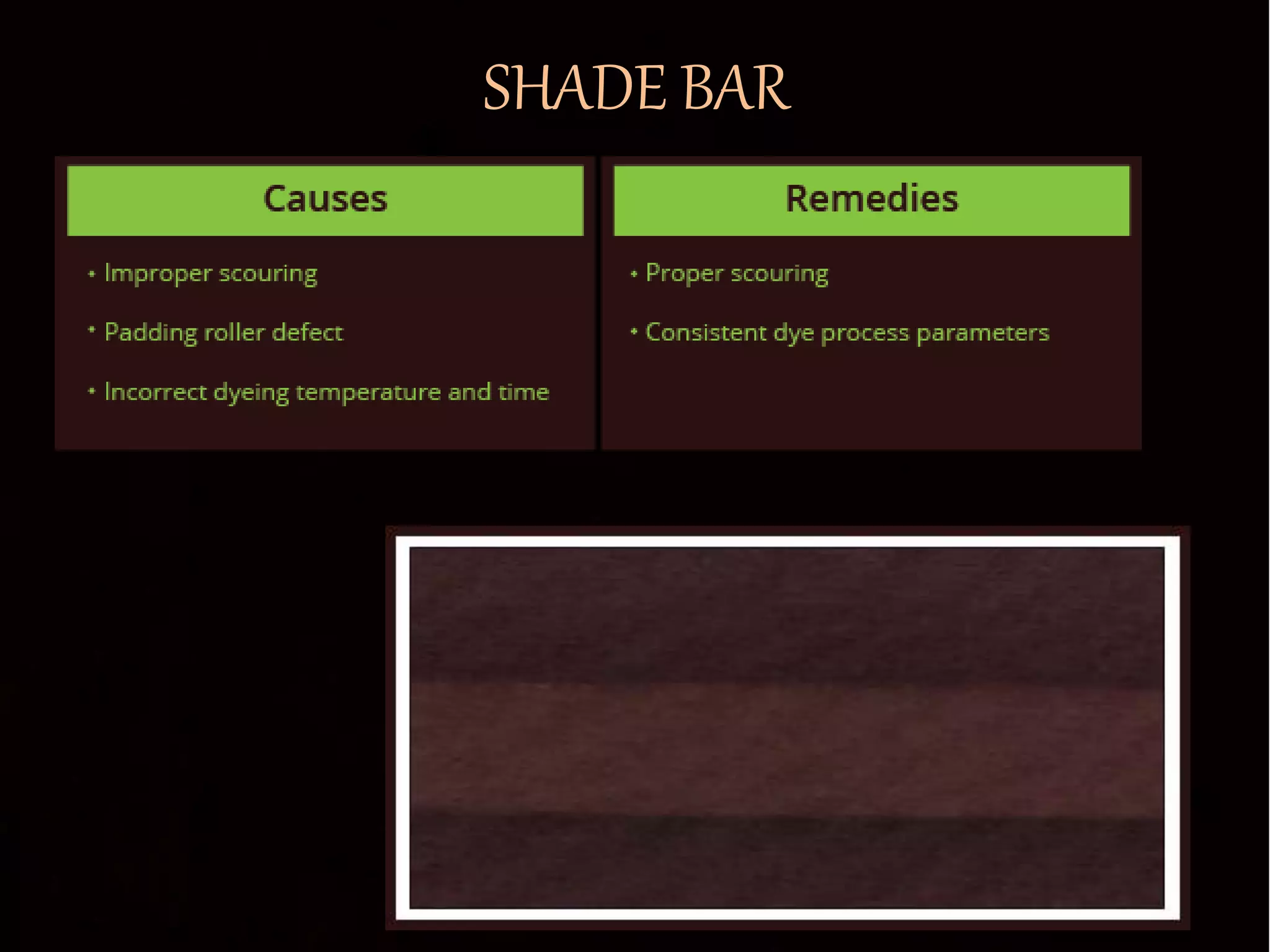
SHADE BAR
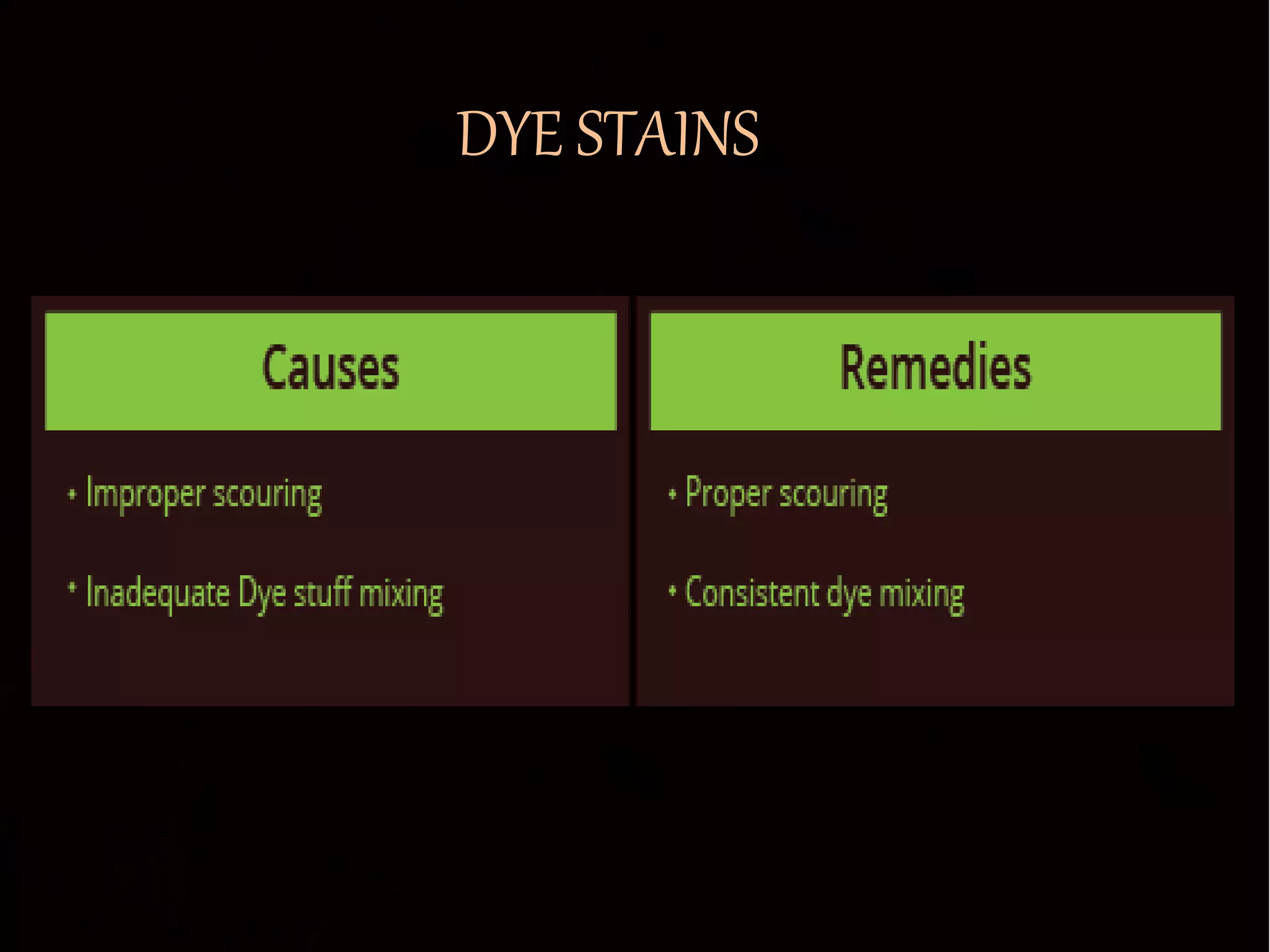
DYE STAINS
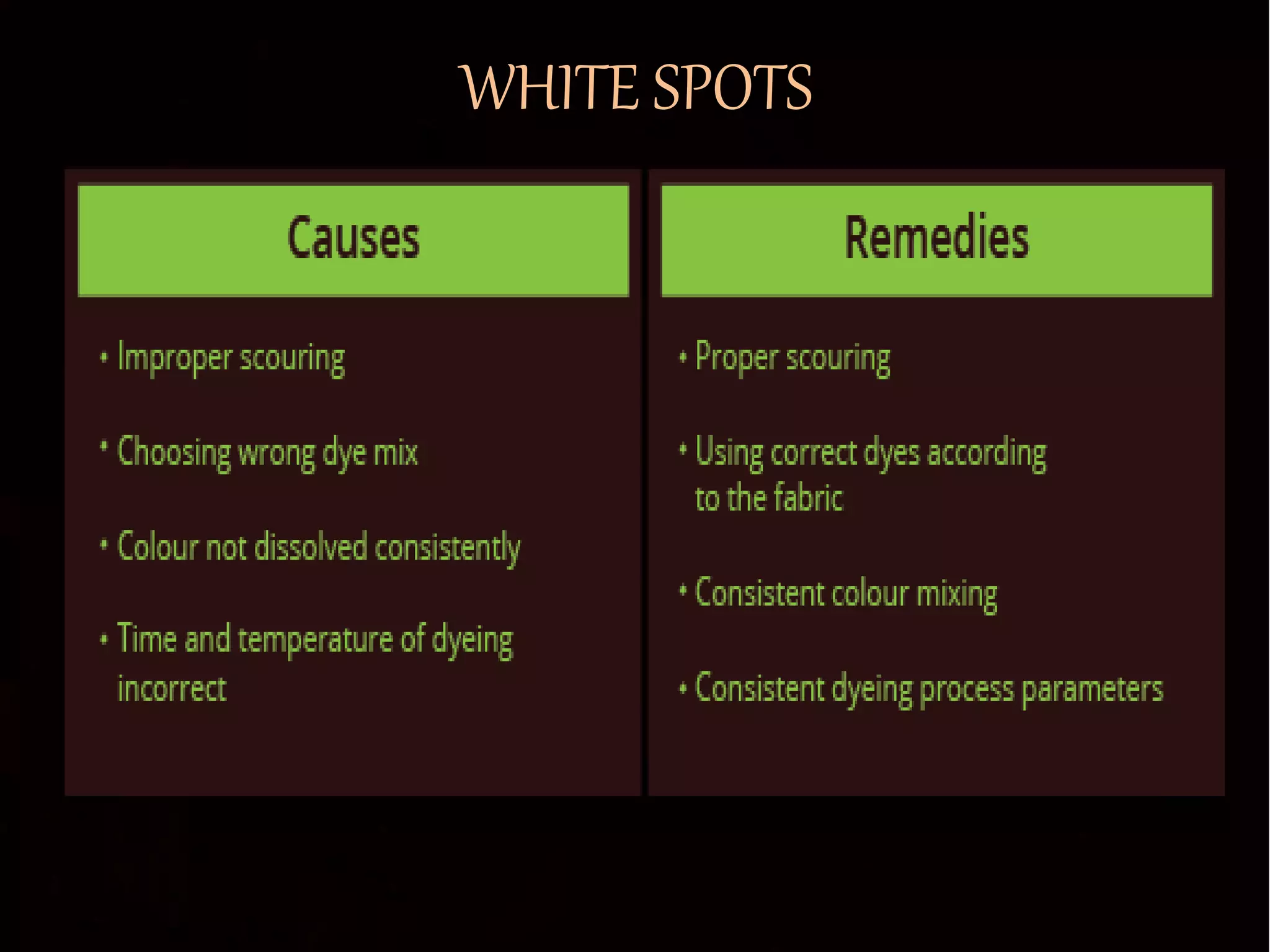
WHITE SPOTS
COLOR CROCKING
Printing
defects
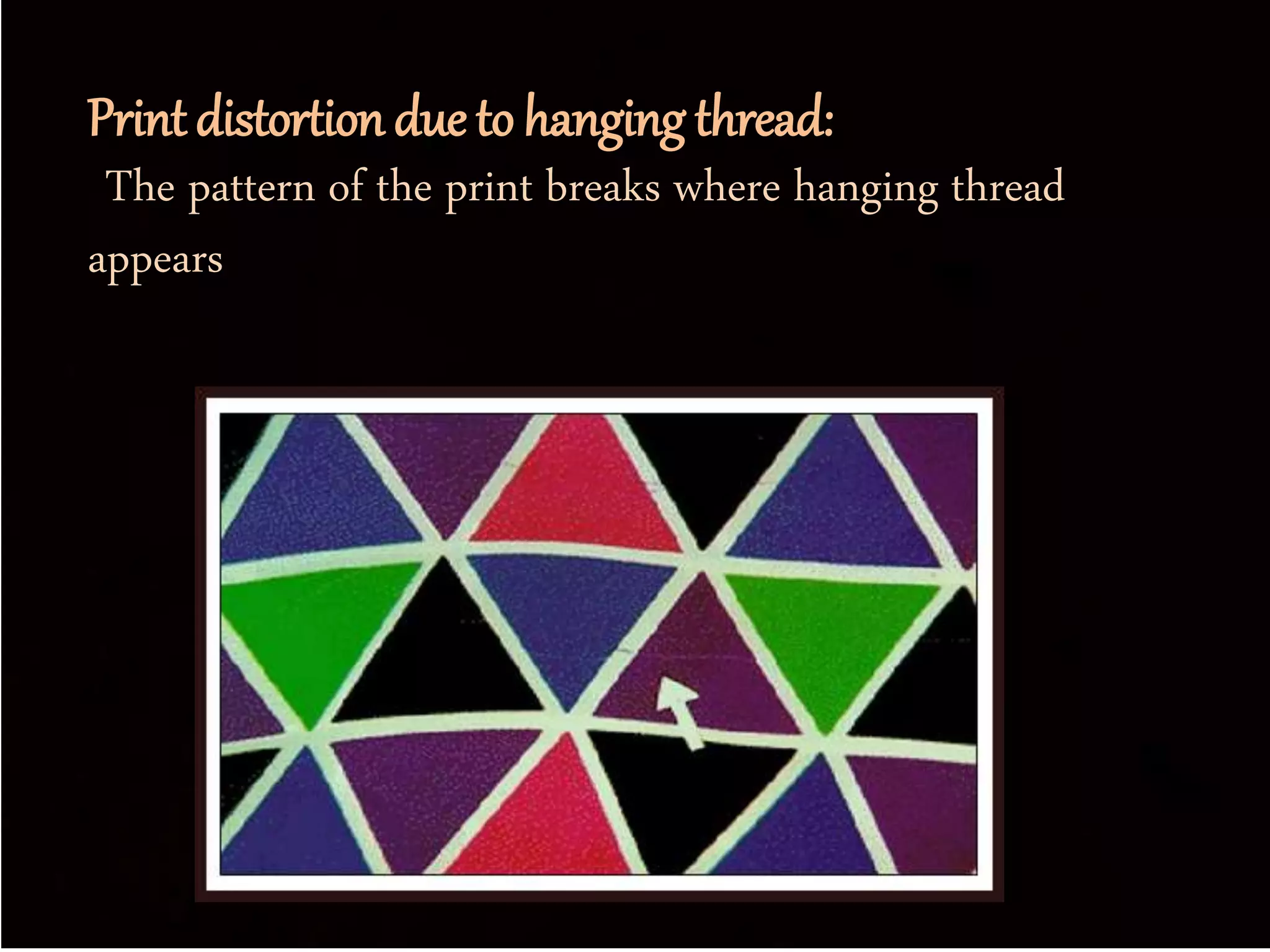
Print distortion due to hanging thread:
The pattern of the print breaks where hanging thread
appears
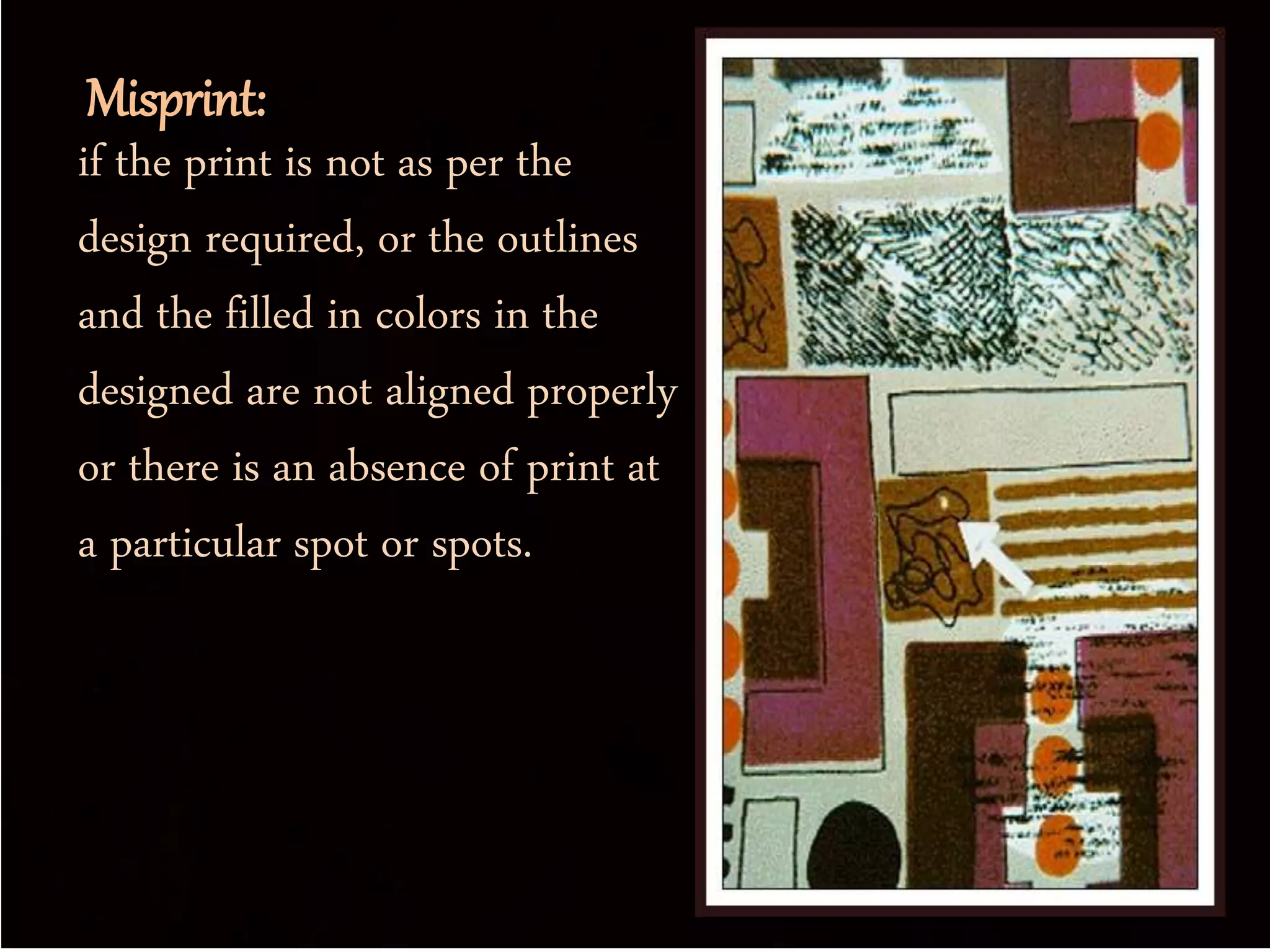
Misprint:
if the print is not as per the
design required, or the outlines
and the filled in colors in the
designed are not aligned properly
or there is an absence of print at
a particular spot or spots.
MISPRINT
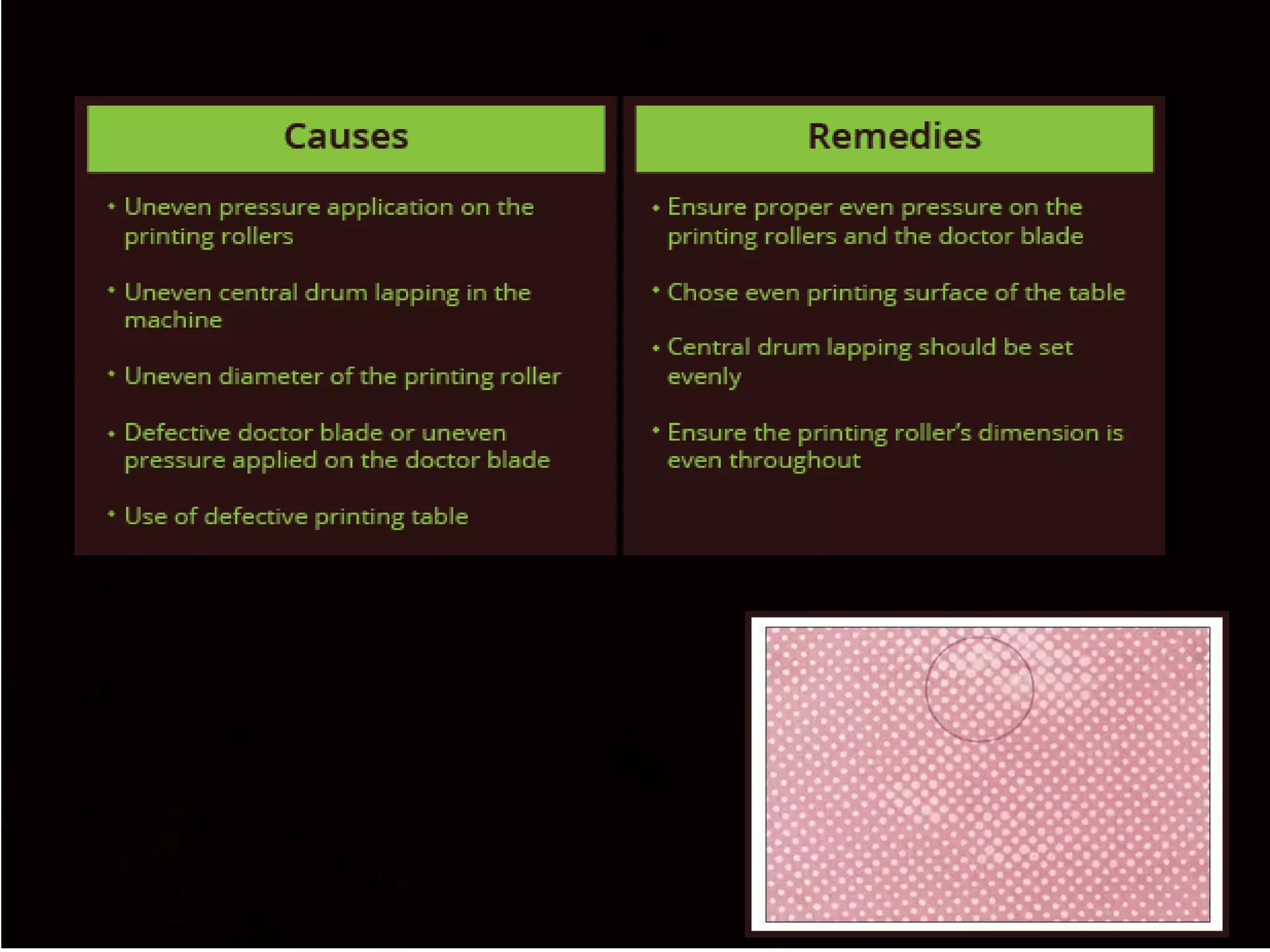
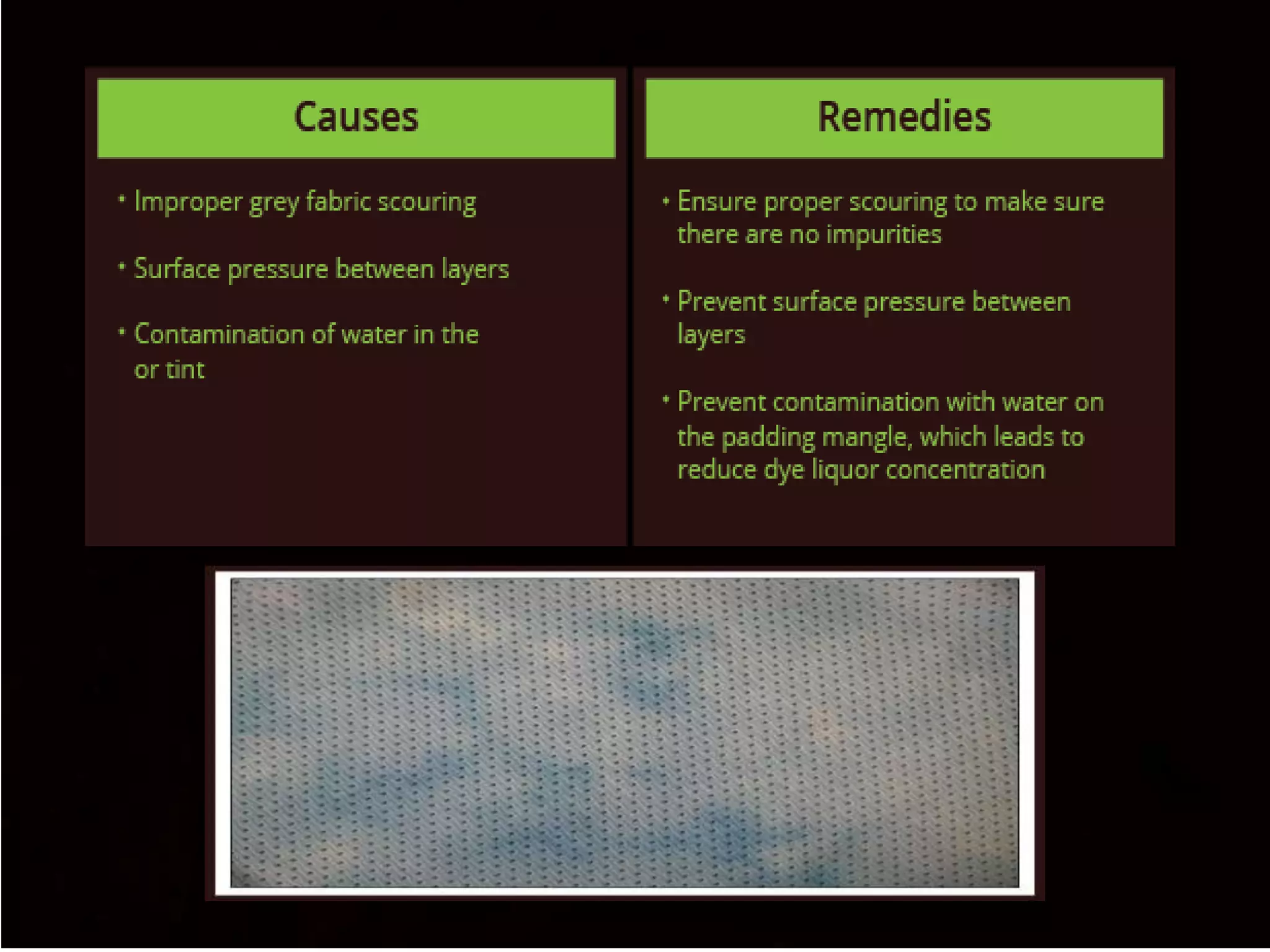
Uneven print:
Fabric’s print has a tint or
bold and dull spaces
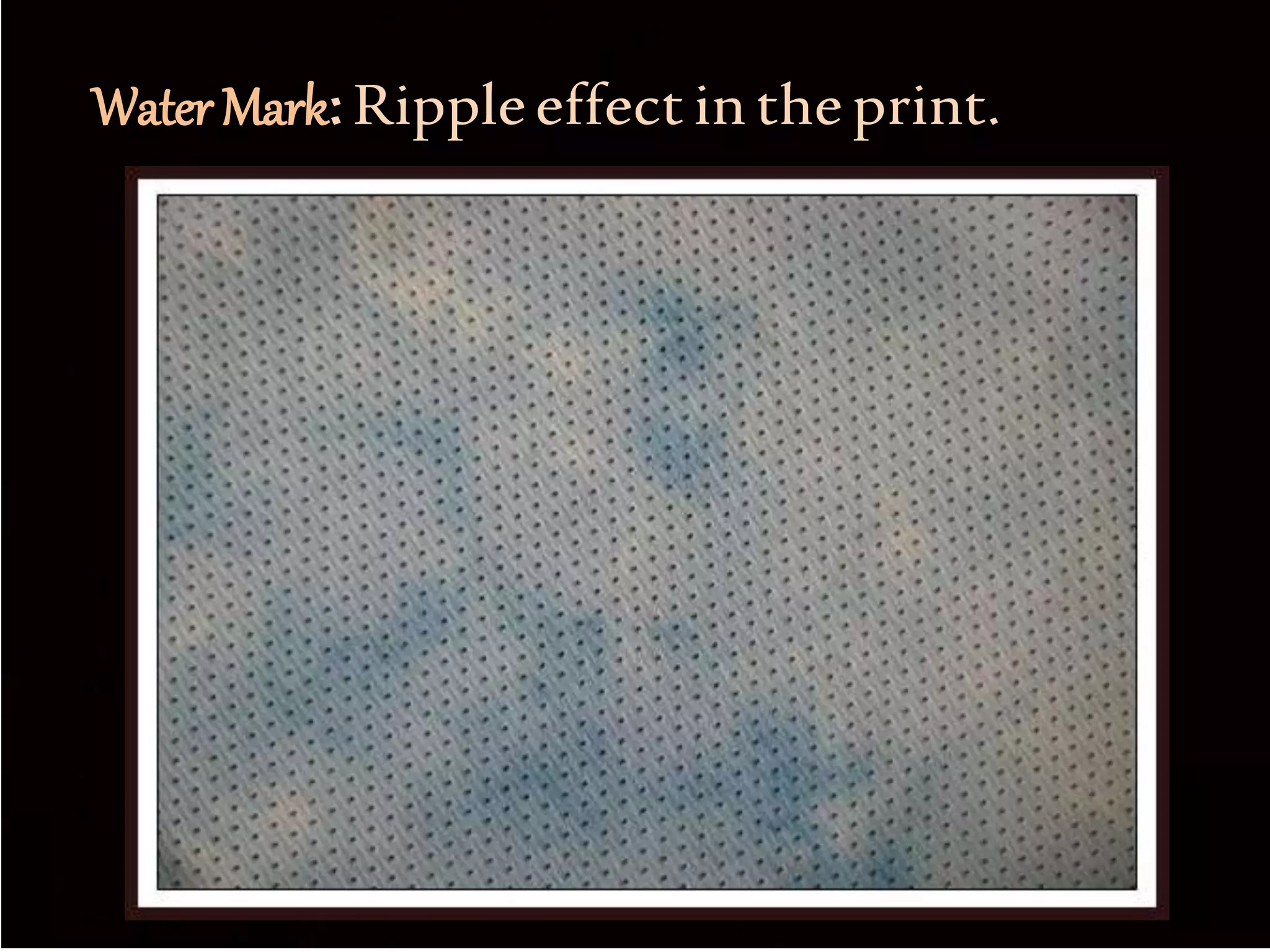
Water Mark:Rippleeffectintheprint.
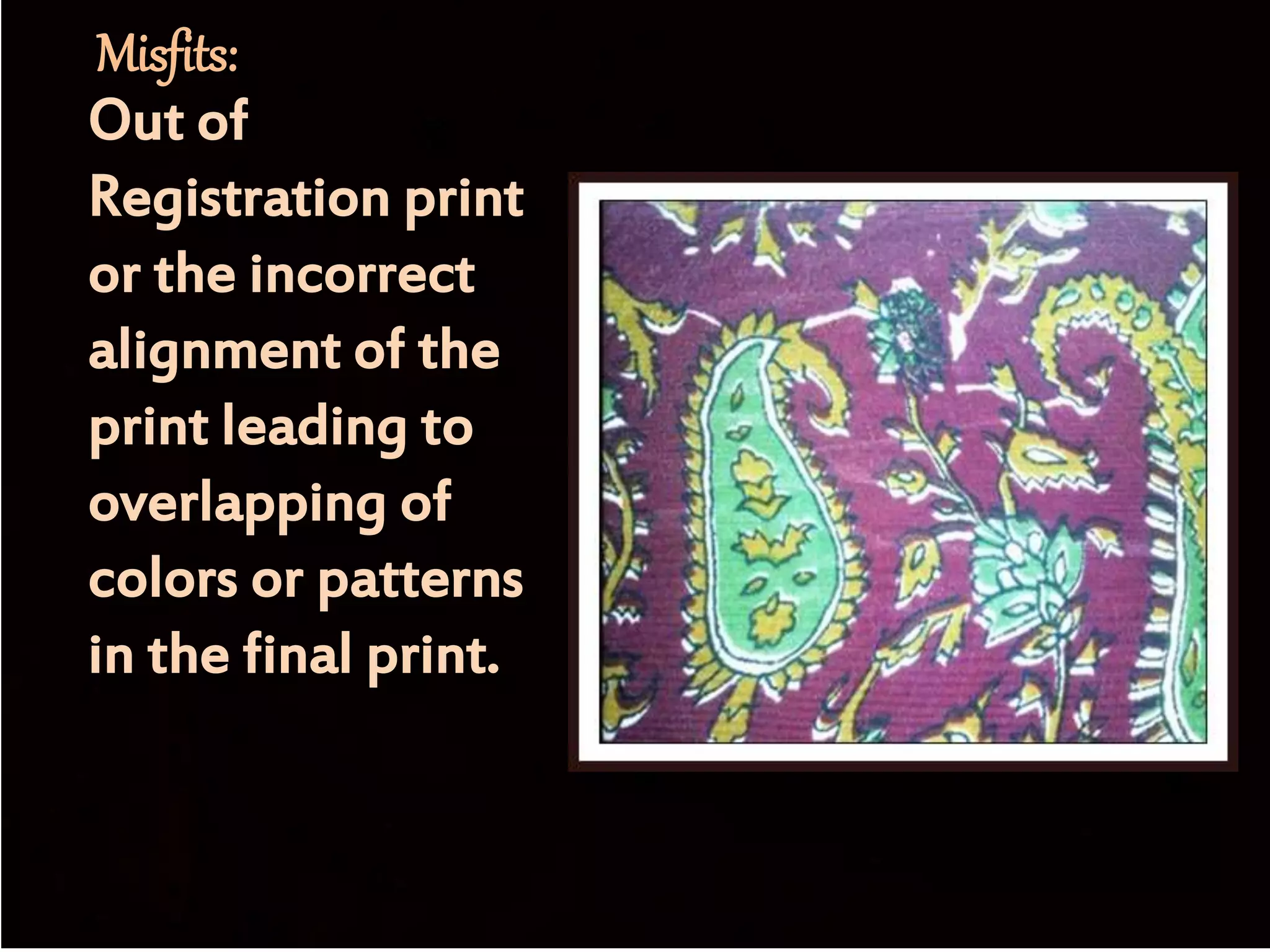
Misfits:
Out of
Registration print
or the incorrect
alignment of the
print leading to
overlapping of
colors or patterns
in the final print.
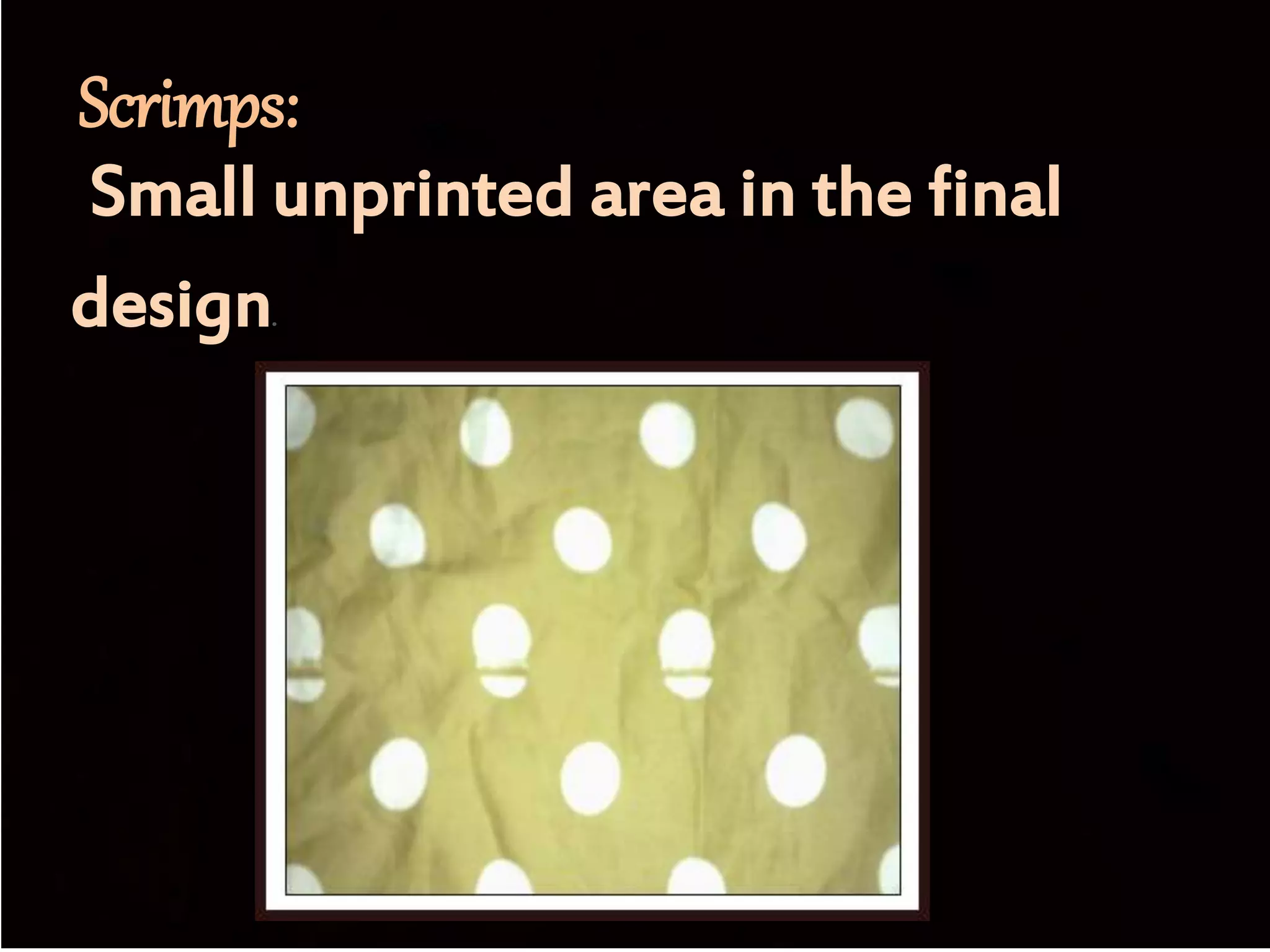
Scrimps:
Small unprinted area in the final
design.
Wicking/Flushing:printed area bleeding out on the
unprinted area on the fabric causing a shadow
effect around the print.
Fabric defects

Fabric defects