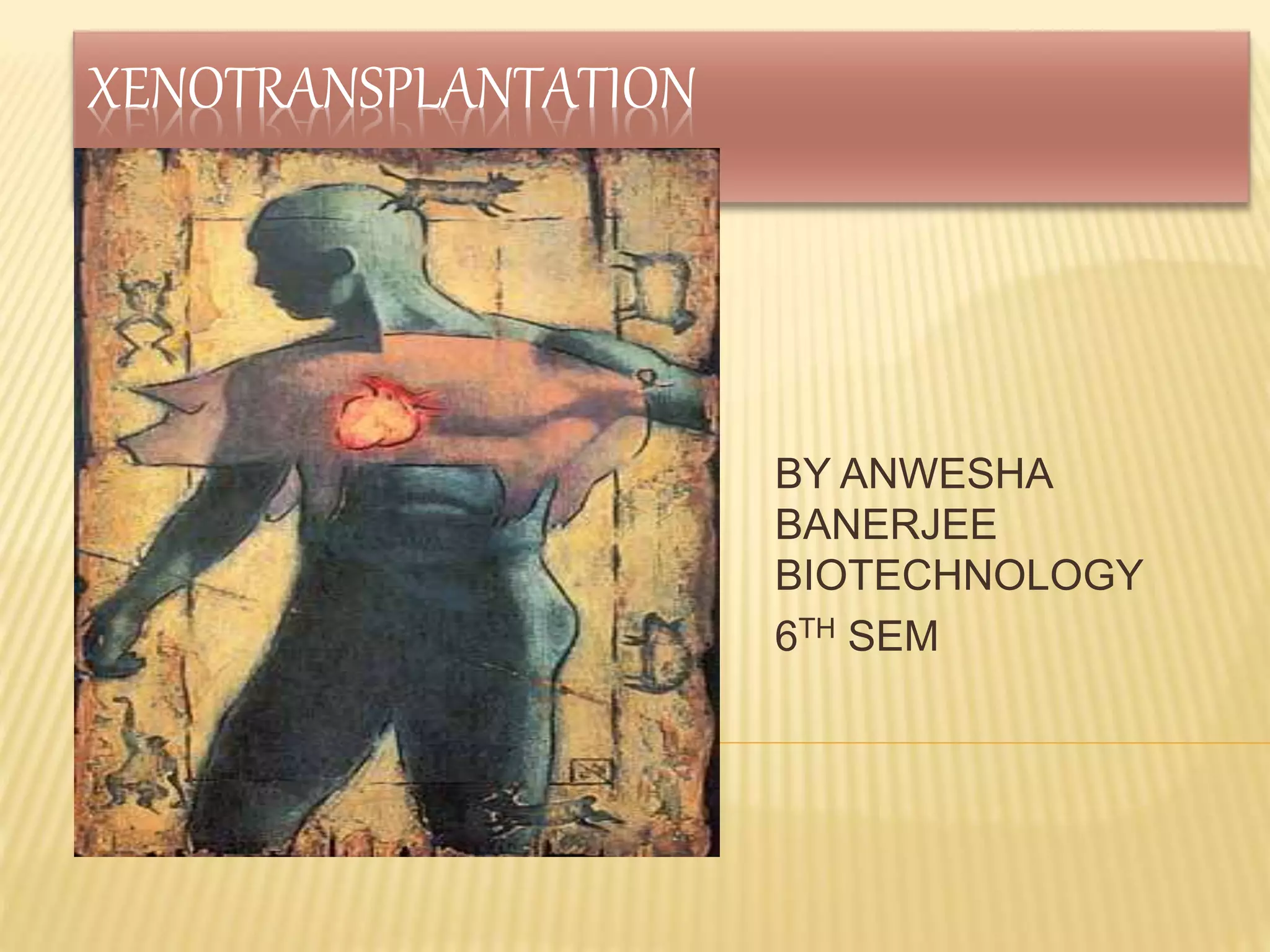
XENOTRANSPLANTATION
BY ANWESHA
BANERJEE
BIOTECHNOLOGY
6TH SEM
INTRODUCTION TO
XENOTRANSPLANTATION
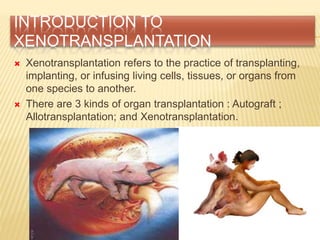
 Xenotransplantation refers to the practice of transplanting,
implanting, or infusing living cells, tissues, or organs from
one species to another.
 There are 3 kinds of organ transplantation : Autograft ;
Allotransplantation; and Xenotransplantation.
BRIEF HISTORY :--
 Organ donation started in
1682 in Russia where a
scientist used a bone of a
dog to treat it for a skull
injury.
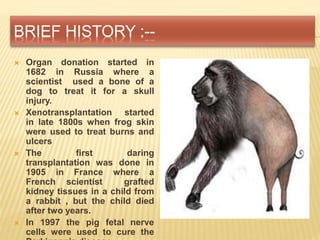
 Xenotransplantation started
in late 1800s when frog skin
were used to treat burns and
ulcers
 The first daring
transplantation was done in
1905 in France where a
French scientist grafted
kidney tissues in a child from
a rabbit , but the child died
after two years.
 In 1997 the pig fetal nerve
cells were used to cure the
ORGAN DONORS:--
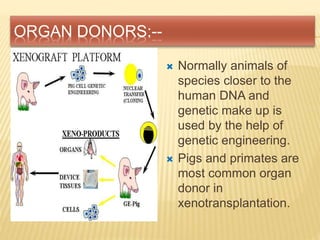
 Normally animals of
species closer to the
human DNA and
genetic make up is
used by the help of
genetic engineering.
 Pigs and primates are
most common organ
donor in
xenotransplantation.
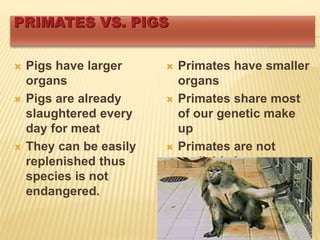
PRIMATES VS. PIGS
 Pigs have larger
organs
 Pigs are already
slaughtered every
day for meat
 They can be easily
replenished thus
species is not
endangered.
 Primates have smaller
organs
 Primates share most
of our genetic make
up
 Primates are not
available in mass
PROS&CONS:-
XENOTRANSPLANTATION.
 CONS:--
 25 known diseases
can be contacted
from pig to human
 Rejection rate is
higher
 Public Health risks
 Perfection of Cloning
is required.
 PROS:--
 Transplanted animal
cells to be used for
hemophillia, diabetes,
Alzheimer’s, and
Parkinson’s disease
 Organ Transplants
 A Way of delivering
genes of therapeutic
importance
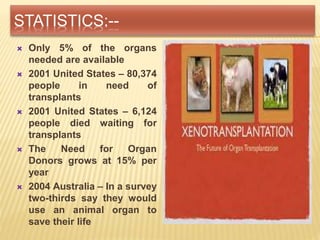
STATISTICS:--
 Only 5% of the organs
needed are available
 2001 United States – 80,374
people in need of
transplants
 2001 United States – 6,124
people died waiting for
transplants
 The Need for Organ
Donors grows at 15% per
year
 2004 Australia – In a survey
two-thirds say they would
use an animal organ to
save their life
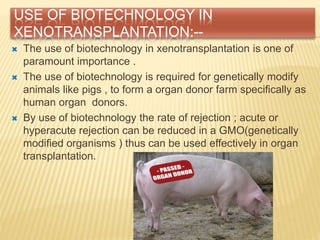
USE OF BIOTECHNOLOGY IN
XENOTRANSPLANTATION:--
 The use of biotechnology in xenotransplantation is one of
paramount importance .
 The use of biotechnology is required for genetically modify
animals like pigs , to form a organ donor farm specifically as
human organ donors.
 By use of biotechnology the rate of rejection ; acute or
hyperacute rejection can be reduced in a GMO(genetically
modified organisms ) thus can be used effectively in organ
transplantation.
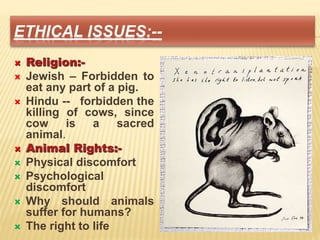
ETHICAL ISSUES:--
 Religion:-
 Jewish – Forbidden to
eat any part of a pig.
 Hindu -- forbidden the
killing of cows, since
cow is a sacred
animal.
 Animal Rights:-
 Physical discomfort
 Psychological
discomfort
 Why should animals
suffer for humans?
 The right to life
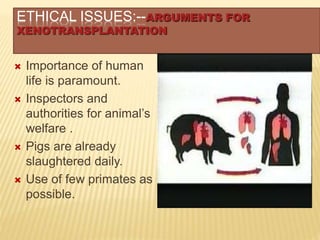
ETHICAL ISSUES:--ARGUMENTS FOR
XENOTRANSPLANTATION
 Importance of human
life is paramount.
 Inspectors and
authorities for animal’s
welfare .
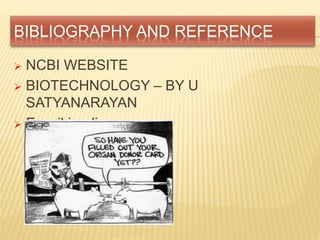
 Pigs are already
slaughtered daily.
 Use of few primates as
possible.
CASES OF XENOTRANSPLANTATION:--
CASE 1
 Baboon bone-marrow xenotransplant in a patient with advanced
HIV disease: case report :---
 BACKGROUND:--Xenotransplantation offers a solution to the shortage of
organ donors and may offer resistance to human-specific pathogens.
Baboons are resistant to productive infection with HIV-1. A baboon bone-
marrow transplant (BMT) was performed in an attempt to reconstitute the
immune system of a patient with advanced AIDS.
 RESULTS:--A 38-year-old male with advanced AIDS, who had failed to
respond to triple-drug antiretroviral therapy, underwent BMT in 1995. The
patient tolerated the procedure without complication. Baboon cells were
detected in the peripheral blood on days 5 and 13 after transplantation.
Baboon endogenous virus (BaEV) was detected on day 5 but not
subsequently. Antibody to BaEV was not detected. HIV-1 viral load
declined 1.5 log and remained low until 11 months. The patient improved
clinically, and no adverse events occurred. The patient is alive 8 years
after the procedure.
 CONCLUSION:--Baboon BMT to treat AIDS was attempted using
nonmyeloablative conditioning and resulted in transient microchimerism
and clinical and virologic improvements. Long-term improvement was not
achieved; however, no adverse events occurred, and no evidence of
transmission of xenogeneic infections was found.
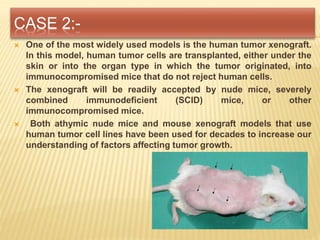
CASE 2:-
 One of the most widely used models is the human tumor xenograft.
In this model, human tumor cells are transplanted, either under the
skin or into the organ type in which the tumor originated, into
immunocompromised mice that do not reject human cells.
 The xenograft will be readily accepted by nude mice, severely
combined immunodeficient (SCID) mice, or other
immunocompromised mice.
 Both athymic nude mice and mouse xenograft models that use
human tumor cell lines have been used for decades to increase our
understanding of factors affecting tumor growth.
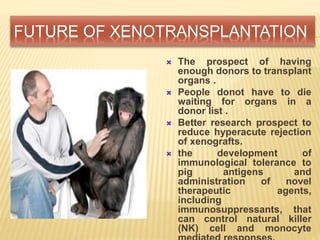
FUTURE OF XENOTRANSPLANTATION
 The prospect of having
enough donors to transplant
organs .
 People donot have to die
waiting for organs in a
donor list .
 Better research prospect to
reduce hyperacute rejection
of xenografts.
 the development of
immunological tolerance to
pig antigens and
administration of novel
therapeutic agents,
including
immunosuppressants, that
can control natural killer
(NK) cell and monocyte
BIBLIOGRAPHY AND REFERENCE
 NCBI WEBSITE
 BIOTECHNOLOGY – BY U
SATYANARAYAN
 En.wikipedia.org
Xenotransplantation

Xenotransplantation

  • 1.
  • 2.
    INTRODUCTION TO XENOTRANSPLANTATION  Xenotransplantationrefers to the practice of transplanting, implanting, or infusing living cells, tissues, or organs from one species to another.  There are 3 kinds of organ transplantation : Autograft ; Allotransplantation; and Xenotransplantation.
  • 3.
    BRIEF HISTORY :-- Organ donation started in 1682 in Russia where a scientist used a bone of a dog to treat it for a skull injury.  Xenotransplantation started in late 1800s when frog skin were used to treat burns and ulcers  The first daring transplantation was done in 1905 in France where a French scientist grafted kidney tissues in a child from a rabbit , but the child died after two years.  In 1997 the pig fetal nerve cells were used to cure the
  • 4.
    ORGAN DONORS:--  Normallyanimals of species closer to the human DNA and genetic make up is used by the help of genetic engineering.  Pigs and primates are most common organ donor in xenotransplantation.
  • 5.
    PRIMATES VS. PIGS Pigs have larger organs  Pigs are already slaughtered every day for meat  They can be easily replenished thus species is not endangered.  Primates have smaller organs  Primates share most of our genetic make up  Primates are not available in mass
  • 6.
    PROS&CONS:- XENOTRANSPLANTATION.  CONS:--  25known diseases can be contacted from pig to human  Rejection rate is higher  Public Health risks  Perfection of Cloning is required.  PROS:--  Transplanted animal cells to be used for hemophillia, diabetes, Alzheimer’s, and Parkinson’s disease  Organ Transplants  A Way of delivering genes of therapeutic importance
  • 7.
    STATISTICS:--  Only 5%of the organs needed are available  2001 United States – 80,374 people in need of transplants  2001 United States – 6,124 people died waiting for transplants  The Need for Organ Donors grows at 15% per year  2004 Australia – In a survey two-thirds say they would use an animal organ to save their life
  • 8.
    USE OF BIOTECHNOLOGYIN XENOTRANSPLANTATION:--  The use of biotechnology in xenotransplantation is one of paramount importance .  The use of biotechnology is required for genetically modify animals like pigs , to form a organ donor farm specifically as human organ donors.  By use of biotechnology the rate of rejection ; acute or hyperacute rejection can be reduced in a GMO(genetically modified organisms ) thus can be used effectively in organ transplantation.
  • 9.
    ETHICAL ISSUES:--  Religion:- Jewish – Forbidden to eat any part of a pig.  Hindu -- forbidden the killing of cows, since cow is a sacred animal.  Animal Rights:-  Physical discomfort  Psychological discomfort  Why should animals suffer for humans?  The right to life
  • 10.
    ETHICAL ISSUES:--ARGUMENTS FOR XENOTRANSPLANTATION Importance of human life is paramount.  Inspectors and authorities for animal’s welfare .  Pigs are already slaughtered daily.  Use of few primates as possible.
  • 11.
    CASES OF XENOTRANSPLANTATION:-- CASE1  Baboon bone-marrow xenotransplant in a patient with advanced HIV disease: case report :---  BACKGROUND:--Xenotransplantation offers a solution to the shortage of organ donors and may offer resistance to human-specific pathogens. Baboons are resistant to productive infection with HIV-1. A baboon bone- marrow transplant (BMT) was performed in an attempt to reconstitute the immune system of a patient with advanced AIDS.  RESULTS:--A 38-year-old male with advanced AIDS, who had failed to respond to triple-drug antiretroviral therapy, underwent BMT in 1995. The patient tolerated the procedure without complication. Baboon cells were detected in the peripheral blood on days 5 and 13 after transplantation. Baboon endogenous virus (BaEV) was detected on day 5 but not subsequently. Antibody to BaEV was not detected. HIV-1 viral load declined 1.5 log and remained low until 11 months. The patient improved clinically, and no adverse events occurred. The patient is alive 8 years after the procedure.  CONCLUSION:--Baboon BMT to treat AIDS was attempted using nonmyeloablative conditioning and resulted in transient microchimerism and clinical and virologic improvements. Long-term improvement was not achieved; however, no adverse events occurred, and no evidence of transmission of xenogeneic infections was found.
  • 12.
    CASE 2:-  Oneof the most widely used models is the human tumor xenograft. In this model, human tumor cells are transplanted, either under the skin or into the organ type in which the tumor originated, into immunocompromised mice that do not reject human cells.  The xenograft will be readily accepted by nude mice, severely combined immunodeficient (SCID) mice, or other immunocompromised mice.  Both athymic nude mice and mouse xenograft models that use human tumor cell lines have been used for decades to increase our understanding of factors affecting tumor growth.
  • 13.
    FUTURE OF XENOTRANSPLANTATION The prospect of having enough donors to transplant organs .  People donot have to die waiting for organs in a donor list .  Better research prospect to reduce hyperacute rejection of xenografts.  the development of immunological tolerance to pig antigens and administration of novel therapeutic agents, including immunosuppressants, that can control natural killer (NK) cell and monocyte
  • 14.
    BIBLIOGRAPHY AND REFERENCE NCBI WEBSITE  BIOTECHNOLOGY – BY U SATYANARAYAN  En.wikipedia.org