


TRANSGENIC PIGS AND
SCOPE FOR HUMAN
HEALTH
Presented By: Andleeb Sultana
• Definition
• Introduction
• Applications of swine as biomedical research
• Pros and cons of xenotransplantation
• Xenoxoonosis
• Ethics
• Conclusion
DEFINITION
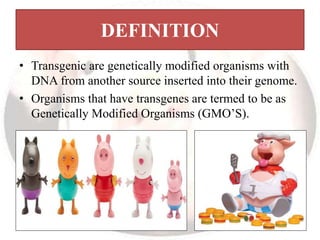
• Transgenic are genetically modified organisms with
DNA from another source inserted into their genome.
• Organisms that have transgenes are termed to be as
Genetically Modified Organisms (GMO’S).
INTRODUCTION
• Transgenic technology has led to the development of fishes,
live stock and other animals with altered genetic profiles
which are useful to mankind.
• Pigs, especially miniature pigs, have similar physiology to
humans thus can serve as an important biomedical model for
human diseases.
• The use of swine in biomedical research has gained much
importance as they have always been considered excellent
models for the studies related to various cardiovascular
diseases, cutaneous pharmacology, diabetes, cancer biology,
lipoprotein metabolism, pathobiology of intestinal transport,
injury and repair, repair and healing of wounds, etc.
Cont….
• Also been considered for being potential source of different
organs for the xenotransplantation as can be seen in the heart
transplantation studies.
• Miniature pigs were developed in the 1950s and have been
selectively bred for their small size and docile nature.
• 1985 First transgenic pigs were produced by Microinjection
of DNA into one pronucleus of a zygote.
• For over 30 years, scientists have been using pigs in a number
of medical fields, including dermatology, cardiology and more.
• Recently, scientists were even able to re-grow human leg
muscles using implants made of pig bladder tissue.
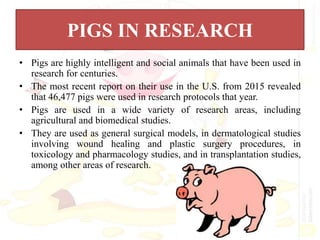
• Pigs are highly intelligent and social animals that have been used in
research for centuries.
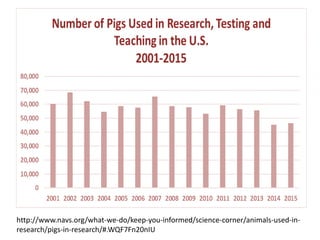
• The most recent report on their use in the U.S. from 2015 revealed
that 46,477 pigs were used in research protocols that year.
• Pigs are used in a wide variety of research areas, including
agricultural and biomedical studies.
• They are used as general surgical models, in dermatological studies
involving wound healing and plastic surgery procedures, in
toxicology and pharmacology studies, and in transplantation studies,
among other areas of research.
PIGS IN RESEARCH
http://www.navs.org/what-we-do/keep-you-informed/science-corner/animals-used-in-
research/pigs-in-research/#.WQF7Fn20nIU
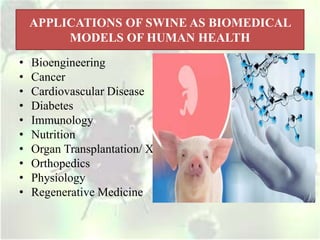
APPLICATIONS OF SWINE AS BIOMEDICAL
MODELS OF HUMAN HEALTH
• Bioengineering
• Cancer
• Cardiovascular Disease
• Diabetes
• Immunology
• Nutrition
• Organ Transplantation/ Xenograft
• Orthopedics
• Physiology
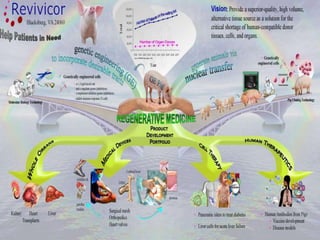
• Regenerative Medicine
Cont…
• It just so happens that, despite our differences, many of the pig’s biological
systems are very similar to our own.
• According to Swindle, many of the pig’s organ systems are 80 to 90 percent
similar to the corresponding systems in humans – both in anatomy and
function.
• The system that matches up best may be the cardiovascular system, as a
pig’s heart is about the same size and shape as a human heart.
• Pigs develop atherosclerosis – artery plaque buildup – in the same way that
humans do, and they react similarly to myocardial infarction, the classic
heart attack.
• Tissues derived from pig hearts have been used to replace defective heart
valves in humans, lasting upwards of 15 years in the human body.
Cont….
• “The pig is a true omnivore like we are,” Swindle said. “It can eat and
drink anything. And because of this, the physiology of digestion and the
metabolic processes in the liver are also similar to humans. They’re used in
a lot of dietary type of studies, as well as oral absorption studies of drugs.”
• Pig kidneys are comparable in size and function to human kidneys, lending
themselves to renal research. And pigs have been one of the standard
plastic surgery models for decades, as their skin wounds heal similarly to
humans’ skin.
• Diabetics who needed daily insulin injections relied on pork insulin until
the 1980s, when manufacturers started making biosynthetic insulin through
recombinant DNA technology.
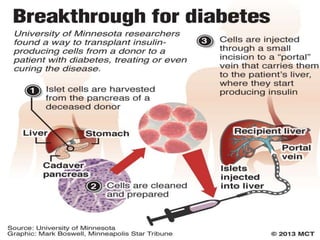
• The insulin-producing cells in a pig’s pancreas are similar to humans’, so a
significant amount of research on diabetes has been aimed at isolating those
cells and harnessing them for future treatments.
Cont….
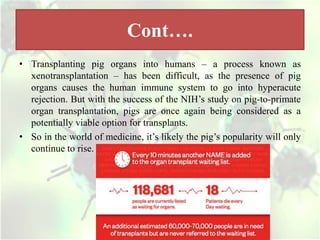
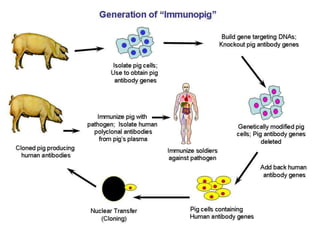
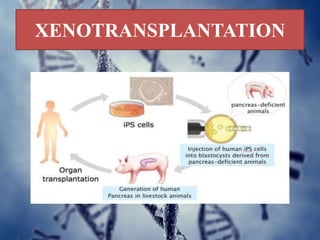
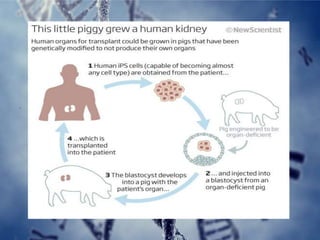
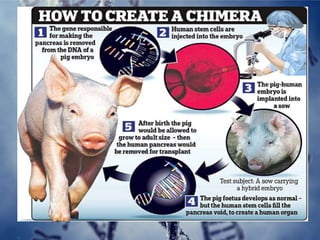
• Transplanting pig organs into humans – a process known as
xenotransplantation – has been difficult, as the presence of pig
organs causes the human immune system to go into hyperacute
rejection. But with the success of the NIH’s study on pig-to-primate
organ transplantation, pigs are once again being considered as a
potentially viable option for transplants.
• So in the world of medicine, it’s likely the pig’s popularity will only
continue to rise.
XENOTRANSPLANTATION
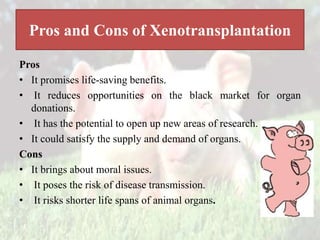
Pros and Cons of Xenotransplantation
Pros
• It promises life-saving benefits.
• It reduces opportunities on the black market for organ
donations.
• It has the potential to open up new areas of research.
• It could satisfy the supply and demand of organs.
Cons
• It brings about moral issues.
• It poses the risk of disease transmission.
• It risks shorter life spans of animal organs.
XENOZOONOSIS
• Xenozoonosis, also known as zoonosis or xenosis, is the transmission of
infectious agents between species via xenograft. Animal to human infection
is normally rare, but has occurred in the past. An example of such is the
avian influenza, when an influenza A virus was passed from birds to
humans.
• Examples of viruses carried by pigs include porcine herpes virus, rotavirus,
parvovirus, and circovirus. Porcine herpes viruses and rotaviruses can be
eliminated from the donor pool by screening, however others (such as
parvovirus and circovirus) may contaminate food and footwear then re-
infect the herd.
• Thus, pigs to be used as organ donors must be housed under strict
regulations and screened regularly for microbes and pathogens. Unknown
viruses, as well as those not harmful in the animal, may also pose risks
(Takeuchi and George, 2000).
ETHICS
• Xenografts have been a controversial procedure since they were first attempted.
Many, including animal rights groups, strongly oppose killing animals to harvest
their organs for human use.
• The prohibition of the consumption of pig does pose problems in Jewish and
Islamic communities.
• In general, the use of pig and cow tissue in humans has been met with little
resistance, save some religious beliefs and a few philosophical objections.
• The safety of public health is a factor to be considered. If there is any risk to the
public at all for an outbreak from transplantation there must be procedures in place
to protect the public.
• Not only does the recipient of the transplantation have to understand the risks and
benefits, but society must also understand and consent to such an agreement.
• he Ethics Committee of the International Xenotransplantation Association points
out one major ethical issue is the societal response to such a procedure. The
assumption that the recipient of the transplantation will be asked to undergo
lifelong monitoring.
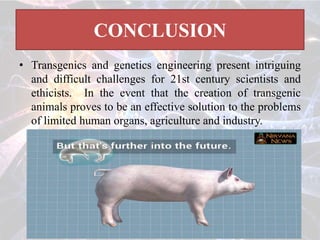
CONCLUSION
• Transgenics and genetics engineering present intriguing
and difficult challenges for 21st century scientists and
ethicists. In the event that the creation of transgenic
animals proves to be an effective solution to the problems
of limited human organs, agriculture and industry.
REFERENCES
• Information Resources on Swine in Biomedical Research 1990-2000. 2000 Swindle MM
and Smith AC. www.nal.usda.gov/awic/pubs/swine/swine.htm
• 2. Schook L, Beattie C, Beever J, Donovan S, Jamison R, Zuckermann F, Niemi S,
Rothschild M, Rutherford M, Smith D. Swine in biomedical research: creating the
building blocks of animal models. Anim Biotechnol. 2005;16:183-90
• 3. Schook LB, Tumbleson ME. Advances in Swine in Biomedical Research. Springer
Publishing Corp. 2004
• 4. Vodicka P, Smetana K Jr, Dvorankova B, Emerick T, Xu YZ, Ourednik J, Ourednik V,
Motlik J. The miniature pig as an animal model in biomedical research. Ann N Y Acad
Sci. 2005;1049:161-71
• 5. Ibrahim Z, Busch J, Awwad M, Wagner R, Wells K, Cooper DK. Selected physiologic
compatibilities and incompatibilities between human and porcine organ systems.
Xenotransplantation. 2006;13:488-99
• 6. Tuggle CK, Wang Y-F, Couture O. Advances in Swine Transcriptomics. Int J. Biol Sci.
2007;3:132-152
Transgenic pigs
Transgenic pigs

Transgenic pigs

  • 1.
    TRANSGENIC PIGS AND SCOPEFOR HUMAN HEALTH Presented By: Andleeb Sultana
  • 2.
    • Definition • Introduction •Applications of swine as biomedical research • Pros and cons of xenotransplantation • Xenoxoonosis • Ethics • Conclusion
  • 4.
    DEFINITION • Transgenic aregenetically modified organisms with DNA from another source inserted into their genome. • Organisms that have transgenes are termed to be as Genetically Modified Organisms (GMO’S).
  • 5.
    INTRODUCTION • Transgenic technologyhas led to the development of fishes, live stock and other animals with altered genetic profiles which are useful to mankind. • Pigs, especially miniature pigs, have similar physiology to humans thus can serve as an important biomedical model for human diseases. • The use of swine in biomedical research has gained much importance as they have always been considered excellent models for the studies related to various cardiovascular diseases, cutaneous pharmacology, diabetes, cancer biology, lipoprotein metabolism, pathobiology of intestinal transport, injury and repair, repair and healing of wounds, etc.
  • 6.
    Cont…. • Also beenconsidered for being potential source of different organs for the xenotransplantation as can be seen in the heart transplantation studies. • Miniature pigs were developed in the 1950s and have been selectively bred for their small size and docile nature. • 1985 First transgenic pigs were produced by Microinjection of DNA into one pronucleus of a zygote. • For over 30 years, scientists have been using pigs in a number of medical fields, including dermatology, cardiology and more. • Recently, scientists were even able to re-grow human leg muscles using implants made of pig bladder tissue.
  • 7.
    • Pigs arehighly intelligent and social animals that have been used in research for centuries. • The most recent report on their use in the U.S. from 2015 revealed that 46,477 pigs were used in research protocols that year. • Pigs are used in a wide variety of research areas, including agricultural and biomedical studies. • They are used as general surgical models, in dermatological studies involving wound healing and plastic surgery procedures, in toxicology and pharmacology studies, and in transplantation studies, among other areas of research. PIGS IN RESEARCH
  • 8.
  • 9.
    APPLICATIONS OF SWINEAS BIOMEDICAL MODELS OF HUMAN HEALTH • Bioengineering • Cancer • Cardiovascular Disease • Diabetes • Immunology • Nutrition • Organ Transplantation/ Xenograft • Orthopedics • Physiology • Regenerative Medicine
  • 10.
    Cont… • It justso happens that, despite our differences, many of the pig’s biological systems are very similar to our own. • According to Swindle, many of the pig’s organ systems are 80 to 90 percent similar to the corresponding systems in humans – both in anatomy and function. • The system that matches up best may be the cardiovascular system, as a pig’s heart is about the same size and shape as a human heart. • Pigs develop atherosclerosis – artery plaque buildup – in the same way that humans do, and they react similarly to myocardial infarction, the classic heart attack. • Tissues derived from pig hearts have been used to replace defective heart valves in humans, lasting upwards of 15 years in the human body.
  • 11.
    Cont…. • “The pigis a true omnivore like we are,” Swindle said. “It can eat and drink anything. And because of this, the physiology of digestion and the metabolic processes in the liver are also similar to humans. They’re used in a lot of dietary type of studies, as well as oral absorption studies of drugs.” • Pig kidneys are comparable in size and function to human kidneys, lending themselves to renal research. And pigs have been one of the standard plastic surgery models for decades, as their skin wounds heal similarly to humans’ skin. • Diabetics who needed daily insulin injections relied on pork insulin until the 1980s, when manufacturers started making biosynthetic insulin through recombinant DNA technology. • The insulin-producing cells in a pig’s pancreas are similar to humans’, so a significant amount of research on diabetes has been aimed at isolating those cells and harnessing them for future treatments.
  • 12.
    Cont…. • Transplanting pigorgans into humans – a process known as xenotransplantation – has been difficult, as the presence of pig organs causes the human immune system to go into hyperacute rejection. But with the success of the NIH’s study on pig-to-primate organ transplantation, pigs are once again being considered as a potentially viable option for transplants. • So in the world of medicine, it’s likely the pig’s popularity will only continue to rise.
  • 16.
  • 21.
    Pros and Consof Xenotransplantation Pros • It promises life-saving benefits. • It reduces opportunities on the black market for organ donations. • It has the potential to open up new areas of research. • It could satisfy the supply and demand of organs. Cons • It brings about moral issues. • It poses the risk of disease transmission. • It risks shorter life spans of animal organs.
  • 22.
    XENOZOONOSIS • Xenozoonosis, alsoknown as zoonosis or xenosis, is the transmission of infectious agents between species via xenograft. Animal to human infection is normally rare, but has occurred in the past. An example of such is the avian influenza, when an influenza A virus was passed from birds to humans. • Examples of viruses carried by pigs include porcine herpes virus, rotavirus, parvovirus, and circovirus. Porcine herpes viruses and rotaviruses can be eliminated from the donor pool by screening, however others (such as parvovirus and circovirus) may contaminate food and footwear then re- infect the herd. • Thus, pigs to be used as organ donors must be housed under strict regulations and screened regularly for microbes and pathogens. Unknown viruses, as well as those not harmful in the animal, may also pose risks (Takeuchi and George, 2000).
  • 23.
    ETHICS • Xenografts havebeen a controversial procedure since they were first attempted. Many, including animal rights groups, strongly oppose killing animals to harvest their organs for human use. • The prohibition of the consumption of pig does pose problems in Jewish and Islamic communities. • In general, the use of pig and cow tissue in humans has been met with little resistance, save some religious beliefs and a few philosophical objections. • The safety of public health is a factor to be considered. If there is any risk to the public at all for an outbreak from transplantation there must be procedures in place to protect the public. • Not only does the recipient of the transplantation have to understand the risks and benefits, but society must also understand and consent to such an agreement. • he Ethics Committee of the International Xenotransplantation Association points out one major ethical issue is the societal response to such a procedure. The assumption that the recipient of the transplantation will be asked to undergo lifelong monitoring.
  • 25.
    CONCLUSION • Transgenics andgenetics engineering present intriguing and difficult challenges for 21st century scientists and ethicists. In the event that the creation of transgenic animals proves to be an effective solution to the problems of limited human organs, agriculture and industry.
  • 26.
    REFERENCES • Information Resourceson Swine in Biomedical Research 1990-2000. 2000 Swindle MM and Smith AC. www.nal.usda.gov/awic/pubs/swine/swine.htm • 2. Schook L, Beattie C, Beever J, Donovan S, Jamison R, Zuckermann F, Niemi S, Rothschild M, Rutherford M, Smith D. Swine in biomedical research: creating the building blocks of animal models. Anim Biotechnol. 2005;16:183-90 • 3. Schook LB, Tumbleson ME. Advances in Swine in Biomedical Research. Springer Publishing Corp. 2004 • 4. Vodicka P, Smetana K Jr, Dvorankova B, Emerick T, Xu YZ, Ourednik J, Ourednik V, Motlik J. The miniature pig as an animal model in biomedical research. Ann N Y Acad Sci. 2005;1049:161-71 • 5. Ibrahim Z, Busch J, Awwad M, Wagner R, Wells K, Cooper DK. Selected physiologic compatibilities and incompatibilities between human and porcine organ systems. Xenotransplantation. 2006;13:488-99 • 6. Tuggle CK, Wang Y-F, Couture O. Advances in Swine Transcriptomics. Int J. Biol Sci. 2007;3:132-152