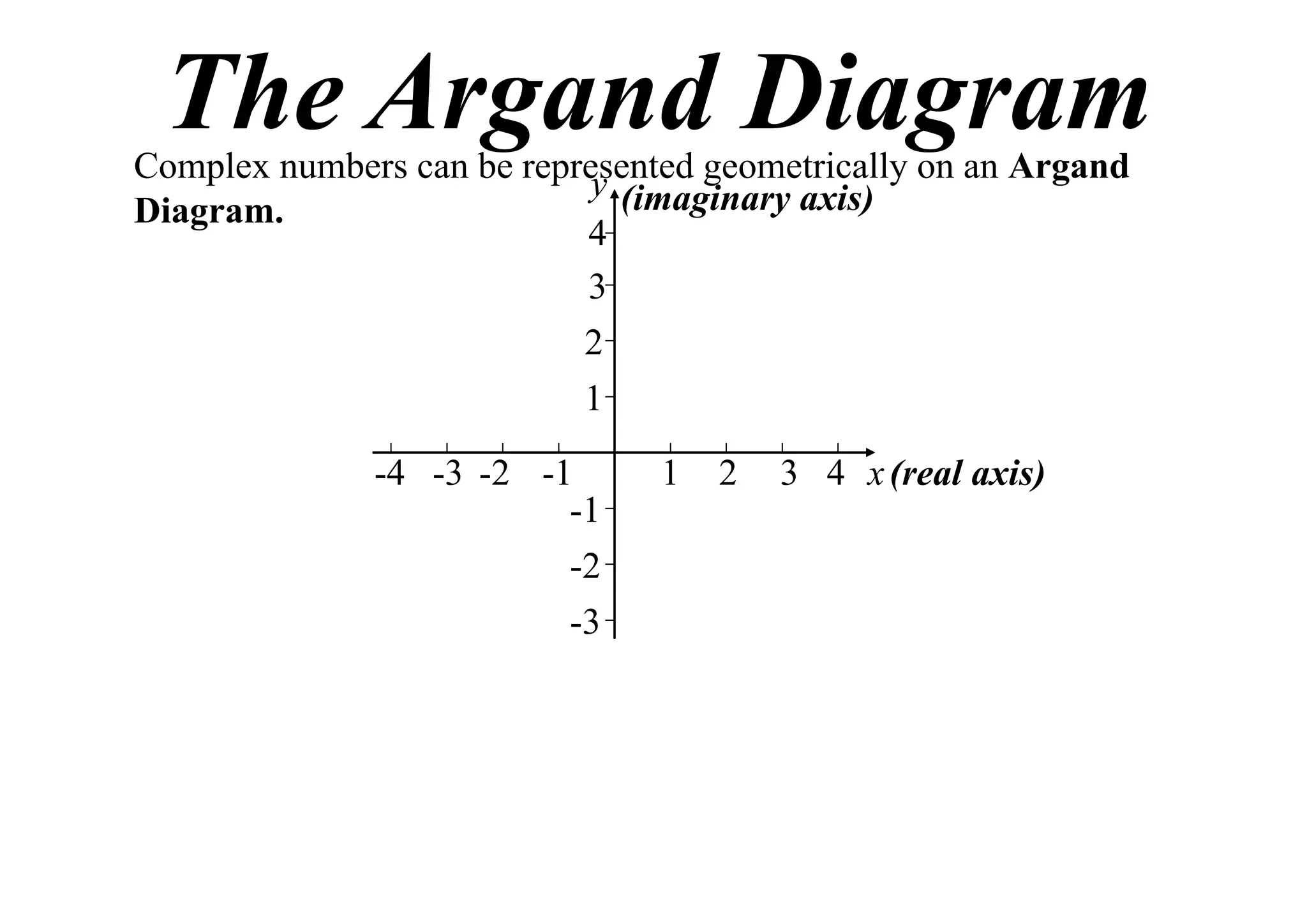
The document describes how complex numbers can be represented geometrically on an Argand diagram, which uses a horizontal x-axis for the real part and a vertical y-axis for the imaginary part. It provides examples of various complex numbers plotted as points on the diagram and notes that conjugates are reflections across the x-axis, while opposites involve a 180° rotation. The document then discusses how loci of complex functions can be represented as horizontal and vertical lines, circles, or other shapes on the Argand diagram. It provides two examples, showing that the locus of (i) (z + 4 + i)(z + 4 - i) = 49 is a circle with center (-4, -1) and radius 7 units


![Adv math[unit 1]](https://cdn.slidesharecdn.com/ss_thumbnails/advmathunit1-140731091801-phpapp01-thumbnail.jpg?width=640&height=640&fit=bounds)


