Intercepts


Objective: To graph a linear equation
using the x- and y-intercepts or using
      the slope and y-intercept.
5-Minute Check
Find the slope of the line that contains each pair of points.

   1. C(-4, -2), D(5, 3)
5-Minute Check
Find the slope of the line that contains each pair of points.

   1. C(-4, -2), D(5, 3)               5/9
5-Minute Check
Find the slope of the line that contains each pair of points.

   1. C(-4, -2), D(5, 3)               5/9

   2. H(1, 4), S(5, -2)
5-Minute Check
Find the slope of the line that contains each pair of points.

   1. C(-4, -2), D(5, 3)               5/9

   2. H(1, 4), S(5, -2)                -3/2
5-Minute Check
Find the slope of the line that contains each pair of points.

   1. C(-4, -2), D(5, 3)               5/9

   2. H(1, 4), S(5, -2)                -3/2

   3. G(0, 7), B(2, -7)
5-Minute Check
Find the slope of the line that contains each pair of points.

   1. C(-4, -2), D(5, 3)               5/9

   2. H(1, 4), S(5, -2)                -3/2

   3. G(0, 7), B(2, -7)                -7
5-Minute Check
Find the slope of the line that contains each pair of points.

   1. C(-4, -2), D(5, 3)               5/9

   2. H(1, 4), S(5, -2)                -3/2

   3. G(0, 7), B(2, -7)                -7

   4. J(0, 0), W(4, -4)
5-Minute Check
Find the slope of the line that contains each pair of points.

   1. C(-4, -2), D(5, 3)               5/9

   2. H(1, 4), S(5, -2)                -3/2

   3. G(0, 7), B(2, -7)                -7

   4. J(0, 0), W(4, -4)                -1
5-Minute Check
Find the slope of the line that contains each pair of points.

   1. C(-4, -2), D(5, 3)               5/9

   2. H(1, 4), S(5, -2)                -3/2

   3. G(0, 7), B(2, -7)                -7

   4. J(0, 0), W(4, -4)                -1

   5. R(-4, -4), F(-5, -3)
5-Minute Check
Find the slope of the line that contains each pair of points.

   1. C(-4, -2), D(5, 3)               5/9

   2. H(1, 4), S(5, -2)                -3/2

   3. G(0, 7), B(2, -7)                -7

   4. J(0, 0), W(4, -4)                -1

   5. R(-4, -4), F(-5, -3)             -1
What is an interception in football?
Intercepts


Learning the Concept
The graph of a linear function may cross either the x-
axis, the y-axis, or both axes.
The x-intercept is the x-coordinate of the point
where the graph crosses the x-axis.
The y-intercept is the y-coordinate of the point
where the graph crosses the y-axis.
Intercepts
     The line graphed below crosses both axes.

x-intercept The line graphed crosses the         6
            x-axis at (5, 0). Therefore the      5

            x-intercept is 5. Note that the      4

            corresponding y-coordinate is 0.     3   y-intercept
                                                 2


y-intercept The line crosses the y-axis at       1

                                                 0
            (0, 2). So the y-intercept is 2.         1   2   3     4   5       6


            Note that the corresponding                          x-intercept
            x-coordinate is 0.
Intercepts

From the previous slide, we learned that the y-
coordinate for the point of the x-intercept is 0.
We also learned that the x-coordinate for the point of
the y-intercept is 0.
So, to solve for the x-intercept for an equation, we
let the y-value be 0 and then solve for x.
Also to solve for the y-intercept for an equation, we
let the x-value be 0 and then solve for y.
Intercepts
Example 1
Find the x-intercept and y-intercept for y = 3/2x – 6.
Then graph the equation using the x- and y-intercepts.
 x-intercept:                  y-intercept:
 y = 3/2x – 6                  y = 3/2x – 6
 0 = 3/2x – 6                  y = 3/2*0 – 6
  0 + 6 = 3/2x – 6 + 6          y= –6
  6 = 3/2x
 6*2/3 = 3/2*2/3x
 4=x                           The y-intercept is -6.
 The x-intercept is 4.         The ordered pair is (0,-6).
 The ordered pair is (4,0).
Intercepts
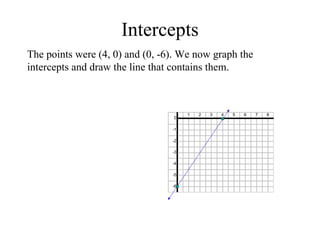
The points were (4, 0) and (0, -6). We now graph the
intercepts and draw the line that contains them.


                                      1   2   3   4   5   6   7   8
                                 0

                                 -1

                                 -2

                                 -3

                                 -4

                                 -5

                                 -6
Intercepts
The points were (4, 0) and (0, -6). We now graph the
intercepts and draw the line that contains them.


                                      1   2   3   4   5   6   7   8
                                 0

                                 -1

                                 -2

                                 -3

                                 -4

                                 -5

                                 -6
Intercepts
The points were (4, 0) and (0, -6). We now graph the
intercepts and draw the line that contains them.


                                      1   2   3   4   5   6   7   8
                                 0

                                 -1

                                 -2

                                 -3

                                 -4

                                 -5

                                 -6
Intercepts
The points were (4, 0) and (0, -6). We now graph the
intercepts and draw the line that contains them.


We can check our work by
selecting a point on the line,     0
                                        1   2   3   4   5   6   7   8

(2,-3) to see if we are correct.   -1

                                   -2
y = 3/2x – 6
                                   -3


– 3 = 3/2(2) – 6                   -4

                                   -5


–3=3–6                             -6


–3=–3
Intercepts
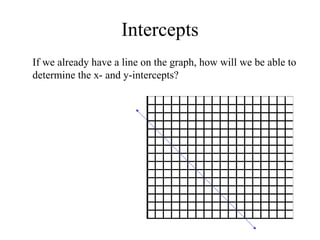
If we already have a line on the graph, how will we be able to
determine the x- and y-intercepts?
Intercepts
 If we already have a line on the graph, how will we be able to
 determine the x- and y-intercepts?


What are the intercepts?
Intercepts
If we already have a line on the graph, how will we be able to
determine the x- and y-intercepts?

What is the slope
of this line?

Pre algebra lesson 8-7

  • 1.
    Intercepts Objective: To grapha linear equation using the x- and y-intercepts or using the slope and y-intercept.
  • 2.
    5-Minute Check Find theslope of the line that contains each pair of points. 1. C(-4, -2), D(5, 3)
  • 3.
    5-Minute Check Find theslope of the line that contains each pair of points. 1. C(-4, -2), D(5, 3) 5/9
  • 4.
    5-Minute Check Find theslope of the line that contains each pair of points. 1. C(-4, -2), D(5, 3) 5/9 2. H(1, 4), S(5, -2)
  • 5.
    5-Minute Check Find theslope of the line that contains each pair of points. 1. C(-4, -2), D(5, 3) 5/9 2. H(1, 4), S(5, -2) -3/2
  • 6.
    5-Minute Check Find theslope of the line that contains each pair of points. 1. C(-4, -2), D(5, 3) 5/9 2. H(1, 4), S(5, -2) -3/2 3. G(0, 7), B(2, -7)
  • 7.
    5-Minute Check Find theslope of the line that contains each pair of points. 1. C(-4, -2), D(5, 3) 5/9 2. H(1, 4), S(5, -2) -3/2 3. G(0, 7), B(2, -7) -7
  • 8.
    5-Minute Check Find theslope of the line that contains each pair of points. 1. C(-4, -2), D(5, 3) 5/9 2. H(1, 4), S(5, -2) -3/2 3. G(0, 7), B(2, -7) -7 4. J(0, 0), W(4, -4)
  • 9.
    5-Minute Check Find theslope of the line that contains each pair of points. 1. C(-4, -2), D(5, 3) 5/9 2. H(1, 4), S(5, -2) -3/2 3. G(0, 7), B(2, -7) -7 4. J(0, 0), W(4, -4) -1
  • 10.
    5-Minute Check Find theslope of the line that contains each pair of points. 1. C(-4, -2), D(5, 3) 5/9 2. H(1, 4), S(5, -2) -3/2 3. G(0, 7), B(2, -7) -7 4. J(0, 0), W(4, -4) -1 5. R(-4, -4), F(-5, -3)
  • 11.
    5-Minute Check Find theslope of the line that contains each pair of points. 1. C(-4, -2), D(5, 3) 5/9 2. H(1, 4), S(5, -2) -3/2 3. G(0, 7), B(2, -7) -7 4. J(0, 0), W(4, -4) -1 5. R(-4, -4), F(-5, -3) -1
  • 12.
    What is aninterception in football?
  • 13.
    Intercepts Learning the Concept Thegraph of a linear function may cross either the x- axis, the y-axis, or both axes. The x-intercept is the x-coordinate of the point where the graph crosses the x-axis. The y-intercept is the y-coordinate of the point where the graph crosses the y-axis.
  • 14.
    Intercepts The line graphed below crosses both axes. x-intercept The line graphed crosses the 6 x-axis at (5, 0). Therefore the 5 x-intercept is 5. Note that the 4 corresponding y-coordinate is 0. 3 y-intercept 2 y-intercept The line crosses the y-axis at 1 0 (0, 2). So the y-intercept is 2. 1 2 3 4 5 6 Note that the corresponding x-intercept x-coordinate is 0.
  • 15.
    Intercepts From the previousslide, we learned that the y- coordinate for the point of the x-intercept is 0. We also learned that the x-coordinate for the point of the y-intercept is 0. So, to solve for the x-intercept for an equation, we let the y-value be 0 and then solve for x. Also to solve for the y-intercept for an equation, we let the x-value be 0 and then solve for y.
  • 16.
    Intercepts Example 1 Find thex-intercept and y-intercept for y = 3/2x – 6. Then graph the equation using the x- and y-intercepts. x-intercept: y-intercept: y = 3/2x – 6 y = 3/2x – 6 0 = 3/2x – 6 y = 3/2*0 – 6 0 + 6 = 3/2x – 6 + 6 y= –6 6 = 3/2x 6*2/3 = 3/2*2/3x 4=x The y-intercept is -6. The x-intercept is 4. The ordered pair is (0,-6). The ordered pair is (4,0).
  • 17.
    Intercepts The points were(4, 0) and (0, -6). We now graph the intercepts and draw the line that contains them. 1 2 3 4 5 6 7 8 0 -1 -2 -3 -4 -5 -6
  • 18.
    Intercepts The points were(4, 0) and (0, -6). We now graph the intercepts and draw the line that contains them. 1 2 3 4 5 6 7 8 0 -1 -2 -3 -4 -5 -6
  • 19.
    Intercepts The points were(4, 0) and (0, -6). We now graph the intercepts and draw the line that contains them. 1 2 3 4 5 6 7 8 0 -1 -2 -3 -4 -5 -6
  • 20.
    Intercepts The points were(4, 0) and (0, -6). We now graph the intercepts and draw the line that contains them. We can check our work by selecting a point on the line, 0 1 2 3 4 5 6 7 8 (2,-3) to see if we are correct. -1 -2 y = 3/2x – 6 -3 – 3 = 3/2(2) – 6 -4 -5 –3=3–6 -6 –3=–3
  • 21.
    Intercepts If we alreadyhave a line on the graph, how will we be able to determine the x- and y-intercepts?
  • 22.
    Intercepts If wealready have a line on the graph, how will we be able to determine the x- and y-intercepts? What are the intercepts?
  • 23.
    Intercepts If we alreadyhave a line on the graph, how will we be able to determine the x- and y-intercepts? What is the slope of this line?