Planning for teaching
and learning
Focus: Outcomes and
domains
“Fail to prepare, then prepare to fail”
Bill McClaren
What am I
Doing?
We are going to look at how to:
•Write clear & measurable learning outcomes
•Decide which domain your subject belongs to
•Consider some issues with the ‘outcome culture’
Designing the Curriculum
Qualifications and Curriculum Authority
(QCA) has developed the following 3
questions – these could be the starting
point for planning
• What are we trying to achieve?
• How do we organise learning?
• How well are we achieving our aims?
Focus of curriculum design
Shift to a ‘learner centred’ approach
“focuses on the learner and their needs, rather than being
centred around the teacher's input…….aims at reliance
on active rather than passive learning, an emphasis on
deep learning and understanding, an increased
responsibility and accountability on the part of the
student…....” (Bologna Process Initiatives 2009)
How can teachers translate that vision
into planning for teaching and learning?
• One view is that central to designing
sessions which focus upon the needs of
students and what they should be able to
achieve in the session is the development
of a clear and concise AIM and specific
and measurable LEARNING OUTCOMES
(LO’s)
What is Planning?
“Planning is the bridge between identification
of learners’ needs and the learning
activities they undertake……it is the
process of making decisions about the
directions that learners will take and the
activities they will engage in……….”
(Castling 1996)
Starting point for planning a
session
You need to be able to describe what you
want them to do or what your intention is
i.e. have an AIM
“aims are the teachers intentions”(Adam
2004) “general content, direction and
intentions”(Moon 2002)
You say objectives, I say outcomes,
she says learning targets
What do you say?
What does the documentation you use say?
What’s the difference?
Does it matter?
Learning Outcomes
• You need know what you want them to learn in
order to assess whether or not they have
learned it
• They need to know what they are expected to
do
• The outcomes must focus on the action the
learners will take rather than what you will
do (i.e. ‘learner centred’) NOT what you will
do
Learning outcomes
Specify precisely what learners should be able to
do or be SMART
•Specific
•Measurable
•Achievable (possible)
•Relevant (within the timeframe)
•Time bound (setting timeframes)
Examples
By the end of the session the learners
will be able to
• Assemble a door frame which accurately
follows the plan provided
• Name all the Prime Ministers of Britain
from 1900 to the present day
• List 3 short-term health benefits of
stopping smoking
Are these Learning Outcomes?
By the end of the session………..
• I will show them how to use a chisel to safely
produce a dove tail joint
• Understand how to use powerpoint
• Will know about why the 2nd
World War started
Where does the idea that we
need outcomes come from?
• Curriculum model called the Product
Model or Outcomes Model
• Attempts to correct the perceived
vagueness of education. Politically
motivated?
• Also need to specify practical skills more
precisely – vocational and craft courses
Setting Goals – Hattie and effect
size
• Empirical data showing how you can
improve the ‘effect’ of learning.
• Students setting own ’goals’ creates
highest ‘effect’- e.g. “ set yourself a goal
now- write it on the top of your work”
• Remind learners of goals from time to time
in the session “Have you achieved your
goal yet – why not? What information do
you need?” (Hattie 1999)
Classification of outcomes
B. S. Bloom (1956) first developed his
‘Taxonomy of Educational Objectives’
This classified all learning into three domains
(Cognitive, Psychomotor and Affective)
www.nwlink.com/~donclark/hrd/bloom.html
http://www.learningandteaching.info/learning/bloomtax.htm
http://projects.coe.uga.edu/epltt/index.php?title=Bloom%27s_Taxonomy
Cognitive
• Cognitive = Intellectual skills, remembering
and understanding
(e.g. history and law)
Easiest = remembering
Hardest = evaluation
Psychomotor
• Motor or physical skills, including hand
and eye coordination (e.g. sport, joinery
and hairdressing)
Easiest = copy
Hardest = naturalisation
• Affective - Attitudes, awareness, opinions
values, behaviour (health studies and
counselling – PROBLEM! How can you
have precise measurement of learning in
this domain?
Easiest = Receiving
Hardest = Internalisation
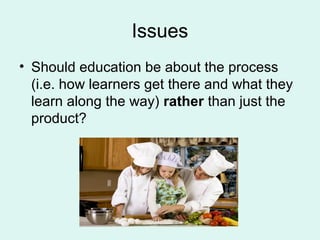
Issues
• Should education be about the process
(i.e. how learners get there and what they
learn along the way) rather than just the
product?
• Does the language of business have any
place in education OR should we have
educational language for education?
• Who in your curriculum delivery decides
what the outcomes should be? Is it the
right people?
• Does writing ‘good’ outcomes
automatically make you a better teacher?
• Could it constrain learning, making it less
responsive to the needs and interests of
the learner AND wider needs
Kelly sums up this approach as the actions
of a ‘kind of ‘thought police’ designed to
prevent teachers from indulging in acts of
‘sabotage’ by acting on their own
professional judgement’ (Kelly p.15)
Avoid jargon or official ‘teacher talk’ when
introducing outcomes to your students.
Instead……………………..
……………..
• Create interest/curiosity
• Make them into a task
• Use as a diagnostic tool
• Let the learners rank them – prioritise
• Facilitate reflection and self-assessment
• Encourage dialogue and interaction
• Surprise them/make them fun
Useful sites & References
• http://www.heacademy.ac.uk/assets/ps/documents/primers/primers/
ps0091_writing_learning_outcomes_mar_2005.pdf
• Reece, I. and Walker, S. (2006) Teaching, training and learning.
Sunderland: Business Education Publishers.
• Petty, G ( 2009) Evidence-based teaching. 2nd
Edition. Cheltenham:
Nelson Thornes
• Hattie, J.A. (1999) Influences on student learning. [Online]. Available
http://www.education.auckland.ac.nz/uoa/home/about/staff/j.hattie/h
attie-papers-download/influences. [02 September 2013]
Classroom Activities
Why is it important to use
objectives?
2 or 3 minutes to discuss and feedback
Reasons might include:
• You know what they have learnt
• You can measure/assess their success/or
not
• Supporting those not achieving
• Stretching those who find it easy
• Make sure they meet the course reqs.
• Links to assessment tasks

Planning for teaching and learning

  • 1.
    Planning for teaching andlearning Focus: Outcomes and domains “Fail to prepare, then prepare to fail” Bill McClaren What am I Doing?
  • 2.
    We are goingto look at how to: •Write clear & measurable learning outcomes •Decide which domain your subject belongs to •Consider some issues with the ‘outcome culture’
  • 3.
    Designing the Curriculum Qualificationsand Curriculum Authority (QCA) has developed the following 3 questions – these could be the starting point for planning • What are we trying to achieve? • How do we organise learning? • How well are we achieving our aims?
  • 4.
    Focus of curriculumdesign Shift to a ‘learner centred’ approach “focuses on the learner and their needs, rather than being centred around the teacher's input…….aims at reliance on active rather than passive learning, an emphasis on deep learning and understanding, an increased responsibility and accountability on the part of the student…....” (Bologna Process Initiatives 2009)
  • 5.
    How can teacherstranslate that vision into planning for teaching and learning? • One view is that central to designing sessions which focus upon the needs of students and what they should be able to achieve in the session is the development of a clear and concise AIM and specific and measurable LEARNING OUTCOMES (LO’s)
  • 6.
    What is Planning? “Planningis the bridge between identification of learners’ needs and the learning activities they undertake……it is the process of making decisions about the directions that learners will take and the activities they will engage in……….” (Castling 1996)
  • 7.
    Starting point forplanning a session You need to be able to describe what you want them to do or what your intention is i.e. have an AIM “aims are the teachers intentions”(Adam 2004) “general content, direction and intentions”(Moon 2002)
  • 8.
    You say objectives,I say outcomes, she says learning targets What do you say? What does the documentation you use say? What’s the difference? Does it matter?
  • 9.
    Learning Outcomes • Youneed know what you want them to learn in order to assess whether or not they have learned it • They need to know what they are expected to do • The outcomes must focus on the action the learners will take rather than what you will do (i.e. ‘learner centred’) NOT what you will do
  • 10.
    Learning outcomes Specify preciselywhat learners should be able to do or be SMART •Specific •Measurable •Achievable (possible) •Relevant (within the timeframe) •Time bound (setting timeframes)
  • 11.
    Examples By the endof the session the learners will be able to • Assemble a door frame which accurately follows the plan provided • Name all the Prime Ministers of Britain from 1900 to the present day • List 3 short-term health benefits of stopping smoking
  • 12.
    Are these LearningOutcomes? By the end of the session……….. • I will show them how to use a chisel to safely produce a dove tail joint • Understand how to use powerpoint • Will know about why the 2nd World War started
  • 13.
    Where does theidea that we need outcomes come from? • Curriculum model called the Product Model or Outcomes Model • Attempts to correct the perceived vagueness of education. Politically motivated? • Also need to specify practical skills more precisely – vocational and craft courses
  • 14.
    Setting Goals –Hattie and effect size • Empirical data showing how you can improve the ‘effect’ of learning. • Students setting own ’goals’ creates highest ‘effect’- e.g. “ set yourself a goal now- write it on the top of your work” • Remind learners of goals from time to time in the session “Have you achieved your goal yet – why not? What information do you need?” (Hattie 1999)
  • 15.
    Classification of outcomes B.S. Bloom (1956) first developed his ‘Taxonomy of Educational Objectives’ This classified all learning into three domains (Cognitive, Psychomotor and Affective) www.nwlink.com/~donclark/hrd/bloom.html http://www.learningandteaching.info/learning/bloomtax.htm http://projects.coe.uga.edu/epltt/index.php?title=Bloom%27s_Taxonomy
  • 16.
    Cognitive • Cognitive =Intellectual skills, remembering and understanding (e.g. history and law) Easiest = remembering Hardest = evaluation
  • 17.
    Psychomotor • Motor orphysical skills, including hand and eye coordination (e.g. sport, joinery and hairdressing) Easiest = copy Hardest = naturalisation
  • 18.
    • Affective -Attitudes, awareness, opinions values, behaviour (health studies and counselling – PROBLEM! How can you have precise measurement of learning in this domain? Easiest = Receiving Hardest = Internalisation
  • 19.
    Issues • Should educationbe about the process (i.e. how learners get there and what they learn along the way) rather than just the product?
  • 20.
    • Does thelanguage of business have any place in education OR should we have educational language for education? • Who in your curriculum delivery decides what the outcomes should be? Is it the right people? • Does writing ‘good’ outcomes automatically make you a better teacher?
  • 21.
    • Could itconstrain learning, making it less responsive to the needs and interests of the learner AND wider needs Kelly sums up this approach as the actions of a ‘kind of ‘thought police’ designed to prevent teachers from indulging in acts of ‘sabotage’ by acting on their own professional judgement’ (Kelly p.15)
  • 22.
    Avoid jargon orofficial ‘teacher talk’ when introducing outcomes to your students. Instead……………………..
  • 23.
    …………….. • Create interest/curiosity •Make them into a task • Use as a diagnostic tool • Let the learners rank them – prioritise • Facilitate reflection and self-assessment • Encourage dialogue and interaction • Surprise them/make them fun
  • 24.
    Useful sites &References • http://www.heacademy.ac.uk/assets/ps/documents/primers/primers/ ps0091_writing_learning_outcomes_mar_2005.pdf • Reece, I. and Walker, S. (2006) Teaching, training and learning. Sunderland: Business Education Publishers. • Petty, G ( 2009) Evidence-based teaching. 2nd Edition. Cheltenham: Nelson Thornes • Hattie, J.A. (1999) Influences on student learning. [Online]. Available http://www.education.auckland.ac.nz/uoa/home/about/staff/j.hattie/h attie-papers-download/influences. [02 September 2013]
  • 25.
  • 26.
    Why is itimportant to use objectives? 2 or 3 minutes to discuss and feedback Reasons might include: • You know what they have learnt • You can measure/assess their success/or not • Supporting those not achieving • Stretching those who find it easy • Make sure they meet the course reqs. • Links to assessment tasks