Outcomes 
Peter Fenrich 
Instructional Development Consultant 
Learning and Teaching Centre (bcit.ca/ltc) 
British Columbia Institute of Technology 
Tel: 604-432-8817 
Peter_Fenrich@bcit.ca
Possible Confusion? 
 As a student, have you 
ever asked yourself: 
 “What should I focus 
on?” 
 “What does he/she 
really want us to be able 
to do?” 
 “What is on the test?”
The Outcome 
 By the end of this lesson, 
you should be able to: 
- write complete outcomes 
- evaluate whether an 
outcome is written well 
 What does outcome mean 
to you?
What are Outcomes? 
 Outcomes are specific measurable 
skills that tell what learners should 
be able to do. 
 Also called learning outcomes, 
objectives, and competencies.
Goals Versus Outcomes 
 Goals are broad skills that may not 
be directly measurable. 
- You should be able to teach 
effectively. 
 Outcomes are specific measurable 
skills. 
- You should be able to make 
lessons interactive through asking 
open-ended questions.
For Who? 
 Outcomes communicate to learners, 
instructors, and other interested 
people, what learners should be 
able to do. 
 Stated outcomes lead to an 
expectation of what is to be taught. 
You need to do your best to achieve 
those outcomes.
Why Outcomes Help Learners 
 With those at your table, determine 
two reasons why outcomes help 
learners? 
1) __________________________ 
__________________________ 
2) __________________________ 
__________________________
Why Outcomes Help Learners 
 Learners do better, when informed 
 They help learners: 
- focus their thoughts 
- organize their studying 
- avoid becoming lost 
- make appropriate decisions 
- maintain their motivation 
 Note that higher expectations lead 
to higher results
Why Cover Outcomes (1)? 
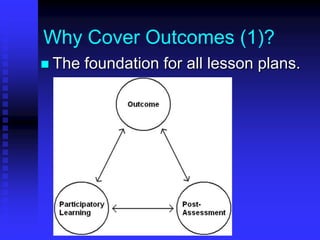
 The foundation for all lesson plans.
Why Cover Outcomes (2)? 
 Outcomes are often 
a) assessed at a different than 
stated level 
b) not set to a high enough level 
c) written poorly 
d) all of the above
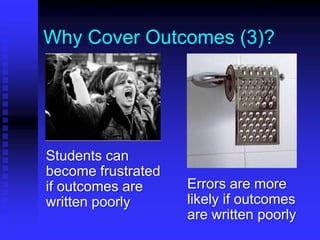
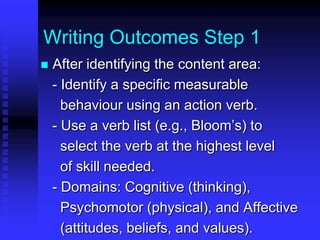
Why Cover Outcomes (3)? 
Students can 
become frustrated 
if outcomes are 
written poorly 
Errors are more 
likely if outcomes 
are written poorly
Steps to Writing Outcomes
Writing Outcomes Step 1 
 After identifying the content area: 
- Identify a specific measurable 
behaviour using an action verb. 
- Use a verb list (e.g., Bloom’s) to 
select the verb at the highest level 
of skill needed. 
- Domains: Cognitive (thinking), 
Psychomotor (physical), and Affective 
(attitudes, beliefs, and values).
Writing Outcomes Step 1 
 Do NOT use the following, as they are 
imprecise, are hard to measure, and/or 
can be at various thinking levels. 
 E.g., You will appreciate the importance 
of personal protective equipment 
 Understand, appreciate, know, discover, realize, 
comprehend, grasp, get, believe, think, perceive, figure 
out, enjoy, learn, consider, feel, see, be introduced to, 
show awareness of, show an interest in, show a proper 
attitude, show capacity for, become familiar with, 
develop critical thinking abilities, develop intelligence, 
use
Writing Outcomes Step 1 
 In the content area of “Outcomes”: 
- For this lesson, “Write” and 
“Evaluate” are good verbs to use. 
- “Have knowledge of” is a bad 
“verb”. Why? 
- For this lesson, I would not teach 
you to “Describe” a learning 
outcome. Why not?
Writing Outcomes Step 2 
 After selecting the verb, write a 
sentence with the content area put 
after the verb. For example: 
 Write an outcome that has a 
measurable action verb.
Writing Outcomes Step 3 
 After putting the content area after 
the verb, specify applicable 
conditions. For example: 
 Write an outcome that has a 
measurable action verb, given verbs 
listed within Bloom’s taxonomy.
Writing Outcomes Step 4 
 After specifying applicable 
conditions, specify applicable 
criteria. For example: 
 Write an outcome that has a 
measurable action verb, given verbs 
listed within Bloom’s taxonomy, that 
is at the highest level needed. 
 Conditions can be about accuracy. 
 When is 100% accuracy needed?
Writing Outcomes Step 5 
 After specifying applicable criteria, it 
is complete. 
 Review the learning outcome. 
- Consider having others do this.
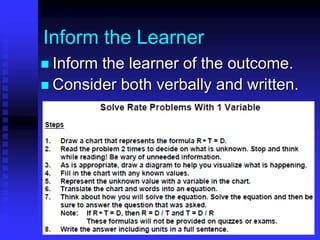
Inform the Learner 
 Inform the learner of the outcome. 
 Consider both verbally and written.
Phrasing the Outcome 
 A “risky” start to an outcome is: 
“Today we will talk about …” 
 A “safe” start to an outcome is: 
“You should be able to …” 
 Why is the former risky compared to 
the latter?
Summary 
 Outcomes are specific measurable skills. 
 1. Identify a specific measurable 
behaviour using an action verb. 
Ensure the verb is at the highest 
appropriate level. 
 2. Put the content area after the verb. 
 3. Specify applicable conditions. 
 4. Specify applicable criteria. 
 5. Review it.
Key Points 
 Write down two or more key points 
about writing learning outcomes that 
are important to you. 
______________________________ 
______________________________ 
______________________________ 
______________________________ 
______________________________
Write/Review An Outcome 
 Write your own learning outcome 
_______________________________________ 
_______________________________________ 
_______________________________________ 
_______________________________________ 
 Review it based on the steps. 
 Ask one other person review it. 
 Check it with me.
What questions 
about outcomes 
do you still have?

06 Outcomes

  • 1.
    Outcomes Peter Fenrich Instructional Development Consultant Learning and Teaching Centre (bcit.ca/ltc) British Columbia Institute of Technology Tel: 604-432-8817 Peter_Fenrich@bcit.ca
  • 2.
    Possible Confusion? As a student, have you ever asked yourself:  “What should I focus on?”  “What does he/she really want us to be able to do?”  “What is on the test?”
  • 3.
    The Outcome By the end of this lesson, you should be able to: - write complete outcomes - evaluate whether an outcome is written well  What does outcome mean to you?
  • 4.
    What are Outcomes?  Outcomes are specific measurable skills that tell what learners should be able to do.  Also called learning outcomes, objectives, and competencies.
  • 5.
    Goals Versus Outcomes  Goals are broad skills that may not be directly measurable. - You should be able to teach effectively.  Outcomes are specific measurable skills. - You should be able to make lessons interactive through asking open-ended questions.
  • 6.
    For Who? Outcomes communicate to learners, instructors, and other interested people, what learners should be able to do.  Stated outcomes lead to an expectation of what is to be taught. You need to do your best to achieve those outcomes.
  • 7.
    Why Outcomes HelpLearners  With those at your table, determine two reasons why outcomes help learners? 1) __________________________ __________________________ 2) __________________________ __________________________
  • 8.
    Why Outcomes HelpLearners  Learners do better, when informed  They help learners: - focus their thoughts - organize their studying - avoid becoming lost - make appropriate decisions - maintain their motivation  Note that higher expectations lead to higher results
  • 9.
    Why Cover Outcomes(1)?  The foundation for all lesson plans.
  • 10.
    Why Cover Outcomes(2)?  Outcomes are often a) assessed at a different than stated level b) not set to a high enough level c) written poorly d) all of the above
  • 11.
    Why Cover Outcomes(3)? Students can become frustrated if outcomes are written poorly Errors are more likely if outcomes are written poorly
  • 12.
  • 13.
    Writing Outcomes Step1  After identifying the content area: - Identify a specific measurable behaviour using an action verb. - Use a verb list (e.g., Bloom’s) to select the verb at the highest level of skill needed. - Domains: Cognitive (thinking), Psychomotor (physical), and Affective (attitudes, beliefs, and values).
  • 14.
    Writing Outcomes Step1  Do NOT use the following, as they are imprecise, are hard to measure, and/or can be at various thinking levels.  E.g., You will appreciate the importance of personal protective equipment  Understand, appreciate, know, discover, realize, comprehend, grasp, get, believe, think, perceive, figure out, enjoy, learn, consider, feel, see, be introduced to, show awareness of, show an interest in, show a proper attitude, show capacity for, become familiar with, develop critical thinking abilities, develop intelligence, use
  • 15.
    Writing Outcomes Step1  In the content area of “Outcomes”: - For this lesson, “Write” and “Evaluate” are good verbs to use. - “Have knowledge of” is a bad “verb”. Why? - For this lesson, I would not teach you to “Describe” a learning outcome. Why not?
  • 16.
    Writing Outcomes Step2  After selecting the verb, write a sentence with the content area put after the verb. For example:  Write an outcome that has a measurable action verb.
  • 17.
    Writing Outcomes Step3  After putting the content area after the verb, specify applicable conditions. For example:  Write an outcome that has a measurable action verb, given verbs listed within Bloom’s taxonomy.
  • 18.
    Writing Outcomes Step4  After specifying applicable conditions, specify applicable criteria. For example:  Write an outcome that has a measurable action verb, given verbs listed within Bloom’s taxonomy, that is at the highest level needed.  Conditions can be about accuracy.  When is 100% accuracy needed?
  • 19.
    Writing Outcomes Step5  After specifying applicable criteria, it is complete.  Review the learning outcome. - Consider having others do this.
  • 20.
    Inform the Learner  Inform the learner of the outcome.  Consider both verbally and written.
  • 21.
    Phrasing the Outcome  A “risky” start to an outcome is: “Today we will talk about …”  A “safe” start to an outcome is: “You should be able to …”  Why is the former risky compared to the latter?
  • 22.
    Summary  Outcomesare specific measurable skills.  1. Identify a specific measurable behaviour using an action verb. Ensure the verb is at the highest appropriate level.  2. Put the content area after the verb.  3. Specify applicable conditions.  4. Specify applicable criteria.  5. Review it.
  • 23.
    Key Points Write down two or more key points about writing learning outcomes that are important to you. ______________________________ ______________________________ ______________________________ ______________________________ ______________________________
  • 24.
    Write/Review An Outcome  Write your own learning outcome _______________________________________ _______________________________________ _______________________________________ _______________________________________  Review it based on the steps.  Ask one other person review it.  Check it with me.
  • 25.
    What questions aboutoutcomes do you still have?

Editor's Notes

  • #6 Mention that 10 minutes is not a rule.