

Teaching with Focus
on Learning Outcome
and Assessment
Dr. V Ramadas
Professor of Education
NCERT, RIE Mysore
What is your philosophy of teaching?
My philosophy of teaching
The way you perceive learning the way you
learn
The way you learn the way you teach
The way you teach the way the children learn
The way they learn the way they become
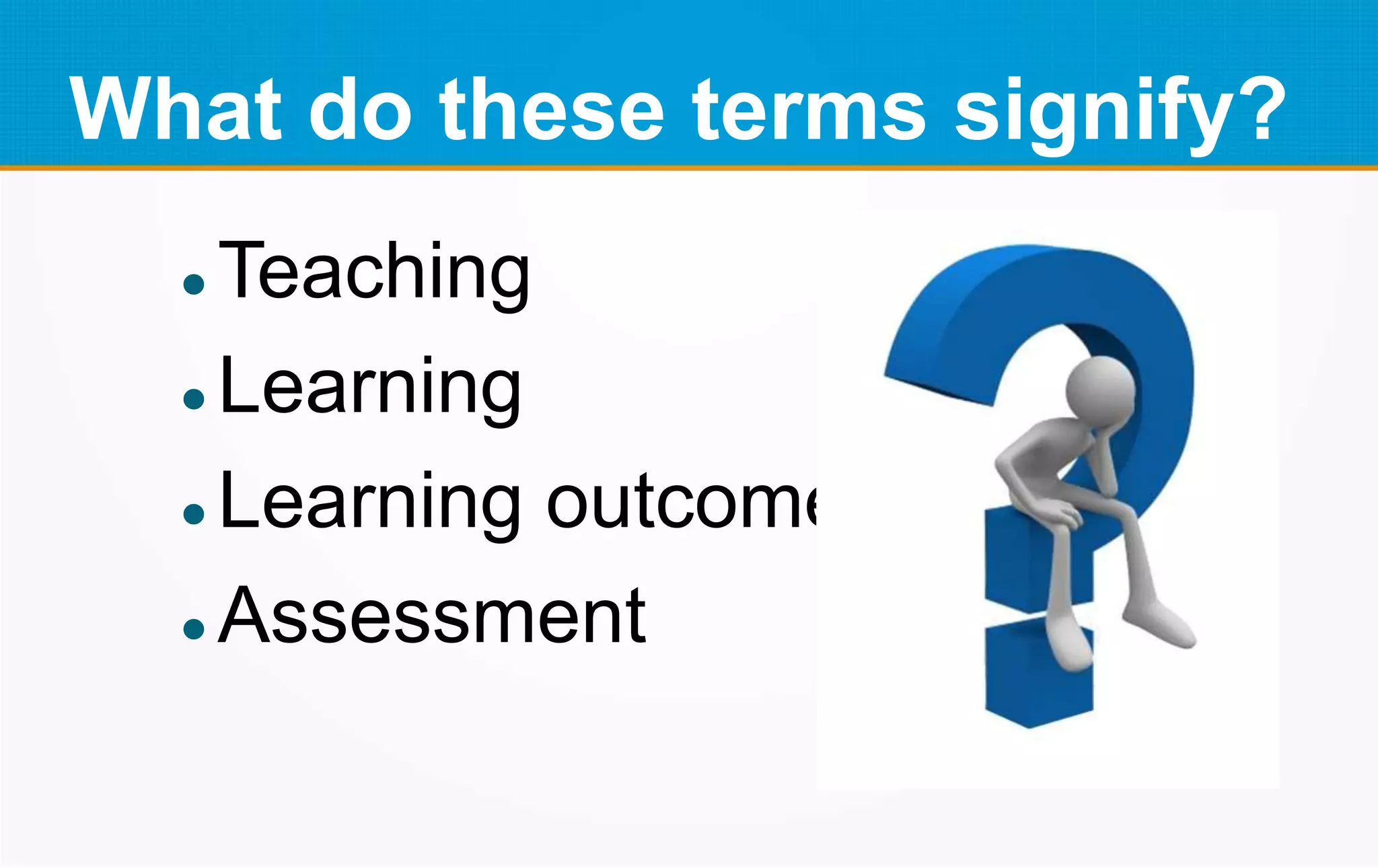
What do these terms signify?
 Teaching
 Learning
 Learning outcome
 Assessment
Which image is closest to your
idea of teaching?
A BA C
D E F
Has your idea about learning
changed over the years?
Many learning environment
 Teaching is context-specific.
Learning environment must be
suitable to the context.
 Examples of different learning
environments:
 A school or classroom
 An online course
 Military training
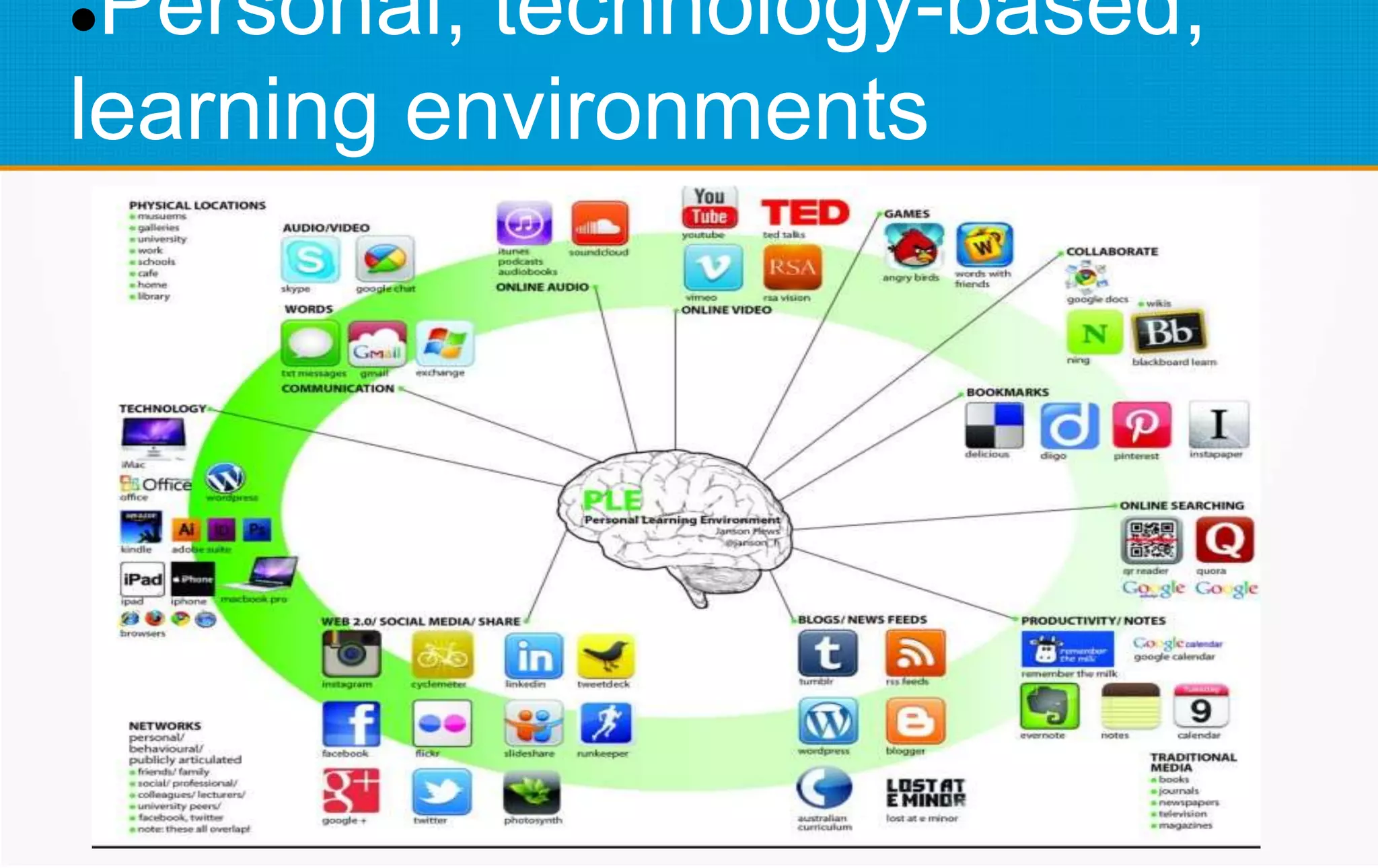
Personal, technology-based,
learning environments
Issues in developing effective
learning environment
1.It is the learner who has to do the learning.
 All that teacher can do is to create and manage an
environment that enables and encourages learning.
 The focus should be learner and what the learner needs.
2.Any learning environment is much more than the
technology used to support it.
 Technology-based learning environments may components of
effective learning environment.
 The technology may be necessary but it is not sufficient.
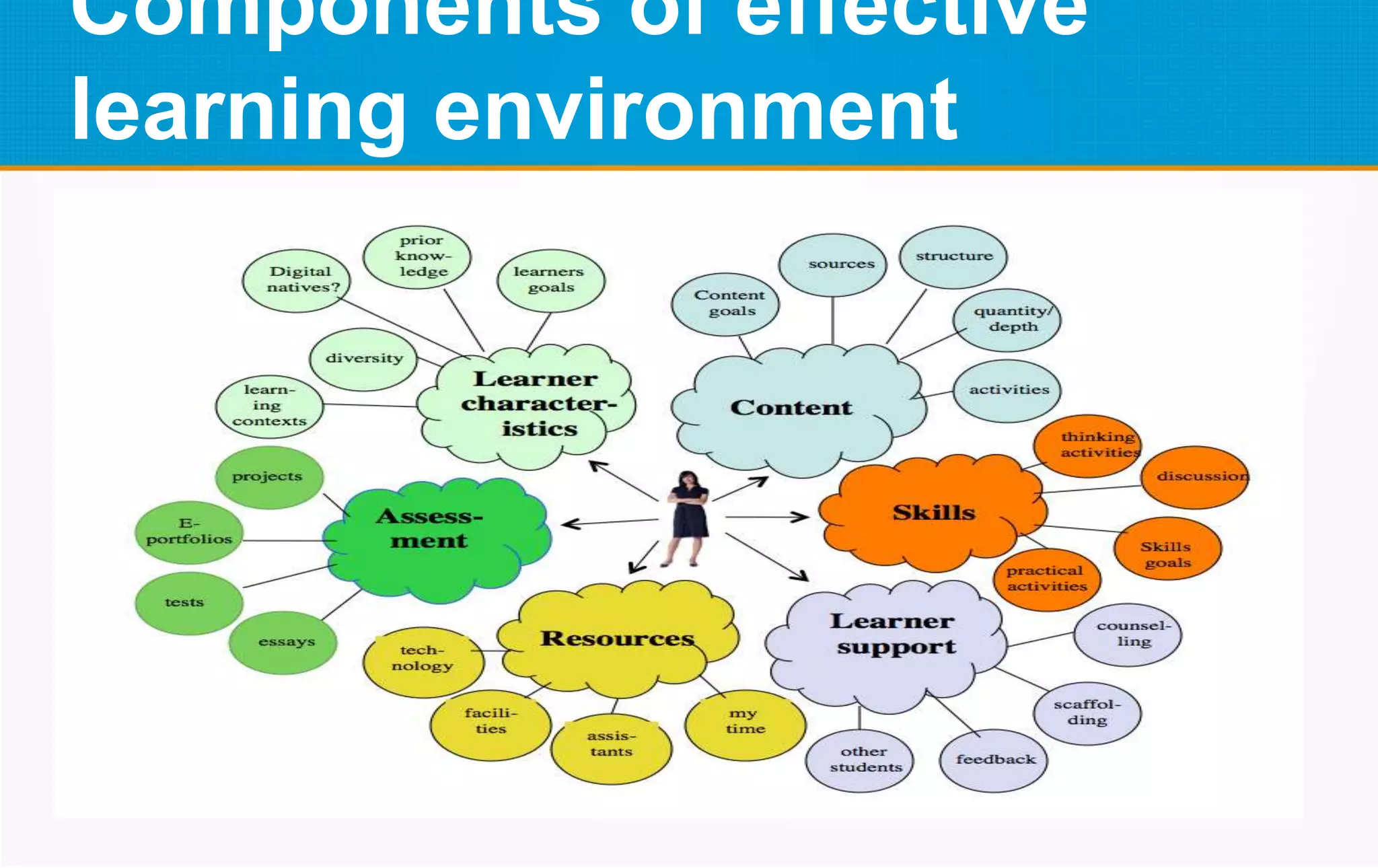
Components of effective
learning environment
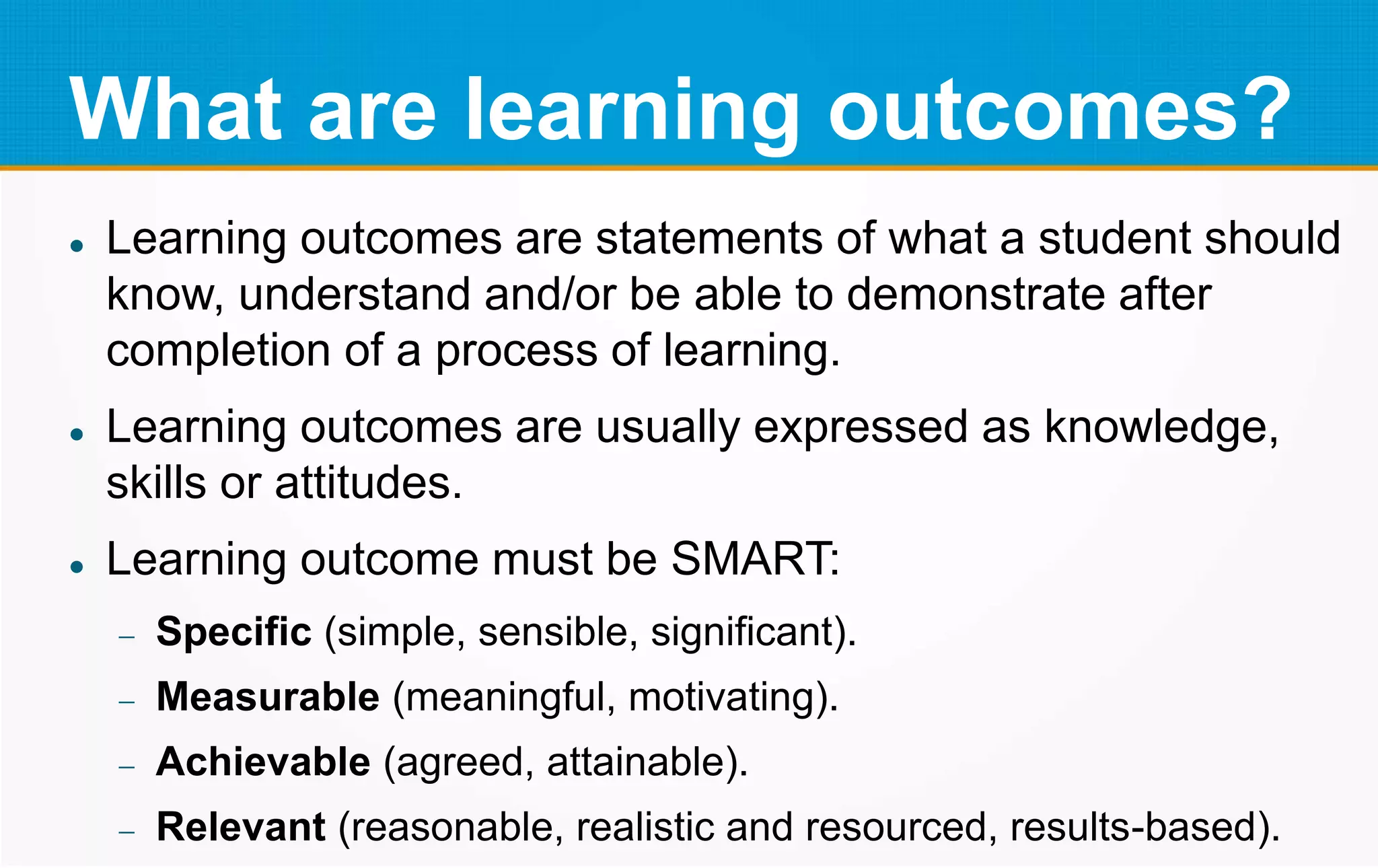
What are learning outcomes?
 Learning outcomes are statements of what a student should
know, understand and/or be able to demonstrate after
completion of a process of learning.
 Learning outcomes are usually expressed as knowledge,
skills or attitudes.
 Learning outcome must be SMART:
 Specific (simple, sensible, significant).
 Measurable (meaningful, motivating).
 Achievable (agreed, attainable).
 Relevant (reasonable, realistic and resourced, results-based).
Why learning outcome?
 Students, teachers, parents, community members and
educational administrators have to know about the
learning of students
 monitoring of the progress in learning
 Need to have some criteria against which the extent of
expected learning could be mapped/assessed.
 To help different stakeholders make their efforts; be at
home, classroom, school to ensure learning among
students providing quality education.
 To help agencies at the district, state, national or global
Elementary Stage”
(NCERT, 2016)
 Addressing quality concerns in education
 (Global Monitoring Report, ASER, NAS, Report of Joint Review Mission for SSA)
 Limitation of (MLL, 1992)
 (Product oriented, Inadequate to assess overall development)
 Radical shift in curriculum focus and role of the teacher
(NCF 2005)
 (Learner as constructor of knowledge, Teacher as a facilitator of learning process etc.)
 Right to Free and Compulsory Education Act 2009
(RTE)
 (Overall development of the child, CCE, Monitoring learning progression, Fear and trauma
free environment)
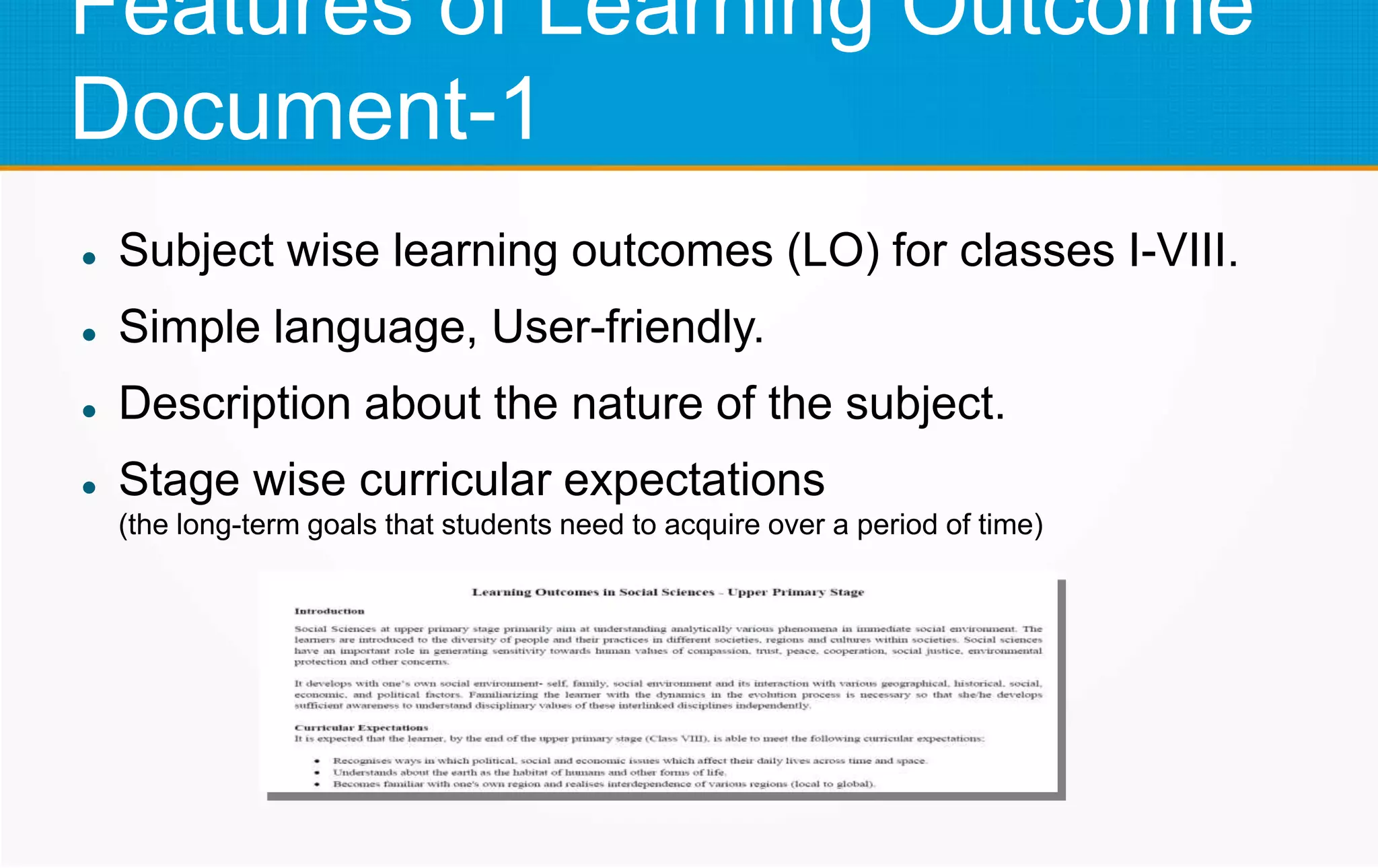
Features of Learning Outcome
Document-1
 Subject wise learning outcomes (LO) for classes I-VIII.
 Simple language, User-friendly.
 Description about the nature of the subject.
 Stage wise curricular expectations
(the long-term goals that students need to acquire over a period of time)
Features of Learning Outcome
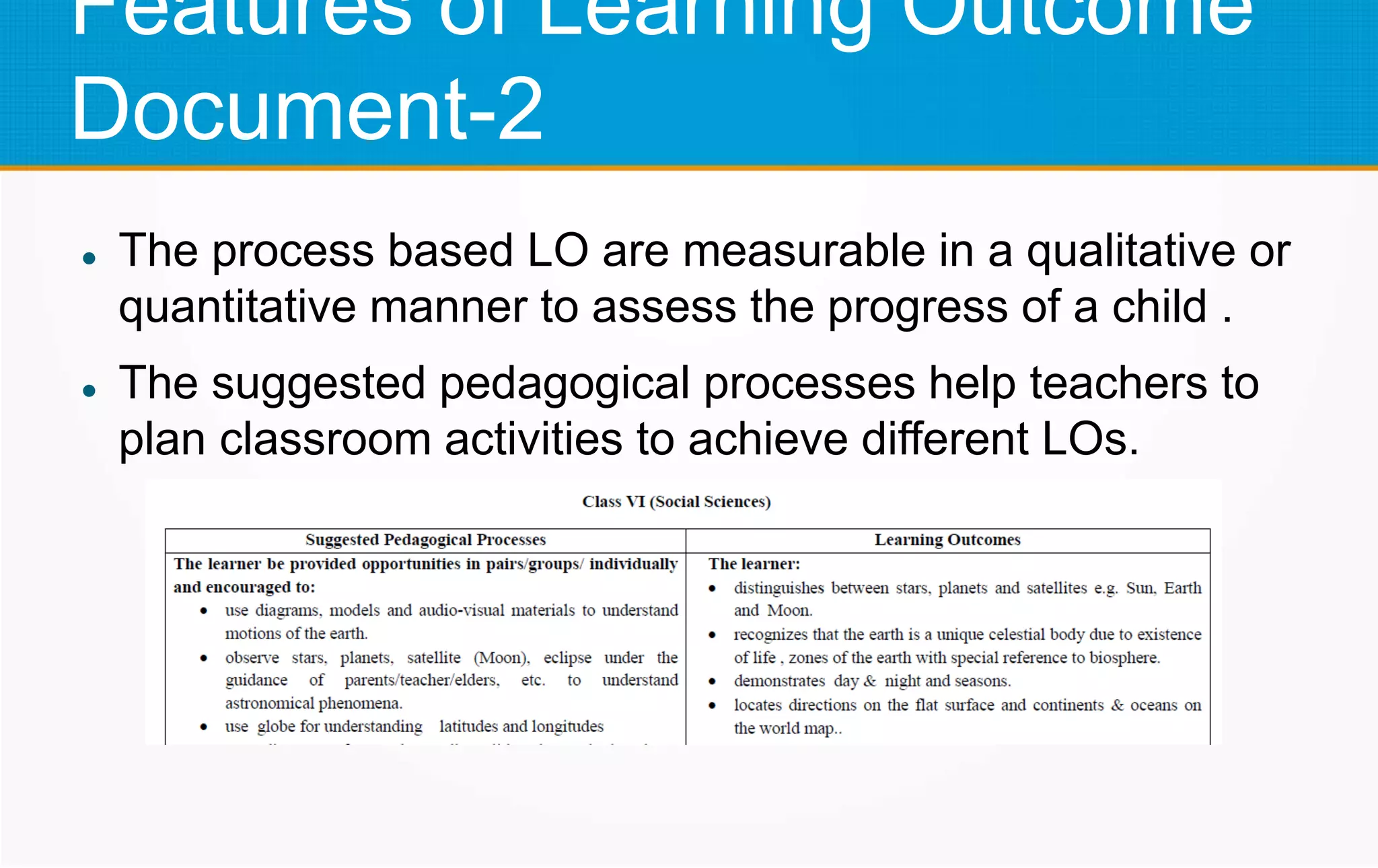
Document-2
 The process based LO are measurable in a qualitative or
quantitative manner to assess the progress of a child .
 The suggested pedagogical processes help teachers to
plan classroom activities to achieve different LOs.
Features of Learning Outcome
Document-3
 Using contextual resources and appropriate learning
processes, teachers can design and provide a variety of
learning situations in an inclusive classroom.
 The pedagogical processes are not directed at a
particular LO. They must be looked at holistically.
 The teachers may adopt/adapt and can even design
many more as per the availability of resources and local
context.
Features of Learning Outcome
Document-4
 The CWSN need to be facilitated with different aids and
peer support.
 (mobility aids (wheel chair, crutches, white cane), hearing-aids, visual aids (spectacles),
modifying the learning situations suiting to their needs, sensitising other children to help
them in need)
 The LOs in each curricular area are spirally linked in
terms of age appropriateness and complexity within and
across curricular areas and stages.
 The class-wise section may not be viewed in isolation but
a holistic perspective will help accomplish the goal of
overall development of a child.
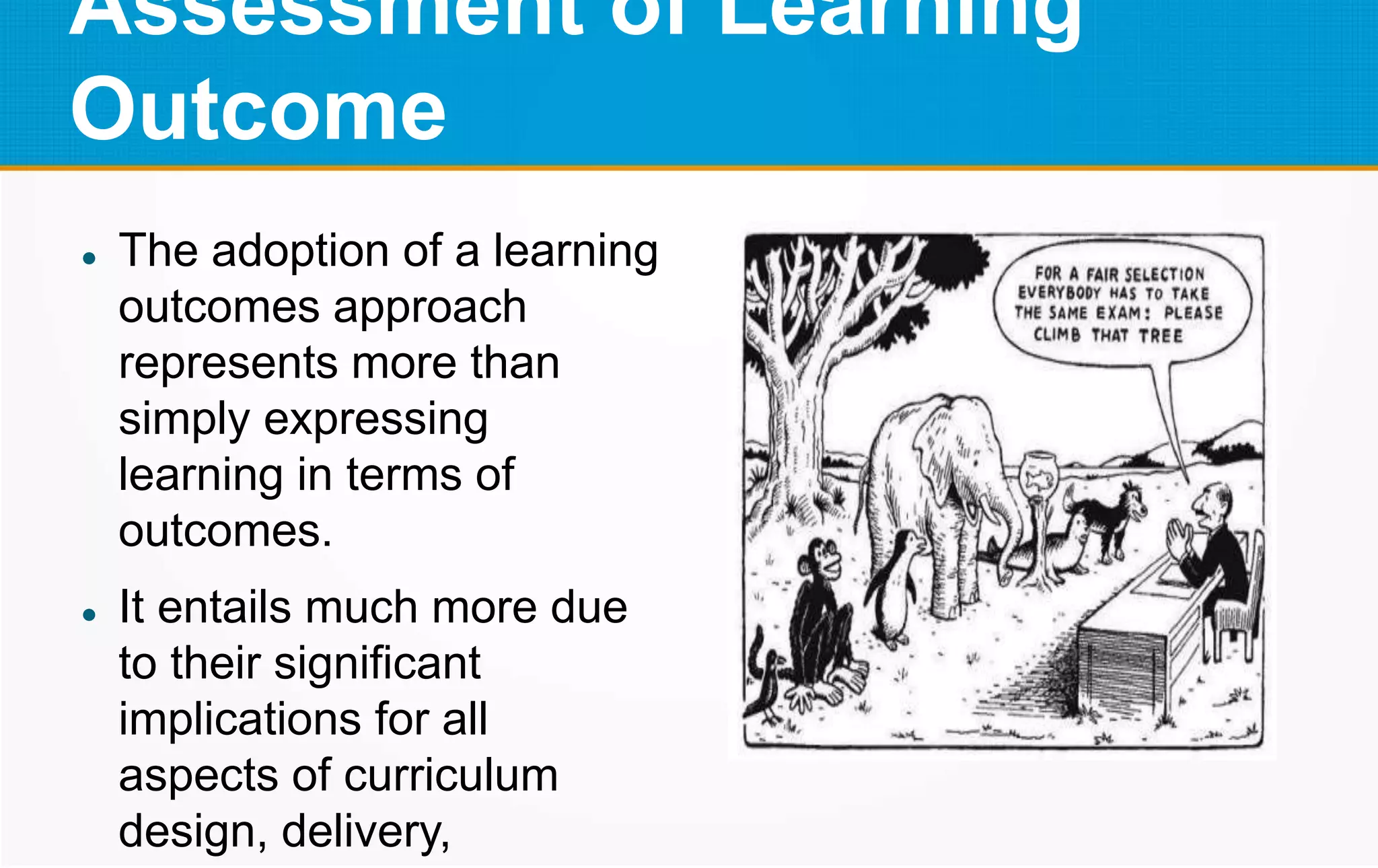
Assessment of Learning
Outcome
 The adoption of a learning
outcomes approach
represents more than
simply expressing
learning in terms of
outcomes.
 It entails much more due
to their significant
implications for all
aspects of curriculum
design, delivery,
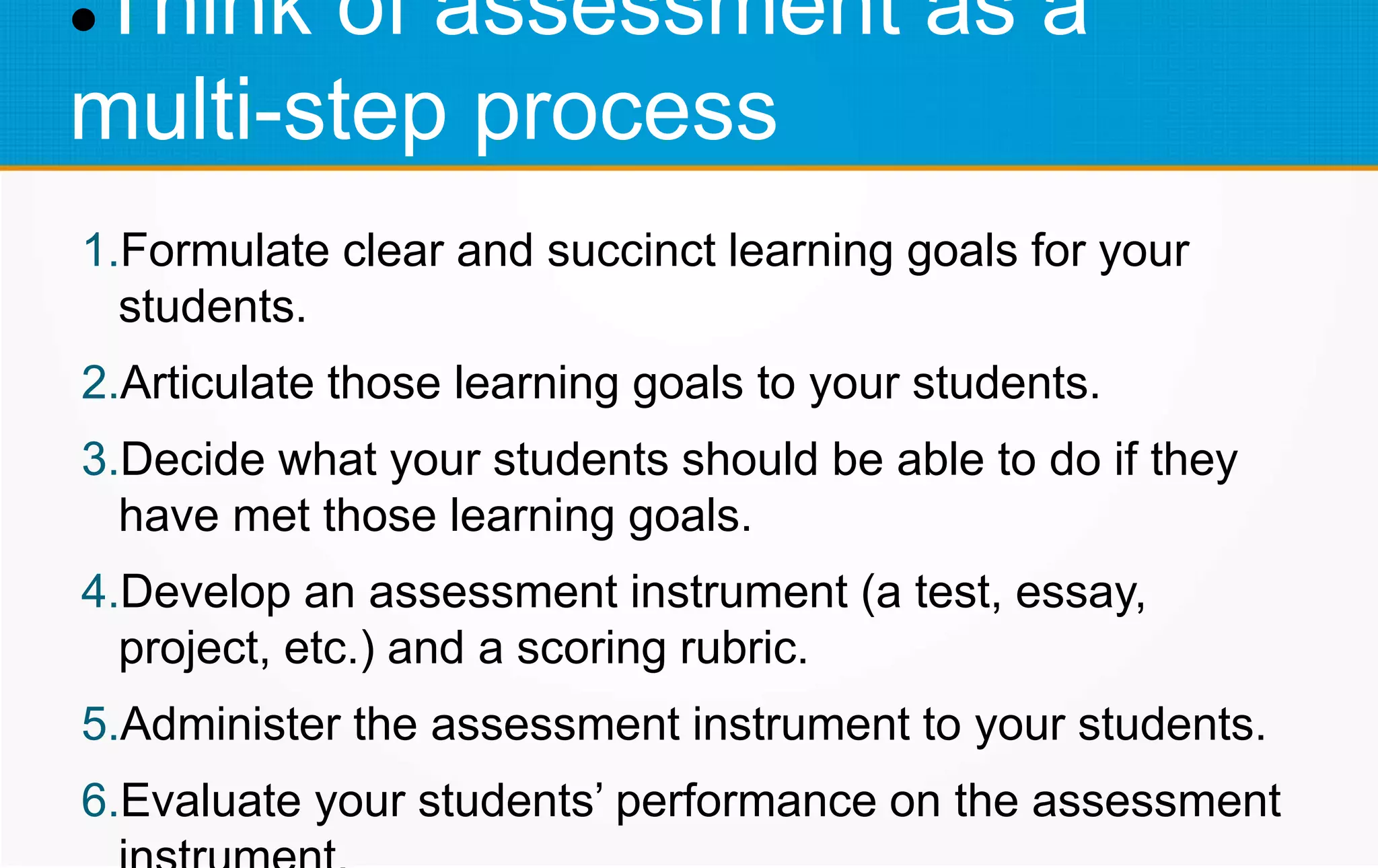
Think of assessment as a
multi-step process
1.Formulate clear and succinct learning goals for your
students.
2.Articulate those learning goals to your students.
3.Decide what your students should be able to do if they
have met those learning goals.
4.Develop an assessment instrument (a test, essay,
project, etc.) and a scoring rubric.
5.Administer the assessment instrument to your students.
6.Evaluate your students’ performance on the assessment
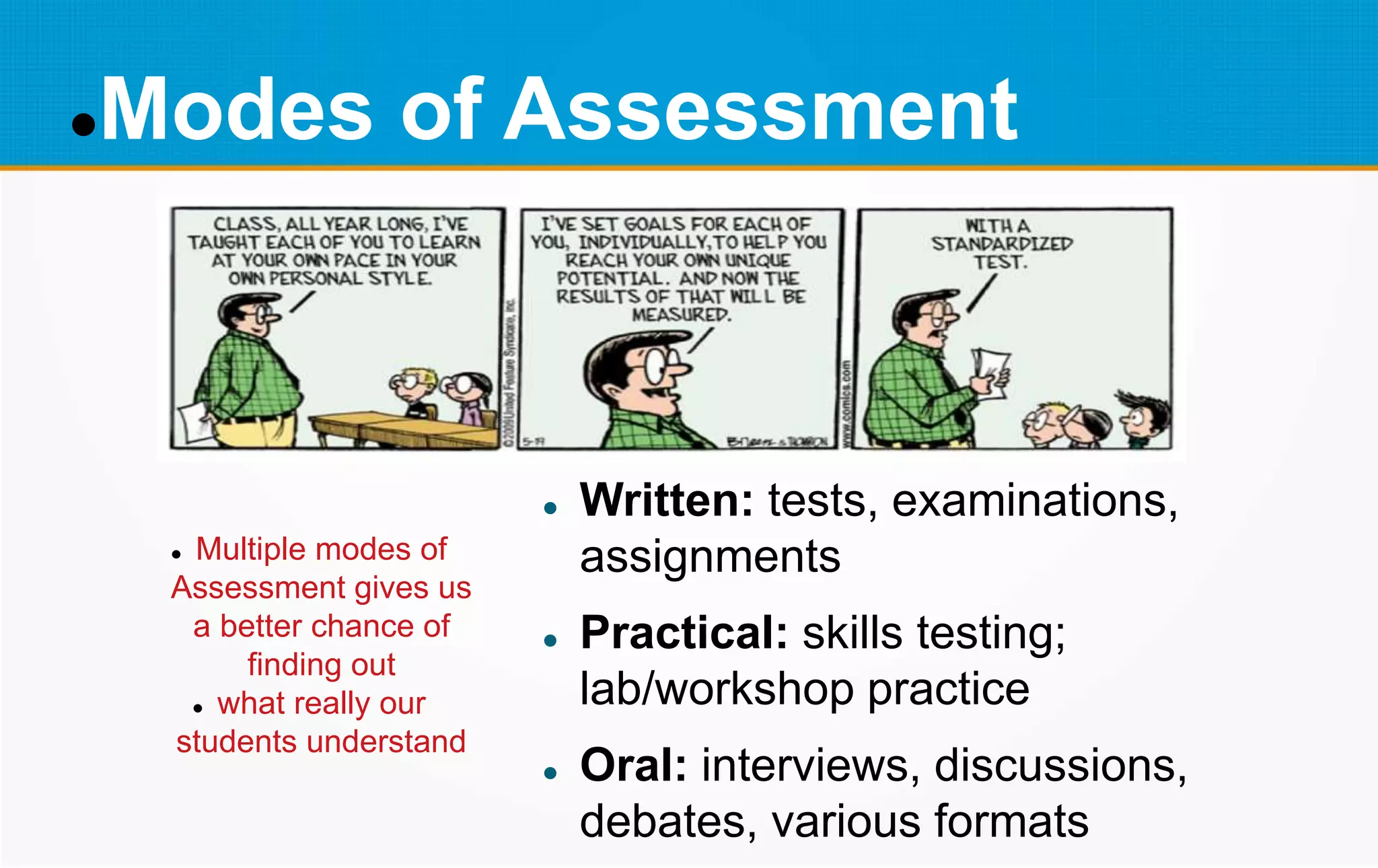
Modes of Assessment
 Written: tests, examinations,
assignments
 Practical: skills testing;
lab/workshop practice
 Oral: interviews, discussions,
debates, various formats
 Multiple modes of
Assessment gives us
a better chance of
finding out
 what really our
students understand
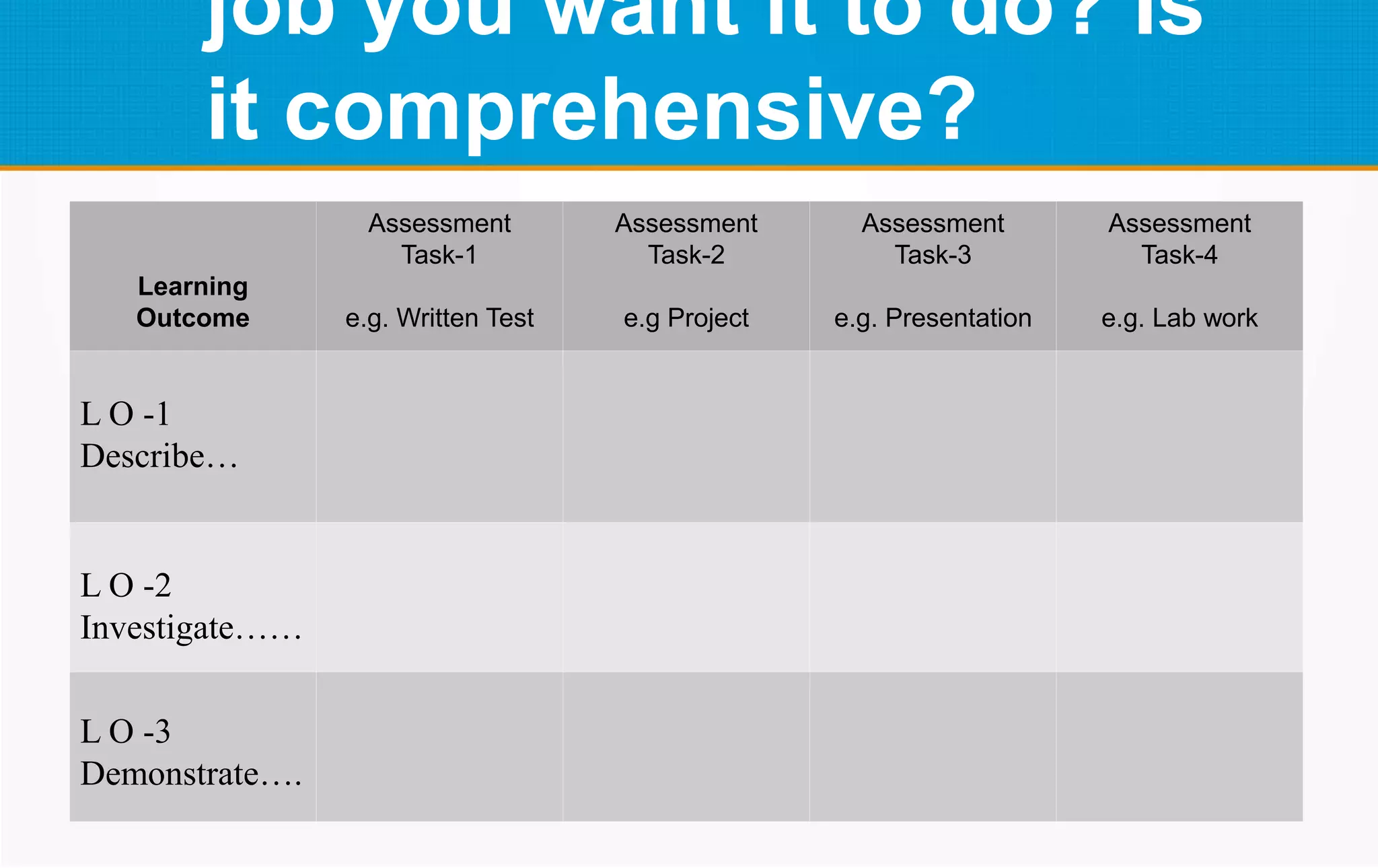
job you want it to do? Is
it comprehensive?
Learning
Outcome
Assessment
Task-1
e.g. Written Test
Assessment
Task-2
e.g Project
Assessment
Task-3
e.g. Presentation
Assessment
Task-4
e.g. Lab work
L O -1
Describe…
L O -2
Investigate……
L O -3
Demonstrate….
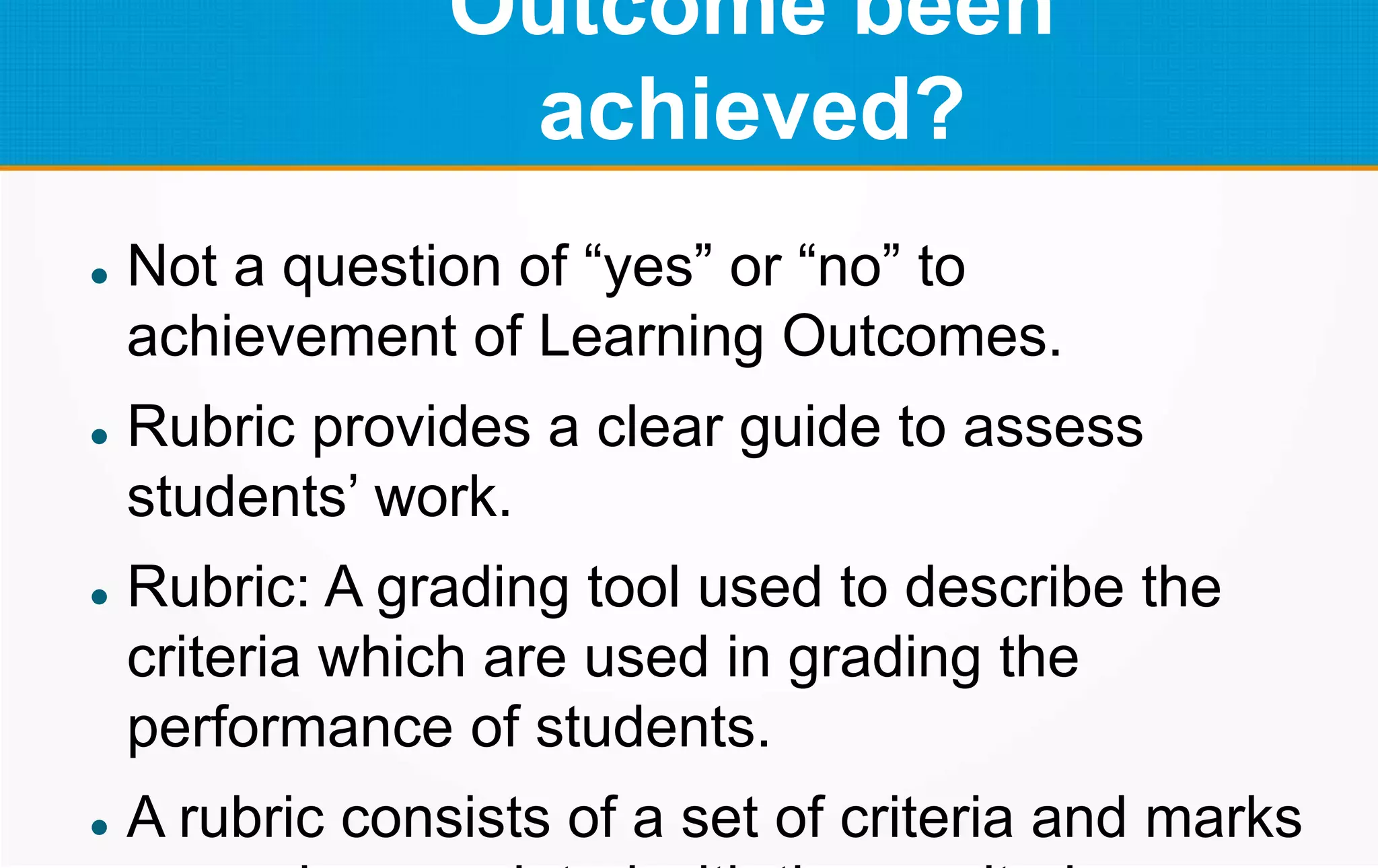
Outcome been
achieved?
 Not a question of “yes” or “no” to
achievement of Learning Outcomes.
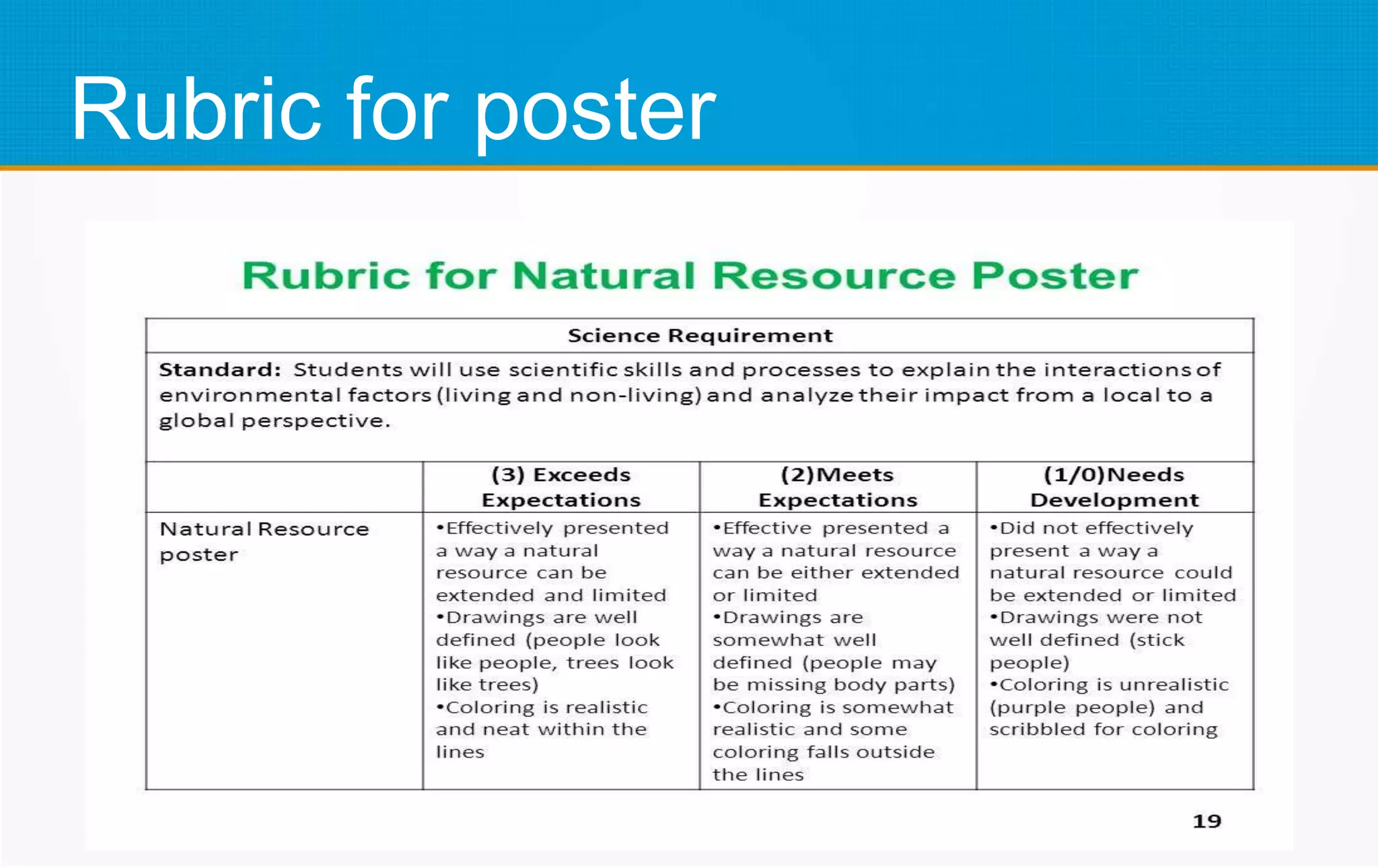
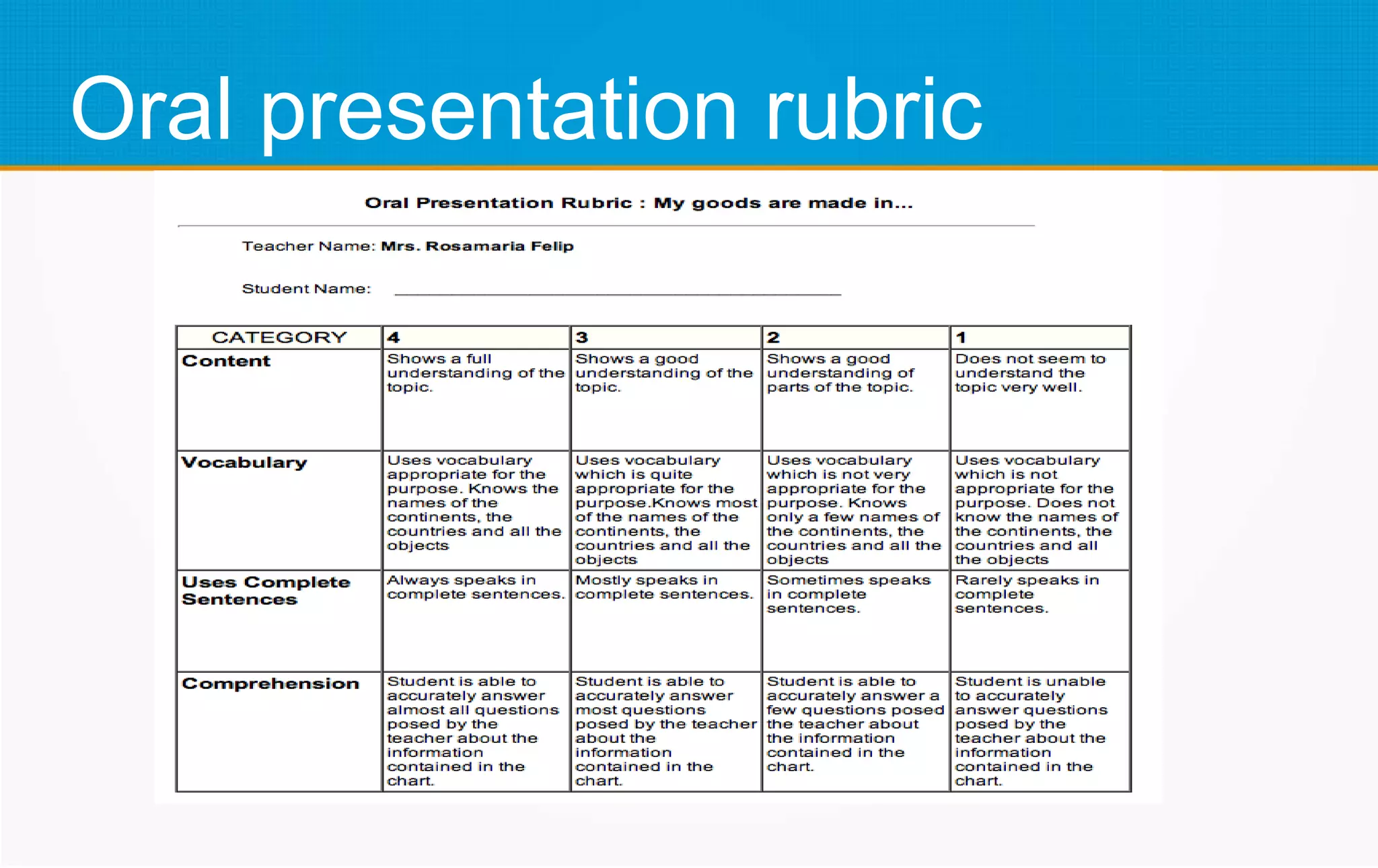
 Rubric provides a clear guide to assess
students’ work.
 Rubric: A grading tool used to describe the
criteria which are used in grading the
performance of students.
 A rubric consists of a set of criteria and marks
Rubric for poster
Oral presentation rubric
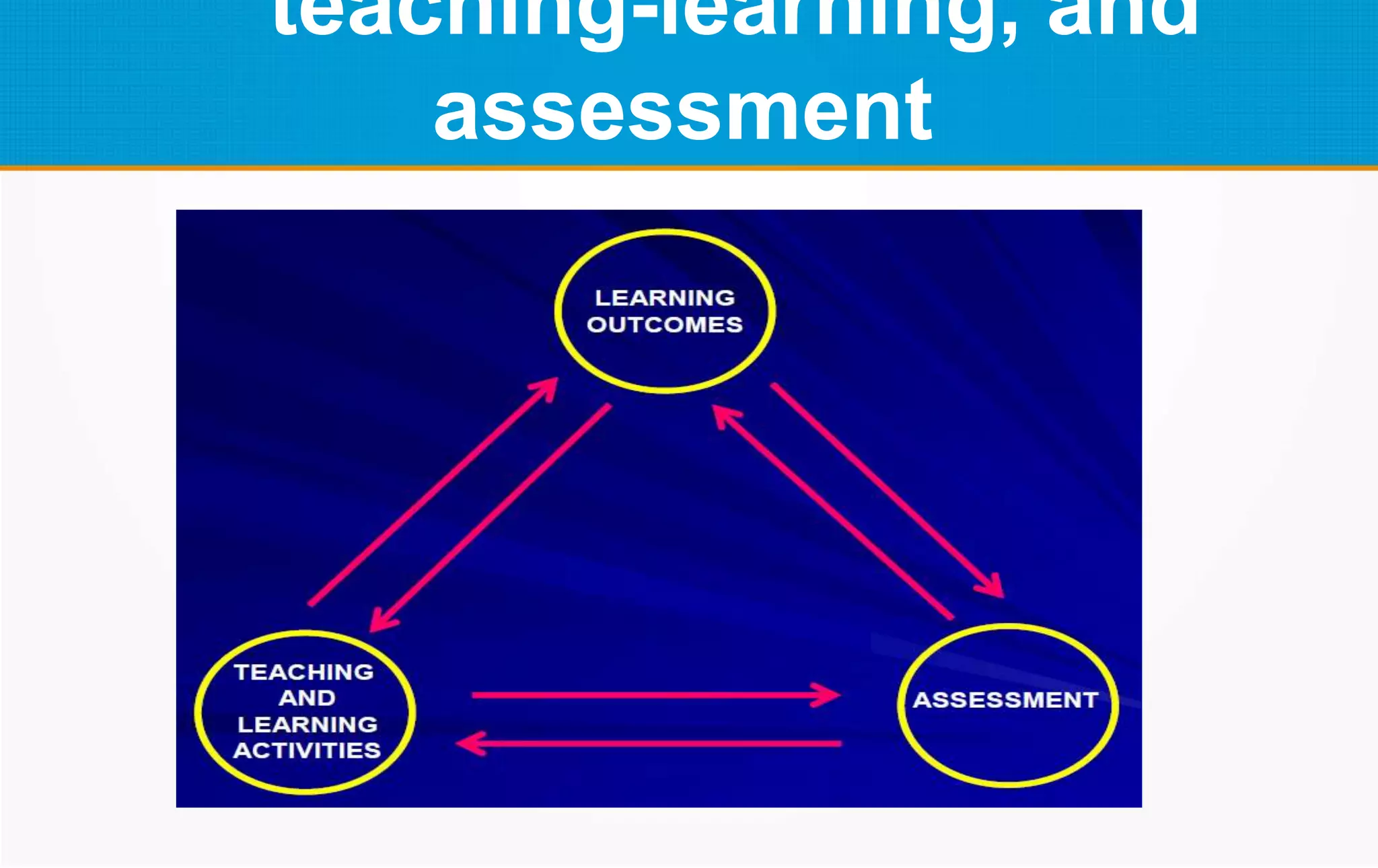
teaching-learning, and
assessment
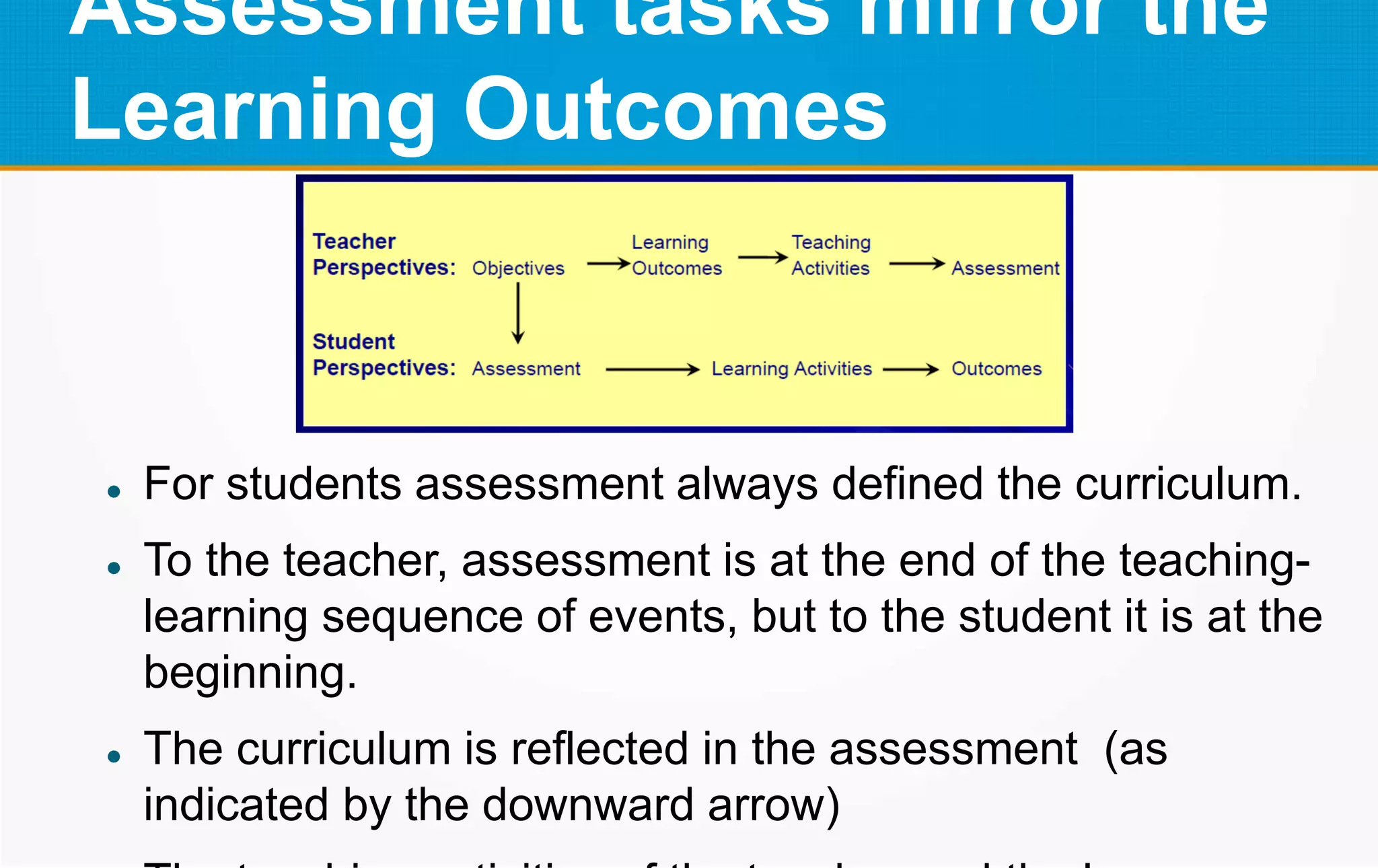
Assessment tasks mirror the
Learning Outcomes
 For students assessment always defined the curriculum.
 To the teacher, assessment is at the end of the teaching-
learning sequence of events, but to the student it is at the
beginning.
 The curriculum is reflected in the assessment (as
indicated by the downward arrow)
Teaching-Learning Activities
and Assessment
 Clearly define the learning
outcomes.
 Select teaching and learning
methods that are likely to
ensure that the learning
outcomes are achieved.
 Choose a techniques to assess
the achievement of the
learning outcomes.
 Assess the learning outcomes
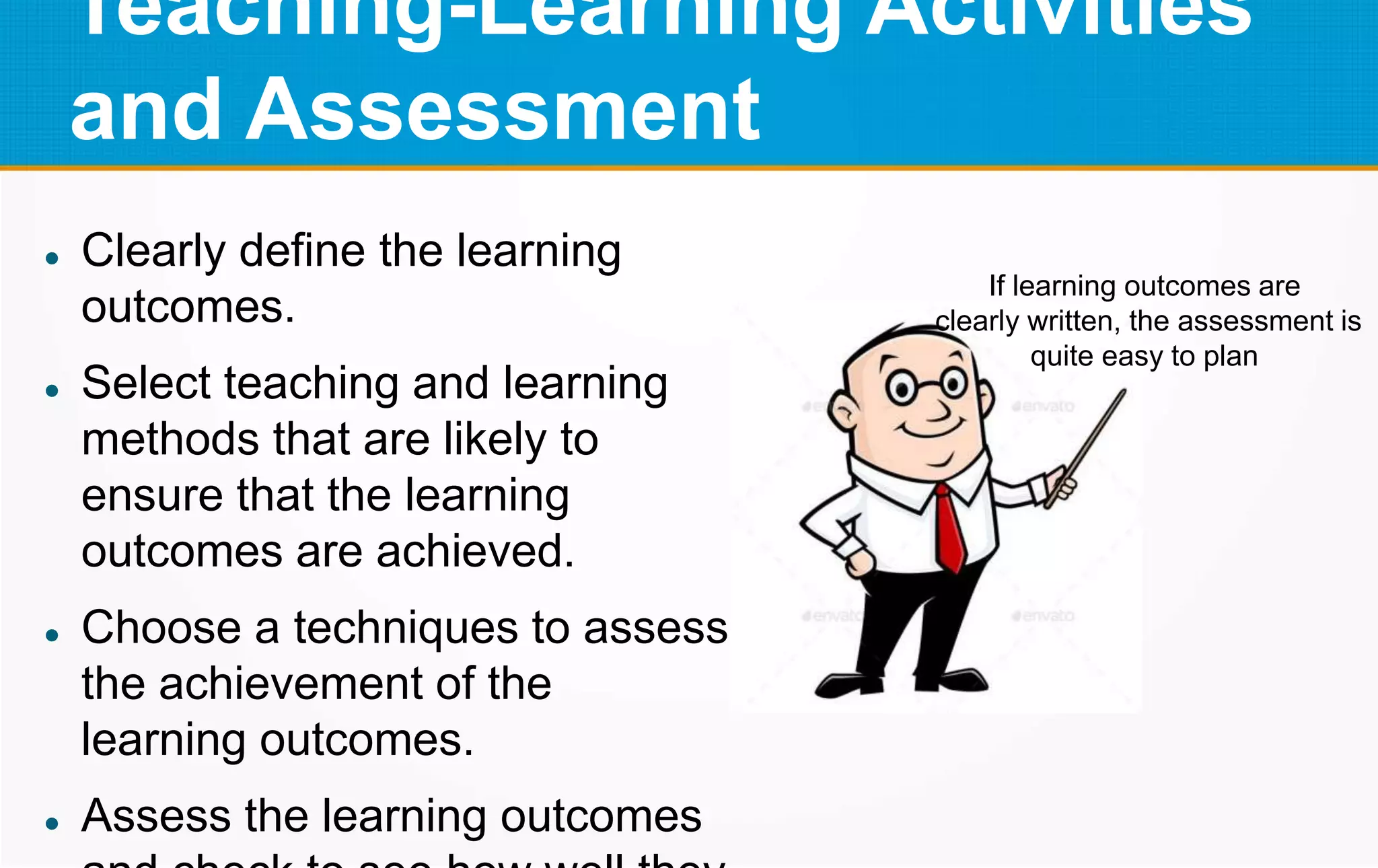
If learning outcomes are
clearly written, the assessment is
quite easy to plan
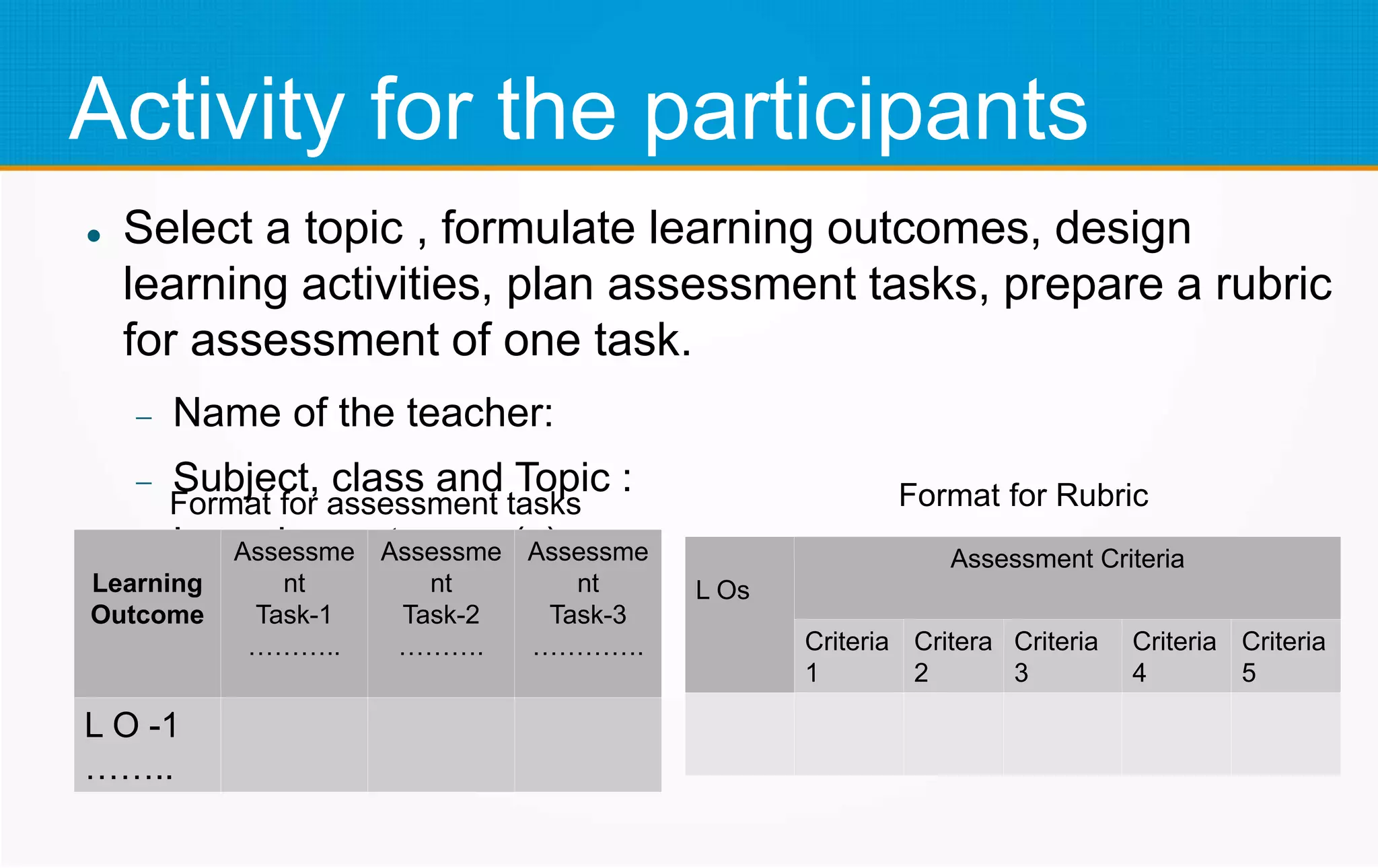
Activity for the participants
 Select a topic , formulate learning outcomes, design
learning activities, plan assessment tasks, prepare a rubric
for assessment of one task.
 Name of the teacher:
 Subject, class and Topic :
 Learning outcome (s):
 Learning activities
 Assessment tasks:
Learning
Outcome
Assessme
nt
Task-1
………..
Assessme
nt
Task-2
……….
Assessme
nt
Task-3
………….
L O -1
……..
L Os
Assessment Criteria
Criteria
1
Critera
2
Criteria
3
Criteria
4
Criteria
5
Format for RubricFormat for assessment tasks
THANK
YOU

Teaching with Fucous on Learning Outcomes and Assessment

  • 1.
    Teaching with Focus onLearning Outcome and Assessment Dr. V Ramadas Professor of Education NCERT, RIE Mysore
  • 2.
    What is yourphilosophy of teaching?
  • 3.
    My philosophy ofteaching The way you perceive learning the way you learn The way you learn the way you teach The way you teach the way the children learn The way they learn the way they become
  • 4.
    What do theseterms signify?  Teaching  Learning  Learning outcome  Assessment
  • 5.
    Which image isclosest to your idea of teaching? A BA C D E F
  • 6.
    Has your ideaabout learning changed over the years?
  • 7.
    Many learning environment Teaching is context-specific. Learning environment must be suitable to the context.  Examples of different learning environments:  A school or classroom  An online course  Military training
  • 8.
  • 9.
    Issues in developingeffective learning environment 1.It is the learner who has to do the learning.  All that teacher can do is to create and manage an environment that enables and encourages learning.  The focus should be learner and what the learner needs. 2.Any learning environment is much more than the technology used to support it.  Technology-based learning environments may components of effective learning environment.  The technology may be necessary but it is not sufficient.
  • 10.
  • 11.
    What are learningoutcomes?  Learning outcomes are statements of what a student should know, understand and/or be able to demonstrate after completion of a process of learning.  Learning outcomes are usually expressed as knowledge, skills or attitudes.  Learning outcome must be SMART:  Specific (simple, sensible, significant).  Measurable (meaningful, motivating).  Achievable (agreed, attainable).  Relevant (reasonable, realistic and resourced, results-based).
  • 12.
    Why learning outcome? Students, teachers, parents, community members and educational administrators have to know about the learning of students  monitoring of the progress in learning  Need to have some criteria against which the extent of expected learning could be mapped/assessed.  To help different stakeholders make their efforts; be at home, classroom, school to ensure learning among students providing quality education.  To help agencies at the district, state, national or global
  • 13.
    Elementary Stage” (NCERT, 2016) Addressing quality concerns in education  (Global Monitoring Report, ASER, NAS, Report of Joint Review Mission for SSA)  Limitation of (MLL, 1992)  (Product oriented, Inadequate to assess overall development)  Radical shift in curriculum focus and role of the teacher (NCF 2005)  (Learner as constructor of knowledge, Teacher as a facilitator of learning process etc.)  Right to Free and Compulsory Education Act 2009 (RTE)  (Overall development of the child, CCE, Monitoring learning progression, Fear and trauma free environment)
  • 14.
    Features of LearningOutcome Document-1  Subject wise learning outcomes (LO) for classes I-VIII.  Simple language, User-friendly.  Description about the nature of the subject.  Stage wise curricular expectations (the long-term goals that students need to acquire over a period of time)
  • 15.
    Features of LearningOutcome Document-2  The process based LO are measurable in a qualitative or quantitative manner to assess the progress of a child .  The suggested pedagogical processes help teachers to plan classroom activities to achieve different LOs.
  • 16.
    Features of LearningOutcome Document-3  Using contextual resources and appropriate learning processes, teachers can design and provide a variety of learning situations in an inclusive classroom.  The pedagogical processes are not directed at a particular LO. They must be looked at holistically.  The teachers may adopt/adapt and can even design many more as per the availability of resources and local context.
  • 17.
    Features of LearningOutcome Document-4  The CWSN need to be facilitated with different aids and peer support.  (mobility aids (wheel chair, crutches, white cane), hearing-aids, visual aids (spectacles), modifying the learning situations suiting to their needs, sensitising other children to help them in need)  The LOs in each curricular area are spirally linked in terms of age appropriateness and complexity within and across curricular areas and stages.  The class-wise section may not be viewed in isolation but a holistic perspective will help accomplish the goal of overall development of a child.
  • 18.
    Assessment of Learning Outcome The adoption of a learning outcomes approach represents more than simply expressing learning in terms of outcomes.  It entails much more due to their significant implications for all aspects of curriculum design, delivery,
  • 19.
    Think of assessmentas a multi-step process 1.Formulate clear and succinct learning goals for your students. 2.Articulate those learning goals to your students. 3.Decide what your students should be able to do if they have met those learning goals. 4.Develop an assessment instrument (a test, essay, project, etc.) and a scoring rubric. 5.Administer the assessment instrument to your students. 6.Evaluate your students’ performance on the assessment
  • 20.
    Modes of Assessment Written: tests, examinations, assignments  Practical: skills testing; lab/workshop practice  Oral: interviews, discussions, debates, various formats  Multiple modes of Assessment gives us a better chance of finding out  what really our students understand
  • 21.
    job you wantit to do? Is it comprehensive? Learning Outcome Assessment Task-1 e.g. Written Test Assessment Task-2 e.g Project Assessment Task-3 e.g. Presentation Assessment Task-4 e.g. Lab work L O -1 Describe… L O -2 Investigate…… L O -3 Demonstrate….
  • 22.
    Outcome been achieved?  Nota question of “yes” or “no” to achievement of Learning Outcomes.  Rubric provides a clear guide to assess students’ work.  Rubric: A grading tool used to describe the criteria which are used in grading the performance of students.  A rubric consists of a set of criteria and marks
  • 23.
  • 24.
  • 25.
  • 26.
    Assessment tasks mirrorthe Learning Outcomes  For students assessment always defined the curriculum.  To the teacher, assessment is at the end of the teaching- learning sequence of events, but to the student it is at the beginning.  The curriculum is reflected in the assessment (as indicated by the downward arrow)
  • 27.
    Teaching-Learning Activities and Assessment Clearly define the learning outcomes.  Select teaching and learning methods that are likely to ensure that the learning outcomes are achieved.  Choose a techniques to assess the achievement of the learning outcomes.  Assess the learning outcomes If learning outcomes are clearly written, the assessment is quite easy to plan
  • 28.
    Activity for theparticipants  Select a topic , formulate learning outcomes, design learning activities, plan assessment tasks, prepare a rubric for assessment of one task.  Name of the teacher:  Subject, class and Topic :  Learning outcome (s):  Learning activities  Assessment tasks: Learning Outcome Assessme nt Task-1 ……….. Assessme nt Task-2 ………. Assessme nt Task-3 …………. L O -1 …….. L Os Assessment Criteria Criteria 1 Critera 2 Criteria 3 Criteria 4 Criteria 5 Format for RubricFormat for assessment tasks
  • 29.