Dr Laurence Sullivan MB BS FRANZCO
Melbourne
Australia
Dr Laurie Sullivan 2013
laurence.sullivan@gmail.com
 Lifelong learning and development.
 Evidence to support or modify current
practice
 New techniques / drugs / treatments
Dr Laurie Sullivan 2013
laurence.sullivan@gmail.com
 Not a newspaper
 Not an advertisement
 Not company-produced marketing material
Dr Laurie Sullivan 2013
laurence.sullivan@gmail.com
 Peer reviewed
 Reliable
 Truthful
Dr Laurie Sullivan 2013
laurence.sullivan@gmail.com
Dr Laurie Sullivan 2013
laurence.sullivan@gmail.com
 Title / table of contents
◦ Is the title of interest?
 Abstract (conclusion)
◦ Does this relate to your field?
 Methods
◦ Are they relevant to your local practice?
Dr Laurie Sullivan 2013
laurence.sullivan@gmail.com
Dr Laurie Sullivan 2013
laurence.sullivan@gmail.com
Statistics
P<0.05
Means that the chance of the findings not being
due to random variation is 0.95 or 95%
Dr Laurie Sullivan 2013
laurence.sullivan@gmail.com
Dr Laurie Sullivan 2013
laurence.sullivan@gmail.com
Dr Laurie Sullivan 2013
laurence.sullivan@gmail.com
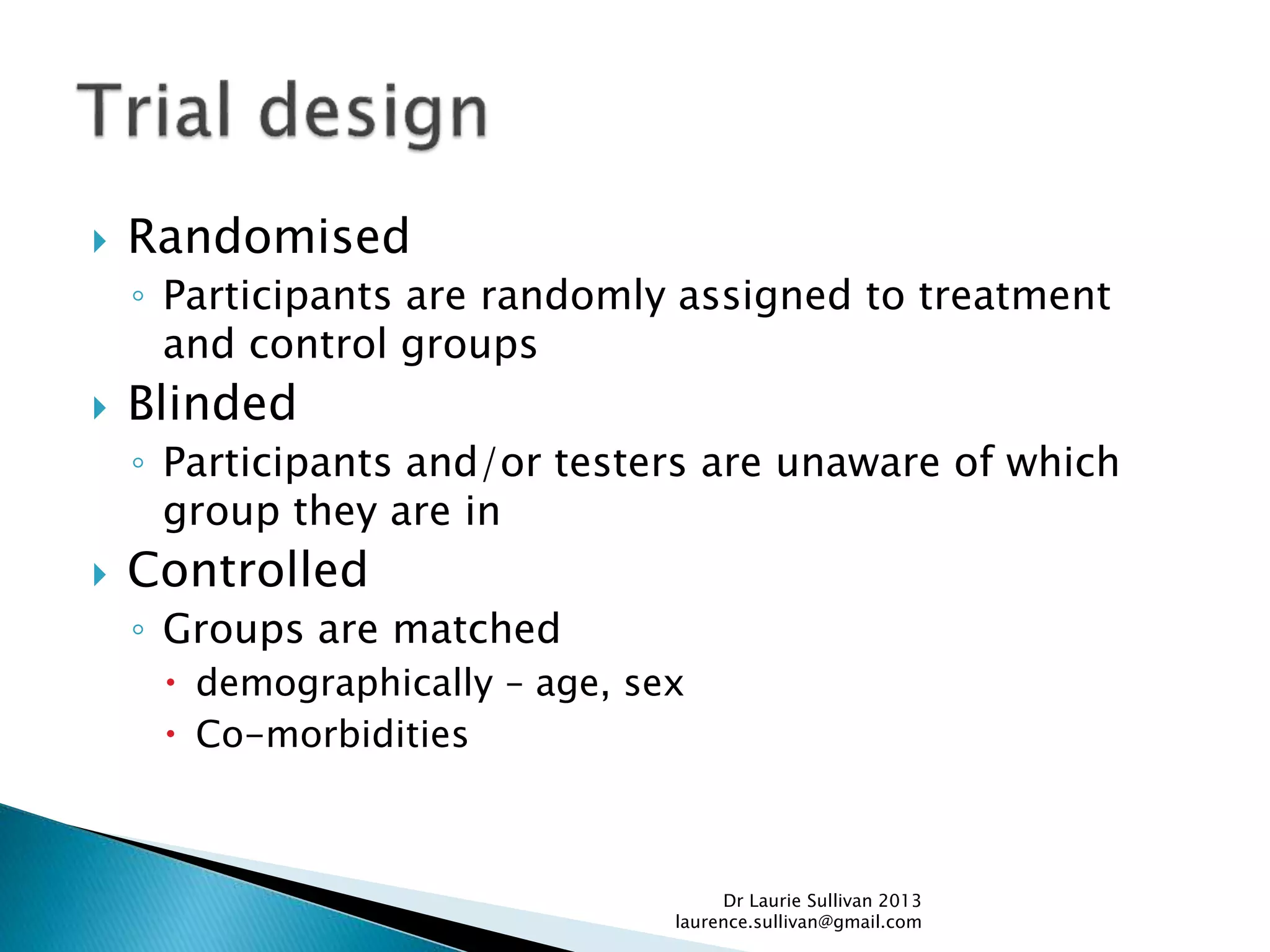
 Randomised
◦ Participants are randomly assigned to treatment
and control groups
 Blinded
◦ Participants and/or testers are unaware of which
group they are in
 Controlled
◦ Groups are matched
 demographically – age, sex
 Co-morbidities
Dr Laurie Sullivan 2013
laurence.sullivan@gmail.com
Dr Laurie Sullivan 2013
laurence.sullivan@gmail.com
 Share new knowledge
 Qualifications
 Assess outcomes of current practice Eg
surgical outcomes (easy) or medical
interventions (harder – placebo effect)
Dr Laurie Sullivan 2013
laurence.sullivan@gmail.com
 The abstract is divided into 5 separate
sections (ie, structured) in agreement with the
presentation of information in the article.
 Guides/reflects the structure of the study
Dr Laurie Sullivan 2013
laurence.sullivan@gmail.com
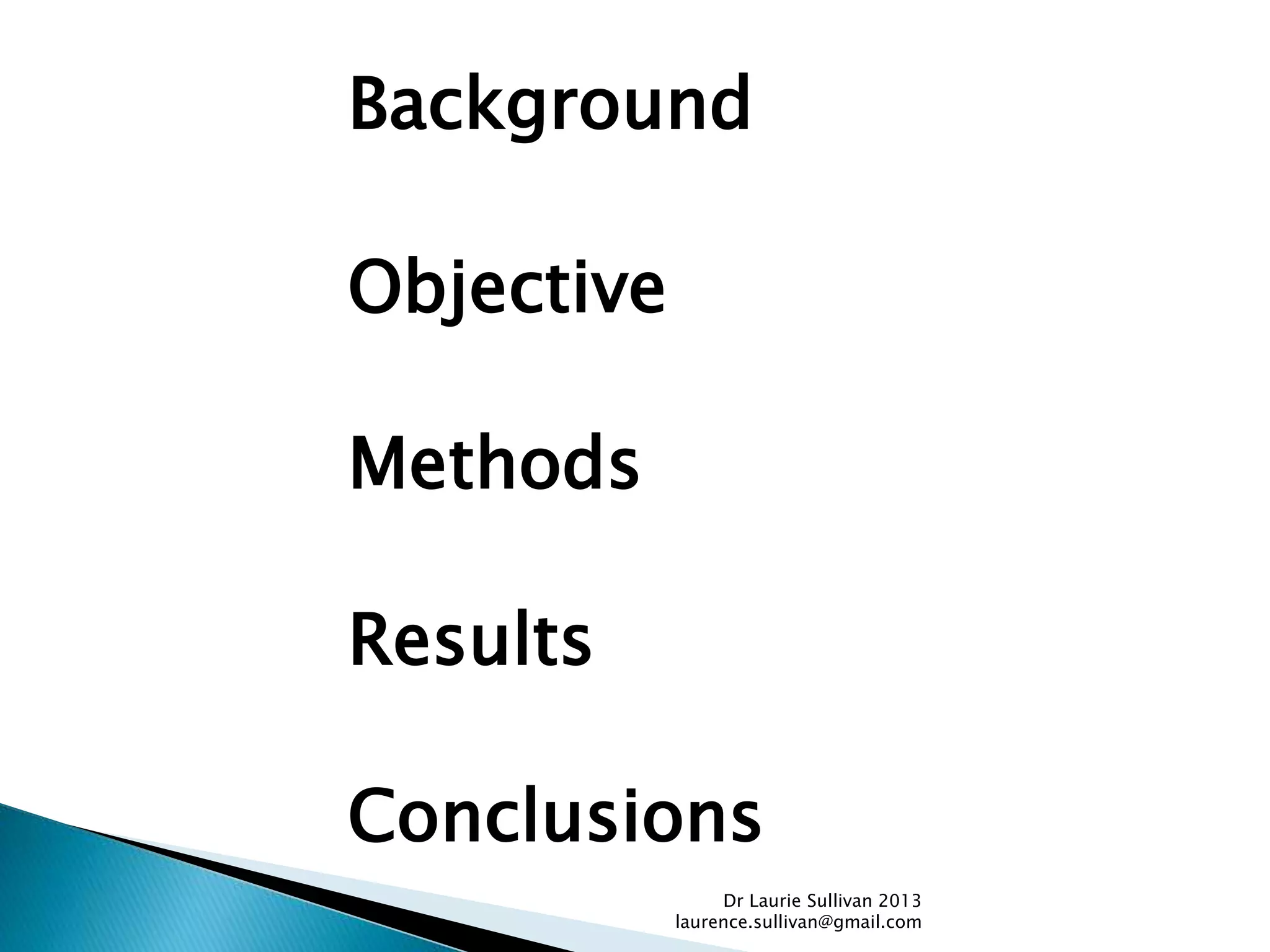
Background
Objective
Methods
Results
Conclusions
Dr Laurie Sullivan 2013
laurence.sullivan@gmail.com
 Brief (2-3 sentences) description of why the
study is needed and its contribution to the
field.
Dr Laurie Sullivan 2013
laurence.sullivan@gmail.com
 Concise (1-2 sentences) statement of the
objective or hypothesis to be addressed.
 Primary objective identified and stated first,
followed by any key secondary objectives.
Dr Laurie Sullivan 2013
laurence.sullivan@gmail.com
Design: Clear statement of the study's design,
including all aspects (eg, parallel group,
randomized, blinded).
 Participants and setting: The most pertinent
inclusion and exclusion criteria, and the setting
within which the study was conducted.
 Interventions: Complete details on treatment (eg,
drug dose, route of administration, and duration
of administration) and, if pertinent, control
interventions.
 Outcome: Primary and secondary outcome
measures, identified as such.
Dr Laurie Sullivan 2013
laurence.sullivan@gmail.com
Conclusions (not summary) of the study, based
only on the results shown, with balance of
benefits and harms.
 Clinical application of the findings, again
based only on the data obtained (ie, avoid
over-generalization) and whether more study
is needed before findings should be
implemented into clinical practice.
Dr Laurie Sullivan 2013
laurence.sullivan@gmail.com

How to read and write a scientific paper

  • 1.
    Dr Laurence SullivanMB BS FRANZCO Melbourne Australia Dr Laurie Sullivan 2013 laurence.sullivan@gmail.com
  • 2.
     Lifelong learningand development.  Evidence to support or modify current practice  New techniques / drugs / treatments Dr Laurie Sullivan 2013 laurence.sullivan@gmail.com
  • 3.
     Not anewspaper  Not an advertisement  Not company-produced marketing material Dr Laurie Sullivan 2013 laurence.sullivan@gmail.com
  • 4.
     Peer reviewed Reliable  Truthful Dr Laurie Sullivan 2013 laurence.sullivan@gmail.com
  • 5.
    Dr Laurie Sullivan2013 laurence.sullivan@gmail.com
  • 6.
     Title /table of contents ◦ Is the title of interest?  Abstract (conclusion) ◦ Does this relate to your field?  Methods ◦ Are they relevant to your local practice? Dr Laurie Sullivan 2013 laurence.sullivan@gmail.com
  • 7.
    Dr Laurie Sullivan2013 laurence.sullivan@gmail.com
  • 8.
    Statistics P<0.05 Means that thechance of the findings not being due to random variation is 0.95 or 95% Dr Laurie Sullivan 2013 laurence.sullivan@gmail.com
  • 9.
    Dr Laurie Sullivan2013 laurence.sullivan@gmail.com
  • 10.
    Dr Laurie Sullivan2013 laurence.sullivan@gmail.com
  • 11.
     Randomised ◦ Participantsare randomly assigned to treatment and control groups  Blinded ◦ Participants and/or testers are unaware of which group they are in  Controlled ◦ Groups are matched  demographically – age, sex  Co-morbidities Dr Laurie Sullivan 2013 laurence.sullivan@gmail.com
  • 12.
    Dr Laurie Sullivan2013 laurence.sullivan@gmail.com
  • 13.
     Share newknowledge  Qualifications  Assess outcomes of current practice Eg surgical outcomes (easy) or medical interventions (harder – placebo effect) Dr Laurie Sullivan 2013 laurence.sullivan@gmail.com
  • 14.
     The abstractis divided into 5 separate sections (ie, structured) in agreement with the presentation of information in the article.  Guides/reflects the structure of the study Dr Laurie Sullivan 2013 laurence.sullivan@gmail.com
  • 15.
  • 16.
     Brief (2-3sentences) description of why the study is needed and its contribution to the field. Dr Laurie Sullivan 2013 laurence.sullivan@gmail.com
  • 17.
     Concise (1-2sentences) statement of the objective or hypothesis to be addressed.  Primary objective identified and stated first, followed by any key secondary objectives. Dr Laurie Sullivan 2013 laurence.sullivan@gmail.com
  • 18.
    Design: Clear statementof the study's design, including all aspects (eg, parallel group, randomized, blinded).  Participants and setting: The most pertinent inclusion and exclusion criteria, and the setting within which the study was conducted.  Interventions: Complete details on treatment (eg, drug dose, route of administration, and duration of administration) and, if pertinent, control interventions.  Outcome: Primary and secondary outcome measures, identified as such. Dr Laurie Sullivan 2013 laurence.sullivan@gmail.com
  • 19.
    Conclusions (not summary)of the study, based only on the results shown, with balance of benefits and harms.  Clinical application of the findings, again based only on the data obtained (ie, avoid over-generalization) and whether more study is needed before findings should be implemented into clinical practice. Dr Laurie Sullivan 2013 laurence.sullivan@gmail.com