Chapter II
REVIEW OF THE LITERATURE AND
CONCEPTUAL FRAMEWORK
Related Literature
Conceptual Framework
Research Hypotheses
Definition of Terms
ALAN S. ABERILLA
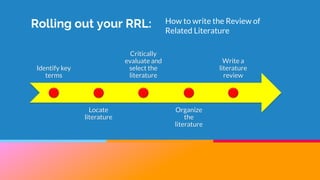
Rolling out your RRL: How to write the Review of
Related Literature
Identify key
terms
Locate
literature
Critically
evaluate and
select the
literature
Organize
the
literature
Write a
literature
review
Use the statement of problem as guide to structure and
sequence of topics
Avoid ‘copy/cut and paste; all literature cited must form a
coherent whole
Last part highlights gaps in literature specifically
addressed by your study
Use appropriate format for citations and references
Cited references should be congruent to bibliography
entries
In writing this section…
Review of
Related
Literature
A literature review is a comprehensive summary of previous research
on a topic. The literature review surveys scholarly articles, books, and
other sources relevant to a particular area of research. The review
should enumerate, describe, summarize, objectively evaluate and
clarify this previous research. It should give a theoretical base for the
research and help you (the author) determine the nature of your
research. The literature review acknowledges the work of previous
researchers, and in so doing, assures the reader that your work has
been well conceived. It is assumed that by mentioning a previous work
in the field of study, that the author has read, evaluated, and
assimiliated that work into the work at hand.
A literature review creates a "landscape" for the reader, giving her
or him a full understanding of the developments in the field. This
landscape informs the reader that the author has indeed
assimilated all (or the vast majority of) previous, significant works in
the field into her or his research.
"In writing the literature review, the purpose is to convey to the
reader what knowledge and ideas have been established on a
topic, and what their strengths and weaknesses are. The literature
review must be defined by a guiding concept (eg. your research
objective, the problem or issue you are discussing, or your
argumentative thesis). It is not just a descriptive list of the material
available, or a set of summaries.
(http://www.writing.utoronto.ca/advice/specific-types-of-writing/literature-review)
What are the commonly used citation and
reference styles?
 APA, American Psychological
Association – Social Sciences,
www.apastyle.org
 MLA, Modern Language Association –
Literature & Humanities, www.mla.org
 Chicago Manual of Style – Humanities &
Social Sciences,
www.chicagomanualofstyle.org
If you use the name of the author(s) in your writing, place the year of
publication of the work in parentheses after the author ’s name.
Ex. Mullane (2006) conducted research into the effect of…
If you refer to a work in the text of your paper, place the author's last
name and the year of publication of the work in parentheses at the end
of the sentence.
Ex. The research conclusively proved a correlation between the results
(Mullane, 2006).
APA In-text Citation
Book
Andreasen, N. C. (2001). Brave new brain: Conquering mental illness in the
era of the genome. Oxford, England: Oxford University Press.
Journal
Potente, S., Anderson, C., & Karim, M. (2011). Environmental sun
protection and supportive policies and practices: An audit of
outdoor recreational settings in NSW coastal towns. Health
Promotion Journal of Australia, 22, 97- 101.
Website
Satalkar, B. (2010, July 15). Water aerobics. Retrieved from
http://www.buzzle.com
APA Referencing Style
▷1. Define a topic and audience.
▷2. Search and research the literature.
▷3. Take notes while reading.
▷4. Choose the type of review you wish to write.
▷5. Keep the review focused but make it of broad interest.
▷6. Be critical and consistent.
▷7. Find a logical structure.
▷8. Make use of feedback.
▷9. Include your own relevant research but be objective.
▷10. Be up-to-date but do not forget older studies.
10 SIMPLE RULES FOR WRITING
RELATED LITERATURE
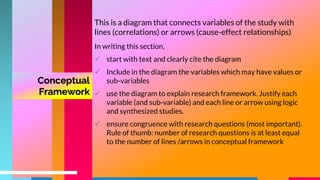
In writing this section,
 start with text and clearly cite the diagram
 Include in the diagram the variables which may have values or
sub-variables
 use the diagram to explain research framework. Justify each
variable (and sub-variable) and each line or arrow using logic
and synthesized studies.
 ensure congruence with research questions (most important).
Rule of thumb: number of research questions is at least equal
to the number of lines /arrows in conceptual framework
This is a diagram that connects variables of the study with
lines (correlations) or arrows (cause-effect relationships)
Conceptual
Framework
EXAMPLE OF CONCEPTUAL FRAMEWORK
A hypothesis is a prediction of the possible outcomes of
a study (Fraenkel & Wallen, 2009).
Hypotheses are statements in quantitative research in
which the investigator makes a prediction or a
conjecture about the outcome of a relationship among
attributes or characteristics (Creswell, 2012)
Question: Is there a significant relationship between the
Grade 11 student-respondents’ availability of internet
connection at home and their average sleeping time?
Hypothesis: There is no significant relationship between
the Grade 11 student-respondents’ availability of
internet connection at home and their average sleeping
time?
Research
Hypotheses
Developing a hypothesis
1. Ask a question
Writing a hypothesis begins with a research question that you want to
answer. The question should be focused, specific, and researchable
within the constraints of your project.
Do students who attend more lectures get better exam results?
2. Do some preliminary research
Your initial answer to the question should be based on what is already
known about the topic. Look for theories and previous studies to help you
form educated assumptions about what your research will find.
At this stage, you might construct a conceptual framework to identify
which variables you will study and what you think the relationships are
between them.
At this stage, you might construct a conceptual framework to identify
which variables you will study and what you think the relationships are
between them.
3. Formulate your hypothesis
Now you should have some idea of what you expect to find. Write your
initial answer to the question in a clear, concise sentence.
Attending more lectures leads to better exam results.
4. Refine your hypothesis
You need to make sure your hypothesis is specific and testable. There
are various ways of phrasing a hypothesis, but all the terms you use
should have clear definitions, and the hypothesis should contain:
The relevant variables
The specific group being studied
The predicted outcome of the experiment or analysis
5. Phrase your hypothesis in three ways
To identify the variables, you can write a simple prediction in if…then
form. The first part of the sentence states the independent variable
and the second part states the dependent variable.
If a first-year student starts attending more lectures, then their exam
scores will improve.
In academic research, hypotheses are more commonly phrased in
terms of correlations or effects, where you directly state the predicted
relationship between variables.
The number of lectures attended by first-year students has a positive
effect on their exam scores.
If you are comparing two groups, the hypothesis can state what
difference you expect to find between them.
First-year students who attended most lectures will have better exam
scores than those who attended few lectures.
6. Write a null hypothesis
If your research involves statistical hypothesis testing, you will also
have to write a null hypothesis. The null hypothesis is the default
position that there is no association between the variables. The null
hypothesis is written as H0, while the alternative hypothesis is H1 or Ha.
H0: The number of lectures attended by first-year students has
no effect on their final exam scores.
H1: The number of lectures attended by first-year students has a
positive effect on their final exam scores.
https://www.scribbr.com/research-process/hypotheses/
Format:
The research hypotheses of the study are: (stated with
expected direction)
Example (Compare with expected answer to
research question):
The mean attitude of female millennials is significantly
lower than that of the males.
Significant or significantly – implies that results are
not due to chance alone.
Research
Hypotheses
Format:
The following terms are defined as used in the study: (followed
by list of terms with conceptual and operational definitions,
if appropriate)
Conceptual definition – original author’s qualitative
definition.
Terms defined operationally are variables measured using
instruments, e.g., test or rating scale.
Example: Millennials’ attitude – total rating in a rating scale.
Variables and sub-variables or values in conceptual
framework are defined, except very common variables like
grade level, gender, school type where the values are
indicated in the framework itself.
Definition of
Terms
Chapter II
REVIEW OF THE LITERATURE AND
CONCEPTUAL FRAMEWORK
Related Literature
Conceptual Framework
Research Hypotheses
Definition of Terms
Sir Von Christopher Chua
ACTIVITY 3: C2 CRAFTING TIME
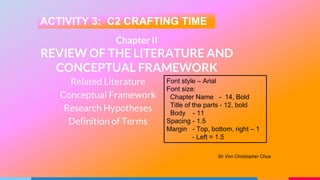
Font style – Arial
Font size:
Chapter Name - 14, Bold
Title of the parts - 12, bold
Body - 11
Spacing - 1.5
Margin - Top, bottom, right – 1
- Left = 1.5
GOOD LUCK
KEEP SAFE
GOD BLESS
Sir A

Lesson 4 chapter 2

  • 1.
    Chapter II REVIEW OFTHE LITERATURE AND CONCEPTUAL FRAMEWORK Related Literature Conceptual Framework Research Hypotheses Definition of Terms ALAN S. ABERILLA
  • 2.
    Rolling out yourRRL: How to write the Review of Related Literature Identify key terms Locate literature Critically evaluate and select the literature Organize the literature Write a literature review
  • 3.
    Use the statementof problem as guide to structure and sequence of topics Avoid ‘copy/cut and paste; all literature cited must form a coherent whole Last part highlights gaps in literature specifically addressed by your study Use appropriate format for citations and references Cited references should be congruent to bibliography entries In writing this section… Review of Related Literature
  • 4.
    A literature reviewis a comprehensive summary of previous research on a topic. The literature review surveys scholarly articles, books, and other sources relevant to a particular area of research. The review should enumerate, describe, summarize, objectively evaluate and clarify this previous research. It should give a theoretical base for the research and help you (the author) determine the nature of your research. The literature review acknowledges the work of previous researchers, and in so doing, assures the reader that your work has been well conceived. It is assumed that by mentioning a previous work in the field of study, that the author has read, evaluated, and assimiliated that work into the work at hand.
  • 5.
    A literature reviewcreates a "landscape" for the reader, giving her or him a full understanding of the developments in the field. This landscape informs the reader that the author has indeed assimilated all (or the vast majority of) previous, significant works in the field into her or his research. "In writing the literature review, the purpose is to convey to the reader what knowledge and ideas have been established on a topic, and what their strengths and weaknesses are. The literature review must be defined by a guiding concept (eg. your research objective, the problem or issue you are discussing, or your argumentative thesis). It is not just a descriptive list of the material available, or a set of summaries. (http://www.writing.utoronto.ca/advice/specific-types-of-writing/literature-review)
  • 6.
    What are thecommonly used citation and reference styles?  APA, American Psychological Association – Social Sciences, www.apastyle.org  MLA, Modern Language Association – Literature & Humanities, www.mla.org  Chicago Manual of Style – Humanities & Social Sciences, www.chicagomanualofstyle.org
  • 7.
    If you usethe name of the author(s) in your writing, place the year of publication of the work in parentheses after the author ’s name. Ex. Mullane (2006) conducted research into the effect of… If you refer to a work in the text of your paper, place the author's last name and the year of publication of the work in parentheses at the end of the sentence. Ex. The research conclusively proved a correlation between the results (Mullane, 2006). APA In-text Citation
  • 8.
    Book Andreasen, N. C.(2001). Brave new brain: Conquering mental illness in the era of the genome. Oxford, England: Oxford University Press. Journal Potente, S., Anderson, C., & Karim, M. (2011). Environmental sun protection and supportive policies and practices: An audit of outdoor recreational settings in NSW coastal towns. Health Promotion Journal of Australia, 22, 97- 101. Website Satalkar, B. (2010, July 15). Water aerobics. Retrieved from http://www.buzzle.com APA Referencing Style
  • 9.
    ▷1. Define atopic and audience. ▷2. Search and research the literature. ▷3. Take notes while reading. ▷4. Choose the type of review you wish to write. ▷5. Keep the review focused but make it of broad interest. ▷6. Be critical and consistent. ▷7. Find a logical structure. ▷8. Make use of feedback. ▷9. Include your own relevant research but be objective. ▷10. Be up-to-date but do not forget older studies. 10 SIMPLE RULES FOR WRITING RELATED LITERATURE
  • 10.
    In writing thissection,  start with text and clearly cite the diagram  Include in the diagram the variables which may have values or sub-variables  use the diagram to explain research framework. Justify each variable (and sub-variable) and each line or arrow using logic and synthesized studies.  ensure congruence with research questions (most important). Rule of thumb: number of research questions is at least equal to the number of lines /arrows in conceptual framework This is a diagram that connects variables of the study with lines (correlations) or arrows (cause-effect relationships) Conceptual Framework
  • 11.
  • 13.
    A hypothesis isa prediction of the possible outcomes of a study (Fraenkel & Wallen, 2009). Hypotheses are statements in quantitative research in which the investigator makes a prediction or a conjecture about the outcome of a relationship among attributes or characteristics (Creswell, 2012) Question: Is there a significant relationship between the Grade 11 student-respondents’ availability of internet connection at home and their average sleeping time? Hypothesis: There is no significant relationship between the Grade 11 student-respondents’ availability of internet connection at home and their average sleeping time? Research Hypotheses
  • 14.
    Developing a hypothesis 1.Ask a question Writing a hypothesis begins with a research question that you want to answer. The question should be focused, specific, and researchable within the constraints of your project. Do students who attend more lectures get better exam results? 2. Do some preliminary research Your initial answer to the question should be based on what is already known about the topic. Look for theories and previous studies to help you form educated assumptions about what your research will find. At this stage, you might construct a conceptual framework to identify which variables you will study and what you think the relationships are between them.
  • 15.
    At this stage,you might construct a conceptual framework to identify which variables you will study and what you think the relationships are between them. 3. Formulate your hypothesis Now you should have some idea of what you expect to find. Write your initial answer to the question in a clear, concise sentence. Attending more lectures leads to better exam results. 4. Refine your hypothesis You need to make sure your hypothesis is specific and testable. There are various ways of phrasing a hypothesis, but all the terms you use should have clear definitions, and the hypothesis should contain:
  • 16.
    The relevant variables Thespecific group being studied The predicted outcome of the experiment or analysis 5. Phrase your hypothesis in three ways To identify the variables, you can write a simple prediction in if…then form. The first part of the sentence states the independent variable and the second part states the dependent variable. If a first-year student starts attending more lectures, then their exam scores will improve. In academic research, hypotheses are more commonly phrased in terms of correlations or effects, where you directly state the predicted relationship between variables.
  • 17.
    The number oflectures attended by first-year students has a positive effect on their exam scores. If you are comparing two groups, the hypothesis can state what difference you expect to find between them. First-year students who attended most lectures will have better exam scores than those who attended few lectures. 6. Write a null hypothesis If your research involves statistical hypothesis testing, you will also have to write a null hypothesis. The null hypothesis is the default position that there is no association between the variables. The null hypothesis is written as H0, while the alternative hypothesis is H1 or Ha.
  • 18.
    H0: The numberof lectures attended by first-year students has no effect on their final exam scores. H1: The number of lectures attended by first-year students has a positive effect on their final exam scores. https://www.scribbr.com/research-process/hypotheses/
  • 19.
    Format: The research hypothesesof the study are: (stated with expected direction) Example (Compare with expected answer to research question): The mean attitude of female millennials is significantly lower than that of the males. Significant or significantly – implies that results are not due to chance alone. Research Hypotheses
  • 20.
    Format: The following termsare defined as used in the study: (followed by list of terms with conceptual and operational definitions, if appropriate) Conceptual definition – original author’s qualitative definition. Terms defined operationally are variables measured using instruments, e.g., test or rating scale. Example: Millennials’ attitude – total rating in a rating scale. Variables and sub-variables or values in conceptual framework are defined, except very common variables like grade level, gender, school type where the values are indicated in the framework itself. Definition of Terms
  • 21.
    Chapter II REVIEW OFTHE LITERATURE AND CONCEPTUAL FRAMEWORK Related Literature Conceptual Framework Research Hypotheses Definition of Terms Sir Von Christopher Chua ACTIVITY 3: C2 CRAFTING TIME Font style – Arial Font size: Chapter Name - 14, Bold Title of the parts - 12, bold Body - 11 Spacing - 1.5 Margin - Top, bottom, right – 1 - Left = 1.5
  • 22.