Getting Published: Exploring the Issues and Dispelling the Myths Professor Simon HaslettDean, School of STEMPresentation at Swansea Metropolitan UniversityWednesday 30th March 2011
Attention!Welcome to the Getting Published seminar.Please come in and help yourself to tea or coffee.Please sit at a table where there are at least some people who you have never met or don’t know that well, but don’t worry I’m sure they won’t bite!
A bit about the facilitatorSince 1990 Simon has published:Over 120 academic articles, mostly peer-reviewed journal articles.Over 50 articles in the popular press (newspapers, magazines, blogs, etc).Over 50 conference papers.Seven edited books (three as sole editor).Two sole authored books.Served as editor on four academic peer-reviewed journals and professional magazines (e.g. for learned society).
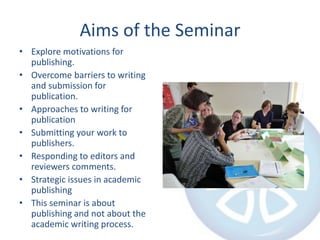
Aims of the SeminarExplore motivations for publishing.Overcome barriers to writing and submission for publication.Approaches to writing for publicationSubmitting your work to publishers.Responding to editors and reviewers comments.Strategic issues in academic publishingThis seminar is about publishing and not about the academic writing process.
Part 1: Why are you here?What are your motivations for wanting to write and publish your work?ICE BREAKER!In two’s or three’s, tell each other and discuss your main motivation for wanting to get published.5 minutes
What are you bringing with you?In pairs/three’s, tell each other about a piece of writing that you have written and are proud of, published or not.Think of up to three positive writing tips each (things that helped you succeed in this piece of writing) and share them with each other.Make a note of them.Should take around 10 minutes altogether.
So why are you here?What are the barriers that are preventing you writing and/or publishing your work?In pairs/three’s, discuss the main barriers to writing and getting published.Make a note of each one.10 minutes
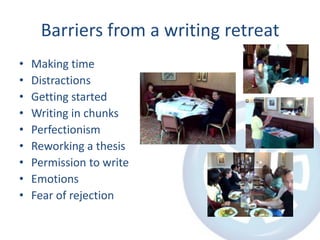
Barriers from a writing retreatMaking timeDistractionsGetting startedWriting in chunksPerfectionismReworking a thesisPermission to writeEmotionsFear of rejection
Homework!Following the seminar today visit the Getting Published blog and register at:http://academic-publishing.blogspot.comUnder the Swansea Metropolitan University post, if you’re happy to do so, please click on ‘comment’.Please leave a ‘comment’ containing at least your:MotivationTipsBarriersAlso, please reflect on how you may use this to inform your future approach to writing and publication?Please comment on others ‘comments’ too.If you have a Google Account please ‘follow’ the blog.
Part 2: Submitting for PublicationMaking your name known.Who is your audience?Types of publications?The academic writing process.Choosing a journal to submit to.Preparing your manuscript.What not to do.Possible outcomes.Dealing with and overcoming rejection.Responding to reviewers comments.Proof stage.Strategic issues in academic writing and publication.
Making your name knownCollaborate with your supervisor (or a colleague)Become active in your academic communityPresent at conferencesJournal editors actively look out for good papersPrepare effective conference postersNetwork: talk to journal editors (who are other academics)Write working papersPractice in writing academic papersUseful feedbackDoes not count as prior publication if revisedCreate your own website
AudienceLocal, national, international?Researchers, practitioners, teachers, general public?Type of PublicationJournal article (watch out for special issues)Magazine articleReview articleBook review – good way of startingResearch note (short report or work in progress)Working paper – mainly for conferencesBook or chapter in book (often through invitation)
The Academic Writing ProcessInventing and researchPlanningDraftingRevisingEditingSubmissionPeer review processRevisionsProof stage and publication(modified from Ganobcsik-Williams, 2009)Draw up a plan and discuss with a colleague – what issues come to mind?
Choosing the Right JournalResearch the journals in your fieldLibrary and websitesConference standsTalk to peers Familiarise yourself with aims and scope of journalsChoose the most suitable journal(s) for your articleGood to have a fall back or twoShould it be an Open Access journal? http://www.youtube.com/watch?v=7mRFRe4DxdMType of journal (pro’s and con’s)Multidisciplinary (often for a general subject readership)Niche (need to be hot on specifics)Do youWrite an article for a specific journal? (I prefer this from the start)Find a journal for your article? (if I haven’t chosen a journal yet)
Assessing the Best Journal for Your ArticleWhat is the readership and usage?Prestige in your fieldWho is the editor and who are on the editorial board?Who is likely to review your paper – can you suggest reviewers? Is Who publishes in the journal? Is it published by a major publisher or association? Local/national/international?Is it peer reviewedHow long will this take?Is it on the Institute of Scientific Information (ISI) Citation Database?How often is it cited?Is it available online and in print?
Writing for Your Chosen JournalCheck the aims and scopeLook at previous papers to get a feel for what is accepted – has it got a history in a topic area?Contact the editor – maybe?What does my research contribute to the field?Make your research relevant to the wider world; you need to be explicit about its widest context.Ask a colleague to read paper prior to submission – maybe? Except where English needs to be checked/improved.
Preparing the ManuscriptRead the guidelines carefully – many submit through an online gateway now.Comply with minimum and maximum limits Expand any acronymsEspecially if the audience is international or interdisciplinaryWrite an abstract that conveys the content, results and main conclusions (add keywords)Check spelling and grammarDouble spaced and single sided (usually required).
Manuscript Preparation Cont’d.Ensure references cited in text appear in bibliography – and vice versaNot too many self-references if reviewed anonymously (add them after review)Figures, tables and photographsCheck they are ALL presentResolution and file type is important e.g. TIFFsObserve conventions e.g. maps should have scale bars and north arrowPlace in a separate fileMake sure they are all numbered and referred toConsider/suggest how they will appear in the journalEnsure you have the correct copyright clearanceSome journals now accept audio and video clips
What not to doDon’t try to boil down your whole PhD/Masters thesis into one articleDon’t put the article on your website firstDon’t send your article to more than one journal at onceDon’t plagiarise, including self-plagiarismDon’t repeat the same article with just small changesDon’t wait for a decision before you start your next article.
Possible outcomesAccept as submitted – very rareAccept with minor revisionsAccept with major revisions – with or without second peer-review stage.Higher Education Quarterly receives c. 90 papers/year and accepts 30%, but 30% of those are never resubmitted after revision.Reject – commonStudies in Higher Education rejects 350 of the 400 papers it receives every year!
Why articles are rejectedProfessor David Phillips (University of Oxford), Editor of Oxford Review of Education, offered the following ten reasons:Article not ready, only a draftArticle is parochialPoor EnglishManuscript is poorly prepared Too short or too longArticle is submitted to the wrong journalNothing new is stated or foundUnder theorisedUnder contextualisedNot a proper journal article
Overcoming rejectionRejection can be a positive result - it is sometimes better than major revision.Prestigious journals only accept 20% of submissionsVery few papers are accepted without revisionMentoring function of editorial boardsfeedback from best in field Act on comments Try again
Responding to CommentsGo through the reviewers comments and number each action expected of you.Make a list of all actions, combining similar points – can you address them? If yes, how?Revise the manuscript and resubmit with a covering letter explicitly outlining how you dealt with the reviewers comments.If you couldn’t make a requested change, or disagree with the reviewer(s), then say so and justify why – the editor will make the final decision.Make a decision to declare, or not, if you are submitting a rejected paper to a new journal – sometimes it helps?
Proof stageYou will usually be emailed a pdf of the proofs of your paper.Check them very carefully.Identify errors, not usually possible to make significant changes, but no harm in asking if you think it’s important.Select your type of reprint – usually pdf.When published circulate to everyone who you think may be interested – don’t be shy.
Strategic IssuesSome issues that may influence you:Research Excellence Framework (REF)High impact, ISI-listed journalsResearch Degree Awarding Powers (RDAPs)Learned/professional society journalsInstitutional/Departmental StrategyE.g. Research-informed teachingTo assist in gaining external fundingPrioritisation and personal goalsE.g. always wanted to publish in a particular journal
What’s your next move?In pairs, discuss what might be your next step on the road to writing and getting published? For example:Will you collaborate or go it alone?Do you have any strategic priorities?Do you need further support or advice?Following the seminar, draw up a personal action plan with targets and a timescale for achieving them; what will you do if you don’t meet them (feel free to post on the blog)?
Bibliography & ResourcesHEA-ICS, 2007. Writing for Publication. http://www.ics.heacademy.ac.uk/events/displayevent.php?id=187 [accessed 28th June 2010].Taylor and Francis Ltd, 2004. Getting published in academic publications: Tips to Help you Publish Successfully. At www.lancs.ac.uk/celt/celtweb/files/gettingpublished_js.ppt [accessed 28th June 2010].Vitae, 2010. Publishing your research. http://www.vitae.ac.uk/researchers/1298/Publishing-your-research.html [accessed 28th June 2010].

Getting Published Seminar

  • 1.
    Getting Published: Exploringthe Issues and Dispelling the Myths Professor Simon HaslettDean, School of STEMPresentation at Swansea Metropolitan UniversityWednesday 30th March 2011
  • 2.
    Attention!Welcome to theGetting Published seminar.Please come in and help yourself to tea or coffee.Please sit at a table where there are at least some people who you have never met or don’t know that well, but don’t worry I’m sure they won’t bite!
  • 3.
    A bit aboutthe facilitatorSince 1990 Simon has published:Over 120 academic articles, mostly peer-reviewed journal articles.Over 50 articles in the popular press (newspapers, magazines, blogs, etc).Over 50 conference papers.Seven edited books (three as sole editor).Two sole authored books.Served as editor on four academic peer-reviewed journals and professional magazines (e.g. for learned society).
  • 4.
    Aims of theSeminarExplore motivations for publishing.Overcome barriers to writing and submission for publication.Approaches to writing for publicationSubmitting your work to publishers.Responding to editors and reviewers comments.Strategic issues in academic publishingThis seminar is about publishing and not about the academic writing process.
  • 5.
    Part 1: Whyare you here?What are your motivations for wanting to write and publish your work?ICE BREAKER!In two’s or three’s, tell each other and discuss your main motivation for wanting to get published.5 minutes
  • 6.
    What are youbringing with you?In pairs/three’s, tell each other about a piece of writing that you have written and are proud of, published or not.Think of up to three positive writing tips each (things that helped you succeed in this piece of writing) and share them with each other.Make a note of them.Should take around 10 minutes altogether.
  • 7.
    So why areyou here?What are the barriers that are preventing you writing and/or publishing your work?In pairs/three’s, discuss the main barriers to writing and getting published.Make a note of each one.10 minutes
  • 8.
    Barriers from awriting retreatMaking timeDistractionsGetting startedWriting in chunksPerfectionismReworking a thesisPermission to writeEmotionsFear of rejection
  • 9.
    Homework!Following the seminartoday visit the Getting Published blog and register at:http://academic-publishing.blogspot.comUnder the Swansea Metropolitan University post, if you’re happy to do so, please click on ‘comment’.Please leave a ‘comment’ containing at least your:MotivationTipsBarriersAlso, please reflect on how you may use this to inform your future approach to writing and publication?Please comment on others ‘comments’ too.If you have a Google Account please ‘follow’ the blog.
  • 10.
    Part 2: Submittingfor PublicationMaking your name known.Who is your audience?Types of publications?The academic writing process.Choosing a journal to submit to.Preparing your manuscript.What not to do.Possible outcomes.Dealing with and overcoming rejection.Responding to reviewers comments.Proof stage.Strategic issues in academic writing and publication.
  • 11.
    Making your nameknownCollaborate with your supervisor (or a colleague)Become active in your academic communityPresent at conferencesJournal editors actively look out for good papersPrepare effective conference postersNetwork: talk to journal editors (who are other academics)Write working papersPractice in writing academic papersUseful feedbackDoes not count as prior publication if revisedCreate your own website
  • 12.
    AudienceLocal, national, international?Researchers,practitioners, teachers, general public?Type of PublicationJournal article (watch out for special issues)Magazine articleReview articleBook review – good way of startingResearch note (short report or work in progress)Working paper – mainly for conferencesBook or chapter in book (often through invitation)
  • 13.
    The Academic WritingProcessInventing and researchPlanningDraftingRevisingEditingSubmissionPeer review processRevisionsProof stage and publication(modified from Ganobcsik-Williams, 2009)Draw up a plan and discuss with a colleague – what issues come to mind?
  • 14.
    Choosing the RightJournalResearch the journals in your fieldLibrary and websitesConference standsTalk to peers Familiarise yourself with aims and scope of journalsChoose the most suitable journal(s) for your articleGood to have a fall back or twoShould it be an Open Access journal? http://www.youtube.com/watch?v=7mRFRe4DxdMType of journal (pro’s and con’s)Multidisciplinary (often for a general subject readership)Niche (need to be hot on specifics)Do youWrite an article for a specific journal? (I prefer this from the start)Find a journal for your article? (if I haven’t chosen a journal yet)
  • 15.
    Assessing the BestJournal for Your ArticleWhat is the readership and usage?Prestige in your fieldWho is the editor and who are on the editorial board?Who is likely to review your paper – can you suggest reviewers? Is Who publishes in the journal? Is it published by a major publisher or association? Local/national/international?Is it peer reviewedHow long will this take?Is it on the Institute of Scientific Information (ISI) Citation Database?How often is it cited?Is it available online and in print?
  • 16.
    Writing for YourChosen JournalCheck the aims and scopeLook at previous papers to get a feel for what is accepted – has it got a history in a topic area?Contact the editor – maybe?What does my research contribute to the field?Make your research relevant to the wider world; you need to be explicit about its widest context.Ask a colleague to read paper prior to submission – maybe? Except where English needs to be checked/improved.
  • 17.
    Preparing the ManuscriptReadthe guidelines carefully – many submit through an online gateway now.Comply with minimum and maximum limits Expand any acronymsEspecially if the audience is international or interdisciplinaryWrite an abstract that conveys the content, results and main conclusions (add keywords)Check spelling and grammarDouble spaced and single sided (usually required).
  • 18.
    Manuscript Preparation Cont’d.Ensurereferences cited in text appear in bibliography – and vice versaNot too many self-references if reviewed anonymously (add them after review)Figures, tables and photographsCheck they are ALL presentResolution and file type is important e.g. TIFFsObserve conventions e.g. maps should have scale bars and north arrowPlace in a separate fileMake sure they are all numbered and referred toConsider/suggest how they will appear in the journalEnsure you have the correct copyright clearanceSome journals now accept audio and video clips
  • 19.
    What not todoDon’t try to boil down your whole PhD/Masters thesis into one articleDon’t put the article on your website firstDon’t send your article to more than one journal at onceDon’t plagiarise, including self-plagiarismDon’t repeat the same article with just small changesDon’t wait for a decision before you start your next article.
  • 20.
    Possible outcomesAccept assubmitted – very rareAccept with minor revisionsAccept with major revisions – with or without second peer-review stage.Higher Education Quarterly receives c. 90 papers/year and accepts 30%, but 30% of those are never resubmitted after revision.Reject – commonStudies in Higher Education rejects 350 of the 400 papers it receives every year!
  • 21.
    Why articles arerejectedProfessor David Phillips (University of Oxford), Editor of Oxford Review of Education, offered the following ten reasons:Article not ready, only a draftArticle is parochialPoor EnglishManuscript is poorly prepared Too short or too longArticle is submitted to the wrong journalNothing new is stated or foundUnder theorisedUnder contextualisedNot a proper journal article
  • 22.
    Overcoming rejectionRejection canbe a positive result - it is sometimes better than major revision.Prestigious journals only accept 20% of submissionsVery few papers are accepted without revisionMentoring function of editorial boardsfeedback from best in field Act on comments Try again
  • 23.
    Responding to CommentsGothrough the reviewers comments and number each action expected of you.Make a list of all actions, combining similar points – can you address them? If yes, how?Revise the manuscript and resubmit with a covering letter explicitly outlining how you dealt with the reviewers comments.If you couldn’t make a requested change, or disagree with the reviewer(s), then say so and justify why – the editor will make the final decision.Make a decision to declare, or not, if you are submitting a rejected paper to a new journal – sometimes it helps?
  • 24.
    Proof stageYou willusually be emailed a pdf of the proofs of your paper.Check them very carefully.Identify errors, not usually possible to make significant changes, but no harm in asking if you think it’s important.Select your type of reprint – usually pdf.When published circulate to everyone who you think may be interested – don’t be shy.
  • 25.
    Strategic IssuesSome issuesthat may influence you:Research Excellence Framework (REF)High impact, ISI-listed journalsResearch Degree Awarding Powers (RDAPs)Learned/professional society journalsInstitutional/Departmental StrategyE.g. Research-informed teachingTo assist in gaining external fundingPrioritisation and personal goalsE.g. always wanted to publish in a particular journal
  • 26.
    What’s your nextmove?In pairs, discuss what might be your next step on the road to writing and getting published? For example:Will you collaborate or go it alone?Do you have any strategic priorities?Do you need further support or advice?Following the seminar, draw up a personal action plan with targets and a timescale for achieving them; what will you do if you don’t meet them (feel free to post on the blog)?
  • 27.
    Bibliography & ResourcesHEA-ICS,2007. Writing for Publication. http://www.ics.heacademy.ac.uk/events/displayevent.php?id=187 [accessed 28th June 2010].Taylor and Francis Ltd, 2004. Getting published in academic publications: Tips to Help you Publish Successfully. At www.lancs.ac.uk/celt/celtweb/files/gettingpublished_js.ppt [accessed 28th June 2010].Vitae, 2010. Publishing your research. http://www.vitae.ac.uk/researchers/1298/Publishing-your-research.html [accessed 28th June 2010].