Your Report:
what goes where
LJMU Academic
Achievement team
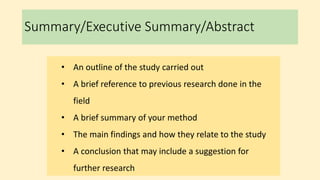
Summary/Executive Summary/Abstract
• An outline of the study carried out
• A brief reference to previous research done in the
field
• A brief summary of your method
• The main findings and how they relate to the study
• A conclusion that may include a suggestion for
further research
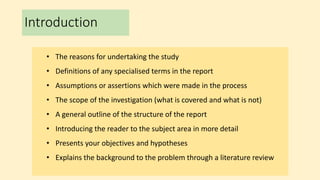
Introduction
• The reasons for undertaking the study
• Definitions of any specialised terms in the report
• Assumptions or assertions which were made in the process
• The scope of the investigation (what is covered and what is not)
• A general outline of the structure of the report
• Introducing the reader to the subject area in more detail
• Presents your objectives and hypotheses
• Explains the background to the problem through a literature review
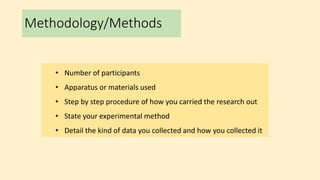
Methodology/Methods
• Number of participants
• Apparatus or materials used
• Step by step procedure of how you carried the research out
• State your experimental method
• Detail the kind of data you collected and how you collected it
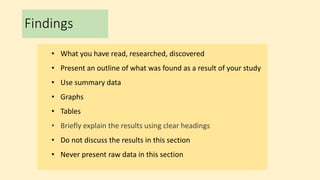
Findings
• What you have read, researched, discovered
• Present an outline of what was found as a result of your study
• Use summary data
• Graphs
• Tables
• Briefly explain the results using clear headings
• Do not discuss the results in this section
• Never present raw data in this section
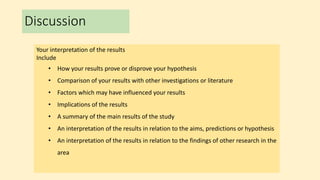
Discussion
Your interpretation of the results
Include
• How your results prove or disprove your hypothesis
• Comparison of your results with other investigations or literature
• Factors which may have influenced your results
• Implications of the results
• A summary of the main results of the study
• An interpretation of the results in relation to the aims, predictions or hypothesis
• An interpretation of the results in relation to the findings of other research in the
area
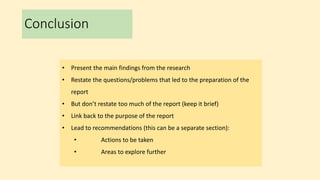
Conclusion
• Present the main findings from the research
• Restate the questions/problems that led to the preparation of the
report
• But don’t restate too much of the report (keep it brief)
• Link back to the purpose of the report
• Lead to recommendations (this can be a separate section):
• Actions to be taken
• Areas to explore further

Writing your report card sorting activity

  • 1.
    Your Report: what goeswhere LJMU Academic Achievement team
  • 2.
    Summary/Executive Summary/Abstract • Anoutline of the study carried out • A brief reference to previous research done in the field • A brief summary of your method • The main findings and how they relate to the study • A conclusion that may include a suggestion for further research
  • 3.
    Introduction • The reasonsfor undertaking the study • Definitions of any specialised terms in the report • Assumptions or assertions which were made in the process • The scope of the investigation (what is covered and what is not) • A general outline of the structure of the report • Introducing the reader to the subject area in more detail • Presents your objectives and hypotheses • Explains the background to the problem through a literature review
  • 4.
    Methodology/Methods • Number ofparticipants • Apparatus or materials used • Step by step procedure of how you carried the research out • State your experimental method • Detail the kind of data you collected and how you collected it
  • 5.
    Findings • What youhave read, researched, discovered • Present an outline of what was found as a result of your study • Use summary data • Graphs • Tables • Briefly explain the results using clear headings • Do not discuss the results in this section • Never present raw data in this section
  • 6.
    Discussion Your interpretation ofthe results Include • How your results prove or disprove your hypothesis • Comparison of your results with other investigations or literature • Factors which may have influenced your results • Implications of the results • A summary of the main results of the study • An interpretation of the results in relation to the aims, predictions or hypothesis • An interpretation of the results in relation to the findings of other research in the area
  • 7.
    Conclusion • Present themain findings from the research • Restate the questions/problems that led to the preparation of the report • But don’t restate too much of the report (keep it brief) • Link back to the purpose of the report • Lead to recommendations (this can be a separate section): • Actions to be taken • Areas to explore further