Conducting Research (1)
Dr. Rasha Salama
PhD. Community Medicine
Suez Canal University
Egypt
Research
• Research is the systematic
collection, analysis and
interpretation of data to answer a
certain question or solve a problem
• It is crucial to follow cascading
scientific steps when conducting
one’s research
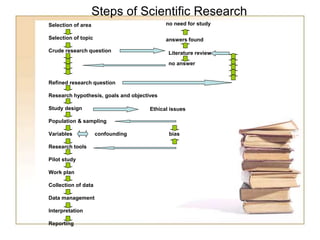
Steps of Scientific Research
Selection of area
Selection of topic
Crude research question
no answer
Refined research question
Research hypothesis, goals and objectives
Study design
Population & sampling
Variables confounding bias
Research tools
Pilot study
Work plan
Collection of data
Data management
Interpretation
Reporting
no need for study
answers found
Literature review
Ethical issues
Selection of Research Area
• Selection of this broad entity
of research is based on the
following:
– researcher’s:
• Specialty
• Interest
• Scientific background
• Experience
– Actual need for research in this
area
– Available resources (interest of
funding body)
Selection of Research Topics
The priority of a topic for research
depends on:
– The characteristics of the problem (topic):
• Impact on health:
– Magnitude
– Seriousness
– Preventability
– Curability
• Available interventions
• Proposed solutions
– The characteristics of the proposed study:
• Feasibility
• Cost-effectiveness
• Applicability of the results
Research question
The investigator must make sure that:
• He has a research question
• The question is clear and specific
• It reflects the objectives of the study
• It has no answer by common sense
• It has no answer in the LITERATURE
• Finding an answer to the question will
solve or at least help in solving the
problem to be studied.
Doing a Literature Review
What is a “Literature Review”?
• “…a literature review surveys
scientific articles, books,
medical journals,
dissertations and other
sources […] relevant to a
particular issue, area of
research, or theory, providing
a description, summary, and
critical evaluation of each
work.”
Purpose of Literature Review
A literature review may constitute an essential chapter of a thesis or
dissertation, or may be a self-contained review of writings on a subject. In
either case, its purpose is to:
• Place each work in the context of its contribution to the
understanding of the subject under review
• Describe the relationship of each work to the others under
consideration
• Identify new ways to interpret, and shed light on any gaps
in, previous research
• Resolve conflicts amongst seemingly contradictory
previous studies
• Identify areas of prior research to prevent duplication of
effort
• Place one's original work (in the case of theses or
dissertations) in the context of existing literature
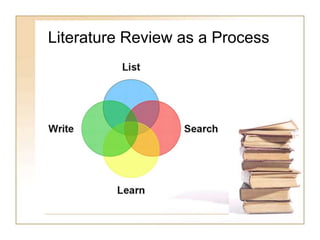
Literature Review as a Process
Components of Lit. Review
• Development of the literature review
requires four stages:
– Problem formulation—which topic or field is
being examined and what are its component
issues?
– Literature search—finding materials relevant to
the subject being explored
– Data evaluation—determining which literature
makes a significant contribution to the
understanding of the topic
– Analysis and interpretation—discussing the
findings and conclusions of pertinent literature
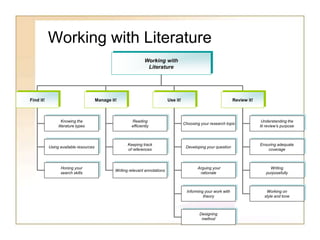
Working with Literature
Working with
Literature
Find it! Manage it! Use it! Review it!
Knowing the
literature types
Reading
efficiently
Choosing your research topic
Understanding the
lit review’s purpose
Using available resources
Keeping track
of references
Developing your question
Ensuring adequate
coverage
Honing your
search skills
Writing relevant annotations
Arguing your
rationale
Informing your work with
theory
Designing
method
Writing
purposefully
Working on
style and tone
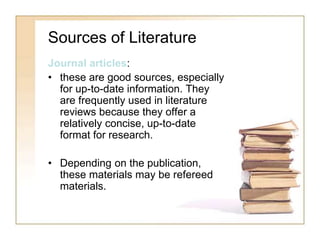
Sources of Literature
Journal articles:
• these are good sources, especially
for up-to-date information. They
are frequently used in literature
reviews because they offer a
relatively concise, up-to-date
format for research.
• Depending on the publication,
these materials may be refereed
materials.
What about Non-refereed Journals?
• Non-refereed materials such as
Trade Journals, or magazines
use less rigorous standards of
screening prior to publication.
• Non-refereed materials may not be
checked as intensely as refereed
materials, but many can still be
considered useful, although not for
scientific literature and research.
Sources of Literature (cont.)
Books: remember that books tend
to be less up-to-date, as it takes
longer for a book to be published
than for a journal article.
• They are still likely to be useful for
including in your literature review
as they offer a good starting point
from which to find more detailed
and up-to-date sources of
information.
Sources of Literature (cont.)
Conference proceedings: these can
be useful in providing the latest
research, or research that has not
been published.
• They are also helpful in providing
information about people in
different research areas, and so
can be helpful in tracking down
other work by the same
researchers.
Sources of Literature (cont.)
Government/corporate reports:
• Many government departments and
corporations commission carry out
research.
• Their published findings can provide
a useful source of information,
depending on your field of study.
Sources of Literature (cont.)
Theses and dissertations: these can be
useful sources of information. However
there are disadvantages:
• they can be difficult to obtain since they
are not published, but are generally only
available from the library or interlibrary
systems
• the student who carried out the research
may not be an experienced researcher
and therefore you might have to treat their
findings with more caution than published
research.
Sources of Literature (cont.)
Internet: the fastest-growing source of
information is on the Internet.
• bear in mind that anyone can post
information on the Internet so the quality
may not be reliable
• the information you find may be intended
for a general audience and so not be
suitable for inclusion in your literature
review (information for a general
audience is usually less detailed)
In assessing each piece, consideration should be
given to:
• Provenance—What are the author's
credentials? Are the author's arguments
supported by evidence (e.g. primary historical
material, case studies, narratives, statistics,
recent scientific findings)?
• Objectivity—Is the author's perspective even-
handed or prejudicial? Is contrary data
considered or is certain pertinent information
ignored to prove the author's point?
• Persuasiveness— is the author's thesis
convincing?
• Value—Does the work ultimately contribute in
any significant way to an understanding of the
subject of my research?
Writing Literature
• Three components:
– The introduction
– The body
– The conclusion
Writing the Introduction
In the introduction, you should:
• Define or identify the general topic, issue, or
area of concern, thus providing an appropriate
context for reviewing the literature.
• Point out overall trends in what has been
published about the topic; or conflicts in
theory, methodology, evidence, and
conclusions; or gaps in research
• Establish the writer's reason (point of view) for
reviewing the literature; explain the criteria to
be used in analyzing and comparing literature
Writing the Body
In the body, you should:
• Group research studies and other types of
literature (reviews, theoretical articles, case
studies, etc.) according to common
denominators such as qualitative versus
quantitative approaches, conclusions of
authors, specific purpose or objective, etc.
• Summarize individual studies
• Make comparisons and analyses.
Writing the Conclusion
In the conclusion, you should:
• Summarize major contributions of significant
studies and articles to the body of knowledge
under review, maintaining the focus
established in the introduction.
• Evaluate the current "state of the art" pointing
out major methodological flaws or gaps in
research, inconsistencies in theory and
findings, and areas or issues pertinent to
future study.
• Conclude by providing some insight into the
relationship between the central topic of the
literature review and a larger area of study
(rationale)
Rationale
• An explanation of the
fundamental reasons for your
research
• Justification of your work
A few things that worked for me…
• Learn / use effective search
strategies
• Keep a credible research journal
• Write about everything you read
• Don’t write a lit review (yet)
• Write a summary (today)
• Read others’ lit reviews
• Ask questions!
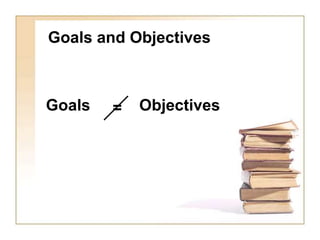
Goals and Objectives
Goals Objectives
=
Research Goal & Objectives
• The goal (aim) and objectives must be
stated at the very beginning of the study,
since they will guide the investigator during
the process of formulating research
questions and hypothesis.
• They will also help in the prioritization
process.
• They will enable the reader or consumer of
the work to judge whether the investigator
had achieved these objectives or not.
Goals
• It describes the aim of the
work in broad terms
Objectives
• These are more specific and
relate directly to research
question. They may be
divided into two types:
– Primary objectives  (bound to
be achieved)
– Secondary objectives  (by the
way)
Research Objectives
• The research objectives should be:
– Closely related to the research question
– Covering all aspects of the problem
– Very specific
– Ordered in a logical sequence
– Stated in action verbs that could be
evaluated e.g. to describe, to identify, to
measure, to compare, etc.
– Achievable, taking into consideration the
available resources and time
– Mutually exclusive, with no repetitions or
overlaps
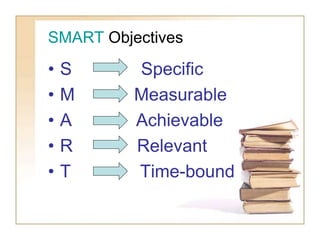
SMART Objectives
• S Specific
• M Measurable
• A Achievable
• R Relevant
• T Time-bound
Research objectives
• Properly formulated, specific
objectives will facilitate the
development of your research
methodology and will help to
orient the collection, analysis,
interpretation and utilization of
data.
Research Hypothesis
“ Research hypothesis is a
statement of the research
question in a measurable
form”
Research Hypothesis (cont.)
• A hypothesis can be defined as a
prediction or explanation of the
relationship between one or more
independent variables
(PREDISPOSING/RISK FACTORS) and one
dependent variable
(OUTCOME/CONDITION/DISEASE)).
• A hypothesis, in other words, translates
the problem statement into a precise, clear
prediction of expected outcomes.
• It must be emphasized that hypotheses are
not meant to be haphazard guesses, but
should reflect the depth of knowledge,
imagination and experience of the
investigator.
Research Hypothesis (cont.)
• Null hypothesis
• Alternative hypothesis
Example 1: (KAP Study)
• Area: Family medicine
• Topic: communicable diseases-
hepatitis
• Goal: to contribute to the reduction
of hepatitis in Qatar through
studying public perceptions about
the disease
• Objective: To assess the
awareness, knowledge, and
attitudes of the general public
towards hepatitis in Qatar
Example 2: (Interventional Study)
• Research area: cardiology
• Research topic: ischemic heart disease (IHD)
• Goal: to contribute to prevention of IHD
• Primary objective: to determine the effect of
reducing LDL on the occurrence of MI
• Secondary objective: to describe the side effects
of lowering LDL
• Research question: does hypocholesterolemic
agent “A” decrease the risk of MI?
• Research hypothesis: the risk of MI among
patients treated with hypocholesterolemic agent
“A” is lower than the risk among controls not
treated with hypocholesterolemic agents
Thank You

32241.ppt

  • 1.
    Conducting Research (1) Dr.Rasha Salama PhD. Community Medicine Suez Canal University Egypt
  • 2.
    Research • Research isthe systematic collection, analysis and interpretation of data to answer a certain question or solve a problem • It is crucial to follow cascading scientific steps when conducting one’s research
  • 3.
    Steps of ScientificResearch Selection of area Selection of topic Crude research question no answer Refined research question Research hypothesis, goals and objectives Study design Population & sampling Variables confounding bias Research tools Pilot study Work plan Collection of data Data management Interpretation Reporting no need for study answers found Literature review Ethical issues
  • 4.
    Selection of ResearchArea • Selection of this broad entity of research is based on the following: – researcher’s: • Specialty • Interest • Scientific background • Experience – Actual need for research in this area – Available resources (interest of funding body)
  • 5.
    Selection of ResearchTopics The priority of a topic for research depends on: – The characteristics of the problem (topic): • Impact on health: – Magnitude – Seriousness – Preventability – Curability • Available interventions • Proposed solutions – The characteristics of the proposed study: • Feasibility • Cost-effectiveness • Applicability of the results
  • 6.
    Research question The investigatormust make sure that: • He has a research question • The question is clear and specific • It reflects the objectives of the study • It has no answer by common sense • It has no answer in the LITERATURE • Finding an answer to the question will solve or at least help in solving the problem to be studied.
  • 7.
  • 8.
    What is a“Literature Review”? • “…a literature review surveys scientific articles, books, medical journals, dissertations and other sources […] relevant to a particular issue, area of research, or theory, providing a description, summary, and critical evaluation of each work.”
  • 9.
    Purpose of LiteratureReview A literature review may constitute an essential chapter of a thesis or dissertation, or may be a self-contained review of writings on a subject. In either case, its purpose is to: • Place each work in the context of its contribution to the understanding of the subject under review • Describe the relationship of each work to the others under consideration • Identify new ways to interpret, and shed light on any gaps in, previous research • Resolve conflicts amongst seemingly contradictory previous studies • Identify areas of prior research to prevent duplication of effort • Place one's original work (in the case of theses or dissertations) in the context of existing literature
  • 10.
  • 11.
    Components of Lit.Review • Development of the literature review requires four stages: – Problem formulation—which topic or field is being examined and what are its component issues? – Literature search—finding materials relevant to the subject being explored – Data evaluation—determining which literature makes a significant contribution to the understanding of the topic – Analysis and interpretation—discussing the findings and conclusions of pertinent literature
  • 12.
    Working with Literature Workingwith Literature Find it! Manage it! Use it! Review it! Knowing the literature types Reading efficiently Choosing your research topic Understanding the lit review’s purpose Using available resources Keeping track of references Developing your question Ensuring adequate coverage Honing your search skills Writing relevant annotations Arguing your rationale Informing your work with theory Designing method Writing purposefully Working on style and tone
  • 13.
    Sources of Literature Journalarticles: • these are good sources, especially for up-to-date information. They are frequently used in literature reviews because they offer a relatively concise, up-to-date format for research. • Depending on the publication, these materials may be refereed materials.
  • 14.
    What about Non-refereedJournals? • Non-refereed materials such as Trade Journals, or magazines use less rigorous standards of screening prior to publication. • Non-refereed materials may not be checked as intensely as refereed materials, but many can still be considered useful, although not for scientific literature and research.
  • 15.
    Sources of Literature(cont.) Books: remember that books tend to be less up-to-date, as it takes longer for a book to be published than for a journal article. • They are still likely to be useful for including in your literature review as they offer a good starting point from which to find more detailed and up-to-date sources of information.
  • 16.
    Sources of Literature(cont.) Conference proceedings: these can be useful in providing the latest research, or research that has not been published. • They are also helpful in providing information about people in different research areas, and so can be helpful in tracking down other work by the same researchers.
  • 17.
    Sources of Literature(cont.) Government/corporate reports: • Many government departments and corporations commission carry out research. • Their published findings can provide a useful source of information, depending on your field of study.
  • 18.
    Sources of Literature(cont.) Theses and dissertations: these can be useful sources of information. However there are disadvantages: • they can be difficult to obtain since they are not published, but are generally only available from the library or interlibrary systems • the student who carried out the research may not be an experienced researcher and therefore you might have to treat their findings with more caution than published research.
  • 19.
    Sources of Literature(cont.) Internet: the fastest-growing source of information is on the Internet. • bear in mind that anyone can post information on the Internet so the quality may not be reliable • the information you find may be intended for a general audience and so not be suitable for inclusion in your literature review (information for a general audience is usually less detailed)
  • 20.
    In assessing eachpiece, consideration should be given to: • Provenance—What are the author's credentials? Are the author's arguments supported by evidence (e.g. primary historical material, case studies, narratives, statistics, recent scientific findings)? • Objectivity—Is the author's perspective even- handed or prejudicial? Is contrary data considered or is certain pertinent information ignored to prove the author's point? • Persuasiveness— is the author's thesis convincing? • Value—Does the work ultimately contribute in any significant way to an understanding of the subject of my research?
  • 21.
    Writing Literature • Threecomponents: – The introduction – The body – The conclusion
  • 22.
    Writing the Introduction Inthe introduction, you should: • Define or identify the general topic, issue, or area of concern, thus providing an appropriate context for reviewing the literature. • Point out overall trends in what has been published about the topic; or conflicts in theory, methodology, evidence, and conclusions; or gaps in research • Establish the writer's reason (point of view) for reviewing the literature; explain the criteria to be used in analyzing and comparing literature
  • 23.
    Writing the Body Inthe body, you should: • Group research studies and other types of literature (reviews, theoretical articles, case studies, etc.) according to common denominators such as qualitative versus quantitative approaches, conclusions of authors, specific purpose or objective, etc. • Summarize individual studies • Make comparisons and analyses.
  • 24.
    Writing the Conclusion Inthe conclusion, you should: • Summarize major contributions of significant studies and articles to the body of knowledge under review, maintaining the focus established in the introduction. • Evaluate the current "state of the art" pointing out major methodological flaws or gaps in research, inconsistencies in theory and findings, and areas or issues pertinent to future study. • Conclude by providing some insight into the relationship between the central topic of the literature review and a larger area of study (rationale)
  • 25.
    Rationale • An explanationof the fundamental reasons for your research • Justification of your work
  • 26.
    A few thingsthat worked for me… • Learn / use effective search strategies • Keep a credible research journal • Write about everything you read • Don’t write a lit review (yet) • Write a summary (today) • Read others’ lit reviews • Ask questions!
  • 27.
  • 28.
    Research Goal &Objectives • The goal (aim) and objectives must be stated at the very beginning of the study, since they will guide the investigator during the process of formulating research questions and hypothesis. • They will also help in the prioritization process. • They will enable the reader or consumer of the work to judge whether the investigator had achieved these objectives or not.
  • 29.
    Goals • It describesthe aim of the work in broad terms
  • 30.
    Objectives • These aremore specific and relate directly to research question. They may be divided into two types: – Primary objectives  (bound to be achieved) – Secondary objectives  (by the way)
  • 31.
    Research Objectives • Theresearch objectives should be: – Closely related to the research question – Covering all aspects of the problem – Very specific – Ordered in a logical sequence – Stated in action verbs that could be evaluated e.g. to describe, to identify, to measure, to compare, etc. – Achievable, taking into consideration the available resources and time – Mutually exclusive, with no repetitions or overlaps
  • 32.
    SMART Objectives • SSpecific • M Measurable • A Achievable • R Relevant • T Time-bound
  • 33.
    Research objectives • Properlyformulated, specific objectives will facilitate the development of your research methodology and will help to orient the collection, analysis, interpretation and utilization of data.
  • 34.
    Research Hypothesis “ Researchhypothesis is a statement of the research question in a measurable form”
  • 35.
    Research Hypothesis (cont.) •A hypothesis can be defined as a prediction or explanation of the relationship between one or more independent variables (PREDISPOSING/RISK FACTORS) and one dependent variable (OUTCOME/CONDITION/DISEASE)). • A hypothesis, in other words, translates the problem statement into a precise, clear prediction of expected outcomes. • It must be emphasized that hypotheses are not meant to be haphazard guesses, but should reflect the depth of knowledge, imagination and experience of the investigator.
  • 36.
    Research Hypothesis (cont.) •Null hypothesis • Alternative hypothesis
  • 37.
    Example 1: (KAPStudy) • Area: Family medicine • Topic: communicable diseases- hepatitis • Goal: to contribute to the reduction of hepatitis in Qatar through studying public perceptions about the disease • Objective: To assess the awareness, knowledge, and attitudes of the general public towards hepatitis in Qatar
  • 38.
    Example 2: (InterventionalStudy) • Research area: cardiology • Research topic: ischemic heart disease (IHD) • Goal: to contribute to prevention of IHD • Primary objective: to determine the effect of reducing LDL on the occurrence of MI • Secondary objective: to describe the side effects of lowering LDL • Research question: does hypocholesterolemic agent “A” decrease the risk of MI? • Research hypothesis: the risk of MI among patients treated with hypocholesterolemic agent “A” is lower than the risk among controls not treated with hypocholesterolemic agents
  • 39.