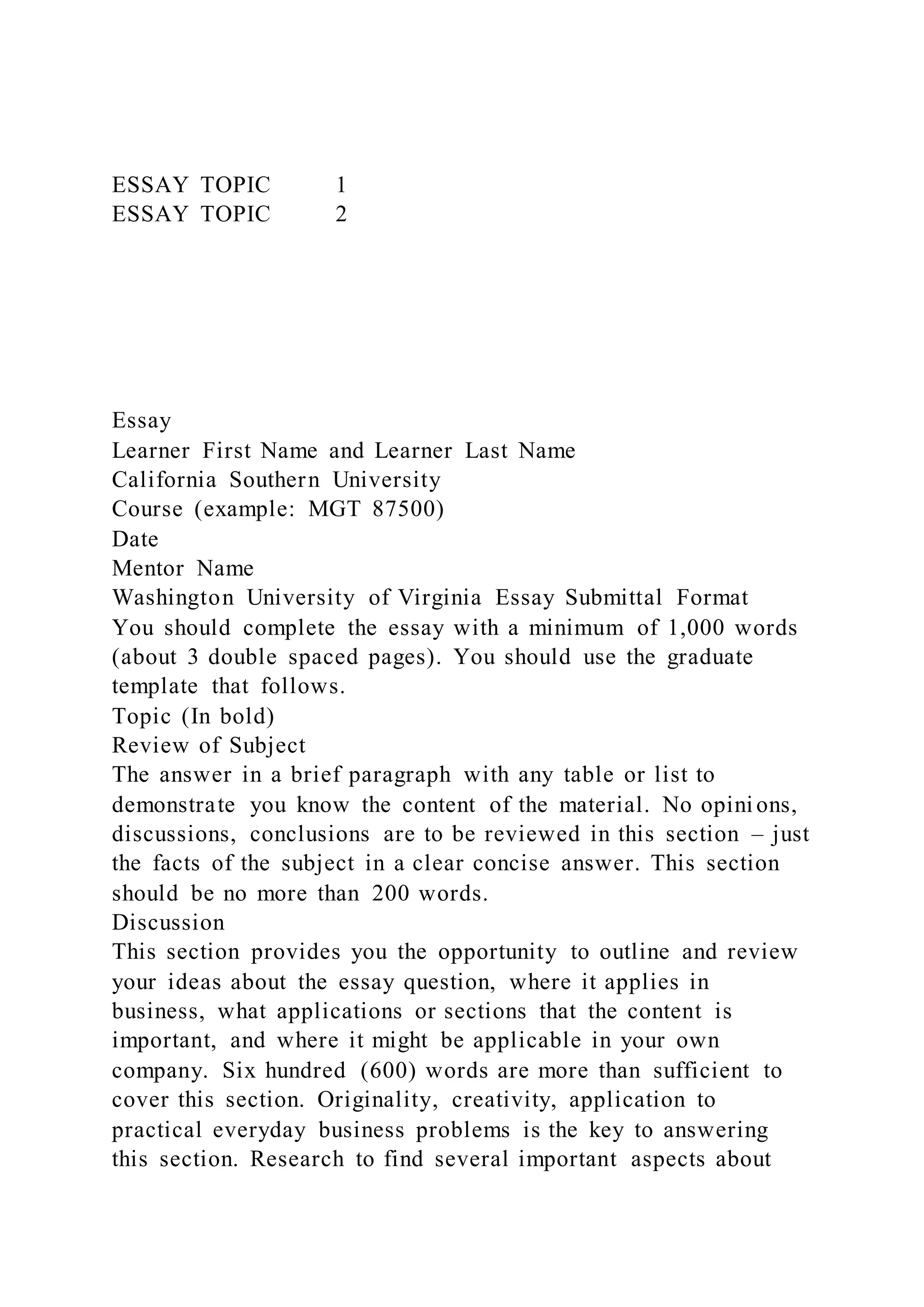
ESSAY TOPIC 1
ESSAY TOPIC 2
Essay
Learner First Name and Learner Last Name
California Southern University
Course (example: MGT 87500)
Date
Mentor Name
Washington University of Virginia Essay Submittal Format
You should complete the essay with a minimum of 1,000 words
(about 3 double spaced pages). You should use the graduate
template that follows.
Topic (In bold)
Review of Subject
The answer in a brief paragraph with any table or list to
demonstrate you know the content of the material. No opini ons,
discussions, conclusions are to be reviewed in this section – just
the facts of the subject in a clear concise answer. This section
should be no more than 200 words.
Discussion
This section provides you the opportunity to outline and review
your ideas about the essay question, where it applies in
business, what applications or sections that the content is
important, and where it might be applicable in your own
company. Six hundred (600) words are more than sufficient to
cover this section. Originality, creativity, application to
practical everyday business problems is the key to answering
this section. Research to find several important aspects about
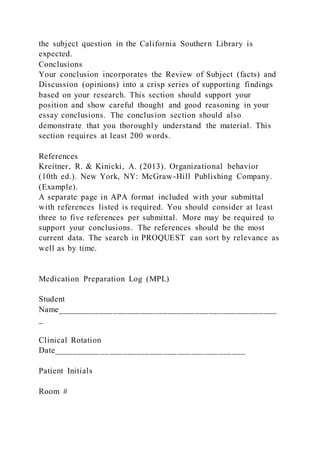
the subject question in the California Southern Library is
expected.
Conclusions
Your conclusion incorporates the Review of Subject (facts) and
Discussion (opinions) into a crisp series of supporting findings
based on your research. This section should support your
position and show careful thought and good reasoning in your
essay conclusions. The conclusion section should also
demonstrate that you thoroughly understand the material. This
section requires at least 200 words.
References
Kreitner, R. & Kinicki, A. (2013). Organizational behavior
(10th ed.). New York, NY: McGraw-Hill Publishing Company.
(Example).
A separate page in APA format included with your submittal
with references listed is required. You should consider at least
three to five references per submittal. More may be required to
support your conclusions. The references should be the most
current data. The search in PROQUEST can sort by relevance as
well as by time.
Medication Preparation Log (MPL)
Student
Name________________________________________________
_
Clinical Rotation
Date__________________________________________
Patient Initials
Room #
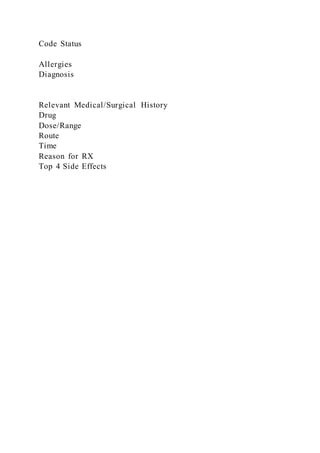
Code Status
Allergies
Diagnosis
Relevant Medical/Surgical History
Drug
Dose/Range
Route
Time
Reason for RX
Top 4 Side Effects
Nursing Care Plan Form
Student Name
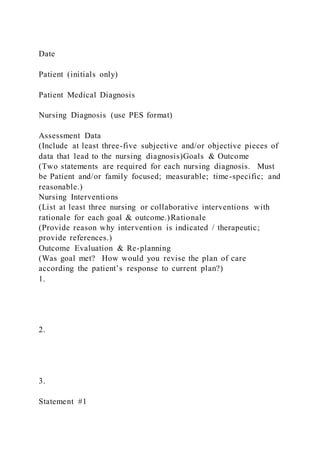
Date
Patient (initials only)
Patient Medical Diagnosis
Nursing Diagnosis (use PES format)
Assessment Data
(Include at least three-five subjective and/or objective pieces of
data that lead to the nursing diagnosis)Goals & Outcome
(Two statements are required for each nursing diagnosis. Must
be Patient and/or family focused; measurable; time-specific; and
reasonable.)
Nursing Interventions
(List at least three nursing or collaborative interventions with
rationale for each goal & outcome.)Rationale
(Provide reason why intervention is indicated / therapeutic;
provide references.)
Outcome Evaluation & Re-planning
(Was goal met? How would you revise the plan of care
according the patient’s response to current plan?)
1.
2.
3.
Statement #1
Statement #2
1.
2.
3.
1.
2.
3.
1.
2.
3.
1.
2.
3.
Outcome #1
Outcome #2
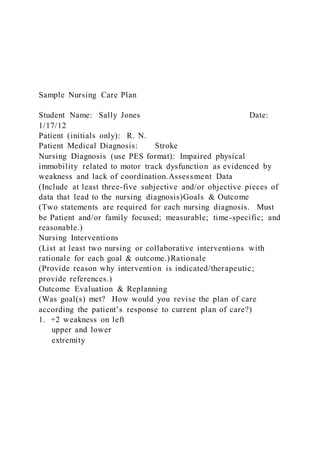
Sample Nursing Care Plan
Student Name: Sally Jones Date:
1/17/12
Patient (initials only): R. N.
Patient Medical Diagnosis: Stroke
Nursing Diagnosis (use PES format): Impaired physical
immobility related to motor track dysfunction as evidenced by
weakness and lack of coordination.Assessment Data
(Include at least three-five subjective and/or objective pieces of
data that lead to the nursing diagnosis)Goals & Outcome
(Two statements are required for each nursing diagnosis. Must
be Patient and/or family focused; measurable; time-specific; and
reasonable.)
Nursing Interventions
(List at least two nursing or collaborative interventions with
rationale for each goal & outcome.)Rationale
(Provide reason why intervention is indicated/therapeutic;
provide references.)
Outcome Evaluation & Replanning
(Was goal(s) met? How would you revise the plan of care
according the patient’s response to current plan of care?)
1. +2 weakness on left
upper and lower
extremity
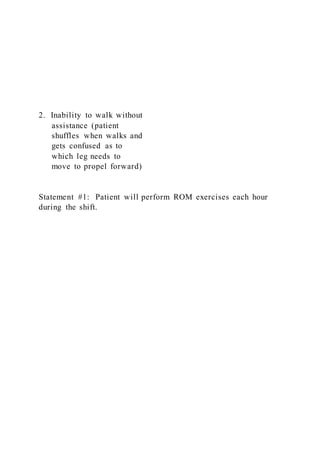
2. Inability to walk without
assistance (patient
shuffles when walks and
gets confused as to
which leg needs to
move to propel forward)
Statement #1: Patient will perform ROM exercises each hour
during the shift.
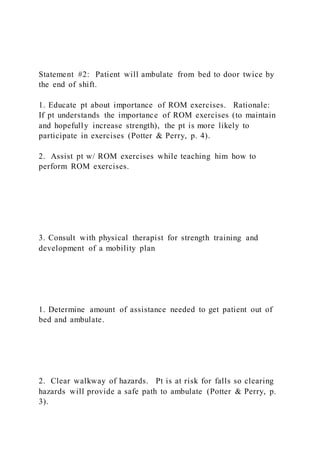
Statement #2: Patient will ambulate from bed to door twice by
the end of shift.
1. Educate pt about importance of ROM exercises. Rationale:
If pt understands the importance of ROM exercises (to maintain
and hopefully increase strength), the pt is more likely to
participate in exercises (Potter & Perry, p. 4).
2. Assist pt w/ ROM exercises while teaching him how to
perform ROM exercises.
3. Consult with physical therapist for strength training and
development of a mobility plan
1. Determine amount of assistance needed to get patient out of
bed and ambulate.
2. Clear walkway of hazards. Pt is at risk for falls so clearing
hazards will provide a safe path to ambulate (Potter & Perry, p.
3).
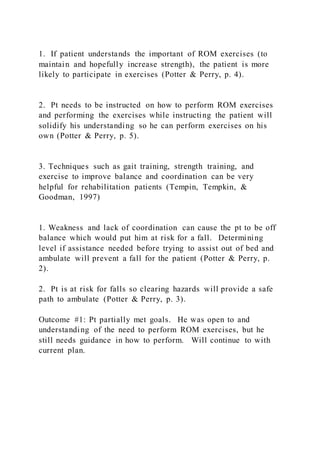
1. If patient understands the important of ROM exercises (to
maintain and hopefully increase strength), the patient is more
likely to participate in exercises (Potter & Perry, p. 4).
2. Pt needs to be instructed on how to perform ROM exercises
and performing the exercises while instructing the patient will
solidify his understanding so he can perform exercises on his
own (Potter & Perry, p. 5).
3. Techniques such as gait training, strength training, and
exercise to improve balance and coordination can be very
helpful for rehabilitation patients (Tempin, Tempkin, &
Goodman, 1997)
1. Weakness and lack of coordination can cause the pt to be off
balance which would put him at risk for a fall. Determining
level if assistance needed before trying to assist out of bed and
ambulate will prevent a fall for the patient (Potter & Perry, p.
2).
2. Pt is at risk for falls so clearing hazards will provide a safe
path to ambulate (Potter & Perry, p. 3).
Outcome #1: Pt partially met goals. He was open to and
understanding of the need to perform ROM exercises, but he
still needs guidance in how to perform. Will continue to with
current plan.
Outcome #2: Patient exceeded goal: he walked 4 times. Wil
modify plan to increase distance (to nurses’ station).

Essay topic1 essay topic2essaylearner first n

  • 1.
    ESSAY TOPIC 1 ESSAYTOPIC 2 Essay Learner First Name and Learner Last Name California Southern University Course (example: MGT 87500) Date Mentor Name Washington University of Virginia Essay Submittal Format You should complete the essay with a minimum of 1,000 words (about 3 double spaced pages). You should use the graduate template that follows. Topic (In bold) Review of Subject The answer in a brief paragraph with any table or list to demonstrate you know the content of the material. No opini ons, discussions, conclusions are to be reviewed in this section – just the facts of the subject in a clear concise answer. This section should be no more than 200 words. Discussion This section provides you the opportunity to outline and review your ideas about the essay question, where it applies in business, what applications or sections that the content is important, and where it might be applicable in your own company. Six hundred (600) words are more than sufficient to cover this section. Originality, creativity, application to practical everyday business problems is the key to answering this section. Research to find several important aspects about
  • 2.
    the subject questionin the California Southern Library is expected. Conclusions Your conclusion incorporates the Review of Subject (facts) and Discussion (opinions) into a crisp series of supporting findings based on your research. This section should support your position and show careful thought and good reasoning in your essay conclusions. The conclusion section should also demonstrate that you thoroughly understand the material. This section requires at least 200 words. References Kreitner, R. & Kinicki, A. (2013). Organizational behavior (10th ed.). New York, NY: McGraw-Hill Publishing Company. (Example). A separate page in APA format included with your submittal with references listed is required. You should consider at least three to five references per submittal. More may be required to support your conclusions. The references should be the most current data. The search in PROQUEST can sort by relevance as well as by time. Medication Preparation Log (MPL) Student Name________________________________________________ _ Clinical Rotation Date__________________________________________ Patient Initials Room #
  • 3.
    Code Status Allergies Diagnosis Relevant Medical/SurgicalHistory Drug Dose/Range Route Time Reason for RX Top 4 Side Effects
  • 4.
    Nursing Care PlanForm Student Name
  • 5.
    Date Patient (initials only) PatientMedical Diagnosis Nursing Diagnosis (use PES format) Assessment Data (Include at least three-five subjective and/or objective pieces of data that lead to the nursing diagnosis)Goals & Outcome (Two statements are required for each nursing diagnosis. Must be Patient and/or family focused; measurable; time-specific; and reasonable.) Nursing Interventions (List at least three nursing or collaborative interventions with rationale for each goal & outcome.)Rationale (Provide reason why intervention is indicated / therapeutic; provide references.) Outcome Evaluation & Re-planning (Was goal met? How would you revise the plan of care according the patient’s response to current plan?) 1. 2. 3. Statement #1
  • 6.
  • 7.
  • 8.
    Sample Nursing CarePlan Student Name: Sally Jones Date: 1/17/12 Patient (initials only): R. N. Patient Medical Diagnosis: Stroke Nursing Diagnosis (use PES format): Impaired physical immobility related to motor track dysfunction as evidenced by weakness and lack of coordination.Assessment Data (Include at least three-five subjective and/or objective pieces of data that lead to the nursing diagnosis)Goals & Outcome (Two statements are required for each nursing diagnosis. Must be Patient and/or family focused; measurable; time-specific; and reasonable.) Nursing Interventions (List at least two nursing or collaborative interventions with rationale for each goal & outcome.)Rationale (Provide reason why intervention is indicated/therapeutic; provide references.) Outcome Evaluation & Replanning (Was goal(s) met? How would you revise the plan of care according the patient’s response to current plan of care?) 1. +2 weakness on left upper and lower extremity
  • 9.
    2. Inability towalk without assistance (patient shuffles when walks and gets confused as to which leg needs to move to propel forward) Statement #1: Patient will perform ROM exercises each hour during the shift.
  • 10.
    Statement #2: Patientwill ambulate from bed to door twice by the end of shift. 1. Educate pt about importance of ROM exercises. Rationale: If pt understands the importance of ROM exercises (to maintain and hopefully increase strength), the pt is more likely to participate in exercises (Potter & Perry, p. 4). 2. Assist pt w/ ROM exercises while teaching him how to perform ROM exercises. 3. Consult with physical therapist for strength training and development of a mobility plan 1. Determine amount of assistance needed to get patient out of bed and ambulate. 2. Clear walkway of hazards. Pt is at risk for falls so clearing hazards will provide a safe path to ambulate (Potter & Perry, p. 3).
  • 11.
    1. If patientunderstands the important of ROM exercises (to maintain and hopefully increase strength), the patient is more likely to participate in exercises (Potter & Perry, p. 4). 2. Pt needs to be instructed on how to perform ROM exercises and performing the exercises while instructing the patient will solidify his understanding so he can perform exercises on his own (Potter & Perry, p. 5). 3. Techniques such as gait training, strength training, and exercise to improve balance and coordination can be very helpful for rehabilitation patients (Tempin, Tempkin, & Goodman, 1997) 1. Weakness and lack of coordination can cause the pt to be off balance which would put him at risk for a fall. Determining level if assistance needed before trying to assist out of bed and ambulate will prevent a fall for the patient (Potter & Perry, p. 2). 2. Pt is at risk for falls so clearing hazards will provide a safe path to ambulate (Potter & Perry, p. 3). Outcome #1: Pt partially met goals. He was open to and understanding of the need to perform ROM exercises, but he still needs guidance in how to perform. Will continue to with current plan.
  • 12.
    Outcome #2: Patientexceeded goal: he walked 4 times. Wil modify plan to increase distance (to nurses’ station).